Tag Archives: weather

The Last Week in February

Well, it’s been quite a winter here in eastern Massachusetts, and last week was quite a week, so I think I’m going to take a break from topical posting and just present the week that was. It started with a blizzard, and even though it is now March 1, as I am typing I see big fluffy snowflakes out there again. But not all was white: there was bright blue towards the end of the week as my husband and I proceeded north for a little break. In this topsy turvy winter, Rhode Island experienced 30+ inches of snow while midcoast Maine seems to have had just a dusting. By the time we got up there on Thursday, it seemed springlike to me! We saw my stepson, who works at an oyster farm near Damariscotta, engaged in a bit of house-hunting, and (lucky us) stayed at the storied Norumbega Inn in Camden. The latter was a long-time wish of mine, having driving by the fantasy castle on Route One many a time, and it did not disappoint. After two nights in Camden, we returned to Salem on Saturday for a really cool event at Hamilton HallFashioning Freedom: Layers of Liberty. This was a theatrical performance fashioned as a “a celebratory, historical runway of Black creativity and activism” featuring prominent nineteenth-century African Americans, including the Remond family of the Hall, Frederick Douglass’s wife Anna, educator Charlotte Forten, and sculptor Edmonia Lewis. A collaboration between Salem’s revered historical theater company, History Alive, and the Hall, it was a can’t miss event for me: all Renaissance scholars adhere to the concept of “self-fashioning,” which is just what we saw, and of course after having written about John Remond in Salem’s Centuries it was a thrill to see “him” right in front of me. So it was a very interesting week and I am ready for March!

Monday’s blizzard from my second-floor windows.

And then: bright blue sky and sea in Maine! Obviously there was snow up there too, but less of it and more room to spread it around. City snow can be exhausting: you just can’t find get it out of the way and it is increasingly gray (among other colors). Below are a few houses in Newcastle, Cushing and Friendship, and then we were off to Camden and the Norumbega.

The Norumbega, otherwise known as Norumbega Castle, was built as a private home for Maine native Joseph Barker Stearns in 1886-87 in a style that is generally described as “Queen Anne”. To me, it has always seemed more Romanesque, but its interior was a bit lighter than I imagined—smaller too. Not that it is small, it’s just that the scale is not baronial or overwhelming. We stayed in one of the turret rooms, named Sandringham. Stearns made his millions in the telegraph industry by patenting and licensing duplex telegraphy, by which two messages could be sent over the same wire simulteneously. Camden is a hilly coastal Maine town (with its own municipal ski slope, called the Snow Bowl) and the Norumbega is situated on an elevated site which once, and really still, has unobstructed views over Penobscot Bay. The house remained residential for a century, and then was converted into an inn. We really enjoyed our stay: our room was lovely, as were all the public rooms, and breakfast and bar bites in the small blue cocktail lounge were special touches. We actually saw a bit less of Camden than we expected to because we just wanted to hang out in the castle—you can do that in the winter and not feel guilty. But Saturday morning we knew we had a date with the Remonds so back to Salem we went.

The real Remonds at Hamilton Hall and a few shots from “Fashioning Freedom” before and after the performance. It was a very visual evening so check out Hamilton Hall for more professional photos in the next few days. Congratulations to all involved! The month ended with the news that Salem’s new consolidated elementary school will be named after Sarah Parker Remond–yet another triumph for an important Salem family! I do tend to view them in the collective as they were all so invested and engaged. As we enter women’s history month, here’s a clip of an 1855 petition calling for the resignation of Judge Edward Greeley Loring, the Massachusetts Justice most associated with the enforcement of the Fugitive Slave Act, signed by ALL the Remond women, including matriarch Nancy, her daughters and daughters-in-law, and their friend Charlotte Forten. You can see more at the Massachusetts Archives Anti-Slavery Petititions Dataserve at Harvard University:

https://dataverse.harvard.edu/dataverse/antislaverypetitionsma.


Frosty Salem

So I was going to bring you some photographs of Salem during yesterday’s snowstorm today, but that would have necessitated actually going out and walking around, and just a few steps from my backyard out onto Chestnut Street at midday were enough to convince me that I didn’t want to do that. So I have images of snowstorms past, mostly new discoveries, and most from the Peabody Essex Museum’s Phillips Library, which possesses the largest collection of famed photographers Frank Cousins and Samuel Chamberlain, as well as images by amateur photographers in family papers. True to their promises of several years ago, the Phillips librarians have been steadily digitizing their local collections and everytime I go their digital collections page I see new-to-me things. If you’re new to Salem photo-sleuthing, you can just start with their very accessible “Salem Streets” collection, culled from a variety of sources. And of course all the glass plate negatives of Frank Cousins were digitized quite a while ago, and can also be found at Digital Commonwealth. My title is from Cousins, who assembled several of his favorite images for an 1891 collage, which I imagine was hung in the window of his Bee-Hive shop that very winter. Then I’m going to double back and proceed in chronological order.

So let’s go back a decade into the 1880s, when we really start to see a lot of photographs of Salem streets and buildings, both commercially published and popping up in family papers. I’ll never forget opening up the volumes of the Francis Lee papers a few summers ago at the Phillips Library in Rowley and seeing all of these gorgeous photographs from the mid-1880s. The photos below are from the same time period—1884-86—and this first amazing one is taken from the vantage point of Lee’s house, 14 Chestnut Street. No filter! Isn’t this a striking image? This photo and those that follow are attributed to John Robinson, a Salem author and horticulturalist and trustee of pretty much every single civic institution in the city at the time. I wasn’t aware that he was a photographer as well; I don’t know if had commissioned these images for some future publication? The last one of this group is from the vantage point of his house on Summer Street, and so we have two striking views of Samuel McIntire’s South Church, which burned to the ground in 1903.

Chestnut Street winters, Salem Streets collection, Phillips Library, Peabody Essex Museum.

The 1890s: was Frank Cousins’ most productive decade as a photographer. He loved to photograph Chestnut Street too, but he branched out, all over the city, as his “Frosty Salem” poster illustrates. I love his winter shots because many of them include people, while his more formal architectural photographs decidedly do not.

Essex Street, the Common, Dearborn and Lafayette Streets,1890s, Frank Cousins Glass Plate Negative Collection, Phillips Library via Digital Commonwealth.

Also from the 1890s are several photographs by amateur photographers of an uprooted (Elm?) tree on Chestnut Street, with every possible angle captured!  I have looked in vain for more views of dealing with the snow, but this is as close as I could get. Closing out this decade are several beautiful photographs of the Pickering and Bartlett houses on Broad Street which are somehow connected to (taken by?) a certain Katherine A. Pond. I need to know more about her.

Chestnut and Broad Streets, 1890s, Phillips Library Digital Collections.

The 1920s: when I was looking for photos of Salem’s 1926 Tercentenary in various family albums at the Phillips, I came across the photos of the winter of 1924-25 in Francis Tuckerman Parker’s album. Again, these are not professional, and they are not digitized—I just took photos of the snapshots myself—so they not that great quality, but they are so interesting for what they show. The first image shows the intersection of Chestnut, Summer, and Norman Streets and on the extreme right is what I think is the last photograph of Samuel McIntire’s house before its demolition. The second, looking up Chestunt in the other direction, shows the church that replaced McIntire’s South Church, which was later demolished. Then we have a snow trolley on Essex, and a very messy intersection at the Essex and Summer.

Salem in the winter of 1924-25, Parker Family Photograph Album, Phillips Library.

1930s: the Phillips Library also possesses the huge negative collection of Samuel Chamberlain, a very important mid-century photographer of New England architecture and scenery, which is accessible at Digital Commonwealth. Chamberlain published Historic Salem in Four Seasons in 1938, so I assume these photos are from that time, but the collection encompasses his entire career. Pioneer Village, Salem’s outdoor living-history museum, was in its first decade, and Chamberlain photographed its buildings and landscape lavishly.

Pioneer Village by Samuel Chamberlain, Digital Commonwealth.

And finally, a street view of Broad Street in 1956 and an aerial view of Chestnut in 1972, both after the storms. The latter is included in a feature in Life magazine in that year, prompted by President Nixon’s visit to China. Eastern-oriented Salem seemed like a good place to examine American perspectives on Asia at that time; I don’t think that would be the first Salem association now.

Salem in 1956 and 1972: William F. Abbott collection at the Phillips Library and Life magazine, 1972.


May Day Weather

May Day is a day with many associations and representations: an “olde” festival with attendant Green Man and maypoles, a cross-quarter celebration of spring and surviving the winter, a day to celebrate and demonstrate the power of workers everywhere, a signal of alarm. In between its folkloric and political roles, however, it appears to have taken on the more mundane role of annual weather check. I went through some Massachusetts newspapers published in the nineteenth century to see how May Day was celebrated, if at all, and while there were occasional references to May Queens and lots of bad poetry, I found many more assessments of what’s in bloom and how present May Days compared to the past in terms of flora. Actually it was often more about the climate than the weather. Here’s a great evaluation from the Newburyport Herald in 1837: On the whole, we may consider ourselves as gainers in regard to climate. We enjoy longer summers, milder autumns and shorter winters than our ancestors enjoyed. Spring is the only season in regard to which we are losers. The celebrated season of “ethereal mildness” seems to be entirely degenerated — it is nothing but a constant alternation of summer and winter weather. Spring losers!

Dwight William Tryon, Early Spring in New England, 1897. Smithsonian Institution, Freer Gallery of Art. Gift of Charles Lang Freer.

The Salem papers presented poetry for May Day in the earlier decades of the nineteenth century but then switched to more wary but still hopeful assessments of the day and the weather at mid-century. In their stories on the first heralds/flowers of spring, one is immediately struck by the lack of references to tulips and daffodils: bulbs must have been a later thing?  It’s all about woodland natives, found in the “Great Pasture” off Highland Avenue. The Salem Gazette heralded a “May Morning Bouquet” in 1849, noting that May comes to us this year out of the atmosphere of an iceberg, as it were, but it may prove as pleasant a month as the poets avow it to be in less fickle climes. Five plants made up this bouquet: hepatica (which was generally called liverwort), Sanguinaria canadensis (bloodroot), anemones, mayflowers (trailing arbutus), and violets. These hardly flowers “will amply reward a search on May morning amongst the thickets and rocks in the neighborhood. But then it may rain, or freeze, or snow!”

Liverwort and Bloodroot in Charles F. Millspaugh’s Medicinal plants : an illustrated and descriptive guide to plants indigenous to and naturalized in the United States which are used in medicine, their description, origin, history, preparation, chemistry and physiological effects fully described (1892).

Anemone from William B. Barton’s Flora of North America (Volume 2), 1821.

Arbutus (also called Epigaea repens or Mayflower) in Jacob Bigelow’s American medical botany :being a collection of the native medicinal plants of the United States, containing their botanical history and chemical analysis, and properties and uses in medicine, diet and the arts (1817).

Violet from Jacob Sturm’s Deutschlands Flora in Abbildungen nach der Natur mit Beschreibungen (1798).

These are lovely little wildflowers: I have bloodroot in my garden and (unfortunately) violets too, but a bouquet? I think not, we need more robust flora for that. And please, I would prefer to stroll in a sunny green pasture rather than among the “thickets and rocks.” Maybe we should not have abandoned our devotion to the Green Man over here in Puritan New England: we have consequently become spring losers! 


Winter Salem, Day and Night

This is a rather lazy picture post: I’m basking in the glow of the publication of my book and rather drained from teaching AND I have some nice pictures of Salem on my camera roll so I thought I would just share them. Salem is really lovely after snowfalls: the architecture pops as the automobiles disappear. It’s rather brown out there now: these photographs were taken after a big snowstorm several weeks ago and a much smaller one a week ago. There are some truly dreadful structures that have risen in Salem over the past few years downtown and around, but if you stick to the neighborhoods you can avoid them for the most part. I observe a strict don’t look up (or over) rule as I walk to work past the Frankenstein-esque Hampton Inn, but once I make it home to the McIntire District I’m happy.

After the first big snowstorm:


The park, our house and garden, and a few other snowy structures on Super Bowl evening, and earlier in the day:


And here’s my hot-off-the-press book!


Tragedy amidst the Everyday

I LOVE Diaries: they offer such personal perspectives into the past, encompassing both “big” events and everyday occurrences. I read diaries, teach with diaries, and think about diaries often. I even like books about diaries, such as Kate O’Brien’s volume in my favorite Britain in Pictures series. So it is rather odd that I have omitted one of the most important diaries of a Salem woman in this year of #SalemSuffrageSaturdays until now: that of Mary Vial Holyoke (1737-1802), the second wife of Salem’s most eminent physician, Edward Augustus Holyoke (1728-1829). Mary’s diary was published in a compiled volume of Holyoke diaries published by the Essex Institute in 1911, after having been in the possession of several collectors, including the famed Salem numismatist Matthew Stickney.

Photograph of a Greenwood Portrait of Mary Simpson Vial before her Marriage.

1771 Portraits of Dr. Edward Augustus Holyoke and Mary Vial Holyoke by Salem artist Benjamin Blyth, referred to in Mary’s diary: Dr. Holyoke’s portrait, which descended in the Osgood family, is from the Northeast Auctions archive; Mary’s portrait, which descended in the Nichols family, appears to be lost at present.


Last week’s list of “notable Salem women” from the perspective of 1939 included Mary and drew me back to her diary, a record of 40 years of her rather enclosed life in Salem from 1760 to 1799. I had read it several times before but found it………….. unpleasant is the word I think I want to use. At first reading, the impression that I formed was of a superficial woman who gave birth to babies annually—most of which died within days—and resumed her social activities and household duties without missing a beat. None of this was unfamiliar to me as an early modernist: infant mortality hovered between 15 and 20% while 60% of all children born died before the age of 16 in the sixteenth and seventeenth centuries and childbirth was the leading cause of death for women, who were not especially introspective when they took pen to paper. But both Mary’s losses (8 of her 12 children) and her diary’s quickfire mix of the mundane and the sorrowful are comparatively extreme. Just one page of entries from the summer of 1767 contains entries about gardening, polishing or “scouring” furniture brasses, hanging bed curtains, attending “turtle” feasts and hosting the regular Monday assembly. Then on September 5 she was “brought to bed” at 2:00 in the morning, and gave birth to a daughter baptized Mary on the next day. On September 7 she reports that “The Baby very well till ten o’clock in the evening & then taken with fits.” Two days later, “It Died about 8:00 in the morning.” On the next day, we read simply “was buried” without even a pronoun.

A child’s shoe last from the first half of the nineteenth century, Historic New England

As I read the diary again over this past week more carefully, Mary emerged as a more thoughtful, caring, and substantive person. She was among a circle of women in Salem who were not just drinking tea and attending “turtles” (I love this name for social gatherings and think we should resume it) with great regularity, but also attending all those were brought to bed: for birth, for illness, for death: they were always “watching”. Mary was watched, her dying children were watched, and she herself watched. The entry above seems cold to be sure, but Mary generally referred to “my dear child” while noting the burials of her infants. And then there was the particularly poignant entry after the death of yet another of her newborns in 1770: the same as all the others. You almost can’t blame her for getting right back to the business of household work, which she does with great relish after she and the Dr. (this is how she refers to her husband) move into their permanent house on Essex Steet: this becomes “our house” and there’s a lot of work to do to maintain it: scouring, provisioning, ironing, soap-making, bottling, sewing, cooking, gardening, preserving (preserved damsons, a week too late! exclamation mine) and other tasks are all noted in detail. I think I dismissed the diary previously because Mary had little to say about the Revolution, but she does take note of the repeal of the Stamp Act and the “setting off” of a “feathered man” before the Revolution, and as it proceeds she gradually refers to the Americans as “our people”, perhaps reflecting her husband’s transition from Tory to Patriot. Dr. Holyoke was an early adopter of smallpox inoculation, and she records the constant outbreaks as well as the incremental inoculations. Earthquakes also appear with surprising regularity in the diary: I had no idea Salem was subject to so many tremors in the later eighteenth century. Extreme weather was also notable: Salem experienced some very hot summers and several “great” snows during Mary’s lifetime she elaborates on the former and is quite succinct about the latter. There’s more to learn about and from Mary Vial Holyoke, to be sure: you’ve just got to read carefully, between the lines and with careful attention to the personal pronouns, as she brings us into her world.

The Bowditch-Holyoke House at the corner of Essex & Central Streets in Salem, presently the site of the Naumkeag Block     


The Gardener’s Labyrinth

I’m having this really neat synchronicity of research, writing and life right now, as I’m working on Chapter Three of my book, which is focused on Elizabethan horticulture. So I get up, water my garden, and then go upstairs into my study and read and write about English gardening texts from the sixteenth century. Or there is the alternative day: I get up, drink coffee, read and write about English gardening texts, and then go downstairs for “cocktail watering” at the end of the day.  Regardless of when I sit down to immerse myself in this topic, it is obvious that there was a lot to write about then, and so I have a lot to write about now: new plants, coming from the Continent or the New World, how to feed the rapidly growing city of London, how to harness the power of plants for a variety of medicinal purposes. There were kitchen gardens, physic gardens, market gardens, and “summer gardens” for pleasure and relaxation. No matter what the purpose of the garden, the general belief was that it should be adjacent to the house and laid out in beds segregated by paths and walkways: the influences of the French parterre and medieval precedents encouraged the creation of a “knotted” or knot garden, which seems to have become a Tudor symbol. The pioneer of English gardening texts, Thomas Hyll (or Hill) published his first book, The Profitable arte of gardening in 1558: it was reprinted frequently thereafter and published in an amplified edition called The Gardeners Labyrinth posthumously in 1577. The Labyrinth was also very popular, due to the combination of Hyll’s “plain” instructions on how to lay out, enclose, plant, fertilize, irrigate, protect, and harvest a garden as well as its wonderful illustrations, the most reprinted of which are his images of watering the garden, something we all need to think about right now in the August doldrums (at least in New England). And true to its title, the Labyrinth also includes illustrations—templates really, for knot gardens, mazes, and labyrinths. Somehow I am more appreciative of his watering advice right now, in these 90-degree days!

Gardeners Collage First

Gardeners Labyrinth 1594 (2)

Gardeners Labyrinth Ch. 20 (3)

Gardeners Labyrinth 1594 watering through troughs (2)

Gardeners Labyrinth Watering (3)Tending to and ordering your garden in the Elizabethan era: Thomas Hyll’s Gardeners Labyrinth.

I am a bit confused by these two alternative watering techniques: “the maner of watering with a pumpe by troughes in the garden” and “the maner of watering with a pumpe in a tubbe” as Hyll is quite clear in the text that “water rotteth and killeth above ground.” So do we water from above or below?  I generally do both: aiming for the roots when I start watering and then just lazily arching it from above when I get tired and lazy—especially if I am watering with wine-in-hand. So many tools we use now were used then—rakes, hoes, shovels, watering “pottes”: and he calls his tin watering devices “great Squirtes”! August was hot in those Elizabethan summers as well: and Hyll instructs his readers to get out there and water in whatever way they can.

20200810_185343

20200810_070845Bad cocktail watering (?) and the garden in the morning.

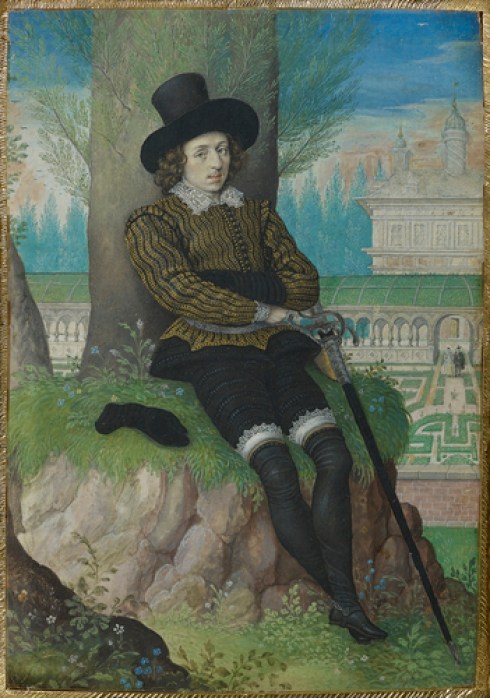
There are several knot garden examples in The Gardener’s Labyrinth as well as mazes: Hyll had to appeal to the literary public, which was essentially a monied and aspirational one, and so his gardens had to have ornamental qualities as well as utilitarian ones. The knot or maze is a perfect and very literal example of man bending nature to his will, a key Renaissance preoccupation: man is at the center of everything. The perfectly-ordered gardens that appear in the backgrounds of English portraits from this era reflect very well on their individual subjects, as well as the society at large.

Gardeners Knot (2)

Gardeners Maze (3)

Lord Edward Russell

Gardening Young Man

Garden Lettice Newdigate 1606Knot & Maze designs from the Gardeners Labyrinth, 1577; Lord Edward Russell by George Perfect Harding, watercolor copy of a 1573 portrait after unknown artist, National Portrait Gallery; Isaac Oliver, a Young Man seated under a Tree, 1590-95, Royal Collection Trust; Lettice Newdigate, c. 1606, Private Collection: Arbury Hall, Warwickshire.


Break for Ice Cream

I was reading and writing about the 1563 plague in London—very deadly and very overshadowed by later Tudor and Stuart plagues—when I had to take a break for ice cream in the midst of a stifling afternoon. The break went on a bit longer than expected because I became diverted into the history of ice cream: I just opened up an old cookbook I had for a moment (really!) but the recipe looked similar to some that I had seen in the seventeenth-century cookbooks that I am going to be writing about later in this chapter that I’m working on so I indulged myself for a bit longer in the name of “research”……and before you I knew it I had abandoned early modern England and was looking into the history of ice cream in Salem. From the plague to ice cream in a half hour: the balance of book and blog will not work well if I continue to be so indulgent (but it was hot).

earliest-ice-cream-recipe

Take three pints of the best cream, boyle it with a blade of Mace or else perfume it with orang flower water or Ambergreece, sweeten the Cream, with sugar[,] let it stand till it is quite cold, then put it into Boxes, e[i]ther of Silver or tinn, then take, Ice chopped into small peeces and put it into a tub and set the Boxes in the Ice covering them all over, and let them stand in the Ice two hours, and the Cream Will come to be Ice in the Boxes, then turn them out into a salvar [salver = dish] with some of the same seasoned Cream, so sarve [serve] it up to the Table.

This is Lady Ann Fanshawe’s handwritten recipe for “icy cream” from the mid-seventeenth century and the Wellcome Library’s digitized recipe-book collection (MS.71113) . It is unusual when compared to the first published recipes for ice cream in the next century, which are more custard-style creams, made with egg yolks, and then frozen. But Lady Fanshawe’s ingredients–mace, orange-flower water, and even ambergris (well maybe I should exclude ambergris)–were not that unusual: early ices were made with a wide range of ingredients: all sorts of fruits and herbs, honey, tea and coffee, crumbled cakes and biscuits. Ice cream history in the nineteenth century is marked by two big developments, both in the US: the development of the portable ice cream “freezer” and “Philadelphia-style” ice creams, made without eggs. But nineteenth-century ice creams, sorbets and sherberts were still more exotic than we think they were, or at least thought they were: Mrs. Lincoln’s Frosty Fancies and Frozen Dainties, published in the late nineteenth century for best-selling freezer manufacturer White Mountain, feature lots of interesting ices, and ice creams made with arrowroot, cornstarch, and gelatin for their foundation, rather than eggs.

Ice Cream Frosty Fancies (3)

ice_cream_Fozen-removebg-preview (2)

And yes: I think this is yet another aspect of Salem’s history which seems notable, although I did not extend my break to make a city-by-city, town-by-town comparative analysis of ice-cream production and consumption. Salem had a very early ice cream “manufactory”, from at least 1856, as well as several antebellum retail shops or saloons. And these multiplied over the later nineteenth century and then of course opened up in the tourist destination that was (and remains) Salem Willows. Salem also had ice cream “peddlers” from the late nineteenth century on, and even a “millionaire milkman”: Gilbert H. Hood of the famous H.P. Hood Company, still very much with us, who spent the summer and fall of 1921 “learning the business from the ground up” while based at Hood’s Salem ice cream factory, now the site of luxury condominiums.

Salem Ice Cream

Cool-1881

Ice Cream Holly Tree

Ice Cream Shute (5)

Ice Cream NDN Aug 19 1989

Hood Collage

Notice of Salem’s first ice cream manufactory in the Salem Register, June 30, 1856; Salem Willows postcards from 1905; The manufactory at 271 Essex became a “saloon” in the 1870s and another popular ice cream parlor was the Holly Tree on Central Street (Collections of Historic New England); “Ira Moody Chute standing in front of his ice cream wagon, Salem, Mass., ca. 1898,” (Historic New England); The Newburyport Daily News, August 19, 1889; Gilbert H. Hood in the Boston Herald, October 9, 1921.

More! The SERVING of ice cream was serious business a century ago, and Historic New England has some great examples from the Phillips House: ice cream forks, scoops, molds, trays, etc….: check them out here.


Salem in the Time of Corona

I imagine Salem must be like your town or city at this time: quiet and closed. As it is a compact and walkable city full of architectural treasures (still), the quiet more than compensates for the closure, but you are all too aware of the hardship that both are causing. It’s not a singular holiday that is allowing you to walk or bike freely with few cars in your path but rather a prolonged period of anxiety through stoppage for the freelancers and entrepreneurs among us, many in a city like Salem. I’m grateful for my security: there’s no stoppage for me, either of work or of income. I find that remote teaching takes more time than classes which actually meet in person: and while the latter invigorates you (or me) the former drains, so out in the streets of Salem I go to try to get some energy back. But again, I’m grateful for my security and have no complaints.

20200406_152925

20200406_154831

20200406_155236

20200406_155341

20200406_155433

20200406_171432

20200406_154433

20200406_153918

This week’s weather is so much better than that of last week, when the sun failed to appear for days. I am determined to: 1) put on real pants, with zippers; 2) observe proper meal times; 3) drink more tea; 4) turn off the computer for one full day; 5) avoid the daily presidential briefings; and 6) try to play board games with my husband (I am a terrible game-player but he loves them). This is not a very challenging list, obviously. In addition to all these tasks and working, I take my daily walks, noting new architectural details but also new orders of business around town: restaurants which are still open for take-out, or have transformed themselves into makeshift grocery stores which deliver, shops whose owners will meet you at the curb with your online purchases. The signs for canceled events are the other conspicuous markers of Corona time, like those for Salem Restaurant Weeks (March 15-26) and the annual Salem Film Fest (March 20-29) in the reflective windows of the Chamber of Commerce.

pixlr

20200406_153035

20200406_153212

20200406_153800

20200406_153653

20200406_154520

20200406_154554

But there are other signs too: of support for health-care workers and grocery clerks, teddy bears and other animals for children’s scavenger hunts. And signs of Spring, of course.

20200406_161256

20200406_152234

20200404_162345

IMG_20200406_203634_527


February in Newport

Another beautiful weekend, and I drove down south again: this time to Newport, Rhode Island. Newport is not really a likely February destination but why not when it is 50 degrees, clear and sunny? I had an academic rationale for my trip, but I spent most of the day wandering around looking at houses. The Remond family, the African-American family who lived and worked at Hamilton Hall in Salem for many years, was exiled to Newport from 1835 to 1843 when two of the Remond daughters were expelled from Salem High School: their father John, an advocate for abolition, desegregation, and universal suffrage, promptly moved his family out of town in protest. As I’ve got several talks scheduled on the Remonds in the next few months and I’ve largely ignored their Newport interlude, I went down to see some of the places they might have inhabited: not much luck with home or shop but I did find their church, or at least the present incarnation of what was their church: the Union Congregational Church, the first free black church in America.

LIBMS0000053-Full JPG Remond SL Newport (2)

20200223_122718Trade Card from the Remond Family Papers, Phillips Library, Peabody Essex Museum.

But 137 Thames Street is a parking lot, so off I went on an architectural tour. Structurally speaking, there are two Newports, of course, the old Newport and the Mansions of Bellevue Avenue. February is not the time to visit the latter and I’m more interested in the former anyway, so I kept to the narrower streets. I got a bit indignant when I found myself on Cornè Street, named after the Italian artist Michele Felice Cornè, who was brought to the United States on a Derby ship in 1800: I think of him as a Salem artist but a casual look at his biography indicates he spent much more time in Newport: his house stands at the beginning of his street, with a plaque noting his re-introduction of the tomato to the western hemisphere. There are far more National Registry plaques in Newport than Salem.

20200223_122257

20200223_122233

Cornè’s house is in the midst of a color spectrum I am going to call “Newport Greige”: there are many houses along the historic streets of the city that share this spectrum, but they are distinguished by their colorful doors, among other architectural details. Here are just a few:

20200223_130426

20200223_125921

20200223_125859

20200223_122935

20200223_122429

20200223_115159

20200223_114535

20200223_114550

Believe me, I could go on and on with this neutral palette, but there are plenty of colorful houses in Newport too: a few pumpkin-painted houses, bright red and “colonial” blue, a dark, dark green, and almost-black. They all pop among the greige, and as you can see, all are in pristine condition. The whole city is in pristine condition! No stumbling on these sidewalks—and they take care of their trees!

20200223_114904

20200223_120039

20200223_122151

20200223_130152

20200223_120304

20200223_122547

20200223_115837

20200223_120008

20200223_130409

20200223_115715

20200223_114412

20200223_115206

20200223_114727

So you can see I’m happy to wander around in the eighteenth century, but Newport’s historic district has considerable architectural diversity, and as you head towards the mansions, things get more stridently nineteenth-century, with the occasional lane of older houses: it all adds up to an interesting melange. I do like the Shingle houses, including the Newport Museum of Art and the Isaac Bell House below, which look amazing in the midst of the dormant February foliage, but the less “natural” Kingscote is my favorite of the Newport mansions: the rest are just too much, at least for February.

20200223_123231

20200223_120842

20200223_121546

20200223_133138

20200223_133025

20200223_135958


Etching Salem

This is generally a beautiful time of year to take photographs around Salem but it’s been rather cold and dreary for the past few weeks, with the exception of a few isolated days. I’m sure that when everything dries out we will be living in a lush and green world, but for right now I’m more predisposed to take out a book than go outside. So after I finished my grading (always a celebratory moment), I curled up with some old architecture and photography books and soon realized that one “Salem artist” whom I have never featured is Philip Kappel (1901-1981), an etcher and book illustrator who spent several years working with Philip Little and in his waterfront studio off Derby Street. Kappel was not really a Salem artist: he was born in Connecticut, educated in New York City, and as he was employed by several steamship lines over his career, he traveled the world six times over, gathering materials for his etchings everywhere he went. But he did publish a lovely book in 1966 titled New England Gallery with several Salem images inside, as well as some interesting commentary on his time here.

20190514_161149

20190514_161436

20190514_161415

20190514_142244 See what I mean about the weather? But Kappel’s Ropes Mansion and Witch House hint at brighter and warmer days, even with no color!

20190514_161404

20190514_151427

20190514_161301

20190514_150116

Little Studio

20190514_161348The Custom House (which is celebrating its 200th anniversary this year) Derby Wharf Lighthouse, The Little Studio (just above the compass star)–where both Philip Little and Philip Kappel worked, in different seasons—and the House of the Seven Gables.

Kappel relates the standard histories of most of the Salem structures presented in New England Gallery but is more effusive about Chestnut Street because that is where his friend and mentor, Philip Little, lived. Little summered on MacMahan Island off Boothbay Harbor every year, and during a visit to the mainland he chanced upon a small exhibition of Kappel’s drawings and sought the young artist out. Kappel was teaching art in Boothbay, but Little thought he should and could do better, and offered him his Salem studio on Daniels Street Court, “hard by Salem Harbor, in the heart of the area which made Salem a great seaport in its heyday.” There, Kappel reveals, “inspired by its moods and reveling in its historic past, I never worked harder or produced more work. Every summer passed too quickly.” Kappel’s depiction of the Little house at 10 Chestnut Street includes the entrance pillars of Hamilton Hall, which gives him an opportunity to pass along a charming little anecdote:  Many years ago Philip Little took me on a tour through Hamilton Hall. As we were descending the long flight of stairs that led to the second floor from the first, I notices a series of large white circles painted on the top step, and a similar treatment accorded the last step. (I have since learned that the circles have been removed.) When I asked the purpose of this unusual feature, Philip Little forthrightly informed me that the circles served as warning signals for those who might have “sipped too long and too much at the punchbowl,” alerting them to the impending dangers of a fall when taking the first step into the space, the circles on the last step indicating that all was well; a successful landing had been effected. There is carpet on those stairs now, but having been to one or two enthusiastic events at Hamilton Hall over the years, I’m wondering if we should put those circles back!

20190514_161320

20190514_161311Chestnut Street