Tag Archives: Teaching

Facts, Feelings, and Erasure

I really didn’t want to publish any more about the Salem City Seal saga here, but the closing meeting of the Task Force which has recommended its replacement was concerning in so many ways that I simply had to write about it (it was keeping me up at night). For those that haven’t followed this issue and are (really) interested, previous posts are here and here and here. I am going to write about the discourse and deliberations in this last meeting, but I’m not going to use names. I don’t see any need to get personal beyond public statements, but you can watch all of the recorded zoom meetings (which get very personal), including the November 1oth one, here. A very brief summary before I get into it. In the spring of 2024, several Salem residents, most of whom seem to be members of the North Shore Asian American and Pacific Islanders Coalition, expressed their opposition to the Salem City Seal, which features a depiction of a native of the Aceh province of Sumatra, a pepper plant, and an arriving ship, all of which represent the lucrative and impactful pepper trade which dominated Salem’s economy and society (and culture) in the first half of the nineteenth century and left a lasting imprint. The seal was adopted in 1839, and its central image was redesigned by Salem artist Ross Turner in the 1880s to represent a more general Asian figure, with the ship and pepper plant remaining. Those opposed to the seal perceived its central depiction as an offensive cartoonish character, and called for its replacement. The City’s Race Equity Commission voted to do just that, without consulting the residents of Salem in any way, but the Mayor and City Council recommended the appointment of a deliberative body to conduct historial research, gauge public opinion, and make a recommentation. And so the City Seal Task Force first met in March of this year, ostensibly for a period of 18 months, with members appointed from the Race Equity Commission and the Salem Cultural Council, two “credentialed” historians, and other mayoral appointees. By October they had concluded their business with a recommendation to replace the seal and since then they’ve been dealing with the cumbersome business of assembling their final report. The meeting on November 10th was the last meeting of the Task Force, and on the agenda was the approval of this report, which was created by the submission of individual sections by task force members and a editorial process to create a “unified” voice.

Paintings of the original seal and Ross Turner replacement, and the current seal. The former are in the public drive of the Task Force, where you can find presentations and other materials. I had never seen the original seal before.

The dynamic in this meeting was led largely by four people, the two designated historians and the editors of the draft final report.For reasons that were unclear to me, the charge to those writing sections of this report was to keep it short, very short: a page or two. This mandate was explained in the meeting by the two editors, who are the Chair and Vice Chair of the Task Force: attention spans. Anyone reading this report would have a short attention span. Since this report will be sent to the City Council for final approval I thought this was a little insulting to its members, and pretty condescending to the Salem public at large. Anyway, that was the charge and everyone obeyed, but the two historians had asked that citations be included in the report and excluded from the draconian word limitations since documentation is a requisite part of any historical analysis. Apparently that request was agreed upon, but the draft report has no citations: as the editors explained, they had included a bibliography which, in their view, was a sufficient replacement for footnotes. Now I am sure everyone reading this can understand the difference between footnotes and a bibliography. As I am typing this, I am taking a break (although I don’t really need one, as they are very good!) from a stack of rough drafts my students have submitted in our capstone seminar course, and I can assure you that these history students are documenting their assertions. What you have in the report are assertions without documentation, which to me looks like a device to render them mere opinion. Since there is a very stark contrast between the non-historical sections, in which the seal is presented in the company of strident images of nineteenth-century Orientalism and twentieth-century popular culture, and the historical sections which lay out the vastness of of the pepper trade and its impact in a more documentary manner, it’s almost impossible to discern between feelings and fact when you read this report unless you are independently knowledgeable about any of the information presented “in evidence.”

I’m going to let James Lindgren move my “story” along while demonstrating the use of a footnote, but I should say that the historians on the Task Force were trying to source and document primary sources as well as interpretive texts.

There was a lot of back and forth on this issue, and the citations are somehow going to be made public, but I don’t think they are going back in the text, because that would make it far too long for all those readers with short attention spans. But a larger issue loomed over all of this discussion, introduced at the beginning and never resolved. One of the historians asserted that his entire section had been rewritten by the editors, with the exception of one dangling (citation-less) quote!  Neither of the editors appeared to assume responsibility for this, and so the charge kept coming back, politely but assertively, with the final observation that the rewrite was so awkward that it must have been the work of ChatGPT. Immediately after this serious concern was raised, another task force member commented that the historians in the group were trying to dominate not only the discussion, but the report, with their voices—-immediately after her colleague declared that he had lost his! This exchange made everything so crystal clear to me: I had never seen erasure so up close and personal before. Generally historical erasure is about omission, or so I thought, but this seems much more pro-active. As soon as voices from Aceh, the people actually represented on the seal, spoke in its favor, they were diminished and dismissed. Salem’s long-running pepper trade was reduced to the Battle of Quallah-Battoo (Kuala Batu), a retaliatory attack by the US Navy on the Malays who had seized the ship Friendship and killed three of of her crew in 1831, an obvious overreaction which was questioned and even condemned up and down the eastern seaboard. A half-century of maritime history, with major reverbations on both sides of the world, reduced to one action, and attempts to introduce historical context rewritten, literally. Indeed, it seemed to me that the majority of the City Seal Task Force was intent on erasing not only Salem’s history, but the discipline of history itself.

200th Anniversary of PEM’s East India Hall this very year! At the dedication dinner in October of 1825, President John Quincy Adams gave a toast to Salem’s trade with the East Indies: No commercial nation has been great without it, may the experience of ages induce us to cherish this rich source of national wealth.


Words or Pictures or Numbers?

This post is about the work of a venerable but new-to-me graphic designer, Seymour Chwast, but before I get to him I have to explain how I got to him. If you have been reading the blog over the past year or so, you might have perceived that I have become mildly obsessed with two images associated with Salem: the official Salem City Seal with its Sumatran trader, now likely on its way out after 180 years or so, and more recently a cartoon cat mascot chosen by the Mayor of Salem and the Salem 400+ Committee to represent our city’s “unique identity” for our upcoming Quadricentennial. The discussion, and in the latter case lack thereof, over both images has been perplexing. I’ve written quite a bit about the seal, and was going to write more about the mascot, but I now realize that such efforts are a waste of time. These images, deemed rascist or representative or not, will stand or fall according to the whims of five or six or maybe 20 people at best. That’s how Salem works: the average person has very little power over matters of civic identity or branding (or anything else for that matter.) Nevertheless, it’s been so interesting exploring the power of images over the past year or so in various ways. As a Renaissance historian, I’ve always been aware of the complexity of images, but if you want to consider their power in the present, that brings you into the realm of graphic design, and so that brought me to Seymour Chwast, briefly. And then he popped into my consciousness again just last week when I was searching for an image of the Battle of Sluys for a powerpoint lecture on the Hundred Years War. The search led to a compelling image of a medieval naval battle which was not Sluys but rather Chwast’s depiction of the Battle of Zonchio in 1499, fought between Venice and the Ottoman Empire. This is just one of nine hand-colored linocut battle scenes, paired with literary quotes on the opposing page, included in Chwast’s 1957 folio A Book of Battles. 

Chwast is in his 90s and still working, I think: his career is too prolific and illustrious to summarize here but I will take a stab. Over six decades he has published all sorts of images and illustrations, individually and on behalf of the Push Pin Studios (now Group) the graphic design firm he co-founded in the 1954. From magazine covers to posters to corporate advertising to packaging to theatrical backdrops to his own publications: he has done it all. Chwast is the author of 30 childrens’s books and four graphic novels, and he is also a typeface designer! Chwast’s career is marked by his intent and ability to utilize design as a political force on many occasions, and one theme seems to run through much of his editorial work from the beginning: pacifism. This was certainly the inspiration for his Book of Battles, as the juxtapositions of images and words make clear.

And then, in 2017, a capstone (or maybe not yet) anti-war book, At War with War: 5000 Years of Conquests, Invasions, and Terrorist Attacks. An Illustrated Timeline. More striking graphics and literary excerpts, but a timeline too, which means numbers. The (red) numbers somehow make the illustrations all the more menacing, especially as we proceed into the (modern?) information age in which casualties can be marked along with dates. It all packs a powerful punch.


Fall Reading 2025

The stars seem to have aligned and I am all set for a fall full of reading. Salem’s Centuries is in production (and out on January 6), my new saffron project hasn’t taken flight yet, and I have a course release for the semester. I’ve written two books in five years and now is the time to ingest. Escaping into book worlds is another way of avoiding my least favorite season in Salem as well. So I have a long list, already about a quarter devoured. As usual with my book lists, it’s very light on fiction, heavy on history, and reflective of the odd ephemeral interest. So let’s go: it will be interesting to see how I group these rather disparate texts.

I think I’ll start out with broad, cultural histories as they might have the most general appeal: I’m always reading “commodity histories” and this year will be no exception, but I have to tell you that Robert Hellyer’s Green with Milk and Sugar has a bit more depth and dimension than most books about tea—and there are a lot of books about this particular commodity. I had the difference between black and green teas down, but did not discern between different types of the latter (and their impact) until I read this very interesting book. Another important global commodity, sugar, has also received quite a bit of attention from scholars (beginning with Sidney Mintz’s classic Sweetness and Power) but the latest effort, the Dutch economic historian Ulbe Bosma’s World of Sugar, is supposed to be particularly comprehensive. I bought it last year but haven’t delved into it yet. Super excited to read Catland: how can it not be amazing? I’m not sure where to put Chanterelle Dreams, Amanita Nightmares, a book I discovered in the gift shop of the Coastal Maine Botanical Garden a few weeks ago solely for its title (+ lore), in this post so I guess I’ll put it here: it is kind of a broad cultural history of human perceptions of muchrooms. It’s also very much a “pick up and read a bit” book.

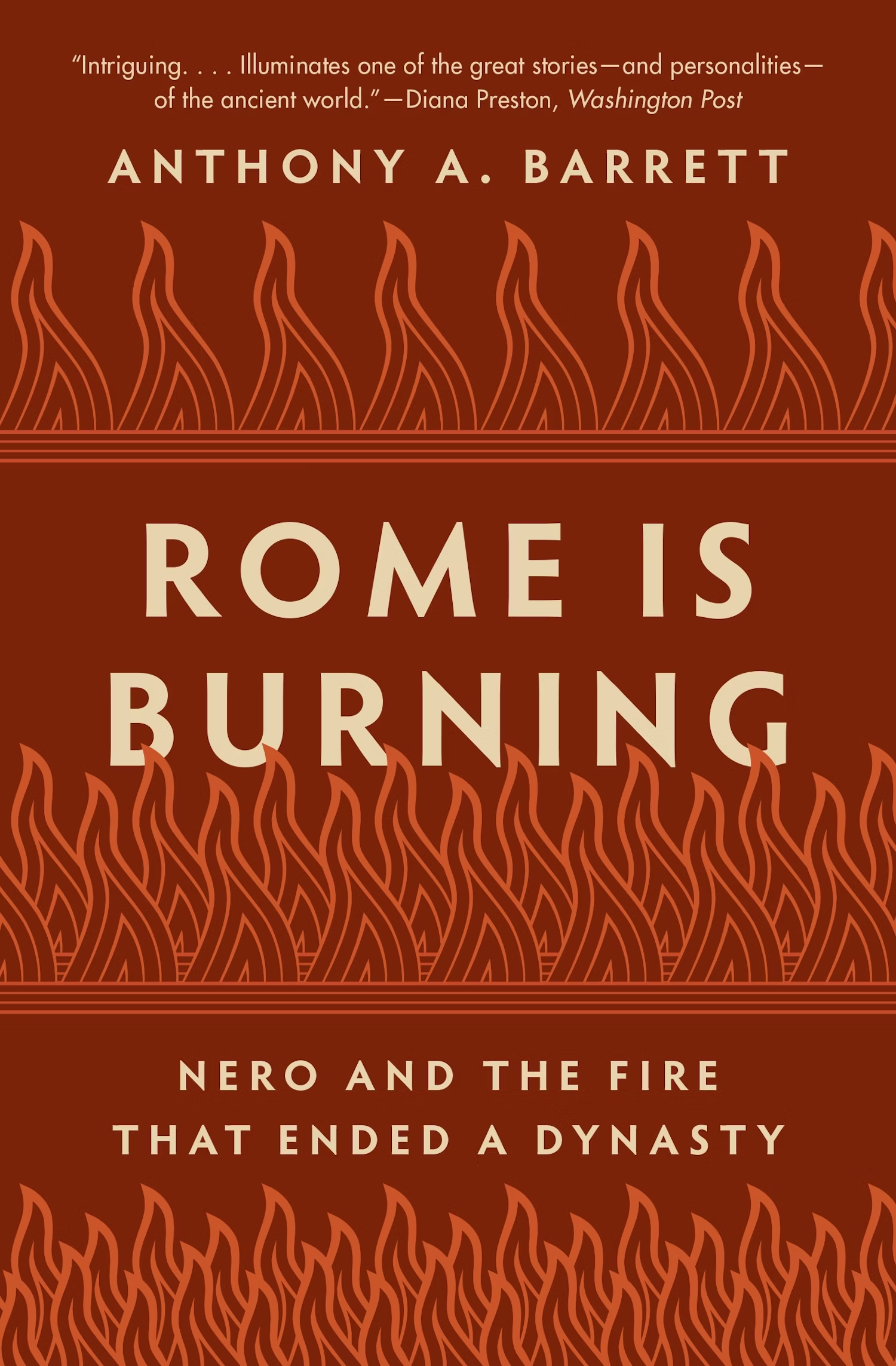
I find that I am reading new books on the Atlantic Slave Trade regularly because we are in the midst of a golden age of research into the history of this terrible trade and provocative analyses of its cascading impacts are published every year.  Traders in Men and Plantation Goods are on my fall list but I should have read them this summer, in advance of teaching my Introduction to European History course. Instead, I had a “Roman interlude” prompted by a re-reading of Suetonius’s Twelve Ceasars last spring. So two half-read Roman books are on my fall list too: a very accessible history by Anthony Barrett about Emperor Nero and the burning of Rome and a book by Roland Mayer about Roman ruins which is more about later perceptions of Rome than Rome itself. The Mayer book probably belongs with the broad cultural history books above. I have started Traders in Men and Plantation Goods (as you will discern by now, I read books in phases, concurrently with other books, a habit I’ve been trying to break but cannot) and my assessment so far would be: both very important and well-sourced studies, with Plantation Goods probably more accessible as it focuses on the basic. It is very much a “material history.”

There are several books which were recently published in my scholarly fields which now sit beside my bed in a stack: first up is Inventing the Renaissance and then we have two books on major late Tudor/Jacobean players: George Villiers, the Duke of Buckingham, and Robert Cecil. I’ll read these for myself, but also to discern whether or not I’ll assign them to students. Stephen Alford (author of All His Spies)’s previous book, London’s Triumph, was a big hit among my grad students this past summer. I suspect that Palmer’s Inventing the Renaissance will be great for historiographical discussions in both undergrad and grad courses. And because it was set in my period and in an interesting period in Mary, Queen of Scots’ life, I actually read a novel all the way through this summer: Flora Carr’s The Tower.

Finally, books on more topical interests which are preoccuping me constantly and/or currently. I’m always interested in architecture, and I read one book this summer which I loved: Thomas Heatherwick’s Humanise (it’s spelled Humanize in its American edition but I prefer the British one’s cover). I don’t think many architects like this book as it is quite critical of contemporary architecture not so much on the basis of design but of craftsmanship. Heatherwick has provoked a reaction among architects in the UK (I’m not sure about here) as he is not an architect himself and does not hold back on characterizing much present-day building as both soul-crushing and soulless (generally because it is so boring) and has launched a campaign to bring joy and craftsmanship back to construction. He’s a real crusader! I’ve been interested in the urban planning idea of the “15-minute city” for a while, so I picked up Shrink the City to learn more about it. The whole idea of meeting all your needs within a 15-minute radius could work for a city with the infrastructure of Salem, but not if we continue our comprehensive commitment to witchcraft tourism, which has resulted in a multitude of witch shops replacing those selling clothing and groceries. As this past year I seem to have become preoccupied with symbols and emblems, first because of the ongoing discussion over the Salem city seal and more recently by the dumbing-down of the Massachusetts state seal and flag, I’ve really been searching more insights into visual culture and graphic design. It’s like another language which I don’t understand. One book that has really helped me is the classic Megg’s History of Graphic Design, but I welcome suggestions. I have yet to find a thoughtful or even interesting book on vexillology.


A Salem Printer & Procrastination

It’s the end of the semester, a transitional time in which I traditionally don’t quite know what to do with myself. Instead of finishing up all of my little annoying tasks, I am persusing random pieces of print here and there. My stepmother has observed that my father can be sidetracked very easily from any task by “printed matter,” generally a newspaper or magazine, something that can be read quickly but is not (by him). I have observed this many times. It runs in the family: I too can be diverted by printed matter, but for me, it’s not the text but rather the type. I don’t really care what the words (or images) are, it’s how they have been printed, their design and composition. This goes back decades with me, since I wrote my dissertation on English printers in the sixteenth and seventeenth centuries. I did so much research on their world, their shops, their type, that I became a typography fan for life. If I happen to spot a striking typeface, a new-to-me specimen pamphlet, or an interesting title page, I will chase these impressions down to the ends of research database-earth. That happened this past weekend: hours went by, but I did discover a new Salem printer. One glance at the bookplate of Irving Kinsman Annable in the large collection of bookplates amassed by Daniel Fearing at Harvard’s Houghton Library, and I was lost.

Annabale (1867-1949) was a Salem resident who established and ran the Berkeley Press of Boston for over 50 years, eventually passing the business down to his son Walter. When I read some of the advertisements for the Press, I assumed they were job printers, producing forms and flyers, envelopes and enclosures. These very practical (and emphemeral) products were the basis of the Berkeley business, but clearly the Annabales had an artistic and skilled devotion to their craft and were not just pumping pieces out. Inland Printer, the long-running printing industrial periodical, has many reviews of the Berkeley Press, and also features the full range of its advertising: again and again the claim is “a specialty of out-of-the-ordinary printing.” Besides these orders, the Berkeley Press produced or contributed to lots of specialty publications for regional institutions and trade organizations, as well as a succession of patriotic pamphlets, including the Declaration of Independence and Gettysburg Address. Houghton Mifflin even commissioned Berkeley to produce one of the earliest (and most popular) pictorial maps, the black-and-white version Melanie Elisabeth Leonard’s view of Cape Cod, in 1926. Catalogs, portfolios, all sorts of enclosures: the press printed anything and everything, except for larger books. (I think, but I don’t have access to any business records, though there are papers in the Phillips Library collection that I want to check out if my curiosity continues). Of course, Berkeley’s own advertising materials, like the pamphlet on decoration below in the collection of Historic New England, are the most beautiful.

The first half of the twentieth century was such an exciting time for the craft of printing as its practicioners were earnest advocates for its skills and exemplars in the face of increasing mechanization. These men (mostly) were all inspired by William Morris and his Kelmscott Press, but they went on to acquire distinct skills and attributes through their own practice, societies, and appreciation of printing history. They kept their businesses small and identified as artisans first. In Boston, the leader of the printing craft movement was clearly Daniel Berkley Updike (1860-1941) and his Merrymount Press, which produced lots of ephemera as well, but many more books than Berkeley, each one a work of art. I don’t think the contemporaries Updike and Annabale were competitors; I think they were colleagues, and both were active in the Boston Society of Printers. Annabale was definitely more interested in advertising as an art, writing quite clearly about the power of “word images.” The Berkeley Press did produce several small books, especially if there was a local connection as in the case of Joseph Ashton’s History of the Salem Athenaeum, 1810-1910, but they are nothing to get excited about. On the other hand, Annable seems extremely excited about the power of perfectly printed slogans and symbols. In the press prospectus Houseflags & Trademarks (1924—the author is not credited but this reads like all of Annable’s other copy) he compares the flags flown by New England ships a century before, when they “were such frequent travellers across the waters of the world….[that] their flags were familiar spots of color in the harbors of six continents” with the trademarks of his day: if the design was right the same “familiarity” would emerge. Though he did some printing in Salem for friends and organizations which which he was associated, and even produced some picture and postcards which he sold himself (enough that I’m wondering if there was a press at home—a really cute mansard roof cottage still standing on Willow Avenue), I think Annabale saw his professional life as existing in Boston, for over fifty years.

Houseflags & Trademarks courtesy of Bailgate Books, Ltd.


Saints & Sinners & a Bad Professor

So you would think that I would be happy when an exhibition of paintings, texts and objects right in my teaching sweet spot of late Medieval/Renaissance/Reformation/Early Modern Europe comes to my very own city, and yes, I am. Have I taken advantage of said exhibition and brought my students to see things which I regularly refer to? No I have not. The “Saints & Sinners” in my post title refers to the current exhibition at the Peabody Essex Museum, Saints, Sinners, Lovers, and Fools: 300 Years of Flemish Masterworks, and the “Bad Professor” is me. This has happened before: the PEM has a global purview, and several exhibits which have complemented my courses have been up, but this one is really spot on. So when I finally went yesterday afternoon (it opened in December and is up until May), I really enjoyed it, but also felt bad. I am really not good at out-of-the-classroom activities with my students: I never have been and I never had to be. All my colleagues are a lot better. I always used to think, oh well, they’re Americanists, it’s easy for them, but that’s not going to work in this case is it? And I’ve always blamed it on Salem State’s location—about a mile out of downtown Salem. It’s not very far, but it feels far, when you’re trying to cover so much in the limited time of a semester. I walk it often, but to and from is going to eat up an entire class with not much time for viewing in between. The original Salem State (Salem Normal School) was located just behind my house on Broad Street, but in the 1890s there was a big move to a more expansive—now residential—area south. The move made sense at that time, but now I think our university would benefit from a downtown location, or maybe I’m just making excuses! I have occasionally invited my students to join me at exhibitions, and a few have, but never the entire class: my students seem very busy, taking six classes and working two jobs—oops, more excuses. In any case, I’m certainly going to extend that offer to them for this exhibition, because they will in fact see many things which they have heard about before.

Detail  from Jan Wildens, Panoramic View of the City of Antwerp across the River Scheldt, 1630.

Saints and Sinners is a traveling exhibition co-organized by the Denver Art Museum and the Phoebus Foundation in Antwerp, and it is very Antwerp-centric. Once certainly gets a sense of the somewhat wider world that was late medieval and Renaissance Flanders, but Antwerp is the star of the show. But that’s ok, because Antwerp was a very dynamic city in this era–the first non-Italian European entrepot. [a great read for the non-specialist is Michael Pie’s Europe’s Babylon: the Rise and Fall of Antwerp’s Golden Age] The exhibition opens with two galleries exploring intense late medieval piety and the rise of Christian humanism in northern Europe: there wasn’t much discussion in the exhibition text about the latter (or humanism in general, really) but I saw it all around me in both the Christocentric devotion and the subtle critique of the Church, most evident in Anthony Rebukes Archbishop Simon de Sully in Bourges, (c. 1475, by Master of the Prado Adoration). There is a lovely little triptych with a nice interpretive feature.

Circle of Dirk Bouts, The Virgin and Child in an Enclosed Garden , about 1468; Master of the Prado Adoration, Anthony Rebukes Archbishop Simon de Sully in Bourges, about 1475; Artist in the Southern Netherlands, Triptych with Saint Luke Painting the Virgin Mary and Jesus, 1520-30.

Then we were on to more worldly things: shockingly fresh portraits of people who were not saints, still-lives of stuff, a few landscapes, battle scenes, scenes of daily life and satire, cabinets of curiosities. The segue between the spiritual and material worlds was a succession of Adoration of the Magi paintings, focusing on stuff. You can never underestimate the impact of the Renaissance portrait, and I was particularly wowed by the portrait of Joost Aemsz. van der Burch by Jan van Scorel. He looks very (Thomas) Cromwellian to me, and yes, he was a contemporary and also a legal advisor, to Holy Roman Emperor Charles V. I love portraits of the new nobility of merit or robe (rather than the sword) and also of merchants, the other new men of the era. One of the most captivating (double) portraits of this exhibition is the rather pointed portrait of two “tax collectors,” a copy of the famous Quentin Massys painting of the same title. This image is a great teaching tool: I suspect the men were in fact “tax farmers,” collecting taxes for the government for a certain percentage, a practice which emerged before the expansion of professional state fiscal agencies, and their depiction conveys a lot about attitudes towards money, class, occupation, society, and even color. Another double portrait of a married couple was also interesting: they are obviously well-heeled and playing “triktrak,” an early form of backgammon.

Quinten Massys, Tax Collectors, late 1520s, oil on panel, 86 x 71 cm. Liechtenstein Collection, Vaduz/ Vienna.

LOVE this first portrait above: Jan van Sorel, Portrait of Joost Aemsz. van der Burch1530-1; Marinus von Reymerswaele, After Quinten Metskis, Tax Collections, about 1530; Jan Sanders van Hemessen (Hemessen c. 1504-1556 Antwerp), Double Portrait of a Couple Playing Triktrak, 1532.

I was familiar with most of the printed texts in the exhibitions but the key reference works were there: the very important and popular Cosmographia of Petrus Apianus, the pioneering On the Fabric of the Human Body by Andreas Vesalius, and the Nova Reperta engravings by Flemish artist Johannes Stradanus published by Philips Galle. The Nova Reperta (New Intentions of Modern Times) is a portfolio of 19 European “inventions” (many of which are not inventions and certainly not European inventions) is such a testament to European pride (and invention!) at the end of the very dynamic sixteenth century. The frontispiece alone is revealing [I use this great digital site at the Newberry Library in class]: highlighted are 1) the western hemisphere (ok Europe gets credit for that discovery), the printing press (Chinese origin–I don’t see the type here!), distillation (I would call this a Eurasian collaboration), wood from the guiacum tree in Brazil (then thought of as the cure to another American import, syphillis, but soon to be abandoned for mercury), a cannon (ok the Europeans encased Chinese gunpowder), a saddle with stirrups (ancient!), a clock (clock history is complicated but if we’re talking mechanical I think I will give it to Europe).  As the exhibit moved into a surreal and satirical gallery, with a Bosch-esque Hell, and lots of foolery, I was with it, but I walked right through the boring Classical Impact section (not what I’m looking for in Antwerp) into the galleries of wonder and cabinets of curiosity. It was fun to see actual Wunderkammer as well as paintings of wealthy Flemish men and women with their collections of exotic objects and paintings; one can easily grasp how connoisseurship expanded into collecting and it was almost as if these galleries were a mirror of the entire exhibition.

Andreas Vesalius, On the Fabric of the Human Body in Seven Books, 1543; Follower of Hieronymus Bosch, detail from Hell, 1540-5-; Daniel Teniers, Festival of Monkeys, 1633;  Gillis van Tilborgh II, Twelve Gentlemen in an Elegant Interior, about 1661; The Famous Pocupine in London, 1672 @Trustees of the British Museum. After I saw him in the bottom right corner of the Cabinet in the exhibition, I had to put in him here as he is my favorite early modern porcupine.

What if the Tudors had Thanksgiving?

I’ve been teaching a first year seminar this semester on the Tudors and I’m not sure it’s been a successful class. These topical seminars are required for freshmen, and they are hybrid in nature: half topic, half introduction to college. I’m not good at melding the two halves together, and while I have a few Tudor fans in the course, there are clearly some students who just got stuck with this particular topic. Everyone is very polite, but you can tell when students are not really invested in a course. Anyway, I tried to wow them last week with a presentation on Tudor food, and several yawns indicated that I was not successful (it doesn’t help that this course is at 3:00 in the afternoon). I did quite a bit of research, however, so this topic has to do double duty as I am inflicting it on all of you! I’m hosting Thanksgiving this year as well, an unusual role for me, so I put two and two together and conjured up a Tudor feast with the help of Thomas Dawson, the author of The good huswifes jewell and The Second part of the good Hus-wifes jewell (1596-97).

“The Blessing” by Flemish artist Gordius Geldorp; my two favorite Tudor cookbooks by Thomas Dawson (I have these very convenient Nova Anglia Press editions but they have been digitized.)

Three staples of the American Thanksgiving meal were available in Tudor England: turkies, pumpkins, and potatoes. The first two could have ended up in a late November feast: there are recipes for turkey roasts and various pumpkin preserves and confits from the later sixteenth century. No mashed potatoes though: it will take Englishmen and -women a little longer to warm up to this particular “root.”  For those who could afford a diet consisting of more than pottage and bread, meat and fowl were far more popular than fruits or vegetables, so it follows that turkeys were embraced before pumpkins, which were perceived to be some sort of exotic melon. Apparently they were driven to the London markets, and in the 1570s Thomas Tusser included turkey in his “Christmas Husbandry Fare.” By that time, perhaps turkeys were too common for the courtly table, but as all the Tudor monarchs loved very showy feasts, they might have gone for a multi-bird roast, the early modern version of today’s turdrucken. I’ve seen references to five-bird roasts and more, in particular a pigeon inside a partridge inside a chicken inside a goose inside a turkey, often encased in pastry. Thomas Dawson provides a recipe “to bake a Turkie and take out his bones” which might be preliminary to a more extravagant engastration (new word for me!)

Pumpkins (called pumpions or pompions) were introduced into England about the same time as turkeys, and they have a similar crest of popularity: sought-after rarity to more humble fare. By the end of the sixteenth century they are included in texts about kitchen gardens and foods which can decrease famines. The Tudors did not see pumpkins as squash, because they didn’t have squash, so it was often identified as a melon (and occasionally a cucumber!) Dawson has a couple of pumpkin recipes: “to make a conserve of Mellons, or Pompions,” to sweeten them, and to make them into “confections,” so they could be on the holiday table in those forms, but not as a pie or tart: the first pumpkin pie recipe in England dates from the seventeenth century. If we’re going to have a Tudor fruit pie, I think it would be filled with peaches, pears, plums, quinces, damsons or even medlars, a forgotten autumnal fruit. A Tudor table would definitely have a savory pie too, or a sweet and savory and spicy pie like this veal variation from The good huswives handmaid (1597).

A conspicuous pumpkin in Sir Nathaniel Bacon’s Cookmaid with Still Life of Vegetables and Fruit, 1620s. Tate Museum: Dawson’s recipe for medlars in pastry, and two of Ivan Day’s beautiful pies with a recipe for Sweet Pies of Veal.

The Tudors did not embrace potatoes, so they would not be on either a courtly or husbandly table. I want to substitute mashed turnips or parsnips, but I don’t see any recipes, except for the occasional pudding. We always have creamed onions in my family, and that seems like a perfect Tudor dish, as they loved everything that was white and creamy—-but I could only find boiled onions. Stuffing is so Tudor: they stuffed (farsed) everything! There’s a perfect stuffing recipe in Dawson’s Second Part of the good Hus-wives jewell: “to farse all things.” Just take “a good handfull of tyme, Isope, Parselye, and three or foure yolkes of Egges hard rosted, and choppe them with hearbes small, then take white bread graited and raw eggs with sweet butter, a few small Raisons, or Barberies, seasoning it with Pepper, Cloves, Sinamon and Ginger, woorking it altogether as a paste, and the may you stuffe with it what you will.” There were no cranberries in England in the sixteenth century, but plenty of substitutes, whether you want a syrup (I would go for gooseberries) or the paste kind that comes out of can (Quince, of course!) And we call all wash it down with some Hippocras, a spiced wine “tonic” concoction named after the Father of Medicine.


Twilight Time

Pardon me, I’ve got to engage in some historiography. The history of historical interpretation can be a deadly topic in the context of precise historical events or periods, but is nevertheless essential engagement for comprehensive historical understanding. I feel like I’ve been swimming on the surface with all the Salem stuff this summer, so took advantage of a rainy cleaning-out-my-study afternoon to re-engage with two classic books that have been part of my life and work since graduate school, if not before: Johan Huizing’s Waning of the Middle Ages (1919) Otto Friedrich’s Before the Deluge (1972). I remember my first reading of both books very vividly: their ability to capture a mood and a time using a variety of sources and expressions and to illustrate the peak of their respective eras and civilizations in such captivating ways that you could feel the decline that followed. Both are “decline and fall” books that focus on the before, thus articulating the transition to after in such a way that you really don’t want to get there but you certainly appreciate the change. I think both books really set the standard for cultural history, and also for a succession of histories that focus on the late summer/autumn of civilizations, the waning, the twilight.

Late Summer and the onset of harvesting invokes feelings of seasonal change in general, but this particular summer has seemed almost apocalyptic to me in an environmental sense, so these books seemed to call to me when I was culling my library the other day—they will always be on my bookshelf but I don’t look at them every year. Huizinga’s period is my period so he’s always relevant for me, but even Before the Deluge felt timely when I opened it up the other day. The title is metaphorical, but it can apply literally now. Après moi le déluge, the famous phrase attributed alternatively to either Louis XV or his favorite, Madame de Pompadour, had a more specific meaning when it was uttered in the mid-18th century, but the overwhelming tide of change brought about by the French Revolution transformed it into both a prescient and universal statement by Marx in the 19th century and Great War survivors of the twentieth. I think both Huizinga and Friedrich have had a global impact in terms of imitators and successors, but I’m only familiar with European historiography so that’s going to be my focus in this post. The majority of “waning” books seem to dwell on the same eras as Huizinga and Friedrich, as well as that of the Revolution: they are seeking to explain and illustrate the great transitions from medieval to early modern and from modern to contemporary in classic European chronology. Not all are successful, as you will see from my comments below! 

Bouwsma’s book is inspired by two classical late medieval historiographical trends, that of Huizinga and his predecessor Jacob Burckhardt, whose Civilization of the Renaissance in Italy articulated a definitive Renaissance break and the beginnings of modernity. Unlike Burkhardt, Bouwsma sees the Renaissance as ending, and not just evolving into the early modern era. I really like this book, but it’s narrower in focus than most books focusing on transitions, maybe because it’s not. Norman Cantor was a great medieval historian, but in his later years I think he veered away from his expertise a bit too much: I really did not like In the Wake of the Plague, and I wanted to like The Last Knight, but I think many of his assertions about John of Gaunt were speculative: but just look at the subtitle!

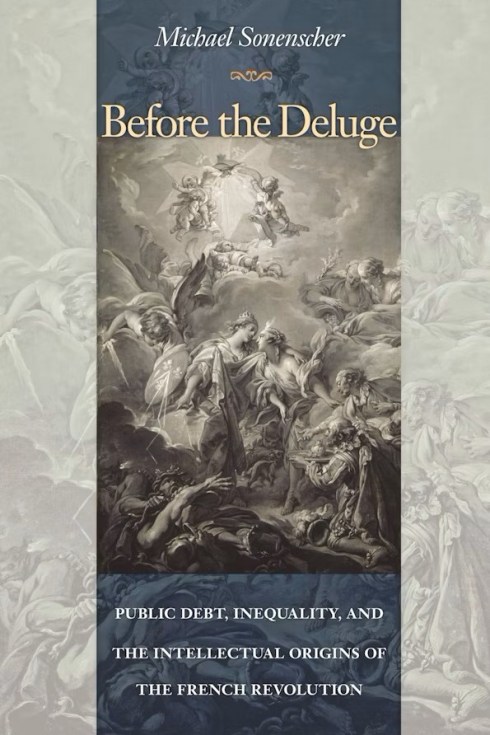
This book by the intellectual historian Michael Sonenscher comes closest to my original understanding of the Après moi quote, and really conveys social perceptions of the coming financial deluge in the later 18th century. It’s more about the “coming” than the “waning” but still belongs in my subgenre. The medieval and early modern “twilight texts” are definitely academic and thus hard going in places, but the interpretations become a bit more accessible with the Friedrich-inspired texts below.

Before the Deluge is about the 1920s and there are several books about the Weimar Republic which mirror its approach in places (I like Weimar Germany: Promise and Tragedy by Eric Weitz) but books which attempt to recreate the pre-World War I mentality seem to me a bit more Friedrich-inspired. Frederic Morton and Juliet Nicolson both have family history to draw on for their social histories of Venice and England before the Great War, and while their works don’t quite approach the dazzling depths of Friedrich’s book, they are both very readable and often poignant. Nicolson’s book is very atmospheric: as I’m not really a fiction reader, for me, The Perfect Summer is the perfect summer read.


A Visual History of Home

My mind is whirling these days: we’re at the end of the semester, and a teaching-free summer lies ahead of me, but so do three writing projects, maybe more. I’m always thinking, but I’m also really tired, so it’s not all constructive. Thankfully gardening season has begun, but I did not feel particularly re-energized after my first foray out back last weekend—just sore! Then I remembered this book that I picked up down in Connecticut during our stay at the Griswold Inn a few weeks ago. The Griswold has no televisions in their rooms, which pleased me, but not my husband, so I suggested we go to a rather elegant used bookstore next door. We browsed, he more intently than I, but I came across a beautiful book that I thought I could add to my bedside stack of books I never read because I seem to only read for information, and all my informational books are in my study. I bought it, threw it in my suitcase, brought it home and forgot all about it until this past Sunday, when I poured myself a glass of wine and opened it up………….and immediately began to relax, in the best possible, almost entranced way. This book is entitled At Home. The American Family 1750-1870, and it was written by Elisabeth Donaghy Garrett (now Widmer), then (1990) a vice-president at Sotheby’s, and author of several books on historic interiors. Apparently Ms. Garrett had published a series of articles on “the American Home” in The Magazine Antiques in 1983 that was so well-received that it prompted the publication of this book and boy, I can understand why. Peter Thornton, whose book Authentic Decor: the Domestic Interior 1620-1920 I am familiar with, notes in his Forward that the “outstanding quality” of At Home is “the sheer weight of evidence that has been marshaled and the manner in which it has all been presented.” I agree, but I think the manner is more important, at least for my personal purposes: I seldom read for pleasure, and this book offered both pure pleasure and tons of information, in well-crafted text and well-curated pictures. It really took me away, and that never happens.

I really wanted this book to be a picture book, a coffee table book, which I could just breeze through from time to time. And I suppose it is that, if you want it to be. The illustrations are amazing, representing a full-spectrum of deep-hued oils from well-known American artists of the eighteenth and nineteenth centuries, to seldom-seen (at least by me) watercolors of domestic scenes sourced from local historical societies. But once I started reading, I couldn’t stop: Garrett is a wonderful writer who favors narrative and literary sources, so her text is quite lively, and as Thornton observed, she manages to integrate a lot of information in a very accessible manner. I could take a lesson from her, but I’d rather just enjoy her book. The chapters begin with individual rooms in the house (their uses and all about their furnishings, in great detail) and then proceed to the myriad elements and tasks that go into making a home, all year round, and in the city and the country. So we have: parlors, the dining room, the kitchen, the bedchambers, lighting, “the daily dog-trot routine of domestic duties,” “the quest for comfort,” (probably my favorite chapter–a lot of heating and cooling advice, and bugs!), the tribulations of the early American housewife, and husband and wife as consumers. Here are some of my favorite images, and a few notes about how Garrett used them: I tend toward the vernacular, because so many of the paintings and prints in this book were new to me, but there are plenty of formal interior scenes as well. Since we’re in the beautiful month of May, I’m also going to focus primarily on summer homes: cozy parlors can come later.

The Children of Nathan Comfort Starr, Middletown, CT by Ambrose Andrews, 1855, Metropolitan Museum of Art. Garrett notes the elevation of the house, designed to promote healthy air inside. This looks like a happy scene of children playing shuttlecock, but Garrett believes that it is a memorial painting of the youngest son (in the dress, of course) who died when he was just over a year old.

York, Pennsylvania Family, 1828, anonymous artist, St. Louis Museum of Art. At Home is just as much about households as houses, including servants. Garrett discusses servants but she does not discuss race. This is a book of its time (1990), which is before the renewed historiographical focus on the roles of African-Americans in the northern US. She includes three images of African-Americans in the corners or the margins, but she does not digress on their identity or position beyond that of “trusted servants.” At Home is a study in material culture, not a social history, and so this painting is used to describe the vivid wallpaper and carpet (boy does this book have a lot to say about carpets!) contrasted with the simple painted furniture.

Rhode Island Interior by an anonymous artist, 1800-1810, collection of Fenton Brown. It’s really all about the carpets! They demanded so much time, and money. Women (or their servants) pulled them up in the spring, nailed them down in the fall, and spent a lot time worrying about moths. Garrett uses this particular image to present a European gaze on American interiors, which she does often throughout her book. An Italian observer noted that Americans “displayed few pictures, statues, or ornamented furniture, preferring instead mahogany furniture and fine carpets.”

Two paintings by Massachusetts artist Ellla Emory of Peter Cushing House in Hingham, MA: East Chamber and Old Laundry, c. 1878, both Private Collection. I love this artist! Back to the floors: this sisal-like straw matting was very popular in the summer for centuries—one of my favorite paintings of the Elizabethan court shows the same covering! Floors could be bare in the back of the house, and in hallways as well, and beach sand was spread around.

Garrett includes quite a few watercolors by new-to-me New Bedford artist Joseph Shoemaker Russell (1795–1860), all of which I found absolutely charming. Russell painted New England interiors, but spent some time in Philadelphia too, where he captured all the rooms of his boarding house: above are Mrs. A.W. Smith’s Parlor and Mrs. J.S. Russell’s Room at Mrs. A.W. Smith’s, both 1853 and in private collections. These are summer views, and present opportunities for Garrett to discuss shutters in detail, as well as the necessity of closing up the fireplace with fireboards or flowers during the warm months. The parlor view shows a gas-fed lamp of the 1850s, and also the American custom (noted by all of Garrett’s European sources) of placing all the furniture along the walls of the room. Silhouettes are everywhere in this book!

More summer images (and challenges): View from the House of Henry Briscoe Thomas, Baltimore, by an anomynous artist, c. 1841, Metropolitan Museum of Art; Tea, Alexandria by William Marshall Merrick, 1860, New York Public Library. Come Spring, the lady of the house (or her servants) had to change not only the carpet, but also the draperies. If she didn’t have shutters, she had to pull down the heavy drapes and replace with sheers. She (or her servants) also had to drag all the furniture outside for an airing: Spring cleaning was a really big deal. The battle against bugs intensified with the warm weather, but it was really fought all year long, the principal enemies being flies, mosquitoes, moths and bedbugs.

Ice Cart by Nicolino Calyo, c. 1840-44, New-York Historical Society. The provisioning of the household also varies with the seasons, and “the ice-cart was an integral part of the iconography of summer in the city” from May until October. The New England re-export ice trade was an Atlantic affair, and Garrett’s European observers frequently commented on the abundance of ice in American households.

Now refreshed: I can attack the (digital) pile of final papers and examinations before me!


When Salem had Castles

I’ve got castles on my mind: all my courses this semester have an architectural theme and I’m in the midst of long survey of encastellation in my medieval course, using castle-building to explain virtually everything and anything. I often strive to connect teaching and living, to look around my own environment for connections to the past. For my Americanist colleagues, Salem and its region can serve as a classroom, but I’ve got to be a bit more creative. Sometimes it is easy: just last week we were discussing the Roman Republic in my world history class and we arrived at the Cleopatra representation issue, and there was Salem sculptor William Wetmore Story’s very influential statue/case in point. When I’m teaching the Reformation and the early modern era, it’s easy to bring in Salem from time to time, but this semester I have only world and medieval/Renaissance courses so there are not many opportunities for place-based history. But castles can be American in their decorative reincarnations, and we have several examples in our own region: Hammond Castle in Gloucester, Herreshoff Castle in Marblehead, and Winnekenni Castle up in Haverhill. The busy city of Salem was never a summer residential destination for Gilded Age millionaires, so no large castle-esque “cottages” were ever built along its shores, but there was a strong Gothic Revival influence at work in the mid-nineteenth century, very evident primarily in civic and ecclesiastical architecture from that era. These buildings are as close as Salem gets to castles and while some survive, most do not. My list starts with the most castle-like structures, long gone, proceeds through the nearly Norman, and ends with the “castle” with the most potential.

The Salem Armory and the Eastern Railroad Depot WERE castles right in the midst of downtown Salem, and their loss is still being felt, I think: you can see how integral they were to Salem’s evolving streetscape in every photograph. The Armory was nearly restored by fire in 1982, its surviving drill shed was converted into the Salem Armory Visitor Center in1994, and its Head House facade demolished by the Peabody Essex Museum in 2000. The Depot was built in 1847 and demolished in 1954. Certain views of the pre-fire Naumkeag Steam Cotton Company mills, otherwise known as Pequot Mills, make the buildings look castle-eque, especially the view from Derby Wharf below, which shows the facility’s crenellated towers. No castle features were incorporated in the post-fire buildings.

Kernwood, the North Salem estate of Francis Peabody, was Salem’s only palatial summer residence and so I am including it here: it is less fortified Normanesque and more Gothic Revival confection, though it does have a stone “rustic arch” surviving as the entrance to Kernwood Country Club. Kernwood was built in 1840, after Peabody had advocated for a number of Gothic constructions throughout Salem, including the First Church on Essex Street and Harmony Grove Cemetery. The photos below are from a series of Essex County views published in 1884 and Frank Cousins in the 1890s: I’m not sure exactly when the mansion came down, but the Country Club was established in 1914 and Walker Evans captured the converted clubhouse still looking very Gothic in the early 1930s.

The other castle-esque constructions in Salem were churches, all of which survive: St. Peter’s Episcopal, the First Church on Essex, and the East Church on the Common. St. Peter’s was designed by Boston architect Isaiah Rogers and constructed in 1833; the First Church was built three years later with Francis Peabody overseeing the construction. I’m curious if Salem residents in that decade noted the similarity and wondered: wow, is our city going to be taken over with these medieval structures the same way we wonder about the plastic boxes which define our era? I want to believe that the integrity of craftsmanship and materials would have reassured them, but who knows? In the next decade, the most castle-like church was constructed: the East Church on Salem Common. Designed by New York City architect Minard Lefever, the East Church had soaring towers that were truncated later, just as its function was reduced to the present-day Witch “Museum”.

The First Church, St. Peter’s (2) and the First Church today; Frank Cousins photograph of the East Church, Phillips Library via Digital Commonwealth.

Last, but certainly not least, the “castle” with potential: the old superior court building on Federal Street. Behind it (to the north) will rise a dreadful new building shoe-horned into a sliver-shaped lot, but that will be the price we pay for restoration of this amazing courthouse. Its turret and tower (best viewed from the rear) are so soaring and its interiors so baronial: I’m really glad that this building (which has been empty for decades now) is going to be preserved with a new purpose. I have no idea what that purpose will be, but I vote for a new Salem museum/visitor center with authentic exhibits and professional interpretation of all of Salem’s history: an installation which will defend our city from encroaching tourist trapdom.

Front of the former Superior Court at Salem, 1954, Brearley Collection, Boston Public Library via Digital Commonwealth; back–a bit foggy view taken yesterday at twilight: it’s difficult to capture the entirety of this building!


A Big end-of-year Book Post

I always do a book post at this time of year for several reasons: it’s fun to go through the mental process of compiling “best of” lists, I like to offer gift suggestions, and the time between semesters is always one of intense reading for me. This year, I’m a little late for gift suggestions, but the two other inspirations apply: I read some great books over the past summer and I have my usual stack of unread books right by my bedside, all ready for December 26. This was the year that I published my own book, so I had more time for reading, but now I’ve just finished proposals for two new books, so the next year might not be so free (hopefully). I want to take advantage of the time that I have to read as much as I can, and I’m driven to learn more about: 1) Ukraine (because war); 2) commodities and trade in the pre-modern world (because saffron, the subject of one of my proposed books; 3) information dispersion, broadly defined (because academic+general interest); 4) the history of science (because academic+general interest); 5) early American history (because Salem, the subject of the other proposed book); and anything to do with design (just because). No fiction recommendations here, sorry: I  like fiction, I try to read fiction, but I just don’t seem to be able to finish novels at this point in my life. I put them down because I get curious about something: there are dog-eared spine-cracked books all over the house! So here goes: this is a “best of” list of what I’ve read or was on my radar in 2022 rather than what was published this year, and it’s pretty academic, but there are some fun and beautiful books here too.

Ukraine: I read Yale historian Marci Shore’s The Ukrainian Night: An Intimate History of the Revolution this past summer (and into September—it took me a while): I really learned a lot. My Ph.D. is in European comparative history, but boy, this book made me realize how little I know about Eastern Europe—and the twentieth century. The Ukrainian Night places the Crimean crisis of 2014 in historical context and thus also provides the context for the current crisis, and it is very much a personal, “intimate” history rather than an academic tome. I picked up Polish journalist Pawel Pieniazek’s Greetings from Novorossiya (2017) for more personal history of the ongoing conflict in eastern Ukraine and Timothy Snyder’s introduction: the latter (also at Yale) is my guide to everything Ukraine on Twitter (still). I imagine we’ll get “first-draft” histories of the Russian assault and Ukrainian response soon.

The demand, supply, consumption, and exchange of a range of commodities in the late medieval and early modern world are all academic and personal interests of mine, and 2022 was a banner year for books on all sorts of economic history. Any former student of mine will tell you that I believe that the Black Death was the most consequential event ever, for a variety of reasons, so I have been waiting for Belich’s book forever. It’s brilliant, and ties together all the trends and themes I have been teaching for years. I wanted to assign it to my undergrads this past semester, but I thought it would be a bit much for them. Future grad students, however, are duly “warned.” In terms of economic dominance in the world the plague made, it’s increasingly all about the Dutch, so Pioneers of Capitalism. The Netherlands 1000-1800 is a welcome book too. I like its long time span: too often the Dutch “Golden Age” seems to spring from a rather shallow pool. Anne Gerritsen’s The City of Blue and White has been by my bedside for a year or so, but I recently moved it to the top of the stack.

The City of Blue and White is definitely calling me, but it will probably have to wait until I have finished Pamela H. Smith’s latest book From Lived Experience to the Written Word. Reconstructing Practical Knowledge in the Early Modern World as I’m reviewing it for an academic journal. I wish I had read this book before I wrote my own, but Smith is a prolific and active scholar so I had the benefit of her prior publications. She teaches at Columbia, where she is also the Director of the Center for Science and Society and its Making and Knowing Project, which “explores the intersections between artistic making and scientific knowing.” There’s nothing new about “maker culture” and it was far more robust and fluid in the early modern era, when making became knowing. Jumping up a century or so and into the realm of visual information dissemination, I am obsessed with the new book series from San Francisco’s Visionary Press : Information Graphic Visionaries, edited by RJ Andrews, who told Print magazine’s Steven Heller that he is “obsessed with craft. To me, the most fascinating thing is to understand the story behind how something came to be.” That’s just how I feel, so I wish I had put these three books on my Christmas list. I’ll just have to buy them myself, beginning with volume on Emma Willard’s history maps (the “Temple of Time,” above, is just one) which are just fascinating in so many ways.

Speaking of ambitious and confident Victorians who believed in progress passionately, Iwan Rhys Morus’s How the Victorians Took Us to The Moon is a survey of nineteenth-century British innovators as well as the innovative “spirit” of their era. It’s a bit biographical for me but that approach definitely increases its accessibility. The other history of science, broadly and brilliantly focused, which I purchased this year is Lorraine Daston’s Rules: A Short History of What We Live By. I thought it would be a good aid for teaching, but I just devoured it, and find myself picking it up often: reference and readability: you can’t beat that!

My Salem State colleagues and I are collaborating on a book of essays for Salem’s 400th anniversary in 2026 and I’m going to have to do a deep dive into several periods of American history for my contributions. Since I’m not an American historian, I need some foundations, and I really like the “American Beginnings” series from the University of Chicago. Three series books are above: the first two explore a topic that my colleague Dane Morrison has been working on for a while: how trade to the East in particular and maritime history in general contributed to the formation of American identity. Dane has a book out this year too: Eastward of Good Hope. Early America in a Dangerous World. Salem was absolutely central to this expansive trade and thus to America’s emerging identify, and this is the broad context that we want for our book.

I’m just realizing that this is a very serious list so let’s lighten it up a bit! I’m not sure it’s an actual genre, but my favorite books to read for pleasure are “house stories” focused on houses and their evolution over time, along with, and because of, the people who lived in them. Here are three examples I picked up this year:

I absolutely hated the recent Netflix series on Anne Boleyn, Blood, Sex & Royality: it is that same weird hybrid documentary drama approach last seen in The Last Czars, which remains the most appalling historical “thing” I have ever seen. It’s so odd to see the main characters, actual historical people, engaging in intimacies followed by the commentary of a talking head. Anyway, one of the talking heads in Anne’s story, Owen Emerson, is one of the authors of The Boleyns of Hever Castle, which I absolutely love. I bought the book after I viewed the program, just to get all the horribly imagery of the latter out of my head, and it did. Clive Aslet’s The Story of the Country House is just wonderful, and I think Ruth Dalton’s Living in Houses. A Personal History of English Domestic Architecture (over four centuries) is going to be great too: I do hope I have time to read it. As you can see, I really need some stories of houses outside of Britain, so please send recommendations! Merry Christmas to all, and to all: try to reserve the week between Christmas and New Year’s for yourself: for reading (or whatever else you like to do).