Tag Archives: Shopping

A Sampler of Salem Folk Art

Salem is not particularly known for its folk art, I think. The standard for craftsmanship during the later eighteenth and early nineteenth century was so high, and production so prolific, that the curatorial and collecting emphasis always seems to be on the best and the brightest of the decorative arts rather than the more idiosyncratic. But I’m always looking for interesting examples of folk art, and every once in a while I do a round-up of samplers, silhouettes and signs. The Peabody Essex Museum has wonderful examples of Salem-made folk art in their huge collection, including my favorite trade sign, featuring a bust of Paracelsus made for James Emerton’s Essex Street apothecary shop, samplers from the famous Sarah Stivours school, and the “soft sculpture” (I’m not sure what else to call it) of textile artist, author and abolitionist Lucy Hiller Lambert Cleveland. And all manner of maritime objects of course. The amazing decoys of Captain Charles Osgood, carved while the Captain was biding his time waiting for his gold rush ship to set sail from San Francisco back to Salem in 1849 and hidden in a friend’s hunting lodge in Rowley for a century thereafter, are valued quite highly. Most are in the collection of the Shelburne Museum in Vermont, but one came up for auction recently with an impressive result.

 Lucy Hiller (Lambert) Cleveland, Sailor’s Home, mid-1800s, cotton, wood, leather, pigments, Gift of Mary T. Saunders, 1915, Peabody Essex Museum; Sally Rust’s Sampler from the Sarah Stivours School, 1788, Peabody Essex Museum; three Osgood decoys, Shelburne Museum.

But a lot of anonymous pieces crafted in Salem seem to sell for very little money. There’s a painting of Salem Harbor by an anonymous artist coming up for auction later this month at Eldred’s Auctions that is so beautiful I could fall into it—and it has a higher starting bid than I’ve seen before for folk art marine paintings. It seems worth it; this is not just a painting of a ship, but of life on land and sea. Contrast this with another nautical view below, a reverse glass painting of “Ship Siam of Salem / Built 1847 / Capt. Ebenezer Graves” sold by Jeffrey S. Evans & Associates Auctions. There’s certainly a lot more going on. Also from Evans, these two wonderful carved allegorical figures, which were apparently located at Salem Willows! I really can’t imagine where, precisely. Silhouettes cut in Salem appear at auctions frequently, but I’m not sure these would count as Salem art as such artists seemed to have been characteristically itinerant.

Folk art painting of Salem Harbor, Eldred’s Auctions; reverse glass painting and allegorical figures, Jeffrey S. Evans & Associations Auctions; Massachusetts cutwork silhouette “of S.P.H. of Salem, cut by S.A.D,” Dovetail Auctions.

Besides the first painting above, my favorite recent folk art finds are twentieth-century creations: a c. 1910 popcorn popper  and a wooden house purse made by Mercedes Hitchcock of Houston, Texas. You can find more about her business, “Houses by Hitchcock,” here. Apparently women from all over the country would send in photographs of their houses to her, and she would make scale model wooden pocketbooks for them! The owner of a Summer Street house commissioned a purse, and it came up for auction a few years ago. I’ve got to go for a walk–not quite sure which house it is. But it’s November, so safe now.

Scary Salem Popcorn Popper, c. 1910; Mercedes Hitchcock Folk Art Wooden Salem House Purse, Fairfield Auction; Salem Popcorn Popper, Bray & Co. Auctions.


Two Visions for Salem

I’m in the history business, so I rarely dwell on visions, unless they are in the rear-view mirror. But last week I happened to take two photographs while running around in downtown Salem, and when I looked at them later on my phone I realized that they represented two visions for Salem, at least to me. Here they are and then I’ll explain.

The first (top) one is a photograph of recent changes to Washington Street, the key north-south corridor in downtown Salem forever. Vehicle traffic has been limited to just one lane now, with parking alongside and an expanded sidewalk and hot-top bikelane. The present administration LOVES bike lanes and wants to install as many as possible anywhere and everywhere, even in this case at the expense of safety (how can an ambulance or fire truck possibly get through with one lane, especially during peak tourist time?), aesthetics, and congestion (look at all that parallel parking—that takes time–even for those who know how to do it!)

The second (bottom) photograph shows Salem’s 157th t-shirt shop, now installed in a very prominent building on the corner of Essex and North Streets, just across from the Witch/Corwin House. Just rows and rows and rows of t-shirts.

For me, the first photograph represents the City’s attempt to take back territory ceded to cars over the past century or so, in terms of both parking and driving. This is certainly a laudable goal with which I have no problem (except with the implementation—there’s just too much ugly concrete going in downtown in my opinion) but I think a corollary of that vision is one of a “15-minute city” in which residents can obtain all essential goods and services within a 15-minute walk or bike ride in any direction.The 15-minute city concept has been popular among planning professionals for the last decade after being introduced by Carlos Moreno, an urban studies and business professor at IAE Paris – Panthéon Sorbonne University. I actually think that Salem could be a 15-minute city, BECAUSE IT WAS, but not now—as that goal is completely incompatible with its current status as mecca for witchcraft tourism. I’m sorry, but I don’t think droopy or pointy witch hats are an essential good, nor palm readings an essential service. I live in downtown Salem, or right on the edge of it, and I know that I must drive to purchase shoes or go to the dry cleaner or the doctor. I’m not sure the concept of the 15-minute city is compatible with any city centered on tourism, unless it’s a big city, like Paris. But smaller cities have to make a choice, and to me, it seems like Salem has chosen tourists over residents. As evidence of that choice let me offer up another photograph that I took this past week, of the bump-out and bollards in front of the Ropes Mansion. Because of Hocus Pocus rather than history, this historic house is a popular walking tour and selfie destination, and unfortunately a car-on-pedestrian accident happened a few years ago. To accomodate and protect the crowds, the city expanded the sidewalk and installed many shiny black bollards, just another example of how Salem’s streetscape is being shaped not by the rhythms of daily life for its residents, but the demands of larger and larger crowds of tourists.

I’ve been thinking about the 15-minute city concept for quite a while, after discovering (actually being shown) an amazing map of downtown Salem in 1946 at the Salem State Archives and Special Collections. It’s a real estate map with a focus on businesses, incredibly detailed and revealing very clearly a 15-minute city in which everyone could buy or do anything within that radius. The variety of shops was just amazing: just place little witch hats on one part of one street on the sites of buildings  that were formerly shoe shops, druggists, stores selling fruit, paint, rubber, hats, and draperies, dry cleaners, and “Topsy’s Chicken Coop,” and you have the visual history in a nutshell. The SSU Archives has tons of busy street scenes on their Flickr page but I thought I would feature some more focused street scenes from a newish and loose collection of “Salem Streets” images from the Phillips Library as I have become enraptured by them! So yes, even though I started and titled this post with “visions,” I have reverted to form and am looking back. I just can’t help it: the future is a bit scary.

The incredibly detailed Nirenstein Realty Map of the “Business Section of Salem,” 1946, Salem State Archives and Special Collections and Dockham’s Salem Business Chart, n.d., Phillips Library Broadsides, above.

Views of Central Street, 1880s-1932, from the Phillips Library Salem Streets collection:

Brown Street, c. 1910, Phillips Library Salem Streets Collection.

A very old shop on Mill Hill (Washington Street) before the Great Salem Fire of 1914, Phillips Library Salem Streets collection.

And the cutest cobbler shop ever on Broad Street (of course there was no comprehensive zoning before the 1930s either—so the home/work/shopping radius could be very small indeed). Phillips Library Digital Collections.


Weekend in Wiscasset

Just back from a long weekend in Wiscasset, Maine with family, lots of eating and drinking, house-hunting, and pumpkins. My stepson is working at an oyster farm in the region so we’re going to midcoast Maine pretty regularly, and this Columbus/Indigenous Peoples Day weekend was of course a good opportunity to escape Witch City. We stayed in a lovely house in Wiscasset, one of Maine’s prettiest towns, and made regular trips up Route One to Damariascotta, which was holding its annual Pumpkinfest, complete with Pumpkin Queen, Pumpkin Drop, Pumpkin Derby, Pumpkin Regatta, and a main street embellished with large embellished and carved Pumpkins.

Wiscasset houses & shopping & Damariascotta pumpkins.

I worked at Historic New England’s Phillips House in Salem on Saturday and visited Historic New England’s Nickels-Sortwell House in Wiscasset on Sunday. It certainly has been an HNE summer for me! We spent so much time with the pumpkin festivities in Damariascotta that I turned up at Nickels-Sortwell at 3:00 pm: the last tour of the day on the last day of their season! Bad form on my part, and I apologized profusely, but of course my guide was  completely gracious and welcoming and eager to show off the house. Historic New England has two houses in Wiscasset: the very dramatic Castle Tucker and the very……..strident Nickels-Sortwell, and I had never been to the latter so I was thrilled to be able to squeeze it in this weekend. I always look at history and houses through a comparative Salem prism, and this was not difficult to do regarding the Phillips and Nickels-Sortwell Houses: both are Federal constructions which evolved into a Victorianized rooming house/hotel and then were restored with Colonial Revival inspiration by wealthy Yankee families.

I learned a lot about the house and the families who lived in it on my tour, but after we said our goodbyes I was still puzzled by the assertion of my guide that in the year of the house’s construction, 1807, “Wiscasset was the busiest port north of Boston.” Of course I couldn’t stop myself from contesting that statement: I think Salem was? Certainly Portsmouth and Portland were busier? She responded that she wasn’t sure but that was a pretty standard Wiscasset claim. And she’s right: I looked at all the the Wiscasset tourist and historical information on the web and there it was, again and again: Wiscasset was the busiest port north of Boston, Wiscasset was the busiest port east of Boston in 1807, the year of the Jefferson Embargo Act. This is clearly not true in terms of tonnage or voyages, but I’m wondering if “busiest” means something else? Shipbuilding and other maritime industries AND customs revenues? HELP early American maritime historians!


Paint it Black

There are more and more and more witch shops in Salem, or perhaps I better loosen up that description to goth shops or macabre markets? In any case, our local chronicler had to reassure his readers that there were, in fact, places downtown where socks could be purchased. But sneakers? I think not. It is concerning as many of these shops are only open “in season,” producing a deadening effect downtown in the “off-season.” [Somewhat off-topic tangent: I often think that Salem’s planners are going for a “15minute city” but I don’t understand how that goal is compatible with Witch City—I’ll follow up in a later post] In the downtown, there is oversight for these shops’ signs and exteriors, and Salem is a constantly-evolving city, so I’m not inclined to get too perturbed about this darkening trend, unless said shops alter an historic interior radically, perhaps permanently: and that’s the case with the former Merchants National Bank, a much-heralded 1908 Little & Browne Colonial Revival structure on Essex Street now transformed into a local outlet of Blackcraft Cult, a Goth fast-fashion retailer based in California. The creative vision of this store is simple: paint it black, all black, walls and trim, ceiling and much of the floor. All is black except for a red witch descending from the center dome, replacing the gilded eagle that overlooked everything previously. Witch kitsch displaces classicism: I don’t think you can find a better visual metaphor for what’s happened to Salem over the last decade or so.

Once an Eagle……now the former Merchants National Bank building on Essex Street is home to Salem’s largest witch! In the vicinity are more seasonal shops, closed on this beautiful & sunny February afternoon.

This building was the fourth headquarters of the Merchants National Bank in Salem, founded in 1811. It received quite a bit of attention after it opened for business in 1908: in national architectural publications and local periodicals, as well as the Bank’s own centennial anniversary publication which tied its history and success to Salem’s history and success. There’s so much craftsmanship and detail and sheer abundance in Salem’s traditional architecture that we take it for granted: I wish I had spent more time in this building considering its now-darkened detail, and I wonder if Salem’s preservationist organization, Historic Salem, Inc., is considering a more agressive policy of seeking interior preservation restrictions and covenants. Perhaps it is time, before everything goes black.

Images of the Bank from 1911: in the Brickbuilder, its centennial anniversary booklet “In the Year 1811,” and an unsigned watercolor, Bull Run Auctions.


When the Frame is in the Picture

Starting 2023 off with some color and creativity; I need some brightness. There is a portrait of Queen Elizabeth I which I have long admired: it’s from relatively early in her reign, and the artist is anonymous. It’s a serious portrait of a young woman of faith: holding a book (for prayer, presumably) and with a poetic inscription about transubstantiation below: it’s certainly not an official portrait as she would never be so open about her personal religious beliefs in her quest to be Queen of the English people rather than just Queen of the English Protestants. The other notable aspect of the portrait is the frame: there really isn’t one, it’s a faux gilt “frame” which is painted on the same board as the portrait. Later on, much later on, this will become a more common trompel’œil technique, but I think it was pretty novel in 1565!

@Christie’s Images Ltd. The caption reads: Twas God the Word that spake it: And what that Word did make it, That I believe and take it.

When I was looking for a nice image to post for Elizabeth’s birthday this past fall, I came across one of the “Runneth Over” adaptations by DVM/Maloos: and that of another Renaissance Woman! More Rainbow portrait and Mona Lisa, you can’t beat that.

Then I was off and running, discovering lots of cool images. I like to use a relatively narrow focus to discover things, but as I moved forward in time I realized that “frame as part of the picture” is not a discreet search term for modern art. There are indeed quite a few such playful paintings, so I’m just including a few of my discoveries below: I really like the work of Jorge Alberto, whose encased queen card is just one of his faux frame paintings, and I also like this shadowy lemon. As their titles suggest, Sarah Gilman’s Trompe l’oeil after Gijsbrechts paintings reproduce the framed “memo-board” paintings of seventeenth-century Dutch and Flemish artists rather deliberately.

As the Runneth Over works demonstrate, not all “integrated frame” paintings need to be illusory: my last featured artist is Carolyn Misterek, whose “Everyday Occurences” paintings feature an assemblage of botanicals, flat color, and frames. They seem unassuming yet striking at first glance, but the frame adds something besides dimension: formality, finish, fancifulness?

Three “Everyday Occurences” paintings by Carolyn Misterek.


Christmas Shopping in Salem: the Macabre and the Merry

I try to shop local whenever possible: compared to decades past, it’s not difficult as Salem seems to have become as much of a shopping destination as a dining one. But you’ve got to pick a side: goth or gleeful? dark or bright? macabre or merry? Krampus or Santa Claus? Because of the ever-increasing exploitation of the tragedy of 1692 and its contrived connection to Halloween, “witchy” shops, an aesthetic very broadly defined in Salem, have proliferated over the past few years, reaching the level of self-sustaining demand. This article asserts that Salem has become an “alt fashion hotspot” for those seeking gothic garb, and explains the supply and the demand far better than I can! Maybe you can have it both ways—there are certainly some Salem shops that manage to merge the macabre and the merry quite creatively—but with a list consisting of babies and mostly middle-aged people, I’m squarely in the Merry Christmas camp.

It’s difficult to take photographs of shop windows in the daytime, but Witch City Consignment’s windows represent Salem Christmas shopping well: all is bright but there are looming monsters!

So let’s take a walk down Essex Street from the Witch House to the Hawthorne Hotel and I’ll point out some of my favorite shops along the way and on the side streets. Remember my “merry” bias: this is not an all-inclusive tour! I’m so down on witch-kitschiness that I’ve sworn not to patronize businesses that even have “Witch City” in the name, but I have to make occasional exceptions. I can’t resist Witch City Consignment: there’s so much to see and buy there, though generally I end up buying more things for myself rather than friends or family. I can’t resist the Salem stuff and right now I’m into “apothecariana” or whatever you call it: I love these turn-of-century gold-lablel pharmacy bottles and they are on sale! Witch City Wicks across the way has great candles: I’ve been buying them from the pre-brick-and-mortar days. This section of Essex Street is pretty gothy with the looming Vampfangs and the new Blackcraft, a southern California company which transformed a Colonial Revival bank building into an all-black emporium with a red witch descending from the center ceiling medallion. I skipped the former and went into the latter, for a very brief spell. There’s a lot of black in the store, but very little craft: strictly made in China as far as I could tell. On to Town House Square past the Christmas Tree in Lappin Park.

Witch City Consignment wares; nice to see the cheery windows of the Gulu-Gulu Cafe after I left Blackcraft.

I craved more craft and more merry after Blackcraft, so I headed right for a trio of shops on the corner of Washington and Front Streets owned by a very creative and entrepreneurial couple: the brand new Spruce Home, Oak+Moss, and Roost & Company. Much shopping ensued: these shops have something for everyone, and their wares are unique yet usable, tactile and textural, both decorative and utilitarian. I scooped up napkin rings and onesies, managed to resist all manner of cocktail culture, but had to have my very own merry & bright banner!

Spruce Home and Oak+Moss.

There is great shopping on Front Street (particularly at J.Mode for women’s clothing) which runs paralell to Essex on either side of Derby Square, but I did so well at the Spruce/Oak/Roost triumvirate that I headed straight for Emporium 32 on Central, before getting back on Essex. Here we have the curation of yet another creative couple, who have packed their tin-ceilinged shop with more whimsical wares, including nostalgic Christmas decorations, jewelry, prints, very visual books, barware and outerware. It’s a great accessory shop, and also a wonderful place to shop for men with hats, gloves, and shaving stuff galore. Plus it’s just a merry place, which always cheers you up, no matter the season (and they always have the best windows, in every season). At this point, I have to admit that I had my husband with me and we had nearly reached his shopping capacity, so it was time to break for lunch at the tavern at the Hawthorne Hotel (and drinks, of course: I had this delicious blood orange & bourbon cocktail, below). 1925, the latest venture from the Emporium entrepreneurs, will be opening in the corner shop of the Hotel in the new year.

Shopping at Emporium 32 and drinks (+ food and a pointsettia Christmas tree) at the Hawthorne Hotel.

With sustenance, my husband declared he could do two more shops and no more, so we set off for the Peabody Essex Museum shop and DiehlMarcus & Company, a lovely store located in a Bulfinch building almost across from Emporium 32 on Central Street. Even when I was furious with the PEM for removing the Phillips Library to Rowley (five years ago!) I still shopped in its lovely shop: its buyers have always found the best things. This particular year, the PEM shop seems to have embraced all things Salem, commissioning little wooden replicas of all of its buildings from The Cat’s Meow. I want them all and I couldn’t possibly choose, so I “settled” for some Ropes Mansion placemats, among other items. There’s no question that more damage would have been done if my husband wasn’t with me, and I will have to return to do some actual shopping for others. It does seem a bit odd to me to be featuring all these buildings that are not presently open to the public, particularly the empty Plummer Hall, long home to the Phillips Library, and its adjoining and also-dark Daland House: maybe these little houses are a sign of future openings?

All the PEM houses! The Museum even installed a ye olde Salem Christmas neighborhood in the windows of one of its empty storefronts on Essex Street.

After DiehlMarcus, my husband dropped out and I was on my own in the shops of Church Street and at Pickering Wharf: the former is a sparkling street of signs while the latter is looking a bit shopworn, I must admit (no fault of the shopowners but rather of their landlord, of course). But I always like to buy a few things at the Marble Faun at the Wharf, a book and gift shop for anglophiles and Hawthorne-philes (more books at the PEM shop and Wicked Good Books on Essex Street), and I knew that Joe’s Fish Prints had some cute coffee cups which would work for everyone on my list except the babies.

Candles (+ great tea and soap and lots of other things) at Diehl-Marcus, fish impressions at Pickering Wharf, very pretty hand-crafted jewelry at Jenni Stuart Fine Jewelry and more apothecary bottles at Hive and Forge/Red Antler Pharmacy. This combined and eclectic shop also features a lot of taxidermy, so be forewarned if that’s not your thing, but also the crafts of 30+ makers.

I realize that my shopping guide is a bit late and long, but I’d like to mention a few online local makers and sellers as well: please add more in the comments!

Kamillascrochet for cute hats, made very speedily.

JandJGraphicsLLC for merry and bright calendars with local scenes.

EVArtandDesign for merry and bright “windows of Salem” digital illustrations.

Chloesgoodstuff for cat drawings.

WidowsWeedsAntiques for interesting ephemera.


Selling Seeds

A rather fluffy post on seed packets for this week: it’s grading time! This combination of gardening + paper, two of my favorite things, is irresistable to me at all times, but I have also noticed a trend over the last decade or so. I was thinking about my 2007 wedding the other day, as our anniversary coming up at the end of the month. The reception was held outside under a fairytale tent at the House of the Seven Gables, and so there was not much decoration, just some beautiful simple arrangements to complement the colonial revival garden. With that theme in mind, I made my own seed packets with custom labels for favors, as it was next to impossible to find decorative packets at the time. Now there are many sources for packets with striking graphics, with or without seeds! I seldom sow seeds, but whenever I have, I’ve always purchased the most decorative packets I could find: Renee’s Garden Seeds and Monticello were my go-to purveyors, and the Hudson Valley Seed Company, which has always had the most creative packets. These are still great sources, but there seem to be many more now; this particular post was inspired by some gorgeous packets designed for the Italian seed company Piccolo by the London-based studio Here Design. These packets look like little Penguin books, another obsession of mine! Once I saw them, I knew I was not up to date in the dynamic development of seed packets, so I dug in and looked for more.

Hudson Valley Seed Co. and Monticello seed packets; Piccolo packets by Here Design, London; Floret’s Flower Farm Seeds by illustrator Nina Sajeske, with design by Nicole A. Yang; Row 7 vegetable seeds; Baker Creek Heirloom Seeds; Lesley Goren’s packets for Artemesia Nursery in California; Anellabees Pollinator Seed Blends at Terrain; Kew Gardens seed packets, which are beautiful but unfortunately not available in the US.

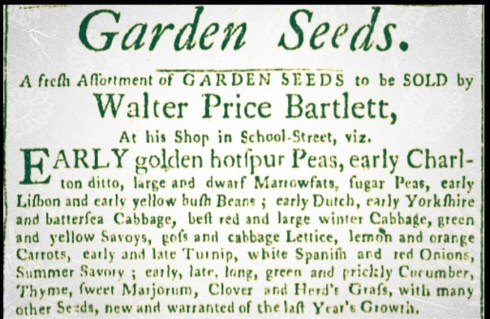
Going back a bit: because of course I’ve got to delve into the history of the seed packet, which seems to be an eighteenth-century innovation here in the United States. It is tied to, and illustrative of, the emergence and development of a commercial retail market for gardening supplies. Usually the D. Landreth Seed Company, founded in 1784 in Philadelphia by brothers David and Cuthbert Landreth and still very much in business, is given credit for the first seed packets, but a few years ago some packets were found in the eaves of the eighteenth-century Woodlands Mansion just up the river from the famous Bartram’s Garden in Philadelphia (clearly a horticultural nexus): whether they were for storage or sale is unclear. There were several seed shops in Salem in the mid and later 18th century, like Mr. Bartlett’s below, but I have no idea how they sold their seeds: perhaps people just came in and grabbed a handful? In any case, moving forward into the nineteenth century, there is no doubt that the entrepreneurial Shaker colonies were pioneers in the mail-order seed trade, to which many plain “papers,” or packets testify.

Essex Gazette 27 April 1773; Shaker, Landreth & Woodlands seed packets.


Candy Land

In my sweetest dreams Salem is Candy Land rather than Witch City, and it certainly has the heritage to claim that title (although Candy Land was a Milton Bradley game rather than a Parker Brothers production.) There are of course the famous Gibralters and Black Jacks, still sold at the Ye Olde Pepper Candy Company on Derby Street, America’s oldest candy company. Mrs. Spencer sold her hard candy from a horse-driven carriage, and her primary competition seems to have been the stationary confectioner John Simon, whose shop was stocked with a variety of syrups and sweets, everything from anise drops to peppermint. He was always announcing his “removal” to Boston but somehow never made the move. Before the later nineteenth century, however, most confectionary item were not sold by single confectioners, but rather by grocers and apothecaries, and their lists of available sweets became longer and longer with every decade. Nourse’s Fruit Store on Washington Street sold “calves foot jelly candy, strawberry jelly candy, sherbet candy, gum jelly drops, and “East India Red Rock Candy” and all sorts of candies made with the New England’s favorite ingredient, molasses. Confections got a bit softer in the later nineteenth century, when cream candies became popular, and then comes Chocolate!
The Theodore Metcalf Company, one of Boston’s most successful apothecaries, published a beautiful pamphlet on gibralters and black jacks but these were SALEM candies; Nourse’s advertisement, Salem Observer 4 November 1865; Trade cards illustrate the softer trend in confectionary consumption.

The decline of hard candy and the rise of chocolate seems to be a major trend, but candy customers still loved variety. The most successful, and very long-running, confectionary business in twentieth-century Salem was the “Palace of Sweets” on Essex Street, from which the Moustakis Brothers sold their “mastermade” (a patented term) confections. This business was in operation from 1905 until 1968, and after the Taft Summer White House in Beverly placed a series of larger orders it received—and marketed—the presidential seal of approval.

Moustakis Brothers’ Menu from the digital archives of the Culinary Institute of Technology.

Salem is still candy central, in fact two confectionary shops opened up just this past year: Curly Girl Candy Shop on Washington Street and the Chocolate Pantry on Derby, not far from Ye Olde Pepper Candy Company further down the street. And then there is the venerable and amazing Harbor Sweets, the manufacturers of my very favorite candy, Sweet Sloops. I don’t even really have a sweet tooth, and if I am going to indulge I prefer jelly beans to chocolates, but bring a box of Sweet Sloops into the house and I will not rest until they are gone!

The House of the Seven Gables and Ye Olde Pepper Candy Company sponsored the ice sculpture of Mrs. Spencer’s horse and carriage for the Salem’s So Sweet festival this past weekend: its position made it difficult to photograph but it’s much bigger than it appears in this photo! My beloved Sweet Sloops, available at Harbor Sweets on Leavitt Street in Salem as well as lots of other retailers.


Hudson River Valley Highlights

I’m just back from almost two weeks staying at my brother’s house in Rhinebeck, New York, right in the middle of the Hudson River Valley. I’ve seen a lot, and have many beautiful photographs to upload here, but I’m not quite sure how to curate them: no theme is emerging other than wow, there’s so much here. I’ve been to this region quite a bit over the past few decades, and I thought I knew it, but this longer stay has convinced me that I do not, really. You know I’m not really interested in nature (apart from its harnessing) so it’s not about the River for me, it’s about the houses and the towns, the built environment. Do I organize my hundreds of photos of structures and streetscapes by family (the Livingstons are everywhere), by chronology, by origin (Dutch vs. English), by size (the two cities of Kingston and Hudson on the west and eastern sides, surrounded by smaller towns and “hamlets” and the larger cities of Poughkeepsie and Tarrytown to the south), or by style? Mansions or private residences? Shops, or more particularly, shop windows (which seem to be curated here to a level we haven’t seen in Salem since the 1950s)? One theme which might work is that of stewardship, which I always think about when I’m in the midst of a region as architecturally and institutionally rich as this valley, but that will take some work and as I have officially entered the last week before classes that means I have SYLLABI looming: better stick to highlights!

Mansions and Cottages:

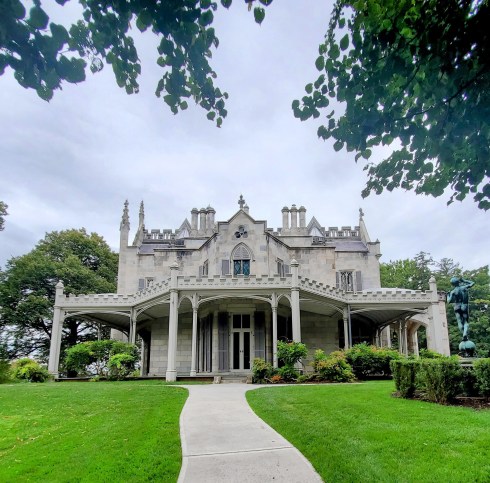
The stunning Lyndhurst Mansion in Tarrytown, designed by Alexander Jackson Davis for the Paulding and Merritt families over several decades beginning in 1838 and later acquired by Jay Gould, whose daughter left it to the National Trust for Historic Preservation; neighboring Sunnyside, the home of Washington Irving; Wilderstein in Rhinebeck and a detail from its stables; Montgomery Place and its stables, now the property of Bard College.


A Decayed Mansion with much potential: The Point, or Hoyt House, at the Mills Mansion/Staatsburg State Historic Site, Hyde Park.

There are several impressive structures on the vast riverfront acreage of the Staatsburg State Historic Site, including the Classically columned Mills Mansion, but I only had eyes for the Hoyt House on my hike. Designed by Calvert Vaux before his Central Park partnership with Olmsted, it just looks perfect, despite its decay (or maybe because of it?) The Calvert Vaux Preservation Alliance, of which my brother-in-law Brian is a director, is raising funds for the Hoyt House’s restoration and potential repurposing as a center of traditional craftsmanship training—talk about stewardship! I’m wondering if this cottage on the main road outside of the park is tied to the estate, as well as this adjacent entrance?


Alexander Jackson Davis’s furniture: almost everything is arched.

Chairs, beds, mirrors, even tables, so there is no “head” of the table: all at Lyndhurst.


Private residences: both vernacular and very high style—-all sorts of styles.

A Foxhollow Farm cottage, more contemporary board and batten, and two houses in Claverack to the north (I spent a lovely hour or so inside the white brick Hillstead, at the gracious invitation of Bruch Shostok and Craig Fitt); all sorts of restorations going on in Hudson; the lighthouse at the entrance to Kingston’s harbor.


And shopping! Mostly at Hudson, a bit at Kingston (Grounded) lured in by creative shop windows (which we need more of in Salem). History was in the windows too.


Christmas Suffragist Style

A great friend gave me the lovely gift of a Suffragist ornament the other day: I prominently placed it on my tree and went out to look for more. We were going to have no ornaments this year, just lights (actually, I didn’t even want a tree, or lights, but my husband did), and there is no way I was not going to put that lady on my tree and she needed company. It seems appropriate to go out of this year the same way I went in, in the company of Suffragists. I’m sorry that the ladies did not get their due in this challenging year, but I certainly learned a lot about the Suffragists in general and Salem women in particular on all these #SalemSuffrageSaturdays: two more to go! One thing I learned about the Suffrage movement in general, in both the United States and Britain, is how sophisticated it was in terms of visual messaging: the colors, the images, the products. Everything they produced or inspired still looks good.

Suffragist Christmas Ornaments (+ Joan of Arc, a very important Suffragist symbol herself) fron the Peabody Essex Museum Shop and RosieCentral .


Christmas cards from the Museum of London and the Ann Lewis Suffrage Collection (a great resource!)


Tea Towels from the Radical Tea Towel Co.