For International Women’s Day today, I thought I would put together a walking tour of Salem women’s history. Of course, every street and every building in Salem has traces of women’s history, most of it hidden from us. I would like to include more than “notable” women on my tour, and I think I’ve busted out that category a bit, but there’s still a lot of work to do and a lot more to learn. I decided to limit the tour to existing buildings, so it definitely skews towards the nineteenth and twentieth centuries. I read revews of Salem walking tours occasionally, mostly because I want some sign of hope that Salem tourists are interested in topics other than the Salem Witch Trials, and that’s the number one complaint: we stood on the sidewalk looking at a parking lot. If they were interested in something other than the Salem Witch Trials, they would no doubt see more buildings and places than parking lots. So my tour is all about buildings, and the women who lived in them. Beware if you want to do it yourself: it’s a long tour—I easily got in my 10,000 steps!
We’re starting on Derby Street, right next to the Custom House, at 1) The Brookhouse Home for Aged Women. Not only is this a McIntire building and an early (1861) example of a privately-established residential home for senior women, but it was also the home of Massachusetts congressman and Secretary of the Navy Benjamin W. Crowninshield, whose wife Mary was quite the Washington socialite: her letters are very revealing about the social scene during the administrations of Presidents Madison and Monroe in general and Dolley Madison in particular. Mary Crowninshield spared no detail, either of drapery or dress trimmings.

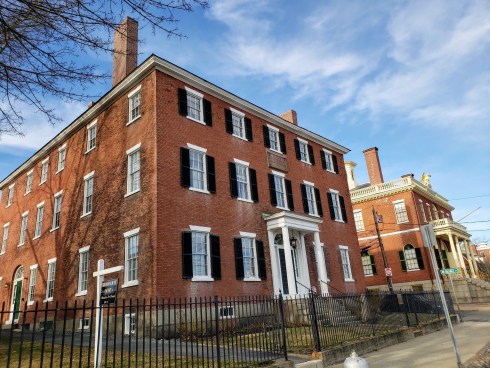
Then it’s on to another impressive brick Federal house turned social institution, 2) the Woman’s Friends Society on Hawthorne Boulevard. Founded in 1876 as a residence and employment “bureau” for younger women, the Society acquired its impressive brick double house from Salem’s famed philanthropist Captain John Bertram and his daughter Jennie (Bertram) Emmerton, the mother of Caroline Emmerton of House of the Seven Gables fame. So it is the Emmerton House, and it continues in its original mission. Lots of women’s stories to tell here, as it also became a center for social work, craft eduction, and public health initiatives.

We walk westerly on Charter Street until we come to the so-called 3) Grimshawe House where the famous Peabody sisters lived and where Nathaniel Hawthorne courted his future wife, Sophia. This house was built around 177o and educators Elizabeth and Mary lived here between 1835-1841 with said Sophia, their parents and brother. It has been in decline for most of the second half of the twentieth century, serving as a eerie gray neighbor of the Charter Street cemetery, but last year signs of restoration (and color) appeared.

Now we’re walking towards the McIntire Historic District along Front and Norman Streets and then we’re on Chestnut. There are quite few houses on this street worth noting in relation to women’s history, but I limited myself to 4) Mrs. Parker’s house at #8, 5) Hamilton Hall; 6) the Phillips House, and 7) a Caroline Emmerton-commisioned house. My neighbors just across the street live in the beautiful house occupied by Mary Saltonstall Parker, an author and artist at the turn of the last center. Mrs. Parker loved traditional crafts and antiques and wrote about both in a succession of small books which reflect the Colonial Revival movement, but she was also a “maker” herself and one of her embroidered samplers was on the cover of House Beautiful in 1915. Hamilton Hall is a veritable monument to women’s history, including the work of the Remond family, all those festive fundraising fairs in the nineteenth century, debutante assemblies and the lecture series sponsored by the Ladies Committee in the twentieth. And schools! Dancing schools and “dame schools,” including that of Lucy Stone in the 1880s below. I certainly learned a lot about a variety of women working at the Phillips House this past summer, including ladies of the Phillips family and their staff, but I wanted to spotlight this house at was also the home of Caroline Howard King, the author of one of the most popular (and literary) Salem memoirs, When I lived in Salem. Before the house was the Phillips House, it was actually a genteel boarding house, and Caroline lived there from the 1890s until her death in 1907, I believe. The last house below is Caroline Emmerton’s commissioned copy of the Derby House by architect William Rantoul: it completes the street.


Over on Essex Street, we stop at the venerable 8) David Mason House. Notable for its namesake occupant’s role in Leslie’s Retreat in 1775, more than a century later it was purchased and restored by the prolific author and suffragist Grace Atkinson Oliver, who also served as a member of Salem’s School Board. Across the street is the 9) Quaker Cemetery, where one can reflect on the persecution of Salem’s Quakers in the seventeenth century, including Cassandra Southwick and her daughter Provided. Further down the street towards downtown are 10) the Cabot-Endicott-Low House, childhood home of Salem’s only “dollar princess,” Mary Endicott Chamberlain Carnegie, pictured below just before she presented her stepdaughters to Queen Victoria, of whom she was reportedly a favorite, 11) Caroline Emmerton’s stately house and 12) that of Susan Osgood, another preservationist of sorts, who was the niece of Salem’s first, Joseph Barlow Felt, who was married to Abigail Adams’ niece, also named Abigail. Because the Felts had no children, a lot of her aunt’s things ended up with Susan, including items that Abigail Felt inherited from HER aunt Abigail Adams. Susan donated Abigail’s Inauguration dress (+ slippers!!!) to the Smithsonian Institution, where they reside in the First Ladies exhibit.


Through the Ropes Garden and over to Federal Street and the 13) home of Salem’s first female physician, Dr. Sarah Sherman. She was an amazing woman, who was also elected to the School Board in 1879, the first “school suffrage” election in Salem. Then we will walk towards downtown, cross North Street, and visit two Lynde Street houses, home to two accomplished Marys. First up is the 14) house of Mary Bradford Hagar, who served as the chair of the Salem Ladies Centennial Committee in the 1870s, which organized Salem”s exhibits for the Centennial Exhibition of 1876. Her committee did such a great job that it won national acclaim, and 100 years later in 1975, the Essex Institute mounted a re-exhibition. Next is the 15) house of Mary Harrod Northend, the prolific author of everything “Old Salem” in the early twentieth century. A very Colonial Revival street!


Salem walking tours always stop at the 16) Lyceum Building, now Turner’s Seafood Restaurant, on Church Street as it was supposedly the site of the first Witch Trial victim Bridget Bishop’s orchards, but I would include it on my tour because it was the site of so many meetings of Salem’s Suffrage Society from the 1870s on. I’m cheating a bit here as the present Lyceum building was not the one in which Salem’s Suffragists met: there was an earlier wooden structure on the same site. Like so many sites in central Salem, it is historic in more ways than one. Walking towards the Common, I think I would stop at the Peabody Essex Museum’s 17) Bray House, because it is so cute and also because Salem’s most successful commercial artist, Sarah Symonds, had a workship and retail space there.


I want to include at least one house on Washington Square on my tour, so I think I’m going with the present-day 18) Bertram House. What does this former home for aged men and current assisted living facility for both genders have to do with women’s history? My link is another Endicott and preservationist, Clara Endicott Sears (contemporary and cousin of Mary Endicott), who wrote a charming childhood memoir of life in this house with her grandparents entitled Early personal reminiscences in the old George Peabody mansion in Salem, Massachusetts (1956). The Bertram House overlooks the Common, where a grand historical pageant was present for the Salem Tercentenary in July of 1926: its author was Nellie Stearns Messer, who lived at 19) 15 Oliver Street, pictured just below. By all accounts that I have read and heard, she seems to have been a very active mid-century public historian, before that term was used. In addition to the Tercentenary pageant, she also wrote very substantive histories of the Tabernacle Church and Ropes House. We then walk northward towards Pleasant Street, and the 20) home of one of Salem’s most notable entrepreneurs, Charlotte Fairfield. Charlotte ran a coal company that undercut Salem’s coal cartel in the first decade of the twentieth century, and received lots of attention in the Boston papers for doing so. Independent indeed.


For the last leg of the tour we’re going to swing over to Pickman Street to see the building which houses the 21) Esther C. Mack Industrial School for Girls from the 1890s through the 1920s. Established by a large bequest in the will of its namesake, the school taught what we would call domestic rather than “industrial” skills, mostly sewing and cooking, to young girls and had quite a few collaborations with the Woman’s Friend Society. The photograph below, by Mary Harrod Northend, is of a sewing class. So many progressive women in Salem at this time: I haven’t even touched on the House of the Seven Gables except for showcasing several properties associated with its founder, Caroline Emmerton, or any of the public health and cultural initiatives of this era. This is why I get more than a little frustrated with the continuing almost-exclusive focus on 1692 in this city: it excludes so much history in general, and so much women’s history in particular. But we’ve walked enough for one tour, so I propose crossing the Common, perhaps taking a peak and the 22) birthplace of prominent Salem artist Fidelia Bridges, and then popping into the tavern at the Hawthorne Hotel for a drink, and a toast to the ladies.


Map made by John Northey for the Bicentennial in 1976: as you can see, there’s a lot more land to cover.
Like this:
Like Loading...



 I don’t know what Dorothy Talby looked like: I’m making “silhouettes” from contemporary sources to depict the women I’m featuring on social media this month and I’m sure several will end up here. There’s a real picture problem with pre-modern women: either they are not pictured at all or they are pictured by romanticized images from the last century or so. I used one of Wenceslaus Hollar’s wonderful images from the collection at the University of Toronto for Dorothy’s “silhouette”.
 A more radical intervention of the age: itinerant surgeon extracting stones from a woman’s head; symbolising the removal of her ‘folly’ (insanity). Line engraving after N. Weydtmans after himself, 17th century. Wellcome Collection.


 Historical artist Peter Waddell’s
 Peter Waddell’s recreation of one of Dolley Madison’s “Wednesday Squeezes” with many turbans and feathers in evidence, White House Historical Association; the capture and burning of Washington in 1814, New York Historical Society. Mrs. Madison continued to be an active hostess in her temporary quarters, which Mrs. Crowninshield tells us all about, but she does not have much to say about the post-war state of Washington.






