Tag Archives: Salem Witch Museum

Salem in the Press, 2023 Halloween Edition

Since I’ve been living outside of Salem for the past month, only coming in for classes and shooting right back to Maine on my (not-so) secret routes, I followed the press coverage on seasonal tourism a bit more closely than in years past. I set up a google alert and got notifications nearly every day. There are always a lot of what I would call obligatory articles about Salem at this time of year focusing on crowds and traffic but it struck me that in this particularly year the coverage was a bit more negative, though as you know, I’m not a Haunted Happenings fan, so I could have been reading what I wanted to read. I will be the first to admit extreme bias in this realm, but I tried to read every article which came my way several times, and there was definitely an underlying tension in several, between the “success” of Salem’s tourism and its costs, whether they were traffic, trash, or exorbitant short-term rentals. For me, the tone seemed to be set in late August, when the Salem Witch Museum was identified by as the #2 tourist trap in the entire world by USA Today: this generated more stories in the regional press, concluding with the recent “visit” of the Boston Globe to the “Museum.” This article is not especially probing in its exploration of either a for or against position on the attraction’s rating, and gives a rather blase tourist the last word: “you have to expect it to be a tourist trap. It’s Salem in October. Isn’t that kind of the whole point?” Indeed.  The Globe featured a stronger, more focused article in mid-October on the skyrocketing prices of Salem airbnbs, which was no surprise to anyone who lives in Salem. They’re everywhere, even though municipal regulations attempted to limit their number a few years back. The article quoted Mayor Dominick Pangallo as asserting that there are “250 t0 300 airbnbs” in Salem, while the rental website listed considerably more units in October.

Of course the victims of 1692 were NOT witches, but Airbnb puts a special focus on “haunted” or themed Salem rentals in October, like this one featuring a “100% that witch” bedroom./Airbnb

This year’s offering from the Washington Post is longer than the Globe pieces, but nevertheless manages to say very little. I don’t understand its title, “Salem bet big on spooky season. Now witch girlies are everywhere,” nor do I discern anything close to a theme or thesis. It’s all over the place with lots of quotes from locals, including my colleague, the president of our preservation organization, and several Salem shopkeepers. But none of the quotes seem to have much context, including one which made me see red after (apparently) confining twentieth-century Salem to the simplistic characterization of a “horrible factory town.” This is the tourist industry’s party line: witchcraft tourism saved Salem. After a summer of reading and writing about the past century for our book, I just can’t stand to hear it anymore–it erases the hopes, dreams, activities and achievements of generations. It’s a falsehood, but also a quote out of context according those who offered this characterization. So now I’m wondering what it, and the entire article, means. I can tell that my colleague is presenting an argument here—about the balance of history and entertainment, the need to discern the authentic from the fake, and tourism’s toll on Salem’s residents, but his quotes are so strung out that I couldn’t quite grasp it–and I know him! And then there are the captions, like the one for the photo below: “people dress up in Salem in late October.”  Wow, really? I have news for you, Washington Post, people dress up in Salem in late July.

Washington Post

The Wall Street Journal’s Salem story, “Living in the Middle of Halloween Central is Not Wicked Fun,” is much tighter and much better. And as you can tell from its title, more negative with its focus on the experience of residents. It’s far more historical in its analysis of how Salem evolved from shame to exploitation in its attitude to the trials, with one Salem tour guide furnishing a very interesting anecdote about Southern slaveholders taunting Salem abolitionists for “burning their grandmothers” and yet another referencing Joey Buttafuoco and Amy Fisher (the spectrum of Salem tour guides never ceases to amaze). And then there is the suggestion of a Florida (of course) tourist, who wants to see “a life-size wooden replica of the gallows where they hung the witches,” in order to “give a real sence of how intense it must have been.” A wary Salem social worker worries that “we’re commercializing a tragedy” and yes, her use of the word “we’re” is spot on: Salem’s exploitative and ever-encroaching tourism not only impacts but also reflects upon all of its residents. The WSJ article was my pick of the litter until a late-season entry appeared on my screen just two days ago: “Salem’s Unholy Bargain” by Lex Pryor, a writer for the sports and popular culture website The Ringer. A BRILLIANT writer: just read this one paragraph, and you’ll be hooked, like me:

It is awesome, financially beneficial, and out of control. In Salem, Halloween is a monthslong beast with an unquenchable appetite. It gobbles late-summer weekends and the first-of-winter snows. There are people who welcome it and people who flee it, but everyone feels it. And though by lineage this creation is at best rarely theirs, by geography and the inalterable stain of days gone by, they are full inheritors of its weight. Because of history—its burdens and allure—a community is held in a periodical and self-imposed state of bedlam. Look beyond the hoopla and you’ll see in Salem a storm, age-old as it is modern, that manages to unmask the knotty, innermost contents of the place and the folks who frequent it.

And one more: a brilliant quip involving bratwursts: the morbid nature of Salem’s appeal isn’t that uncommon among travel destinations. Millions visit the Colosseum every year. Same with Hiroshima and Nagasaki. I have never been to Auschwitz, but I am wholly certain that someone is selling something like bratwursts somewhere nearby. Salem is Salem because, unlike those sites, in Salem a plurality of people come for the bratwursts. They arrive in spite of the history, and they have no shame in this.

THEY COME FOR THE BRATWURSTS! And we can’t get away.

Well I could keep quoting this brilliant piece, but you can read it for yourself: you should read it for yourself if you’re interested in what Salem has become. I was going to conclude with the New York Times’ Salem article for this year but it is quite literally so small by comparison with Mr. Pryor’s piece in its focus on the plague of nip bottles on the streets of Salem that I think I’ll just leave you with the link.

NOVEMBER 1!!!


The Aesthetics of Ancestry

I’m still simmering with anger and frustration over Salem’s “new” “Heritage” trail, confined to the downtown, anchored by commercial establishments presenting the sad tale of 1692 with pathetic mannequins which inspire laughter rather than learning, marked by a line of yellow paint applied in an egalitarian manner to both new concrete and old brick. All of my original objections are still standing, but they’ve had almost a year to fester. I’ve lost faith in so many people and institutions: city councillors, various public officials, even fellow historians and organizations which I thought were committed to the preservation and presentation of Salem’s rich heritage. I don’t see any understanding of what heritage tourism is in the realm of official or quasi-official Salem, much less any desire to follow its path. Indeed I wonder what heritage means to the people who have put together this heritage trail.

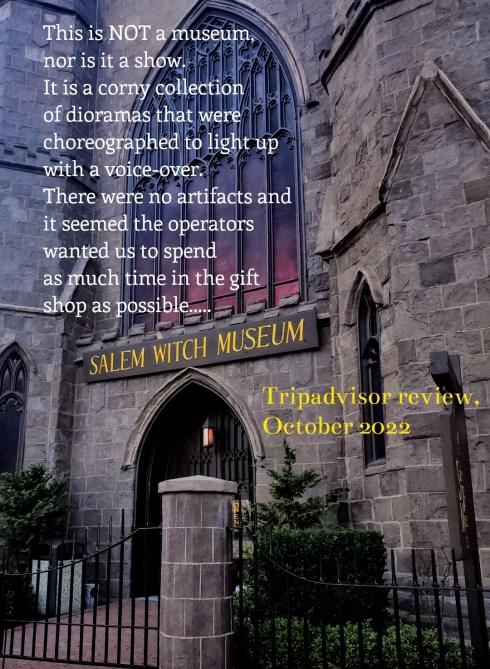
The words in the graphics above illustrate my concerns: a recent review of one of the two commercial institutions featured on the trail, the Salem Witch Museum, and some definitions of heritage by the Center for Heritage & Society at the University of Massachusetts, Amherst. I find the review to be very representative of those that the Salem Witch Museum has received, but of course, I am biased. There are certainly much better reviews, and there are also those which are substantive indictments: you can read them for yourself at the Tripadvisor site. But even many of the good reviews point out the dated nature of the presentation, the fact that the attraction is not a “Museum,” and its blatant commercialism. What is fascinating to me is that these reviews go back years (the Salem Witch Museum recently celebrated its 40th anniversary) and they are very repetitive, yet still the people keep coming and the dated dioramas endure: this is the most successful business in Salem, I believe, certainly the most successful attraction. There’s no attempt to update or improve the presentation, and why should there be? The people keep coming. But what does this institution have to do with Salem heritage and why does it have to be on the Salem Heritage Trail? The Witch Trials are certainly part of Salem’s heritage, though not, I would argue, as large a part as the City of Salem presents them to be—but that argument is certainly a lost cause! But is a dated diorama how we want to acknowlege this tragedy? Is there anything public or in any way reflective of the inclusion of the Salem Witch Museum on on the Salem Heritage Trail? The Salem Witch Museum will continue to be successful, no doubt, regardless of its inclusion on the Heritage Trail, so why can’t this one trail represent a more public and thoughtful presentation of Salem’s heritage in the fullest sense of the word? (I will never get an answer to this question)

I am not a tourism naysayer; I simply respect the past and want both Salem’s visitors and residents to experience its heritage in a layered and an engaging way. As I am writing this, I am looking up Chestnut Street as the Salem Trolley is making its way down, and I’m glad to see it. At least the tourists on board are exposed to more of Salem’s material heritage. It remains absolutely mystifying to me why the Salem Heritage Trail would not include the city’s oldest and largest Historic District, home to the Pickering House, the Phillips House, Hamilton Hall, the Salem Athenaeum, the Ropes Mansion, the Quaker Burying Ground, and streets of beautifully-preserved houses. There are no shops or restaurants or witch “attractions” over here: could that be the answer? Unfortunately the selection of paint in general, and that striking shade of yellow paint in particular, made the exclusion of residential historic districts a foregone conclusion: I know that most of my neighbors would welcome more walking tourists, but I doubt that many of them would like to see that yellow line run in front of their houses. The trolley is running past houses associated with a trio of brothers from a famous Salem family, the Bensons, and I’m wondering if the tourists on board are hearing anything about them, because I think their lives and works are representative of several important strands of Salem’s heritage. I’m sure Frank Weston Benson (residing at 14 Chestnut, 1862-1951) is getting a mention, as he was a pretty famous artist in his day, producing accessible paintings in a light-filled American Impressionist style as well as a succession of distinctive etchings primarily focused on wildfowl. His younger brother Henry (1866-1942) lived around the corner on Hamilton Street and served two terms as Salem’s mayor as well as the president of Salem’s largest business, the Naumkeag Steam Cotton Company. But I think it’s the brother between them, John Prentiss Benson (1865-1947), who is more evocative of an enduring Salem heritage, even though he seldom lived here in his adulthood (though he did design the massive and fantastic Colonial Revival mansion at 30 Chestnut Street).

A 1943 self-portrait by John Prentiss Benson and photograph of his younger self in Salem; Captain Samuel Benson of Salem as depicted by his grandson, John Prentiss Benson and Benson’s copy of “Reaper of Salem, S. Benson, Master, painted originally by Antoine Roux. All of the images and much of the text from this point on is taken from a lovely book entitled The Artistic Legacy of John Prentiss Benson, which was edited and published by the husband of Benson’s granddaughter in 2003. It’s really fabulous–with lots of family pictures and anecdotes.

I’ve never really appreciated maritime art, but I saw a painting that I really liked last week and looked at the signature: John P. Benson! I thought he was an architect by profession and an artist by hobby, but I was wrong: he had two careers, first architecture, then painting. This one painting took me down a rabbit hole of John P. Benson paintings, and I found some really lovely Salem ones, inspired by his birthplace and his heritage, primarily his descent from Captain Samuel Benson, of Reaper fame. All three Benson brothers plus their siblings grew up in an Italianate house which once faced the Common, on a site which is now the parking lot of the Hawthorne Hotel. Frank’s predisposition towards an artistic career was evident pretty early, as was John’s, but apparently there could only be one artist in the family so their father steered the latter towards the more practical architecture. He went to Paris for training, and returned to a job at the prestigious New York architectural firm McKim, Mead & White before setting up his own partnership. By all accounts, Benson had a successful architectural practice focused on the greater New York area, while living in Plainfield, New Jersey and later Flushing, New York with his wife Bessie and their four children. He retired from architecture in his later 50s and began painting full-time, primarily in his studio at a house called Willowbank in Kittery, Maine. He was prolific, and even though he had not lived in his native city since his departure for Paris, a notable number of his paintings are of Salem ships and harbor scenes.

Ship Eliza of Salem, Salem Coal Wharf, and Derby Wharf, John Prentiss Benson.

I particularly like a series of paintings which Benson produced as murals for his son Philip’s Cohasset home, entitled Salem Harbor memories. I trust that they still survive and I wish they could be on public view, because they are a perfect illustration of a family’s heritage and the endurance of a city’s heritage: it’s so interesting that these images were in the home of a man (Philip) who was not born in Salem, who never lived in Salem, but still saw Salem as part of his heritage. I’m not a fan of the witch trials vs. maritime history either/or debate as I believe that Salem’s heritage is both plus MUCH more but these maritime views are so poignant, especially in their invocation of memories which we can “enjoy, regret, and learn from” at the same time. Believe me, I know that the Benson brothers cannot compete with the suffering mannequins of the Salem Witch and Witch Dungeon Museums of the Heritage Trail. I think there are some other Chestnut Street stories that might be able to do so, but that’s not my point or my concern. If this trail was called the “Tourism Trail” or the “Witch City Trail,” I would have no concerns. But it isn’t: it’s called the Heritage Trail. So I ask my fellow Salem residents: does it represent your heritage?

A Memory of Salem Harbor, in Cohasset.


Witch City: the Film and the Moment

It seems ridiculous, but when I moved to Salem I remember being surprised at the extent of Halloween hoopla and kitsch in the city: it seemed really tacky to me but not particularly concerning. It was the early 1990s, I was still in graduate school, and frankly more wrapped up in the literature and discussion surrounding the 500th anniversary of Columbus’s landing than the 300th anniversary of the Salem witch trials. I was also much more familiar with the European witch trials, an extended crisis by which over 100,000 people were accused of witchcraft in the sixteenth and seventeenth centuries, so the Salem trials seemed like a much smaller event to me: in terms of size, extent, impact. I had visited Trier and Bamberg at the center of the witch-trial-storm in Germany, where hundreds had been executed for the “exceptional crime” in the 1580s and the 1620s: neither had transformed themselves in Witch Cities; I had spent considerable time in Essex, the county which was the most impacted by the less-intense English witch trials: no Witch Cities to be found there either. So I was surprised by Salem, even though I grew up only an hour away and had visited the Salem Witch “Museum” on a school trip (when I swear I saw the same “performance” that is playing there now). I suspect I was so bewitched by the architecture that I looked the other way!

18th century Witch Trial relief sculpture in Düsseldorf: Horst Ossinger dpa/lnw 

After several years in residence, I lost my naiveté and came to realize just how insidious witchcraft tourism was in Salem and how powerful were its purveyors. Halloween just got bigger and longer, as the city’s identity, as well as the experience of residential life, were fused with a holiday that had a very tenuous connection to the 1692 trials, whose victims were not witches. One of the effects–an unintended consequence, I’m sure– of the 1992 commemoration was to provide a rationale for the continued commercial exploitation of the trials, under the label of toleration: Salem has risen above its moment of extreme intolerance so it is perfectly ok for us to profit from it! We are not profiting we are educating! This message facilitated the Halloween steamroller perfectly and kept it rolling; it is still rolling. Salem’s children are not in schools during this pandemic, but tourists fill our streets: priorities. So obviously, I’m not a fan, but even more so than the exploitative nature of Salem’s Halloween I am bothered (and actually a little bewildered) by the lack of any public dialogue about it. There is simply no procedural opportunity for any person—resident, victim descendant, whomever—to say Hey this is wrong, or even ask to tone it down. The city puts out a questionnaire to Salem residents after every Halloween season, but all the questions are about logistics (traffic, parking, carnival): it is either assumed that everyone buys into the hellish Halloween, or the city government just doesn’t care what its residents think about it. When I look back over my long residence in Salem, I think there were only two eventful opportunities to discuss the way the city was selling itself: a brief moment prior to the placement of the Bewitched statue in Town House Square in the Spring of 2005, and the first screening of the documentary Witch City in the Spring of 1997. The more recent opportunity was extremely limited, as the Salem Redevelopment Authority (SRA) moved fairly quickly to grant permission for the statue’s placement in Salem’s most historic square in time for TV Land, its sponsor, to reap the benefits of cross-promotional advertising for the film Bewitched in June of 2005. The city of Salem was unmoved by the fact that the statue of a fictional witch would stand in close proximity to the location at which the very real victims of 1692 were condemned as witches or the appeals of those victims’ descendants in 2005, and it remains so. There was controversy over Samantha in 2005, but I remember more controversy about the debut of Witch City in 1997, but that might be just because I had a more invested view.

City of Salem advertising in the 1990s: a still from the 1997 documentary Witch City. City of Salem advertising today.

Whew! That was a long preamble to the central topic of this post: the documentary itself, and its Salem debut, prompted by its recent availability (for the first time) hereWitch City is a fast-moving, often-funny, always spot-on documentary about Salem’s escalating Halloween in the 1990s, a place and a time when “American history encounters American capitalism” (I think the latter won). It was made by several local filmmakers, Joe Cultrera, Henry Ferrini, Philip Lamy, Bob Quinn and John Stanton, and in classic documentary fashion it lets most of the participants speak for themselves: Arthur Miller and Elie Wiesel at Tercentenary events, the- then Mayor of Salem, Neil Harrington, the “official witch of Salem”, Laurie Cabot, and the owner of the Salem Witch “Museum”, Bif Michaud, among others. Mr. Michaud, of Marblehead, made an unfortunate and perplexing comment equating the Witch Trials and the Holocaust (you’ll have to hear it for yourself) in the film which leaked out, causing considerable discussion in town and the Peabody Essex Museum to cancel the Salem premiere so not to offend its neighbor. Somehow, my colleague Tad Baker and I came up with the idea that our Department might sponsor the premiere: we were new to Salem State, untenured and unconnected, but we had the encouragement and support of our senior colleague John Fox, who had worked with Joe Cultrera on an earlier film, Leather Soul. And so that’s what happened: the History Department sponsored the Salem premiere of Witch City at Hamilton Hall of all places: I remember the tech people laying wires all day long in the Hall but I can’t recall why we didn’t have it at the university! The show was sold out, the Hall was packed, and we had a great panel featuring Tad and Danvers Archivist Richard Trask, now both acknowledged as THE authorities on the Trials. There was lively discussion, and I remember thinking: we can talk about this, we will talk about this when it was over. Witch City went on to be screened at the Immaculate Conception church and eventually on our local PBS station, WGBH, but unfortunately the Hamilton Hall premiere was not the beginning of a sustained public dialogue about Halloween in Salem, but rather just one brief shining moment.

Boston Globe piece on the premiere by Anne Driscoll, a Salem Award winner 20 years later.

You can rent, stream, or download Witch City here.