Tag Archives: Quakers

A Salem Women’s History Tour

For International Women’s Day today, I thought I would put together a walking tour of Salem women’s history. Of course, every street and every building in Salem has traces of women’s history, most of it hidden from us. I would like to include more than “notable” women on my tour, and I think I’ve busted out that category a bit, but there’s still a lot of work to do and a lot more to learn. I decided to limit the tour to existing buildings, so it definitely skews towards the nineteenth and twentieth centuries. I read revews of Salem walking tours occasionally, mostly because I want some sign of hope that Salem tourists are interested in topics other than the Salem Witch Trials, and that’s the number one complaint: we stood on the sidewalk looking at a parking lot. If they were interested in something other than the Salem Witch Trials, they would no doubt see more buildings and places than parking lots. So my tour is all about buildings, and the women who lived in them. Beware if you want to do it yourself: it’s a long tour—I easily got in my 10,000 steps!

We’re starting on Derby Street, right next to the Custom House, at 1) The Brookhouse Home for Aged Women. Not only is this a McIntire building and an early (1861) example of a privately-established residential home for senior women, but it was also the home of Massachusetts congressman and Secretary of the Navy Benjamin W. Crowninshield, whose wife Mary was quite the Washington socialite: her letters are very revealing about the social scene during the administrations of Presidents Madison and Monroe in general and Dolley Madison in particular. Mary Crowninshield spared no detail, either of drapery or dress trimmings.

Then it’s on to another impressive brick Federal house turned social institution, 2) the Woman’s Friends Society on Hawthorne Boulevard. Founded in 1876 as a residence and employment “bureau” for younger women, the Society acquired its impressive brick double house from Salem’s famed philanthropist Captain John Bertram and his daughter Jennie (Bertram) Emmerton, the mother of Caroline Emmerton of House of the Seven Gables fame. So it is the Emmerton House, and it continues in its original mission. Lots of women’s stories to tell here, as it also became a center for social work, craft eduction, and public health initiatives.

We walk westerly on Charter Street until we come to the so-called 3) Grimshawe House where the famous Peabody sisters lived and where Nathaniel Hawthorne courted his future wife, Sophia. This house was built around 177o and educators Elizabeth and Mary lived here between 1835-1841 with said Sophia, their parents and brother. It has been in decline for most of the second half of the twentieth century, serving as a eerie gray neighbor of the Charter Street cemetery, but last year signs of restoration (and color) appeared.

Now we’re walking towards the McIntire Historic District along Front and Norman Streets and then we’re on Chestnut. There are quite few houses on this street worth noting in relation to women’s history, but I limited myself to 4) Mrs. Parker’s house at #8, 5) Hamilton Hall; 6) the Phillips House, and 7) a Caroline Emmerton-commisioned house. My neighbors just across the street live in the beautiful house occupied by Mary Saltonstall Parker, an author and artist at the turn of the last center. Mrs. Parker loved traditional crafts and antiques and wrote about both in a succession of small books which reflect the Colonial Revival movement, but she was also a “maker” herself and one of her embroidered samplers was on the cover of House Beautiful in 1915. Hamilton Hall is a veritable monument to women’s history, including the work of the Remond family, all those festive fundraising fairs in the nineteenth century, debutante assemblies and the lecture series sponsored by the Ladies Committee in the twentieth. And schools! Dancing schools and “dame schools,” including that of Lucy Stone in the 1880s below. I certainly learned a lot about a variety of women working at the Phillips House this past summer, including ladies of the Phillips family and their staff, but I wanted to spotlight this house at was also the home of Caroline Howard King, the author of one of the most popular (and literary) Salem memoirs, When I lived in Salem. Before the house was the Phillips House, it was actually a genteel boarding house, and Caroline lived there from the 1890s until her death in 1907, I believe. The last house below is Caroline Emmerton’s commissioned copy of the Derby House by architect William Rantoul: it completes the street.

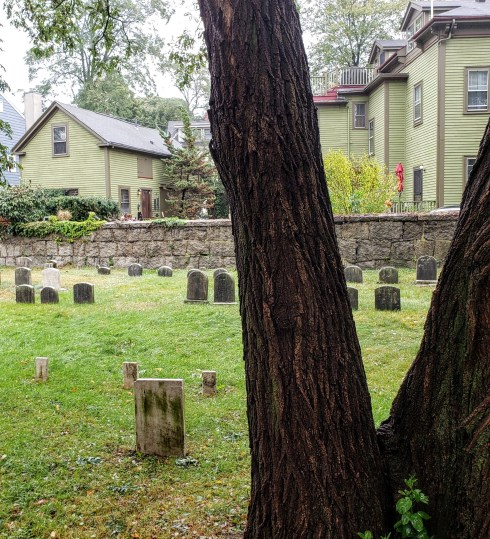
Over on Essex Street, we stop at the venerable 8) David Mason House⁠. Notable for its namesake occupant’s role in Leslie’s Retreat in 1775, more than a century later it was purchased and restored by the prolific author and suffragist Grace Atkinson Oliver, who also served as a member of Salem’s School Board. Across the street is the 9) Quaker Cemetery, where one can reflect on the persecution of Salem’s Quakers in the seventeenth century, including Cassandra Southwick and her daughter Provided. Further down the street towards downtown are 10) the Cabot-Endicott-Low House, childhood home of Salem’s only “dollar princess,” Mary Endicott Chamberlain Carnegie, pictured below just before she presented her stepdaughters to Queen Victoria, of whom she was reportedly a favorite, 11) Caroline Emmerton’s stately house and 12) that of Susan Osgood, another preservationist of sorts, who was the niece of Salem’s first, Joseph Barlow Felt, who was married to Abigail Adams’ niece, also named Abigail. Because the Felts had no children, a lot of her aunt’s things ended up with Susan, including items that Abigail Felt inherited from HER aunt Abigail Adams. Susan donated Abigail’s Inauguration dress (+ slippers!!!) to the Smithsonian Institution, where they reside in the First Ladies exhibit.

Through the Ropes Garden and over to Federal Street and the 13) home of Salem’s first female physician, Dr. Sarah Sherman. She was an amazing woman, who was also elected to the School Board in 1879, the first “school suffrage” election in Salem. Then we will walk towards downtown, cross North Street, and visit two Lynde Street houses, home to two accomplished Marys. First up is the 14) house of Mary Bradford Hagar, who served as the chair of the Salem Ladies Centennial Committee in the 1870s, which organized Salem”s exhibits for the Centennial Exhibition of 1876. Her committee did such a great job that it won national acclaim, and 100 years later in 1975, the Essex Institute mounted a re-exhibition. Next is the 15) house of Mary Harrod Northend, the prolific author of everything “Old Salem” in the early twentieth century. A very Colonial Revival street!

Salem walking tours always stop at the 16) Lyceum Building, now Turner’s Seafood Restaurant, on Church Street as it was supposedly the site of the first Witch Trial victim Bridget Bishop’s orchards, but I would include it on my tour because it was the site of so many meetings of Salem’s Suffrage Society from the 1870s on. I’m cheating a bit here as the present Lyceum building was not the one in which Salem’s Suffragists met: there was an earlier wooden structure on the same site. Like so many sites in central Salem, it is historic in more ways than one. Walking towards the Common, I think I would stop at the Peabody Essex Museum’s 17) Bray House, because it is so cute and also because Salem’s most successful commercial artist, Sarah Symonds, had a workship and retail space there.

I want to include at least one house on Washington Square on my tour, so I think I’m going with the present-day 18) Bertram House. What does this former home for aged men and current assisted living facility for both genders have to do with women’s history? My link is another Endicott and preservationist, Clara Endicott Sears (contemporary and cousin of Mary Endicott), who wrote a charming childhood memoir of life in this house with her grandparents entitled Early personal reminiscences in the old George Peabody mansion in Salem, Massachusetts (1956). The Bertram House overlooks the Common, where a grand historical pageant was present for the Salem Tercentenary in July of 1926: its author was Nellie Stearns Messer, who lived at 19) 15 Oliver Street, pictured just below. By all accounts that I have read and heard, she seems to have been a very active mid-century public historian, before that term was used. In addition to the Tercentenary pageant, she also wrote very substantive histories of the Tabernacle Church and Ropes House. We then walk northward towards Pleasant Street, and the 20) home of one of Salem’s most notable entrepreneurs, Charlotte Fairfield. Charlotte ran a coal company that undercut Salem’s coal cartel in the first decade of the twentieth century, and received lots of attention in the Boston papers for doing so. Independent indeed.

For the last leg of the tour we’re going to swing over to Pickman Street to see the building which houses the 21) Esther C. Mack Industrial School for Girls from the 1890s through the 1920s. Established by a large bequest in the will of its namesake, the school taught what we would call domestic rather than “industrial” skills, mostly sewing and cooking, to young girls and had quite a few collaborations with the Woman’s Friend Society. The photograph below, by Mary Harrod Northend, is of a sewing class. So many progressive women in Salem at this time: I haven’t even touched on the House of the Seven Gables except for showcasing several properties associated with its founder, Caroline Emmerton, or any of the public health and cultural initiatives of this era. This is why I get more than a little frustrated with the continuing almost-exclusive focus on 1692 in this city: it excludes so much history in general, and so much women’s history in particular. But we’ve walked enough for one tour, so I propose crossing the Common, perhaps taking a peak and the 22) birthplace of prominent Salem artist Fidelia Bridges, and then popping into the tavern at the Hawthorne Hotel for a drink, and a toast to the ladies.

Map made by John Northey for the Bicentennial in 1976: as you can see, there’s a lot more land to cover.


It Happened in Town House Square

I didn’t expect to be posting on Salem for a while as I’m on my way to Maine to escape the Halloween Hordes (haven’t quite broken away yet!) but I’m in the midst of writing the last chapter for Salem’s Centuries and I thought posting would help. It’s why I started this blog in the first place, so long ago, to indulge my curiosity about Salem’s lost history and free up my writing from its academic constraints! This last chapter is on the long history of Salem’s center, Town House Square, and I’m just kind of enraptured with everything that happened there, but also haven’t figured out the meaning of it all. I’m trying to use the chapter to summarize the book Salem’s Centuries and also Salem’s centuries by using the Square as kind of a “stage” (at least that’s the word I’m using now). So this will be kind of a sketchy post as it is a work in progress and I welcome all comments and corrections.

I’m happy with my opening paragraph:

A crowd filled Town House Square on a sunny day in June of 2005, cheering and jeering the unveiling of a bronze statue of the actress Elizabeth Montgomery in character as Samantha Stevens of the television series Bewitched. The rationale for the statue was the filming of a few episodes of the series in Salem in 1970, commencing a successful intensification of witchcraft-focused tourism in the view of those who cheered, while less-enthusiastic attendees noted the impropriety of installing a fictitious witch within view of the sites where the victims of 1692 were accused and tried. The Reverend Jeffrey Barz-Snell, 31st pastor of the First Church of Salem, which stood across the street for centuries, was among those who had urged the Salem Redevelopment Authority to reject the statue weeks before“in due deference to our history”and its location: “we must object to this statue being sponsored by the city of Salem, less than twenty yards away from site where we committed, arguably, one of the worst…..crimes in the history of this city.” This argument was countered by the majority opinion, expressed succinctly by Salem City Councilor Thomas Furey: “Salem is the Witch City. I think we all need to lighten up, take a breath, and let Salem have fun.” This moment in time and place is representative of the continuous significance of a small parcel of land, more of an intersection than a square, over Salem’s centuries. The crowd, the expression of civic identity, representations of church, state and commerce: all have had their role to play in Town House Square.

Then I go back to the seventeenth century and start with the English settlement of Salem from 1626, including a brief discussion of how the topography shaped the town and its center at the intersections of its two main thoroughfares, later called Essex and Washington Streets. This became known as Town House Square in the 18th century, and that’s still its place-name, although I wonder how many Salem residents (much less tourists) know it as such today. Then it’s all about meeting houses—-four on the same site: it really took a lot of time to figure out all that building history. First there was a small meeting house built in 1634 which was long thought to be the small building you can see in the rear of Plummer Hall on the Peabody Essex Museum’s campus, a larger though still quite simple structure built around 1670, the first “churchly” meeting house with a belfry, built in 1718, and finally the present building (1826) which long served as the Daniel Low & Co. store after the First Church departed to its present building further along Essex Street. Salem’s meeting houses are confusing, both before and after the First Church splits up into successor congregations: East, North, South and Tabernacle. Thank goodness I don’t have to go into the theological and factional disputes: I’m sticking to Town House Square.

So, once I set the stage, action will begin: here’s what happened in Town House Square, with an emphasis on the public. Obviously lots of other things happened in this vicinity over 400 years but why do some leave a mark or record and others not? And do the happenings in the Square reveal its public nature and role? Just questions I’m asking myself as I am writing.

  1. Lots of Quaker resistance: holding their own meetings right next to the First Church/Meeting House, wearing their hats into the latter, and then in 1662, Quaker Deborah Buffum Wilson, accompanied by her mother and half-sister, walked “naked for a sign” down Washington Street in imitation of an Old Testament episode (Isaiah 20.2-3) and in denunciation of the spiritual “nudity” of those who condemned them. Yes, a NAKED QUAKER walked down Washington Street. This resistance was met with an equal (or larger) measure of persecution, especially by the William Hathorne, who lived right on the Square.
  2. Anti-Royalist protests: by the same William Hathorne, who as Major of the Salem Militia, assembled his armed soldiers in Town House Square for his impassioned speech against the Royal Commissioners present in Massachusetts in 1664, after which he himself was summoned to England on the charge of refusing to submit to royal authority.
  3. The Salem Witch Trials: also happened in Town House Square once the judicial proceedings moved from Salem Village to Salem Town. Close quarters! Judge John Hathorne, son of William, lived right there, as did the Reverend Nicholas Noyes, and victim Bridget Bishop. The combined courthouse/schoolhouse at the northern end of the Square, made of the framing of the 1634 meeting house, separated the properties of Noyes and Bishop, and High Sheriff George Corwin resided at the southern end of the Square.
  4. Salem’s first July 4th: came before the Revolution! There was a huge party at the Town House (sometimes called the provincial Court House, sometimes even the State House—think of the old State House in Boston) to celebrate Sir William Pepperrell, the hero of the Siege of Louisbourg, in 1746. The cannons surounding the Town House were fired after every toast, and there were many.
  5. Big Town Meeting Protests: against British taxation, commencing with the Stamp Act (1765), at the Town House. (But less than 20 years earlier they were celebrating the hero of a war they were not willing to pay for–just a British historian’s perspective.)
  6. Salem’s “Tea Party”: a crate of tea from Boston is seized and burned in Town House Square on October 4, 1774, “in the presence of several hundred spectators.”
  7. Last meeting of the Massachusetts Provincial Assembly: against the orders of Governor Thomas Gage, electing delegates to the new Provincial Congress which met in Concord on October 7, 1774.
  8. Colonel Alexander Leslie and his regiment passed through Town House Square on their way to the North River to recover rumored cannon, and back again on their retreat, February 1775.
  9. Presidential Parades: George Washinton in 1789, and Theodore Roosevelt in 1912.
  10. Salem’s “big digs”: the first railroad tunnel built in 1839, and rebuilt in the later 1950s.
  11. Nathaniel Hawthorne’s romanticized view of colonial history set against Town House Square in two stories: A Rill from the Town Pump and Endicott and the Red Cross.
  12. Town House Square Transportation Hub: trains, trolleys, and later, buses.
  13. Daniel Low & Co. established in the former fourth meeting house of the First Church, 1867. A mail order innovator, the store also issued a catalog which projected both Salem and Town House Square to the entire country.
  14. War Bond Rallies: the Square was the center of  “community chest” and war bond events during both World War I and World War II, including one which featured  fake Germans attacking during the former!
  15. Restaurant action: I think this can take me from the second half of the twentieth century into the twenty-first, from the long-running Gerber’s “Little Town Hall” restaurant through various fast-food experiments to today.
  16. And then came Samantha……back where I started. I don’t really believe in historical objectivity, but I know that I can’t even try to write about that awful statue in a balanced way, so I better close with a reprise of Reverend Barz-Snell’s and Councillor Furey’s statements.

John Smibert’s portrait of Sir William Pepperrell, Peabody Essex Museum; the “Salem Tea Party” of October 4, 1774; there are great historic placques in Town House Square but I don’t think the tourists are really interested. Where can I Get a Car?, 1894; The Story of a Store, 1926. Boy, what a devolution of opponents: from King George to Burger King. Town House Square today, or yesterday: it’s Samantha’s neighborhood.


Slavery Siege in Salem

The occupants of a house on Bryant Street in North Salem, British emigre Thomas Spencer, his wife and mother, both named Mary, and their houseguests, experienced a very scary night in late October of 1835, and I am not referencing Halloween. For this Preservation Month, the National Trust for Historic Preservation has selected the theme (or charge) of telling the full story, encouraging people across the country to dig deeper as they explore the histories of their built environment. I try to do that all the time here, as there are so many layers to Salem’s history, and this particular house is a perfect case in point: all at the same time it represents triumph over adversity, triumph over inequality, triumph over discrimination, triumph over terror, and candy. 

First the house, 17 Bryant Street, then the backstory, then the terrible night: Halloween Eve, 1835.

17 Bryant Street, the Thomas Spencer Homestead, built c. 1800. Here pictured in 1904 (Essex Institute Historical Collections), 1979, 1986 and yesterday. As the Macris inventory indicates, this Federal house has been “altered beyond recognition”.

The backstory: much as been written about the Spencers, yet there is still quite a bit of confusion about the essential facts of their lives, both in Britain and in Salem. I used some genealogical and British records to come up with my summary, but I still have questions. I think I can do better than the standard Salem tale, however, which is basically “poor shipwrecked soul (Mary Sr.) is washed up on the North Shore penniless and gifted a barrel of sugar which she transforms into a miraculous hard candy called Gibralters and sells on the front steps of the First Church and the streets of Salem from her ever-recognizable buggy (make sure to add one or more exclamation marks to the closing phrase:) which is in the collection of the PEM!!! This candy is still being made and sold in Salem, at the Ye Olde Pepper Candy Company on Derby Street near the House of the Seven Gables.

I really don’t have much to add about the candy: that seems covered. But there’s a lot more to say about the Spencers. Mary Smith (Spencer) was born in Nottinghamshire in 1759: I really don’t know how she became a Spencer. Nearly every record I tracked down seemed to confuse the “Thomas Spencer” who was supposedly her husband with the “Thomas Spencer” who actually was her son, who was born in 1792 or 1793 in Coventry. She booked passage on the New York ship Jupiter which left London in March of 1805: it hit an iceberg off Newfoundland and was shipwrecked. There were many reports in the eastern newspapers, including the Salem Register, identifying the 27 passengers who drowned, along with the captain and most of the crew, but the survivors are not named. These “persons preserved” in the Jupiter’s longboat ended up in Marblehead, and later, Salem, Mary Spencer among them. There are also newspaper reports of the charity extended to these survivors, including, the sugar that was reportedly granted to Mary Spencer by the benevolent ladies of Salem, enabling her to become the enterprising confectioner of  lore and legend.

Salem Register; the iconic image of Mrs. Spencer, from Early Personal Reminiscences in the old George Peabody mansion in Salem, Massachusetts by Clara Endicott Sears. 

I don’t think Thomas was with Mary; I believe he came over in the 1820s and eventually took over his mother’s business. He was married to Mary Robinson in England in 1817: their two sons, Franklin and John Kirby, were both born in Salem. Thomas remained in Salem, very much part of the community, until 1837, when he was bequeathed a considerable amount of property in the villages of Sturton and Bransby in Lincolnshire by the Reverend John Kirby, the namesake of his younger son. There was no “title,” as some of the Salem accounts suggest, but some very nice properties nonetheless. In various letters sent back to some of his friends in Salem, Thomas writes that he is finally doing what he always wanted to do: farming. He left his mark in Salem, however: as an entrepreneur, as part of the Quaker community, as a naturalist (a topic he spoke on regularly at the Salem Lyceum), and above all, as a abolitionist. Both Thomas and Mary R. Spencer were devoted Quakers, and a big part of the expression of their faith was an equally strong commitment to the transatlantic abolitionist cause. Thomas was one of the founders of Salem’s Anti-Slavery Society in 1834, and he and Mary attended a series of abolitionist conventions over the next few years, but the peak of their commitment to the cause was clearly their shelter and protection of their fellow English abolitionist George Thompson and his family in late October of 1835.

Salem Gazette; George Thompson in the 1830s, National Portrait Gallery.

Following the passage of the Slave Emancipation Act in 1833, which granted enslaved persons in many (but not all) of the colonies of the British Empire their freedom after a five-year period of “transition” and compensation to the slave-owners rather than those who were enslaved, British abolitionists focused on the immediate abolition of slavery in the empire—and the world. One of their most effective missionaries, George Thompson, was commissioned to undertake a series of lectures in the United States in 1834-1835 in collaboration with the American Anti-Slavery Society. It’s very clear that Thompson’s tour, or Thompson himself, was a lightening rod: while he was instrumental in inspiring the formation of more than 300 local abolitionist societies, he faced constant criticism (even in Northern newspapers) as well as threats of mob violence in all the major cities he visited, including Boston and Salem. The general criticism was along the lines of “who is this infamous foreign scoundrel who deigns to lecture the citizens of the United States on their domestic duties?” It was nativist, xenophobic, and nationalistic, with slight variations in each locale. When Thompson came to Salem on the last leg of his tour, he quite naturally stayed at the large Federal home of his countryman and fellow abolitionist Thomas Spencer, a bit removed from the city center. On the morning of October 30, this is the handbill that circulated around town: The Citizens of Salem, the friends of order, who are desirous to preserve the quiet of families, and the peace of town by driving from our society the foreign pest, who is endeavoring to agitate the country with his doctrines and to destroy the Union of State by his fanaticism, are earnestly requested to meet at the Town Hall, this afternoon, at 3 o’clock to adopt measures to effect this object. Salem, October 30, 1835. The main “measure” implemented was essentially the formation of a large mob, which surrounded Spencer’s North Salem house that very night, even though Thompson had fled. The Boston papers reported on “symptoms of violence” the next day, but Spencer was more forthcoming in a letter he wrote to one of Thompson’s sponsors, the Glasgow Ladies Auxiliary Emancipation Society.

Boston Morning Post; Thomas Spencer reports to the Glasgow Ladies Auxiliary Emancipation Society, 1835, in Three Years’ Female Anti-Slavery Effort, in Britain and America: Being a Report of the Proceedings of the Glasgow Ladies’ Auxiliary Emancipation Society.

Well obviously there’s a lot here: a mob of 400 men! The xenophobia (“one Englishman is as good as another” ) and the anti-Quaker expressions as well: shades of seventeenth-century Salem. Because of some notable abolitionist individuals and institutions like the Remonds and the Female Anti-Slavery Society, we are accustomed to thinking about Salem as a center of progressive abolitionism, but my Americanist colleagues remind me that only a small percentage (1-3%) of urban dwellers in antebellum cities identified as Abolitionists. Spencer writes about “Southerners from Boston” (which is a funny expression–do you think he means actual Southerners or did Salem people look upon Bostonians as “Southerners”?) as well as pro-Slavery men of Salem. His mother, the famous Mary Spencer, is obviously still alive, but I think she died that very year. His wife, the other Mary Spencer, has a “new-born babe” in her arms, but I can’t find any record of that child. Is it any wonder that Thomas Spencer sold everything in Salem and departed for England two years later after coming into his inheritance from the Reverend Kirby? And shouldn’t we be talking about a bit more than candy when we consider Mary and Thomas Spencer and the Salem in which they lived?

Home in Englanda special photograph of Thomas and Mary Spencer in front of their home in Bransby, Lincolnshire, in 1867 from the Sturton & Stow History Society. They both died in 1876.


Witches are Sexier than Quakers

I would really love to buy the toleration rationale that is used almost universally to justify Salem’s exploitation of the 1692 Witch Trials for commercial gain, but I have several issues. The argument goes like this:  yes, we had a terrible tragedy here in 1692, but now we owe it to civilization to spread awareness of the intolerance of that community in order to raise awareness of intolerance in our own time. If we can make money at the same time, so be it, but it’s really all about teaching tolerance. I’ve written about this before, several times, so I’m not going to belabor the point, but I think this rationale reinforces a notion among some—actually many—that the victims of 1692 were doing something that was in some way aberrant or diverse, when in fact they were just plain old pious Protestants like their neighbors and accusers. The focus on toleration is supposed to connect the past to the present, but more than anything, it privileges the present over the past. My other problem with the toleration rationale is the exclusivity of its application: only to the Witch Trials, the intolerant episode with the most income-generating potential. We seldom hear of any other moments of intense intolerance in Salem’s history: the fining, whipping, and banishment of separatists, Baptists and Quakers in the seventeenth century, the anti-Catholicism and nativism of two centuries later. Certainly the Witch Trials were dramatic, but so too was the intense persecution in Massachusetts in general and Salem in particular over a slightly longer period, from 1656-1661: just read the title pages of these two incredibly influential texts which documented it.

Quakers 2012_NYR_02622_0107_000(quakers_--_burrough_edward_a_declaration_of_the_sad_and_great_persecut)

Quakers Bishop

Edward Burrough, A Declaration of the Sad and Great Persecution and Martyrdom of the People of God, called Quakers, in New England, for the Worshiping of God (1661; Christie’s —-the whole text can be found here); George Bishop, New England judged, not by man’s, but the spirit of the Lord: and the sum sealed up of New-England’s persecutions being a brief relation of the sufferings of the people called Quakers in those parts of America from the beginning of the fifth month 1656 (the time of their first arrival at Boston from England) to the later end of the tenth month, 1660 (1661; Doyle’s—the whole text is here).

The whipping, scourging, ear-cutting, hand-burning, tongue-boring, fining, imprisonment, starvation, banishment, execution, and attempted sale into slavery of Massachusetts Quakers by the colonial authorities is documented in almost-journalistic style by Edward Burrough and George Bishop and the former’s audience with a newly-restored King Charles II in 1661 resulted in a royal cease and desist missive carried straight to Governor Endicott by Salem’s own Samuel Shattuck, exiled Quaker and father of the Samuel Shattuck who would testify against Bridget Bishop in 1692. So yes, the Quakers accused the Puritans of intolerance far ahead of anyone else, and their detailed testimony offers many opportunities to explore an emerging conception of toleration in historical perspective: we don’t have to judge because they do. Every once in a while, an historical or genealogical initiative sheds some light on Salem’s Quakers—indeed, the Quaker Burying Ground on Essex Street was adorned by a lovely sign this very summer by the City, capping off some important restoration work on some of the stones—but their story is not the official/public/commercial Salem story: that’s all about “witches”.

Quaker Meeting House

Quaker Meeting House 1832

20191012_105821

20191012_105802

20191012_105912

Quakers Grave

Much of Salem’s Quaker history is still around us: the Essex Institute reconstructed the first Quaker Meeting House in 1865 and it is still on the grounds of the PEM’s Essex Street campus (Boston Public Library photograph via Digital Commonwealth);  the c. 1832 meeting house formerly at the corner of Warren and South Pine Streets, Frank Cousins photograph from the Phillips Library Collection at Digital Commonwealth; the c. 1847 meeting house–now a dentist’s office overlooking the Friends’ Cemetery on upper Essex Street; Samuel Shattuck’s grave in the Charter Street Cemetery, Frank Cousins, c. 1890s, Phillips Library Collection at Digital Commonwealth.

Quakers can’t compete with “witches”, any more than factory workers, soldiers, inventors, poets, suffragists, educators, or statesmen or -women can: they’re just not sexy enough for a city whose “history” is primarily for sale. There was a time when I thought we could get the Bewitched statue out of Town House Square, but no more: it will certainly not be replaced by a Salem equivalent of the Boston memorial to Mary Dyer, one of the Boston Quaker “Martyrs”. The placement of a fictional television character in such a central place—just across from Salem’s original meeting house–and not, say, a memorial to Provided Southwick, whose parents were banished to Long Island, dying there in “privation and misery”, whose brother was whipped from town to town, and who would have been sold into slavery (along with another brother) near this same square if not for several tolerant Salem ship captains*, is a bit unbearable, but that’s Witch City. Apparently grass just won’t grow in this little sad space, so soon we will see the installation of artificial turf , which strikes me as completely appropriate.

Quakers Genealogy

Quakers Whittier

OLYMPUS DIGITAL CAMERA

“The Attempted Sale into Slavery of Daniel and Provided Southwick, son [children] of Lawrence and Cassandra Southwick, by Governor Endicott and his Minions, for being Quakers”, from the Genealogy of the descendants of Lawrence and Cassandra Southwick of Salem, Mass. : the original emigrants, and the ancestors of the families who have since borne his name (1881); *John Greenleaf Whittier tells Provided’s tale under Cassandra’s (more romantic?) name, and adds the “tolerant ship captains”: we only know that the sale did not go through. The Mary Dyer Memorial in front of the statehouse, Boston, Massachusetts.

Appendix: There was a very public attempt to place a memorial statue to the Quaker persecution in Salem by millionaire Fred. C. Ayer, a Southwick descendant, in the early twentieth century which you can read about here and here: the Salem City Council (or Board of Aldermen, as it was then called) objected to the representation of Governor Endicott as a tiger devouring the Quakers, so the proposed installation on Salem Common was denied. If the aldermen had read Burrough’s and Bishop’s accounts,  I bet they would have been a bit more approving.