Tag Archives: Portsmouth

So much WOOD!

The Historic New England season is closing this Columbus/Indigenous People’s Day weekend and as I am up in York Harbor, I went to visit one of HNE’s oldest houses (both in terms of sheer vintage and time under its stewardship): the Jackson House in Portsmouth, built circa 1664. This is an extraordinary house: I’m sorry to be posting at this time when you won’t be able to visit it until next June, because I’d really like to urge everyone reading to go. I had been in it before, but when I was much younger and couldn’t appreciate it properly. But now, wow. I always thought it was a saltbox: it is not. It’s a seventeenth-century two-story small square house which had an elaborate lean-to added a bit later, along with two additions on each side. It is also a lavish display of wood: certainly not from an American perspective, but from an English one, which would have been its builder, Richard Jackson’s perspective. When I was writing my first book, The Practical Renaissance, I was reading treatises written for carpenters and shipbuilders, as well as some more general agricultural pamphlets, all of which made me aware of the increasing concern about the shortage of wood in seventeenth-century England. All the first-growth forests had long been chopped down, so to come to North America and see all this wood must have been something. So for me, the Jackson House was just a great illustration of that abundance. Our guide emphasized this theme adroitly as she described the house’s framing, exterior and interior, and she also illustrated the construction impact of less-abundant woodland in New Hampshire by showing us the attic over the eighteenth-century addition, with its decidedly less-robust timbers. The Jackson House is one of Historic New England’s unfurnished study houses (like the Gedney House in Salem), so the emphasis is decidedly on construction, but we got to learn a fair amount about the family as well, who possessed the house until 1924, when William Sumner Appleton, the founder of the Society for the Preservation of New England Antiquities (now Historic New England) purchased it.

Perfect 17th century parlor and east and west wings, with a patch of preserved wallpaper.

Appleton had apparently been obsessed with the Jackson House since his freshman year at Harvard, when he came up from Cambridge and knocked on the door. A pioneering preservationist and critic of “one property museums,” he began acquiring choice properties after the founding of SPNEA/HNE in 1910. Rather than stripping off the east and west additions of the house, he removed stucco and plaster to reveal its construction. The original property was extensive, fifty acres or so just across the North Mill Pond from downtown Portsmouth, in a neighborhood named Christian Shore. When I was growing up across the Piscataqua River in southern Maine in the 1970s and 1980s, Christian Shore seemed to me a drive-through area with delapidated old houses, but then suddenly appeared The Inn at Christian Shore and I started noticing all the beautiful old houses and now they really are all beautifully restored. Portsmouth is actually growing in this direction, with several hotels built in what were once vacant lots which divided Christian Shore from downtown. But when you look out the windows (replaced by Appleton, but in their original openings) of the house on its slightly elevated lot, you can imagine, and even sort of feel, the aura of its first century.

The replacement windows and upstairs, including some wood-carvings. I knew all about the counter-magical daisy wheel from the M.A. thesis on apotropaic marks by Alyssa Conary at Salem State, so it was fun to see it (a perfect example of how I didn’t “see” on my first visit as I have no memory of it). A watercolor and Detroit Publishing Co. (Library of Congress) photograph of the house before it became a museum.


I’m Confused by Pineapples

This is one of those “writing it out” posts. It starts out with confusion in the hope that I can work it out, but I may not so it might end in confusion as well. I’m confused about the symbolism of pineapples. Of course everyone knows that pineapples represent “hospitality,” but do they really? What else might they represent? I started out with the question as to whether pineapples are Colonial or Colonial Revival, and it seems that that they are both. I’m also wondering if there are differences in what they represent in the northern US as opposed to the south, and between the US and the UK. My wonder is prompted by recent road trips down south, where I saw a lot of pineapples, as well as an interest in symbolism in general prompted by the recent discussions here in Salem over our official city seal, which some see as stereotypical and rascist and others see as evocative of a proud global maritime heritage. I always find that a historical perspective helps with understanding both images and events; apparently the members of the Task Force charged with examing the seal do not. In any case, there’s always a personal and arbitrary angle: it’s so interesting that different people see very different things in the same image. And that is true of pineapples too: while for the most part they seem to convey a sense of decorative hospitality, they also have associations with exoticism and exclusivity and excess, colonization, plantations (both in the West Indies and Hawaii), coerced labor and ultimately slavery. I am always interested in Salem’s famed “Pineapple House,” a Georgian structure first located on Brown Street and then removed to Brown Street Court which was demolished by 1911 with only its pineapple-pedimented door preserved, first in the Essex Institute and now in the American galleries at the Peabody Essex Museum. I’ve written about it before, but I know more now: its pineapple was not a local creation but rather a British import and its importer, Captain Thomas Poynton, became one of Salem first Loyalistist refugees, leaving his house (and his wife!) for England in 1775. That conspicuous (always gilded by all accounts) pineapple might have had Tory associations in Revolutionary Salem, but nevertheless it became the inspiration for one of Salem’s most important Tercentenary expressions, the band stand on Salem Common erected in 1926.

There are pineapple motifs on New England furniture and wallpapers from the 18th century through the mid-twentieth, but in terms of conspicuous architectural detail I think the best examples are the Hunter House in Newport, RI and the Wentworth-Gardner House in Portsmouth, NH (after Salem’s Pineapple House, of course). The Hunter House was also owned by a prominent Loyalist, and a recent article on its new Orientation Gallery describes its current interpretation as a  “paradigm shift”: Here visitors can examine a historic photograph of the house’s pineapple pediment alongside a silver coffee pot and a pair of covered baskets adorned with pineapple finials. The display discusses the tropical fruit as a product of colonization and slavery as well as a symbol of wealth and hospitality in colonial Newport. For the Preservation Society, which long ago adopted the pineapple as part of its logo, this analysis represents a paradigm shift. It’s been a few years since I’ve been on a tour, but I don’t think this kind of deep dive is offered up at the Wentworth Gardner House in Portsmouth, which was restored by none other than Colonial Revival evangelist and entrepreneur Wallace Nutting in 1916-18. And there’s no need, as Nutting added the pedimented pineapple, and the entire entrance surround to the house. This very Colonial Revival pineapple anticipated the ever-present fruit emblems at another prominent Colonial-esque institution: Colonial Williamsburg.

And down south, it’s the same thing: there are eighteenth-century pineapples and then there is a twentieth-century pineapple revival. Virginia’s oldest plantation, Shirley, has a very prominent three-foot-tall pineapple right at the apex of the roof of its main house, which was built around the same time as the Poynton House in Salem and the Hunter House in Newport.  Installing a pineapple on the pinnacle of one’s roof must have been a James River Plantation thing, as Brandon Plantation has one as well. Another interesting transatlantic pineapple connection relates to the last Colonial Governor of Virginia, John Murray, the fourth Earl of Dunmore, who commissioned a stone-carved pineapple summerhouse for his Scottish estate in 1761, likely the most famous pineapple construction in the world. The pineapple is very prominent in Charleston, of course, with the pineapple gateposts (which I think were supposed to be pinecones?) of the Simmons-Edwards House dating from around 1816 and the famous pineapple fountain dating from 1990.

Shirley and Brandon Plantations in Virginia; The Dunmore Pineapple, Stirlingshire, Scotland via the National Trust for Scotland; Gate at the Simmons-Edwards House at 14 Legare Street, Charleston, built 1816, from the lovely site Glimpses of Charleston; some pineapple images from one of my favorite books, Charleston Style, by Susan Sully with photographs by John Blais.

Pineapples on the gatepost (and I suppose by extension the very popular pineapple doorknocker) are said to be visual “traditions” based on the practice of ship captains returning from exotic realms displaying pineapples on their properties to indicate that they were home, and ready to receive visitors. This story is repeated again and again and again, but I don’t seem to find any references to it before the early twentieth century. I think it’s more Colonial Revival romance. Pineapple stories just keep getting repeated with very little insight, analysis or research, at least over here. With the exception of the Newport Preservation and a Smithsonian blog post about the “prickly” history of the pineapple, these storied fruits (and their visualizations) don’t have much cultural depth over here in the US: and if they are in fact emblems I think they should have more. But in the UK, wow! Here’s a great History Workshop piece with all sorts of associations, and very recently, a “sinister history of the pineapple” student project at the University of Southampton in collaboration with Royal Botanic Gardens at Kew was featured in DezeenMy research for this post exposed me to yet another pineapple association: apparently an upside-down pineapple sign on a door means means there are swingers within! That’s a long way from friendly sea captains, and obviously there’s much more to pineapples than meets the eye (but I’m still confused).

Dezeen Magazine, July 26, 2025: A “Sign of Status” by Jas Jones, who concludes “the pineapple is no innocent fruit.”


The Last Weekend in July

I could have named this post “boats and blooms” because that’s about all I have to offer: this has been a working summer and I am running out of steam so no controversies, critiques or deep dives today. Just boats and flowers. We were up in York Harbor for the weekend and as usual, I bypassed the beach for Portsmouth. I just can’t stay away from that city: it was always the perfect place for me when I was growing up and I moved to Salem because it reminded me of Portsmouth but was a bit closer to Boston. Now it has become my anti- or ideal Salem: without witch kitsch and with smooth brick sidewalks. This year, Portsmouth is particularly festive because it is celebrating its 400th anniversary, and there were tall ships in the harbor, along with the usual display of exuberant gardens, shops, and architecture.

Back home, my father’s plentiful display of bee balm was kind of picked-over by all the hummingbirds it attracts, but still deserves honorable mention. And I never miss the gardens at Stonewall Kitchen’s flagship store in York.

And now for the boats! Something absolutely wonderful happened as Saturday night turned into Sunday morning: a windy storm came in and blew away all of the humidity that we’ve been living with for the past month. I know it’s nothing compared to the extreme conditions that other parts of the country are experiencing, but wow, Sunday felt like a whole new world. We decided to celebrate by going out on a sunset cruise of Portsmouth Harbor on the Piscataqua, a reproduction of a nineteenth-century gundalow, a coasting barge with a distinctive lanteen sail: it always looks medieval to me in the harbor! We sailed past the visiting NAO Trinidad, the Portsmouth Naval Shipyard (which is in Kittery, Maine), Fort Constitution in NH, Fort McClary in Maine and out to Wood Island, with a companion privateer, the Mystic, for the last leg.


Colorways: a Parade of Portsmouth Doors

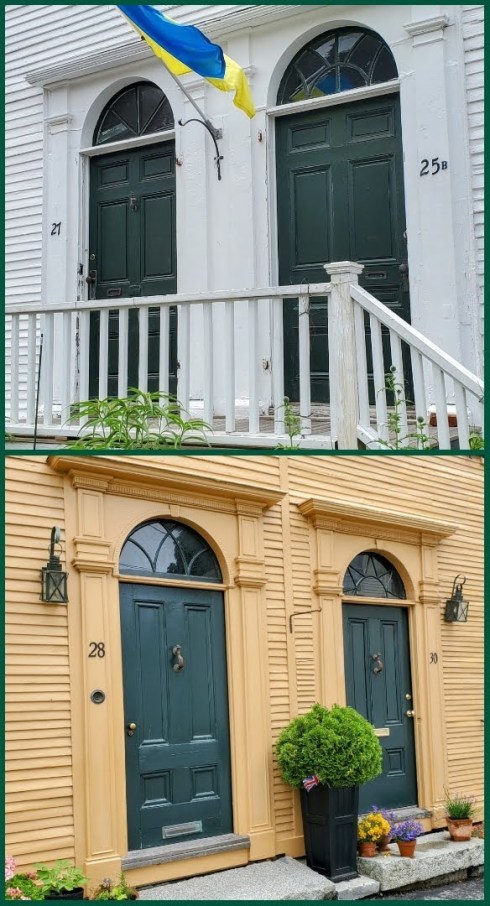
I’ve been in York Harbor all June and just returned to Salem. It was a very productive month removed from daily tasks and diversions, but I missed certain things and people: my husband (I brought the cats), my garden, my street. Certainly not the tour guides and groups though: they were in part what drove me away. Of course I found the usual Dunkin iced-coffee cup propped up on my stoop the moment I got home. Salem is busy and festive all year long now it seems; while the incessant witch tourism annoys me the other celebrations are great, and June is a particularly festive month with its mix of private and public celebrations: weddings and graduations, Juneteenth and Pride. Salem goes all out for Pride and  I missed that, and definitely craved some color amidst our rainy and foggy weather, so I took off for Portsmouth late last week seeking flags but finding doors. When I was growing up across river, Portsmouth was a much shabbier place: now you are hard-pressed to find an old house that is not in perfect condition. I expanded my usual downtown walk to include neighborhoods a bit more outlying like that bordering Christian Shore and the South End, and found so many lovely houses, all with very colorful entries. Red was an exotic front-door color before; now there is a veritable rainbow of Portsmouth doors. And I’ve got some flags here too.

Ok, I think I have the whole spectrum represented! It was surprisingly difficult to find white doors: as you see, one is hiding behind a tree. I wasn’t sure where to put taupe, so I paired it with brown. There are no painted brown doors, just various shades of natural woodwork. Not too many black doors either, but lots of green, and lots of yellow. Do not tell me that one of my purple doors is blue; it is purple. Portsmouth is the best walking city ever: beautiful neighborhoods, dynamic downtown, tons of historical markers, pocket parks, well-maintained sidewalks. More rainbows are there for the making!

Some singular Portsmouth doors: two-tone green and Happy Fourth!


Anniversary History: Local Edition 2023

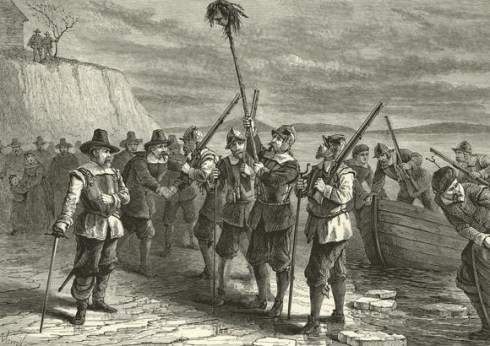
Looking ahead to the new year from a local history perspective, there are commemorative moments for at least six events: five European settlements and a tea party, the 250th Anniversary of the Boston Tea Party, to be precise. A century and a half earlier, there were settlements at Gloucester, Massachusetts and Portsmouth, Rye (the Pannaway Plantation) and Dover (the Cocheco Plantation), New Hampshire. The ill-prepared and -fated Wessagusset Colony was established in Weymouth, Massachusetts in 1622 but its demise came the following year after the brutal Wessagusett “Incident,” more appropriately referred to as a massacre. Commemorative history should acknowledge both the good and the bad, the heroic and the tragic, the kind and the cruel, and so the Wessagusett Massacre of March 1623, a veritable “red wedding” which harmed relations between Native Americans and English settlers for years to come, demands a spotlight. Like the first Gloucester settlement by the Dorchester Company, Wessagusett was decidedly not a plantation in the seventeenth-century sense, but rather a fishing and trading station of 60+ men financed by London merchant Thomas Weston. “Weston’s Men” were completely unprepared for the New World and by the winter of 1622-1623 they were starving, and altogether dependent on both Plymouth and the Native Americans in the region. But foodstuffs were scarce for everyone that winter, and everyone was anxious. Rumors of an impending Native American raid on both settlements drove the Wessagusett men to seek aid from Plymouth, and militia leader Myles Standish and eight men sailed a shallop to the northern settlement and issued an invitation to Massachusett tribal leaders Pecksuot, Wituwamat, and others to attend a summit during which commenced a slaughter just as they all sat down to dinner. I’m going to let Charles Francis Adams tell the tale, as he presented it in his anniversary address on the occasion of the 250th anniversary of Weymouth: the savages were taken by surprise, but they fought hard, making little noise but catching at their weapons and struggling until they were cut almost to pieces. Finally Pecksuot, Wituwamat and a third Indian were killed; while a fourth, a youth of eighteen, was overpowered and secured; him, Standish subsequently hung. The massacre, for such in historic justice it must be called, seeing that they killed every man they could lay their hands on, then began. There were eight warriors in the stockade at the time,—Standish and his party had killed three and secured one; they suddenly killed another while the Weston people despatched two more. Only one escaped to give the alarm, which spread rapidly through the Indian villages. Interesting language for 1873: savages is employed, but Adams does not refrain from calling this slaughter a “massacre” unlike many of his contemporaries who labeled it a pre-emptive strike. Several Wessagusset men also died during the massacre, and the rest opted to abandon the settlement; Standish returned to Plymouth with the head of Wituwamat on a pike in ancient English warrior fashion, “to ornament the Plymouth block-house as a terror to all evil-disposed savages” in the words of Adams. This massacre seems worthy of a bit more commemorative reflection, at least a fraction of what the Boston Massacre receives continuously.

“The Return of Myles Standish from Wessagusset,” from Pioneers in the settlement of America: from Florida in 1510 to California in 1849 by William August Crafts, 1876. Ironically, nearly 300 years later (299!) Myles Standish lost his head when the Standish monument in Duxbury was struck by lightning: according to this post by Carolyn Ravenscroft, archivist of the Duxbury Rural and Historical Society, his replacement head was too heavy for the damaged “body,” so an entirely new Standish was created by Boston sculptor John Horrigon, pictured here in 1930.

I’m not sure what the plans for the commemoration of the Wessagusset Massacre are but all the early settlements have been planning their 400th anniversaries for quite some time, particularly Gloucester, which has assembled a multi-layered calendar of commemorative initiatives and offerings focused overwhelmingly on the city’s social history. I’ve been so impressed with the “400 Stories” project, which aims to collect, present and preserve stories from 400 of Gloucester’s residents from 1623 to 2023, thus connecting the past to the present. There are books, an artistic competition for a new commemorative medal, walking tours, festivals, and a gala: the evolving celebratory schedule is at Gloucester 400.

Portsmouth is all geared up too, although its big reveal party is on January 6 so I don’t know all the details. The PortsmouthNH400 site is here, and so far its signature product is a lovely bookA History of Portsmouth NH in 101 Objects, to which both my Salem State History colleague Tad Baker and alum Alyssa Conary have contributed. There’s an ongoing speakers’ series and exhibition based on the book, and on January 6 Portsmouth’s Memorial Bridge will be illuminated in blue, PortsmouthNH400th’s commemorative color. Like Gloucester, Portsmouth is also collecting stories (of 400 words) from its residents, to be compiled in a commemorative book designed to update its 350th anniversary history. Rye and Dover also have their 400th anniversary committees and calendars, derived from considerable public participation: the mission of Dover400 is “to honor our past, celebrate our present, and to inspire our future through meaningful and creative community engagement.”

The 250th anniversary of the Boston Tea Party is going to be big: after all, from the Boston perspective, it was “the single most important event leading up to the American Revolution.” I’m excited about all of the offerings by Revolutionary Spaces at the Old South Meeting House and the Old State House, including an exhibition on the power of petitions, an “immersive theatrical experience,” and various programs on the nature and expression of protest. Of course the Boston Tea Party Ships & Museum has plans as well, and is already counting down to the big reenactment on December 16, 1773. And there will be merch, including lots of commemorative tea.

Teas from Elmwood Inn & Oliver Pluff & Co.


The Wentworth-Gardner House

We were in York Harbor all last week with family and friends, several of whom had never been to this region of New England before. So I was a bit of a tour guide, in my fashion. On a morning tour of Portsmouth, we passed by my favorite house in town, the Tobias Lear House, as well as its more famous neighbor, the Wentworth-Gardner House, one of the most famous Georgian structures in the country. I’m very familiar with this house, but for some reason I’ve never been inside, and the door was open with a flag out front, so in I went, forgetting all about my companions. They followed me, but I really gave them no choice in the matter! We had a lovely tour with a very knowledgeable guide, and the house was ever more stunning than I imagined. I’m kind of glad that I had never been in before, as this house is probably the best example of the entrepreneurial antiquarian Wallace Nutting’s material and cultural impact in New England and I’ve come to appreciate him only recently. Nutting purchased the house in 1915 and added it to his collection of “Colonial Pictorial Houses” after his restoration, and thus it became one of the more influential representatives of the “olden time” in his time and the Colonial Revival in ours. Images of Nutting’s wispy colonial ladies in its midst are scattered throughout and a room is devoted entirely to his work.

The Wentworth-Gardner House in Portsmouth, New Hampshire: present and before Wallace Nutting’s purchase in 1915; the amazing center hall with a stairway re-installed by Nutting, and one of his colonial ladies descending (from a large collection of Nutting images at Historic New England).

The houses was built by Mark Hunking and Elizabeth Rindge Wentworth in 1760 as a wedding gift for their son Thomas, who lived in it until his death in 1768. It was owned and occupied by Major William Gardner from 1793 to 1833, and thereafter by his widow. In the later nineteenth century the grand mansion became a rooming house as its South End neighborhood declined, and then Nutting came to its rescue! As you can see, his most extensive restoration was to its exterior, but the reinstallation of the stairway was a major undertaking as well. I know that the pineapple was a customary colonial symbol of hospitality, but I can’t help but wonder if Nutting was inspired by Salem’s “Pineapple House.”

Nutting’s restored doorway (Historic New England) and Salem doorheads from the 1895 Visitors’ Guide.

Nutting sold the house to the Metropolitan Museum of Art just after the close of World War I, initiating the threat of removal to New York City that was itself removed by the onset of the Depression. After a brief stint of stewardship by the Preservation of New England Antiquities, the Wentworth-Gardner (and adjoining Lear house) House was acquired by a group of local preservationists who eventually became known as the Wentworth-Gardner Historic House Associates in 1940. It’s just a great place to visit: so many wonderful structural and decorative details, including the wonderfully carved mantel in the front left parlor (another one of Nutting’s reinstallations), the newly-installed reproduction eighteenth-century flocked wallpaper, the very Colonial Revival kitchen with its steep steps leading to upstairs, several great bedchambers (I couldn’t call them simply bedrooms), the Wallace Nutting room, and a very nice exhibition on historic preservation in Portsmouth. I remain so impressed by this small city with all of its historic houses, in wonderful condition and all open to the public. It’s a great example of community commitment to material heritage and the importance of having several institutional stewards thereof, rather than just one or two.

Georgian and Colonial Revival styles/worlds merge in the Wentworth-Gardner House, Portsmouth, New Hampshire.


Lilac Days

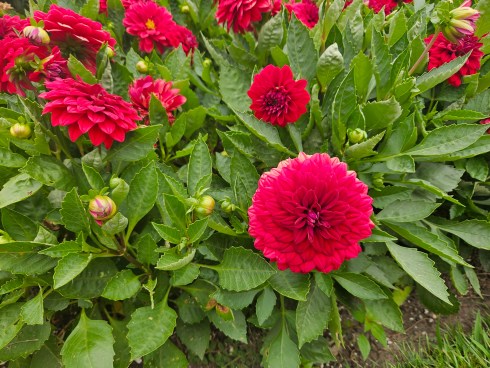
Lilacs are so ubiquitous in New England in May that you tend to overlook them, but over the past pleasant days I have been seeking them out in some of my favorite spots. I’m always so conflicted during this month, as my academic responsiblities conflict with my desire to immerse myself in all things horticultural. Over the last few weeks, I missed both Lilac Sunday at the Arnold Arboretum, as well as the peak spring blooming at the Stevens-Coolidge garden in North Andover. But I finished my grading over the weekend, and found myself going to and from my family’s house in York Harbor, Maine on my own wayward routes, chasing lilacs along the way. I saw lilacs by the sea, lilacs in town, lilacs in the country, lilacs by front doors, back doors, bulkheads, gates, and many many fences.

Starting out in York Harbor yesterday (where it seems to me that there were many more lilacs in the past; I guess childhood memories are always like that!), then on to Portsmouth, where lilacs peaking through garden gates and alongside foundations lured me into Strawberry Banke. I really loved the garden at the Nutter House, the boyhood home of author Thomas Bailey Aldrich–this last lilac bush is in the garden his wife designed for him later and it is at least a century old. More on this garden later in the summer!

From Portsmouth, I drove to North Andover, as I decided to visit the Stevens-Coolidge garden even though I knew the tulips would be a bit past their peak: it’s still a lovely garden! Not many lilacs though: just a couple of tall hedges, which were waving constantly on this very breezy day. North Andover is an old town, so I knew I’d find some lilacs peaking out from any number of places, and I was not disappointed: they enclose several venerable house lots, the Parson Barnard House included.

From North Andover I headed home on the old Salem Road that takes you through Middleton and Danvers: bound for the beautiful Glen Magna garden in the latter town. I ended the day in a purple haze, but also with lots of gratitude and appreciation for the North Andover, Topsfield and Danvers Historical Societies, which maintain all these properties in such beautiful condition. From my jaded Salem perspective, the absence of cash-cow commodification of heritage sites is so welcome and refreshing. I visit the Glen Magna garden all summer long, and view it much in the same way that its founder and his successors, the Salem merchant Joseph Peabody and several generations of the Endicott family, must have: as a retreat from bustling Salem. Of course I can’t set myself up in the house like they did, but I’m very grateful for the open garden! The last Endicott to summer at Glen Magna, William Crowninshield Endicott, Jr., brought the 1794 summer house designed by Samuel McIntire for the Derby farm on Lowell Street in Peabody to Glen Magna in 1901. This amazing structure is worth a visit at any time of the year—it looks just as strking in the midst of winter as it does in the midst of all this green, and purple.

Lilacs against the Parson Capen House’s barn, and the gardens at Glen Magna.


What About Fort Pickering?

I love commemorations: I have posted about them often here, particularly at the beginning of a new year like 2020, during which the long-planned commemorations (of the achievement of women’s suffrage, the Mayflower voyage, and the bicentennial of the state of Maine) didn’t quite go off as planned, obviously. As I spend much of my time thinking about the past, I relish any moment in which a more collective present is so engaged. In four years’ time, Salem is going to be thrust into a big commemorative year, even bigger than 2020 and hopefully more celebratory and reflective: 2026 will mark the 250th Anniversary of the beginning of the American Revolution and the 400th anniversary of the first European settlement in Salem. Revolution 250 has been planning the regional observance of the Revolutionary anniversary for quite some time in a collaborative and dynamic manner, because “commemorations bring people together.” I think there is some Salem participation in this effort, but I’m really not sure. I’m even less sure about what is being planned for Salem’s 400th anniversary: when I look at the organizing that has been going on in two other cities facing big anniversaries, Portsmouth and Gloucester, I see much more organization than is in evidence here in Salem, but then again these cities’ 400th anniversaries are next year so they better have their acts together! Salem certainly has time, but from what foundation and inspiration will it proceed? Who is in charge and who is involved? What will “Salem 400” entail and hope to achieve? I google that term from time to time but all I get is this. Without a professional historical society or heritage commission to shepherd such an initiative, there is no doubt that the 400th anniversary of Salem’s founding will be a much more “top-down” initiative than that of its sister cities, or even its own Tercentenary, which inspired a multi-layered calendar of commemorative events and expressions, including a parade of 10,000 participants, pageants and performances, musters and medals, open houses, bonfires, and headlines in national newspapers.

Official Tercentenary Program, 1926: you can see some great photographs of the events here.

I can’t imagine 10,000 people turning out for a Quadricentennial parade in 2026! The past century has transformed history into a product in Salem, something to be exploited rather than contemplated or celebrated. A singular focus on 1692 seems to have deadened the city’s interest in nearly everything else, save for the occasional nod to the military or the marginalized. I’m not sure how anyone can engage in history in Salem, save for nostalgic facebook postings. The few references to plans and goals for 2026 seem to acknowledge this by emphasizing places over people, and the present over the past: foremost among them is Mayor Kimberley Driscoll’s “Signature Parks Initiative,” which is “focused on planning and carrying out improvements and preservation work in six of Salem’s busiest and most beloved public parks and open spaces, ensuring that they will remain available and enjoyable for future generations to come: Forest River Park, Palmer Cover Park, Pioneer Village, Salem Common, Salem Willows and Winter Island.” Certainly this initiative is welcome, and will be beneficial to Salem’s residents (as will more trees, also a part of “quadricentennial planning”) but is it commemorative? Is it engaging, inspiring, and challenging the public, as opposed to simply providing for them? Maybe it is for some, or even many, but not for me: I want more history—and more humanity—in my quadricentenary. Compare Mayor Driscoll’s Signature Parks Initiative with the centerpiece of the Gloucester 400 commemoration: the 400 Stories Project, “a citywide undertaking whose goal is to collect, preserve, and share 400 stories of Gloucester and its people” from 1623 until 2023. The Project’s administrators invite Gloucester residents to “help us make history” by sharing their stories. This is a pretty sharp commemorative contrast between these two old Essex County settlements.

“Our People, Our Stories”: I wonder what the tagline of Salem’s Quadricentenary will be?

So far the most conspicuous work of the Signature Park Initiative in Salem has been in evidence at Forest River Park in South Salem: one end of the park now features new public pools and trails along with an enlarged and renovated bathhouse while the other is slated for a dramatic alteration revolving around the exchange of the Colonial Revival reproduction “Pioneer Village” currently situated there with the YMCA camp formerly located at Camp Naumkeag in Salem Willows. The writing has been on the wall for Pioneer Village, built for the Massachusetts Tercentenary of 1630, for quite some time as the City has neglected its buildings and landscape for decades and expanded the adjacent baseball field more recently. However, the exchange plan has hit a snag recently, as the City had to apply for a waiver of its own demolition delay ordinance before its own Historical Commission in order to remove the buildings at Camp Naumkeag, which was first established as a tuberculosis camp over a century ago. So far this waiver has not been granted, and a notable resistance to both the destruction of Camp Naumkeag and the relocation of Pioneer Village has emerged. I wrote about Pioneer Village at length last summer, and I have been rather ambivalent up until last month, when several admissions shifted me into the wary and possibly-even-opposed zone: I’m still thinking about it as I find it a particularly vexing public history problem! This is an ambitious plan: Pioneer Village is not simply going to be relocated but rebuilt and re-interpreted with the addition of a visitors’ center and a new focus on the relationship between the European settlers and the indigenous population of pre-Salem Naumkeag. This is an admirable goal for sure, but to my ears, the new interpretive plans sound vague, simplistic and ever-shifting, and above all, lacking in context. They are supposedly the work of the numerous consultants who have worked on the project, paid and unpaid and including several people whom I admire, so it might just be a matter of presentation, but there are several statements that I find concerning. In the first Historical Commission hearing, one consultant responded to the argument that Camp Naumkeag was itself an important historical site because of its role in public health history with an assertion that that role would enhance the new Pioneer Village’s focus on the virgin soil epidemic which devastated the indigenous population even before settlement, as if infectious diseases were interchangeable and detached from time and place! [“Pioneer Village Complicated by History,” Salem News, September 16, 2021] Several months later, the City posted its plans on its website, with this all-encompassing but yet incomprehensible statement of goals: increased access and visibility to the breadth of Salem’s history as represented by the breadth of the site’s history, including Salem Sound’s natural history, the original inhabitants, Fort Lee and the Revolutionary War, the Willows, Camp Naumkeag, and the Pioneer Village. So now it seems as if the newly-situated Pioneer Village will be utilized to interpret almost the entirety, or breadth, of Salem’s history, and in a space which the accompanying plan revealed will have parking for only ten cars. In terms of both interpretation and logistics, this is a flawed plan as presented: its reliance on the seasonal trolley for access is confirmation of its orientation to tourists over residents as well as its seasonal status, in contradiction to the breadth of its stated goals and costs.

The current Plan for the new Pioneer Village on Fort Avenue, on the site of the present-day Camp Naumkeag.

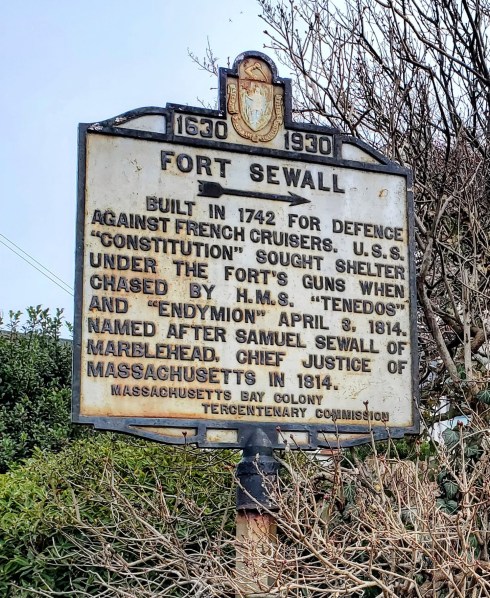
While at face value the inclusion of yet another long-neglected Salem historical resource, Fort Lee, looks like a good thing, I find it concerning. Why should Fort Lee be included in the interpretation of the faux Pioneer Village and not its very authentic (and far more important) neighboring fort on Winter Island, Fort Pickering? This is the guiding principle of the the 2003 study commissioned by the City and the Massachusetts Historic Commission, the Fort Lee and Fort Pickering Conditions Assessment, Cultural Resources Survey, and Maintenance and Restoration Plan: that the forts should be “restored, maintained and interpreted together [emphasis mine] as part of the Salem Neck and Winter Island landscape for enhanced public access.” To its credit, the City has begun a phased rehabilitation of Fort Pickering, but I see much less energy and far fewer resources committed to it than to the Pioneer Village project, which is perplexing given its authenticity and historical importance. Winter Island has served successively as a fishing village, a shipbuilding site, and in continuous military capacities from the very beginning of Salem’s settlement by Europeans to the mid-twentieth century.  The storied fortification which became known as Fort Pickering in 1799 was built on the foundation of the British Fort William, part of a massive effort by the new American government to fortify its eastern coastline beginning in 1794 under the direction of French emigré engineer Stephen Rochefontaine. Fort Pickering was manned, and rebuilt, on the occasions of every nineteenth-century conflict, and was especially busy during the Civil War. Another regional Rochefontaine fort, Fort Sewall in Marblehead, shines under the respectful stewardship of that town. Salem is so fortunate to have so much built history:  why can’t we focus our energies and resources on preserving and re-engaging with authentic sites, rather than creating new ones? (And could someone please find our SIX Massachusetts Tercentenary markers? Every other town in Massachusetts seems to have held on to theirs).

Talk about a site that can illustrate the BREADTH of Salem history: Winter Island was an early site for fishing and fish flakes (and even more substantial “warehouse” structures) as well as the location of Salem’s first fort William/Pickering. The Salem Frigate Essex (depicted by Joseph Howard) was built adjacent to the Fort in 1799, and Winter Island also served as the site of Salem’s “Execution Hill” in the later eighteenth and nineteenth century and of a Coast Guard air station from 1935-70. Members of the US Coast Guard Women’s Reserve, or SPARS, were stationed on the island during World War II. Rochefontaine’s 1794 plan and block house sketches and Frank Cousins’ photographs of the island and fort in the 1890s, Phillips Library of the Peabody Essex Museum. Marblehead’s Fort Sewall on the last day of December, 2021.


Camouflage or Color Pop?

We drove up to Portsmouth to have lunch with my parents and afterwards took a long walk around the old town, as the restaurant I chose was definitely in the new! Portsmouth is experiencing a building boom like Salem, but better. We walked past Market Square in the center of downtown Portsmouth (where there was one lone sign holder—-everyone else was in Iowa, I presume) past the skaters in Strawbery Banke to the South End, and then back again in a big circle. Everything seemed gray-brown in the chilly damp air, except for the old houses, or should I say some of the old houses, painted in shades of gold and pumpkin, green and red. There seems to be a custom of leaving clapboards unpainted in Portsmouth, however, so some of these weathered houses faded right into the streetscape, like camouflage. Lots of contrast on the streets of Portsmouth—and texture.

20200201_143312

20200201_150654

20200201_144330We caught the owner of this amazing 1766 house coming out, and he told us all about his restoration process—he replaced all those clapboards himself.

20200201_145455

20200201_145117_20200203221956953

20200201_145002_20200203221814237

Since I was in the neighborhood, I really wanted to check out my favorite house in Portsmouth, the Tobias Lear House, named for George Washington’s secretary. I have adored this house since my teens, and it is likely the source of my admiration for all historic houses, or at least Georgian ones. The last time I checked in, it was in rough shape, so I was a bit nervous when we turned the corner on Hunking Street, but yay: preservation in action!

pixlr_20200203195119185

Then we walked by the famous Wentworth-Gardner House (once owned by Wallace Nutting!) and turned a corner and then: the ultimate unpainted house: so stark and stately, with pops of green potted plants in every window. I don’t remember ever noticing this house before, even though I grew up right over the bridge from Portsmouth. Wow!

20200201_150231

20200201_150826

20200201_150756

20200201_150729

Circling back by the skaters in Strawbery Banke, and the lone sign holder in Market Square (it was the weekend before Iowa—this weekend will be very different!), with brief stops at shops (there really can never be enough plaid for Portsmouth), and along the Harbor, where a big ship was delivering sand for this so-far snowless winter.

20200201_143623

20200201_145029

20200201_142609

20200201_152435

20200201_154735

A February Saturday in Portsmouth…….


Codfish Aristocracy

Growing up in York, Maine, my focus was increasingly over the river and out of state once I hit my teens, to Portsmouth, New Hampshire, a larger town with a mall, movie theaters, downtown shops, and lots and lots of restaurants. As I’ve said before, I think I ended up in Salem in large part because of its similarity to Portsmouth, and its greater proximity to Boston (now Salem surely has more restaurants, but fewer shops). For some reason which I can’t remember, my favorite restaurant in Portsmouth has always been The Oar House, which still exists, but a close second was The Codfish Aristocracy, which is long gone. I had very little historical curiosity then, as well as very little regard for American history, so I never questioned the name; only later did I delve into the origins of this interesting idiom. Since I have cod on the brain this week, I decided to delve into it a bit more, and of course, in this year of discovering all sorts of legacies of slavery, here is another one. I think there are several connections, actually. As a general reference to the New England aristocracy of families whose “new” wealth was based on the Atlantic fisheries and trade to both the West Indies and Europe, the term predates the nineteenth century; after all the original “sacred cod” was placed in the old Colonial State House in the early eighteenth century and the present one dates from 1798. Salem even has a claim for the origins of the term, based on the cod embellishment on the stairs in Colonel Benjamin Pickman’s beautiful Georgian mansion on Essex Street, built in 1756. A lithograph of this house was included in the materials chosen by a special Essex Institute committee to represent Salem at the Columbian Exposition in 1893, when it was “still standing though defaced by shops in front. It is said that the term “Codfish Aristocracy” arose from the fact that the end of each stair in the hall of this was house was ornamented with gilded codfish, Colonel Pickman’s fortune being derived from the fisheries”.

Cod in State House Griffin DC

Pendleton PickmanArthur Griffin photograph of the Sacred Cod in the State House, 1950s; The Pickman House by Pendleton’s Lithography, Digital Commonwealth & Boston Athenaeum.

New England cod fed both enslaved Africans and free Europeans and thus created great wealth in New England, but the derisive use of the term “Codfish Aristocracy”, in reference to the ostentatious and vulgar display of that wealth, comes later, in the 1840s and 1850s, and most prominently in the debate over slavery. He was not the originator of the phrase, but when Senator Andrew Pickens Butler of South Carolina remarked that We should regard it somewhat strange if we should require a codfish aristocracy to keep us in order in the midst of a speech on the floor of the Senate in the summer of 1850, it seemed to hit a chord. As a leading pro-slavery, anti-abolitionist voice, Butler drew heated criticism from Massachusetts Senator Charles Sumner, who indicted Butler as both “the Don Quixote of slavery,” and an admirer of “the harlot, Slavery” in his own Senate speech in May of 1856: in retaliation Butler’s cousin Preston S. Brooks responded by caning Sumner on the Senate floor days later, instigating his three-year incapacitation. In the following year, after Senator Clement Claiborne Clay introduced a bill repealing all laws allowing bounties to vessels employed in the fisheries under the rationale that 25 states were made to pay tribute to the Codfish Aristocracy of a mere six, papers in Massachusetts opined that “southern hatred of New England” was his true motivation.

Somewhere between the absolute disdain conveyed by the southern use of the term and the occasional pride displayed in the North was the New York attitude: more mockery than condemnation. There are three caricatures of the Codfish Aristocracy that represent this perspective well in the collection of the Library Collection of Philadelphia: literal representations are always an effective form of censure!

Codfish LC

Codfish LC 2

Codfish Aristocracy LC 3Three Codfish Aristocrats: McAllister Collection, Library Company of Philadelphia, c. 1840-1880.