
Tag Archives: Portraits

Escape to Old Newbury

I had yet another “symbol trauma” (I have no other way to refer to it) on Friday when people starting sending me images of little anime cats with notes indicating that this was the new official mascot for Salem’s 400th commemoration, Salem 400+. Was this a joke? Apparently not. Here’s the press release text and the cat (in front of 1910 City Hall just to emphasize his/her official status).

Mayor Dominick Pangallo has announced an exciting new community engagment opportunity: a naming context for Salem 400+’s black cat mascot! Salem 400+ has unveiled a charming black cat character designed to strengthen the program’s connection with the community and celebrate Salem’s unique identity. Salem students in 3d through 8th grade have been invited to participate in naming this special mascot through a district-wide contest that opened a few weeks ago. “There was so much positive community spirit and creativity when it came to naming our new trash truck, Chicken Nugget, we wanted to open up this opportunity to our students as well, said Mayor Pangallo, “the Salem 400+ black cat will help represent Salem and this special moment, and we want our young students to be part of bringing it to life.” 

So of course engaging students in a naming contest is great but I’m sorry: the choice of this AI anime cat is not. He (or she—we don’t know yet!) is everything that Salem is not: superficial, generic, silly, not serious. I understand the political reality here (the Chicken Nugget roll-out was intense—it was very clear that whoever got in between the trash truck and a Salem politician was in trouble if photographers were nearby), but I’m just so tired of the triviality. There are always these gestures in Salem that go 3/4 of the way but never all the way: a Remond Park with incorrect information about where Salem’s 19th century African American residents actually lived, a Forten Park which loses Charlotte between gaudy installations and pirate murals. But this is a whole new dimension of dissing Salem history. Even my long-suffering husband, who has to hear me rant nearly every day, said wow. There’s nothing anyone can do but disengage, so when I woke up Saturday morning, I knew I had to get out of town. Fortunately it was a grand weekend of Revolutionary remembrance in Essex County, so up to Newburyport I went. It happened that this was the 250th anniversary of Benedict Arnold’s Quebec Expedition, in which Newburport played a large role. So I headed north, because even Benedict Arnold looked good to me.

The Quebec Expedition (I think the first poster is rather old) was a spectacular failure. With the new Continental Army ensconced in Cambridge, Colonel Arnold approached General Washington with the idea of an eastern invasion force aimed at Quebec City in concert with General Richard Montgomery’s western expedition from New York. Washington gave Arnold 1110 men, who sailed from Newburyport on September 19, 1775. Their destination was the mouth of the Kennebec River, from which they would progress upriver to Fort Western (Augusta, ME) after which they would navigate water, marsh and land to the Chaudiere and St. Lawrence Rivers and Quebec. They encountered so many difficulties along the way that ultimately a quarter of the regiment turned back (taking essential provisions with them), and Arnold arrived in Quebec with 600+ exhausted and starving men. A New Year’s Eve battle was a disastrous defeat, resulting in the death of General Montgomery, the injury of Arnold, and the capture of Captain Daniel Morgan and hundreds of his riflemen. Nevertheless, Arnold was promoted to Brigadier General for his leadership of the expedition. The weekend’s activities were definitely focused on Newburyport’s “early and ardent embrace of the Revolutionary cause” rather than on Arnold himself.

Everywhere I went in Newburyport and adjoining Newbury I ran into people engaged in their history: the celebration of a new plaque recognizing the patriots of Newburyport at the Old South Church (above), a parade of participants making their way down High Street following a reenactment of the 1775 dedication for departing troops at the nearby First Parish Church, glanced from the doorway of Historic New England’s SwettIlsley House after the guide and I paused our tour. The Museum of Old Newbury set out its revolutionary artifacts in the rooms of its 1808 Cushing House, including a reconstructed Newburyport rum jug taken out of the ground in shards amidst the “Great Carrying Place,” a 13-mile portage trail between the Kennebec and Dead Rivers through which Arnold and his men passed 250 years ago. Actually, the jug was on a brief loan to the Museum from the Arnold Expedition Historical Society and Old Fort Western Museum and Executive Director Bethany Groff Dorau drove up to Maine to retrieve it for just this commemorative weekend., but the Museum is full of its own treasures and I’ve featured just a few of my favorites below. I’m looking forward to going back, and back again.

Rooms and Collections at the Swett-Ilsley and Cushing Houses in Newbury and Newburyport: that’s a portrait of Lafayette leading into the south parlor at Cushing—what a punch they made for him when he visited in 1824! And I am obsessed with the c. 1786 portrait of the Reverend John Murray by Christian Gullager. Great Liverpool jugs! The Museum is the historical sociey of Newbury, Newburyport, and West Newbury, so its collections are vast and varied.

And on the way home, I encountered a handtub muster on Newbury upper common! What could be better? Just a perfect day away.


“A Country by Itself”

A mayoral task force commission has been meeting for the past few months, called to contextualize charges that Salem’s City Seal is demeaning to Asian Americans and explicity rascist. The image in question depicts an apparent native of Sumatra’s westernmost province of Aceh in the foreground, with a pepper plant alongside and (an apparent) Salem ship in the background: a rare 19th century acknowledgement that a western society’s (Salem) prosperity was tied to its trade with the East. I posted about this issue back in the fall of last year, when my stance was generally supportive of the 1839 seal but open to a community dialogue. I’m doing so again because I’ve watched (there is no other way to “participate” besides a form you can send in) four of the Task Force’s meetings and after looking at images of the Sumatran figure presented alongside Sambo images as “proof” of racism and hearing an assertion that the seal is the equivalent of the Confederate flag I am convinced that this is not a serious inquiry. The Task Force has scheduled a listening session for July 14 and one member who is a Salem native and expert in Indonesia’s history and culture has yet to make an appearance so perhaps things will get a bit more substantive but I don’t have high hopes at this point. That a tradition of such longstanding should be given such short shrift is unfortunate—actually more than unfortunate, unsettling.

Salem’s City Seal was adopted as the insignia of the City in March 1839, and it was a rather “flexible” image for the next fifty years or so: the central figure even changed from a man to a woman!  In 1888, artist Ross Turner was commissed to paint the orginal seal (bottom left) and it was pretty much standardized after that. For the 1926 Tercentenary of the founding of Salem, the City produced Seal medals (bottom right). There has been no attempt by the Task Force as of yet to place this image—or its evolution—in any historical context; the assumption seems to be that the existence of an 1839 rendering of an Acehnese Native is without question objectionable and the best way to modify the Seal is simply to remove said Native and have a lovely Sumatran scene sans person. The City motto, “Divitis Indiae usque ad ultimum sinum” – “To the farthest port of the rich East” – never changed and doesn’t appear to bother the Task Commission. It has inspired a number of artistic creations: the piece below is quilted fabric but I’ve seen the same in tile and as a painting and print.

I really don’t want to watch these meetings anymore.; I come away from them feeling quite sad. I know why Salem people are troubled by the prospect of an altered seal because I’ve heard from some: for some civic service or upon retirement fathers and mothers and brothers and sisters received a seal from the Mayor of the moment as a photograph was taken and a memory made. It’s not so personal for me, but I do have a somewhat-related memory from around the time I first moved to Salem. I was still in graduate school, working on my dissertation, and I used the purchase of my first house and the move as a rationale to procrastinate as much as possible from working on it: I had four new (old) fireplaces and suddenly it was really important to deck them out with andirons and everything—even though it was June! So I drove around the North Shore, poking around every antique shop that I came upon. In Essex (most definitely the antique capital of the North Shore) I got into a really nice discussion with a man who told me (I’m paraphrasing from memory here) that in its heyday Salem was so prosperous and Salem ships so numerous that all of its trading partners in the East Indies thought it was “a country unto itself.” To them, Salem was the United States or the United States was Salem. I was looking at maps in his shop (because of course I had to have antique maps all over my new walls) and he said something like—and there’s a map somewhere, with Salem depicted as the United States. Well, for the next decade or so, I was looking for that map. I thought it would look something like this:

Well maybe a less strident SALEM but you get the point. Of course I never found this map, because it never existed! Once I started reading about Salem history (which was pretty much when I started this blog) I soon realized that my antique dealer had it wrong or I had it wrong: but the perception behind the nonexistent map was very, very real. It is expressed generally in all the maritime histories of the nineteenth century, as well as texts that probe the cultural history of America’s encounters with the East. Samuel Eliot Morison gives the most detailed description in his Maritime History of Massachusetts: While Boston ships followed Magellan westward around the Horn, Salem sent her vessels eastward to the Dutch East Indies, Manila, both coasts of Africa and the smaller islands of the Pacific, and so thoroughly did they pre-empt this trade that as late as 1833 Po Adam, the wealthiest merchant of Quallah Battoo ‘‘believed Salem to be a country by itself, and one of the richest and most important sections of the globe.” I’m not sure Po Adam was the wealthiest merchant of Quallah Battoo (Kuala Batu), the major pepper port in Aceh, but he was a well-known friend of the American traders who disembarked there, warning Captain Charles Endicott of the impending attack on his ship Friendship in 1831 which resulted in the retaliatory attack by the U.S. Naval Frigate Potomac in the following year. In his account, Endicott called him “my old and tried friend” and captains for the ships owned in part or whole by Salem’s largest pepper trader, Joseph Peabody, expressed the same sentiments. Trade is always about human relationships, for better or for worse, and I think that’s why Joseph Peabody’s son George, the Salem alderman who is universally credited with the conception and depiction of the Salem Seal in 1839, placed a person in the center of it. And when that figure is stripped from Salem’s seal, inevitably it seems at this point, all we will have left is a commodity (like a Witch here in the Witch City).

Drawing of Po Adam from James Duncan Phillips, Pepper and Pirates, 1949; George Peabody by John Singer Sargent, Museum of Fine Arts, Boston. 


Saints & Sinners & a Bad Professor

So you would think that I would be happy when an exhibition of paintings, texts and objects right in my teaching sweet spot of late Medieval/Renaissance/Reformation/Early Modern Europe comes to my very own city, and yes, I am. Have I taken advantage of said exhibition and brought my students to see things which I regularly refer to? No I have not. The “Saints & Sinners” in my post title refers to the current exhibition at the Peabody Essex Museum, Saints, Sinners, Lovers, and Fools: 300 Years of Flemish Masterworks, and the “Bad Professor” is me. This has happened before: the PEM has a global purview, and several exhibits which have complemented my courses have been up, but this one is really spot on. So when I finally went yesterday afternoon (it opened in December and is up until May), I really enjoyed it, but also felt bad. I am really not good at out-of-the-classroom activities with my students: I never have been and I never had to be. All my colleagues are a lot better. I always used to think, oh well, they’re Americanists, it’s easy for them, but that’s not going to work in this case is it? And I’ve always blamed it on Salem State’s location—about a mile out of downtown Salem. It’s not very far, but it feels far, when you’re trying to cover so much in the limited time of a semester. I walk it often, but to and from is going to eat up an entire class with not much time for viewing in between. The original Salem State (Salem Normal School) was located just behind my house on Broad Street, but in the 1890s there was a big move to a more expansive—now residential—area south. The move made sense at that time, but now I think our university would benefit from a downtown location, or maybe I’m just making excuses! I have occasionally invited my students to join me at exhibitions, and a few have, but never the entire class: my students seem very busy, taking six classes and working two jobs—oops, more excuses. In any case, I’m certainly going to extend that offer to them for this exhibition, because they will in fact see many things which they have heard about before.

Detail  from Jan Wildens, Panoramic View of the City of Antwerp across the River Scheldt, 1630.

Saints and Sinners is a traveling exhibition co-organized by the Denver Art Museum and the Phoebus Foundation in Antwerp, and it is very Antwerp-centric. Once certainly gets a sense of the somewhat wider world that was late medieval and Renaissance Flanders, but Antwerp is the star of the show. But that’s ok, because Antwerp was a very dynamic city in this era–the first non-Italian European entrepot. [a great read for the non-specialist is Michael Pie’s Europe’s Babylon: the Rise and Fall of Antwerp’s Golden Age] The exhibition opens with two galleries exploring intense late medieval piety and the rise of Christian humanism in northern Europe: there wasn’t much discussion in the exhibition text about the latter (or humanism in general, really) but I saw it all around me in both the Christocentric devotion and the subtle critique of the Church, most evident in Anthony Rebukes Archbishop Simon de Sully in Bourges, (c. 1475, by Master of the Prado Adoration). There is a lovely little triptych with a nice interpretive feature.

Circle of Dirk Bouts, The Virgin and Child in an Enclosed Garden , about 1468; Master of the Prado Adoration, Anthony Rebukes Archbishop Simon de Sully in Bourges, about 1475; Artist in the Southern Netherlands, Triptych with Saint Luke Painting the Virgin Mary and Jesus, 1520-30.

Then we were on to more worldly things: shockingly fresh portraits of people who were not saints, still-lives of stuff, a few landscapes, battle scenes, scenes of daily life and satire, cabinets of curiosities. The segue between the spiritual and material worlds was a succession of Adoration of the Magi paintings, focusing on stuff. You can never underestimate the impact of the Renaissance portrait, and I was particularly wowed by the portrait of Joost Aemsz. van der Burch by Jan van Scorel. He looks very (Thomas) Cromwellian to me, and yes, he was a contemporary and also a legal advisor, to Holy Roman Emperor Charles V. I love portraits of the new nobility of merit or robe (rather than the sword) and also of merchants, the other new men of the era. One of the most captivating (double) portraits of this exhibition is the rather pointed portrait of two “tax collectors,” a copy of the famous Quentin Massys painting of the same title. This image is a great teaching tool: I suspect the men were in fact “tax farmers,” collecting taxes for the government for a certain percentage, a practice which emerged before the expansion of professional state fiscal agencies, and their depiction conveys a lot about attitudes towards money, class, occupation, society, and even color. Another double portrait of a married couple was also interesting: they are obviously well-heeled and playing “triktrak,” an early form of backgammon.

Quinten Massys, Tax Collectors, late 1520s, oil on panel, 86 x 71 cm. Liechtenstein Collection, Vaduz/ Vienna.

LOVE this first portrait above: Jan van Sorel, Portrait of Joost Aemsz. van der Burch1530-1; Marinus von Reymerswaele, After Quinten Metskis, Tax Collections, about 1530; Jan Sanders van Hemessen (Hemessen c. 1504-1556 Antwerp), Double Portrait of a Couple Playing Triktrak, 1532.

I was familiar with most of the printed texts in the exhibitions but the key reference works were there: the very important and popular Cosmographia of Petrus Apianus, the pioneering On the Fabric of the Human Body by Andreas Vesalius, and the Nova Reperta engravings by Flemish artist Johannes Stradanus published by Philips Galle. The Nova Reperta (New Intentions of Modern Times) is a portfolio of 19 European “inventions” (many of which are not inventions and certainly not European inventions) is such a testament to European pride (and invention!) at the end of the very dynamic sixteenth century. The frontispiece alone is revealing [I use this great digital site at the Newberry Library in class]: highlighted are 1) the western hemisphere (ok Europe gets credit for that discovery), the printing press (Chinese origin–I don’t see the type here!), distillation (I would call this a Eurasian collaboration), wood from the guiacum tree in Brazil (then thought of as the cure to another American import, syphillis, but soon to be abandoned for mercury), a cannon (ok the Europeans encased Chinese gunpowder), a saddle with stirrups (ancient!), a clock (clock history is complicated but if we’re talking mechanical I think I will give it to Europe).  As the exhibit moved into a surreal and satirical gallery, with a Bosch-esque Hell, and lots of foolery, I was with it, but I walked right through the boring Classical Impact section (not what I’m looking for in Antwerp) into the galleries of wonder and cabinets of curiosity. It was fun to see actual Wunderkammer as well as paintings of wealthy Flemish men and women with their collections of exotic objects and paintings; one can easily grasp how connoisseurship expanded into collecting and it was almost as if these galleries were a mirror of the entire exhibition.

Andreas Vesalius, On the Fabric of the Human Body in Seven Books, 1543; Follower of Hieronymus Bosch, detail from Hell, 1540-5-; Daniel Teniers, Festival of Monkeys, 1633;  Gillis van Tilborgh II, Twelve Gentlemen in an Elegant Interior, about 1661; The Famous Pocupine in London, 1672 @Trustees of the British Museum. After I saw him in the bottom right corner of the Cabinet in the exhibition, I had to put in him here as he is my favorite early modern porcupine.

The First Loyalist of Salem

I’ve been researching Salem’s Tories for a while, and I think it’s time to name the top guy. Gilbert Streeter, whose “Salem before the Revolution” essay is full of gossipy details and strident assertions (I don’t know if I would call it “history” but it sure is fun to read), refers to William Browne as “easily the First Citizen of Salem” in the early 1770s, but he lost that status over the course of 1774, and became the First Loyalist of Salem in my humble opinion. His classmate at Harvard, John Adams, later referred to Browne as “a solid, judicious character…They made him a judge of the superior court and that society made of him a refugee. A Tory I verily believe he never was.” I can’t really understand why Adams made that last assessment: Browne seems like the ultimate Tory to me, by his own words, and by his sacrifices, which included Salem’s grandest “mansion house,” a farmhouse in South Salem which later became the home of Revolutionary hero John Glover, and thousands of acres in Connecticut which he had inherited from his grandfather. He left all of that behind when he departed for England in the Spring of 1776, and it was formally confiscated by the Provincial Congress of Massachusetts several years later. This was not devestating to Browne: he moved on, taking on the not-uncommon role for Loyalists newly-arrived in Britain, that of tourist, for a few years before his appointment as the royal Governor of Bermuda.In his will, he left thousands of pounds to his daughters, but no property, He also refers to himself as “late of Salem.”

A Joseph Blackburn portrait of a young William Browne, donated to the Bermuda Historical Museum late in 2023 by Judith Herdeg of Chadds Ford, PA.

Browne’s commitment to the King is clear; he never faltered. His loyalism was manifest. He was one of the 17 rescinders of 1768, described by Adams as Wretches, without Sense or Sentiment, after they voted to rescind the Massachusetts Circular Letter which had been drafted by the House of Representatives (well, really Samuel Adams I believe) in opposition to the Townshend Acts.  The Letter, which was disseminated among the colonies, called for resistance, and Massachusetts Governor Francis Barnard ordered the House to rescind it or be dissolved. A vote was held in the assembly, which resulted in 92 nays and 17 yeas in favor of rescission, with Salem’s representatives Browne and Peter Frye (to whom I would give the title Second Loyalist) voting YEA. The non-rescinders were lionized in Massachusetts, and the rescinders demonized, quite literally by Paul Revere, who cast them into hell. But it was not so easy to dismiss the well-connected (and well-liked, by most accounts) Browne and Frye in Salem.

Paul Revere (1735-1818) & Benjamin Church (1734-1778), A Warm Place — Hell…. While gasping Freedom wails her future fate, and Commerce sickens with the sick’ning State… [Boston: Edes & Gill, 1768].87. A rare copy of this broadside sold last month at Christie’s for over $63,000.

On July 18, 1768, one of the most extraordinary meetings in Salem’s history occurred, a gathering that exposed the division of the town’s leaders over royal policy. It was a response to a petition of 58 men who wanted a public denouncement of Brown and Frye, expressed in more civil language, of course–or maybe not. And so the body voted to approve the action of the House of Representatives in not rescinding the Circular Letter and to thank the House for its defense of American liberties. After these votes, the moderator of the meeting, Benjamin Pickman (I think he would be my Third Tory), expressed a minority view, bolstered by other “placemen,” that what is proposed to be done (whether design’d or not) may tend to injure the Gentlemen who represented this town in the last General Assembly of this Province, and especially if so design’d, may discourage every suitable Person from serving the Town in any capacity whatsoever. About 30 men, Browne and Frye included, signed on to this addendum, but the majority judgement stood. The Boston Gazette and Country Journal followed up with an article identifying the connections (family, marriage, business) between the protesters and Browne, and anonymous letters to the editor of both Boston and Salem papers heaped scorn upon the Salem Rescinders for the next few months.

The division exposed by the town meeting in the summer of 1768 continued to harden, all the way up to the beginning of the Revolution. Browne was clearly respected and even liked, but he would not be able to survive the coming of General Thomas Gage in the early summer of 1774. As a customs official, Colonel of the militia, and one of the richest men in town with the grandest house, he was probably expected to welcome the new royal governor to the new provincial capital, but by all accounts he went above and beyond. Browne was too much in Gage’s company, and the contemporary accounts—and even the histories well into the nineteenth century—report that he “took offices from Gage” as the latter consolidated royal power over the Massachusetts government. The two offices in question were a permanent judgeship on the Superior Court as well as a seat on the new mandamus council, for which Browne took the oath of office from Gage in Salem in early August. The Patriots called for county conventions that same month, and the Ipswich Convention met on September 6 with 67 delegates representing each Essex County town in attendance. It called for the resignation of royal officeholders, and a delegation of Salem men delivered this demand to Browne in Boston shortly thereafter. He refused.  Salem’s (or the county’s) response was the resignation of the entire contingent of officers of the First Essex Regiment, rendering it impossible for Browne to continue as their colonel. There was further commentary: Browne was now “politically deceased of a pestilent and mortal disorder, and now buried in the ignominious ruins at Boston.” Clearly there was no going back for Browne: he was dead to Salem where his family had lived for five centuries. But I don’t think he wanted to go back: for him, service to his “country” meant service to his King.

P.S.William Browne has been dancing around several of my posts and I really wanted to be done with him, but I am not. There’s more to learn and write. The confiscation of his properties in 1779 has shed some light on his slaveholding in the Salem, Connecticut region, but several enslaved persons lived in his Salem, Massachusetts house as well. How did his New England past, especially this part of his past, affect his policies as the Governor of Bermuda, for which he generally receives high marks? That’s just one (more) question I have about William Browne.


What the Judge Ate

And drank. Today I have a new source (to me anyway) for food history: the diary of a Colonial judge who rode the circuit, keeping accounts of his tavern food and drink along the way. I’ve been immersed in Salem diaries for the past few weeks, preparing a talk I’ve giving for Salem Ancestry Days and the Pickering House on April 23. I’ve got diaries from the seventeenth century to the twentieth, and Judge Benjamin Lynde Sr.’s is one of the earliest. He’s an early transatlantic man: born in Salem in 1666, he was sent to England by his parents in his teens for an education. I don’t know if the law was the plan, but he ended up reading it at the Middle Temple in London, and when he returned to Masssachusetts he became the first judge in the Massachusetts Superior Court of Judicature with formal legal training. He became chief justice in 1729 and his son and namesake succeeded him later in the century, serving as one of the justices in the Boston Massacre trial. I think Benjamin Lynde Jr. lived in more interesting times but I find Benjamin Lynde Sr. more interesting!

Two very different views of Judge Lynde: by the Pollard Limner, c. 1730 (Peabody Essex Museum) and John Smibert, c. 1731 (Huntingdon Library).

Given his legal training and experience, you would think that Judge Lynde would analyze some of his trials in his diary but that is not the case: very few legal concepts are discussed, although the occasional execution is referencd. He is more forthcoming about his travels and his tavern accounts, and he is tireless, riding the circuit from York, Maine (my hometown—then part of Massachusetts province), to Plymouth and Springfield. He rides out to the Cape, and sails out to Nantucket for a session. When he returns home to Salem for a spell he immediately goes out to his farm at Castle Hill and works the fields. He is hale and hearty and on the job into his seventies. Can we attribute this to his diet? Well, I don’t think so, but here it is.

Breakfast:  frequent “chocolate breakfasts” but sometimes the Judge liked heartier fare: cheese and bread, fowl, lobster in the summer! But you can’t underestimate the colonial consumption of chocolate, it was food, drink, stimulant, even medicine all in one. The most popular transatlantic recipe called for the chocolate (sold in brick form and ground or shaved) to be mixed with sugar, long pepper, cloves, aniseed, almonds and other nuts, and some sort of flower water, “the hotter it is drunke, the better it is.” On those days which were not commenced with a Chocolate Breakfast, he went for ale, particularly sage ale, and a few times he referenced “superior wine” in the morning. No mention of coffee; tea pops up once or twice.

Lunch: is never referenced by the Judge. It’s more of a nineteenth and twentieth century concept, although I have found references to it in the 18th: one English author admits that he “clapp’d a good Lunch of Bread into my Pocket” in 1707. But Judge Lynde was busy, or on the road. Maybe he did have something in his pocket, but he doesn’t tell us—or his diary. When he stops in the middle of the day, he would have more ale, cider, the occasional “lime punch” and some plum cake, sometimes with cheese, sometimes without.

Dinner: a regular range from simple to substantive. There are quite a few “milk suppers” and also those of “three eggs” but he also orders up large dinners: lamb, mutton, turkey, fowls, bread with cheese and “isle butter,” lobster. Sometimes he is very detailed: he enjoyed a dinner of “fine chowdered cod” on one occasion, on another he dined on “puff apple pie and cheese with a bottle of ale, an ear of corn, and sugar brandy dram.” He ate “minced veal” and “neats tongues,” beef tongues which were seasoned and dried to preserve them and used in a variety of recipes (I included one below). He really liked sauces for his fish, and his lobster, and plum cake, any time and anywhere. Gingerbread and apple tarts are also referenced, and all sorts of beverages: madeira, madeira, and more madeira, “green Fyal wine,” cherry and brandy drams, strong beer, cider, different ales, flips, “Florence” flasks (I’m not sure of what this is: general “Florence” was a reference to olive oil at this time, but this seems to be something he is drinking), various punches, and “sangaree,” a form of sangria. And rum of course. Judge Lynde’s detailed tavern accounts are clearly intended for his compensation by the provincial authorities, but when he is at home the only commodities he records purchasing are gallons of rum and madeira, plum cakes, and “bread with cider for the poor.” Presumably someone else was keeping his household accounts.

Francis Symonds advertised the “first” chocolate mill in Salem in 1771 (Essex Gazette, 17 December 1771) so I’m not sure where the Judge got his supply when he was at home earlier in the century; a recipe for Neats Tongue and Udders Alamode for a late 17th century cookbook at the Folger Library; the Lynde family tankard, Sothebys.

Thanks to my friend Alicia Diozzi for the title! She envisioned the Judge’s meals as an Instagram account.


Cogswell’s Grant

Like several summers in the past, this was supposed to be my “Historic New England Summer” in which I made a determined attempt to visit and write about as many HNE houses as possible. I started out very close to home at the Phillips House, and then was supposed to go on from there, but other plans and places interfered, and so I’m just now getting back to the “plan.” Yesterday I spent a delightful hour or so at Cogswell’s Grant, an expansive eighteenth-century farm which was long the summer house of two prominent collectors of Americana, Bertram and Nina Fletcher Little. The house is in the midst of glorious farmland surrounded by river and bays in Essex: a New England home in the midst of “Constable country” has always been my impression, reinforced by the golden early-September ambiance. I was so fortunate to have been given a tour by the site manager, Kristen Weiss, who knows the collections, and the family, so well. And that’s the key to Cogswell’s Grant: it is full to overflowing with the Littles’ collections, but also the stories of the things they collected as well as their own stories as collectors. The collections and the stories are inseparable and integral to the story of the house, from the 1930s until today.

A front parlor and Mrs. Little’s charming closet office.
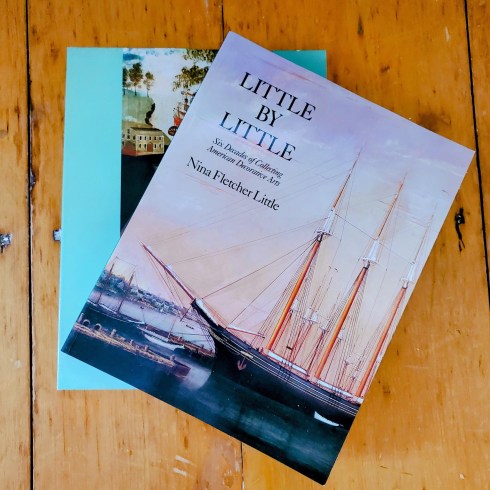
My perspective on the Littles was far too Salem-centric, as Bertram Little was the son of Salem Mayor (as well as naval architect, photographer, silversmith, military officer, bank director, and the last collector of the Custom House) David Mason Little and grew up on Chestnut Street in the midst of other Littles. But his purview, along with that of his wife and and collecting partner, Nina Fletcher of Brookline, was regional rather than parochial. They were New Englanders, who lived in Brookline during most of the year and at Cogswell’s Grant during the summers, from the late 1930s. I did not appreciate the professionalism of their collecting activities to the extent that I should have, or their partnership, or her scholarship: I returned home with just a few of her many books. Generally, when I visit a historic house I feel that I can sum it up in a somewhat representative way pretty quickly, but there’s just too many stories at Cogswell’s Grant: I’ve got to go back for more. It’s probably best to approach the vast collection through categories, which Mrs. Little does in her narrative of how their collection grew, Little by Little. Six Decades of Collecting American Decorative Arts (although as Kristen pointed out, this very accessible book employs a chronological framework as well). Again, so many stories: she was collecting stories as well as objects. Beginning with her first piece of blue and white Staffordshire she leads us through fireplace accessories, hooked rugs, clocks, “useful wares,” furniture, maritime art (the collection of which was tied to her husband’s Salem heritage), decoys, textiles, pictorial panels, all manner of portraits and paintings, and interesting miscellaneous items, like the engraved ostrich eggs the Littles purchased at a North Shore auction on the eve of World War II: they had to use a good amount of their precious gas ration to attend, but it was worth it! The portraits stand out in my photographs, just as they do in the house, but they are only part of a much larger story.

The open hearth kitchen/dining room and various halls of objects. An anonymous couple in their finery by Royall Brewster Smith, c. 1830.

With so much visual stimulation, you can either get overwhelmed or adopt a very personal perspective on what you are seeing: I always try to do the latter. Of all the portraits at Cogswell’s Grant, the one that I had the most immediate reaction to was of eighty-four-year-old Jacob Gould [Jacop Goold] by Benjamin Greenleaf, painted in 1803. He has an open book and a conspicuously-pointed finger, but all I could see was his red cap! I had just been proofing the copy edits to my forthcoming book the day before, and one chapter has a section on Renaissance suggestions for better sleep: wear a red cap!

Mr. Gould in his red cap; second-floor parlor and bedrooms; an amazing pictorial collage of the arrival of the first Oddfellows in America (there they are in the bottom left corner!); the BIG barn.


Tragedy amidst the Everyday

I LOVE Diaries: they offer such personal perspectives into the past, encompassing both “big” events and everyday occurrences. I read diaries, teach with diaries, and think about diaries often. I even like books about diaries, such as Kate O’Brien’s volume in my favorite Britain in Pictures series. So it is rather odd that I have omitted one of the most important diaries of a Salem woman in this year of #SalemSuffrageSaturdays until now: that of Mary Vial Holyoke (1737-1802), the second wife of Salem’s most eminent physician, Edward Augustus Holyoke (1728-1829). Mary’s diary was published in a compiled volume of Holyoke diaries published by the Essex Institute in 1911, after having been in the possession of several collectors, including the famed Salem numismatist Matthew Stickney.

Photograph of a Greenwood Portrait of Mary Simpson Vial before her Marriage.

1771 Portraits of Dr. Edward Augustus Holyoke and Mary Vial Holyoke by Salem artist Benjamin Blyth, referred to in Mary’s diary: Dr. Holyoke’s portrait, which descended in the Osgood family, is from the Northeast Auctions archive; Mary’s portrait, which descended in the Nichols family, appears to be lost at present.


Last week’s list of “notable Salem women” from the perspective of 1939 included Mary and drew me back to her diary, a record of 40 years of her rather enclosed life in Salem from 1760 to 1799. I had read it several times before but found it………….. unpleasant is the word I think I want to use. At first reading, the impression that I formed was of a superficial woman who gave birth to babies annually—most of which died within days—and resumed her social activities and household duties without missing a beat. None of this was unfamiliar to me as an early modernist: infant mortality hovered between 15 and 20% while 60% of all children born died before the age of 16 in the sixteenth and seventeenth centuries and childbirth was the leading cause of death for women, who were not especially introspective when they took pen to paper. But both Mary’s losses (8 of her 12 children) and her diary’s quickfire mix of the mundane and the sorrowful are comparatively extreme. Just one page of entries from the summer of 1767 contains entries about gardening, polishing or “scouring” furniture brasses, hanging bed curtains, attending “turtle” feasts and hosting the regular Monday assembly. Then on September 5 she was “brought to bed” at 2:00 in the morning, and gave birth to a daughter baptized Mary on the next day. On September 7 she reports that “The Baby very well till ten o’clock in the evening & then taken with fits.” Two days later, “It Died about 8:00 in the morning.” On the next day, we read simply “was buried” without even a pronoun.

A child’s shoe last from the first half of the nineteenth century, Historic New England

As I read the diary again over this past week more carefully, Mary emerged as a more thoughtful, caring, and substantive person. She was among a circle of women in Salem who were not just drinking tea and attending “turtles” (I love this name for social gatherings and think we should resume it) with great regularity, but also attending all those were brought to bed: for birth, for illness, for death: they were always “watching”. Mary was watched, her dying children were watched, and she herself watched. The entry above seems cold to be sure, but Mary generally referred to “my dear child” while noting the burials of her infants. And then there was the particularly poignant entry after the death of yet another of her newborns in 1770: the same as all the others. You almost can’t blame her for getting right back to the business of household work, which she does with great relish after she and the Dr. (this is how she refers to her husband) move into their permanent house on Essex Steet: this becomes “our house” and there’s a lot of work to do to maintain it: scouring, provisioning, ironing, soap-making, bottling, sewing, cooking, gardening, preserving (preserved damsons, a week too late! exclamation mine) and other tasks are all noted in detail. I think I dismissed the diary previously because Mary had little to say about the Revolution, but she does take note of the repeal of the Stamp Act and the “setting off” of a “feathered man” before the Revolution, and as it proceeds she gradually refers to the Americans as “our people”, perhaps reflecting her husband’s transition from Tory to Patriot. Dr. Holyoke was an early adopter of smallpox inoculation, and she records the constant outbreaks as well as the incremental inoculations. Earthquakes also appear with surprising regularity in the diary: I had no idea Salem was subject to so many tremors in the later eighteenth century. Extreme weather was also notable: Salem experienced some very hot summers and several “great” snows during Mary’s lifetime she elaborates on the former and is quite succinct about the latter. There’s more to learn about and from Mary Vial Holyoke, to be sure: you’ve just got to read carefully, between the lines and with careful attention to the personal pronouns, as she brings us into her world.

The Bowditch-Holyoke House at the corner of Essex & Central Streets in Salem, presently the site of the Naumkeag Block     


Elizabethan Exemplar

It’s been a long time since I featured one of my Renaissance crushes, but today is Sir Philip Sidney’s birthday so time to indulge. Sidney of course was a wonderful poet, but for me he is much more than that: he is the perfect Elizabethan Renaissance Man, multi-faceted, adept at both words and action, on the spot in all the key settings. He is one of those people whose lives can represent an age, albeit a rarefied experience. And he died young, on the battlefield, so that just makes him more: more elusive, more martyr-like, more crush-worthy. His notable contemporaries who lived longer had more layered lives in which both their attributes and their flaws were manifested, but Sidney seems flawless. His biographers note his proficiency in all the subjects in the studia humanitatis, but he himself asserted that one should aim for “well-doing, and not of well-knowing only” in The Defence of Poesy (published posthumously in 1595).

Sidney 2012-03-09-images-sidney_ma409_4_engraving The Sensational Sidney brothers as boys: Sir Philip and Sir Robert, from a painting by Mark Garrard at the Sidney’s ancestral home Penshurst Palace, Kent.

Sir Philip Sidney (1554-1586) was always connected: He was the eldest son of Sir Henry Sidney, the Lord Deputy of Ireland, the nephew of Queen Elizabeth’s favorite, Robert Dudley, and the godson of King Philip of Spain. I’m not sure he would have been happy about this latter affiliation given that he became a relatively strident Protestant later on, which was perhaps a flaw in Queen Elizabeth’s estimation as she preferred a more moderate public religious stance and must have been very annoyed when Sidney opposed her marriage to Francis, the Duke of Alençon and Anjou, in 1579 on religious grounds. His principled Protestantism is not a problem for me, however: it makes him look like less of a dilettante courtier. Sidney was educated at Oxford but left for a “Grand Tour” on the Continent before taking his degree: clearly he was ahead of his time as this custom did not become popular among the English aristocracy until a century later. He returned to England to the life of a courtier (when he pleased Elizabeth), patron and poet, but clearly longed for some kind of serious placement, which he eventually received in the form of various official diplomatic missions on the Continent. In between, he commenced writing his corpus of poetry, invested in overseas expeditions, and spent time at the estate of his beloved sister, Mary, the Countess of Pembroke, to whom he dedicated his most ambitious work, The Arcadia, and who established a reputation as both a literary patron and poet(ess) herself.

Sidney 1577 (3)_edited

pixlr_20191130100316782-1 Sir Philip Sidney, 1577-78, courtesy the Marquess of Bath, Longleat House; A trio of Sidney copied portraits from the sixteenth, eighteenth, and twentieth centuries: National Portrait Gallery, London; an 18th century copy, NPG, London, and a 20th century version attributed to Frederick Hawkesworth Sinclair, Pembroke College, Oxford University.

All of the Sidneys are so interwoven with Elizabeth, most conspicuously Philip and Mary’s mother Mary Dudley Sidney (also a writer!) who served and nursed the Queen during her smallpox seclusion, contracting the disease herself and marring her beauty permanently. There is a theme of sacrifice that connects mother to son: Philip accompanied his uncle the Earl of Leicester’s expedition to the Netherlands in 1586 to fight England’s now arch-enemy Spain, and reportedly urged Leicester to push harder, eventually falling on the battlefield himself at the Battle of Zutphen. He was shot in the thigh, but took 21 days to die—likely of gangrene. He then becomes larger than life, memorialized by an ostentatious public funeral (paid for by his father-in-law Francis Walsingham), elegies, biographies and posthumous portraits. He is forever young and bold in imagery, and ever eloquent in text.

Sidney 17th Knole_edited

screenshot_20191130-080116_chrome

screenshot_20191130-075953_chrome

screenshot_20191130-080224_chrome Sir Philip Sidney, early 17th century, National Trust @Knole; by John de Critz the Elder, c. 1620; by John de Critz the Elder, 17th century; by George Knapton, 1739.


A Breech-less Brute

The students in my Elizabethan class had quite a lot to say about Marcus Gheerhaerts’ 1594 portrait of Captain Thomas Lee yesterday: it is indeed a provocative portrait and he was indeed a provocative man. A poor relation of Sir Henry Lee, the Queen’s Champion and Master of the Armouries, Thomas’s career is characterized by his long “service” in Ireland, from the mid 1570s until the late 1590s, after which he was implicated in the Essex Rebellion of 1601 and executed for treason. In his pursuit of the conquest of Ireland and his own personal gain, Captain Lee murdered, blinded, stole, and conspired. When he was not “serving”, he engaged in highway robbery and was imprisoned for debt. He was not a happy outlaw, however, and the Gheerhaerts portrait, along with his two essays, A brief declaration of the government of Ireland  (1594) and The discovery and recovery of Ireland with the author’s apology (1599), are attempts to repair his reputation. Too little too late–though his arrest and execution at Tyburn in February of 1601 were consequences of his involvement in the Essex plot rather than any of his actions in Ireland, which were supposedly on behalf of the Queen.

Captain_Thomas_Lee_by_Marcus_Gheeraerts Portrait of Captain Thomas Lee by Marcus Gheeraerts II, 1594, Tate Britain.

Well of course this personal history does not explain why Captain Lee is not wearing pants (or breeches, or hose). Clearly that is the defining feature of this portrait, commonly known as “the man with the bare legs”. There’s something vaguely classical about the painting, with its pastoral background and Latin inscription on the right: Facere et pati Fortia, “To act and suffer bravely”, a quotation from Livy’s history of the Roman commander Caius Mucius Scaevola, who defeated Etruscan rebels by penetrating their camp and living among them, so he could know the enemy. He was recognized for his bravery and rewarded handsomely by the Roman government for his efforts and thus represented a useful example for Lee, who perhaps saw himself as performing a similar service for the Queen among the “wild” Irish. Despite its fanciful fabric, Lee’s outfit is actually a bit more pragmatic: he is fully-armed and wears some semblance of the “uniform” of an Irish foot-soldier, or “wood-kerne”, bare-legged to better accommodate the boggy terrain of the Emerald Isle. So Lee is presenting himself as Irish: he has “gone native” in the (sacrificial) service of the Queen. The true measure of his claimed “sacrifice” can only be grasped through a realization of just how “wilde”, barbaric, and brutal the English perceived and presented the Irish to be: John Derrick’s Image of Irelande (1581) is a good source for this, as is a book by another man who was constantly currying favor with the Queen, Edmund Spenser’s thoroughly racist View of the Present State of Ireland (c. 1596).

Lee Discovery Folger

1024px-The_Image_of_Irelande_-_plate01

Lee’s discoverye and recoverye of Ireland with the authors apologie, ca. 1600. Folger Shakespeare Library: John Derrick, The Image of Irelande, with a Discoverie of Woodkarne, 1581, Edinburgh University Library.

Save

Save

Save

Save

Save

