Tag Archives: Photography

Frosty Salem

So I was going to bring you some photographs of Salem during yesterday’s snowstorm today, but that would have necessitated actually going out and walking around, and just a few steps from my backyard out onto Chestnut Street at midday were enough to convince me that I didn’t want to do that. So I have images of snowstorms past, mostly new discoveries, and most from the Peabody Essex Museum’s Phillips Library, which possesses the largest collection of famed photographers Frank Cousins and Samuel Chamberlain, as well as images by amateur photographers in family papers. True to their promises of several years ago, the Phillips librarians have been steadily digitizing their local collections and everytime I go their digital collections page I see new-to-me things. If you’re new to Salem photo-sleuthing, you can just start with their very accessible “Salem Streets” collection, culled from a variety of sources. And of course all the glass plate negatives of Frank Cousins were digitized quite a while ago, and can also be found at Digital Commonwealth. My title is from Cousins, who assembled several of his favorite images for an 1891 collage, which I imagine was hung in the window of his Bee-Hiveย shop that very winter. Then I’m going to double back and proceed in chronological order.

So let’s go back a decade into the 1880s, when we really start to see a lot of photographs of Salem streets and buildings, both commercially published and popping up in family papers. I’ll never forget opening up the volumes of the Francis Lee papers a few summers ago at the Phillips Library in Rowley and seeing all of these gorgeous photographs from the mid-1880s. The photos below are from the same time period—1884-86—and this first amazing one is taken from the vantage point of Lee’s house, 14 Chestnut Street. No filter! Isn’t this a striking image? This photo and those that follow are attributed to John Robinson, a Salem author and horticulturalist and trustee of pretty much every single civic institution in the city at the time. I wasn’t aware that he was a photographer as well; I don’t know if had commissioned these images for some future publication? The last one of this group is from the vantage point of his house on Summer Street, and so we have two striking views of Samuel McIntire’s South Church, which burned to the ground in 1903.

Chestnut Street winters, Salem Streets collection, Phillips Library, Peabody Essex Museum.

The 1890s:ย was Frank Cousins’ most productive decade as a photographer. He loved to photograph Chestnut Street too, but he branched out, all over the city, as his “Frosty Salem” poster illustrates. I love his winter shots because many of them include people, while his more formal architectural photographs decidedly do not.

Essex Street, the Common, Dearborn and Lafayette Streets,1890s, Frank Cousins Glass Plate Negative Collection, Phillips Library via Digital Commonwealth.

Also from the 1890s are several photographs by amateur photographers of an uprooted (Elm?) tree on Chestnut Street, with every possible angle captured!ย  I have looked in vain for more views of dealingย with the snow, but this is as close as I could get. Closing out this decade are several beautiful photographs of the Pickering and Bartlett houses on Broad Street which are somehow connected to (taken by?) a certain Katherine A. Pond. I need to know more about her.

Chestnut and Broad Streets, 1890s, Phillips Library Digital Collections.

The 1920s:ย when I was looking for photos of Salem’s 1926 Tercentenary in various family albums at the Phillips, I came across the photos of the winter of 1924-25 in Francis Tuckerman Parker’s album. Again, these are not professional, and they are not digitized—I just took photos of the snapshots myself—so they not that great quality, but they are so interesting for what they show. The first image shows the intersection of Chestnut, Summer, and Norman Streets and on the extreme right is what I think is the last photograph of Samuel McIntire’s house before its demolition. The second, looking up Chestunt in the other direction, shows the church that replaced McIntire’s South Church, which was later demolished. Then we have a snow trolley on Essex, and a very messy intersection at the Essex and Summer.

Salem in the winter of 1924-25, Parker Family Photograph Album, Phillips Library.

1930s:ย the Phillips Library also possesses the huge negative collection of Samuel Chamberlain, a very important mid-century photographer of New England architecture and scenery, which is accessible at Digital Commonwealth. Chamberlain publishedย Historic Salem in Four Seasonsย in 1938, so I assume these photos are from that time, but the collection encompasses his entire career. Pioneer Village, Salem’s outdoor living-history museum, was in its first decade, and Chamberlain photographed its buildings and landscape lavishly.

Pioneer Village by Samuel Chamberlain, Digital Commonwealth.

And finally, a street view of Broad Street in 1956 and an aerial view of Chestnut in 1972, both after the storms. The latter is included in a feature inย Lifeย magazine in that year, prompted by President Nixon’s visit to China. Eastern-oriented Salem seemed like a good place to examine American perspectives on Asia at that time; I don’t think that would be the first Salem association now.

Salem in 1956 and 1972: William F. Abbott collection at the Phillips Library and Life magazine, 1972.


Norman Street Will Break Your Heart

Norman Street has been an important street in Salem for centuries, serving as an east-west way first to the harbor, then to the train station, and linking downtown and the city’s west-lying residential neighborhoods. It was once tree-lined, along with Georgian colonial houses interspersed with shops. It had a bit of a reputation as an American “Harley Street,” with several prominent physicians in residence, and it even has an eerie element, referenced by an entry in Nathaniel Hawthorne’s notebook for 1839 in which he recounts a story told to him by Custom House inspector William Pike, who “Another time โ€” or, as I think, two or three other times โ€” saw the figure of a man standing motionless for half an hour in Norman street, where the headless ghost is said to walk.” Norman street was also Samuel McIntire-central: Fiske Kimball asserted that the great architect and woodcarver was born at #21, and both his father and brother lived (and worked) on the street. Despite its heritage, and because of its continuous role as a central corridor, Norman Street was very vulnerable to one of the most dominant forces of the twentieth century: the car. From about 1930, it was transformed from a human-scaled city street into a wide suburban “connector,” a process that was intensified with the construction of two large buildings at its eastern and western ends, a new U.S. Post Office building and the headquarters for the Holyoke Mutual Fire Insurance Company. These buildings wiped out more than 50 residences on their side of the street and adjacent streets, even more after the Holyoke building’s expansion in the 1970s. On the north side of Norman, the New England Telephone Company initiated a similar cascade of demolition commencing several decades earlier. Business and residency had co-existed on Norman Street since Salem’s founding, but these larger businesses brought more workers and more traffic. The street was widened considerably, causing it to lose much of its residential charm, and one by one the remaining colonial houses fell, along with all of its trees. There is no question that the car was the major culprit in this unfortunate transformation, but Norman Street is also a study in how little control a municipality has over urban development if it does not have robust planning tools in place, or if it chooses not to utilize those tools.ย  When I look at Norman Street today it appears that the City of Salem seems to have essentially written it off, leaving it to landlords and speeding cars. If you’re a preservationist or a pedestrian, Norman Street will break your heart, especially if you know what was there before.

Norman Street past.

Looking down (east) Norman Street in the 1880s and 1910s, Lee MSS & Frank Cousins slide, Phillips Library, Peabody Essex Museum; the Cox House, 1890s, Dionne Collection, Salem State University Archives & Special Collections. EIGHT LARGE BRICK OVEN FIREPLACES in the Felt House, an “antiquarian’s delight.” Looking west towards Chestnut Street, Lee MSS, Phillips Library and “Newsboys” at the corner of Washington and Norman Streets, c. 1910, Salem State University Archives & Special Collections. The very famous Mansfield House with its carved stair and mantel, Cousins photos and Boston Architectural College Yearbook for 1925; wallpaper from Dr. Cook’s famous house on Norman Street, the Magazine Antiques, June 1925; Postcard of the new Holyoke Mutual Fire Insurance Company headquarters at the corner of Summer and Norman Streets, 1936, SSU Archives & Special Collections; the Texaco station across the street, 1979, MACRIS; New condos at the northeastern end of Norman Street, 1982, Boston Globe and SSU Archives & Special Collections.

The last two photos of condo conversion and construction in the 1980s represent a positive change for Norman Street: the return of residents! The business blocks and setbacks, along with the widening of the street, have certainly left their mark, however, as you can see from the photographs below which I took this weekend. It’s hard to recognize this once charming street. A couple of years ago, I kind of got my hopes up for Norman, and that’s why heartbreak is in my title (and also the description of the Felt House above). Responding to the crush of traffic at the terrible intersection of Norman and Summer, the City installed a mini roundabout, and I thought this might be the start of a concerted effort to recognize the street as a proper entranceย corridor, but no, it’s just a circle of fake brick in the middle of the road. Drivers still get so frustrated by this intersection that they tend to speed up before and after, which is why I’m always anxious about crossing Norman Street. Bordering this circle are beautiful Chestnut Street houses on the west side and the hulking former Holyoke buildingย  and an 18th century house with a strident 21st century addition on the east: this space sends a mixed message! Last summer, the weeds surrounding the Holyoke building reached up to its lower windows, and signs and litter are always strewn about. Its owner has had difficulty finding commercial tenants, and so part of the building (I think the original 1930s building) will now be consigned to a homeless center for families operated by Centerboard, the largest housing provider in Massachusetts. A proposed new housing development for the Texaco site across the street has just been granted significant tax credits by the Commonwealth, and so will now go forward. At the very least, this project (you can see a rendering here, but it’s from a couple of years ago) should eliminate that hole along the streetscape, but I hope the design does more than that. In fact, I think that this new building is Norman Street’s only hope.

Norman Street present.


It would be nice if that “Caution X-Walk Ahead” sign was positioned towards drivers in the street rather than pedestrians on the sidewalk.


Salem’s Abandoned Revolutionary Forts: a Bicentennial View

Every time I go up to the treasure trove that is the Phillips Library it’s a significant commitment of time so I try to order up a variety of items so I can accomplish whatever mission I’m on but also treat myself. Its collections are so diverse that you can always find something new and exciting but you have to spend some time in the catalog before you even get there. Fortunately, there are very good finding aids, for which I will always be grateful to the librarians who craft them. Last week I was after materials relating to Salem’s Tercentenary in 1926 but I also wanted to look at sources for the Revolution: I’m giving a talk on Salem’s early revolutionary role later this semester so am on the hunt for anything that can add a few anecdotes. It was actually thrilling to look at one small paper-bound journal constituting the records of Salem’s Committee of Correspondence for 1775-1776 and quite another experience to look at some photos of our city’s long-abandoned forts, Fort Pickering and Fort Lee, taken during the Bicentennial 200 years later. I have never been able to figure out what the City’s policy is towards these installations beyond benign neglect: Fort Lee is all grown over and Fort Pickering has these strange plaques dedicated to the US Army’s Special Forces which have nothing to do with its history or that of Salem. There have been myriad studies and reports: with funding from the Massachusetts Historical Commission, the City commissioned an excellent study in 2003 that used to be online but now I can’t find it, and Essex Heritage sponsored another comprehensive study which was published in 2023. Maybe this recent report will inspire some action! The photographs below were all taken by a man named Alfred K. Shroeder for the Council on Abandoned Military Posts, New England Chapter, and he captures both the sites and the ceremony, nearly fifty years ago.

Apparently The Council on Abandoned Military Posts is now CAMP: the Council on America’s Military Past. Below: Several perspectives on the Bicentennial commemorations at Fort Pickering:

Winter Island has aย longย military history and was home not only to Fort Pickering but also Coast Guard Air Station Salem from 1935 to 1970, which became an air-rescue station in the last year of World War II. The property then passed to the City of Salem. The first picture below shows the doors of the station’s hangar and the barracks—in much better condition in 1976 than now—and then aerial views of Fort Pickering and the adjacent Winter Island structures from different perspectives. Finally, there are some steps to Fort Lee, just off the island on Salem Neck, and an aerial view of its groundworks.

Phillips Library PHA 107: Photographs of abandoned military posts in Salem, Mass., 1976.

Putting in another plug/link for the recent historical narrative & resource study on Forts Pickering and Lee by Frederick C. Detwiller as it should be your first stop if you want to learn more about these forts!ย 


In Praise of a Handcrafted Halloween

So here I am in Salem, supposedly the Halloween capital of the world, wondering where all the creative costumes are. I’ve tried to embrace the “holiday” (invasion) this year (well not really, but I did take several walks) but all I have seen for costumes are flimsy puritans, vampires and superheroes and a sea of those little felt witch hats: nothing original or creative or made from a natural fabric (well, maybe the hats). My stepson came down from Maine for the weekend to prowl about with his friends in a pirate costume that he had purchased from one of those Halloween superstores along the way: I said “you can’t put together a PIRATE costume yourself!ย He did have the cool idea of going as Tiny Tim as he is 6’5” and on one crutch because of a sprained ankle, but I have yet to see him put this costume together. I’m wondering where the creativity is? Salem is instagram city at this time of year and those cheap costumes are hardly instagrammable: more of an effort would certainly result in viral views. Dogs have better outfits out there: I’ve seen pumpkins, bees, and even avocado toast! There is certainly lots of historical inspiration for humans, including British fancy dress books and digitized fashion plates and some great photography books on Halloween. We’ll see: the big day approaches.

But what are we to wear?ย Some suggestions from Arderne Holt’s Fancy Dresses Described or What to Wear at Fancy Balls (1887). You can be a box of dominoes or a bowl of lemons, and also a hornet or a witch (if you must). I think the hornet costume could do double duty as a bee.

Costume books published in the US are a bit less elaborate and historical than their British counterparts in the later nineteenth century, and also more…..paternalistic (is that possible)? We will skip past all the Native American costumes and go straight to the usual Halloween suspects, with a bit of whimsy for Miss Chess and Master Chimney Sweep….plus a pint-sized Guy Fawkes. These are still pretty elaborate costumes though—I’d have to distil them down considerably in terms of detail. Masquerade and carnival: their customs and costumesย (1892) also includes some from Robin Hood: perhaps the inspiration for a c. 1907 item in the collections of Historic New England?

From the same period is this incredible handcrafted “Imperialist” skirt from the John Bright Collection—a template for any political commentary surely. I am hoping for some political costumes this year but we’ll see.

When I was looking for inspiration for this post, I discovered a new book and dusted off another. The discovery is anย amazingย book of photography entitled Dressed for Thrills: 100 Years of Halloween Costumes and Masquerade (2002) by Phyllis Golembo.I’ve ordered this book but haven’t received it yet, so the photos below are from Golembo’s website. I can’t wait for the book to arrive so I can see every single photograph, because what I have seen is so very arresting: who knew that just photographing scraps of fabric could be so effective? We’ve all seen those photographs of early 20th century costumed revelers, from the time when tricks and maskingย were more important than the recognition of pop culture personas. They look eerie and odd. But somehow the costumes alone look eerier and odder still! The evil bunny mask below is frightening, and so is the Mickey Mouse costume, both from the 1930s.

The book I dusted off is a book I never opened and I have no idea when or where I got it:ย Jane Asher’s Fancy Dress, first published in 1983 (and later as Jane Asher’s Costume Book). It’s full of whimsical costumes modeled by British actors and actresses of the 1980s, including Terry Jones. One day last week I was showing an episode of Jones’ Crusades series to my students and the next I was looking at him dressed as a “blob”! Now these are costumes you can actually make, from around-the-house materials like cardboard toilet paper rolls (glued together to make a British judge’s wig). The little Elizabeth and peapod below are a little more involved, but this bat has wings made from a broken black umbrella!


Miss Abbott’s Albums

Summers have been about old Salem photographs for the past several years. I go up to the Phillips Library to research something, order up a few old photograph albums to give myself a break, and then just dive in to another world, another Salem. Last year I really had to restrict myself as I was still wrting chapters for our forthcoming bookย Salem’s Centuries; this year the book is essentially done so I’m just looking for a few images to illustrate it, or so I tell myself. Really, I just like to look at old photographs. Last week I looked through the three albums of Miss Lilly S. Abbott, a librarian at the Salem Public Library, who began her tenure in 1925 and rose through the positions of assistant, children’s librarian, reference librarian, acting director and assistant director over her 47 years at the library. She was obviously a committed collector and curator of photographs, choosing very important images for her albums, and labeling them on the front or back. She supplied photographs to the Salem Evening News, and also to the Salem Cultural Council’s exhibition of “Salem Streets and People” in 1971. Some of her photos I had seen before, but many were new to me. I sharpened up a few photographs below, but most of her photos were very clear and had been processed from lantern slides very effectively. Unlike a lot of Salem photographers and photography collectors, she was obviously more focused on Salem streets and people than on structures: most of her album photos feature downtown, and she obviously loved the Willows too.

Here are some of my favorites: first, a group of photos of downtown Salem—some are dated, most are not, but I think they’re from about 1900-1920, beginning with this great photo of Ash Street in 1900. Urban Renewal wiped Ash Street out, and now it only has one house!

Ash Street, Crombie Street, Essex Street, Norman Street, North Street and Bridge, Washington Street.

Here’s a few of Derby Street, including the Philadelphia wharf—-I was very excited to see this as it was built by the man who lived in my house. Plus, David Little on his “Little Steamer,” Salem’s first automobile! (Miss Abbott seems to have been very interested inย transportation).

On to the Willows: including interior and exterior shots of the famous Brown’s Flying Horses carousel,ย in situย in Salem until 1945.

Some odds and ends: the only photos of famed Chestnut Street in Miss Abbott’s albums are very different: a car driving west, which to us will look like the wrong way, as it is one-way the other way now, and the day after the fire that destroyed Samuel McIntire’s Second Church in 1903. I’ve never seen this. Then there’s the Tontine building on Warren Street, destroyed by the Great Salem Fire in 1914, and a great photo of the Gedney House on High Street before its acquisition and restoration by Historic New England. Finally, Old Home Week, always a BIG celebration in Salem, in 1909. I’m grateful to Miss Abbott for preserving these wonderful images of Salem streets and people.

Town House Square, 1909.

Lily S. Abbott Photographic Albums (PHA 113). Couresy of Miss Abbott and the Phillips Library of the Peabody Essex Museum, Rowley, Massachusetts. Miss Abbott donated the albums to the Essex Institute in Salem in 1981 in memory of her brother, William.


The Troublesome Girls

A few weeks ago, a social media post popped up on my feeds from Destination Salem, our city’s official tourism office, featuring two young women dressed in garish costumes with giggly grins. They were/are wannabe “girl historians” (actually not historians at all) visiting Salem to promote their current podcast series, a comedy on the Salem Witch Trials. I was taken aback; you see and hear all sorts of exploitative expressions about 1692 in Salem, but seldom from “official” parties, which tend to walk a finer line. I reposted, along with a statement about how absolutely funnyย the witch trials were, and the next day the post disappeared. I had captured a screen shot, however, and here it is.

I was kind of angry when I captured the screen shot, but over the following week I just forgot about it. I really didn’t want to invest much time into something that seemed kind of silly. I tried to listen to the “girls,” but all I can say is: there are many great history podcasts, a lot of great podcasts by real historians who happen to be women, and several great podcasts on the Salem witch trials, and their podcast falls into none of those categories. But it’s not about them, really; it’s about Salem, because Destination Salem represents the City, and by extension, its residents. The photograph above kept dwelling in the back of my mind (rent-free!) and after a while I realized that it was conjuring up memories of another photograph, or series of photographs. There was a huge spread inย Lifeย magazine in September of 1949 on Marian Starkey’s groundbreaking new book,ย The Devil in Massachusetts: a Modern Enquiry into the Salem Witch Trials,ย which featured very evocative photographs of Salem sites and the “Salem girls” by photographer Nina Leen. Now these photos were dress-up promotion, just like the photo of the “girl historians” above, but what a difference! The subtlety and poignancy and starkness represent respect of a tragedy,ย rather than the craven commercialization of a “comedy”. The promotion of an insignificant podcast seems so small, pathetic actually, when compared with a multi-page spread in a national periodical, so much so that the event itself seems reduced in significance.ย Funnyย how that happened.

Nina Leen photographs, Life Magazine, September 1949.


The Summer of Old Photographs

I worked all summer long on my chapters forย Salem’s Centuriesย and a few other projects, researching and writing, researching and writing, researching and writing. Once I’m on the trail, I’m a pretty steady worker, but I do take breaks: I’ve learned from other writing projects that you have to pause to let your mind absorb and process information. Sometimes the break might be at night when you’re asleep—I got into the habit of leaving a notebook by my bedside when I was writing my dissertation and when I woke up in the morning sometimes I would see notations inside that I didn’t even remember writing! That must have been one of the benefits of aย youngerย mind because it didn’t happen this summer, when all my breaks were conscious. Every time I went up to the Phillips Library in Rowley, I would dutifully call up boring municipal records but also collections which contained old photographs of Salem. I’d pore over them a bit and photograph them for later perusal, and by the end of the summer I had quite a collection. The Phillips has digitized two of its largest collections of Salem photographs: the Frank Cousins and Samuel Chamberlain collections, but there remain many seldom-seen images within collections. Fortunately there are great finding aids to locate such images, but also some very miscellaneous collections which yielded surprises, at least for me! I loved schoolteacher Grace Hood’s shots of the Salem and Massachusetts celebrations in 1926-1930 (PHA 67; including some completely new-to-me views of the opening day of Pioneer Village in 1930) and an unknown photographer’s depictions of a very gritty Salem encased in a large composite collection entitledย Photographs of interiors and exteriors of Salem, Mass., circa 1890-1950ย (PHA 151). And there’s much more.

Phillips Library PHA 67 & 151.

My favorite collection was the first one I accessed, back in May: a treasure trove of images contained in the scrapbooks of Francis Henry Lee of 14 Chestnut Street, mostly from the 1880s (Phillips Library MSS 128). Lee was the son-in-law of the woman who lived in my house, and a committed architectural antiquarian focused on documenting the history of every house on Chestnut and adjoining streets. He did not rely on hearsay, but sent queries to anyone who ever lived in the neighborhood, and his scrapbooks are filled with detailed responses, some written on black-trimmed stationery indicating that their authors were in mourning. I was familiar with his articles in the Historical Collections of the Essex Institute, but surprised to find his research materials accompanied by so many wonderful photographs.

Some of my favorites: (I filtered those that were really hazy or damaged).

Chestnut, Summer & Norman Streets from two perspectives. I’ll never get over how wonderful Norman Street was!

Riding and looking north on Summer Street, and then south (Samuel McIntire’s house is on the extreme left of the last photograph).

Broad Street, looking west.

Cambridge Street, looking north and south.

Work on Bott’s Court.

Hamilton Street, looking north.

Chestnut Street Houses—what’s going on with that figure at the third-floor level of the third photo above, which I think is #26?

Warren Street, looking towards the “Turnpike” (Highland Avenue).
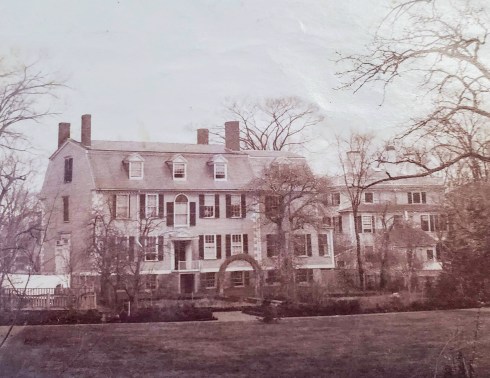
There were several photographs which were especially exciting to see among the Lee papers, including those which show the magnificent formal garden in the rear of the Cabot-Endicott-Low House on Essex Street, which extended to Chestnut before no. 30 Chestnut was built in 1896. This garden was quite famous: it was prominently featured in many horticultural publications and was by all accounts quite the tourist attraction, especially in the spring. A 1904 Boston Globe article on “Beautiful Old Gardens of Salem” reports thatย for many years the tulip bed was the greatest feature of this garden, and each spring, when these flowers were in perfection, and upper portion of the high fence on Chestnut was removed to enable the public to view the exhibit.

Even more exciting than this lost garden were two photographs of my own house that I had never seen before, including one sansย the apartment that was added on in phases between 1890-1910. Our house is the right side of a double house built in 1827: both sides were identifical until the 1850s, when one of our owners expanded the house considerably in back and altered the interior to look more fashionable at the time—round mouldings rather than square ones! The big entrance alteration reflects the changes inside, but I did not know that this guy also put new mouldings over the windows, and disdained shutters as too colonial, I guess. Several owners later, there was a sequential addition on the side of the house: first as an office for a very well-know opthamologist who lived here, and then bedrooms were built above: this is our present-day 7 1/2, a really cute apartment with the best views of Chestnut Street. I assumed that it covered up windows which were on the side of our house, but it looks like there were none. As you can see from all of the other photos of the street, Chestnut was driveway-less in the nineteenth-century: the larger houses had carriage access on Warren or Essex: the property of our house actually wrapped around Hamilton Hall next door and so our carriage house—long- demolished—accessed Cambridge Street.


Preservation Polaroids

I have heard, and read about, Salem’s experience with urban renewal many times, including first-hand accounts, so I thought I understood its causes, course and impact pretty well, but when you write about something, you have to engage on another level and come to yourย ownย understanding in order to explain it to others. It’s the same with teaching. One of the chapters forย Salem’s Centuriesย that I’ve been working on this summer is about the city’s development over the twentieth century and so I really had to dig deep into urban renewal. I decided to start fresh with primary sources, so I went through all the records of the Salem Redevelopment Authority (SRA) located up at the Phillips Library in Rowley (these are public records, which should be in Salem, but I’m actually glad they are in Rowley because the City’s digitized records are impossible to search and I don’t know how one might access the paper). The SRA was the agency created to oversee urban renewal in Salem’s downtown and it still has jurisdiction: its composition was incredibly important and remains so. I’m going to be quite succinct here, because the narrative is rather complex and therefore quite boring to read or write about, but here’s the gist of what happened: after conducting a comprehensive study in the early 1960s the City created the SRA and put forward a very ambitious urban renewal plan which was overwhelmingly focused onย clearance,ย including the demolition of between 120-140 buildings in Salem’s downtown area. The goal was to create a new pedestrian shopping plaza, to compete with the new Northshore Shopping Center just miles away in Peabody. The focus was on Parking, Parking, and more Parking. What I did not know before I delved into this research was that at the same time that this plan was brewing, Salem also had another committee looking at the downtown: an Historic District Study Committee, which was surveying all of central Salem’s buildings for inclusion in potential historic districts. What a clash! The “before” photos that you see below, candid polaroids, were taken by members of the Study Committee in 1965, the same year that the SRA was rolling out its demolition plan. Among the SRA records up in Rowley, there is a mimeographed document entitled a “Do it Yourself Walking Tour” prepared by John Barrett, Executive Director of the SRA, for Historic Salem, Inc., Salem’s preservation organization, then and now. It’s a remarkable document, because Barrett basically takes the Study Committee’s inventory and turns it into a hit list: this is what we’re going to demolish! Take a tour and see for yourself! There were 119 building slated for demolition, a number that would expand to over 140 over the next few years. The polaroids represent buildings that Salem’s preservationists were trying to save: they were successful in some cases, but not in others. Their resistance resulted in a far less destructive approach to “renewal”, however, which focused more on rehabilitation than destruction, as these images illustrate well.

This doesn’t line up perfectly, but what a great restoration +addition by Salem architect Oscar Padjen: very representative of the creativity ofย  “Plan B”!

As these photos also illustrate, once rehabilitation became an objective, several key buildings were restored in exemplary fashion, by local Salem architects and utilizing the new means of facade easements. If you compare past facades of these building with the present, urban renewal looks great, particularly with the hardscaping design of landscape architect John Collins of Philadelphia, whose work is also representative of the “Plan B” approach. What is more difficult to illustrate are the great wide swaths of buildings that were taken down, principally on the main Essex and Federal Streets but also on St. Peter and Brown Streets, while Plan A was still operational. We can never see these buildings restored, they were just swept away. What remains are parking lots and ghastly modern buildings. I’m not a fan of what was called the East India Mall in its orginal incarnation, but its colonnaded side entrance (not quite sure what to call it???) was quite distinctive, and it was butcheredย under the auspices of the SRA in the 1990s so now we have the Witch City Mall. I think Front Street (below) it probably the most perfect example of Plan B, along with Derby Square, but Central Street (just above) is pretty representative too.

Washington Street was the boundary of “Heritage Plaza East,” where most of the renewal activity happened in both phases, but it did not experience as much demolition as it had already weathered a major tunnel project just a decade before. That’s another realization for me: I somehow never put Salem’s “Big Dig,” during which its railroad tunnel was constructed and depot demolished in the 1950s, in such close chronological proximity to its experience with urban renewal in the 1960s. This generation of Salem residents weathered a lot of construction and dislocation: as always, past experiences temper the present. If you shift the perspective even further back, to the 1930s, when the new Post Office was built after an entire neighborhood was cleared out, you can understand why there is so much concern about the lack of housing downtown today: 51 buildings gone in the 1930s, 87 in the 1960s. Salem’s long “plaza policy” certainly took its toll, but I remain grateful to those residents who persevered in their preservation efforts for what remains.

Strking transformations on Washington Street.

NB: I’m confident in most of these past-and-present pairings, but not all, because streets numbers can change—not quite sure about the Subway market on Front Street for example……….


A Big Move

No, not me: the Crowninshield-Bentley House! Visiting Louise DuPont Crowninshield’s former garden in Marblehead last week prompted me to reconsider her impact on Salem as a preservation advocate and philanthropist as it is considerable. At least two institutions in Salem, the Salem Maritime National Historic Site and the Peabody Essex Museum, reflect her commitment to the preservation of Salem’s material heritage which was manifested both by her direct involvement and her inspiration. The best example of the latter is one of the Peabody Essex Museum’s historic houses, the Crowninshield-Bentley House, which was moved by the Essex Institute from a rather precarious position on Essex Street to its current location in 1959. This early Georgian house, home to generations of the Crowninshield family as well as Salem’s pre-eminent diarist the Reverend William Bentley, was originally located at 108 Essex Street. In 1958 the Hawthorne Hotel donated the house to the Essex Institute with the condition that it be removed to make way for a parking lot. The move to its new site adjacent to the Gardner-Pingree House and across the street from the Hotel, was preceded by the demolition of a venerable commercial building and succeeded by a comprehensive restoration to its 18th century form under the direction of Abbot Lowell Cummings as a tribute to the “work and memory of preservationist Louise DuPont Crowninshield.” The Crowninshield-Bentley House became the cornerstone of the Essex Institute (now Peabody Essex Museum)’s main “campus” of historic structures, and to complete the vision, gardens also dedicated to the legacy of Mrs. Crowninshield were installed in its midst. Another reason I wanted to post on this big move today is the great visual documentation by Essex Institute President Albert Goodhue, Jr., who snapped photographs of the the entire process over what must have been several days (weeks???) in 1965. These are among some great sources at the Phillips Library in Rowley documenting Salem’s ever-evolving streetscape, one of the major topics we’ll be covering in our upcoming book Salem’s Centuries.

Washington Square West and Essex Street, Salem (Mass.) Photographs, MSS 0.1619. Courtesy of Phillips Library, Peabody Essex Museum, Rowley, MA.

Amazing!!! I love the nonchalance of the pedestrians, and not a police detail in sight. Everyone is just going about their business while the walls are tumbling down! The building being demolished was quite a storied commercial building, also an 18th century structure (I think) but altered and extended considerably. There were some very notable apothecary and stationary shops located within, and Salem architect/artist William Henry Emmerton made an iconic image of it in 1850 when it was his cousin’s apothecary shop (Emmerton was a great draftsman, and the Phillips Library has digitized the records of his architectural firm, Emmerton, Foster & Putnam, so you can see more of his work here). Those big storefront windows were apparently the second of their kind installed in Salem, and the Paracelsus bust trade sign was pretty conspicuous too. After the move and restoration was completed, the Crowninshield-Bentley House received a lot of attention in both academic and popular publications: there are both feature articles and cover stories throughout the 1960s into the 1970s and even the 1980s. The more scholarly pieces tend to focus on the detailed 1761 probate inventory of Capt. John Crowninshield as a primary source for the restoration (which includes references to “a Negro man” valued at ยฃ66.13.4 and a “Negro woman” valued at ยฃ40 about whom I’d like to know more)ยง while trade periodicals seem to focus overwhelmingly on the kitchen. There’s a big spread on the interior of the house in the July 1987ย Colonial Homes, part of feature on Salem as the “showcase of early America,” which it was, then.

William Henry Emmerton, Apothecary shop of James Emerton in Salem, c.1850 (pen & ink and sepia wash on paper), Peabody Essex Museum; the Crowninshield-Bentley House on the cover of Americana, September 1973; the kitchen as photographed by Samuel Chamberlain (1970, Phillips Library via Digital Commonwealth) and in House and Garden, January 1974; Frank Cousins photograph of the house in its original Essex Street location, 1890s, Phillips Library via Digital Commonwealth. The House today.

ยง The Phillips Library has also digitized all of the booklets in the Essex Institute Historic House Booklet Series, including The CrowninshieldBentley House, Essex Institute historic house booklet series, no. 2, by Abbot Lowell Cummings, Dean A. Fales, Jr., & Gerald W.R. Ward, which you can access here. “An Inventory of the Estate of Capt. John Crowninshield Late of Salem and Apprized by Us the Subscribers at Salem November 10th 1761” is included as an Appendix.


Tattered Flags

The Civil War began with the lowering of a tattered 33-star flag from Fort Sumter in 1861 after which tattered flags defined, symbolized and memorialized the bravery, sacrifices and experiences of its participants on both sides for at least a half century—and likely much longer. There is no more powerful symbol of both commitment and conflict, and no more inspirational object. After surrenduring the Fort on April 12, Major Robert Anderson brought the Sumter storm flag with him to New York City, where it became the focus of a patriotic rally just a week later and then was put on a tour of northern cities to raise funds and rally troops. Almost exactly four years later and after the Confederate surrender of the fort, then Brevet Major-General Anderson returned to Charleston to raise the flag in a momentous ceremony that was overshadowed unfortunately by the assassination of President Lincoln. And in the interim, many flags were reduced to tatters and fragments.

Flag fallout: Edwin Francis Church painted several different versions of Our Banner in the Sky (Fine Art Museums of San Franciso, above), inspired by the tattered flag of Ft. Sumter. Commercial adaptations were printed, along with other Remember Fort Sumter! ephemeral images. Library of Congress.

Ever since I first saw the striking photograph of Sgt. William Carney of the Massachusetts 54th bearing the standard he rescued from the bloody battle of Fort Wagner in 1863 in Luis Emilio’s Brave Black Regimentย I have been struck by the visual poignancy of the tattered flag. He just wouldn’t let that flag go, and consequently he became the first African-American recipient of the Medal of Honor in 1900. Just a few years later, Sargeant Samuel Hendrickson Smith bore the colors of the storied 8th Massachusetts in a Salem parade: he suffered permanent damage to his sight, hearing, and speech during the War but lived until 1910.

Newspaper drawing of Sergeant Carney holding the American flag during the battle at Fort Wagner: from an article in the Boston Journal, “Hero of Fort Wagner: Tale of Color Bearer William H. Carney,” published on December 29, 1898; Sgt. Samuel Hendrickson Smith of Salem and the 8th and 19th Massachusetts Regiments, 1905.

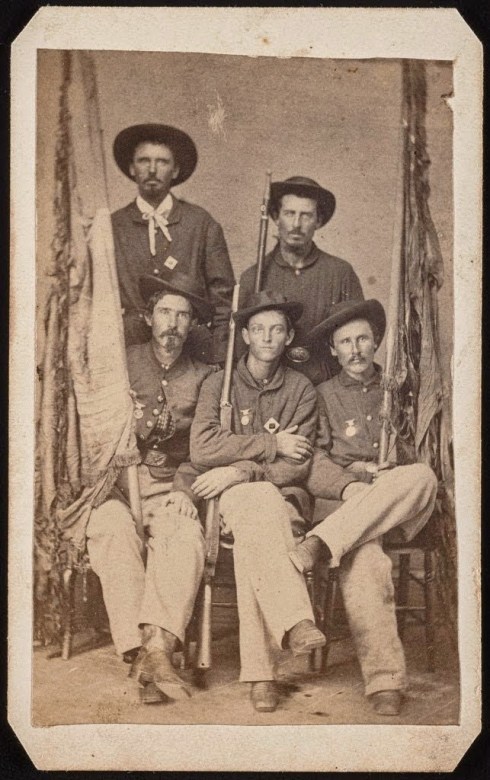
It’s easy to grasp the symbolic importance of the tattered flag image, during the Civil War and all wars really, but I never realized it was a distinct photographic genreย until fairly recently. The enormous popularity of the carte de visite, the new photographic technology of the mid 19th century, accounts for many images of flags and flag bearers. Louis-Dรฉsirรฉ Blanquart-Evrard had invented albumen printing, in which a negative photograph was printed on paper coated with egg whites (albumen) and mounted on thick cardstock, in the 1850s, resulting in a new mass media with expanded access toย  photographic images. The Fort Sumter flag tour could be expanded by degrees, and remembrance of individual, regimental, state and national service and sacrifice recorded for posterity. Tattered flags became “relics” of the war, both in the hands of their bearers and simply standing there in their distressed state. Here are a few of my favorite images among the collection of “Tattered Flag CDVs” (actually the their preferred term is “battle-torn”) at the Library of Congress:

19th Massachusetts; 7th Connecticut; 4th New Hampshire; 44th New York; 30th Ohio; 21st Mississippi, Library of Congress.

The images above were public: I’m wondering if war-torn flags confiscated during battles were also made so. The American Civil War Museum has a large collection of confederate flags captured by Union soldiers and the National Archives has an inventory entitled “Records of Rebel Flags Captured by Union Troops after April 19, 1861” (RG 94). Every state historical society or museum or state house has a collection of war-torn flags, “brought home” during or after (sometimes well after) the war. Sometimes there is just an assemblage of scraps and threads, or perhaps just a material outline of what is sometimes referred to as a “ghost” flag: and like any ghost, it is haunting.

Flag of an unidentified unit. Captured at the battle of the Wilderness, Virginia, May 12, 1864 by Lt. Benjamin Y. Draper, 1st Delaware Infantry and scraps of a confederate flag confiscated (and divided) during the occupation of Richmond by troops from Springfield, Massachuesetts, American Civil War Museum. Remnants of the 95th Pennsylvania and 1st Massachusetts flags, Cowan’s Auctions and Morphy Auctions.