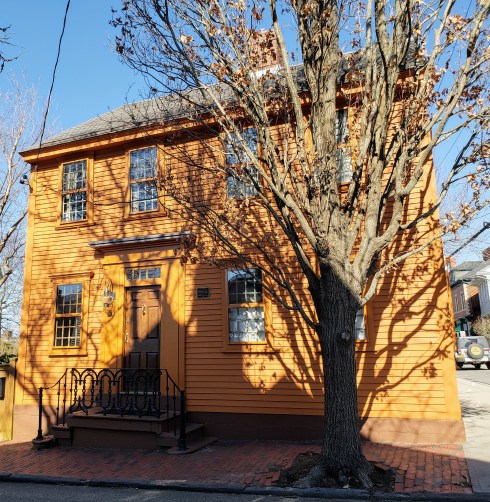
This is one of those “writing it out” posts. It starts out with confusion in the hope that I can work it out, but I may not so it might end in confusion as well. I’m confused about the symbolism of pineapples. Of course everyone knows that pineapples represent “hospitality,” but do they really? What else might they represent? I started out with the question as to whether pineapples are Colonial or Colonial Revival, and it seems that that they are both. I’m also wondering if there are differences in what they represent in the northern US as opposed to the south, and between the US and the UK. My wonder is prompted by recent road trips down south, where I saw a lot of pineapples, as well as an interest in symbolism in general prompted by the recent discussions here in Salem over our official city seal, which some see as stereotypical and rascist and others see as evocative of a proud global maritime heritage. I always find that a historical perspective helps with understanding both images and events; apparently the members of the Task Force charged with examing the seal do not. In any case, there’s always a personal and arbitrary angle: it’s so interesting that different people see very different things in the same image. And that is true of pineapples too: while for the most part they seem to convey a sense of decorative hospitality, they also have associations with exoticism and exclusivity and excess, colonization, plantations (both in the West Indies and Hawaii), coerced labor and ultimately slavery. I am always interested in Salem’s famed “Pineapple House,” a Georgian structure first located on Brown Street and then removed to Brown Street Court which was demolished by 1911 with only its pineapple-pedimented door preserved, first in the Essex Institute and now in the American galleries at the Peabody Essex Museum. I’ve written about it before, but I know more now: its pineapple was not a local creation but rather a British import and its importer, Captain Thomas Poynton, became one of Salem first Loyalistist refugees, leaving his house (and his wife!) for England in 1775. That conspicuous (always gilded by all accounts) pineapple might have had Tory associations in Revolutionary Salem, but nevertheless it became the inspiration for one of Salem’s most important Tercentenary expressions, the band stand on Salem Common erected in 1926.


There are pineapple motifs on New England furniture and wallpapers from the 18th century through the mid-twentieth, but in terms of conspicuous architectural detail I think the best examples are the Hunter House in Newport, RI and the Wentworth-Gardner House in Portsmouth, NH (after Salem’s Pineapple House, of course). The Hunter House was also owned by a prominent Loyalist, and a recent article on its new Orientation Gallery describes its current interpretation as a “paradigm shift”: Here visitors can examine a historic photograph of the house’s pineapple pediment alongside a silver coffee pot and a pair of covered baskets adorned with pineapple finials. The display discusses the tropical fruit as a product of colonization and slavery as well as a symbol of wealth and hospitality in colonial Newport. For the Preservation Society, which long ago adopted the pineapple as part of its logo, this analysis represents a paradigm shift. It’s been a few years since I’ve been on a tour, but I don’t think this kind of deep dive is offered up at the Wentworth Gardner House in Portsmouth, which was restored by none other than Colonial Revival evangelist and entrepreneur Wallace Nutting in 1916-18. And there’s no need, as Nutting added the pedimented pineapple, and the entire entrance surround to the house. This very Colonial Revival pineapple anticipated the ever-present fruit emblems at another prominent Colonial-esque institution: Colonial Williamsburg.


And down south, it’s the same thing: there are eighteenth-century pineapples and then there is a twentieth-century pineapple revival. Virginia’s oldest plantation, Shirley, has a very prominent three-foot-tall pineapple right at the apex of the roof of its main house, which was built around the same time as the Poynton House in Salem and the Hunter House in Newport. Installing a pineapple on the pinnacle of one’s roof must have been a James River Plantation thing, as Brandon Plantation has one as well. Another interesting transatlantic pineapple connection relates to the last Colonial Governor of Virginia, John Murray, the fourth Earl of Dunmore, who commissioned a stone-carved pineapple summerhouse for his Scottish estate in 1761, likely the most famous pineapple construction in the world. The pineapple is very prominent in Charleston, of course, with the pineapple gateposts (which I think were supposed to be pinecones?) of the Simmons-Edwards House dating from around 1816 and the famous pineapple fountain dating from 1990.


 Shirley and Brandon Plantations in Virginia; The Dunmore Pineapple, Stirlingshire, Scotland via the National Trust for Scotland; Gate at the Simmons-Edwards House at 14 Legare Street, Charleston, built 1816, from the lovely site Glimpses of Charleston; some pineapple images from one of my favorite books, Charleston Style, by Susan Sully with photographs by John Blais.
Pineapples on the gatepost (and I suppose by extension the very popular pineapple doorknocker) are said to be visual “traditions” based on the practice of ship captains returning from exotic realms displaying pineapples on their properties to indicate that they were home, and ready to receive visitors. This story is repeated again and again and again, but I don’t seem to find any references to it before the early twentieth century. I think it’s more Colonial Revival romance. Pineapple stories just keep getting repeated with very little insight, analysis or research, at least over here. With the exception of the Newport Preservation and a Smithsonian blog post about the “prickly” history of the pineapple, these storied fruits (and their visualizations) don’t have much cultural depth over here in the US: and if they are in fact emblems I think they should have more. But in the UK, wow! Here’s a great History Workshop piece with all sorts of associations, and very recently, a “sinister history of the pineapple” student project at the University of Southampton in collaboration with Royal Botanic Gardens at Kew was featured in Dezeen. My research for this post exposed me to yet another pineapple association: apparently an upside-down pineapple sign on a door means means there are swingers within! That’s a long way from friendly sea captains, and obviously there’s much more to pineapples than meets the eye (but I’m still confused).

Dezeen Magazine, July 26, 2025: A “Sign of Status” by Jas Jones, who concludes “the pineapple is no innocent fruit.”

 Print depicting the arrivl of Rochaembeau’s troops in Newport in July 1780, Daniel Chodowiecki, The Society of the Cincinnati, Washington, DC.







 Trade Card from the Remond Family Papers, Phillips Library, Peabody Essex Museum.