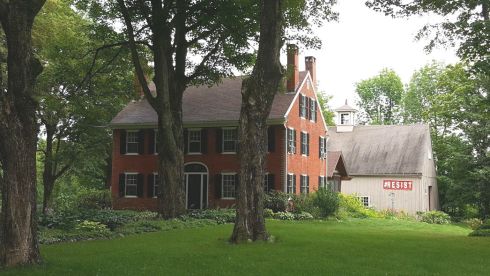
Tag Archives: New Hampshire

Destination Tamworth

Even though I previously, and unjustly, relegated New Hampshire to the status of “drive-through” state, it doesn’t mean that I never stopped in its midst. I brake for historical markers, and I’m pretty certain that New Hampshire has more markers than all of the other New England states combined—and not just to dead white men like Mr. Webster below. All sorts of events, institutions and individuals are memorialized by green road-side Bicentennial markers: combined with the historical societies which seem to be located in nearly every New Hampshire town, they are a testament to a state that takes its history seriously. This earnest presentation is refreshing, frankly, especially when contrasted with Salem’s more cynical commercialization of just one aspect of its more varied past: history for history’s sake rather than for profit. Driving northwesterly across the state to the Lakes Region, I wanted to stop at each and every historical society, but I was pressed for time: I did stop at many markers.

NH Marker Webster

Many people are drawn to New Hampshire for its mountains and lakes, but these attractions are secondary to me: if you’ve spent any time at all on this blog you will have noticed my preference for the built landscape! So even though I had a prominent lakes/mountain destination last weekend, I became much more fixated on a town nestled between the two: Tamworth, established in 1766. Tamworth has everything: a picture-perfect town center, a pedigreed summer theater (the Barnstormers), a museum dedicated to life and work of  two country doctors (The Remick Country Doctor Museum & Farm) a presidential (Grover Cleveland) summer house, a babbling brook (the Swift River), a farm-to-table restaurant and grocer (The Lyceum), a general store (the Other Store), an amazing foundational edifice named Ordination Rock, a shiny-new distillery (Tamworth Distilling), and an inn (Highland House) built by a Salem sea captain! I’d love to have a summer house here (if I can convince my husband that it is possible to live more than a half-mile from the ocean and still be happy, a big if).
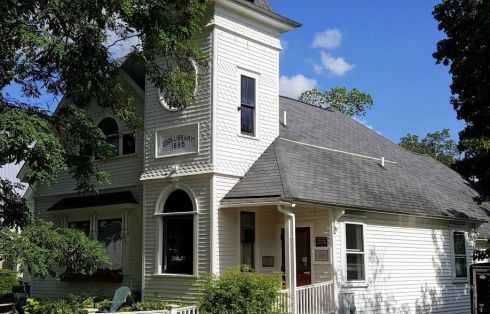
Tamworth Library

Tamworth House

Tamworth House 3

Tamworth Sign

Tamworth Barnstormers

Tamworth Poster Barnstormers

Tamworth Remick Museum

Tamworth Remick Barns

Tamworth Remick House

Tamworth Livestock

Tamworth Cow

Tamworth Brook

Tamworth Lyceum

Tamworth Poster

Tamworth Concert

Tamworth Distilling

Tamworth Brandy Sights & happenings of Tamworth: the Library, Barnstormers Theater, Remick Museum +Buildings+”Inhabitants”, Tamworth Lyceum, Sunday concert, Tamworth Distilling & Mercantile.

Given its heritage, of course Tamworth also has a historical society, recently re-christened (as you can see below) the Tamworth History Center. We found it open and bustling, with volunteers within eager to tell us about the town and the Center, which features revolving exhibits in its two ground-floor rooms: currently the early history of the Barnstormers is on, along with a very comprehensive genealogical exhibition on one of Tamworth’s prominent families. There is a dual preservation/presentation mission at present: focused continually on the town’s heritage as well as on the ongoing restoration of the Center’s c. 1830 headquarters. I enjoyed the exhibits immensely, but became a bit distracted by the untouched-for-decades attractions of the house’s central hallway! When restoration is complete, the house will not feature the traditional period rooms; instead it will serve as a forum, or center, for “the many stories that have made Tamworth unique, from 1766 onwards”. I want to hear more.

Tamworth History Center

Tamworth collage

Tamworth Exhibit

Tamworth HC

Tamworth HC2 Inside the evolving Tamworth History Center above; another visual presentation of Tamworth’s past—and present.

Tamworth PC


The Beautiful Barrett House

I’ve just returned from a brief getaway to the Granite State during which I drove all over much of its lower half (two-thirds?) but became focused on just two towns: New Ipswich and Tamworth. I don’t think I’ve ever developed a proper appreciation for this neighboring state and so I’m trying to work on that: I’ve lived in Vermont, Maine, and Massachusetts, and so New Hampshire was always just a place “in between”, to drive through rather than a destination. Growing up, my father worked at two universities on either side of the state, Dartmouth and UNH, but we lived in Vermont during the earlier period and Maine during the later–and not just over the line of either adjoining state. So I think I always wondered secretly: did my parents DISLIKE New Hampshire? During my teenaged years in southern Maine, Portsmouth, New Hampshire was our go-to town, but somehow I always disassociated it with the rest of the state, as if it was an island. It is not. This particular weekend I was headed up to see a friend in the Lakes Region but decided to take a detour to the southwestern part of the state so I could see a Historic New England house that I’d never visited before: the Barrett House in New Ipswich. Amazing: a high Federal house in a very unlikely place—or is it? New Hampshire is full of perfect white two-story federals, but the Barrett House is something more grand: Portsmouth-like, or even (dare I say it) Salem-like. What’s it doing in sleepy New Ipswich?

Barrett House

Barrett House exterior

Barrett House placque

Well of course New Ipswich was not sleepy when pioneering textile manufacturer Charles Barrett built this grand house as a wedding gift for his son Charles Jr. and daughter-in-law Martha Minot, whose father promised to furnish the house in a manner complementing its (then) cutting-edge style. Across the field in front was the textile mill, down the road was the (Third) New Hampshire Turnpike, connecting Vermont and Massachusetts. After New Ipswich chose not to accept a railroad stop several decades later, its manufacturing era came to an end but an impressive architectural legacy remained, including the 1817 “Appleton Manor” which is now for sale. Successive generations of the Barretts owned and occupied the house into the twentieth century, also their Boston businesses determined that it became more of a country retreat than a primary residence. This evolution echoes that of several houses in central New Ipswich, contributing to the preservation of its architectural landscape. Historic New England’s predecessor, the Society for the Preservation of New England Antiquities (SPNEA), acquired both the Barrett House and its neighboring George Barrett Sr. house in 1948.

Barrett House 1904

BarrettsThe house in 1904, Cambridge Historical Society; Barretts remain on the walls.

Like all of Historic New England’s properties, the house is interpreted in a very personal way, utilizing extensive family furnishings: Barrett Mill-made linens, Barrett-bound books, portraits, furniture, all manner of accessories. All of this creates a feeling of intimacy, as does the smallish scale of the rooms–I found the rather imposing exterior of this house to be somewhat deceptive. It’s perfectly open and light (look at all of those 12 over 12 windows!) and square and Federal: no Victorian additions or “improvements”, and only a bit of stuffy Victorian decor in a back parlor. Even the third-floor ballroom, which extends over the width of the house, retains an aura of intimacy: sparsely furnished with family chairs of different eras, gathered in a circle for conversation and company.

First Floor: front parlor and dining room (with Zuber et Cie wallpaper!). I particularly loved the Chinese Export dishes, which did not belong to the Barretts. The back parlor is a bit more of a mix, befitting a family room.

Barrett Parlor

Barrett downstairs

Barrett DR

Barrett Mantle

Barrett China

Barrett downstairs 2

Barrett books


Second Floor Bedrooms: back and front.

Barrett Bedroom 3

Barrett dining room

Barrett Linens

Barrett Bedroom

Barrett bedroom2

Barrett Chair

LOVE these “peacock” chairs, and below: “furnishing” for an early twentieth-century bathroom, one of the few additions to the house.

Barrett Bathroom


Third-floor ballroom.

Barrett ballroom

Barrett Ballroom 2


Outbuildings: Like Salem’s Ropes Garden, the Barrett House was the setting for the 1979 Merchant-Ivory film The Europeans. Actually it was used far more extensively than the Ropes, for both interior and exterior scenes, and the Barrett’s Gothic Revival gazebo was a particularly effective backdrop. The Carriage House is full of carriages (of course), including a carriage-hearse!

Barrett House collage

Barrett Carriage House 2

Barrett Carriage House 3

Barrett Carriage House


Just a few more New Ipswich houses, for context, beginning with Charles Barrett Sr.’s house next door. There seems to be a fondness for those center projected gable entrances, perhaps inspired by the Barrett House?

Barrett House Senior

Barrett House NI

Barrett House NI2

Barrett House NI4

Barrett House brick


High Summer Gardens

August is beyond peak time in New England gardens but there is still a lot of color out there:  primarily from phlox, phlox and more phlox. I’ve been taking pictures on my local travels and those below are from eastern Massachusetts, coastal New Hampshire, and southern Maine. The first group were taken during a visit to Fuller Gardens in North Hampton, New Hampshire. The garden was designed by landscape architect Arthur Shurcliff (of Colonial Williamsburg fame) for the 50th governor of Massachusetts, Alvan Fuller,  and his wife Viola, who maintained a summer seaside home in North Hampton, which is only about ten miles from the Massachusetts border. The house is no longer there, but its adjacent gardens are, laid out in a series of  “rooms” in the Colonial Revival fashion. Everything is so immaculately maintained, especially Mrs. Fuller’s beloved roses, that it is a treat to visit here in August when nearly every other garden I see (including my own) is looking a bit tired and overgrown.

Up the road a piece, some gardens and flowers in Portsmouth, New Hampshire:  Prescott Park in the afternoon and early evening, a vertical garden on a utility box, and the terraced garden across from the MoffatLadd House (1763) on Market Street.

Some very diverse images of plants and landscapes in southern Maine:  a coastal garden in Kittery Point, a checkerboard courtyard, a border, and my father’s cabbage, all in York.

Back home in Massachusetts, the colonial garden at the Parson Capen House in Topsfield, with its raised beds and very practical herbs and flowers, and my own Salem garden, which I think is a bit behind due to its sheltered location:  the bee balm is still reigning, the phlox (I have only the white, mildew-resistant David variety) is just starting to bloom, and the ferns are starting to sag:  August is not their month.