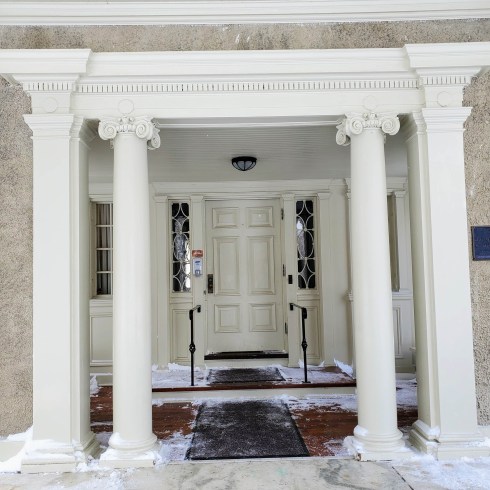
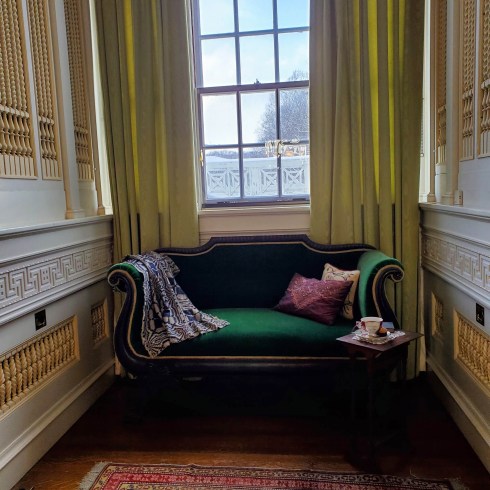
I had a more substantive post planned for this week but I took a little detour and so here I am with menus. I started to write about my experience as a tour guide at the Phillips House of Historic New England, as I’m in my second year and I thought it was time for some reflection. But in doing so, I became fixated on a moment during my tour (well during all of my colleagues’ tours, I’m sure, as it’s definitely a great device) when I show our guests a menu from July 1919 in order to interpret both the dining room and one of the ways in which the household worked. Everyone loves this menu: adults, children, southerners, northerners, midwesterners, westerners, visitors from other countries, Salem residents. There is one particular item on this menu that captures everyone’s attention without exception: Orange Fairy Fluff!


So I thought that before I delved into my reflective post about what I have learned as a tour guide, I should discover the origins of Orange Fairy Fluff, and this took me down a road of restaurant history marked by menus. And then I went down my own memory lane of menus, and so here we are with menus from storied Massachusetts restaurants. The restaurant most closely associated with Orange Fairy Fluff is the famous Toll House Inn in Whitman, Massachusetts, the birth place of chocolate chip cookies. I think the timing is a bit off, however, as the menu above is from 1919 and the Toll House didn’t open until the 1930s, but an earlier (1916) Sunkist cookbook published a recipe before the Toll House owner Ruth Wakefield’s popular “Tried and True” cookbook. The Toll House menu is a perfect example of the “mid-century Colonial” aesthetic I’m so fond of, as are those of its competitors in the 1940s and 1950s.


I’ve been to, or driven by, all of these restaurants, with the exception of the Adams House in Marblehead. I just like its menu and “shore dinners” evokes the restaurant of Salem Willows. I never went to the Towne Lyne House in Lynnfield, but it was a “landmark” on the drive along Route One to and from Boston from Maine, along with “The Ship” restaurant on the other side of the road. All menus above from the Culinary Institute of America’s Menu Collection.
I have very warm memories of Filene’s, in truth the Basement more than the restaurants, but I do like the map menu below—although it doesn’t have Salem on it! Seeing the House of the Seven Gables front and center on the 1940s menu mollified me a bit, as did a menu for St. Clairs Restaurant from Historic New England’s collections which also features the Gables prominently on the cover. I also have childhood and teenage memories of meals at Locke-Ober, the Union Oyster House, and Cafe Marliave in Boston—and the Parker House, of course. The last time I went there—maybe just before Covid?—-it was looking a bit dowdy so I was pleased to hear that it’s going through a big refresh this year. (I wonder if they will keep the worst portrait ever of Nathaniel Hawthorne?)


The CIA collection has a few menus from Salem restaurants, including one from the famous Moustakis “palace of sweets” on Essex Street.When I look at this menu, I think that Salem could use an ice cream parlor today, especially one which offered up Moxie floats (!!!) and College ices (???), but I am also aware that Moustakis was no mere ice cream parlor. A half-century after its founding, it functioned as important gathering place for Salem businessmen according to the 1956 sociological study Community Organization: Action and Inaction by Hunter Floyd:
Other prestige groups observed during the process of study now may be briefly mentioned. There is no athletic club in Salem, nor any downtown men’s club that can serve as a luncheon meeting place. There is, however, a loose tradition that has grown up for various businessmen to eat in a restaurant owned by a Greek named Moustakis. At a rear table of the restaurant, six or eight men can be seated comfortably at a time. During the lunch hour there is a tendency for some of the well-known merchants on “The Street,” as Essex or the main street is called, to gather at this table. As the lunch hour proceeds, professional men, lawyers, accountants, real estate men, and finally bankers may join the group or take the places of men who have finished eating. There is a shifting pattern of membership of this group, but through habit on the part of members, the key pattern is relatively stable. Not all men, by any means, who represent the commercial and professional interests of the community eat at Moustakis’. The restaurant is, however, recognized as a place where gossip is exchanged and an eye is kept on important happenings. Other restaurants serve a similar function, of course, but none are quite as well known as the Moustakis’ “clearing house.”


Menus from the Culinary Institute of America’s Menu Collection and Historic New England’s Collections Access.
And finally, menus from two very different Salem restaurants: the House of the Seven Gables Tea Room (squash pie!) and China Sails, which is still with us, in its original location on Loring Avenue near Vinnin Square. These China Sails menus look like they date from a bit later, and only the Salem location survives (though I don’t think Dave Wong is still in the picture).


 Print depicting the arrivl of Rochaembeau’s troops in Newport in July 1780, Daniel Chodowiecki, The Society of the Cincinnati, Washington, DC.