Tag Archives: Monticello

Virginia Green

Sorry for the delay in posting part II of my spring break road trip: I came back with a nasty flu so re-entry and re-engagement have been stalled. I’m feeling a bit better today and I thought it would make me feel better yet by looking at my photos. From the Eastern Shore, we traveled over the scary Chesapeake Bay bridge/tunnel up to Williamsburg for a few days, then we visited my sisters-in-law in Richmond. It was a real treat to stay in the Williamsburg Inn, and I do like Williamsburg in general even if it has its “history disneyland” qualities, but its highlights on this particular trip were definitely the George Wythe House and the museums. On the way up to Richmond, we stopped at the Berkeley Plantation on the James River, a beautiful and very history-rich site. I always love the capital, and we also visited Monticello up in Charlottesville, which I haven’t been to since I was in college. On the long drive back myself this past Saturday, I stopped on Virginia’s northern neck to visit Menokin, a plantation ruin in the midst of an interpretive restoration. As I drove north from there, I started feeling a bit gray but was thinking mostly of green: as we drove down we saw increasing green and on my ride home I was seeing less. That’s one of the things I like most about my March break trips down south: we won’t see that green in Salem for a while.

Four plantations: Eyre Hall on Virginia’s Eastern Shore, Berkeley and one of its “dependencies,”, Monticello & Menokin.

Eyre Hall, overlooking the Chesapeake on Virginia’s Eastern Shore, is a well-preserved, privately-owned 18th-century plantation whose owners open up its gardens to visitors, so we drove right in and I snuck a photograph of the house. The gardens are supposedly beautiful, but it was a a bit early for blooms. Berkeley has direct connections to the Harrison presidential family and to the Civil War, and is also a site rich in the history and documentation of slavery. There is also a claim to America’s “First Thanksgiving” in 1619, which I’m not going to explore because I’m from Massachusetts. Monticello was of course Thomas Jefferson’s beloved home, and he also has a tie to Berkeley and to the George Wythe house in Williamsburg. The Hemings family is also showcased at Monticello, which was the busiest site we visited by far: it was kind of difficult to take in the house on our packed tour. Menokin, as you can see, is currently a ruin, but its restorers have big plans. I took a lot of notes on interpretation over the week, but I haven’t really sorted them out and I’m not quite up to it, so I’m going to reserve my thoughts on inclusion/exclusion (and Thomas Jefferson!) for later.

Colonial Williamsburg: including the George Whythe (rhymes wth Smith) house, the Capitol and Governor’s Palace, and the museums.

And a view of the University of Virginia’s Lawn from the Rotunda (which I never knew you could spot from Monticello before last week).


Selling Seeds

A rather fluffy post on seed packets for this week: it’s grading time! This combination of gardening + paper, two of my favorite things, is irresistable to me at all times, but I have also noticed a trend over the last decade or so. I was thinking about my 2007 wedding the other day, as our anniversary coming up at the end of the month. The reception was held outside under a fairytale tent at the House of the Seven Gables, and so there was not much decoration, just some beautiful simple arrangements to complement the colonial revival garden. With that theme in mind, I made my own seed packets with custom labels for favors, as it was next to impossible to find decorative packets at the time. Now there are many sources for packets with striking graphics, with or without seeds! I seldom sow seeds, but whenever I have, I’ve always purchased the most decorative packets I could find: Renee’s Garden Seeds and Monticello were my go-to purveyors, and the Hudson Valley Seed Company, which has always had the most creative packets. These are still great sources, but there seem to be many more now; this particular post was inspired by some gorgeous packets designed for the Italian seed company Piccolo by the London-based studio Here Design. These packets look like little Penguin books, another obsession of mine! Once I saw them, I knew I was not up to date in the dynamic development of seed packets, so I dug in and looked for more.

Hudson Valley Seed Co. and Monticello seed packets; Piccolo packets by Here Design, London; Floret’s Flower Farm Seeds by illustrator Nina Sajeske, with design by Nicole A. Yang; Row 7 vegetable seeds; Baker Creek Heirloom Seeds; Lesley Goren’s packets for Artemesia Nursery in California; Anellabees Pollinator Seed Blends at Terrain; Kew Gardens seed packets, which are beautiful but unfortunately not available in the US.

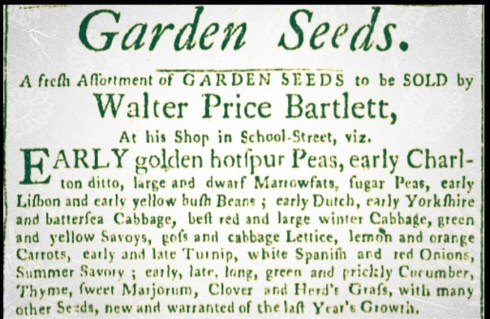
Going back a bit: because of course I’ve got to delve into the history of the seed packet, which seems to be an eighteenth-century innovation here in the United States. It is tied to, and illustrative of, the emergence and development of a commercial retail market for gardening supplies. Usually the D. Landreth Seed Company, founded in 1784 in Philadelphia by brothers David and Cuthbert Landreth and still very much in business, is given credit for the first seed packets, but a few years ago some packets were found in the eaves of the eighteenth-century Woodlands Mansion just up the river from the famous Bartram’s Garden in Philadelphia (clearly a horticultural nexus): whether they were for storage or sale is unclear. There were several seed shops in Salem in the mid and later 18th century, like Mr. Bartlett’s below, but I have no idea how they sold their seeds: perhaps people just came in and grabbed a handful? In any case, moving forward into the nineteenth century, there is no doubt that the entrepreneurial Shaker colonies were pioneers in the mail-order seed trade, to which many plain “papers,” or packets testify.

Essex Gazette 27 April 1773; Shaker, Landreth & Woodlands seed packets.