Tag Archives: Memory

The Battle of Bunker Hill: it’s Personal

A grand reenactment of the Battle of Bunker Hill to be staged at Gloucester’s Stage Fort Park has been in the planning for months to mark its 250th anniversary and I planned to go on this past Saturday until just a few days before. On the actual anniversary, June 17, I started reading some diaries of participants and observers and I soon realized that I wanted continue on with this personal commemoration rather than travel to an offsite reenactment—although I heard it was amazing! As always, I try to find the local angle on big events, and so I have three Bunker Hill Salem stories today. The first is a revisit: a few months back I returned to this post on Lieutenant Benjamin West, the sole Salem casualty at Bunker Hill. I had remembered a reference to a portrait of West, perhaps lodged in the collection of the Essex Institute/Peabody Essex Museum. Could it be found? The answer is YES. I emailed Dr. Ruthie Dibble, the Robert N. Shapiro Curator of American Decorative Art at the Peabody Essex Museum, who solicited the aid of her colleague Dr. Jeff Richmond-Moll, the George Putnam Curator of American Art, and very quickly HE appeared on my screen, in somewhat distressed condition, but still there. It was very poignant to see him.

Artist in the United States, Portrait of Lieutenant Benjamin West, 1774-1775. Pastel on paper. Gift of Mrs. Sarah C. Bacheller, 1922. 116640. Peabody Essex Museum.

Lieutenant West, and all the Salem men who were at (or near) Bunker Hill on that day, did not march in a Salem regiment but rather with other companies. Apparently Salem’s chief military officer Timothy Pickering, who left very late for Lexington and Concord and saw no action, did not respond to the Bunker Hill call at all. But another man living in Salem did, for both professional and personal reasons. Dr. John Warren, the younger brother of General (and Dr.) Joseph Warren, saw and heard the fire in the direction of Charlestown and saddled up in the middle of the night. The younger Dr. Warren had moved up from Boston to study with the eminent Salem physician Dr. Edward Holyoke several years before, eventually establishing his own practice, by all accounts popular but not especially renumerative. His brother set an example for him in both his profession and patriotism, and the younger Warren volunteered for military medical service right after the Boston Tea Party. On his ride south on the night of the 17th, Warren stopped in Medford, where he “received the melancholy and distressing tidings that my brother was missing.” He continued to Cambridge, where he heard differing accounts of his brother’s fate.“This perplexed me almost to distraction,” he confessed, [amd so] “I went on inquiring, with a solicitude which was such a mixture of hope and fear as none but one who has felt it can form any conception of. In this manner I passed several days, every day’s information diminishing the probability of his safety.” And so a brother learns of a martyrdom, gradually. The surviving Dr. Warren left his Salem practice immediately and carried on the life and work of an army surgeon until 1777, after which he returned to Boston, married, and eventually resumed his civilian practice. Dr. John Warren went on to become was one of the founders and first professors at Harvard Medical School, and a President of the Massachusetts Medical Society. In the year of his marriage (which produced 17 children!) he adopted his brother’s four children, who had become a patriotic cause unto themselves after their father’s heroic death, with even Benedict Arnold contributing funds to their care and upkeep. Sometimes the world of Revolutionary movers and shakers seems very small and personal indeed. (Consider that Dr. Joseph Warren saved John Quincy Adams’ finger from amputation—the latter could never attend a Bunker Hill “celebration” afterwards—and that his remains were finally identified by the presence of a tooth fashioned for him by Paul Revere).

Portrait of Joseph Warren by John Singleton Copley, 1765, and John Trumball’s The Death of General Warren at the Battle of Bunker Hill June 17, 1775, Museum of Fine Arts Boston; Portrait of John Warren by Rembrandt Peale, Harvard Art Museums. Dr. John Warren was also Grand Master of all the Lodges of Freemasons in Massachusetts, and appropriately his medical trunk is in the collection of the Scottish Rite Masonic Museum & Library. John Warren’s journal entries are in a volume edited by his son, John Collins Warren (also a prominent physician) entitled Genealogy of Warren : with some historical sketches (1854).

The hero surviver of Bunker Hill was Colonel William Prescott: he’s right there in the Trumball painting above, in the midst of the Patriot contingent behind the fallen Warren. It happens that Prescott’s grandson is Salem’s most esteemed historian (well maybe excepting one or two of my colleagues at Salem State), William Hickling Prescott. The bronze statue of Colonel Prescott was actually created by Salem-born sculptor William Wetmore Story with the aid of a photograph of his grandson. When William H. Prescott married Susan Amory in 1820, he was gifted by her uncle a sword owned by his father Captain John Linzee, a British naval commander fighting on the opposite side on June 17, 1775!  (Linzee does not seem to have been as heroic, or perhaps as successful, as Prescott according to this account). This sword was donated by Prescott to the Massachusetts Historical Society, and the Linzee sword was later donated by his wife to the same institution so that they might not be separated. And thus they exist together at the Society, a personal and public memento of conflict, cohabitation, and commemoration.

Plaque with Crossed Swords, Massachusetts Historical Society. Silver-hilted small-sword belonging to Col. William Prescott, created by Jacob Hurd, circa 1730-1750 and small-sword for an officer of the Royal Navy, belonging to Capt. John Linzee, created by unidentified maker, circa 1780s. More description here.


Leslie’s Retreat 250

More local Revolutionary history! I know I have not been straying far from this focus lately, but this past weekend (well, really February 26) marked the 250th anniversary of Leslie’s Retreat here in Salem with several colorful events which definitely deserve a post. And fair warning, there will be more 1775 over the next few months: I’m giving a talk on Salem’s “pre-Revolutionary Revolution” for Historic New England in April and then there will be the big commemoration of Bunker Hill and then……….we’ll see. I promise to sneak some other topics in here, but for Massachusetts in the American Revolution, it’s really all about 1775, so there’s a lot going on. Saturday’s commemoration kicked off with a presentation at St. Peter’s Church which echoed the sequence of events in 1775 when the Sabbath was disturbed by the arrival of British soldiers in Salem in search of contraband cannon. I arrived a bit late for this event, as it was advertised as featuring “stakeholders” and I knew that meant politicians: that is the term that our previous mayor and present Lieutenant Governor, Kim Driscoll, used all the time during her tenure to distinguish VIPs from mere residents. It’s still used all the time in Salem, and I always bristle when I hear it, so my little rebellion was to stomp over to St. Peter’s late. By the time I arrived, there was a full church listening intently to the last of the stakeholders, our present Mayor Dominick Pangallo. Then we heard from Lt. Colonel Leslie himself, sang a hymn and listened to a timely sermon, and watched as the news of the marching soldiers (some of whom were apparently right next door) interrupted the everyday life a few colonial Salemites. And then we were off to the North Bridge!

The “congregation” walked over to the site, now pretty unrecognizable or unimaginable if you know the historic terrain, where the parley which brought about, and constituted, Leslie’s Retreat, happened nearly 250 years ago. The major difference between this special commemoration and those of previous years was the presence of many more reenacting regiments, so the crowd and the soldiers were separated on two lanes of the bridge, with traffic blocked off (which was quite something, as route 114 is a major artery). In past years civilians and soldiers were mixed in together, and there was less of each. I couldn’t really see or hear the negotiations between Lt. Col. Leslie and the Salem men, but everything that transpired seemed to happen much quicker than was the case in 1775. Leslie retreated very quickly, followed by a few regiments of Colonials which had formed on the other side of the river. All I could really capture was the marching, to and from. A lot of players—I’m sure this took a lot of coordination. After witnessing this, I cannot imagine the complexities of the “curation” of the Battle of Bunker Hill in June.

There were trolley tours and a great exhibit at the Salem Armory Visitor’s Center, but I was focused on a fashionable event in the afternoon: “Fashion in the Season of Revolution: a Panel Discussion and Reenactor Promenade” at the Peabody Essex Museum. This was so interesting: I’m still kind of thinking about it. There were scholarly talks about Abigail Adams’ quilted petticoat and Eldridge Gerry’s sister’s wedding ensemble and the revolutionary preference for homespun as it related to shoes, and then there were questions for an ensemble of reenactors in the audience and on stage. Their answers were really thoughtful and fascinating, including those of a 14-year-old girl who had come up to Salem with her regiment for the day (I’m only 14 so I can’t carry a musket but I have a bugle. Who knew that musiciansuniforms had variant stripes?) I have to tell you that most academic historians have a bit of a snobby attitude towards reenectors: I would include myself in this company until the last few years. It’s the dominance of archival research in our profession, and an assumed exclusive association with military history, I think. Speaking for myself, I had always associated reenacting and “pageantry” with the Victorian romanticization of the pre-modern past, something I’ve always had to counter throughout my teaching career. But my perspective on this has changed over the years, especially as I’ve met local history enthusiasts in this region. I still really can’t handle a Renaissance Fair, but it’s clear to me that for many reenactors, who engage in the pursuit for decades, both their “kit” and their engagement in commemoration are ways to study and venerate the past at the same time. I clearly am craving a material connection to the past as well, as all I really want to do on most days is drive around and look at seventeenth-century houses: and I envy their comaraderie!

After all that, it was off to the Revolution Ball next door at Hamilton Hall. It took me a while to get dressed, as I had my own little reenactor “Caraco” jacket which laces up the front and a really nice dark red silk “petticoat” (skirt) which also took me a while to figure out. The ball was really magical: the Hall looked gorgeous, I hope you can get some sense of it in the photographs below. It was period dress/black tie, and it seemed liked it was about half and half. Dancing with a caller, cocktails, I even ate, which I never do at parties for some reason. There were quite a few people there that had participated in the events of the day, and who were part of other commemoration activities, so there quite a bit of festive camaraderie, so much so that I can justify using that word twice in one post.

N.B. Saturday was a fun celebration, but I woke up on Sunday to a flag hanging upside down at Yosemite National Park (where a former student works, still, I think), a distress signal from its rangers/stewards. So I have to add my hope that the revolutionary commemorations of 2025, 2026, and beyond can communicate to the American public the extreme sacrifices that the Revolutionary generation made for real freedom, not just lower consumer prices. Moreover, this long commemoration is itself threatened by this administration’s attack on federal employees in general and those of the National Park Service in particular: Salem Maritime National Historic Site historian Emily Murphy curated and presented the exhibit on Leslie’s Retreat which will be on view all spring, and obviously Minute Man National Historic Park will be center stage for the commemorations of Lexington and Concord in April. A comprehensive list of the Revolution 250 inititatives and events planned by Massachusetts National Historic sites and parks is here: please support their efforts and their personnel.


Leslie’s Retreat: How an Incident became an Event

Next weekend here in Salem a whirlwind of events will commemorate the 250th anniversary of Leslie’s Retreat, including reenactments of the Redcoats’ march towards the North Bridge and the negotiations/resistance that followed, a variety of tours, an exhibit, a concert, a play at Old Town Hall, a presentation on revolutionary and reenactment clothing at the Peabody Essex Museum, and a ball at Hamilton Hall! A group of stalwart history enthusiasts and educators organized a Retreat reenactment nearly a decade ago and the event has been growing in popularity every since, but this year is BIG because of the 250th anniversary, and the city has jumped on the bandwagon. I’m grateful to those “First Reenactors” as February 26th (or thereabouts) has become a conspicuous non-witchy event on the Salem calendar, so I feel like commemorating them, but their efforts are part of a long tradition: Salem has long celebrated its brief, shining moment of Revolutionary resistance. I’ve posted quite about what the event called “Leslie’s Retreat” was so this year I thought I’d write in response to a slightly different prompt: how did this “incident at the North Bridge in Salem” became the event we call “Leslie’s Retreat?” I’m also interested in how it became known as “the first armed resistance to British troops” when it clearly wasn’t, but I suspect the answer to that question is because they just kept saying it was so I don’t want to waste too much time on that.

Wonderful etching of Salem’s North Bridge in the 1880s by George Merwanjee White, Phillips Library (the shores looks so close!); various mid-century pictorial maps with the “first” claim.

So before I go into all the factors which made Leslie’s Retreat LESLIE’S RETREAT, here’s a very brief summary of what happened on February 26, 1775. VERY BRIEF. You can search for my other Leslie’s Retreat posts or, if you want all the details and the most probing analysis, go to J.L. Bell’s amazing blog Boston 1775which imho and that of many others is the absolutely best source for pre-revolutionary Boston and its environs. Bell is giving a talk for the Marblehead Museum on February 27 which I am very much looking forward to as I have managed to miss all his other presentations on Leslie’s Retreat. Until I am enlightened further by him, here is my summary:

“Leslie’s Retreat” represents the unsuccessful attempt of the 64th Regiment of Foot under the command of Lieutenant Colonel Alexander Leslie to commandeer cannon in Salem. Said cannon were likely 17 twelve-pounders secured by Colonel David Mason, who had commissioned blacksmith Robert Forster to mount them to carriages. Royal Governor Thomas Gage, who had essentially been kicked out of Salem the previous August as the town was serving as the provincial capital (but who clearly still had his contacts) caught wind of this clandestine cannon and ordered Lt. Col. Leslie and his troops to sail from Fort William in Boston Harbor to Marblehead, and from there march to Salem and “take possession of the rebel cannon in the name of His Majesty.” The operation was planned for a sleepy Sabbath Sunday, but as soon as the Regulars landed in Marblehead word got out, and the alarm was sounded not only in Salem but in other Essex County towns. Leslie marched to what was then called the North Field Bridge, which was a drawbridge firmly fixed in the up position which prevented him from crossing the North River to Forster’s forge and foundry. A crowd formed and negotiations began between a frustrated Leslie, several Salem residents and militiamen, and a local pastor, Thomas Barnard. With darkness (and militiamen throughout Essex County) advancing, a compromise was reached: the bridge was lowered and Leslie and his men were able to cross and inspect, but the cannon were long gone. So they retreated back to Marblehead and Boston. 

[Interuption/disruption: in longer narratives of Leslie’s Retreat, a woman named Sarah Tarrant is generally referenced, as she taunted Leslie and his soldiers from her open window. That’s fine, I’m sure Sarah was very brave, but Colonel Mason’s wife Hannah and her two daughters made 5000 FLANNEL CARTRIDGES for the cannon in the preceding month. So I think Hannah Symmes Mason and her daughters Hannah and Susan deserve some glory too.]

John Muller’s authoritative Treatise on Artillery, which Mason no doubt possessed, contains detailed instructions for making cannon cartridges as well as all types of carriages. 

So here are the major factors and forces which transformed Leslie’s Retreat from mere incident to major event: it was a chronological process, of course!

1820s Patriotism. Here in the Boston area, there was clearly some intensifying patriotism focused on the Revolution in the 1820s, the result of a combination of forces, including the upcoming fiftieth aniversary, the visit of General Lafayette, and above all, the movement to commemorate the Battle of Bunker Hill. I was not surprised to see the first public reference to “Col. Leslie’s Retreat” in this decade, though I bet it was a term in use before then. It seems that the loyal citizens of North Salem took matters into their own hands in 1823, and I really would like to see this elaborate staff with an eagle and a bust of George Washington. The Bunker Hill Monument Association was established that same summer, and Lafayette laid the cornerstone for the monument in 1825. It was not completed until 1843, but at the Whig Bunker Hill Convention of 1840, a grand historical parade around the monument-in-progress featured 1200 marchers from Salem bearing a Leslie’s Retreat banner asserting we were the first to defeat our oppression in 1775—we shall be the last to yield to them in 1840.

The Essex Institute. Founded in 1848 and serving as Salem’s de facto historical society until its assimilation into the Peabody Essex Museum in 1992, the Essex Institute commissioned TWO items which are essential to the history, interpretation, and identification of Leslie’s Retreat, Samuel Morse Endicott’s Account of Leslie’s Retreat at the North Bridge in Salem on Sunday Feby’y 26, 1775 (1856) and Lewis Jesse Bridgman’s watercolor of Repulse of Leslie at the  North Bridge (1901). Endicott’s Account became an instant classic and as it was issued in a very nice edition after its first publication in the Collections of the Essex Institute it became even more valuable with age: a brief survey of book auction catalogs from the early twentieth century indicates it was in every gentleman’s library. And as I have written here many times before: it’s difficult to “imprint” anything or anybody in people’s minds without an image, so the Bridgman painting has been equally valuable. It was reproduced everywhere, including as a hugh wall mural donated to Salem High School by the Daughters of the American Revolution, North Bridge Branch, in 1910.

The Civil War. There are numerous “memory” connections between the Revolution and the Civil War, but I think the most important one in Salem’s history is Governor Andrew’s identification of the North Bridge as one of the key places in Massachusetts to fire off a salute in celebration of the ratification of the thirteenth amendment. The bridge had received a new “Liberty Pole” in 1862, so its identification with liberty was pretty established by that time. There’s no question that the North Bridge was a much more hallowed place than it is now: overpasses just don’t conjure up heritage like bridges.

The Big Anniversaries. The years 1875-1876 were similiar to 1975-1976 and 2025-2026, with the convergence of the 100th, 200th and 250th anniversaries of Leslie’s Retreat and the beginning of the American Revolution. “Triumphal arches” were erected on the North Bridge in 1876 and again in 1926, for Salem’s Tercentenary. There were just so many occasions to mark and remember Leslie’s Retreat, and when there wasn’t an occasion, one was made up! The Leslie’s Retreat monument, now under the bridge rather than on it, was erected in 1887, and a quarter of a century later the “Pageant of Salem” dramatized the narrative (as if it wasn’t dramatic enough). I must say, the 1975 reenactment looks like it was really fun.

The 1926 Salem Tercentenary Leslie’s Retreat Float was sponsored by the DAR, North River Branch. Salem State University Archives and Special Collections; Col. Leslie by Racket Shreve in Salem’s wonderful Bicentennial Illustrated Guide Book.

These big anniversaries were important, but they were only highlights in a long history of commemoration: from at least the 1850s, there was some kind of speech or moment recognizing Leslie’s Retreat every year, all through the 1860s, 1870s, 1880s, 1890s, 1900s, 1910s and 1920s. After that, it’s a bit more occasional, but you can still find references. The longest period where there are the fewest mentions in the press was from the Bicentennial to 2017, when the “First Reenactors” reengaged with the event and its impact. I wonder (not really) how Salem changed during these thirty years? We are certainly not in the period where, as one of the commenters on a previous post asserted, “every 8th grader in Salem had to write a paper on Leslie’s Retreat” for better or for worse. But thanks to those First Reenactors of 2017 (or 2016??? I can’t seem to remember) we are in a much better place for commemorating 1775 than we would be without their efforts, so hat’s off and huzzah to them!

Charlie Newhall, Jonathan Streff & Jeffrey Barz Snell and a BIG crowd in 2017.


Streetscape and Memory

I am taking my title from Simon Schama’s classic Landscape and Memory, but my inspiration comes from a brief cocktail party conversation a few weeks ago. I was the host of this particular party, so I was hopping around and really only getting snippets of conversation, but I woke up the next morning with a very clear memory of a bit of discussion between a film historian and a maritime historian/curator about a movie that was filmed in Salem in 1922: Java Head, based on the then-popular novel by Joseph Hergesheimer of the same title. I’ve written about this film before: its theme and narrative focuses on the cross-cultural encounters between the Chinese wife of a Salem trader and his friends and family back home. This was no backstage production: Salem served as the set for the exterior scenes of Java Head and Derby Wharf was actually transformed into a century-earlier version of itself during the height of the China Trade by a very detailed reproduction, right on top of the reliquary pier. My two historian friends were bemoaning the fact that it is extremely unfortunate that this is a lost film, as the reproduction had been informed by the memories of those who had seen the wharf when it was still in some semblance of its former glory. And so I was reminded, once again, of the power of memory—and initiatives to recall it. John Frayler and Emily Murphy, past and present historians at the Salem Maritime National Historic Site, maintain that the set designers worked from old photographs in their 2006 piece, “Java Head is Missing” (Pickled Fish and Salted Provisions, October 2006) and I’m sure that’s true, but I’d also like to think that there was an old salt somwhere in the process. This article also features what must be a very cherished photograph of the reproduced wharf—given that the film is lost, one of only a few extant images of its Salem set.

Photograph of Derby Wharf as reproduced for Java Head, from the “Java Head is Missing” 2006 Salem Maritime Newsletter, “Pickled Fish and Salted Provisions”. ALL of these valuable newsletters, and more from the Salem Maritime archives, can be found at its NPS History eLibrary site.

I’m dwelling on this long-lost film and its set because I have always been interested in, and indeed reliant on, captured memories of Salem’s streetscape. We’re so fortunate to have photographic records from the later nineteenth and twentieth centuries, but there are rich textual records too. Long before the field of “oral history” ever existed, or was acknowledged as such, there were people out there asking other people about their memories of Salem’s built environment: the articles which ran under variations of “Notes on the Building of……..[insert street]” in the Essex Institute Historical Collections convinced me that that institution was definitely functioning as Salem’s historical society from the later nineteenth century onwards. From 1945-1947, the Collections featured a series of reminiscences of former residents of Chestnut Street whose memories were prompted by Francis H. Lee, who was compiling his own history of the street in the 1880s. Lee wrote letters to everyone who ever lived on Chestnut, and many responded with missives of varying detail about the street and its surrounding neighborhood. I looked through the Lee Collection at the Phillips Library when I was researching our Salem book last summer, and was immediately transfixed by his photographs; I knew that all the letters were gold, but I didn’t have time for them then. I think I need to go back to Rowley, but in the meantime the Collections transcripts will have to do. They begin with Leverett Saltonstall’s 1885 letter in the January 1945 issue, in which he gives us the built and social history of the neighborhood in his childhood: schools are everywhere as well as bakeries and stables, but he also tells us who lived in which house on Chestnut and Essex Streets, and when and how they added on to their houses. In a bit of commentary about new (1880s) construction, he notes that the Bancrofts lived on the latter street “in a pretty old-fashioned gambrel roof house, once occupied by Judge Prescott, father of the historian, with a solid old elm in front, which I saw quite recently cut down while apparently in full vigor, by some vandal to display his new shingle palace.” Ah, those elms in full vigor! Saltonstall also recalls swimming in the North River with his friends when it was “a clean body of water and the swim across to “Paradise,” the fields beyond the swirling flood, was a feast for a strong boy.” For the 1880s reader or the 1940s reader, that description of the then-tannery-lined North River would have been notable, likely more so than for us. Saltonstall was born in 1825: there are no photographs of the Salem of his childhood, we must rely on his memory if we want to picture it.

Francis H. Lee photographs of the lower and upper Chestnut Street in the 1880s, Francis Henry Lee Papers, MSS 128. Courtesy of Phillips Library, Peabody Essex Museum, Rowley, MA. Saltonstall and others remember only “fields” past the Phillips House at number 134, the lighter house on the right above.

There are actually a few visual references in the Lee letters. Henry K. Oliver actually provided a plan of his house on  Federal Street, Samuel McIntire’s Samuel Cook house, and a very detailed descriptions of its interior, including the French landscape wallpaper on the walls of its east parlor, “put on in 1825 (60 years ago) and now appears fresh and unfaded.” These were not memories, but Oliver went on to recount the built history of the entire neighborhook of upper Federal Street, including houses moved to that location from the more ancient Essex Street (EIHC LXXXII, April 1946). J.B. Chisholm’s letters to Lee from February of 1885 note that “I had once thrown aside my pencil sketch of the South Meeting House in Chestnut Street (which burned down in 1903) but the possibility of its being suggestive to you induces me to enclose it with this.” (but the sketch is not included in the 1946 Historical Collections article!) My favorite recollection (so far) is that of John H. Nichols, who gave Lee an explanation for the distinct width of Chestnut Street which I had never heard before: At the time it was proposed to open the street, the owners of land on one side were unvilling to contribute their portion and it was then made of half its present width by those on the opposite side, who left a narrow strip, with a wall standing upon it, so that the recusant abuttors should not be benefitted by the new street. When, however, at a later period the latter were willing to part with a portion of their land as first contemplated their proposition was rejected, and they then made another street of the same width, leaving the wall at its center. On the erection of some house, Captain Phillips’ I think (#17), each of the workmen employed received a certain stipulated sum for carrying away a stone from the wall every time he left work, until the whole were removed, and thus the street became double the width originally designed. Two parallel streets of like width with a wall between! We’re never going to see a photograph of this, obviously, but there might be a sketch out there somewhere……..

The wide street of the 1880s (no wall): Looking up (west) and down (east) Chestnut Street, from Salem Picturesque, State Library of Massachusetts.


Anniversary History: Local Edition 2023

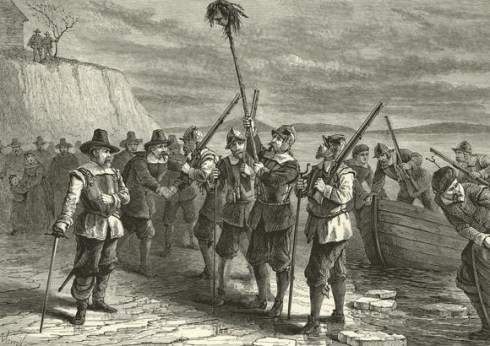
Looking ahead to the new year from a local history perspective, there are commemorative moments for at least six events: five European settlements and a tea party, the 250th Anniversary of the Boston Tea Party, to be precise. A century and a half earlier, there were settlements at Gloucester, Massachusetts and Portsmouth, Rye (the Pannaway Plantation) and Dover (the Cocheco Plantation), New Hampshire. The ill-prepared and -fated Wessagusset Colony was established in Weymouth, Massachusetts in 1622 but its demise came the following year after the brutal Wessagusett “Incident,” more appropriately referred to as a massacre. Commemorative history should acknowledge both the good and the bad, the heroic and the tragic, the kind and the cruel, and so the Wessagusett Massacre of March 1623, a veritable “red wedding” which harmed relations between Native Americans and English settlers for years to come, demands a spotlight. Like the first Gloucester settlement by the Dorchester Company, Wessagusett was decidedly not a plantation in the seventeenth-century sense, but rather a fishing and trading station of 60+ men financed by London merchant Thomas Weston. “Weston’s Men” were completely unprepared for the New World and by the winter of 1622-1623 they were starving, and altogether dependent on both Plymouth and the Native Americans in the region. But foodstuffs were scarce for everyone that winter, and everyone was anxious. Rumors of an impending Native American raid on both settlements drove the Wessagusett men to seek aid from Plymouth, and militia leader Myles Standish and eight men sailed a shallop to the northern settlement and issued an invitation to Massachusett tribal leaders Pecksuot, Wituwamat, and others to attend a summit during which commenced a slaughter just as they all sat down to dinner. I’m going to let Charles Francis Adams tell the tale, as he presented it in his anniversary address on the occasion of the 250th anniversary of Weymouth: the savages were taken by surprise, but they fought hard, making little noise but catching at their weapons and struggling until they were cut almost to pieces. Finally Pecksuot, Wituwamat and a third Indian were killed; while a fourth, a youth of eighteen, was overpowered and secured; him, Standish subsequently hung. The massacre, for such in historic justice it must be called, seeing that they killed every man they could lay their hands on, then began. There were eight warriors in the stockade at the time,—Standish and his party had killed three and secured one; they suddenly killed another while the Weston people despatched two more. Only one escaped to give the alarm, which spread rapidly through the Indian villages. Interesting language for 1873: savages is employed, but Adams does not refrain from calling this slaughter a “massacre” unlike many of his contemporaries who labeled it a pre-emptive strike. Several Wessagusset men also died during the massacre, and the rest opted to abandon the settlement; Standish returned to Plymouth with the head of Wituwamat on a pike in ancient English warrior fashion, “to ornament the Plymouth block-house as a terror to all evil-disposed savages” in the words of Adams. This massacre seems worthy of a bit more commemorative reflection, at least a fraction of what the Boston Massacre receives continuously.

“The Return of Myles Standish from Wessagusset,” from Pioneers in the settlement of America: from Florida in 1510 to California in 1849 by William August Crafts, 1876. Ironically, nearly 300 years later (299!) Myles Standish lost his head when the Standish monument in Duxbury was struck by lightning: according to this post by Carolyn Ravenscroft, archivist of the Duxbury Rural and Historical Society, his replacement head was too heavy for the damaged “body,” so an entirely new Standish was created by Boston sculptor John Horrigon, pictured here in 1930.

I’m not sure what the plans for the commemoration of the Wessagusset Massacre are but all the early settlements have been planning their 400th anniversaries for quite some time, particularly Gloucester, which has assembled a multi-layered calendar of commemorative initiatives and offerings focused overwhelmingly on the city’s social history. I’ve been so impressed with the “400 Stories” project, which aims to collect, present and preserve stories from 400 of Gloucester’s residents from 1623 to 2023, thus connecting the past to the present. There are books, an artistic competition for a new commemorative medal, walking tours, festivals, and a gala: the evolving celebratory schedule is at Gloucester 400.

Portsmouth is all geared up too, although its big reveal party is on January 6 so I don’t know all the details. The PortsmouthNH400 site is here, and so far its signature product is a lovely bookA History of Portsmouth NH in 101 Objects, to which both my Salem State History colleague Tad Baker and alum Alyssa Conary have contributed. There’s an ongoing speakers’ series and exhibition based on the book, and on January 6 Portsmouth’s Memorial Bridge will be illuminated in blue, PortsmouthNH400th’s commemorative color. Like Gloucester, Portsmouth is also collecting stories (of 400 words) from its residents, to be compiled in a commemorative book designed to update its 350th anniversary history. Rye and Dover also have their 400th anniversary committees and calendars, derived from considerable public participation: the mission of Dover400 is “to honor our past, celebrate our present, and to inspire our future through meaningful and creative community engagement.”

The 250th anniversary of the Boston Tea Party is going to be big: after all, from the Boston perspective, it was “the single most important event leading up to the American Revolution.” I’m excited about all of the offerings by Revolutionary Spaces at the Old South Meeting House and the Old State House, including an exhibition on the power of petitions, an “immersive theatrical experience,” and various programs on the nature and expression of protest. Of course the Boston Tea Party Ships & Museum has plans as well, and is already counting down to the big reenactment on December 16, 1773. And there will be merch, including lots of commemorative tea.

Teas from Elmwood Inn & Oliver Pluff & Co.


Revenues and Reparations in the Witch City

I often find that my profession and my residence are in conflict: it’s challenging to be an historian in Salem, especially at this time of year. More than one person has suggested that I move, and I think every one of my colleagues has done so when I come in all hot and bothered about one thing or another. But even though Salem is often frustrating, it is always engaging and has offered me many “teachable moments” throughout my career. The past few days, beautiful autumn days, have been a case in point. On Friday, we were considering the immediate and slightly longer-term aftermath of the Salem Witch Trials in my two freshmen seminars. I am not an American historian or an expert in the Trials, but the historian who is both of those things in my department, my colleague Emerson “Tad” Baker, has been working in the administration for the past few years so I have been pinch-hitting. Students come to Salem State with a certain degree of awareness and/or interest in the Trials and so we thought we should offer a freshman seminar focused on 1692 to introduce students to both college work and Salem. I put a lot of work into last year’s seminars so I thought I should repeat them this year, but never again: Tad is back and that is that! Anyway, on Friday we were reading about apologies, reversals, and restitution: several participants in the trials (Judge Samuel Sewall, the jurors, accuser Ann Putnam) issued apolgies after their conclusion, the General Court of Massachusetts reversed the attainders of witchcraft conviction for some (but not all) of the accused “witches” and also compensated their families for some (obviously not ALL) of their damages upon petition. Both my students and myself were very touched by the petition of Isaac Esty, Sr. for restitution following the execution of his wife Mary, one of the three former Towne sisters accused of witchcraft in 1692. Mary and her sister Rebecca Nurse were executed while their sister Sarah Cloyce escaped to Framingham. Here is Mr. Esty’s petition of September 8, 1710 and a transcription, from the University of Virginia’s Salem Witch Trials Documentary Archive and Transcription Project:

Isaac Esty Sen of Topsfield in the county of Essex in N. E. having been sorely exercis’d through the holy & awful providence of God depriving him of his beloved wife Mary Esty who suffered death in the year 1692 & under the fearfull odium of one of the worst of crimes that can be laid to the charge of mankind, as if she had been guilty of witchcraft a piece of wickedness which I beleeve she did hate with perfect hatred & by all that ever I could see by her never could see any thing by her that should give me any reason in the lest to think her guilty of any thing of that nature but am firmly persuaded that she was as innocent of it as any to such a shameful death — Upon consideration of a notification from the Honored Generall Court desiring my self & others under like circumstances to give some account of what my Estate was damnify’d by reason of such a hellish molestation do hereby declare which may also be seen by comparing papers & records that my wife was near upon 5 months imprisoned all which time I provided maintenance for her at my own cost & charge, went constantly twice aweek to provide for her what she needed 3 weeks of this 5 months she was in prison at Boston & I was constrained to be at the charge of transporting her to & fro. So that I can not but think my charge in time and mony might amount to 20 pounds besides my trouble & sorrow of heart in being deprived of her after such a manner which this world can never make me any compensation for. Isak Esty sen’r.

He had lost his wife 18 years previously, but it sounds like it was yesterday. She hated witchcraft: her death and execution was a “hellish molestation” for which “this world can never make me any compensation for.” She was imprisoned for 5 months, including three weeks in Boston, and he was compelled to pay for all of the associated expenses, which might amount to £20, “besides my trouble & sorrow of heart.” I found the combination of profound emotional distress and relatively inconsequential damages moving; my students did too. So there we were, discussing this horrible event and a community’s attempts at reconciliation. Class dismissed, and I’m walking home through the streets of Salem, and when I get to downtown there are laughing witches, young witches, older witches, half-dressed witches, all sorts of witches—all so celebratory, and happy to be in Salem, the Witch City, where Mary Esty and her sister died with others, proclaiming fervently that they were not witches. Later vindicated, but forevermore witches, because Salem needs to be Halloweentown, and what would Halloweentown be without witches? Our present Mayor, and soon-to-be Lieutenant Governor, expressed the connection succinctly:

And she is expressing a majority opinion. Halloween is very popular in Salem: the crowds get bigger and bigger with each passing year, and apparently so do the revenues, for both private businesses and the City. According to several sources, Salem tourists spent 140 million in the Witch City in 2020, 35% of which was spent during October: and that was a Covid year. I’m sure revenues will be off the charts this year, as crowds certainly are. I had numbers on my brain as I walked home on Friday night and woke up the next morning with them still in my head. We had discovered that the Massachusetts General Court alloted £578 to the Salem victims’ families in 1710-1711: how much would that be now my students asked? We went over to my favorite past-to-present currency calculator at the UK National Archives and came up with around £60,648, which is about $79,000 in US dollars. $79,000, 19 executions, one crushing, five deaths in jail, a succession of reversals of attainder and apologies: this all adds up to the “legendary witch history” referenced by Mayor Driscoll above, the basis of Salem’s spectacularly successful witchcraft tourism. 140 million in a pandemic year, with 49 million generated just in October, compared to a mere $79,000! I wonder if a reconsideration of compensation is in order? That would be one way to justify the exploitative nature of Salem’s witchcraft tourism: acknowledge it for what it is, just business. Thanks to all of the genealogical research on those accused of witchcraft in seventeenth-century Salem we probably know who and where all of their descendants are: why shouldn’t they get a cut? I just kept thinking about these numbers when I was walking around Salem this past weekend, amongst HUGE crowds: people = profits.

Scenes from a Salem weekend, October 2022: light and dark and a very well-dressed witch; there’s a tour guide in there somewhere (no one could hear him, so no one was listening); the line for PEM’s Ropes Mansion which seems to be identified primarily as “Allison’s House” from Hocus Pocus by Salem tourists; Chestnut Street from my bedroom window (that line of cars went on all day long on Saturday)’ the Salem Witch Museum is very proud that this is the 50th anniversary of Haunted Happenings.

Am I really recommending reparations? Sadly, no. I just want to point out the inequities between past and present, and the exploitation of the former by the latter. It’s nothing new, but I don’t think you can call it out enough. While reparations are most commonly referenced in the disastrous imposition on Germany following World War I and the ongoing issue of compensation for enslavement here in the US, there have been more successful experiments, most notably the restitution initiatives extended to the families of Japanese-Americans interned during World War II. But a Salem reparations program would be impossible: so much time as passed, there would be so many claimants, and so much money involved!  Reparations would also run counter to Massachusetts state law, as politicians past protected witchcraft profiteering proactively. The legal exoneration of the persons convicted of witchcraft in Salem in 1692 came in three phases. In 1711 Chapter 80 of the Resolves reversed the attainder for the majority of victims, but excluded six women:  Ann Pudeator, Bridget Bishop, Susannah Martin, Alice Parker, Margaret Scott and Wilmot Redd. Following World War II, relatives of Ann Pudeator started lobbying for her exoneration, which was finally achieved with Chapter 145 of the Resolves of 1957 . Finally, following the appeal of Salem State University graduate student Paula Keen and the concerned families, Chapter 122 of the Acts of 2001 included Bridget Bishop, Susannah Martin, Alice Parker, Margaret Scott and Wilmot Redd in the 1957 law, in which they were simple referred to as “others.” The 1957 Pudeator bill was debated for quite some time, particularly in the period 1954-1957, as legislators openly questioned the impact of the exoneration on tourism and the possibility that it might expose the Commonwealth to legal action. Consequently the language of the bill’s final passage specifically provides that descendants of the victims of 1692 may not sue for damages! No worries for Salem.

United Press National Headlines 1954 & 1957: not sure why Senator Evans of WAKEFIELD was so concerned but he gets the most quotes for sure!

The word “reparations” usually means money, but it also refers to repairing one’s reputation, image, or perception (and not simply replacing it with something new and shiny, as in Salem). I’ve been thinking about that process too, because of another witchcraft course I’m teaching this semester, Magic and Witchcraft in Early Modern Europe (yes, it’s a pretty intense semester). Unlike the situation in Massachusetts, there were no immediate attempts to rehabilitate the many victims of the succession of witch trials which occurred in much of Europe in the sixteenth and seventeenth centuries; indeed, that process is happening now. This very year the provincial governments of Scotland, where witch-hunting was particularly intense, and Catalonia, where witch trials began relatively early, have apologized formally for their witch hunts. Both exoneration movements were clearly feminist in inspiration, highlighting the fact that the majority of the victims in both regions were women, but both also focused on the necessity of repairing the historical memory of the accused. I’ve been so struck by the Catalan discourse, triggered by the slogan/hashtag No Eren BruixesThey were not witches. I hope that that the apologies to those who were not witches paves the way for true historical understanding through reparation in both Catalonia and Scotland, rather than expedient exploitation once the slate has been wiped clean.

“They were not Witches,” (they were Women): a call to action in Catalonia. 


Windows into the Past

With warmer weather and the completion of my manuscript, I’ve been out on the Salem streets more, but every time I’m on a lovely walk I see some horrible structure that makes me run home: it’s not just the new big buildings but also the small old ones, purchased by developers so they can “save” them from rot and decay by gutting their interiors and blowing them out in every possible direction so they can shove five or six or more units into their then-unrecognizable structures, thus solving our housing crisis at the same time! Maybe we might be left with some semblance of a “historical” facade but that’s about it. I’m sure you can tell I’m not happy, but it’s a lovely spring Saturday and I’d like to focus on more pleasant and interesting things, like a really cool preservation/education project at an 18th century plantation ruin in Virginia. But beware: monster preservation (or lack thereof) post coming up: I’m gathering steam and data!

But for today: Menokin, the home of Francis Lightfoot Lee, a signer of the Declaration of Independence. It is a beautiful ruin in the Northern Neck of Virginia, once the center of prosperous Tidewater plantation. Despite its ruined status, Menokin is one of the best documented Georgian houses in America: the original plans exist, and a comprehensive inventory was created by the Historic American Buildings Survey in 1940. It was left to decay for most of the twentieth century, and then a tree fell on it in the 1960s, nearly reducing it to rubble. Now it is under cover, and its owners, the Menokin Foundation, are in the process of “restoring” it in an innovative and transparent way—literally. Those portions of the house which are intact will be preserved and stabilized, while missing walls, floors, and sections will be replaced with glass, thus revealing its fabric and construction over time. The phrase dynamic preservation is used by those who envisioned the project: their goal is tell the story of Menokin through the process of reconstruction, “not as a snapshot in time but as a continuing narrative.” The “Glass House Project,” designed by architect Machado Silvetti in collaboration with glass engineer Eckersley O’Callaghan and landscape architect Reed Hilderbrand, began last summer and is scheduled to be completed in 2023. In a Wall Street Journal article entitled “Neither Ruin nor Relic,” Michael J. Lewis called the Menokin Glass House Project “the first postmodern restoration” and a “cannonball flung between the feet of the historic preservation community.”

Menokin in 1940 (HABS, Library of Congress), after the destructive tree fall, at present and envisioned.

A cannonball indeed! It will be interesting to see what the professional historic preservation community thinks of this project. I’m no professional, and I’m torn, but the educator in me is impressed by the Menokin Foundation’s obvious commitment to transforming the house and its surrounding 500 acres into a teaching tool. The Foundation’s interpretive arm, Menokin: Reimagining a Ruin, is very active, with a series of presentations on both material and human history. The complex topic of slavery is the focus of ongoing initiatives and discussions centered on its Remembrance Structure, built with historical techniques above the archaeological remains of one of the dwellings where the plantation’s enslaved laborers lived. The Foundation clearly has no interest in reconstructing the house according to the constraints of one moment in its history, and dressing up guides in pre-revolutionary or antebellum costumes to give tours to visitors about what once was. Its focus on evolving construction will facilitate more substantive discussions about how and why rather than just when.

Remembrance Structure at night; interior rendering.


Can I have it both ways?

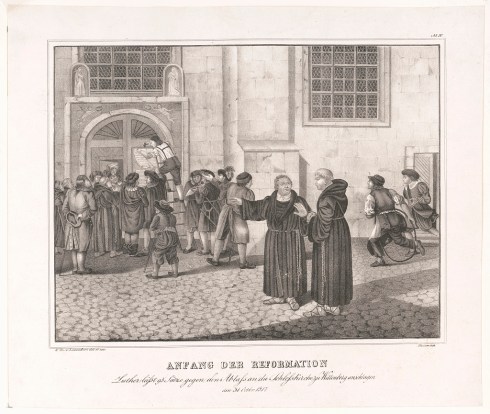
Today is Halloween; today is Reformation Day, the day that Martin Luther posted—or otherwise “published”— his Ninety-five Theses, a scathing and immediately-accessible critique of the abuses of the Catholic Church which launched a Reformation that would divide and alter western Christendom in myriad ways, changes which are still ongoing today. I live in Reformation Land all year long as most of the courses I teach are centered on this era: it’s either in the foreground or the background, a trigger, a factor, a cause or a culmination. But I also live in Salem, which is increasingly Halloween Land all year long. Usually I dwell in the former and shut out the latter as much as possible until the big night, but on October 31 I think I should be able to “celebrate” both, and when a former student sent me an image of Ninety-five Reeses the other day I realized I could!

pixlr_20191031073105292

95 frederick-the-wises-dream

95 Luther Woodcut LOC

luthers-church

screenshot_20191031-064823_facebookFrederick Kemmelmeyer’s portrait of Luther, National Gallery of Art+the carved pumpkins on my neighbor’s front stoop; Frederick the Wise’s Dream and the beginning of the Reformation, October 31, 1517, Library of Congress; Cranach’s  Schlosskirche in Wittenberg; the viral meme that inspired me: 95 Reeses!

Well obviously there have been a succession of trick-or-treating/ Wittenberg memes in social media circulation over the last decade or so, but I found this one particularly inspirating, so much so, I even made my own: of individual Reese’s cups. History and candy: the perfect combination.

20191031_083235

20191031_090603

20191030_202145


A Monumental Divide

At the center of Raleigh is the North Carolina Capitol building, in the midst of Capitol Square, surrounded by more than a dozen monuments to the memory of statesmen and soldiers. The most recent installation (1990) is the North Carolina Veterans Monument, while the tallest memorial is the monument erected “to our Confederate dead” in 1892, and the only monument referencing women is the 1914 statue honoring the North Carolina Women of the Confederacy. The Raleigh-Durham area has seen several intense protests against Confederate monuments over the past several years, resulting in the toppling of the Robert E. Lee and “Silent Sam” statues in Durham and Chapel Hill, but this past August the special “Confederate Monuments Study Committee” of the North Carolina Historical Commission voted that the Capitol monuments should stay in place, despite the request for removal from North Carolina governor Roy Cooper and the Committee’s own opinion that the statues are “an over-representation and over-memorialization of a difficult era in NC history.”

Mon 5

Mon 2

Mon 1

Mon 3

I would have to agree with that characterization, particularly of the Women of the Confederacy statue, which depicts a woman as a mother-historian, reading the heroic tales (I presume) of war to her sword-bearing son. The towering Confederate Dead statue nearby (which was very difficult to photograph) features anonymous soldiers and a rather simple message of honoring the dead, and so is perhaps not as confrontational as a statue of an individual and identified Civil War soldier, though there is also a monument to Henry Lawson Wyatt, purported to be the first Confederate soldier killed in action, on the Capitol grounds. In announcing its decision to let these statues stand, the state Commission called for additional interpretation, “to provide a balanced context and accounting of the monuments’ erection in their time in political history” as well as the erection of additional monuments honoring the contributions of North Carolina’s African-American citizens. I did not see such context, nor equal monumental representation, but we are less than a year out from this ruling and a long-term effort to establish an adjacent “Freedom Park,” designed by architect Phil Freelon, the leader of the design team for the Smithsonian Institution National Museum of African American History and Culture, appears to have accelerated over the past year.

Freedom Park

Plan for the proposed “Freedom Park” and monument in Raleigh.

As I wandered around Capitol Square this past weekend looking at all of its installations with my historical and decidedly northern (even more decidedly Massachusetts) perspective, I had the most visceral reaction to a monument which wasn’t even mentioned in the recent debate over Confederate memorials in North Carolina: that dedicated to Samuel A’Court Ashe in 1940. Ashe obviously lived a full life and was revered by many in his native state, but all I could see when I read this plaque was heroic defender of Fort Wagner. Just a few weeks before I was wandering another hallowed ground, Salem’s Harmony Grove Cemetery, where I saw the graves of several men who served with the 54th Massachusetts Volunteer Infantry Regiment, the first Civil War military unit comprised of African-American soldiers to be raised in the North. The soldiers of the Massachusetts 54th distinguished themselves during the assault on strategic Fort Wagner, which guarded the entrance to Charleston Harbor, at great cost, losing 281 men on July 18, 1863: 54 confirmed casualties (including commanding officer Robert Gould Shaw), 179 wounded, 48 simply lost, while the Confederate troops inside were reportedly “maddened and infuriated at the sight of Negro troops.” Their sacrifice confirmed their promise of hope and glory, in the words of Massachusetts Governor John Andrew, and was memorialized later by the Augustus Saint-Gaudens monument on Boston Common (1897), Robert Lowell’s poem “For the Union Dead”, and the 1989 film Glory. Ashe, the defender of Fort Wagner, has much to say about the war and its commemoration, as his long post-war career was characterized by prolific writing (and Confederate commemoration advocacy) both as a newspaper editor and historian. In his History of North Carolina, he makes no mention of the Massachusetts 54th at Fort Wagner, but only of “the splendid heroism and devotion of the North Carolina troops”, and his “historical” analysis of the causes of the Civil War focuses almost exclusively on the policies of an “unpatriotic” Abraham Lincoln, whom he never refers to as President: it is not true, as Lincoln said, that without slavery there would have been no secession. It was the absence of the spirit of compromise on the part of Lincoln and his party that brought about secession in 1861….Secession would have been averted if Lincoln had copied the example of his patriotic predecessors. But he made his anti-slavery feeling his ‘paramount object’ instead of his desire to save the Union. He was revered as “that stainless leader of the Lost Cause” in the 1940 address given at the dedication of his monument. Frankly, I don’t want to read anything more about or by Mr. Ashe, and the next time I am in Raleigh I will give his memorial a very wide berth.

Mon 7

Monument title 1933

Shaw Memorial

20190612_114421

The monument dedicated to Samuel A’Court Ashe in Raleigh’s Capitol Square and one of his telling titles; the Boston Common monument to Robert Gould Shaw and the Massachusetts 54th by Augustus Saint-Gaudens: two memorials which reference Fort Wagner, and the Civil War, in very different ways. The grave of  Salem native of Luis Fenollosa Emilio, a Captain of the Mass. 54th who survived Fort Wagner and lived to tell their tale in A Brave Black Regiment (1894).


Witness Houses

I was out and about in Lexington and Concord last week as my favorite nurseries are in that area, and between bouts of perusing plants I walked around Lexington Green and along the Battle Road at the Minute Man National Historic Park. In both locales you will see eighteenth-century “witness houses” which overlooked the opening acts of the Revolutionary War and now stand as physical reminders. The National Park Service also utilizes “witness trees” to enhance historical interpretation, particularly at Civil War sites. Certainly both the houses and the trees add to the ambiance of these historic landscapes, but their roles are much more important than that. The trees might bear scars, the houses might have served as refuges or makeshift hospitals: every physical remainder is a reference point or a touchstone. One can grasp their landmark status immediately by glancing at photographic records like Alexander Gardner’s photographic sketchbooks of the Civil War, which documented the contemporary significance of the Matthews House in Manassas and the Burnside Bridge in Antietam among other structures: the house still stands as does the sycamore tree by the bridge, connecting us to the past with their very presence.

Mathews House Gardner

Stone House

Burnside Bridge

witness-tree-sycamore-burnside-bridge-antietam-620Pages from Gardner’s Sketchbook, Volume One at Duke University Library’s Digital Repository; the Stone House and Burnside Bridge at Manassas National Battlefield Park and Antietam National Battlefield.

The importance of place—both in general and in many specific instances—can also be gleaned from accounts of the long process of reconciliation and remembrance following the Civil War. The grave of Calvin Townes, a Salem shoemaker who fought and was wounded with the valiant 1st Regiment of Massachusetts Volunteer Heavy Artillery at Spotsylvania, drew me into the heady history of memorialization for and by these men, who lost 55 of their comrades at the “engagement” at Harris Farm on May 19, 1864, and 484 men during the entire war. The surviving members of the Regiment met annually after the war, and raised funds for a monument on the battlefield near the farmhouse which was the focus of so much of their collective remembrance. The monument was dedicated in 1901; it endures but unfortunately Harris Farm does not, despite its inclusion on the National Register of Historic Places: it was purchased by a developer in 2014 and rather promptly demolished.

20190524_125006

1st regiment reunion at Salem Willows 1890

1st Regiment Monuments

Spotsylvania_HarrisFarmCalvin Townes of the First Regiment; the surviving Regiment at Salem Willows, 1890; Memorials at Spotsylvania and in the Essex Institute, from the History of the First Regiment of Heavy Artillery, Massachusetts Volunteers, formerly the Fourteenth Regiment of Infantry, 1861-1865 (1917); the demolished Harris Farm.

Revolutionary remembrance does not seem as intense, or we don’t have as much evidence of its expressions. Nor do we have opportunities for dramatic photographic contrasts, but the witness houses of Lexington and Concord remind us that these 1775 battles took place within a very human context—-settlements, not barren battlefields. And they also played their roles within the narrative of events. In Lexington Center the houses are privately-owned, and located around the Green; along the Battle Road they are part of the public park.

20190523_114050

20190528_113457pixlr-3

20190528_114456The Munroe House on Lexington Green (which is presently for sale); the Smith House, Hartwell hearth and Tavern, Minute Man National Historic Park.

The term “witness” implies to something: an act or an event. Salem’s historic structures witnessed many events: the arrival of precious cargoes, military maneuvers, political parades, the progress of transportation technology, fires, men going off to war, hordes of Halloween revelers. But of course one event looms large over Salem’s long history: the Salem Witch Trials. There is only one surviving structure which “witnessed” that tragedy: the Jonathan Corwin House, better-known (unfortunately) as the Witch House. Despite Salem’s (unfortunate) dependence on the witch trade, it bears remembering that the Corwin house was not saved and restored by the City, but rather by Historic Salem, Inc., which was founded in 1944 for the purposes of saving the storied house (and its neighbor, the Bowditch House) from demolition due to the widening of Route 114, one of Salem’s major entrance corridors. After its slight relocation and restoration (or recreation? or creation?) by the Boston architect Gordon Robb, the Witch House opened to the public in 1948. Historic Salem, Inc. went on to play key roles in preventing full-scale urban redevelopment in the later 1960s and early 1970s and advocating for both preservation and sensitive redevelopment for decades—a particularly pressing responsibility now. This year marks its 75th anniversary, a notable achievement which will be celebrated this very weekend with an event at the Hawthorne Hotel. Come one and all, and congratulations to HSI!

Witch HOuse HNE

Witch House 1947

Witch House 1940sThe Jonathan Corwin (Witch) House, in all of its incarnations in an early 20th century postcard, Historic New England; in 1947 as restored by Gordon Robb and Historic Salem, Inc., and photographed by Harry Sampson, and in the tourist attraction in the 1950s, Arthur Griffin via Digital Commonwealth.