Tag Archives: Maine

Limning the Local

I’ve engaged in lots of different history here: a lot of public, some world, American and European, but above all, local. I’m always looking for new ways to delve into and present local history. I follow the sources, I chase down new perspectives and approaches whenever I catch a trail, and because I’m operating in a digital world, I always look for striking visuals. All of these avenues have somehow brought me to a somewhat obscure graphic artist who centered much of his life on living in, working in, and  illuminating the backwoods Maine lumber town of Weld, Maine, a man named Seaverns W. Hilton who often signed his work S.W. Hilton. Hilton was born in Rhode Island and worked as a graphic artist (he is generally referred to as a poster artist) in New York City, but by the 1930s and his 30s he was in Weld, a Franklin County town whose population had shrunk precipitously as it lost its lumber trail. He diversified his artistic training into wood carving as a means of reviving and perhaps becoming part of his chosen community, but continued to illustrate on paper as well—mostly local history texts, and this is how I found him. I became a bit preoccupied by Benedict Arnold’s disastrous Quebec Expedition of 1775 after attending some commemorative events in Newburyport a few weeks ago, and found a little treatise with that perfect mod/mid-century aesthetic by none other than S.W. Hilton. And then I caught his trail.

It’s just great! I mean, this was quite the adventure (disaster) and you need the pictures. I tried reading some academic texts, but I think I learned more from Mr. Hilton. He illustrated books about the neighboring towns of Livermore and Rumford, as well as the famous Mount Zircon Moon Tide Spring in the latter. The Bethel Historical Society has an online exhibition on this venerable mineral spring, comparable to Poland Spring, featuring Hilton’s illustrations fromThe Mount Zircon Moon Tide Spring: An Illustrated History by Randall H. Bennett. These inland Maine cities and towns have interesting histories, as highlighted by Hilton and the authors for whom he illustrated, but they are not as well known as the Downeast ports on the coast with their more dramatic maritime narratives, so I appreciate Hilton’s creative spin. The title page of Josiah Volunteered, featuring the Civil War diary of a Maine soldier, also illustrates the Hilton treatment: it was published in the year he died, 1977. Looking at Hilton in a somewhat wider frame, he seems to have had success working in advertising in New York City (his copy work is  scarce but has fetched high prices in recent auctions), and became increasingly entangled in Maine from the later 1930s, primarily through the woodworking shop he founded, Woodworkers of Weld, which produced toys and figurines into the 1950s. Some of his creations garnered a national spotlight when an adjoining restaurant adorned with them, The Farmer’s Wife, was featured in Life magazine in 1937, and postcards followed. In this and all of his work, there’s an obvious whimsy in his depictions of past and present, and I think that’s what I appreciate the most, especially now.

Opening Day of the Mount Zircon Spring, from The Mount Zircon Moon Tide Spring: An Illustrated History by Randall H. Bennett.

Hilton posters for the Northern Pacific from the 1920s: Swann Auction Galleries and David Pollack Vintage Posters.

A wonderful 3 part series about Weld and Hilton starts here: https://luannyetter.wordpress.com/2021/04/09/the-shop-land-part-i/


Up North for a Spell

Sorry for the longer time between posts; I generally try (and succeed!) to post once a week but I was on vacation up in Maine and forgot my power cord, which might have been a good thing. I had my Fall Reading List all ready to post, but now I think I’ll save that for next week and just post my Maine pictures this week. We were based in East Boothbay on the Mid Coast, where we have been very casually house-hunting for a summer house. That was supposed to be the mission of this week as well but really it was just a family vacation as both my parents and my brother and brother-in-law joined us, along with a friend from Salem. We had a big beautiful farmhouse right on the water with spectacular sunsets each night. Great New England Summer weather; none of the swampy heat we’ve had in Massachusetts for most of the summer. I had my very first visit to Monhegan Island, which as inspired artists for generations. The other highlight, at least for me, was a visit to one of the National Park Service’s newest monuments, the Frances Perkins homestead in Newcastle. And the capstone was a oyster farming tour of the Damariascotta River given by my stepson Allen, who works at Muscongus Bay in nearby Edgecombe. Just a great week! Posting vacation pictures is definitely low-effort blogging, but I hope you’ll forgive me as I am now in the dreaded syllabus week before the beginning of the semester.

“Our” House with view and sunsets; around East Boothbay.

I could not resist putting my husband John’s lobster pasta in here as he seems to be on a lifelong quest to create the perfect lobster pasta and this was very good!

The Frances Perkins National Monument in Newcastle, with the sign that greeted us in the parking lot!

Maine is very intertwined with Canada, and I heard concerns about few Canadian visitors everwhere I went: given the hostile rhetoric from our President, it was nice to see this welcoming sign. Frances Perkins was a fierce social justice warrior and the first female cabinet member in U.S. history who served as President Franklin D. Roosevelt’s Secretary of Labor throughout his terms. She was integral to the passage of Social Security. This house along the Damariascotta River was in her family for over 250 years: though she was not raised here (her father moved south to Massachusetts for more opportunities, leaving her uncle to carry on the farm) she visited it often. It became a National Historic Landmark in 2014, and President Biden signed its official designation as an NPS Monument in December of 2024. It was quite poignant to visit this place given events recent and past, and there were quite a few people there—-hopefully Americans and Canadians! After we left the Perkins homestead, we drove out to Pemaquid Point, and this is the best picture I have ever taken of that locale so I had to include it.

Monhegan Island. I can’t believe I have never been there but now I have.

Monhegan is just one of thousands of Maine islands, but it is very storied. About ten miles and an hour and a half off the mainland, it’s about a mile in acreage, divided into a small village and lots of forest. Except for an unfortunate experience with sheep, the islanders seem to have been very intent with their land and pursuits, and the result is a very pictorial islandscape which has been captured by a succession of artists for more than a century. I absolutely loved the Monhegan Museum of Art & History, which blended art and history in nearly every exhibit: seemingly there was always an artist around to create posters for lighthouses (Alexander Parris), tea gardens, and baseball games (Frederic Dorr Steele), along with door panels (Karl Schmidt) and tea cups (Rockwell Kent). I could not leave out the lobster claw composition.

Oyster Farming on the Damariascotta River:

My stepson Allen got permission from his boss at Muscongus Bay Aquaculture to take us on a river tour at their Newcastle farm–just down the road from the Frances Perkins Homestead. It was fascinating, and this is seems like such an important industry for Maine (and all of coastal New England I think) right now: the neighboring Glidden Point farm was just featured in an article in the New York Times, and an oyster farmer is running against Senator Susan Collins in the upcoming election. I captured several “oystermobiles” as I drove around, but the one on Georgetown Island in the last photo above is the best.

Coastal Maine Botanical Gardens in Boothbay. The one cloudy day we had was perfect for pictures.

Lots of late summer color and the famous trolls–very popular but I did manage to get a few alone.


White Houses of Thomaston

We’re up in midcoast Maine for a long Memorial Day weekend and I spent an afternoon walking around Thomaston, which was the site of a very early English arrival in 1605: I’m not sure why this is not more heralded, or at least discussed. It became a very important shipbuilding town over the nineteenth century but for me, growing up in southern Maine, Thomaston had two associations: the prison and large white houses. The Maine State Prison at Thomaston was in operation from 1824 to 2002, and because of my adolescent preoccupation with the Isles of Shoals and the 1873 Smuttynose Murders I knew that the murderer, Louis Wagner, was held and executed at there. My other Thomaston association is far more pleasant: an impression of a succession of large white houses as we drove through on Route One. So I went back to look for the great white houses: there are indeed so many, and not just on the highway.

The most majestic white house of Thomaston (likely very prominent among my childhood impressions) is actually a recreation: of General Henry Knox’s Montpelier. The Revolutionary War hero was married to an heir of the Waldo Patent, which had allocated a large chunk of midcoast Maine to Boston merchant Samuel Waldo in the early 18th century. Waldo’s grandaughter Lucy Knox became his sole heir as her family, the Fluckers, were notable Loyalists who left the country at the onset of the Revolution. After Knox had finished his military and government service, he and Lucy retired to Thomaston and built Montpelier in 1794. They lived there until his death in 1806, after which the house was occupied by members of the Knox family until 1854, when it was sold. Several decades later it was demolished to my way for the Knox and Lincoln Railroad, and recreated in 1930 as a perfect Colonial Revival monument: now it houses the Henry Knox Museum. Was Montpelier the inspiration for all the stately white houses of Thomaston or was it James Overlock (1813-1906), who designed and built scores of solid structures in vernacular and revival styles with all the new building technologies of his day? Likely both, with a healthy measure of New England traditionalism, but all these white houses are certainly a testament to Thomaston’s shipbuilding wealth in the nineteenth century, and to the preservation efforts of their successive owners.

Just one sample of Thomaston’s white houses.


Weekend in Wiscasset

Just back from a long weekend in Wiscasset, Maine with family, lots of eating and drinking, house-hunting, and pumpkins. My stepson is working at an oyster farm in the region so we’re going to midcoast Maine pretty regularly, and this Columbus/Indigenous Peoples Day weekend was of course a good opportunity to escape Witch City. We stayed in a lovely house in Wiscasset, one of Maine’s prettiest towns, and made regular trips up Route One to Damariascotta, which was holding its annual Pumpkinfest, complete with Pumpkin Queen, Pumpkin Drop, Pumpkin Derby, Pumpkin Regatta, and a main street embellished with large embellished and carved Pumpkins.

Wiscasset houses & shopping & Damariascotta pumpkins.

I worked at Historic New England’s Phillips House in Salem on Saturday and visited Historic New England’s Nickels-Sortwell House in Wiscasset on Sunday. It certainly has been an HNE summer for me! We spent so much time with the pumpkin festivities in Damariascotta that I turned up at Nickels-Sortwell at 3:00 pm: the last tour of the day on the last day of their season! Bad form on my part, and I apologized profusely, but of course my guide was  completely gracious and welcoming and eager to show off the house. Historic New England has two houses in Wiscasset: the very dramatic Castle Tucker and the very……..strident Nickels-Sortwell, and I had never been to the latter so I was thrilled to be able to squeeze it in this weekend. I always look at history and houses through a comparative Salem prism, and this was not difficult to do regarding the Phillips and Nickels-Sortwell Houses: both are Federal constructions which evolved into a Victorianized rooming house/hotel and then were restored with Colonial Revival inspiration by wealthy Yankee families.

I learned a lot about the house and the families who lived in it on my tour, but after we said our goodbyes I was still puzzled by the assertion of my guide that in the year of the house’s construction, 1807, “Wiscasset was the busiest port north of Boston.” Of course I couldn’t stop myself from contesting that statement: I think Salem was? Certainly Portsmouth and Portland were busier? She responded that she wasn’t sure but that was a pretty standard Wiscasset claim. And she’s right: I looked at all the the Wiscasset tourist and historical information on the web and there it was, again and again: Wiscasset was the busiest port north of Boston, Wiscasset was the busiest port east of Boston in 1807, the year of the Jefferson Embargo Act. This is clearly not true in terms of tonnage or voyages, but I’m wondering if “busiest” means something else? Shipbuilding and other maritime industries AND customs revenues? HELP early American maritime historians!


The Bowman House

We were vacationing in midcoast Maine last week so I took the opportunity to visit Historic New England’s newest property, the Bowman House, with a few friends. We also saw the nearby Pownalborough Court House, which is one of the most extraordinary Colonial buildings I have ever encountered. The Bowman House is in Dresden, right on what was a very busy Kennebec River short at the time of its construction in the mid-eighteenth century. Now it sits amongst tranquil rolling lawn: this photograph is of the rear, of course; the front entrance looks upon the River.

The house is a very high-style Georgian construction, the type you see built in shipbuilding centers. It has a very charming air about it, partially provided by the architecture, but also by the restoration and decoration, which was the work of Bill Waters, who worked and lived in the house for decades. He died in 2016, after having donated the house to Historic New England with the qualification of lifetime tenure. So even though this house was built in 1762 for Joshua Bowman, a judge with Hancock connections, it really felt like Bill Water’s 21st century Georgian house: his personality shined through both his preservation efforts and his possessions. Since I’ve been working for Historic New England myself this summer, I’ve been thinking about the differences between the work of a tour guide and a professor, and one major one is that the work of the former is a lot more personal: you’re talking to and with smaller groups about more intimate stories rather than trends, causes and consequences. Historic New England’s interpretion focuses on the people who lived in its houses as much as their architectural history, and “Bill’s house” is a great example. (Although our guide did introduce us to local master builder Gershom Flagg, who built both the Bowman House and the Pownalborough Courthouses, and now I am obsessed!) Bill Waters came to the house through the Burrage sisters, Mildred and Madeleine, notable artists and world travelers who moved to Wiscasset in 1962 and became interested in the region’s historic architecture. In 1961 they purchased the Bowman House, and sold it to Waters several years later, and he and his life partner Cyrus Pinkham began their life’s (house) work. 

Bill Waters with Bowman descendant Florence Bixby and the Burrage Sisters in 1968 (Maine Historical Society), and more recently.

So let’s go into the house, shall we? You enter through a single-story sun room which was likely a nineteenth-century addition (the house served as the office for an ice-supply business in the later 19th century) and then into the kitchen and a series of first-floor parlors and dining room adjoining a spacious central hallway—wonderful reproduction wallpapers throughout, including the pillar-and-arch paper that I think is also in Hamilton House? Throughout his tenure, Waters worked to bring as many period-appropriate and/or Bowen furnishings into the house, and everything seems perfect and very colorful, but also very, very livable.

There are several spaces in which he seems like he just stepped away…….like the bar (above) and lots of whimsy, like the feathers on his canopy bed (below). Artful assembly throughout, and very special mirrors!

We exited through the sunroom, a very comfortable space which reveals Waters’ appreciation of trade signs (as well as his southern roots, represented by a small image of General Robert E. Lee) and then drove down the road to the Courthouse: wow! Photographs don’t quite represent the scale of this 1761 building.


Blocked Path

The house which represents refuge from Salem October is the house I grew up in, a shingle “cottage” in York Harbor which is on the main street but also adjacent to a lane which used to offer access to the Cliff Walk, a constructed path along the water which used to proceed from York Harbor Beach all the way to Cow Beach near Long Sands Beach. When I was younger I would just walk down the lane to the Cliff Walk, turn right to go to Cow Beach, which is rocky but where I saw my first (and now that I think about, only) beached whale, or left to go to York Harbor Beach for swimming and tanning. At that time, York Harbor was dominated by summer houses: we were among the minority of full-time residents. And so even though our way to the Cliff Walk had houses on either side with adjacent lawns, nobody was ever there: one was a cool 1920s house and another a big old gray Victorian. Now the cool 1920s house has been turned into something less aesthetic, and the Victorian replaced by another generic coastal house, and yet another generic coastal house has been added to the conjoined lots, and none of the owners of these houses recognize any pre-existing access to or from the Cliff Walk: the path is blocked and gated. The Cliff Walk itself has also been blocked on the way to Cow Beach by a landowner who has planted a big imposing hedge, and while still beautiful, is a stub of its former self. Let’s take a walk from the Harbor Beach to the hedge, passing by my former entrance to the walk—and the sea.

Looking up at the Cliff Walk from York Harbor Beach; the Reading Room is the first building. There used to be four cottages, but they were removed for Hartley Mason Park/Reservation.

Must be fully warned! As you will see, some parts of the path are in better shape than others.

But the path in front of the Reading Room looks great!

Ok, I get it!

For me, the Cliff Walk was all about private lookouts and houses—it was and is the best way to see some of these cliff-hugging cottages. We always stuck to the path, even when we were mischevious kids.

Not too great over this stretch.

My old entrance and exit.

Nicely-maintained after that but there’s not far to go; that big white house is the home of the hedge-maker and the end of the line.

I’m late to this party as I have not been living here. There have been substantive efforts to defend the public’s prescriptive (historical) right to access the entire path, rounding the corner you see above to Cow Beach. The Town of York has a Cliff Walk Committee, and there is a Friends of the Cliff Walk Facebook group. But the Hedge Guy is standing his ground. It’s complicated, and I need to learn more. I certainly understand the privacy and insurance considerations of those who own homes adjacent, but I miss “my” walk—I guess it’s just a memory lane for now.

Golden Hour, indeed!


Sanctuary from Salem 2023

The last time I wrote that title—with another date, 1693—it was nine years ago and I was referring to Salem Witch Trials refugee Sarah Towne Clayes, who found sanctuary in Framingham, Massachusetts, the hometown of both of my parents. Her house was a decayed relic at that time, with little prospects of rehabilitation, but now it has been completely restored! You can see and read about it here: and kudos to the Framingham History Center and the dedicated preservationists who saved this important house. This time, the refugee is me: I have found sanctuary from Salem in my childhood home in York Harbor, Maine. The comparison references the title only of course: my situation hardly rivals Sarah’s, having lost her two sisters to the mob, running for her life. I feel a bit uncomfortable using the same title, but I also feel fortunate to have a place to live outside of Salem and I wanted to convey that feeling. I had to get out of town: away from the sonorous tour guide right outside my door, the haunted halloween party hall right next door, and all that trash and traffic and all those people in little black felt witch hats and Hocus Pocus t-shirts. I’m still working in Salem, so ironically I have developed just a touch more empathy for Salem tourists as I try to make my way back into town. Just a touch. On the other hand, I feel tremendous empathy for my fellow Salem residents who commute by car outside of town! I’m still working on my contributions to our Salem book (as well as a talk I’m giving at the First Church in Salem next week) so it’s still Salem most of the time, but during my down time I can walk or drive around York and see some beautiful scenery. So that’s pretty much this post: some of my favorite places in York.

Our house, a summer “cottage,” one of many built in the summer colony of York Harbor; the buildings of the Old York Historical Society  in York Village, and the First Parish Church.

The McIntire Garrison on Route 91, and one of many walking trails in York just down the road. Then it’s back to York Harbor, following the river.

A view in Cape Neddick, and more favorite houses–more coming!

York is HUGE, encompassing over 54 square miles according to the US Census Bureau. Even though I grew up here, I don’t know it that well, because it is so huge and because it has grown over the decades: when I was driving around last weekend I discovered lots of new developments and even a new road I knew nothing about. I always thought there were four distinct villages within York—-York Harbor, York Village, York Beach, and Cape Neddick—but apparently there is another, Bald Head. York was settled even before Salem and was the first incorporated city in America. I’ve got a lot of territory to explore and a lot to learn, so stay tuned over the next few weeks as I dig a bit deeper.


The Elizabeth Perkins House

One of the chapters I’m working on for Salem’s Centuries this summer is about Colonial Revival Salem, or should I say, a group of antiquarians who lived and worked in Salem from about 1890-1930 who were dedicated to preserving and promoting any and everything about Colonial-era Salem in their time and for the future. Our book is a work of social history, so our focus in on Salem people. But when it comes to the various expressions of the Colonial Revival movement, if you can call it that, I’ve always found that individuals and their often-passionate attachments to the past are so important, and this is particularly true in the case of the Elizabeth Perkins House, one of the Old York Historical Society’s  properties that has recently been reopened. For some reason, this is the one Old York house that I’ve never been inside, and I’d always heard that it was a perfect example of Colonial Revival influence in this region, so I was pretty eager when I showed up for my tour this past Friday.

The Elizabeth Perkins House of the Old York Historical Society, looking over the York River, Sewall’s Bridge and the Hancock Warehouse beyond. Its restorers, expanders and occupants: Mary Sowells Perkins and Elizabeth B. Perkins (photo on right from Old York Historical Society as featured in a very helpful Willaim & Mary 1988 thesis by Melisssa Mosher shows Elizabeth Perkins in front of the house).

This house is absolutely central to the preservation history of York as its early 20th century occupants, Mary Sowles Perkins (1845-1929) and her daughter Elizabeth B. Perkins (1869-1952) contributed it and several other structures (the Old Gaol, Jefferds Tavern, the old Schoolhouse, and the John Hancock warehouse) to what would eventually become the Old York Historical Society as well as encouraging other preservation efforts. So it seems right that Old York’s administrative offices have been relocated to this site as well. There was a whirlwind of restoration, expansion, embellishment and entertaining after the Perkins family purchased the house in 1898: they were from New York, and seem to have known everyone. Mark Twain came over from his summer rental across the river to use their telephone, the first one in York, and in 1905 they hosted the grandest party of the era: a Japenese-themed fête to celebrate the conclusion of the Portsmouth Peace Treaty ending the Russo-Japanese War of 1905 with over 700 guests in attendence. The tour really focused on their house, so much so that I’m not really sure of its pre-Perkins history. Old York is dating the house to around 1730 now, which seems about right to me, but I have postcards from my childhood (showing the house exactly as it looks now and at the time of Perkins’ death in 1952) bearing the date of 1680. The one below of the dining room shows the very “colonial” room that the Perkins created but also one of its most off-putting features for me—the electrified girondoles along the back wall.

Postcard of the dining room from 1960s or 1970s? I think it is a rule that every Colonial Revival house must have Hessians!

At first the house seemed to me like one of those sprawling recreations/creations which Mary Harrod Northend, one of the Colonial Revivalists in my Salem chapter, showcased in her Remodeled Farmhouses (1915) and I immediately wanted to know if Harrod knew either of the Perkins women–the two Marys were of the same generation. But inside, besides the dining room, it felt a little different to me than standard Colonial Revival: I guess there is no standard Colonial Revival because it is often an individual expression. The parlors of the Perkins house felt very traditional to me, but also more cosmopolitan, more worldly, more lavish, more of a mashup between past and present than a “period rooms”. A case in point would be this wonderful 20th century copy of an earlier portrait: this modern woman dressed in period costume just like Elizabeth Perkins above (well, a bit more elegantly). I love this portrait!

Hooked rugs abound of course, but the Perkins ladies were great travelers so that accounts for the worldliness of their rooms and all the interesting assemblages. Now I’m wondering about comparative Colonial Revival settings: if you’re trying to create and preserve a “colonial” home in the country it’s a different experience than in the city, where change is so much more apparent—and threatening. My Salem people, including Harrod, Frank Cousins, George Francis Dow, Caroline Emmerton and Daniel Low, are living and working in an environment of constant development, fire, pollution, and immigration: it seemed like things were being swept away. The Perkins ladies were facing none of that in York, so I’m thinking that they didn’t have to be quite so strident in their pusuit and preservation of the Colonial. Just a thought.

Front parlors and a very traditional entry; love the 17th century “open-back” ??? chairs.

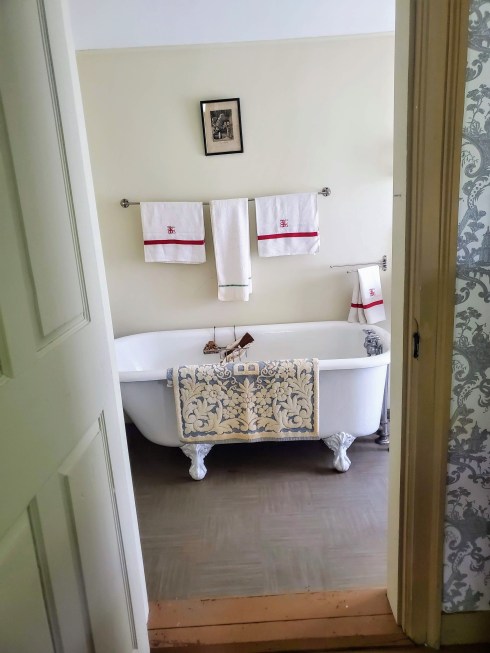
Loved the Currier & Ives presidential prints in the guest bedroom, which also has an en suite bathroom. The other bedrooms, including that of Mrs. Perkins above, have that “just left”/ I was just reading……. feeling, which is very Colonial Revival too: George Francis Dow pioneered the use of the folded-newspaper-by-the-gentleman’s chair motif in his period rooms in Salem, I believe.

Tours every Friday and Saturday available here.


Christmas at Home and Away

Our Christmas was Covid-impacted like everyone else’s, but it ended up being just lovely, with most of our time spent with my brother and brother-in-law in Salem eating, drinking, playing bad board games and watching movies. We went up to York Harbor for Boxing Day with my parents, but we’re not going down to New Jersey to see my husband’s family, so this is a rare holiday season without long-distance travel for me (with the exception of last year, of course), and I’m enjoying lounging around. Because we knew we would be primarily stationary on Christmas weekend, we snuck in a quick trip down to Newport to see the decorated mansions (the Elms, Marble House, and the Breakers) as well as the streets and streets of colonial houses of every color. So all in all, a convivial, colorful, and (so-far) Covid-free holiday! I feel very fortunate.

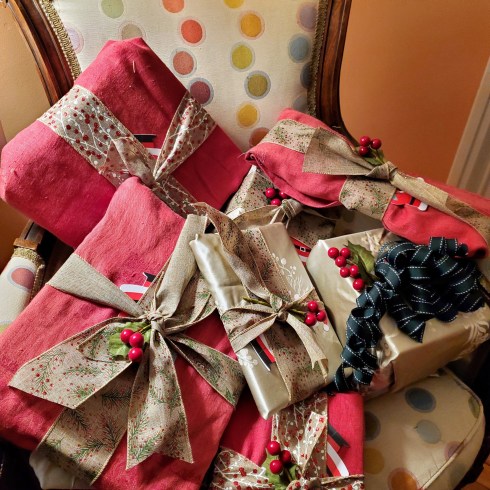
Christmas at Home (with swans this year—and lots of cats, our Trinity & Tuck, and my brother’s Clementine).

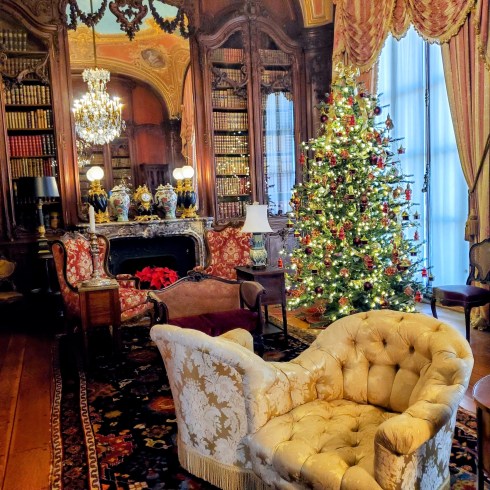
Newport! I really prefer the smaller colonial houses, but when you’re in Newport you’ve got to see some mansions, especially at Christmas time. We had a lovely dinner at the White Horse tavern, and just walked by and through so many houses. Perfect little break. I think I have the many, many Christmas trees and mantles in order of their location—-first The Elms, then Marble House, then the Breakers—but there were just so MANY I might have mixed some up.

The Elms, 1901.

Marble House, 1888-1892.

The Breakers, 1895.

As glittering as they are at this time of year in particular, these mansions are a bit over the top, so I’m ending with the simple themed trees in the basement kitchen of the Breakers (hedgehogs & mushrooms! I’ve been wanting to do those Christmas themes myself) above and my very favorite Newport house and the First Parish Church in my hometown of York, below. Happiest of holidays to everyone.


A Bush Garden

Last week I spent a day in Kennebunkport, a town long associated with the Bush family because of Walker’s Point, which was purchased by President H.W. Bush’s maternal great- and grandfather after the turn of the last century. The usual congregation of onlookers was there, looking down on the Point compound: summer white house towns seem to have lasting appeal and Kennebunkport is a summer white house town x two. I was thrilled because the gate to St. Ann’s-by-the-Sea, a bit further down the coast, was open and so too was the church itself: I had never been inside and this was my chance! It did not disappoint: what a lovely seaside chapel that actually accentuates its setting, a great achievement as its setting is magnificent.

On the road that connects Kennebunkport harbor and downtown to the coast is a small park owned and maintained by the Kennebunkport Conservation Trust named River Green which is the site of a lovely little garden dedicated to former First Lady Barbara Pierce Bush. “Ganny’s Garden,” referring to the name she was called by her 17 grandchildren, was laid out in 2011 and became a memorial garden after Mrs. Bush’s death in 2018. It is completely charming, and also provides a good lesson about what one can do in a relatively small space. It is packed with plants, including some unusual ones (I was struck by the liberal use of mustardbut also personality and presence: bronze “statues” of Mrs. Bush’s gardening shoes and hat lie adjacent to that of an open book (her favorite Pride and Prejudice) as if she had just been there—or was still there.

The garden is overlooked by another statue dedicated to the seafaring forebears of Kennebunkport: Frank Handlen’s Our Forebears of the Coast, which was commissioned in 1994. Its presence made me wonder, in my compare-everything-to-Salem habit which I am trying to kick this summer: why no monument to Salem seafarers? If ever a settlement was made by the sea, it’s this one!