
Tag Archives: Leslie’s Retreat

Leslie’s Retreat 250

More local Revolutionary history! I know I have not been straying far from this focus lately, but this past weekend (well, really February 26) marked the 250th anniversary of Leslie’s Retreat here in Salem with several colorful events which definitely deserve a post. And fair warning, there will be more 1775 over the next few months: I’m giving a talk on Salem’s “pre-Revolutionary Revolution” for Historic New England in April and then there will be the big commemoration of Bunker Hill and then……….we’ll see. I promise to sneak some other topics in here, but for Massachusetts in the American Revolution, it’s really all about 1775, so there’s a lot going on. Saturday’s commemoration kicked off with a presentation at St. Peter’s Church which echoed the sequence of events in 1775 when the Sabbath was disturbed by the arrival of British soldiers in Salem in search of contraband cannon. I arrived a bit late for this event, as it was advertised as featuring “stakeholders” and I knew that meant politicians: that is the term that our previous mayor and present Lieutenant Governor, Kim Driscoll, used all the time during her tenure to distinguish VIPs from mere residents. It’s still used all the time in Salem, and I always bristle when I hear it, so my little rebellion was to stomp over to St. Peter’s late. By the time I arrived, there was a full church listening intently to the last of the stakeholders, our present Mayor Dominick Pangallo. Then we heard from Lt. Colonel Leslie himself, sang a hymn and listened to a timely sermon, and watched as the news of the marching soldiers (some of whom were apparently right next door) interrupted the everyday life a few colonial Salemites. And then we were off to the North Bridge!

The “congregation” walked over to the site, now pretty unrecognizable or unimaginable if you know the historic terrain, where the parley which brought about, and constituted, Leslie’s Retreat, happened nearly 250 years ago. The major difference between this special commemoration and those of previous years was the presence of many more reenacting regiments, so the crowd and the soldiers were separated on two lanes of the bridge, with traffic blocked off (which was quite something, as route 114 is a major artery). In past years civilians and soldiers were mixed in together, and there was less of each. I couldn’t really see or hear the negotiations between Lt. Col. Leslie and the Salem men, but everything that transpired seemed to happen much quicker than was the case in 1775. Leslie retreated very quickly, followed by a few regiments of Colonials which had formed on the other side of the river. All I could really capture was the marching, to and from. A lot of players—I’m sure this took a lot of coordination. After witnessing this, I cannot imagine the complexities of the “curation” of the Battle of Bunker Hill in June.

There were trolley tours and a great exhibit at the Salem Armory Visitor’s Center, but I was focused on a fashionable event in the afternoon: “Fashion in the Season of Revolution: a Panel Discussion and Reenactor Promenade” at the Peabody Essex Museum. This was so interesting: I’m still kind of thinking about it. There were scholarly talks about Abigail Adams’ quilted petticoat and Eldridge Gerry’s sister’s wedding ensemble and the revolutionary preference for homespun as it related to shoes, and then there were questions for an ensemble of reenactors in the audience and on stage. Their answers were really thoughtful and fascinating, including those of a 14-year-old girl who had come up to Salem with her regiment for the day (I’m only 14 so I can’t carry a musket but I have a bugle. Who knew that musiciansuniforms had variant stripes?) I have to tell you that most academic historians have a bit of a snobby attitude towards reenectors: I would include myself in this company until the last few years. It’s the dominance of archival research in our profession, and an assumed exclusive association with military history, I think. Speaking for myself, I had always associated reenacting and “pageantry” with the Victorian romanticization of the pre-modern past, something I’ve always had to counter throughout my teaching career. But my perspective on this has changed over the years, especially as I’ve met local history enthusiasts in this region. I still really can’t handle a Renaissance Fair, but it’s clear to me that for many reenactors, who engage in the pursuit for decades, both their “kit” and their engagement in commemoration are ways to study and venerate the past at the same time. I clearly am craving a material connection to the past as well, as all I really want to do on most days is drive around and look at seventeenth-century houses: and I envy their comaraderie!

After all that, it was off to the Revolution Ball next door at Hamilton Hall. It took me a while to get dressed, as I had my own little reenactor “Caraco” jacket which laces up the front and a really nice dark red silk “petticoat” (skirt) which also took me a while to figure out. The ball was really magical: the Hall looked gorgeous, I hope you can get some sense of it in the photographs below. It was period dress/black tie, and it seemed liked it was about half and half. Dancing with a caller, cocktails, I even ate, which I never do at parties for some reason. There were quite a few people there that had participated in the events of the day, and who were part of other commemoration activities, so there quite a bit of festive camaraderie, so much so that I can justify using that word twice in one post.

N.B. Saturday was a fun celebration, but I woke up on Sunday to a flag hanging upside down at Yosemite National Park (where a former student works, still, I think), a distress signal from its rangers/stewards. So I have to add my hope that the revolutionary commemorations of 2025, 2026, and beyond can communicate to the American public the extreme sacrifices that the Revolutionary generation made for real freedom, not just lower consumer prices. Moreover, this long commemoration is itself threatened by this administration’s attack on federal employees in general and those of the National Park Service in particular: Salem Maritime National Historic Site historian Emily Murphy curated and presented the exhibit on Leslie’s Retreat which will be on view all spring, and obviously Minute Man National Historic Park will be center stage for the commemorations of Lexington and Concord in April. A comprehensive list of the Revolution 250 inititatives and events planned by Massachusetts National Historic sites and parks is here: please support their efforts and their personnel.


Leslie’s Retreat: How an Incident became an Event

Next weekend here in Salem a whirlwind of events will commemorate the 250th anniversary of Leslie’s Retreat, including reenactments of the Redcoats’ march towards the North Bridge and the negotiations/resistance that followed, a variety of tours, an exhibit, a concert, a play at Old Town Hall, a presentation on revolutionary and reenactment clothing at the Peabody Essex Museum, and a ball at Hamilton Hall! A group of stalwart history enthusiasts and educators organized a Retreat reenactment nearly a decade ago and the event has been growing in popularity every since, but this year is BIG because of the 250th anniversary, and the city has jumped on the bandwagon. I’m grateful to those “First Reenactors” as February 26th (or thereabouts) has become a conspicuous non-witchy event on the Salem calendar, so I feel like commemorating them, but their efforts are part of a long tradition: Salem has long celebrated its brief, shining moment of Revolutionary resistance. I’ve posted quite about what the event called “Leslie’s Retreat” was so this year I thought I’d write in response to a slightly different prompt: how did this “incident at the North Bridge in Salem” became the event we call “Leslie’s Retreat?” I’m also interested in how it became known as “the first armed resistance to British troops” when it clearly wasn’t, but I suspect the answer to that question is because they just kept saying it was so I don’t want to waste too much time on that.

Wonderful etching of Salem’s North Bridge in the 1880s by George Merwanjee White, Phillips Library (the shores looks so close!); various mid-century pictorial maps with the “first” claim.

So before I go into all the factors which made Leslie’s Retreat LESLIE’S RETREAT, here’s a very brief summary of what happened on February 26, 1775. VERY BRIEF. You can search for my other Leslie’s Retreat posts or, if you want all the details and the most probing analysis, go to J.L. Bell’s amazing blog Boston 1775which imho and that of many others is the absolutely best source for pre-revolutionary Boston and its environs. Bell is giving a talk for the Marblehead Museum on February 27 which I am very much looking forward to as I have managed to miss all his other presentations on Leslie’s Retreat. Until I am enlightened further by him, here is my summary:

“Leslie’s Retreat” represents the unsuccessful attempt of the 64th Regiment of Foot under the command of Lieutenant Colonel Alexander Leslie to commandeer cannon in Salem. Said cannon were likely 17 twelve-pounders secured by Colonel David Mason, who had commissioned blacksmith Robert Forster to mount them to carriages. Royal Governor Thomas Gage, who had essentially been kicked out of Salem the previous August as the town was serving as the provincial capital (but who clearly still had his contacts) caught wind of this clandestine cannon and ordered Lt. Col. Leslie and his troops to sail from Fort William in Boston Harbor to Marblehead, and from there march to Salem and “take possession of the rebel cannon in the name of His Majesty.” The operation was planned for a sleepy Sabbath Sunday, but as soon as the Regulars landed in Marblehead word got out, and the alarm was sounded not only in Salem but in other Essex County towns. Leslie marched to what was then called the North Field Bridge, which was a drawbridge firmly fixed in the up position which prevented him from crossing the North River to Forster’s forge and foundry. A crowd formed and negotiations began between a frustrated Leslie, several Salem residents and militiamen, and a local pastor, Thomas Barnard. With darkness (and militiamen throughout Essex County) advancing, a compromise was reached: the bridge was lowered and Leslie and his men were able to cross and inspect, but the cannon were long gone. So they retreated back to Marblehead and Boston. 
[Interuption/disruption: in longer narratives of Leslie’s Retreat, a woman named Sarah Tarrant is generally referenced, as she taunted Leslie and his soldiers from her open window. That’s fine, I’m sure Sarah was very brave, but Colonel Mason’s wife Hannah and her two daughters made 5000 FLANNEL CARTRIDGES for the cannon in the preceding month. So I think Hannah Symmes Mason and her daughters Hannah and Susan deserve some glory too.]

John Muller’s authoritative Treatise on Artillery, which Mason no doubt possessed, contains detailed instructions for making cannon cartridges as well as all types of carriages. 

So here are the major factors and forces which transformed Leslie’s Retreat from mere incident to major event: it was a chronological process, of course!

1820s Patriotism. Here in the Boston area, there was clearly some intensifying patriotism focused on the Revolution in the 1820s, the result of a combination of forces, including the upcoming fiftieth aniversary, the visit of General Lafayette, and above all, the movement to commemorate the Battle of Bunker Hill. I was not surprised to see the first public reference to “Col. Leslie’s Retreat” in this decade, though I bet it was a term in use before then. It seems that the loyal citizens of North Salem took matters into their own hands in 1823, and I really would like to see this elaborate staff with an eagle and a bust of George Washington. The Bunker Hill Monument Association was established that same summer, and Lafayette laid the cornerstone for the monument in 1825. It was not completed until 1843, but at the Whig Bunker Hill Convention of 1840, a grand historical parade around the monument-in-progress featured 1200 marchers from Salem bearing a Leslie’s Retreat banner asserting we were the first to defeat our oppression in 1775—we shall be the last to yield to them in 1840.

The Essex Institute. Founded in 1848 and serving as Salem’s de facto historical society until its assimilation into the Peabody Essex Museum in 1992, the Essex Institute commissioned TWO items which are essential to the history, interpretation, and identification of Leslie’s Retreat, Samuel Morse Endicott’s Account of Leslie’s Retreat at the North Bridge in Salem on Sunday Feby’y 26, 1775 (1856) and Lewis Jesse Bridgman’s watercolor of Repulse of Leslie at the  North Bridge (1901). Endicott’s Account became an instant classic and as it was issued in a very nice edition after its first publication in the Collections of the Essex Institute it became even more valuable with age: a brief survey of book auction catalogs from the early twentieth century indicates it was in every gentleman’s library. And as I have written here many times before: it’s difficult to “imprint” anything or anybody in people’s minds without an image, so the Bridgman painting has been equally valuable. It was reproduced everywhere, including as a hugh wall mural donated to Salem High School by the Daughters of the American Revolution, North Bridge Branch, in 1910.

The Civil War. There are numerous “memory” connections between the Revolution and the Civil War, but I think the most important one in Salem’s history is Governor Andrew’s identification of the North Bridge as one of the key places in Massachusetts to fire off a salute in celebration of the ratification of the thirteenth amendment. The bridge had received a new “Liberty Pole” in 1862, so its identification with liberty was pretty established by that time. There’s no question that the North Bridge was a much more hallowed place than it is now: overpasses just don’t conjure up heritage like bridges.

The Big Anniversaries. The years 1875-1876 were similiar to 1975-1976 and 2025-2026, with the convergence of the 100th, 200th and 250th anniversaries of Leslie’s Retreat and the beginning of the American Revolution. “Triumphal arches” were erected on the North Bridge in 1876 and again in 1926, for Salem’s Tercentenary. There were just so many occasions to mark and remember Leslie’s Retreat, and when there wasn’t an occasion, one was made up! The Leslie’s Retreat monument, now under the bridge rather than on it, was erected in 1887, and a quarter of a century later the “Pageant of Salem” dramatized the narrative (as if it wasn’t dramatic enough). I must say, the 1975 reenactment looks like it was really fun.

The 1926 Salem Tercentenary Leslie’s Retreat Float was sponsored by the DAR, North River Branch. Salem State University Archives and Special Collections; Col. Leslie by Racket Shreve in Salem’s wonderful Bicentennial Illustrated Guide Book.

These big anniversaries were important, but they were only highlights in a long history of commemoration: from at least the 1850s, there was some kind of speech or moment recognizing Leslie’s Retreat every year, all through the 1860s, 1870s, 1880s, 1890s, 1900s, 1910s and 1920s. After that, it’s a bit more occasional, but you can still find references. The longest period where there are the fewest mentions in the press was from the Bicentennial to 2017, when the “First Reenactors” reengaged with the event and its impact. I wonder (not really) how Salem changed during these thirty years? We are certainly not in the period where, as one of the commenters on a previous post asserted, “every 8th grader in Salem had to write a paper on Leslie’s Retreat” for better or for worse. But thanks to those First Reenactors of 2017 (or 2016??? I can’t seem to remember) we are in a much better place for commemorating 1775 than we would be without their efforts, so hat’s off and huzzah to them!

Charlie Newhall, Jonathan Streff & Jeffrey Barz Snell and a BIG crowd in 2017.


2025: the Anniversary Year

I like to look ahead to the coming historical anniversaries at the beginning of every year, and in 2025 it’s pretty clear that two wars are going to dominate the commemoration calendar: the beginning of the American Revolution and the end of World War II. The Fall of Saigon occurred in 1975, so you could add a third. Here in Massachusetts, we’ve been gearing up for revolutionary remembrance for quite some time, under the aegis of a coalition called Revolution 250. Even the City of Salem, pretty passive when it comes to matters of heritage and seemingly oblivious to our City’s key pre-revolutionary and revolutionary roles, is getting in on the action by jumping on board the 250th anniversary of “Leslie’s Retreat” in late February. A Revolution Ball at Hamilton Hall—the successor to the pre-Covid Resistance Ball— will also be held in the midst of a very busy commemorative weekend in Salem. The commemorations of the battles of Lexington and Concord in April and Bunker Hill in June promise to be huge, even though the latter will be “fought” in Gloucester rather than Charlestown. Then the focus will shift to Cambridge, where Washington formed the Continental Army: I don’t think it was quite as orderly a process as the Currier & Ives lithograph below presents!

Revolutionary remembrance in Salem and Massachusetts: a view of “Leslie’s Retreat,” when a Salem crowd and dialogue convinced British Lt. Colonel Alexander Leslie and his soldiers to retreat while cannon were carried away, 1955 Emma Crafts Earley Map Salem Massachusettes With History, Phillips Library. This event is widely heralded in Salem as the “first armed resistance by the Colonies to British Authority,” which is just not true, but I think I can accept “the first armed resistance to British in 1775.” The Revolution Ball will be held on February 22: more information here. The Battle of Lexington, Bettman Archive; “An Exact View of the Late Battle at Charlestown, June 17, 1775.” and “Washington Taking Command of the American Army,” Metropolitan Museum of Art. 

While most of the Revolutionary commemoration will likely be exuberant, remembering the end of World War II will be much more nuanced, marking victory and liberation but also loss and destruction. The 80th anniversary of VE Day (May 8) could be “a shared moment of celebration” but obviously Holocaust remembrance will be more solemn, as will the anniversaries of the atomic bombing of Hiroshima and Nagasaki. I probably shouldn’t even reference these atrocities in a post on history anniversaries as their remembrance is quite appropriately ongoing and perpetual, but the eighty-year mark is noted everywhere. A major exhibition, Portraits of the Hibakusha | 80 Years Remembered, featuring a series of 52 lenticular portraits of the survivors of the atomic bombing of Hiroshima and Nagasaki, has already opened and will travel to museums and galleries around the world. Eighty years ago this very month (on January 27), Auschwitz was liberated by soldiers of the 60th Army of the First Ukrainian Front of the Red Army: here is more information about the observances scheduled for this site on this particular International Holocaust Remembrance Day, from which Russia has been excluded for the third straight year.

It seems to me that in terms of public remembrance, we tend to remember bad things more than good, ostensibly because we do not want to repeat the bad. Ultimately (I think!) war remembrance is a hopeful process rather than a macabre one, but it is wearing and wearying. I teach a European history survey pretty much every semester and I always get wary when we approach the twentieth century, but there were two very consequential conflicts from my own period that will also be commemorated in 2025: King Philip’s War (1675-76) and the German Peasants War of 1525, both bloody conflicts between desperate insurgents and established regimes—well, perhaps the colonists of southern New England were not that established when an indigenous coalition under the leadership of Wampanoag chief Metacom, later known as King Philip, attacked English settlements over a 14-month period. Several Salem men, including Nathaniel Hawthorne’s first American ancestor William Hathorne, fought in this conflict, which left hundreds of colonists and thousands of Native Americans dead. Northeastern University Emeritus Professor of Public History Martin Blatt has called for more commemoration of King Philip’s War, but I don’t see any big event on the 2025 calendar. There is, however, some amazing scholarship on the War and its remembrance in New England over the centuries. The German Peasants’ War was the biggest uprising in Western Europe before the French Revolution, extending to much of the Holy Roman Empire. It was notable for being not just a large peasant revolt but one in which an expansive “working class” (a term we don’t usually use before the Industrial Revolution), including miners and urban workers, rose up against serfdom and its remnants, brandishing a document callled The Twelve Articles which justified their demands in scripture. It’s the first sign of the potentially radical impact of the Reformation, and Martin Luther was so horrified by the rebels’ confusion of spiritual and secular “freedom” that he called for the “murderous theiving hordes of peasants” to be cut down. And so they were.

Because of its early expression of “class consciousness,” East Germany commemorated the 45oth anniversary of the Peasants War in 1975 with this stamp and other events. For the 500th anniversary in 2025, the Thuringian state has organized a traveling exhibition.

Lightening up quite a bit. Jane Austen was born in that consequential year of 1775, and given her popularity over these past few decades, I have no doubt that the 250th anniversary of her birth will be commemorated in a big way in Britian—and no doubt elsewhere. Just a few clicks and I realized that the events that constitute Jane Austen 250 make the very busy Revolution 250 calendar look quiet! In Bath, and Winchester, and throughout Hampshire there will be festivals and costume balls and dress-up days and parades. At Jane Austen’s House in Chawton, each book will get its own festival starting with Pride and Prejudice this very month and there will be a special year-long exhibition called Austenmania. Bath has been on the Austen bandwagon for quite some time so there’s a lot going on there but in Winchester, the city where Jane spent her last years and was laid to rest, there’s a bit of a controversy about a new statue to be installed on the Cathedral grounds. There are concerns about overtourism in general and the sanctity of its proposed location in particular, with one critic opining that “I don’t think we want to turn it into Disneyland-on-Itchen. I don’t think the Inner Close is the place to attract a lot of lovely American tourists to come and have a selfie with Jane Austen.” (sounds vaguely familiar) They’ve spent quite a bit of money on the statue, so I think it’s a go, but Winchester is clearly the only place in the region where there are any clouds on the horizon: everywhere and everyone else seems geared up for an enthusiastic Austen year.


In the Thick of It

This weekend is the annual commemoration/celebration of Leslie’s Retreat, a pre-Revolutionary event which could have marked the beginning of the American Revolution, if not for the patience, restraint, and diplomacy of participants on both sides, and one man in particular. On February 26, 1775, British Lieutenant Colonel Alexander Leslie and 240 soldiers of the 64th Regiment, acting upon the orders of General Thomas Gage, landed in Marblehead and began marching to Salem in pursuit of a rumored store of cannon. This was a Sunday, and thus “the Sabbath was disturbed” in both Marblehead and Salem, as patriots from the former town rode ahead and warned residents of the latter. When the British arrived, a stand-off ensued between the assembled crowd and the soldiers, during which the drawbridge across the North River was raised, enabling the not-so-secret cannon on the other side to be carried on field carriages out of town. A frustrated Colonel Leslie was allowed to march his troops across the bridge after the cannon had left the scene, therefore fulfilling his orders from General Gage. Then he and his troops retreated back to Marblehead and their ship, and sailed back to Boston. Things were a little hotter than I am depicting in this brief summary, but fortunately cooler heads prevailed, among them that of the Reverend Thomas Barnard Jr., the minister of Salem’s North Church, which was very much in the thick of things. I’m going to let Edwin Monroe Bacon, author of Historic Pilgrimages in New England (1898) set the scene.

A profile portrait of the Reverend Thomas Barnard Jr. (1748-1814) which looks quite similar to that of his father, the Reverend Thomas Barnard Sr. (1716-1776), above, Skinner Auctions.

I like this description because it conveys a sense of place. Just three years earlier, the North Church had separated from Salem’s First Church and constructed its first meeting house on the corner of Lynde and North Streets, not far from the river and the bridge (and the cannon). Reverend Barnard Jr., the peacemaker of “Leslie’s Retreat,” was actually the cause of the schism: his appointment following his father’s illness divided the congregation. As we can read above, the British soldiers marched past the “old First Church” in Town House Square towards the North Church, where a large crowd had assembled along with their young pastor, whose “counsel prevailed” that late afternoon. This North Church was ephemeral, only in service until 1835 when the congregation built a new and fashionable Gothic Revival meeting house on Essex Street, which became the present First Church after the schism was ended in 1923. The annual commemorations of Leslie’s Retreat take place in and around this church, with good reason, but I wish the old North Church was still standing: its clearly Colonial stature could lend some contemporary ambiance to the proceedings. But it is long gone, replaced first by a grand Victorian house, and then by the parking lot of the adjacent Methodist Church. But what happened to its clock?

“First Meeting House of North Church” by Thomas Davidson (not sure of source, likely the Phillips Library of the Peabody Essex Museum, but I found it in the November 23, 1942 issue of Life Magazine); George Francis Dow, Old Wood Engravings, Views and Buildings of Essex County (1908): with caption: “The North Meeting House, Salem, Built in 1772 at what is now the Corner of North and Lynde Streets, Abandoned for Religious Purposes in 1835 and taken down about 1860. Engraved in 1873 after a Drawing made by Dr. George A. Perkins.” Frank Cousins photograph of Lynde and North Streets, 1890s, Phillips Library, Peabody Essex Museum via Digital Commonwealth.

BELOW: Before Salem became Witch-central, Leslie’s Retreat was THE big historic story, especially for children, so there’s several YA books which feature it. I was trying to get that sense of place, running-through-the-snow-on-a- cold-winter-afternoon-through-close-Colonial-streets perspective in this post, and these illustrations by Lynn Ward from Jean Fritz’s Early Thunder (1967) come close. My favorite contemporary account of Leslie’s Retreat is actually from a boy, Samuel Gray, which is recounted in this post from J.L. Bell’s wonderful blog, Boston 1775. While you’re there, you should read all of Bell’s posts on Leslie’s Retreat as he is the absolute authority (and he doesn’t quite trust all of Gray’s details).

Illustrations by Lynn Ward from Jean Fritz’s Early Thunder (1967), set in Salem in 1774-1775.


Reports of Leslie’s Retreat

This weekend brings the third annual commemorative reenactment of “Leslie’s Retreat” to Salem, an enthusiastic event that I think everyone enjoys because of its non-commercial, non-1692 focus: at least I do! The reenactment marks an event which might have sparked the American Revolution weeks before Lexington and Concord, if shots had been fired; it was nonetheless a notable occurrence of an armed (and potentially very dangerous) resistance. In late February of 1775 General Thomas Gage, the military governor of Massachusetts, got wind of a store of cannon in Salem and dispatched Lieut. Col. Alexander Leslie and 240 soldiers of the 64th Regiment by ship from Boston to Marblehead on the 26th (a Sunday!), with instructions to march to Salem and seize them. There’s a lot of whispering and distrust in this story as the “Tory” and “Patriot” sides do not seem firm, but several Marblehead patriots rode ahead in Revere-like fashion and warned the people of Salem, and thus “the Sabbath was disturbed”. By the time the soldiers arrived in Salem a crowd had assembled in the vicinity of the (old) North Bridge, as across the North River was the blacksmith’s shop where the cannons were being affixed to field carriages. A prolonged standoff ensued with the drawbridge raised, during which the cannons were moved west, several ending up in Concord, I believe. The bridge was lowered so that Colonel Leslie could fulfill his orders, but it was too late, and so he and his troops turned around and marched back to Marblehead, their ship, and Boston. I’ve written about this event several times (here and here), there’s a nice narrative of events here, and the most insightful accounts are on J.L. Bell’s brilliant blog Boston 1775 (I especially like this post but check this one out too, and this one), so there is no need to go into any more detail, but there are three issues I’d like to raise, two “open” and one relatively new (I think, maybe not, not my period!), all from newspaper accounts written in the weeks after Colonel Leslie’s retreat from Salem.

Leslies Retreat Collage

Leslies Retreat Newport Mercury

Leslies Retreat March 15 Masthead

There is some back-and-forth, especially in the first few weeks after the Retreat, but for the most part the papers are essentially publishing the standard story first published by the Essex Gazette. There are so many details to this story, however, that it’s notable what is put in and what is left out. So here are my “outstanding” issues, in the form of a question and two comments.

How many damn cannon(s) were there in Salem?  I can’t lock down the number (and I know “cannon” is plural but I think I have to use cannons here). Apparently General Gage had received reports that old ships’ cannons were being converted in Salem and eight additional cannons had been imported from abroad, while the Essex Register’s report on the Retreat included the assertion that twenty-seven pieces of cannon were removed out of this town, in order to be out of the way of the robbers. I’ve read (and quoted) seventeen cannons, nineteen cannons, and twenty cannons. I think we’ve go to go with the eyewitness account cited by J.L. Bell, in which Samuel Gray, who was nine years old at the time, went into the smithy on the day after and asked how many cannons had been there the day before and was told twelve; understood they were French pieces, and came from Nova Scotia after the late French war; were guns taken from the French; does not know to whom they belonged previous to being fitted up on this occasion. TWELVE. Gray’s remembrances were in response to interviews that Charles Moses Endicott conducted to produce his Leslie’s Retreat; or the Resistance to British Arms, at the North Bridge in Salem, on Sunday, the 26th of February of 1775, which was first published as a separate Proceeding of the Essex Institute in 1856.

 (The remembrance and reconstruction of what became known as “Leslie’s Retreat” enable us to see how Salem’s history was collected, preserved and interpreted by the Essex Institute, one of the founding institutions of today’s Peabody Essex Museum. Contrary to the claims of the PEM leadership: yes, the Essex Institute DID function as a historical society, and that’s why its historical collections, including its publications and historical manuscripts and texts assembled in the Phillips Library, constitute an important archive of Salem’s history, and no, no institution is fulfilling that role for Salem now, so the decisions to end the Institute’s interpretation and collection missions and remove its archival collections from Salem will have far-reaching consequences. These decisions were made by Mr. Dan Monroe, and since he has announced his retirement it is time to consider his legacy—and this is a truly momentous one.) Sorry–the spirit of RESISTANCE overwhelmed me!

Back to the question of the cannon(s): for some reason Endicott goes with 17 in his account, which has become classic, but he includes Gray’s number in his footnotes, clearly giving some credence to his claim. I don’t know why we can’t believe the boy: certainly his would have been a crystalline memory.

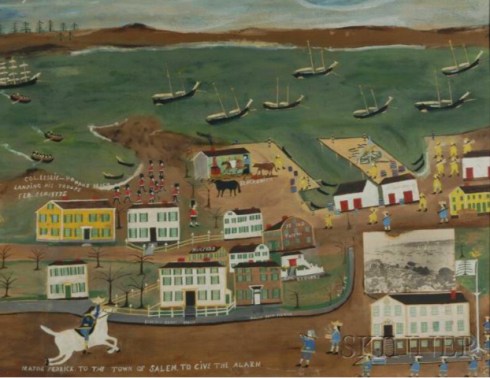
Major Pedrick was a Tory! None of the contemporary reports of the events of February 26, 1775 mention Major John Pedrick as the “alarming” figure who rode ahead of Leslie’s troops to warn the citizens of Salem of their imminent arrival, nor does Endicott. That’s because his role was made up after Endicott’s account. Pedrick was in fact a wealthy Tory who would not have been motivated to play such a conspicuous role at this time; he came around a bit later but anonymous Marbleheaders warned Salem on that Sabbath day. Again, I am relying on J.L. Bell’s succinct analysis of the “myth” of Major Pedrick, which has been perpetuated in the most recent scholarship as well as our reenactment. I was also inspired by Bell’s post to look around and see what else was made up about our event, particularly in the “creative” Marblehead accounts of the later nineteenth century. Samuel Roads Jr.’s History and Traditions of Marblehead (1880) turns Leslie’s Retreat into an all-Marblehead affair: Pedrick is prominent, of course, along with an entire Marblehead Regiment that came to Salem to take up with Leslie’s troops. Not a single Salem name is mentioned in Roads’ account, but we do hear of one Robert Wormsted, one of the young men from Marblehead,—who afterwards distinguished himself by his daring and bravery,—[and ] engaged in  an encounter with some of the soldiers. He was a skillful fencer, and, with his cane for a weapon, succeeded in disarming six of the regulars. Wow. No mention in Endicott of this cane-wielding Wormsted—or Pedrick—but Marblehead folk artist J.O.J Frost seems to have cemented the latter’s place in history in his early twentieth-century painting Major Pedrick. To the Town of Salem, to Give the Alarm.

Leslies Retreat Frost Courtesy Skinner Auctions; note the anachronistic photo inserted on the right.

“Anniversary History” was alive and well in 1775: Even in the standard reports of Leslie’s Retreat published in the week after, I couldn’t help but notice the juxtaposition of what had just happened in Salem and the imminent fifth anniversary of the Boston Massacre. Side by side we can read of Leslie’s “ridiculous” expedition and “an Oration, in commemoration of the Massacre, perpetuated in King-Street, on the 5th of March, 1770, by Joseph Warren, Esq.” and several reports made the connection between the two, which occurred on successive sabbaths. Dr. Warren actually spoke on March 6, 1775, and I wish he had referenced Salem, but he did not. Nevertheless, you can really feel the drumbeat of rebellion when you read the New England papers published in March of 1775: there are lessons to be learned and anecdotes to be memorialized. The editors of the Newport Mercury were also thinking historically when they opined that as our brave ancestors used to carry their implements of war with them to their places of worship during the Indian wars, perhaps our brethren of the Massachusetts Bay have good reason to make use of the same precaution at this day. I also can’t resist adding another eyewitness testimony here, from a “True Son of Old Ireland” who was on the spot, as well as my very favorite photograph of the First Reenactment of Leslie’s Retreat, two years ago: these guys played their roles really well.

Leslies Retreat Lessons Learned Newport Mercury March 6

Essex Gazette March 7 1775 Leslies Retreat

Leslies Retreat best photoThe Newport Mercury of March 6, 1775 and the Essex Gazette of March 7, 1775; Lt. Colonel Leslie (Charlie Newhall!!!) exasperated and outflanked two years ago.

Commemorating Leslie’s Retreat on February 24:  Reenactment at 11:15-11:30 for Redcoats (meet at Hamilton Hall) and Patriots (meet at the First Church). Reception afterwards at First Church.

A Staged Reading of Endicott’s Leslie’s Retreat at the Pickering House by Keith Trickett, 3pm: https://pickeringhouse.org/events/special-leslies-retreat-performance/.

Toast the Retreat and Salem’s Resistance at O’Neill’s Pub on Washington Street from 4-7pm.

And coming in April: the Resistance Ball at Hamilton Hall: https://www.hamiltonhall.org/full-event-calendar/2019/2/1/resistance-ball


Leslie Retreats Again

The 242nd anniversary of Leslie’s Retreat was marked by a spirited reenactment in Salem yesterday, with the central “characters” reprising their roles earnestly and enthusiastically amidst an equally enthusiastic crowd. I stopped over at Hamilton Hall first, where I heard the British were gathering, and was not surprised to encounter Colonel Leslie himself there, with his adjutant and a few supporters in scarlet. I was surprised to run into Major Pedrick from Marblehead on my way out (well, I knew they knew each other…..), but he (in the form of my old friend David Williams, whom I understand is a Pedrick descendant) walked on ahead to the First Church to give the alarm. There we waited a while for events to unfold, but once they did some serious parleying ensued between Colonel Leslie, Colonels Pickering and Mason from the local militia, and the Reverend Thomas Barnard, who had burst out of his church and rallied his congregation to the bridge (or rather a convenient parking lot adjacent to the present-day overpass) so that he could mediate. The discussion was heated, but eventually Colonel Leslie was allowed to cross over the bridge/overpass– a much dicier endeavor in 2017 than 1775 owing to traffic. When no cannon was found on the other side, the ever-gracious Reverend Barnard invited the Colonel–and all of us– to retreat to the First Church parish hall for refreshments, which made for an appropriate end to an event of compromise and commemoration.

reenactment-14

pedrick-2

cambridge-street-collage

first-church

reenactment-8

reenactment-9

reenactment-10

reenactment-collage

reenactment-best

reenactment-2

reenactment-3

reenactment-picture

Colonel Leslie (Charlie Newhall) and The Reverend Thomas Barnard (The Reverend Jeffrey Barz-Snell) face-off in 2017; a great day for community and picture-taking.


Re-engaging with Leslie’s Retreat

Salem is gearing up for a multi-event, multi-venue commemoration of a key event in its history and American history: Leslie’s Retreat, whereby a crowd of civilians compelled the 250-strong 64th Regiment of the Foot under the command of Colonel Alexander Leslie to retreat to Boston on February 26, 1775. The Redcoats came in search of rumored cannon and military stores and left with nothing: a week later the Essex Gazette brazenly reported that twenty-seven pieces of cannon were removed out of this town [neighboring Danvers], to be out of the way of the robbers. No shots were fired and no one was (really) hurt, but a stand was taken that would lead to more standing, most dramatically at Lexington and Concord, several weeks later. The significance of this stand-off was recognized in both the colonial and British papers at the time, and for several months thereafter: passages from the London Public Advertiser (May 2, 1775) and the Gazette (March 7, 1775) are representative of the not-too divergent perspectives.

leslies-retreat-public-advertiser-may-2-1775

leslies-retreat-essex-gazette-march-7-1775

The British view: REBELS enough to have eaten them up.      

And the American: not less than 12 or 15,000 men would have been assembled in this town within twenty-four hours after the alarm, had not the precipitate retreat of the troops from the Draw-Bridge prevented it.

Press accounts on both sides of the Atlantic generally portrayed the Salem event (along with the colonial capture of Fort William and Mary in Portsmouth Harbor in December 1774) as a prelude to the larger opening acts of the Revolution: Lexington and Concord. And that’s pretty much the standard view for the next 200+ years, with occasional moments (like this one!) in which the event’s significance is recognized for its own merits. I’ve written a more detailed post on the actual event before; now I’m more interested in the history of its commemoration, which was shaped by two key factors: its name and its anniversaries. Events generally become “historic” when they are named, and remembered in some form or fashion on anniversaries, and Leslie’s Retreat was no exception. The first reference that I can find to the name dates from 1840, but after the publication of Charles Moses Endicott’s Account of Leslie’s retreat at the North bridge in Salem in 1856 it really stuck, leading to a commemorative “oration”in 1862, a major Centennial commemoration in 1875, the dedication of a memorial stone in 1886, and anniversary services in 1896, 1902, 1925, and finally (long gap here), 1975. Leslie’s Retreat was also an “act” in the elaborate Salem Pageant of 1913, during which several scenarios of Salem history were reenacted by local notables to reinforce proper American values and benefit the House of the Seven Gables. The Centennial was marked with bell-ringing throughout the city at morning, noon and night, a 100-gun salute, flags unfurled everywhere, and a ceremony filled with addresses and hymns, while the Bicentennial featured a reenactment and a ball–just like this year–and inspired national headlines (The Shot Not Heard around the World).

leslies-retreat-arch

leslies-retreat-1875-program

leslies-retreat-1913-pageant

leslies-retreat-1975

The 1875 Memorial Arch and Program; Colonial dress-up for act #4 of the Salem Pageant, 1913; 1975 reenactment.

I can’t find any big splashy commemorations between 1925 and 1975, with the exception of the Salem and Marblehead tercentenaries in 1926 and 1929, but that doesn’t mean Leslie’s Retreat was forgotten: it became part of the civic curriculum, so much so that I found repeated references in the local papers along the lines of the story of Leslie’s Retreat is too well-know to be recounted here. A commenter on my earlier post noted that in the 1950s “Leslie’s Retreat was something every 8th grader had to do a project on” in Salem. The event received national attention again in 1960-61, when an American Heritage article by Eric W. Barnes (All the King’s Horses…and All the King’s Men, with charming illustrations by Edward –see below ) was reprinted in all of the major dailies. Still, I can’t help but think that the rise of Witch City overwhelmed Salem’s revolutionary reputation.

leslies-retreat-illustration2

leslies-retreat-color

leslies-retreat-collage

leslies-retreat-illustration-3

Edward Sorel’s illustrations for American Heritage, October 1960.

leslies-retreat-2017

(Re-) engaging with Leslie’s Retreat in 2017:  A community reenactment this coming Sunday, on its 242nd anniversary, at the First Church on Essex Street from 11:00 to 1:00; a talk by Dr. Peter Charles Hoffer, author of Prelude to Revolution. The Salem Gunpowder Raid of 1775 on March 26 at the Pickering House; a talk by J.L. Bell, author and super-blogger at Boston 1775 on “The Salem Connection” on April 7 at the Salem Athenaeum; a March to Revolution walking tour through Marblehead on April 8; and a “Salem Resistance Ball” at Hamilton Hall, also on April 8.
