Tag Archives: Jane Austen

2025: the Anniversary Year

I like to look ahead to the coming historical anniversaries at the beginning of every year, and in 2025 it’s pretty clear that two wars are going to dominate the commemoration calendar: the beginning of the American Revolution and the end of World War II. The Fall of Saigon occurred in 1975, so you could add a third. Here in Massachusetts, we’ve been gearing up for revolutionary remembrance for quite some time, under the aegis of a coalition called Revolution 250. Even the City of Salem, pretty passive when it comes to matters of heritage and seemingly oblivious to our City’s key pre-revolutionary and revolutionary roles, is getting in on the action by jumping on board the 250th anniversary of “Leslie’s Retreat” in late February. A Revolution Ball at Hamilton Hall—the successor to the pre-Covid Resistance Ball— will also be held in the midst of a very busy commemorative weekend in Salem. The commemorations of the battles of Lexington and Concord in April and Bunker Hill in June promise to be huge, even though the latter will be “fought” in Gloucester rather than Charlestown. Then the focus will shift to Cambridge, where Washington formed the Continental Army: I don’t think it was quite as orderly a process as the Currier & Ives lithograph below presents!

Revolutionary remembrance in Salem and Massachusetts: a view of “Leslie’s Retreat,” when a Salem crowd and dialogue convinced British Lt. Colonel Alexander Leslie and his soldiers to retreat while cannon were carried away, 1955 Emma Crafts Earley Map Salem Massachusettes With History, Phillips Library. This event is widely heralded in Salem as the “first armed resistance by the Colonies to British Authority,” which is just not true, but I think I can accept “the first armed resistance to British in 1775.” The Revolution Ball will be held on February 22: more information here. The Battle of Lexington, Bettman Archive; “An Exact View of the Late Battle at Charlestown, June 17, 1775.” and “Washington Taking Command of the American Army,” Metropolitan Museum of Art. 

While most of the Revolutionary commemoration will likely be exuberant, remembering the end of World War II will be much more nuanced, marking victory and liberation but also loss and destruction. The 80th anniversary of VE Day (May 8) could be “a shared moment of celebration” but obviously Holocaust remembrance will be more solemn, as will the anniversaries of the atomic bombing of Hiroshima and Nagasaki. I probably shouldn’t even reference these atrocities in a post on history anniversaries as their remembrance is quite appropriately ongoing and perpetual, but the eighty-year mark is noted everywhere. A major exhibition, Portraits of the Hibakusha | 80 Years Remembered, featuring a series of 52 lenticular portraits of the survivors of the atomic bombing of Hiroshima and Nagasaki, has already opened and will travel to museums and galleries around the world. Eighty years ago this very month (on January 27), Auschwitz was liberated by soldiers of the 60th Army of the First Ukrainian Front of the Red Army: here is more information about the observances scheduled for this site on this particular International Holocaust Remembrance Day, from which Russia has been excluded for the third straight year.

It seems to me that in terms of public remembrance, we tend to remember bad things more than good, ostensibly because we do not want to repeat the bad. Ultimately (I think!) war remembrance is a hopeful process rather than a macabre one, but it is wearing and wearying. I teach a European history survey pretty much every semester and I always get wary when we approach the twentieth century, but there were two very consequential conflicts from my own period that will also be commemorated in 2025: King Philip’s War (1675-76) and the German Peasants War of 1525, both bloody conflicts between desperate insurgents and established regimes—well, perhaps the colonists of southern New England were not that established when an indigenous coalition under the leadership of Wampanoag chief Metacom, later known as King Philip, attacked English settlements over a 14-month period. Several Salem men, including Nathaniel Hawthorne’s first American ancestor William Hathorne, fought in this conflict, which left hundreds of colonists and thousands of Native Americans dead. Northeastern University Emeritus Professor of Public History Martin Blatt has called for more commemoration of King Philip’s War, but I don’t see any big event on the 2025 calendar. There is, however, some amazing scholarship on the War and its remembrance in New England over the centuries. The German Peasants’ War was the biggest uprising in Western Europe before the French Revolution, extending to much of the Holy Roman Empire. It was notable for being not just a large peasant revolt but one in which an expansive “working class” (a term we don’t usually use before the Industrial Revolution), including miners and urban workers, rose up against serfdom and its remnants, brandishing a document callled The Twelve Articles which justified their demands in scripture. It’s the first sign of the potentially radical impact of the Reformation, and Martin Luther was so horrified by the rebels’ confusion of spiritual and secular “freedom” that he called for the “murderous theiving hordes of peasants” to be cut down. And so they were.

Because of its early expression of “class consciousness,” East Germany commemorated the 45oth anniversary of the Peasants War in 1975 with this stamp and other events. For the 500th anniversary in 2025, the Thuringian state has organized a traveling exhibition.

Lightening up quite a bit. Jane Austen was born in that consequential year of 1775, and given her popularity over these past few decades, I have no doubt that the 250th anniversary of her birth will be commemorated in a big way in Britian—and no doubt elsewhere. Just a few clicks and I realized that the events that constitute Jane Austen 250 make the very busy Revolution 250 calendar look quiet! In Bath, and Winchester, and throughout Hampshire there will be festivals and costume balls and dress-up days and parades. At Jane Austen’s House in Chawton, each book will get its own festival starting with Pride and Prejudice this very month and there will be a special year-long exhibition called Austenmania. Bath has been on the Austen bandwagon for quite some time so there’s a lot going on there but in Winchester, the city where Jane spent her last years and was laid to rest, there’s a bit of a controversy about a new statue to be installed on the Cathedral grounds. There are concerns about overtourism in general and the sanctity of its proposed location in particular, with one critic opining that “I don’t think we want to turn it into Disneyland-on-Itchen. I don’t think the Inner Close is the place to attract a lot of lovely American tourists to come and have a selfie with Jane Austen.” (sounds vaguely familiar) They’ve spent quite a bit of money on the statue, so I think it’s a go, but Winchester is clearly the only place in the region where there are any clouds on the horizon: everywhere and everyone else seems geared up for an enthusiastic Austen year.


Paper Houses

My manuscript is completed and has been dispatched to London, so last night I actually started reading a non-academic book, the first in a year or more. I didn’t last long, between the covers and between the sheets, because I’m tired, but it was novel. The book in question was almost-academic, so it was a good transition: Novel Houses by Christina Hardyment, featuring 20 “famous fictional dwellings,” including everything from Horace Walpole to Hogwarts. This morning I read it right through: a very pleasant read with great illustrations, so I thought I would showcase some of them here. Hardyment chose novels in which the plot is dominated by a structure, so much so that the latter is almost like a character: Walpole’s Castle of Otronto, Jane Austen’s Mansfield Park, Sir Walter Scott’s Waverly, Emily Bronte’s Wuthering Heights, Hawthorne’s House of the Seven Gables (of course, but is this a fictional house?), Charles Dickens’s Bleak House, Harriet Beecher Stowe’s Uncle Tom’s Cabin, Arthur Conan Doyle’s Sherlock Holmes, Henry James’s The Spoils of Poynton, John Galsworthy’s The Forsyte Saga, E.M. Forster’s Howards End, F. Scott Fitzgerald’s The Great Gatsby, Virginia Woolf’s Orlando & Vita Sackville West’s The Edwardians, Stella Gibbons’s Cold Comfort Farm, Daphne du Maurier’s Rebecca, Evelyn Waugh’s Brideshead Revisited, Dodie Smith’s I Capture the Castle, Mervyn Peake’s Gormenghast, J.R.R. Tolkien’s The Hobbit and Lord of the Rings, J.K. Rowling’s Harry Potter. 

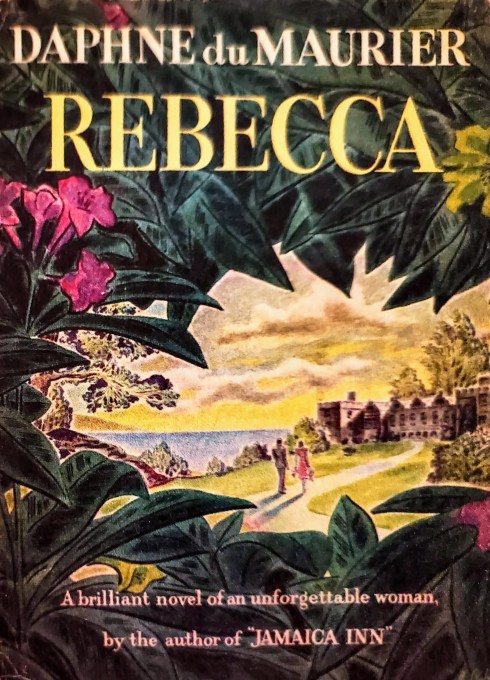
In no particular order: Walpole’s Strawberry Hill, Jane Austen’s ancestral home Chawton, inspiration for many of her novels, 1913 edition of The House of the Seven Gables, an advertisement for Uncle Tom’s Cabin, 1949 edition of I Capture the Castle, Knole, inspiration for Woolf’s Orlando, Galsworthy’s drawing of the fictional “Robin Hill” in The Forsyte Saga, the first edition of Rebecca, cool cover for Cold Comfort Farm, Hobbit houses, Beacon Towers on Long Island Sound, which might have inspired Gatsby’s mansion in West Egg.

Some chapters worked better than others for me in terms of inspirational houses: I haven’t read Peake or Conan Doyle, or The Spoils of Poynton. I think perhaps Manderley and Brideshead are the strongest house-characters. It’s difficult for me to think of the Gables as simply a fictional house, because it actually exists, but it bears remembering that it did not in Hawthorne’s time.

I would love to get some more suggestions for novels in which houses play a major role in the plot, not just the setting.


My December 2019 Book List

I generally post a book list around this time of year: my favorite books of the past year, books I want for Christmas, books I’m reading or assigning for my spring courses, books I want to read over the holiday break. This list is all of that except for the first category: I haven’t read much this past year because I’ve been working so hard—writing myself, teaching, and reading to teach—and so I really can’t play favorites. This was not a leisurely year and there is very little fiction on this list, and even very little history unrelated to my teaching: very little American history in particular. To a certain extent, this blog has been an exercise in discovering the American history which I avoided from high school: I’ve learned a lot but now I’m kind of done—it seems a bit repetitive to me. Other worlds call, and new books in my own fields are piling up! I’ll never be done with the histories of architecture (structure and landscape) and material culture though—and folklore, though nothing of that genre caught my eye this year. So proceeding in chronological order, here are the books which did.

pixlr-2

book-ralegh

Book Elizabethan Globalism

book-gardens

Picture1

These books are all for my courses and an endless writing project which I hope to bring to fruition in the coming year. Simon de Montfort is one of those guys like Sir Philip Sidney: a glamorous representative of his age, in this case the thirteenth century, who has a very dramatic story which students love and which can also represent the best (anti-absolutism) and worst (antisemitism) of the time. I’ve read everything about de Montfort, and this book, by University of Lancaster Lecturer Sophie Thérèse Ambler, is very good, full of details and analysis which will enhance my teaching. I will be reading Renaissance Futurities and Gardens for Gloriana for pleasure and for context for own work over the break, and I am considering Walter Ralegh and Elizabethan Globalism for sections and courses on European expansion in the early modern era, although the latter is also an absolutely gorgeous book that could double as a more casual coffee-table text. Climate history is absolutely essential right now, as as the periods I teach encompass both the “Medieval Warm Period” and the “Little Ice Age” I’m always on the hunt for fresh environmental perspectives: Nature’s Mutiny is a potential adoption for several of my courses but I have to read it over the break to gauge its accessibility.

Book Boston_edited

screenshot_20191202-202149_chrome

Books Folio Society

Book Sandition IMG_1504

Books

Books 2

House Party

These are all books I WANT or want to read: I think Inventing Boston would inform my understanding of Salem craftsmanship in the same key era, Mark Girouard’s classic Life in the English Country House has been reissued in a stunning edition by the Folio Society this year with photographs from Country Life and a binding illustration by architectural artist John Pumfrey, and I collect Penguin clothbound editions by Coralie Bickford-Smith. I’m not sure I buy into Orlando Figes’ themes of European unity and modernity in the nineteenth century, but that is an era with which I need to engage, again. I’ve always been fascinated with Frank Lloyd Wright’s professional and personal life, and who doesn’t want to read about English Country House parties? Oh, and in addition to Sandition, I did want to read one other novel this year if only for the local reference in its title, but no, I cannot read Lucy Ellman’s 1000-page Ducks, Newburyport at this particular time: I just don’t have the ability (or the time) to dwell on a strung-out sentence of rambling thoughts, as experimental and interesting as it/ they may be. Maybe next year, or the year after.


What Would Jane Think?

My guilty pleasure-reward for making it through this particular semester is indulgence in a few Austen-esque books: Curtis Sittenfeld’s Eligible and Among the Janeites: A Journey through the World of Jane Austen Fandom by Deborah Yaffe. Eligible updates Pride and Prejudice by removing the story of Elizabeth and Darcy and their plot-driving families to the suburbs of Cincinnati, where they encounter complications brought on not only by their pride, prejudice, and genteel poverty, but also by a range of modern challenges (and opportunities): everything from artificial insemination to anorexia to a reality television wedding extravaganza. I think I got most of the updating, although I’m not quite sure of the significance of the spider infestation in the Bennet Tudor (Revival). Eligible is the fourth adaptation of HarperCollins’ Austen Project, which has commissioned contemporary authors to “reimagine” six Austen novels: I’ve also read Joanna Trollope’s Sense and Sensibility and am looking forward to the reimagined Persuasion, my favorite Austen. The Austen Project apparently aims not only to update but also to upgrade the usual Austen fan fiction genre, which has produced countless titles since Colin Firth/Darcy emerged from the Pemberley lake in the iconic 1995 BBC miniseries.

Austen Project Collage

Austen Stack

Austens Folio Society stack

British covers of Trolloppe’s Sense and Sensibility and Sittenfeld’s Eligible; my stack of real and inspired Austens; my favorite recent editions, from the Folio Society.

I’m not quite sure that I represent the target audience for all these Austen adaptations, even though I was right there, holding my breath, when Elizabeth encountered a damp Colin/Darcy striding from the lake. I’m probably too old or too traditional or both: while I got Clueless and Bridget Jones’s Diary, I didn’t really understand the point of Pride and Prejudice and Zombies in either text or film form. But I am really interested in the culture–and the economy–of “Janeitism” because it seems like a very vibrant one, offering up many new and varied products every year. I haven’t started Yaffe’s Among the Janeites yet (I’ve been too busy with Eligible) but I’m hoping it will give me lots of insights into this world. You would think that the word “Janeite” is a new one, but actually it goes all the way back to the first big revival of her works, following the publication of her nephew’s Memoir of Jane Austen in 1869, which inspired the appearance of several illustrated and introduced editions in the 1890s. From then on, it wasn’t quite the Austenworld that we live in now, but she was regularly in print (you can see a nice succession of Pride and Prejudice covers here) and occasionally on the screen. Austen adaptations have clearly surpassed those mediums in the twenty-first century, and I can’t help but wonder, what would Jane think?

Austenland

Death Comes to Pemberley

Austen Love & Friendship

balbusso_pp_1 Pride and Prejudice

Stills from Austenland (2013), which was not very good, Death Comes to Pemberley (2015), which was quite good, and a film opening this week, Love & Friendship, based on Austen’s posthumously-published epistolary novel, Lady Susan; Jane thinking, illustration from the 2013 Folio Society edition of Pride and Prejudice by the Anna and Elena Balbusso.