Tag Archives: Inc.

Christmas in Salem 2025: Close to Home

Christmas in Salem, a holiday house tour held hosted every year by Historic Salem, Inc. as its largest fundraiser, has always been one of my favorite events. It represents every thing I love about Salem: architecture, creativity, community, preservation, walkability, pride of place. It’s the light at the end of the long dark Halloween tunnel. I never miss it, and this year I couldn’t miss it, as our house was on the tour, so it came to me! Actually, on Saturday morning, I was so tired of cleaning and decorating and just thinking about it, I got in the car and drove away as soon as my house captain and guides arrived and took charge: I wanted out of sight and mind and out of Salem. But I came home to festive guides and family and knew I had missed out, so yesterday my husband and I set out on the tour ourselves and as usual, it did not disappoint. I don’t mean to convey that the experience of opening your house is in any way oppressive: Historic Salem and the Christmas in Salem team are thoroughly professional and supportive and of course it’s an honor and a privilege to be included among an always-stellar collection of Salem homes. I think I was just tired (it’s the end of the semester) and done on Saturday but I rallied on Sunday, and so I have lots of photos. I missed quite a few houses (there were long lines everywhere and we somehow had to have a drink in the midst of everything) but here are my highlights, grouped by impressions.

New perspectives:

This tour consisted of homes in my immediate neighborhood but I could see very familiar places, including my own house, in new ways. Window, courtyard, and porch views from houses that you don’t live in make things look a little different. Standing on my Cambridge Street neighbors’ porch waiting to enter their very charming house, I realized that their daily view of Hamilton Hall was very different from my own on the other side. While I was waiting to go into a house on Broad Street, I suddenly got a great view of a little Georgian house on Cambridge with its side to the street which I have always slighted. And I copied a great shot a friend of mine took through my front door wreath of the wonderful house across the street, which I get to gaze at everyday.


Boughs and Blooms:

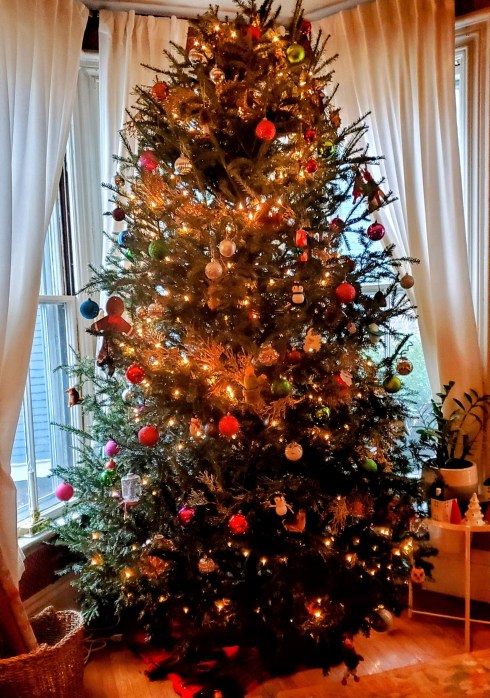
That was the theme this year, so I thought I would show you some boughs and blooms, including some of my favorite Christmas trees on the tour. We had two, a stately one in the front parlor and a short and fat one in back, and I love them both but I don’t think either can compare to this first amazing tree at One Chestnut, located in the perfect dining room alcove. But all Christmas trees are special of course.

You can see that the Salem Garden Club, which decorated the cute Federal cottage with the mansard roof over on Cambridge Street pictured in the three photos above, took the boughs and bloom brief seriously! Really beautiful botanical displays throughout the house. The last time I was on this tour, 20 years ago (!!!), they decorated my house and I’m not sure it was a good idea for me to have taken on that task myself this year. But anyway, here are my two trees, front and back, tall and short.


So many Mantels:

And I have finally managed to spell mantel correctly, a word I’ve mispelled for years. After the tree, I’m always looking for well-dressed mantels at holiday time, and there were lots to see on this tour. If you’ve followed the blog over the years, you know that I have the decorating sensibility of a four-year-old and choose a different animal theme every year, and this year it was snow leopards (though I really couldn’t find enough leopards of the snow variety so I broadened my theme a bit). They were pretty prominently featured on both parlor mantels and on the dining room table. Most mantels on the tour were a bit more traditional, and as is always the case with the Christmas in Salem tour, there was diversity in terms of scale and materials.


Stairways:

Stairs are also a good focal point for holiday decorations and actually the main reason we agreed to go on the tour this year was our front stairway: we wanted to get rid of an old faded and motheaten runner and refinish the treads to match the mahogany banister. It’s good to have a project for these things, and nothing is more motivating than the challenge (threat) of 2000 people walking through your house. We got it done, or should I say the best floor guy in the world, Dan Labreque, got it done: he’s been doing the ballroom at Hamilton Hall for his entire life, following in the craft of his father. We painted our back staircase too, although that was much less of a project. I must also admit that I had a bow brigade to tie these bows as even after watching many tutorials, I just can’t do that. I loved the antique toile wallpaper in the front hall over at the corner of Broad and Cambridge, and the very grand hallway at #1 Chestnut as well.


Tables!

I had my leopards, and everybody else had their best china and/or silver out! Dining rooms or tables are really an encapsulation of all the little details you have to put together, I think.


Very random details: I spent one afternoon making this bower (???) for one of my leopards in my pantry so of course I have to feature it; what a light fixture at 1 Chestnut, my Cambridge Street neighbors spent over a year reconfiguring an addition at the back of their house and the results are stunning–here are some of the artifacts they found during the process and a great bundt pan display, swag from Historic Salem, which gave every homeowner on the tour one of these lovely paintings by Simeen Brown, just a nice simple wreath to close the post.


Christmas Trim

It’s going to be a super busy December, so I got a jump start on decorating my own house: we have eight fireplaces with mantles plus several other surfaces which “require” adornment so there’s a lot of sorting out and arranging to do. I have two rules, or should I say practices, which I observe for holiday decorating: I don’t bring greenery in until just before Christmas and I always choose a creature theme. Down in my basement, there’s a little room with shelves full of creatures of Christmases past: swans from last year, and then bears, foxes, sheep, hedgehogs, rabbits, mice, cats and lots of deer, of course. This year is all about pheasants, as I found some Royal Copley ones that I really liked this fall and wanted to keep them out: I’ve glitzed them up a bit and added some gilded companions. I love natural greenery but I can’t stand to see it fade, so usually I wait until the last possible moment to mix it in with my other decorations. This year I hedged on the rule, and added a few greens because I wanted some warmth and contrast, but more is coming! Someday I might go for simpler decorations but my holiday aesthetic is still pretty much all about abundance. The exception to the greenery rule has always been the Christmas Tree, but over the last few years we’ve had trees die on us before Christmas, so now we’re going to wait for that too. There’s nothing more depressing than a crispy Christmas tree, in my opinion.

Downstairs mantles, the “mantle” in the kitchen, measuring-cup creatures from Anthropologie and my pantry. The glittery squirrels always come out: they’re in the library. By the time I got to the second floor, I was running out of pheasants, so substituted a lowly duck. (There’s a few peacocks mixed in with the pheasants downstairs too, because peacocks). Last year’s swans on the shelf in the basement.

This past weekend was the Christmas in Salem tour, the major fundraiser for Salem’s historic preservation organization, Historic Salem Inc. It’s in a different neighborhood every year, and this year was all about North Salem, encompassing Buffum and Dearborn Streets, on either side of North Street, and a few homes off Dearborn. It was not at all a “colonial” tour, rather it had a bit of a retro feel to me despite the presence of many later nineteenth-century homes, including the gorgeous Queen Anne Ropes House. There was also a stunning 1915 bungalow on the tour, an unusual style for Salem. Gratitude and congratulations to all the homeowners: it’s quite an effort to open your home to 1000 people (believe me, I’ve done it twice). Christmas in Salem always puts me in the holiday mood: it’s such a lavish display of generosity and creativity and cheer: hopefully I’ve captures some semblance of these things in the pictures!

At the Ropes House: love, love, love the button garlands!!! Below: my friend Bradley guiding us through the kitchen in his Princess Diana black sheep sweater and everyone’s favorite “simple” decoration: red branches and floating candles.

Below: lots of textures and nooks and crannies on this tour! These are the details that gave me the retro feel.

What we want to see: table settings, a wreath, and a Christmas tree.

I hope all these homeowners are having a drink just about now (Sunday @5pm)!


Stripped and Razed

I’m in the intense period of writing my book with a March 1 deadline looming, so posts are going to be very spotty over the next few weeks, but today, I needed a break from my ploughmen and practitioners. There’s a lost building in Salem with which I remain fascinated, one of several really. If I ever do write my Salem book, which I have titled “Dead History” in my mind, it will have one whole chapter on structures that were stripped of their amazing interior and exterior architectural detail, but remained standing for decades afterwards, often converted into unrecognizable commercial establishments which bore no resemblance to their glorious past. Then they were put out of their misery at some point in the twentieth century, that great century of destruction. Most, but not all, of these structures were on Essex Street, Salem’s main street from the seventeenth century, including the building I am spotlighting today, the Philip Saunders House, built in the mid-eighteenth century and demolished in 1965. Here’s a photograph of it from the early twentieth century—after it had been altered somewhat, with a lot more to come.

Sorry—I can’t attribute this photograph. I bought it on ebay several months ago, an unusual act for me (not buying on ebay, buying Salem photographs on ebay). Generally old Salem photographs for sale are just reprints of those freely available from their repositories, but the minute I saw this photograph I knew I hadn’t seen it before: this is 260 Essex Street, the Philip Saunders House. The two shops on its ground floor, The Salem Trimming Store and Mary E. Hayes, Hairdresser, were located there up until about 1920, and after that, a succession of shops until it was taken down by the City of Salem in 1965. In between, whoever was sourcing antiques for the Kennedy family purchased its spiral staircase and Georgian paneling, and transferred it to the main house of the Kennedy Compound in Hyannis Port just before the second World War. This happened to Salem houses constantly from about 1890 to 1950. The Saunders House was a unique three-story pre-revolutionary brick building, and there was resistance to its demolition from Historic Salem, Inc. and other organizations and individuals, but not enough, apparently. The preservationists of Salem had been putting our fires for some time in the 1960s, and it was about to get worse with the onslaught of urban renewal. You can almost hear the exhaustion in Elizabeth Reardon’s voice in the newspaper article below, and believe me, she was game.

Both Mrs. Reardon and other preservationists compared the Saunders House in Salem to the Ebenezer Hancock House in Boston, which was also threatened at the time, I think. But it survived: and when you look at it today you can’t help but think of what might have been in Salem.

The Ebenezer Hancock House (1767): in the mid 1970s, from a Boston Landmarks Commission Structures Report, and today.


If You Build it, They will Come

Two very different tourist towns during the Pandemic of 2020: at the beginning of the summer, I was up in my hometown of York, Maine, so I wrote about its opening in the midst of Covid with every intention of writing a comparative “bookend” post on Salem. I am only getting to this now, with summer over and Salem’s Halloween season, 2020 version, gearing up. Yes: Halloween has arrived in Salem: apparently nothing can stop it, even a pandemic! The traffic and the crowds have increased noticeably over the last few weeks, and on Saturday I went for a walk to see to see what was up: I turned around after 5 minutes, it was simply too crowded for me to feel safe, after so many months of relative isolation. Then I went back on Sunday, and it was much better: less crowded, masks much in evidence, enough space away from the restaurants. I am wondering if social distancing downtown will be possible on October weekends: shops, restaurants, and attractions have limited capacity under the Covid conditions, so lines will form—and grow longer with each weekend until Halloween I expect.

Sunday 9/27/20: Salem downtown: not too bad! Most people had on masks, as the whole downtown is a mandatory mask zone. Mask ambassadors out and about. Longer lines at restaurants than the museums, with the exception of the Witch “Museum”, of course—which is not really a museum. This year, it finally gets some stiff competition from the Peabody Essex Museum with TWO Salem exhibitions on view: “Salem Stories” and the “Salem Witch Trials, 1692” (with authentic artifacts, expert curatorship and current historiography, as opposed to mannequins, narrative, and interpretation from circa 1968).

So I was originally going to title this post “City of Mixed Messages”, but after walking around, reading, and thinking a bit, I decided that wasn’t fair: I don’t think the City is putting out mixed messages. All the official events are canceled: people are just coming. There are attractions of course, like the traditional schlocky ones and the new PEM exhibitions, as well as a new Destination Salem app and a Frankenstein-esque Hampton Inn, but apart from the specific draws, I just think people like to come to Salem for (a very extended) Halloween. Witch City has been built with a very solid foundation, and they will come. Away from Essex Street, all was pretty quiet even in the city center: the Charter Street Cemetery has been closed for repairs for quite some time, and I saw only respectful wanderers at the adjacent Salem Witch Trials Tercentenary Memorial: certainly a far cry from thisThe City’s message this year seems to be come with a mask and a plan (like voting!) and hopefully that’s what people will do.

Six feet apart was possible at the Salem Witch Trials Tercentenary Memorial this past weekend.

But it’s still September. I am wondering how state protocols can be observed with more crowds. I saw lots of out-of-state license plates downtown: have these people quarantined for 14 days before they descended upon Salem? Last week when I visited the Beverly Historic Society, there were contact-tracing questions before I could enter the exhibition: is this happening in Salem? What’s going to happen on Halloween night, which is (of course, 2020) on a Saturday this year? No candy from me, kids; I’m sorry, I’ll double up next year.

As you can see, all was pretty quiet in the McIntire Historic District this past weekend, even in the Ropes Mansion garden, which is just GORGEOUS now—it’s the ultimate late-summer garden. The owners of this beautiful Italianate never do anything in half measures, but I suspect they must be part of Historic Salem’s  Halloween event: Halloween in Salem, a “festive virtual house tour” which will go live on October 9. A great idea and a safe way to experience Halloween in Salem.


What would Ada think?

In honor of tomorrow’s symposium, Mightier than a Wrecking Ball: How Ada Louise Huxtable Saved Salem, jointly sponsored by Historic Salem, Inc., the Peabody Essex Museum, and Historic New England, I thought I would ask and consider what Ms. Huxtable (1921-2013) might have thought about the emerging streetscape of Salem in 2015, fifty years after her influential New York Times article “saved” Salem from the destruction of 100+ historic buildings and a four-lane highway running down its center in the guise of “urban renewal” in the fall of 1965. I think she would have abhorred the big glass-and-faux-brick boxes looming on our horizon both literally (now) and digitally (proposals for the future), but I don’t really know. She was certainly not an exclusive preservationist: such a stance would have been impossible in her capacity as the architectural critic for the Times. She seems to have detested “Williamsburging” nearly as much as the emergence of “slab cities” and heralded preservation as a bulwark against thoughtless development with little historical or architectural integrity. In an effort to answer my own question, I browsed through many of her articles in the archives of the Times: this took some time, primarily because she is such an amazing writer. I wanted to restrict myself to skimming, but her sharp observations and critiques (Albert Speer would love the Kennedy Center) kept me reading. Certain words and phrases kept popping up as architectural attributes: art, identity, variety, and the integration of new construction and preservation, and others as outcomes to be avoided at all costs. In this category, I would place the phrase sterilized non-place, which appears in her 1974 follow-up article “How Salem Saved Itself from Urban Renewal”.

Ada 1974 NYT

That phrase just says it all for me: sterilized non-place. And it makes me think that Ada Louise Huxtable, who summered right next door in Marblehead and would have taken a personal interest in all these new buildings going up in Salem, would not have viewed or reviewed them favorably. Lined up all together, as they are below, you can see an apparent generic uniformity on the one hand and a thoughtless, careless nod to Salem’s historic structures on another—just slap on some brick! So since we can never really know Ms. Huxtable’s opinion on these buildings, perhaps it is better to ask is Salem becoming a sterilized non-place?

OLYMPUS DIGITAL CAMERA

Washington at Derby RCG

Big Box Hotel

Big Box District Courthouse

Two existing developments (the J. Michael Ruane Judicial Center-and RCG Corporation’s Washington at Derby building) and two proposals (the winning design to replace the existing District Courthouse and RCG’s proposed Mill Hill development further down Washington Street).