Tag Archives: House Museums

So much WOOD!

The Historic New England season is closing this Columbus/Indigenous People’s Day weekend and as I am up in York Harbor, I went to visit one of HNE’s oldest houses (both in terms of sheer vintage and time under its stewardship): the Jackson House in Portsmouth, built circa 1664. This is an extraordinary house: I’m sorry to be posting at this time when you won’t be able to visit it until next June, because I’d really like to urge everyone reading to go. I had been in it before, but when I was much younger and couldn’t appreciate it properly. But now, wow. I always thought it was a saltbox: it is not. It’s a seventeenth-century two-story small square house which had an elaborate lean-to added a bit later, along with two additions on each side. It is also a lavish display of wood: certainly not from an American perspective, but from an English one, which would have been its builder, Richard Jackson’s perspective. When I was writing my first book, The Practical Renaissance, I was reading treatises written for carpenters and shipbuilders, as well as some more general agricultural pamphlets, all of which made me aware of the increasing concern about the shortage of wood in seventeenth-century England. All the first-growth forests had long been chopped down, so to come to North America and see all this wood must have been something. So for me, the Jackson House was just a great illustration of that abundance. Our guide emphasized this theme adroitly as she described the house’s framing, exterior and interior, and she also illustrated the construction impact of less-abundant woodland in New Hampshire by showing us the attic over the eighteenth-century addition, with its decidedly less-robust timbers. The Jackson House is one of Historic New England’s unfurnished study houses (like the Gedney House in Salem), so the emphasis is decidedly on construction, but we got to learn a fair amount about the family as well, who possessed the house until 1924, when William Sumner Appleton, the founder of the Society for the Preservation of New England Antiquities (now Historic New England) purchased it.

Perfect 17th century parlor and east and west wings, with a patch of preserved wallpaper.

Appleton had apparently been obsessed with the Jackson House since his freshman year at Harvard, when he came up from Cambridge and knocked on the door. A pioneering preservationist and critic of “one property museums,” he began acquiring choice properties after the founding of SPNEA/HNE in 1910. Rather than stripping off the east and west additions of the house, he removed stucco and plaster to reveal its construction. The original property was extensive, fifty acres or so just across the North Mill Pond from downtown Portsmouth, in a neighborhood named Christian Shore. When I was growing up across the Piscataqua River in southern Maine in the 1970s and 1980s, Christian Shore seemed to me a drive-through area with delapidated old houses, but then suddenly appeared The Inn at Christian Shore and I started noticing all the beautiful old houses and now they really are all beautifully restored. Portsmouth is actually growing in this direction, with several hotels built in what were once vacant lots which divided Christian Shore from downtown. But when you look out the windows (replaced by Appleton, but in their original openings) of the house on its slightly elevated lot, you can imagine, and even sort of feel, the aura of its first century.

The replacement windows and upstairs, including some wood-carvings. I knew all about the counter-magical daisy wheel from the M.A. thesis on apotropaic marks by Alyssa Conary at Salem State, so it was fun to see it (a perfect example of how I didn’t “see” on my first visit as I have no memory of it). A watercolor and Detroit Publishing Co. (Library of Congress) photograph of the house before it became a museum.


Escape to Old Newbury

I had yet another “symbol trauma” (I have no other way to refer to it) on Friday when people starting sending me images of little anime cats with notes indicating that this was the new official mascot for Salem’s 400th commemoration, Salem 400+. Was this a joke? Apparently not. Here’s the press release text and the cat (in front of 1910 City Hall just to emphasize his/her official status).

Mayor Dominick Pangallo has announced an exciting new community engagment opportunity: a naming context for Salem 400+’s black cat mascot! Salem 400+ has unveiled a charming black cat character designed to strengthen the program’s connection with the community and celebrate Salem’s unique identity. Salem students in 3d through 8th grade have been invited to participate in naming this special mascot through a district-wide contest that opened a few weeks ago. “There was so much positive community spirit and creativity when it came to naming our new trash truck, Chicken Nugget, we wanted to open up this opportunity to our students as well, said Mayor Pangallo, “the Salem 400+ black cat will help represent Salem and this special moment, and we want our young students to be part of bringing it to life.” 

So of course engaging students in a naming contest is great but I’m sorry: the choice of this AI anime cat is not. He (or she—we don’t know yet!) is everything that Salem is not: superficial, generic, silly, not serious. I understand the political reality here (the Chicken Nugget roll-out was intense—it was very clear that whoever got in between the trash truck and a Salem politician was in trouble if photographers were nearby), but I’m just so tired of the triviality. There are always these gestures in Salem that go 3/4 of the way but never all the way: a Remond Park with incorrect information about where Salem’s 19th century African American residents actually lived, a Forten Park which loses Charlotte between gaudy installations and pirate murals. But this is a whole new dimension of dissing Salem history. Even my long-suffering husband, who has to hear me rant nearly every day, said wow. There’s nothing anyone can do but disengage, so when I woke up Saturday morning, I knew I had to get out of town. Fortunately it was a grand weekend of Revolutionary remembrance in Essex County, so up to Newburyport I went. It happened that this was the 250th anniversary of Benedict Arnold’s Quebec Expedition, in which Newburport played a large role. So I headed north, because even Benedict Arnold looked good to me.

The Quebec Expedition (I think the first poster is rather old) was a spectacular failure. With the new Continental Army ensconced in Cambridge, Colonel Arnold approached General Washington with the idea of an eastern invasion force aimed at Quebec City in concert with General Richard Montgomery’s western expedition from New York. Washington gave Arnold 1110 men, who sailed from Newburyport on September 19, 1775. Their destination was the mouth of the Kennebec River, from which they would progress upriver to Fort Western (Augusta, ME) after which they would navigate water, marsh and land to the Chaudiere and St. Lawrence Rivers and Quebec. They encountered so many difficulties along the way that ultimately a quarter of the regiment turned back (taking essential provisions with them), and Arnold arrived in Quebec with 600+ exhausted and starving men. A New Year’s Eve battle was a disastrous defeat, resulting in the death of General Montgomery, the injury of Arnold, and the capture of Captain Daniel Morgan and hundreds of his riflemen. Nevertheless, Arnold was promoted to Brigadier General for his leadership of the expedition. The weekend’s activities were definitely focused on Newburyport’s “early and ardent embrace of the Revolutionary cause” rather than on Arnold himself.

Everywhere I went in Newburyport and adjoining Newbury I ran into people engaged in their history: the celebration of a new plaque recognizing the patriots of Newburyport at the Old South Church (above), a parade of participants making their way down High Street following a reenactment of the 1775 dedication for departing troops at the nearby First Parish Church, glanced from the doorway of Historic New England’s SwettIlsley House after the guide and I paused our tour. The Museum of Old Newbury set out its revolutionary artifacts in the rooms of its 1808 Cushing House, including a reconstructed Newburyport rum jug taken out of the ground in shards amidst the “Great Carrying Place,” a 13-mile portage trail between the Kennebec and Dead Rivers through which Arnold and his men passed 250 years ago. Actually, the jug was on a brief loan to the Museum from the Arnold Expedition Historical Society and Old Fort Western Museum and Executive Director Bethany Groff Dorau drove up to Maine to retrieve it for just this commemorative weekend., but the Museum is full of its own treasures and I’ve featured just a few of my favorites below. I’m looking forward to going back, and back again.

Rooms and Collections at the Swett-Ilsley and Cushing Houses in Newbury and Newburyport: that’s a portrait of Lafayette leading into the south parlor at Cushing—what a punch they made for him when he visited in 1824! And I am obsessed with the c. 1786 portrait of the Reverend John Murray by Christian Gullager. Great Liverpool jugs! The Museum is the historical sociey of Newbury, Newburyport, and West Newbury, so its collections are vast and varied.

And on the way home, I encountered a handtub muster on Newbury upper common! What could be better? Just a perfect day away.


A Colonial Revival Dining Room

I wrote the chapter on Salem’s Colonial Revival movement in our forthcoming book Salem’s Centuries, an effort that I think was pretty ballsy given that I am neither an American historican or an art/architectural historian. You can be sure that I had both types of experts read it before submission and it has been peer-reviewed several times before publication! I felt confident because I took a biographical and cultural history approach, utilizing the work and lives of Salem exemplars Frank Cousins, Mary Harrod Northend, George Francis Dow, and Caroline Emmerton. They were all so respectful of Salem’s material heritage and more than a bit fearful of change. What we now label the Colonial Revival does seem to have been a movement in Salem, fueled as much (I think!) by nostalgia as by a desire to preserve, and its connections to the fledgling preservation movement in the early twentieth century are what interest me particularly. So while I have a sense of the Colonial Revival as a cultural movement, I am far from any aesthetic understanding, although I think I have made some strides in that direction by working at Historic New England’s Phillips House over these past two summers. The house’s dining room, in particular, a great example of the assertive effort of Salem and Boston architect William Rantoul to “marry” its later-19th century back to its Samuel McIntire front, has become my ideal Colonial Revival room. It all started with the alcove for me. I had seen Rantoul’s colleague and contemporary Arthur Little’s alcove in Caroline Emmerton’s house on Essex Street in person and in renderings (the cyanotype below is from a Little & Browne album in the collections of Historic New England), and it just seemed so Colonial-esque to me, so when I saw some semblance of an alcove in the Phillips’ dining room, it all made sense.

As you can see, Rantoul’s alcove is not nearly as enclosed as that of Little, but the former still carved out that space, removing a staircase for the symmetrical china cabinets and fireplace, delineated from the rest of the room by that strident ceiling moulding. He had modernized the systems for the Phillips after their purchase of the house in 1911: there was no need for that fireplace other than to enhance the “colonial” ambiance, which is also provided by the great Joseph Badger portrait of Phillips relative Thomas Mason (c. 1770-75) with his pet squirrel. I’m not even sure you would call this space an alcove, much less a nook, but it’s the semblence that creates the aura of the past in this large light-filled room.

Frankly this chair annoys me but I understand why it’s there.

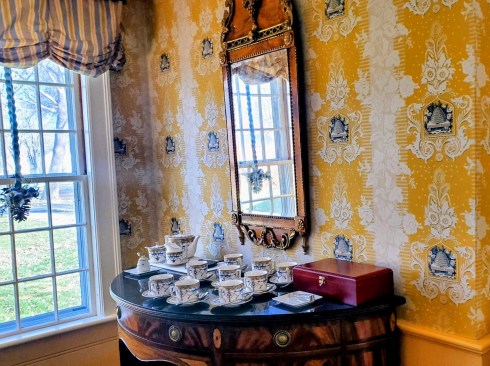
Of course, the furnishings set the scene as well, and authors of decorating books from the teens and twenties always advised their readers that they should avoid placing items “of a set” if they were to attain that authentic Colonial look. It was relatively easy for the Phillips’, with their multi-generational wealth and trove of possessions from different places and times, to achieve the desired layered look. Their dining room seems to have attained the general “Colonial feeling” recommended by Helen Koues in her popular manual On Decorating the House (1928), in which the walls and woodwork are light in value, the furniture is mahogany or brown mahogany, silver is shown, and side lights or chandeliers may be in silver with glass prisms, or some fixture Colonial in feeling. Andirons and fireirons are of brass or brass and iron, and the china displayed is of Wedgwood in patterns of the eighteenth century. Of course, Stephen and Anna Phillips were both from old Salem maritime families, so their Wedgwood (and Limoges) is supplemented by a dazzling display of East Asian ceramics.


Past and Future at the Crane Estate

It’s been a difficult week; I don’t understand the choice that my fellow Americans have made. But I do understand that I am well-insulated from said choice, by my age, occupation, residence and background. I’m a very privileged person; my first thought when I realized how the election was going was: well, I can go back to the sixteenth century and work on my saffron book. And I can, and I will. In the here and now, I realized I needed to immerse myself in something pleasureable: for me, that is always historic architecture. This past weekend, I was indeed very privileged to be able to visit a Samuel McIntire house here in Salem that will come up for sale in the coming weeks: pictures forthcoming. It was so charming, so crafted, so preserved, so comforting. And on Saturday my husband and I drove up to Ipswich for a tour of Castle Hill at the Crane Estate: it was so grandiose, so gilded, so well-situated, but still, somehow, so comforting. The estate is centered by the “Great House” or Castle Hill, a Jacobean Revival (??? not really sure about this label—the front facade is said to be based on the National Trust’s Belton House, a later Stuart structure. Stuart Revival? Carolean Revival? Restoration Revival?) built between 1924-1928 on an ocean-fronted drumlin which provides inspiring views of the surrounding sea and marshland. A complex of mansion, outbuildings, and surrounding landscaped gardens and grounds was commissed by Chicago industrialist Richard Teller Crane Jr. and his wife Florence, who purchased the property in 1910. They first built an Italianate mansion, but as Florence hated it and its stucco walls failed they commissioned Chicago architect David Adler to design a more enduring building in another European style. The house has 59 rooms encompassed in nearly 60,000 square feet, and was donated to the Trustees of Reservations after the death of Mrs. Crane in 1949. We toured about half the house, and then proceeded up to the roof to see its cupola and the surrounding terrain and ocean, along with Crane Beach, the best in New England.

Inside are grand halls and Anglo interiors: there are floors and panels extricated from doomed houses across the Atlantic. The library, with its Grinling Gibbons overmantle carving and woodwork from a Tudor manor house named Cassiobury Park, is definitely the star of the first floor although the perfect-green dining room was a close second for me. As we proceeded upstairs, the rooms seemed more “American” to me, although there was some beautiful French wallpaper (Zuber?) in one of the halls. As Mr. Crane made his fortune in plumbing, the bathrooms are impressive in both fixtures and decorations, but I didn’t get any good photographs! (All summer long, whenever I showed visitors the relatively plain bathrooms at the Phillips House, they would comment oh the bathrooms are much better at Castle Hill. There was a ship’s cabin feel to the charming third-floor Billiards Room, which presently has no billiards table. From here we ascended up to the cupola and roof.

Back down to the gorgeous green dining room, from which I spied the butler in the kitchen washing champagne glasses, his tuxedo so perfectly of the twenties time that I thought he might be a ghost! But no, he came closer and was actually Brendan, a student in two of my courses this semester. I knew he worked at Castle Hill but somehow I had forgotten, so when I saw him, it was kind of a shock; you know, the shock you feel when you see a familiar person in an unfamiliar place. Brendan was very much in his element and I was very happy to see him so: much of my week’s disappointment was for my students, who are going to have to deal with the consequences of this election early in their lives and for longer than I. Something about Brendan in his tuxedo made me think that he was game, along with his contemporaries. Almost immediately after that pleasurable encounter, I stepped out of the house onto the grounds  and ran into none other than Senator/Secretary John Kerry! He was mid-stride and did not look like he wanted to talk and I didn’t really know what to say anyway, but as he walked away I thought, wow, he’s probably doing the same thing as me, coming to this beautifully-preserved Massachusetts place on a gorgeous fall day trying to forget the election. He looked at Crane Beach for a while and then he was gone. That brief encounter made me think of Kerry’s perspective and realize that my frustrations pale in comparison: imagine serving your country in many ways over many decades and then that man is elected president, not only once but twice! Ah well, it was a beautiful day at the Crane Estate.

That green! Brendan, and a wing-less gryphon. I didn’t take Senator Kerry’s photograph because it would have been rude, and I was in the midst of snapping the gryphon. Happy Veterans Day to the Senator and all of his comrades.


Weekend in Wiscasset

Just back from a long weekend in Wiscasset, Maine with family, lots of eating and drinking, house-hunting, and pumpkins. My stepson is working at an oyster farm in the region so we’re going to midcoast Maine pretty regularly, and this Columbus/Indigenous Peoples Day weekend was of course a good opportunity to escape Witch City. We stayed in a lovely house in Wiscasset, one of Maine’s prettiest towns, and made regular trips up Route One to Damariascotta, which was holding its annual Pumpkinfest, complete with Pumpkin Queen, Pumpkin Drop, Pumpkin Derby, Pumpkin Regatta, and a main street embellished with large embellished and carved Pumpkins.

Wiscasset houses & shopping & Damariascotta pumpkins.

I worked at Historic New England’s Phillips House in Salem on Saturday and visited Historic New England’s Nickels-Sortwell House in Wiscasset on Sunday. It certainly has been an HNE summer for me! We spent so much time with the pumpkin festivities in Damariascotta that I turned up at Nickels-Sortwell at 3:00 pm: the last tour of the day on the last day of their season! Bad form on my part, and I apologized profusely, but of course my guide was  completely gracious and welcoming and eager to show off the house. Historic New England has two houses in Wiscasset: the very dramatic Castle Tucker and the very……..strident Nickels-Sortwell, and I had never been to the latter so I was thrilled to be able to squeeze it in this weekend. I always look at history and houses through a comparative Salem prism, and this was not difficult to do regarding the Phillips and Nickels-Sortwell Houses: both are Federal constructions which evolved into a Victorianized rooming house/hotel and then were restored with Colonial Revival inspiration by wealthy Yankee families.

I learned a lot about the house and the families who lived in it on my tour, but after we said our goodbyes I was still puzzled by the assertion of my guide that in the year of the house’s construction, 1807, “Wiscasset was the busiest port north of Boston.” Of course I couldn’t stop myself from contesting that statement: I think Salem was? Certainly Portsmouth and Portland were busier? She responded that she wasn’t sure but that was a pretty standard Wiscasset claim. And she’s right: I looked at all the the Wiscasset tourist and historical information on the web and there it was, again and again: Wiscasset was the busiest port north of Boston, Wiscasset was the busiest port east of Boston in 1807, the year of the Jefferson Embargo Act. This is clearly not true in terms of tonnage or voyages, but I’m wondering if “busiest” means something else? Shipbuilding and other maritime industries AND customs revenues? HELP early American maritime historians!


The Road to Mount Vernon

We have spring break this week, so I’m on one of my road trips, loosely following the footsteps of George Washington. I always feel like I need a theme beyond “interesting old houses” but often I find one along the way which replaces my original intention. Not this year though: George has been pretty present! I started out in northern New Jersey, where I visited a house that I’d long wanted to see because I love Gothic Revival architecture and it looked like the ultimate GR cottage, but it turned out to be much older with a Washington connection: the Hermitage in Ho-Ho-Kus. General Washington was headquartered here following the Battle of Monmouth and during the court martial of General Charles Lee in the summer of 1778, in the company of his aide Alexander Hamilton and the Marquis de Lafayette. Aaron Burr was there too, and a secret romance was initiated between the future Vice-President/duelist and the lady of the house, Theodosia Prevost, who happened to be married to a British officer. At the close of the war and after the death of Theodosia’s husband, the two were married. Decades later this very strategic house was “gothicized” and acquired its present appearance.

Not too far away is a house where Washington and his men spent much more time: the Dey Mansion in Wayne, New Jersey, which served as the General’s headquarters for several months in 1780. This is a beautiful property, maintained and interpreted by Passaic County, which acquired the house in 1934 after which it underwent an extensive restoration. A very knowledgeable guide took me all around the house, even into the atttic, which was absolutely necessary as I couldn’t understand how so many people could have lived in this house during the General’s residence: the Dey family did not vacate! You’re not going to see the house’s gambrel-esque roof that accomodates all this space because I didn’t have a drone with me, but check out the website. It’s a stately house for sure, but the spacious attic made everything clear. Washington, of course, was given the two best rooms, a large parlor/office on the first floor and a bedroom just above, by the master of the house, Colonel Theunis Dey.

The Dey Mansion: the first photos above—all the way down to the blue parlor—are rooms used by George Washington and his aides, including Alexander Hamilton. Then there’s the semi-detached restoration kitchen, and the spacious attic.

So at this point and place, if you really want to do the Washington tour, you should probably drive to Morristown, Trenton, Princeton, east to the Monmouth Battlefield, west to Valley Forge. But I’ve been to all those places several times, so I drove to the General’s last Jersey and last period headquarters in Franklin Township, a rather isolated farmhouse called Rockingham. No Pennsylvania for me; I headed south into Maryland to Annapolis, where Washington resigned his commission at the beautiful State House (obviously my chronology is all over the place, but these two stops did dovetail). I just really wanted to go to Annapolis in any case; George was just an excuse.

Rockingham: Washington’s last headquarters—and on to Annapolis.

A bronze George in the old Senate Chambers of the Maryland State House (Harriet Tubman and Frederick Douglass are just across the way); Hammond-Harwood, Shiplap and row houses in Annapolis.

On to Alexandria, where Washington touchstones abound, given its proximity to Mount Vernon. Like Annapolis, but MORE, Alexandria is full of beautiful townhouses: I started in the center of the Old Town and made my Washington stops—his church, his townhouse (actually a reproduction thereof) his pub—and then walked the streets taking photographs of doorways and wreaths, myriad details, spite and skinny houses. A bright sunshiney day: you almost can’t see this bronze Washington, sitting on a bench outside Duvall’s Tavern, where he was feted after his great victory.

From my parking place on North Washington Street, I drove straight out to Alexandria to Mount Vernon, mere miles away, along the George Washington Memorial Parkway. It definitely felt kind of like a pilgrimage at this point! I have been to Mount Vernon before, but have no vivid memories—an obligatory school trip, I think. It’s one of those houses that looks much bigger on the outside than the inside: it feels quite intimate within, especially as one side was closed off for renovations. I signed up for the “in-depth” tour so I could get some interpretation–and up into the third floor. While the mansion is a must-see, I think you can actually learn more about Washington from the many outbuildings on the estate: he was “Farmer George” and for all of his heroism he was also a slaveowner who seemed to have no regrets in that capacity. There are a lot of Washington contradictions, and there are a lot of Mount Vernon contradictions: while the subject of slavery is addressed up front the overall impression—reinforced especially at the museum adjacent to the orientation center—is of a “great man.” It was a bit too ra-ra for me, but I’m still headed to Yorktown for the last leg of my trip.

Mount Vernon: a house with 10 bedrooms and no bathrooms: the white-canopied bed is in the bedroom where Washington died. The presidential desk, parlor and dining room, key to the Bastille (a gift from Lafayette), greenhouse and garden, and view of the Potomac from the porch.


The Elizabeth Perkins House

One of the chapters I’m working on for Salem’s Centuries this summer is about Colonial Revival Salem, or should I say, a group of antiquarians who lived and worked in Salem from about 1890-1930 who were dedicated to preserving and promoting any and everything about Colonial-era Salem in their time and for the future. Our book is a work of social history, so our focus in on Salem people. But when it comes to the various expressions of the Colonial Revival movement, if you can call it that, I’ve always found that individuals and their often-passionate attachments to the past are so important, and this is particularly true in the case of the Elizabeth Perkins House, one of the Old York Historical Society’s  properties that has recently been reopened. For some reason, this is the one Old York house that I’ve never been inside, and I’d always heard that it was a perfect example of Colonial Revival influence in this region, so I was pretty eager when I showed up for my tour this past Friday.

The Elizabeth Perkins House of the Old York Historical Society, looking over the York River, Sewall’s Bridge and the Hancock Warehouse beyond. Its restorers, expanders and occupants: Mary Sowells Perkins and Elizabeth B. Perkins (photo on right from Old York Historical Society as featured in a very helpful Willaim & Mary 1988 thesis by Melisssa Mosher shows Elizabeth Perkins in front of the house).

This house is absolutely central to the preservation history of York as its early 20th century occupants, Mary Sowles Perkins (1845-1929) and her daughter Elizabeth B. Perkins (1869-1952) contributed it and several other structures (the Old Gaol, Jefferds Tavern, the old Schoolhouse, and the John Hancock warehouse) to what would eventually become the Old York Historical Society as well as encouraging other preservation efforts. So it seems right that Old York’s administrative offices have been relocated to this site as well. There was a whirlwind of restoration, expansion, embellishment and entertaining after the Perkins family purchased the house in 1898: they were from New York, and seem to have known everyone. Mark Twain came over from his summer rental across the river to use their telephone, the first one in York, and in 1905 they hosted the grandest party of the era: a Japenese-themed fête to celebrate the conclusion of the Portsmouth Peace Treaty ending the Russo-Japanese War of 1905 with over 700 guests in attendence. The tour really focused on their house, so much so that I’m not really sure of its pre-Perkins history. Old York is dating the house to around 1730 now, which seems about right to me, but I have postcards from my childhood (showing the house exactly as it looks now and at the time of Perkins’ death in 1952) bearing the date of 1680. The one below of the dining room shows the very “colonial” room that the Perkins created but also one of its most off-putting features for me—the electrified girondoles along the back wall.

Postcard of the dining room from 1960s or 1970s? I think it is a rule that every Colonial Revival house must have Hessians!

At first the house seemed to me like one of those sprawling recreations/creations which Mary Harrod Northend, one of the Colonial Revivalists in my Salem chapter, showcased in her Remodeled Farmhouses (1915) and I immediately wanted to know if Harrod knew either of the Perkins women–the two Marys were of the same generation. But inside, besides the dining room, it felt a little different to me than standard Colonial Revival: I guess there is no standard Colonial Revival because it is often an individual expression. The parlors of the Perkins house felt very traditional to me, but also more cosmopolitan, more worldly, more lavish, more of a mashup between past and present than a “period rooms”. A case in point would be this wonderful 20th century copy of an earlier portrait: this modern woman dressed in period costume just like Elizabeth Perkins above (well, a bit more elegantly). I love this portrait!

Hooked rugs abound of course, but the Perkins ladies were great travelers so that accounts for the worldliness of their rooms and all the interesting assemblages. Now I’m wondering about comparative Colonial Revival settings: if you’re trying to create and preserve a “colonial” home in the country it’s a different experience than in the city, where change is so much more apparent—and threatening. My Salem people, including Harrod, Frank Cousins, George Francis Dow, Caroline Emmerton and Daniel Low, are living and working in an environment of constant development, fire, pollution, and immigration: it seemed like things were being swept away. The Perkins ladies were facing none of that in York, so I’m thinking that they didn’t have to be quite so strident in their pusuit and preservation of the Colonial. Just a thought.

Front parlors and a very traditional entry; love the 17th century “open-back” ??? chairs.

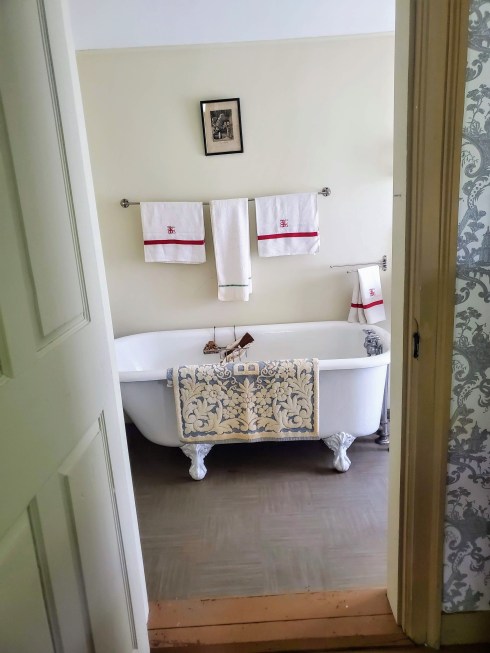
Loved the Currier & Ives presidential prints in the guest bedroom, which also has an en suite bathroom. The other bedrooms, including that of Mrs. Perkins above, have that “just left”/ I was just reading……. feeling, which is very Colonial Revival too: George Francis Dow pioneered the use of the folded-newspaper-by-the-gentleman’s chair motif in his period rooms in Salem, I believe.

Tours every Friday and Saturday available here.


Deerfield Thanksgiving

I know that it was a back-to-big-family-Thanksgiving for many people, but because of health and almost-conflicting family events my husband and I found ourselves alone this year. We made a last-minute decision to head to Historic Deerfield, where we stayed at the Inn for two nights and had a lovely Thanksgiving dinner at the Inn at Boltwood (previously the Lord Jeffrey Inn) in Amherst. We ran into old Salem friends and made new Pennsylvania friends at the Deerfield bar, walked around and in as many of those magnificent houses as we could, and “played” in the attic of the Flynt Center for Early American Life. I have under-appreciated this experience on past visits: there was something about this particular visit that made the “visible storage” of all sorts of items from Historic Deerfield’s collections—everything from ceramics to muskets to wrought iron, in multiples—so very engaging. Maybe it’s because we had this “attic” to ourselves. My husband and I have very different tastes, but he could be over there in the realm of metal-working tools while I was lingering in mocha ware, both of us content. We left the attic only because the weather was so beautiful: clear and sunny and bright, casting all those Connecticut River Valley doorways in stark relief.

Historic Deerfield has always been an exploration of maker/craft culture as much as architecture so a focus on objects on this particular visit seemed correct: I’ve always been too dazzled by the houses to take in the Deerfield-made baskets, famous blue-and-white embroidery pieces and pottery to take proper note of them in situ. Before there was Historic Deerfield, there was Arts and Crafts Deerfield, a haven and destination for traditional crafts and preservation at the turn of the last century, and before then there was of course colonial Deerfield: you can see and feel the layers as you walk down Old Main Street. We had the neighborhood to ourselves as we took a long walk on Thanksgiving morning, so we looked in a lot of windows and hung out in back amongst the barns.

A walk down Old Main Street from South to North and then back towards the Inn: village map with house names and dates.

A recent addition to Old Main Street are the Witness Stone markers laid before every house in which an enslaved person live and worked: these were installed just last month in partnership with the Connecticut-based Witness Stones Project. So there’s another layer uncovered and exposed. Museum neighborhoods can feel a bit static and fixed in time, but I’ve never felt that way about Historic Deerfield: rather it has always seems like an engaging mix of past and present or a cumulative work in progress to me. At the same time, time moves slower there: just turn off Route 5 for an hour or a day or two and catch your breath, take a walk, or rummage around in an attic.

Witness (to slavery) stones, a work in progress, and a signpost right in the midst of Deerfield Academy.


Open House in Essex County

It occurred to me the other day that during the long life of this blog I have never spotlighted Trails and Sails, a calendar of dedicated events and openings throughout Essex County in September organized by the Essex National Heritage Area. I feel remiss; I have friends and former students who work for Essex Heritage, and I myself am a commissioner! These folks know what heritage is and are able to discern it from tourism, and so they connect and cast light on institutions and areas which represent this region’s cultural and material legacy in meaningful ways. Trails and Sails is a 10-day extravaganza of free events throughout our region, beginning next weekend. I’ve picked my events, and my participation will pretty much revolve around visiting old buildings, but don’t let my game plan (mis-) inform yours: there are plenty of events that involve much more outside action like walking, paddling, biking, apple-picking, cider-making, birding, and even “forest bathing” (whatever that is) right here in Salem. So go to the website, or download the digital guide, and chart your course. Note that many (but not all) events and openings are recurring and some require reservations.

Saturday, September 17I’ve got to get into the glorious Grand Army of the Republic Hall in Lynn, so that will be my first stop. I’ve wanted to see this hall for about five years. From Lynn, I’ll drive over to Danvers to tour the 1670 Judge Samuel Holten House, another building which I’ve long admired and never been inside. Same with the Platts-Bradstreet House in Rowley, so that’s next, then back to Salem for a walking tour of Charlotte’s (Forten) Salem by History Alive, Inc.

Lynn’s GAR Hall, two seventeenth-century houses, and Charlotte Forten about to lead us around Salem!

Sunday, September 18: I know that I will have to do some lecture and presentation prep on this day but I am still going to the Open House at the Rocks Village Handtub Building and Toll House Museum on the Merrimack as I love that building and (again) have never been inside. I might as well go to the Brocklebank Museum on Georgetown as it’s on the way home.

Rocks Village,Georgetown, and the Jackman-Willet House in Newbury.

The following week, unfortunately, is super busy and I have my own presentation on Saturday the 24th, so that leaves Sunday the 25th, when I’ll go up to Newbury and see the seventeenth-century Jackman-Willet House and anything else that is happening in that part of the county. I feel like I’m missing out on some great events, particularly Fletcher Steele and Frederick Law Olmsted tours and a view of Gloucester from its grandiose city hall. But there’s always next year: Trails and Sails is an established tradition. As I was looking at the schedule, thinking about where I would like to go, and reflecting upon my past summer, it was just houses, houses, houses! I love visiting old open houses, but I think I must be an outlier among heritage tourists today. I’ve been talking to a few museum professionals over the summer, and they all tell me that house museums just aren’t as popular as they used to be. This might explain why so many in Salem are closed, including all of the Peabody Essex Museum’s houses save the Ropes Mansion and Salem Maritime’s Derby House (well, save the ell). But everywhere I have gone this summer—in New York, and all the New England states—there have been good-sized parties touring houses with me so it makes me feel like there are still some old-house afficionados out there! An anecdotal view, I know, but a hopeful one. Perhaps I should finally admit, however, that my essential childhood bedside book, Samuel Chamberlain’s Open House in New England, might have been a bit odd.


A July Afternoon, Old Lyme

One hot morning last week I was looking at some paintings by the American Impressionist artist Matilda Browne (1869-1947) when I realized I wanted to see more. It was apparent that the best place to do that was the Florence Griswold Museum in Old Lyme, Connecticut, so I hopped in the car and drove down there, arriving in the early afternoon. I was supposed to be doing lots of other things but I ran (drove) away instead: I’m a firm believer in doing that from time to time and have always been grateful that I have the ways and means to do so. Old Lyme is a beautiful town: I’ve been there quite a few times but never to the Griswold Museum, and it was a real feast for the senses, especially at this time of the year, when the Colonial Revival garden in back of Miss Griswold’s mansion was at midsummer peak. There is the 1817 mansion, embellished with the art of Miss Griswold’s artist-boarders who established the Old Lyme Art Colony at the beginning of the twentieth century, the garden and grounds with trails along the Lieutenant River, the modern gallery with cafe and gift shop, and several studio-outbuildings which give the impression of an artistic community past and present. It was a perfect place to spend an afternoon in July, as everything was bathed in that golden midsummer glow, much like the painting by once-resident Edward Simmons of the same title. And I saw lots of Matilda Brown’s paintings too.

Edward Simmons’ July Afternoon, Old Lyme (1906) and the house, garden and grounds of the Florence Griswold Museum.

Florence Griswold’s life (1850-1937) was in some ways common, in other ways not. She was born into a wealthy family, exemplified by the grand 1817 mansion on Old Lyme’s main street, whose money was increasingly diminished to just the house and grounds with no means to keep both. After the death of her father in the 1870s, the house was transformed into a school for genteel ladies, and after the death of her mother in the 1890s, into a boarding house by Florence and her sister. The artist Henry Ward Ranger came to stay in 1899, and convinced other artists to follow suit in the years to come, and the house evolved into an artistic community with Miss Griswold very much in its center and her house the foundation of an emerging art colony in Old Lyme. Apparently extending patronage (in the form of credit) to artists became a higher priority than holding on to the family home, and she lost it before her death in 1937, but over the next decade the Florence Griswold Association was able to purchase it and establish the museum. The first floor of the house is maintained much as it was in her time, while the second floor has galleries devoted to the work produced there, including paintings of the house itself, illustrating her role as “the keeper of the artists.” Resident artists, including Matilda Browne, also painted the house itself, most prominently its door and mantle panels, leaving their mark in more ways than one. While the Old Lyme Art Colony is associated most prominent with American Impressionism because of the residency of Childe Hassam and others, you can also see works representative of the less well-known (at least to me!) school of Tonalism associated with Ranger. And there are also some very impressive cows.

ABOVE: Matilda Brown, Miss Florence’s; Charles P. Gruppe, The Griswold House at Old Lyme; Woodhull Adams, Miss Florence’s Parlor (1912); painted panels in the Griswold dining room. BELOW: Front hall and parlor of the Griswold House, Miss Griswold’s bedroom and a guest bedroom.

It was quite a shift to move from the mellow tones and painterly animals ensconced in the old Griswold House to the museum’s modern galleries, which are currently showcasing a retrospective of artist Dana Sherwood’s more whimsical work, including an installed Bedroom Bestiary (2021) below. Very charming images, but I wanted to stay in the past, as usual, and in the garden, which was lush, lush, lush. So back to Miss Griswold’s environment I went: to the realm of her boarders and borders. It was Matilda Browne who lured me to coastal Connecticut after all.

Works by Dana Sherwood in the 2002 Krieble Gallery; Matilda Browne’s Clark Voorhees House (1905) and Saltbox by Moonlight; William Henry Howe’s Repose, September Days in Normandy (1888-89); back in the garden—somehow I never thought of using sage as a border plant like this.