Tag Archives: Historical Clothing

In Praise of a Handcrafted Halloween

So here I am in Salem, supposedly the Halloween capital of the world, wondering where all the creative costumes are. I’ve tried to embrace the “holiday” (invasion) this year (well not really, but I did take several walks) but all I have seen for costumes are flimsy puritans, vampires and superheroes and a sea of those little felt witch hats: nothing original or creative or made from a natural fabric (well, maybe the hats). My stepson came down from Maine for the weekend to prowl about with his friends in a pirate costume that he had purchased from one of those Halloween superstores along the way: I said “you can’t put together a PIRATE costume yourself! He did have the cool idea of going as Tiny Tim as he is 6’5” and on one crutch because of a sprained ankle, but I have yet to see him put this costume together. I’m wondering where the creativity is? Salem is instagram city at this time of year and those cheap costumes are hardly instagrammable: more of an effort would certainly result in viral views. Dogs have better outfits out there: I’ve seen pumpkins, bees, and even avocado toast! There is certainly lots of historical inspiration for humans, including British fancy dress books and digitized fashion plates and some great photography books on Halloween. We’ll see: the big day approaches.

But what are we to wear? Some suggestions from Arderne Holt’s Fancy Dresses Described or What to Wear at Fancy Balls (1887). You can be a box of dominoes or a bowl of lemons, and also a hornet or a witch (if you must). I think the hornet costume could do double duty as a bee.

Costume books published in the US are a bit less elaborate and historical than their British counterparts in the later nineteenth century, and also more…..paternalistic (is that possible)? We will skip past all the Native American costumes and go straight to the usual Halloween suspects, with a bit of whimsy for Miss Chess and Master Chimney Sweep….plus a pint-sized Guy Fawkes. These are still pretty elaborate costumes though—I’d have to distil them down considerably in terms of detail. Masquerade and carnival: their customs and costumes (1892) also includes some from Robin Hood: perhaps the inspiration for a c. 1907 item in the collections of Historic New England?

From the same period is this incredible handcrafted “Imperialist” skirt from the John Bright Collection—a template for any political commentary surely. I am hoping for some political costumes this year but we’ll see.

When I was looking for inspiration for this post, I discovered a new book and dusted off another. The discovery is an amazing book of photography entitled Dressed for Thrills: 100 Years of Halloween Costumes and Masquerade (2002) by Phyllis Golembo.I’ve ordered this book but haven’t received it yet, so the photos below are from Golembo’s website. I can’t wait for the book to arrive so I can see every single photograph, because what I have seen is so very arresting: who knew that just photographing scraps of fabric could be so effective? We’ve all seen those photographs of early 20th century costumed revelers, from the time when tricks and masking were more important than the recognition of pop culture personas. They look eerie and odd. But somehow the costumes alone look eerier and odder still! The evil bunny mask below is frightening, and so is the Mickey Mouse costume, both from the 1930s.

The book I dusted off is a book I never opened and I have no idea when or where I got it: Jane Asher’s Fancy Dress, first published in 1983 (and later as Jane Asher’s Costume Book). It’s full of whimsical costumes modeled by British actors and actresses of the 1980s, including Terry Jones. One day last week I was showing an episode of Jones’ Crusades series to my students and the next I was looking at him dressed as a “blob”! Now these are costumes you can actually make, from around-the-house materials like cardboard toilet paper rolls (glued together to make a British judge’s wig). The little Elizabeth and peapod below are a little more involved, but this bat has wings made from a broken black umbrella!


Dress UP Salem

Maybe you’ve seen this week’s New Yorker cover: a woman in her apartment on her computer, presumably in a Zoom meeting. She’s wearing a lovely blouse, earrings, and lipstick and her hair looks great, so all “above” is perfect. But below, out of sight of the computer screen, is another matter: she is wearing gym shorts and slippers, there is scattered paper everywhere, along with Amazon boxes, drinking vessels, and two cats. And she’s drinking a cocktail. That, dear readers, is me in the fall of 2020, teaching four courses while writing a book, with a new kitten running all around. Next week classes will end and I’m just about finished with a particularly difficult chapter: then I’m going to put on a skirt and tights and real shoes. This sad state of sartorial affairs has depressed me, as generally in December I’m thinking about what I’m going to wear to the Hamilton Hall Christmas Dance and other holiday events: obviously not happening this year. We’re also fortunate in Salem to see attendees of the Commonwealth Vintage Dancer’s Fezziwig’s Ball walking through the streets to Old Town Hall: again, not this year. So I’ve mustered up some historic Salem dresses and some new-old dresses in historic Salem settings to get myself in the holiday mood, material girl that I am.

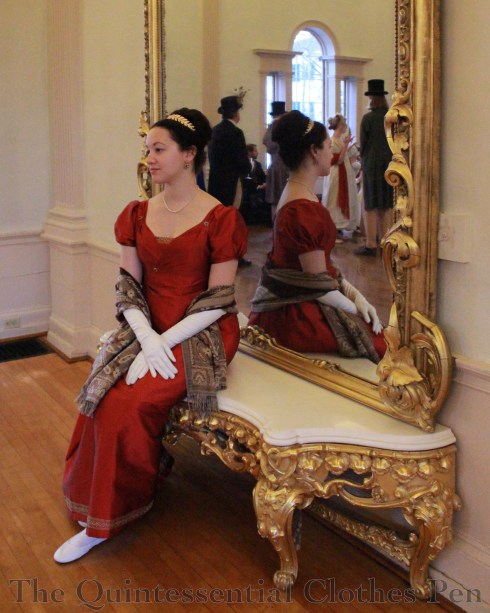
My favorite Salem dress ever is Sarah Ellen Derby Roger’s wedding dress, in the collection of the Peabody Essex Museum. I looked for something similar with Salem provenance, and found this lovely pale pink gown with amazing sleeves. I also found the wonderful blog of historical clothing maker Quinn Burgess, The Quintessential Clothes Pen. Since Quinn has attended several events in Salem wearing her own creations, I thought you would like to see some period clothes in situ, at Hamilton Hall and Old Town Hall. Her dresses below are designs from 1812-1813, about a decade earlier than Sarah’s wedding dress and its more muted cousin.

Sarah Ellen Derby Roger’s Wedding Dress, made in Salem from materials from India,1827, Peabody Essex Museum (Gift of Jeannie Dupee, 1979); Pale pink silk gown, Charles A. Whitaker Auctions. Quinn Burgess at Hamilton Hall and with her friends at Fezziwig’s Ball in Old Town Hall–an annual event sponsored by the Commonwealth Vintage Dancers. Photo credits: L. Stern (white and red dresses at Hamilton Hall) and James Sabino (The Festive Ladies at Old Town Hall).

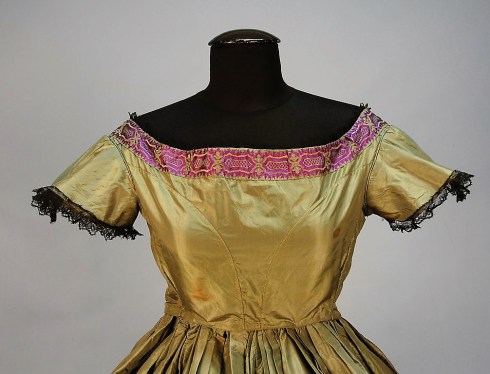
Let’s go forward a bit to the middle of the nineteenth century, not really my favorite period for design, but the ladies below make it look good! I came across this Civil War photograph of Marianne Cabot Devereaux Silsbee, author of A Half Century in Salem (1886) in her photograph album at the Phillips Library in Rowley. Despite the volume, I imagine this must be a day dress, but I found a very colorful chartreuse and purple ballgown from a Salem family in the archives of Whitaker’s auctions in Philadelphia. I always thought I liked that color combination, but now I’m not so sure: I think I prefer Quinn’s more subtle gown—hardly a “little” black dress–indeed Quinn tells me it is blue!

Marianne C.D. Silsbee, Phillips Library PHA 58; Civil War Era silk ballgown from a Salem family, Charles A. Whitaker Auctions; Quinn Burgess in a navy c. 1860 dress at Hamilton Hall (photographer credit: Emma Forrest).

And speaking of little black dresses, I’m going to jump forward a century to show you one from a Salem purveyor: a Mollie Parnis dress from the Mayflower Vintage shop on Etsy. Gorgeous. I’m not sure I’d wear this to the Christmas Dance, as I prefer more of a ballgown for that occasion, but (if I could fit into it), I’d find someplace to wear it. I’m looking forward to the moment when I can even think about what dress I might wear, where.

Mollie Parnis dress from Mayflower Vintage.


Highlights from Charles A. Whitaker Auctions.

More of Quinn Burgess’s work can be found at: The Quintessential Clothes Pen; www.quinnmburgess.com; Twitter (@thequinnpen) and Instagram (@thequinnpen).

You can see more period dances and dancers at vintagedancers.org +upcoming events.