Tag Archives: great houses

Camellia Days

Nineteenth-century monied New Englanders loved camellias and living embodiments of their desire exist at the Lyman Estate greenhouses of Historic New England, which hosts “Camellia Days” in February and March when these old trees are in bloom. Somehow I miss this event every year, but not this year. I drove to Waltham on Wednesday and had a quick view of the Lyman Estate mansion followed by some alone time with the camellias. The Lyman greenhouses are old (1804), and as close as I can get to Salem’s greenhouse era, when there were at least eight (maybe more—my count is ever-evolving) right in the middle of the city. Camellia Days extends to the mansion, which was designed originally by Samuel McIntire, so there’s a more direct Salem connection there too. I was never really a fan of this rambling structure, but now I realize that is because of its robust Victorian additions rather than its original design. McIntire’s plans reveal a charming two-story house unblemished by those bays. I can certainly understand why Arthur Lyman wanted to expand the house in the 1880s, however: he had a large family who enjoyed this bucolic estate as an escape from busy Boston. And I do love the relocated staircase and vaulted ceiling of the added third storey.

The mansion was built in 1793 and expanded and altered in 1882-83, but the Lyman family retained McIntire’s Federal ballroom (which they used as a library) and oval “bow parlor”. The relocated stairway with its Palladian window oversees the grounds and greenhouses.

I really liked the very Victorian library as well, but my heart stopped when I entered the adjacent china room with cabinets full to brimming with purple transferware! “My” Waterhouse wallpaper adorned one of the bedrooms upstairs so that was nice too. It’s a lovely summer estate with a preserved landscape in the midst of now-busy Waltham.

But I was there for the camellias and they did not disappoint! These are lush, heirloom varieties. I’m partial to less showy plants in the bright light of summer, but in the very dim light of late winter these bright blooms are just what you need. The Lyman greenhouses are accessible all year long actually (and there are great plant sales), but Camellia Days provide extra enticement.


The Last Week in February

Well, it’s been quite a winter here in eastern Massachusetts, and last week was quite a week, so I think I’m going to take a break from topical posting and just present the week that was. It started with a blizzard, and even though it is now March 1, as I am typing I see big fluffy snowflakes out there again. But not all was white: there was bright blue towards the end of the week as my husband and I proceeded north for a little break. In this topsy turvy winter, Rhode Island experienced 30+ inches of snow while midcoast Maine seems to have had just a dusting. By the time we got up there on Thursday, it seemed springlike to me! We saw my stepson, who works at an oyster farm near Damariscotta, engaged in a bit of house-hunting, and (lucky us) stayed at the storied Norumbega Inn in Camden. The latter was a long-time wish of mine, having driving by the fantasy castle on Route One many a time, and it did not disappoint. After two nights in Camden, we returned to Salem on Saturday for a really cool event at Hamilton HallFashioning Freedom: Layers of Liberty. This was a theatrical performance fashioned as a “a celebratory, historical runway of Black creativity and activism” featuring prominent nineteenth-century African Americans, including the Remond family of the Hall, Frederick Douglass’s wife Anna, educator Charlotte Forten, and sculptor Edmonia Lewis. A collaboration between Salem’s revered historical theater company, History Alive, and the Hall, it was a can’t miss event for me: all Renaissance scholars adhere to the concept of “self-fashioning,” which is just what we saw, and of course after having written about John Remond in Salem’s Centuries it was a thrill to see “him” right in front of me. So it was a very interesting week and I am ready for March!

Monday’s blizzard from my second-floor windows.

And then: bright blue sky and sea in Maine! Obviously there was snow up there too, but less of it and more room to spread it around. City snow can be exhausting: you just can’t find get it out of the way and it is increasingly gray (among other colors). Below are a few houses in Newcastle, Cushing and Friendship, and then we were off to Camden and the Norumbega.

The Norumbega, otherwise known as Norumbega Castle, was built as a private home for Maine native Joseph Barker Stearns in 1886-87 in a style that is generally described as “Queen Anne”. To me, it has always seemed more Romanesque, but its interior was a bit lighter than I imagined—smaller too. Not that it is small, it’s just that the scale is not baronial or overwhelming. We stayed in one of the turret rooms, named Sandringham. Stearns made his millions in the telegraph industry by patenting and licensing duplex telegraphy, by which two messages could be sent over the same wire simulteneously. Camden is a hilly coastal Maine town (with its own municipal ski slope, called the Snow Bowl) and the Norumbega is situated on an elevated site which once, and really still, has unobstructed views over Penobscot Bay. The house remained residential for a century, and then was converted into an inn. We really enjoyed our stay: our room was lovely, as were all the public rooms, and breakfast and bar bites in the small blue cocktail lounge were special touches. We actually saw a bit less of Camden than we expected to because we just wanted to hang out in the castle—you can do that in the winter and not feel guilty. But Saturday morning we knew we had a date with the Remonds so back to Salem we went.

The real Remonds at Hamilton Hall and a few shots from “Fashioning Freedom” before and after the performance. It was a very visual evening so check out Hamilton Hall for more professional photos in the next few days. Congratulations to all involved! The month ended with the news that Salem’s new consolidated elementary school will be named after Sarah Parker Remond–yet another triumph for an important Salem family! I do tend to view them in the collective as they were all so invested and engaged. As we enter women’s history month, here’s a clip of an 1855 petition calling for the resignation of Judge Edward Greeley Loring, the Massachusetts Justice most associated with the enforcement of the Fugitive Slave Act, signed by ALL the Remond women, including matriarch Nancy, her daughters and daughters-in-law, and their friend Charlotte Forten. You can see more at the Massachusetts Archives Anti-Slavery Petititions Dataserve at Harvard University:

https://dataverse.harvard.edu/dataverse/antislaverypetitionsma.


Mills Mansion Shines

We arrived at my brother’s house in Rhinebeck on Christmas Eve, ate, drank and were merry for two days, and then I woke up on the 26th eager to explore yet another Hudon Valley mansion, what I always want to do when I’m in the area. There are loads of Hudson Valley posts if you want to see past tours: I apologize for the unwieldlyness of my now 14-year-old blog, but you can find most things by keyword searches in the search box. Eventually I will get around to providing an index. The house I chose to visit was ironically located very close to my brother’s house, yet I had never cared to stop in. It’s a big classical revival Beaux-Arts building called the Mills Mansion, located in the midst of the Staatsburgh State Historic Site on the river. I had hiked the trails that used to constitute its vast estate estate, but never ventured through its doors. I pictured enormous square drab rooms, but my vision was wrong. The tour was labeled a “Gilded Age Christmas” and it was indeed very glittery! My brother and brother-in-law came along with me (along with my husband), and they confirmed that the last time they had been in the mansion it was a bit tired, but what we all encountered was a very engaging space, encompassing the efforts of both state staff obviously, but also a very active Friends group. All the docents in the building were so enthusiastic, so obviously happy to be there and share the stories of the mansion and the Mills family. It reminded me of my colleagues at the Phillips House this past summer.

The Mansion was just one home of Ogden and Ruth Livingston Mills, very wealthy members of the fabled NYC 400. Mr. Mills inherited a California gold rush fortune, and Mrs. Mills was New York aristocracy: her Livingston lineage went back to the seventeenth century in the Hudson River Valley. I really can’t think of a better recipe for a Gilded Age couple! She had inherited a much smaller Greek Revival structure generally called Livingston Manor, and in 1895 she and her husband commissioned the prestigious New York City architectural firm of McKim, Mead and White to remodel and enlarge it, a mission which was accomplished in only one year. It was expanded from 25 rooms to 79, and 14 bathrooms were added–if you want to see and study Gilded Age bathrooms, this is really the place! The new Mills Mansion, called Staatsburgh at this time, had its own coal-powered electric plant and central heating but also 23 fireplaces, some of which are quite baronial as you will see below. All the usual classical details were added to the exterior of both the two new wings and the original house in the center, and a huge portico tied everything together. The entire complex was not only a family home and guest palace, but also a working estate of 1600 acres, with gardens and greenhouses, a dairy barn, and additional outbuildings. The entirety, including all of the furnishings, was donated to the State of New York by the Mills’ daughter Gladys Mills Phipps in 1938, following the dearth of her parents in the 1920s. And so a large chuck of riverfront land was preserved for all of us to enjoy. The obligation to steward was also granted to New York State of course, and given the size of the Mansion, that is probably a constant process: several docents, with obvious pride and excitement, informed me that they had just won a grant to restore the period kitchen so that it could be added to the tour. It was obvious to me that both material preservation and interpretation were ongoing initiatives: an exhibition space adjoining the visitor entrance presents the site in a broad social and geographical context, and then you proceed upstairs and get wowed.

The grand reception rooms: library, drawing room, central hall, dining room, service pantry off dining room, a “golden” drawing room.

Staatsburgh/ Mills Mansion was the Mills’ “autumn” house, and when they were in residence, they had lots of guests, attended to by a staff of 25. The bedrooms upstairs were separated and designated to single men and single women guests and married couples: bathrooms were interspersed liberally. There’s a rather widespread belief that Edith Wharton, who was very familiar with this region and its social scene, had used the Mansion for her depiction of Bellomont in the House of Mirth so I was looking for Lily Bart’s bedroom of course. That would make Lily’s hosts, the Trenors, Ruth and Ogden Mills, and Ruth does have a certain “ambitious hostess” reputation. Apparently she was very pleased that she could secure the services of celebrity architect Stanford White for her project before he designed the neighboring Vanderbilt Mansion. Ever the gracious hostess, Mrs. Mills even provided her guests with a safe in which they could deposit their valuables upon arrival.

Guest bedrooms and bathrooms and the safe.

The Mills Mansion docents did not stress Mrs. Mills’ competitive hospitality but rather her family life, and her fraility. She had a heart condition, so her bedroom, an extravagant raspberry damask confection, was located on the first floor adjacent to the reception rooms rather than upstairs. Her husband’s bedroom was just across the way, with a connecting bathroom in between. A smaller staircase connected these rooms to the Mills children’s bedroom upstairs, and doors could be closed to create a more private family “townhouse,” which I thought was pretty clever. All in all, our visit to the very festive Mills Mansion was the beginning of a perfect day after Christmas.

The Mills Family’s “townhouse” within the Mansion.


Mint McIntire

It’s always a big moment when a Salem house crafted by Samuel McIntire comes on the market, and that moment is approaching! Likely the most important McIntire house still in private hands, the very-storied Cook-Oliver House at 142 Federal Street, is coming up for sale quite soon. This house will certainly need considerable work, but my title is an attempt to epitomize the great creative and material efforts of its successive owners to preserve McIntire’s design and craftsmanship. The house was built by Captain Samuel Cook (1769-1861) whose span of life represents Salem’s spectucular maritime rise and fall. He was one of a score of Salem captains and merchants who earned great profits by re-exporting commodities from the East Indies to Europe in the first few decades of the nineteenth century, and only a year or so after the dramatic shipwreck of his ship Volusia off Cape Cod in early 1802 he was able to finance the construction of a house which spared no expense by all accounts. The fortunes of these men always seem so fluid to me! The carved detail, evident inside and out, was so notable in its time that there emerged a narrative which connected Captain Cook’s house to an even more notable McIntire construction: the short-lived Derby Mansion in the center of town. Salem’s merchant prince or King, Elias Hasket Derby, financed the construction of what looks like a proper manor house in his declining years, and it was completed according to the plans of Charles Bulfinch and Samuel McIntire in 1799, the very year he died. Given its central and conspicuous location (right in the middle of what is now called Derby Square), the mansion’s life was short: it was torn down in 1815 to make way for what eventually became the Old Town Hall or Market House. Even though Cook’s house was built a decade earlier, there persisted a story that some of the woodwork was somehow salvaged by him. There is a particular focus on the gateposts of the Cook House having Derby Mansion origins, repeated again and again and again in periodicals and monographs on old American houses until Fiske Kimball dismissed the connection as “legend” in his 1940 study, Mr. Samuel McIntire, Carver: the Architect of Salem.

I was thrilled when my friend Michael Selbst, a very busy Salem realtor with the listing, texted me with an invitation to view the house just before the election, and we went in two days afterwards: a welcome distraction! As you can see, it was a sunny day and the house glowed, despite the traces of moving activity all around. I think that this is the only McIntire house in Salem in which I have not entered before: it was kind of chilling (in a good way) because I had seen so many photographs and now here I was in the real house. It’s hard to explain just how lovely this house is and the photos will not do it justice: there’s something about the combination of the smaller scale and the very detailed woodwork. It is not by any means a small house (especially with its additions) but it has a more intimate presence than the other McIntire houses I have been in: I was actually and immediately reminded of Leonardo’s embrace of the classical concept of in all things is the measure of man. It’s a humanist house!

These two doorways, to the right (parlor) and left (dining room) just as you enter the house, have been photographed so often over the last century or so that I was a little starstruck upon my entrance. 

It is also, and has always been, a family home, and Michael and its owners hope it will be a family home again, with its essential structure and details preserved intact. Captain Cook and his wife Sarah (Sally) lived in the house until their deaths in the 1860s and then it passed on to their daughter Sally and her husband Henry Kemble Oliver, real Renaissance Man: a soldier, officer, civil servant, politican and musician who served successively as mayor of both Lawrence and Salem. Sally Oliver died in 1866, but Henry continued to live at 142 Federal Street until his death in 1885. Several owners later, the long tenure of Dr. and Mrs. Carroli saw the only “losses” for the house as the Dufour wallpaper in the parlor was donated to the Society for the Preservation of New England Antiquities (now Historic New England) in 1904 and a cornice to the Metropolitan Museum of Art in the 1920s. There are apartment and porch additions to the back that did not alter the original structure in any way. The woodwork throughout looks to my eye exactly as it does in the many photographs that date from the early twentieth century. After spending a good part of last year working on the Colonial Revival chapter for our forthcoming book Salem’s Centuries, not always a pleasant task as it involved documenting the “stripping” of several Salem houses, it was nice to see so much in situ!

I got a little flustered in the parlor looking at a unique fireplace insert, so I didn’t get proper photos of the mantle or even much of the room! So I have included some HABS photos, as well as two Frank Cousins views from Historic New England and the New York Public Library Digital Gallery with the Dufour paper, which was removed in 1904. The mantle remains the same! A lovely Palladian window on the second-floor landing, which has a very unique detail. More details, the dining room, kitchen, and my favorite third-floor bedroom. There are more bedrooms, and quite a few cute little rooms—I actually lost count: a sewing room? studies, a trunk room?

All summer long at the Phillips House, I kept describing the original McIntire construction (or relocation to Chestnut Street) as “shallow,” just one room deep. You rarely see Federal houses with this original shallowness—over the nineteenth century they were built on and on and on as needs dictated and so they become more square than rectangular. There’s something about being able to see the backyard from the front door: it adds a lightness to a house. On the dining-room side of the Cook-Oliver house, a first-floor kitchen was added and then the apartments wing, but in the hall and on the parlor side, you can see right through. And what you see is a very expansive yard. A quarter of an acre! Very lavish for Salem, as if this house wasn’t amazing enough.


Appendix: Period Homes, 2005.


Past and Future at the Crane Estate

It’s been a difficult week; I don’t understand the choice that my fellow Americans have made. But I do understand that I am well-insulated from said choice, by my age, occupation, residence and background. I’m a very privileged person; my first thought when I realized how the election was going was: well, I can go back to the sixteenth century and work on my saffron book. And I can, and I will. In the here and now, I realized I needed to immerse myself in something pleasureable: for me, that is always historic architecture. This past weekend, I was indeed very privileged to be able to visit a Samuel McIntire house here in Salem that will come up for sale in the coming weeks: pictures forthcoming. It was so charming, so crafted, so preserved, so comforting. And on Saturday my husband and I drove up to Ipswich for a tour of Castle Hill at the Crane Estate: it was so grandiose, so gilded, so well-situated, but still, somehow, so comforting. The estate is centered by the “Great House” or Castle Hill, a Jacobean Revival (??? not really sure about this label—the front facade is said to be based on the National Trust’s Belton House, a later Stuart structure. Stuart Revival? Carolean Revival? Restoration Revival?) built between 1924-1928 on an ocean-fronted drumlin which provides inspiring views of the surrounding sea and marshland. A complex of mansion, outbuildings, and surrounding landscaped gardens and grounds was commissed by Chicago industrialist Richard Teller Crane Jr. and his wife Florence, who purchased the property in 1910. They first built an Italianate mansion, but as Florence hated it and its stucco walls failed they commissioned Chicago architect David Adler to design a more enduring building in another European style. The house has 59 rooms encompassed in nearly 60,000 square feet, and was donated to the Trustees of Reservations after the death of Mrs. Crane in 1949. We toured about half the house, and then proceeded up to the roof to see its cupola and the surrounding terrain and ocean, along with Crane Beach, the best in New England.

Inside are grand halls and Anglo interiors: there are floors and panels extricated from doomed houses across the Atlantic. The library, with its Grinling Gibbons overmantle carving and woodwork from a Tudor manor house named Cassiobury Park, is definitely the star of the first floor although the perfect-green dining room was a close second for me. As we proceeded upstairs, the rooms seemed more “American” to me, although there was some beautiful French wallpaper (Zuber?) in one of the halls. As Mr. Crane made his fortune in plumbing, the bathrooms are impressive in both fixtures and decorations, but I didn’t get any good photographs! (All summer long, whenever I showed visitors the relatively plain bathrooms at the Phillips House, they would comment oh the bathrooms are much better at Castle Hill. There was a ship’s cabin feel to the charming third-floor Billiards Room, which presently has no billiards table. From here we ascended up to the cupola and roof.

Back down to the gorgeous green dining room, from which I spied the butler in the kitchen washing champagne glasses, his tuxedo so perfectly of the twenties time that I thought he might be a ghost! But no, he came closer and was actually Brendan, a student in two of my courses this semester. I knew he worked at Castle Hill but somehow I had forgotten, so when I saw him, it was kind of a shock; you know, the shock you feel when you see a familiar person in an unfamiliar place. Brendan was very much in his element and I was very happy to see him so: much of my week’s disappointment was for my students, who are going to have to deal with the consequences of this election early in their lives and for longer than I. Something about Brendan in his tuxedo made me think that he was game, along with his contemporaries. Almost immediately after that pleasurable encounter, I stepped out of the house onto the grounds  and ran into none other than Senator/Secretary John Kerry! He was mid-stride and did not look like he wanted to talk and I didn’t really know what to say anyway, but as he walked away I thought, wow, he’s probably doing the same thing as me, coming to this beautifully-preserved Massachusetts place on a gorgeous fall day trying to forget the election. He looked at Crane Beach for a while and then he was gone. That brief encounter made me think of Kerry’s perspective and realize that my frustrations pale in comparison: imagine serving your country in many ways over many decades and then that man is elected president, not only once but twice! Ah well, it was a beautiful day at the Crane Estate.

That green! Brendan, and a wing-less gryphon. I didn’t take Senator Kerry’s photograph because it would have been rude, and I was in the midst of snapping the gryphon. Happy Veterans Day to the Senator and all of his comrades.


Late Summer at Greenwood Farm

I’ve been taking walks at Trustees of Reservations properties all summer long, so it seems appropriate to end the season with a post on one: Greenwood Farm in Ipswich, Massachusetts. I had never been to this saltmarsh farm before this spring, and I returned every other week. Last week was definitely my favorite time: there’s just something poignant about golden late summer, just before the appearance of any red. It’s not a huge reservation, but it is a well-situated one, overlooking the marshes and islands of Ipswich Bay. A perfect first-period house, the Paine House, sits right there along the its main path, with no driveway or modern conveniences in sight. There are venerable oak trees, and some recent additions: “Remembrance of Climate Futures” markers, indicating how and when the landscape will change. They were the only source of anxiety on my walks around Greenwood Farm.

Once again we must be grateful for the efforts of an old and wealthy New England family, the Dodges, who purchased the property in the early 20th century, were responsible stewards during their summer residence, and eventually donated the farm to the Trustees of Reservations in the 1970s. A larger, newer farmhouse built on the property by Thomas Greenwood in the early 19th century served as their principal summer house, and they used the 1694 Paine House as a well-appointed guest house. I’d love to go inside, but it’s never been open—in fact I have never seen a single person on this whole property on my walks this summer! Of course there is a Salem connection: Robert Paine, the first of six generations of farmers to live in the house was a jury foreman during the Salem Witch Trials. As you can see, the house is a touchstone for me as I walk around the farm, but I’ve also developed more appreciation for trees this summer, and solid land when I come across these jarring “remembrance” markers.

Appendix: I searched for an image of the Paine house among the works of  Ipswich artist extraordinaire Arthur Wesley Dow (1857-1922), who mastered all genres—oils, woodblock prints, cyanotypes—and seemed dedicated to depicting every square inch of his native town (as well as being a very influential art educator), but  found nothing. Many of his landscapes look like the farm, because saltmarsh farms ARE Ipswich. This little collaboration of Dow and the poet Everett Stanley Hubbard, which you can access here, is particularly evocative.


Sedgwick Sanctuary

Yesterday I learned a new word, drumlina long, flat-topped hill formed by glaciers, during my visit to the appropriately-named Long Hill in Beverly, one of the properties of the Trustees of Reservations. At the top of this drumlin, away from the “gold coast” where many of their Boston friends summered, Ellery and Mabel Cabot Sedgwick built a Federal Revival House with bricks harvested from an Ipswich mill and detailed woodwork crafted by enslaved workers from a Charleston mansion. They planted a copper beech tree to mark the spot of their new summer home, and after it was built, kept on clearing and planting, crafting a series of inter-connected gardens around it, designed to frame the home and also blend in with the 100+ acres of woodland and meadows beyond. It’s a spectacular site in so many ways: I’ve visited it many times and posted it about here too, but the Trustees have been engaged in a garden revitalization initiative for their properties, and so I wanted to give Long Hill another look. I took a proper tour rather than just wandering around (highly recommended: it was particularly important for me as I know quite a bit about plants but nothing about trees, and Long Hill has some very unsusual specimens) and now I have a whole new appreciation for this amazing space, and the amazing women who created it.

When Ellery and Mabel Cabot Sedgwick purchased the Long Hill property in 1916, he was in the first phase of his long and successful run as owner and editor of the Atlantic Monthly, which extended to 1938. But she was pretty famous too, having published a popular (and still very useful) gardening guide entitle The Garden MonthByMonth in 1907. The pull-out color chart from The Garden graces Long Hill’s library, framed by silhouettes of Mabel and the second Mrs. Sedgwick, the former Marjorie Russell, who was also an accomplished plantswoman. Together, in succession, they built the spectacular Long Hill gardens, Mabel establishing the integrated “garden rooms” format and Marjorie adding more exotic varieties of plant material—and also focusing on plant propagation and experimentation, often in collaboration with Harvard’s Arnold Arboretum. The property served as the summer retreat for the the entire Sedgwick family, including the four children of Mabel and Ellery and their children, until the death of Marjorie Sedgwick in 1978, after which Theodore Sedwick Bond, Henrietta Sedgwick Lockwood, S. Cabot Sedgwick, and Ellery Sedgwick, Jr. donated Long Hill to the Trustees. It still feels a bit like a family house, even with an event tent on site: accessible rather than stately.


One way the Trustees has enhanced the accessibility of the property is to emphasize the fact that it is a place of activity, still a work in progress as it was under the administration of the two Mrs. Sedgwicks. There’s a cutting garden, a greenhouse and horticultural center, cold frames, ongoing plant propagation, workshops, and for those that don’t want to get their hands dirty, the horticultural library in the house. There are also trails for those who want to explore the rest of the 114-acre property, the “world” beyond cultivation. The overall message is appreciate and act.

plant propagation in action for those who don’t recognize it—like me!

I’m going to conclude with some of the spectacular trees on the property, just a sampling for sure. I’m just starting to look at trees after a lifetime of being unblissfully unaware, and this is one of the reasons I wanted to revisit Long Hill and will continue to do so. There’s a lot to learn, but yesterday I was just kind of awestruck by some of the textures and colors of the bark, let along the flowers and leaves. It got increasingly humid as we made our way through the garden(s), and so a weeping hemlock was a welcome rest stop, as it was 10 degrees cooling under its dense branches.

These last two amber trees are a Tall Stewartia and a Paperbark Maple.

A few last photos: the house is beautiful, but it’s really just an orientation center for the garden now—-BUT I want you to see this beautiful wallpaper in the center hall, purchased by the Sedgwicks in London during their house furnishing tours in the 1920s, as well an example of “enslaved craftsmanship,” a mantle from the Isaac Ball House in Charleston.


A Big Move

No, not me: the Crowninshield-Bentley House! Visiting Louise DuPont Crowninshield’s former garden in Marblehead last week prompted me to reconsider her impact on Salem as a preservation advocate and philanthropist as it is considerable. At least two institutions in Salem, the Salem Maritime National Historic Site and the Peabody Essex Museum, reflect her commitment to the preservation of Salem’s material heritage which was manifested both by her direct involvement and her inspiration. The best example of the latter is one of the Peabody Essex Museum’s historic houses, the Crowninshield-Bentley House, which was moved by the Essex Institute from a rather precarious position on Essex Street to its current location in 1959. This early Georgian house, home to generations of the Crowninshield family as well as Salem’s pre-eminent diarist the Reverend William Bentley, was originally located at 108 Essex Street. In 1958 the Hawthorne Hotel donated the house to the Essex Institute with the condition that it be removed to make way for a parking lot. The move to its new site adjacent to the Gardner-Pingree House and across the street from the Hotel, was preceded by the demolition of a venerable commercial building and succeeded by a comprehensive restoration to its 18th century form under the direction of Abbot Lowell Cummings as a tribute to the “work and memory of preservationist Louise DuPont Crowninshield.” The Crowninshield-Bentley House became the cornerstone of the Essex Institute (now Peabody Essex Museum)’s main “campus” of historic structures, and to complete the vision, gardens also dedicated to the legacy of Mrs. Crowninshield were installed in its midst. Another reason I wanted to post on this big move today is the great visual documentation by Essex Institute President Albert Goodhue, Jr., who snapped photographs of the the entire process over what must have been several days (weeks???) in 1965. These are among some great sources at the Phillips Library in Rowley documenting Salem’s ever-evolving streetscape, one of the major topics we’ll be covering in our upcoming book Salem’s Centuries.

Washington Square West and Essex Street, Salem (Mass.) Photographs, MSS 0.1619. Courtesy of Phillips Library, Peabody Essex Museum, Rowley, MA.

Amazing!!! I love the nonchalance of the pedestrians, and not a police detail in sight. Everyone is just going about their business while the walls are tumbling down! The building being demolished was quite a storied commercial building, also an 18th century structure (I think) but altered and extended considerably. There were some very notable apothecary and stationary shops located within, and Salem architect/artist William Henry Emmerton made an iconic image of it in 1850 when it was his cousin’s apothecary shop (Emmerton was a great draftsman, and the Phillips Library has digitized the records of his architectural firm, Emmerton, Foster & Putnam, so you can see more of his work here). Those big storefront windows were apparently the second of their kind installed in Salem, and the Paracelsus bust trade sign was pretty conspicuous too. After the move and restoration was completed, the Crowninshield-Bentley House received a lot of attention in both academic and popular publications: there are both feature articles and cover stories throughout the 1960s into the 1970s and even the 1980s. The more scholarly pieces tend to focus on the detailed 1761 probate inventory of Capt. John Crowninshield as a primary source for the restoration (which includes references to “a Negro man” valued at £66.13.4 and a “Negro woman” valued at £40 about whom I’d like to know more)§ while trade periodicals seem to focus overwhelmingly on the kitchen. There’s a big spread on the interior of the house in the July 1987 Colonial Homes, part of feature on Salem as the “showcase of early America,” which it was, then.

William Henry Emmerton, Apothecary shop of James Emerton in Salem, c.1850 (pen & ink and sepia wash on paper), Peabody Essex Museum; the Crowninshield-Bentley House on the cover of Americana, September 1973; the kitchen as photographed by Samuel Chamberlain (1970, Phillips Library via Digital Commonwealth) and in House and Garden, January 1974; Frank Cousins photograph of the house in its original Essex Street location, 1890s, Phillips Library via Digital Commonwealth. The House today.

§ The Phillips Library has also digitized all of the booklets in the Essex Institute Historic House Booklet Series, including The CrowninshieldBentley House, Essex Institute historic house booklet series, no. 2, by Abbot Lowell Cummings, Dean A. Fales, Jr., & Gerald W.R. Ward, which you can access here. “An Inventory of the Estate of Capt. John Crowninshield Late of Salem and Apprized by Us the Subscribers at Salem November 10th 1761” is included as an Appendix.


Mid-Atlantic Majesty

This has happened to me before: I have this notion of Boston/Salem pre-eminence in all material Federal, and then I see something from Philadelphia or Baltimore, or on my most recent trip New Castle, Delaware. I visited three museums on my recent spring break trips to the Delaware River Valley: at the Court House Museum in New Castle I learned all about Delaware’s nearly simultaneous separation from Great Britian and Pennsylvania, at a return visit to Winterthur I saw some old favorites and learned some things from new perspectives in the galleries, and at the Read Museum and Gardens I was quite simply blown away by the magnificence of a mansion built and embellished by Philadelphia craftsmen in down-river Delaware. The Read House, a National Historic Landmark owned and operated by the Delaware Historical Society, was built by George Read II, the son of a signer of the Declaration of Independence and Delaware Constitution, between 1797 and 1804 on New Castle’s the Strand, running alongside and overlooking the River. Its size (14,000 square feet) and scale and surrounding gardens give it a majesty that rivals the grandest urban townhouses of the era, evident even before you step inside. And then you step inside! The Gardner-Pingree House here in Salem used to be my standard for Federal perfection, but now I think it has been surpassed.

There’s just something about the scale of this house: everything is about a foot  or two bigger than you expect it to be, or I expected it to be, with my Massachusetts standards. But it’s not just about size, of course, it’s the details that make this mansion truly majestic: the plaster, the woodwork, the hardware. Mr. Read had to have the best of everything, and that meant everything Philadelphia. And as he didn’t really have the brilliant career of his father and namesake, this mansion represents something quite beyond his means, and something that could not remain in the family for very long after his death. It passed to a succession of owners, but fortunately remained relatively intact. In 1920 Philip and Lydia Laird acquired the property and installed a “ye olde British pub” for prohibition entertaining in the basement while also amplifying a Colonial Revival image for the rooms upstairs. Mrs. Laird bequeathed the house and grounds to the Delaware Historical Society in 1975, and a comprehensive (and ongoing) restoration ensued. My tour began in the prohibition pub, but I’m going to leave it until the appendix as I want to showcase the house as a contemporary visitor might have entered it, but it is a great cue that you’re about to enter a house which has both “Colonial” and Colonial Revival elements. (I’m putting Colonial in quotes as all the Colonial Revivalist authors I know extend that period up to about 1820, very conveniently).

Double Parlor: just a complete WOW. I couldn’t catch my breath! Fortunately I had a charming guide who told  me everthing I wanted to know because I couldn’t manage to ask. This was your not-so-standard convertible double parlor which served many occasions and capacities: Mr. Read set up his office in what is now the dining room across the hall, so the front (peach) parlor served as a dining room in addition to other functions. Amazing “punch and gouge” carving by Philadelphia craftsmen EVERYWHERE. The (nearly) floor-to-ceiling windows in the rear (green) parlor open up at the bottom, creating doorways to the garden outside. Across the hall (featuring more punch & gouge and unfinished floors to facilitate clearning, according to my guide is the Lairds’s Colonial Revival dining room.

The Dining Room: features a scenic hand-painted mural of a romanticized “Colonial” New Castle from the 1920s with the “three flags” messaging that I also saw at the Court House Museum. William Penn landed in New Castle in 1682, very close to the Read House, and he is pictured being greeted by Dutch, Swedish, and English settlers as well as a members of the native Lenape tribe. On (back) to the kitchen…………..where there was a surprise!

The Kitchen: has a variant Rumford Roaster! My guide explained to me that Mr. Read had to have the best of everything, and the latest technology, so of course he had to have a Rumford Roaster, but somehow the original Rumford design was adapted: the second photograph is the Read House and the third is Hamilton Hall’s roaster right next door to me in Salem: as you see the firing compartments (for want of a better technical term) have been moved over to the main hearth. This was tremendously exciting to me as we have SEVEN Rumford Roasters in Salem and this was quite different! The first photograph in this group shows the bell display for service; the last,  a warming station for dishes and plates, also quite ingenious. And on to a few singular shots and details:

Details, a model New Castle house, and Mrs. Read’s bedroom: how to summon servants, door hardware, stair detail, a model of another New Castle house (and more of the unfinished floors), and lots of soft furnishings in Mrs. Read’s bedroom. Regarding service and the many hands that must have been required to maintain this large house, I did ask about slavery, which was legal in Delaware right up until the ratification of the thirteenth amendment (which it notably did not participate in—OR the 14th and 15th!). Reseach is still ongoing, but account books indicate that the Reads’ cook was a free woman of color.

Appendix: the taproom downstairs, which I prefer to call the “Prohibition pub,” and back in its heyday.


Some Great Early Gloucester Houses

I feel like I should know more about Gloucester, the port city about a half hour to the north of Salem. I have quite a few Salem friends who have summer homes in Gloucester, or have moved to Gloucester, or just go to Gloucester often: it’s like an escape hatch of sorts. 2023 marks Gloucester’s 400th Anniversary, and I have been super impressed with the city’s commemoration efforts: they are creative, comprehensive, and most importantly, expressions of the community rather than of a limited pool of “stakeholders,” as seems to be the case with Salem as it gears up to its 400th in 1626. I’ve been to Gloucester often, but I can’t even begin to characterize it as a place: it doesn’t seem like one city to me, but rather several. It’s certainly big: I decided to drive around in search of some of its earliest houses the other day and it took me all afternoon and I feel like I barely scratched the surface! I’m not even sure that I have the neighborhoods straight, to be honest: I started out in West Gloucester, then drove downtown, then to East Gloucester and Rocky Neck, then through Rockport to the northern side of Gloucester, stopping in Lanesville and Annisquam. Depending on where you are, you can find any style of house you want in Gloucester: big old shingled “cottages,” smaller cottages in a variety of styles, Greek Revivals, vast Victorians, stucco Craftsmans and even a Tudor or two. Not too many three-story Federals so prevalent in Salem, Newburyport, and Portsmouth: Gloucester was/is a fishing port so not as many wealthy merchants. I was looking for Colonials on this little expedition, the older the better, so that determined my route. Unfortunately, I forgot my sources: Prudence Paine Fish’s excellent books on Gloucester’s old houses (Ms. Fish died recently; a great loss for Gloucester) and Edwin Whitefield’s Homes of our Forefathers. On my own I missed quite a bit of this sprawling old city with its innumerable inlets so expect return trips over the next year or so!

I started out in West Gloucester where I drove way out along Concord Street: in my experience streets named for other Massachusetts towns have the oldest houses. At least part of the first house below, the Ella Proctor Herrick House, was built in the seventeenth century and the last one proudly bears a first-period plaque as well.

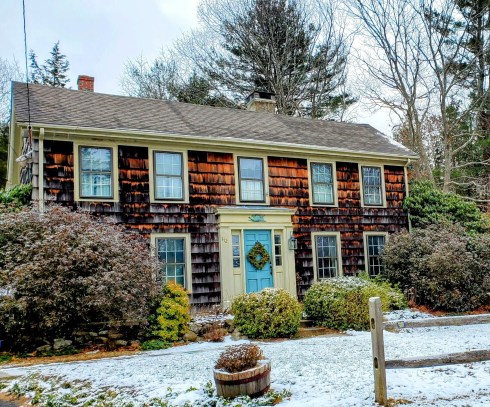
Along Concord Street, West Gloucester.

Then I drove miles to downtown Gloucester, overlooking its expansive harbor. This is the most densely-settled area of the city, obviously, and also where you can find the most architectural variety. It’s also where the Cape Ann Museum (CAM) is, a museum of art and history which also owns and operates several house museums. Of course I’m jealous that Gloucester has a professional local museum, but CAM’s existence is just one of several indicators that Gloucester is serious about preserving and interpreting its heritage, material and textual: I also like the way older houses are interwoven with newer, professional and institutional structures in the city center. The first house below, on Middle Street, is wedged between a bank and some other professional office building, and has lots of Georgian neighbors.

Along Middle Street, Gloucester.

On the way to the Green, where CAM owns and operates two historic houses, I passed by this first cute and very characteristic of Gloucester house and one of the city’s oldest houses, the Whittemore House (1700), now a frame shop. The Green, situated right on Gloucester’s traffic rotary on Route 128, features three historic structures (the White Ellery House, 1710 and the Babson-Alling House, 1740 are below) and CAM’s newest exhibition space, the Janet & William Ellery James Center (2020), which has expanded the museum’s exhibition and archival space signficantly.

I hopped right on the rotary and drove to East Gloucester, which was a pass-through for me as I didn’t have my sources! So I did the Cape Ann loop, enjoying the views and driving through Rockport, and ended up in Lanesville and Annisquam on Gloucester’s northern shore. As you can tell from these photographs, it was a cloudy, dreary day (as has been the case for most of January in our parts) and so I had to snap this bright orange cottage in Lanesville and then it was on to Annisquam, which is really almost too precious and perfect (and with too many “private drives”!) but I had to see the Edward Harraden House (c. 1660)—one of several structures built by this family in Gloucester. It’s a storied name in Salem too as Jonathan Harraden was one of our most famous revolutionary privateers. It did not disappoint.

Eighteenth-century houses in the Lanesville (ORANGE!) and Annisquam villages of Gloucester, and the Edward Harraden House, c. 1660.