Tag Archives: Graphic Design

Limning the Local

I’ve engaged in lots of different history here: a lot of public, some world, American and European, but above all, local. I’m always looking for new ways to delve into and present local history. I follow the sources, I chase down new perspectives and approaches whenever I catch a trail, and because I’m operating in a digital world, I always look for striking visuals. All of these avenues have somehow brought me to a somewhat obscure graphic artist who centered much of his life on living in, working in, and  illuminating the backwoods Maine lumber town of Weld, Maine, a man named Seaverns W. Hilton who often signed his work S.W. Hilton. Hilton was born in Rhode Island and worked as a graphic artist (he is generally referred to as a poster artist) in New York City, but by the 1930s and his 30s he was in Weld, a Franklin County town whose population had shrunk precipitously as it lost its lumber trail. He diversified his artistic training into wood carving as a means of reviving and perhaps becoming part of his chosen community, but continued to illustrate on paper as well—mostly local history texts, and this is how I found him. I became a bit preoccupied by Benedict Arnold’s disastrous Quebec Expedition of 1775 after attending some commemorative events in Newburyport a few weeks ago, and found a little treatise with that perfect mod/mid-century aesthetic by none other than S.W. Hilton. And then I caught his trail.

It’s just great! I mean, this was quite the adventure (disaster) and you need the pictures. I tried reading some academic texts, but I think I learned more from Mr. Hilton. He illustrated books about the neighboring towns of Livermore and Rumford, as well as the famous Mount Zircon Moon Tide Spring in the latter. The Bethel Historical Society has an online exhibition on this venerable mineral spring, comparable to Poland Spring, featuring Hilton’s illustrations fromThe Mount Zircon Moon Tide Spring: An Illustrated History by Randall H. Bennett. These inland Maine cities and towns have interesting histories, as highlighted by Hilton and the authors for whom he illustrated, but they are not as well known as the Downeast ports on the coast with their more dramatic maritime narratives, so I appreciate Hilton’s creative spin. The title page of Josiah Volunteered, featuring the Civil War diary of a Maine soldier, also illustrates the Hilton treatment: it was published in the year he died, 1977. Looking at Hilton in a somewhat wider frame, he seems to have had success working in advertising in New York City (his copy work is  scarce but has fetched high prices in recent auctions), and became increasingly entangled in Maine from the later 1930s, primarily through the woodworking shop he founded, Woodworkers of Weld, which produced toys and figurines into the 1950s. Some of his creations garnered a national spotlight when an adjoining restaurant adorned with them, The Farmer’s Wife, was featured in Life magazine in 1937, and postcards followed. In this and all of his work, there’s an obvious whimsy in his depictions of past and present, and I think that’s what I appreciate the most, especially now.

Opening Day of the Mount Zircon Spring, from The Mount Zircon Moon Tide Spring: An Illustrated History by Randall H. Bennett.

Hilton posters for the Northern Pacific from the 1920s: Swann Auction Galleries and David Pollack Vintage Posters.

A wonderful 3 part series about Weld and Hilton starts here: https://luannyetter.wordpress.com/2021/04/09/the-shop-land-part-i/


Words or Pictures or Numbers?

This post is about the work of a venerable but new-to-me graphic designer, Seymour Chwast, but before I get to him I have to explain how I got to him. If you have been reading the blog over the past year or so, you might have perceived that I have become mildly obsessed with two images associated with Salem: the official Salem City Seal with its Sumatran trader, now likely on its way out after 180 years or so, and more recently a cartoon cat mascot chosen by the Mayor of Salem and the Salem 400+ Committee to represent our city’s “unique identity” for our upcoming Quadricentennial. The discussion, and in the latter case lack thereof, over both images has been perplexing. I’ve written quite a bit about the seal, and was going to write more about the mascot, but I now realize that such efforts are a waste of time. These images, deemed rascist or representative or not, will stand or fall according to the whims of five or six or maybe 20 people at best. That’s how Salem works: the average person has very little power over matters of civic identity or branding (or anything else for that matter.) Nevertheless, it’s been so interesting exploring the power of images over the past year or so in various ways. As a Renaissance historian, I’ve always been aware of the complexity of images, but if you want to consider their power in the present, that brings you into the realm of graphic design, and so that brought me to Seymour Chwast, briefly. And then he popped into my consciousness again just last week when I was searching for an image of the Battle of Sluys for a powerpoint lecture on the Hundred Years War. The search led to a compelling image of a medieval naval battle which was not Sluys but rather Chwast’s depiction of the Battle of Zonchio in 1499, fought between Venice and the Ottoman Empire. This is just one of nine hand-colored linocut battle scenes, paired with literary quotes on the opposing page, included in Chwast’s 1957 folio A Book of Battles. 

Chwast is in his 90s and still working, I think: his career is too prolific and illustrious to summarize here but I will take a stab. Over six decades he has published all sorts of images and illustrations, individually and on behalf of the Push Pin Studios (now Group) the graphic design firm he co-founded in the 1954. From magazine covers to posters to corporate advertising to packaging to theatrical backdrops to his own publications: he has done it all. Chwast is the author of 30 childrens’s books and four graphic novels, and he is also a typeface designer! Chwast’s career is marked by his intent and ability to utilize design as a political force on many occasions, and one theme seems to run through much of his editorial work from the beginning: pacifism. This was certainly the inspiration for his Book of Battles, as the juxtapositions of images and words make clear.

And then, in 2017, a capstone (or maybe not yet) anti-war book, At War with War: 5000 Years of Conquests, Invasions, and Terrorist Attacks. An Illustrated Timeline. More striking graphics and literary excerpts, but a timeline too, which means numbers. The (red) numbers somehow make the illustrations all the more menacing, especially as we proceed into the (modern?) information age in which casualties can be marked along with dates. It all packs a powerful punch.


A Bewitching Bicentennial Book

Salem has been a tourist city for more than a century, so there has been a succession of guide books spotlighting the city’s landmarks and attractions from their particular chronological perspectives. I think I’ve referenced every guide book here, with the exception of the one I am featuring today: The Illustrated Salem Guide Book. Beyond Witch City, published for the Bicentennial in 1976. If you read all the Salem guides in chronological order, two themes are readily apparent: the increasing commodification of history and creeping witches crowding everything else out. The bicentennial book is an exception to both of these trends: it’s a breath of fresh air, guiding its readers to a more cohesive Salem 1976 rather than just downtown “attractions,” and its “Beyond Witch City” subtitle is accurate. It has wonderful illustrations and writing: the efforts of my neighbor Racket Shreve, a well-known maritime artist, and Robert Murray, respectively. It’s just a very special little book: I really love it. It actually makes me nostalgic for a city I never lived in!

One of the key differences between The Illustrated Salem Guide Book and its predecessors and successors is that it was published by the Salem Bicentennial Commission rather than a tourist agency. So the focus is much more on hospitality and non-profit attractions than salesmanship. As you can see above, it proudly bore the (competition-winning) Bicentennial logo as well as a Samuel McIntire swag on its back cover. Inside, we read that “This Guide Book is intended both as a portrait of Salem—an evocation of Salem, old and new, as well as a practical directory for How, What, Where and When.” The combination of aims makes for a thoughtful and accessible book; in its own words, “practical and irreverent.” This book was only one of Salem’s Bicentennial projects: the Commission also organized Visitor Hospitality Centers (in all of Salem’s churches—staffed by volunteers), the development of Fort Lee & Fort Pickering as natural preserves (1976 must have been the last time anyone paid attention to these sites), work on a Salem bikeway, the reconstruction of Samuel McIntire’s Washington Arch (recently restored), “Operation Sail” focused on the waterfront, and several Salem Symposiums “examining Salem’s Past, Present and Future.” This was a very ambitious and engaging agenda. It’s the evocative mission that I’m the most interested in, and while that quality is probably best illustrated by Racket’s illustrations, Robert Murray’s writing is also essential towards realizing this aim: On Oliver Street, an old clockface, empty of hands, hangs on the coach house behind No. 31, its gold numerals luminous at Noon. Attached to the rear of No. 5, two identical carvied friezes, attached side by side upon a stable wall: a touch of Federal surrealism. Beneath the friezes, a sign: Beware of Dog. Murray is particularly good on the history of Salem’s churches: I learned quite a bit. Racket provides some great illustrations of these buildings, and then they both take us all around Salem–not just to the “pretty” spots.

There’s a lot of Salem pride in this book. I was really happy to see a sentiment that I discovered when I was writing about urban renewal for our forthcoming book: an assertion that Salem had “triumphed” over urban renewal, and transformed all those Federal dollars into an initiative that actually focused on renewal rather than destruction. Murray emphasizes  the “imaginative” choice by the Salem Redevelopment Authority to substitute historic renovation for demolition. Salem has won national recognition for its adaptation of its old glories for its modern needs. This is true, and not appreciated sufficiently. Present-day witch-pitching people spin the story that witchcraft tourism “saved” Salem, but I don’t know, 1976 Salem looks pretty dynamic: all of the Essex Institute houses are open, as is its Phillips Library, there’s an ongoing archaelogical dig at the Narbonne House, “a group of rusty oil tanks huddle together aware that they are disliked and soon to be removed” for Pickering Wharf, Pioneer Village is deemed “an excellent place to begin a study of the evolution of the American home.” There were lots of restaurants: Red’s Sandwich Shop, the Lyceum, the Beef & Oyster House, In a Pig’s Eye, Strombergs, the Gutenberg Press Restaurant & Pub, and more—and if you had a party of six you could have dinner at the Daniel’s House: just phone Mrs. Gill and byob.

This little book succeeds in capturing Salem’s past and present from a 1976 perspective: it is not characterized by sickening sentimentality or boosterism. Salem emerges as a city shaped by its past and being shaped by its present. I wish its author and illustrator would create a Salem guide book now (for the 400th anniversary!), because I think it would be very interesting.

What was lost and what remains—the cement slide at Forest River Park! Below, the guide’s map and Racket’s Hamilton Hall Antique Show (a benefit for the then-Peabody Museum of Salem) covers.


Selling Seeds

A rather fluffy post on seed packets for this week: it’s grading time! This combination of gardening + paper, two of my favorite things, is irresistable to me at all times, but I have also noticed a trend over the last decade or so. I was thinking about my 2007 wedding the other day, as our anniversary coming up at the end of the month. The reception was held outside under a fairytale tent at the House of the Seven Gables, and so there was not much decoration, just some beautiful simple arrangements to complement the colonial revival garden. With that theme in mind, I made my own seed packets with custom labels for favors, as it was next to impossible to find decorative packets at the time. Now there are many sources for packets with striking graphics, with or without seeds! I seldom sow seeds, but whenever I have, I’ve always purchased the most decorative packets I could find: Renee’s Garden Seeds and Monticello were my go-to purveyors, and the Hudson Valley Seed Company, which has always had the most creative packets. These are still great sources, but there seem to be many more now; this particular post was inspired by some gorgeous packets designed for the Italian seed company Piccolo by the London-based studio Here Design. These packets look like little Penguin books, another obsession of mine! Once I saw them, I knew I was not up to date in the dynamic development of seed packets, so I dug in and looked for more.

Hudson Valley Seed Co. and Monticello seed packets; Piccolo packets by Here Design, London; Floret’s Flower Farm Seeds by illustrator Nina Sajeske, with design by Nicole A. Yang; Row 7 vegetable seeds; Baker Creek Heirloom Seeds; Lesley Goren’s packets for Artemesia Nursery in California; Anellabees Pollinator Seed Blends at Terrain; Kew Gardens seed packets, which are beautiful but unfortunately not available in the US.

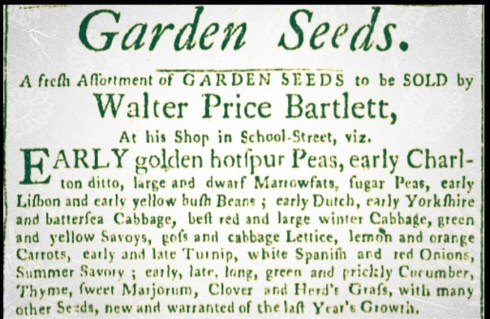
Going back a bit: because of course I’ve got to delve into the history of the seed packet, which seems to be an eighteenth-century innovation here in the United States. It is tied to, and illustrative of, the emergence and development of a commercial retail market for gardening supplies. Usually the D. Landreth Seed Company, founded in 1784 in Philadelphia by brothers David and Cuthbert Landreth and still very much in business, is given credit for the first seed packets, but a few years ago some packets were found in the eaves of the eighteenth-century Woodlands Mansion just up the river from the famous Bartram’s Garden in Philadelphia (clearly a horticultural nexus): whether they were for storage or sale is unclear. There were several seed shops in Salem in the mid and later 18th century, like Mr. Bartlett’s below, but I have no idea how they sold their seeds: perhaps people just came in and grabbed a handful? In any case, moving forward into the nineteenth century, there is no doubt that the entrepreneurial Shaker colonies were pioneers in the mail-order seed trade, to which many plain “papers,” or packets testify.

Essex Gazette 27 April 1773; Shaker, Landreth & Woodlands seed packets.


Decorating the “Little Room”

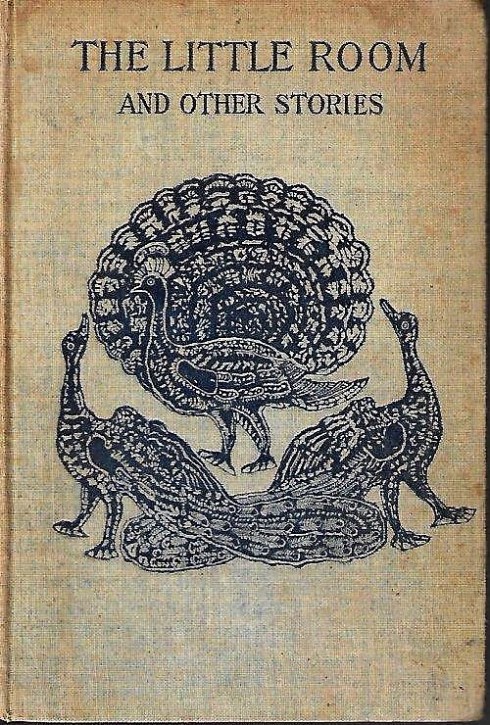
Happy June! I’m going to transition into a summer of lighter fare here: houses, gardens, non-academic books, events with people! In my contrary fashion, I’m going to start this transition with a spooky short story: one of the spookiest and shortest stories I’ve ever read. Madeline Yale Wynne’s “The Little Room” was first published in the August 1895 issue of Harper’s Magazine and then in The Little Room and Other Stories (1906). It’s a story about memories and perceptions, with a lot of ambiguity balanced by (in contrary fashion) very precise details, material details.

I’ll let you read it for yourself (it’s right here), but the basic problem is whether a certain space in an old Vermont farmhouse inhabited by two old maids was in fact a china cupboard or a “little room” complete with a green Dutch door exiting to the outside and a couch “covered with blue chintz—Indian chintz—some that had been brought over by an old Salem sea-captain as a ‘venture'” and given to one of the ladies when she was at school in Salem (yes, there is always a Salem connection). This chintz was described in more detail by those who saw the little room, and not the cupboard: it was “the regular blue stamped chintz, with the peacock figure on it. The head and body of the bird were in profile, while the tail was full front view behind it.” There were also hanging shelves with leather-bound books in the room, from which one bright red volume stood out, titled the Ladies’ Album, which “made a bright break between the other thicker books.” On the lowest shelf was a pink seashell, “lying on a mat of made of balls of red shaded worsted.” Not just a mat: a mat made of balls of red shaded worsted! Can we have any doubt that such a room, such a couch, such a shell, such a mat existed? Yes, we can. The room also contained several bright brass objects, a braided rag rug, and was wallpapered with “a beautiful flowered paper—roses and morning glories in a wreath on light blue ground.” How can this room not have existed? Wynne ensures that we will never know whether it did or not, but at least it can exist in some digital form with a bit of foraging and filtering.

The green Dutch door:

On the walls: I couldn’t find the wallpaper so precisely described by Wynne so I altered the color a bit from a 1960s floral paper on Etsy (which is the best place to find vintage wallpaper) and a watercolor possibly by John Hancock from the Carnegie Museum of Art (this is a lovely painting and I’ve really mucked it up with my filtering so make sure you see the original).

On the Settee: this first fabric looks very “stamped” but it’s really going to clash with my wallpaper, the second is softer but would still make for a very vibrant room!

On the Shelves: Wynne refers to hanging shelves very particularly, not a bookcase. I think of hanging shelves as more contemporary, but there are examples from the 18th and 19th century: the shelves below look appropriate to me, although with everything on them I think they would have to be bigger. These Waverly novels look weighty, but you can see how a slim red Ladies’ Album might pop out: perhaps it was Ladies Home Journal (which used red extravagantly) rather than Ladies Album? I’ve got lots of brass objects for this digital shelf/room (although maybe I should have polished them), and I stole the ultimate shell from my husband’s study. No mat though: I looked far and wide for a mat made of balls of shaded red worsted with no success, so the shell is sitting on a throw (but I used a “faded” filter). And finally, an amazing braided rag rug, which (hopefully) will pull this very interesting room together.

So that’s my “little room,” which was fun to put together. While this little story of a little room is an amusing diversion, it’s really not just about material stuff: it’s about the truth, and that awful scenario when two people, or three or four, or more, cannot decide or agree on what the truth is. This little story is a lot more timely now than when I first read it, maybe twenty years ago: then I think we all knew what the truth was.


My Favorite Penguins

Happy New Year! And my very best wishes to all for a better year than last! I’m a little bleary-eyed, having worked very hard over the holidays on grading and my forthcoming book, which is due at the publisher on March 1. And I’ve got to prep for next semester, which will include a brand new course on English legal history of all topics (yawn: a requirement for our department’s pre-legal concentration). So my posts are going to be a bit sporadic over the next few months but I did want to ring in the New Year with a post and give you all the heads up. Even after ten years, there’s still quite a few Salem topics I want to take on, and I’m hoping, like many of you I am sure, to travel at some point in 2021 so I should have some interesting posts after my big delivery date!

Normally I’m all about books on the blog this time of year: end-of-year best booklists, books I’m looking forward to reading, books for my courses. I’m so focused on my own book this year that I can’t really think about other people’s books during this particular January, except for very specialized academic books which I must include in my bibliography. Books for me are not just things to read however, they are objects which I like to have around, to dip into and just to look at. I love everything about book-objects: fonts, paper, cover design, illustrations, formats, colors. And my favorite books of all are Penguins: plain old orange-and-white paperbacks with yellowed pages and very pretty clothbound classics of more recent vintage and everything in between. I have evolving favorite series, and when I’m focused on a particular series I want to collect every volume possible: a couple years ago it was mid-century King Penguins and I remain very fond of them. People have given me gifts so I have quite a few now: I received “Compliments of the Season” this very Christmas.

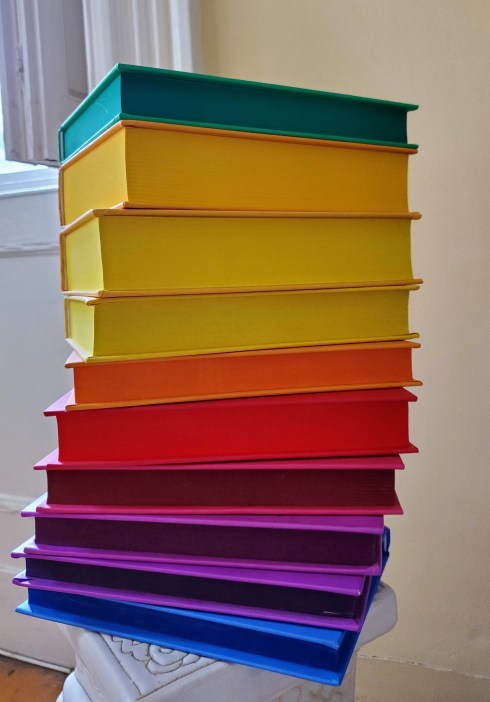
My most recent Penguin obsession, however, is the Drop Caps series, a colorful collection of twenty-six classic hardbound books designed by Jessica Hische, lettering artist extraordinaire. I saw one in a bookshop this summer and suddenly had to have all of them, and I have collected quite a few in the past six months or so. They are very object-like: you can shelve them and stack them in all sorts of interesting combinations. This makes them the perfect Penguins for me now, as I don’t actually have time to read them. But I will soon.


The Mayflower Magazine

Happy Thanksgiving! Those of you who have followed the blog for a while know that I’m a big fan of graphic design and typography, especially from the earlier part of the last century. I love fonts from the entire era of print actually, and script as well now that I think about it, and paper: so when it all comes together in an integrated design, I’m pretty impressed. It’s been such a weighty few months, with the pandemic, and the election, and hours and hours of writing for me everyday: I think I’m going to get a bit lighter for the next month or so, to lift my spirits and yours! I’m beginning with this very festive magazine/catalogue from the late nineteenth and early 20th centuries, titled The Mayflower. It has nothing to do with the ship Mayflower, or Plymouth, or the Pilgrims: it’s all about flowers—and the most robust lettering and chromolithography I have ever seen.

The covers might be somewhat sedate (except for this last one above), but as soon as you delve inside: wow! color—so vibrant you need sunglasses. The magazine was an advertisement for the big botanical business of John Lewis Childs, one of several garden entrepreneurs of this era and the first to establish a mail-order seed business. He created an entire town on Long Island named for his product: Floral Park. The Mayflower was published from 1885 to 1906, offering gardening tips and seed packets to an international audience as well as 2 or 3 colored plates in each issue. Childs also issued seasonal seed catalogs with the same combination of flourishing lettering and vibrant plates of perfect plants, or perhaps I should say too-perfect plants.

The Mayflower magazine covers from Magazineart.org (a great website!); many more Childs seed catalogs at the Smithsonian.


Hildegarde’s Gardening Book

The granddaughter of Nathaniel Hawthorne, Hildegarde Hawthorne (Oskinson) followed in the family business and published a wide variety of works over her lifetime (1871-1952), including children’s books, travel books, poetry, and biographies. I posted previously on one of her “rambles” books, Old Seaports of New England, because it features Salem prominently, but it is not my favorite of her titles: that preference is her garden book, The Lure of the Garden (1911). Gardening books by society ladies such as Hildegarde are a dime a dozen in this era, but The Lure of the Garden is different: it’s not a practical tome or simply an appreciation of the botanical beauty, but rather a series of essays on different cultural aspects of the garden, in her time and over time: from “Our Grandmother’s Garden” to “Childhood in the Garden” to “The Social Side of Gardens” to “Gardens in Literature”. It’s beautifully written (I think shorter-form essays are her strong suit) and beautifully illustrated, by Maxfield Parrish, Jules Guérin, Sigismond de Ivanowski, Anna Whelan Betts, and others, with plates in both color and black and white, paintings, drawings, and photographs. Throughout the book, the theme of the garden as a private refuge and true reflection of one’s inner self emerges, both very literally in considerations of enclosure and garden gates as well as through textual and visual illustration, as she shows off her connections and takes us into the “Gardens of Well-Known People” such as Parrish, Augustus Saint-Gaudens, Cecilia Beaux, Edith Wharton, and Stephen Parrish. For all this (and because I am dealing with the menace of powdery mildew right now), I think my favorite chapter is “Some Garden Vices”, in which the garden is portrayed as an autonomous entity, showering “pity and love to its ugliest weed” to a touching though infuriating extent: it will spare no pains to convey to this voracious plant all the delicately prepared food destined for your lilies or your phlox, will discover the utmost art in draining its water toward the thick roots of its favorite, give it sun and shadow, sweat and labor for it. If you snatch the hateful progeny from its arms, leave only the slightest portion of root behind, that patient, devoted garden will nurse the battered and wounded thing back again to life and health, to flaunt triumphantly in bed and border. As this is Hildegarde’s extravagant prose in reference to weeds, you can imagine her descriptions of more covetous cultivations.

Lure of the Garden Cover

Lure 21

Lure 18

Lure 8

Lure 17

Lure 16

Lure 15

Lure 14

Lure 13

Lure 12

Lure 11

Lure 6

Lure 9

Lure 10

Lure 1

Hildegarde Hawthorne’s The Lure of the Garden is available here.


Striking Fourths

No heavy lifting/posting for me this week, although I did want to offer up something celebratory for the Fourth, so I went through some of my digital files and favorite pictorial resources (MagazineArt.org and the Magazine Rack at the Internet Archive) to come up with a portfolio of July covers from the “Golden Age” of American illustration. It’s interesting to me how different types of magazines use patriotic themes and tropes to fashion images for their particular audiences: just the colors and perhaps a few artfully-placed stars and stripes can be evocative of the holiday without adding Uncle Sam and George Washington. For the most part, I’ve avoided the very literal in favor of the suggestive, although I can’t resist some of the “playing with fire” images which are pretty striking before World War One: the Comfort lady below looks quite uncomfortable, and like she is quite literally blowing off her hand with firecrackers, but the Puck lady seems quite happy to be ablaze. Some of the most illustrative Fourth of July images from this era can be found in children’s magazines (Harper’s Round Table and John Martin’s Book), but women’s and shelter magazines also signaled the holiday in style.

Fourth Harpers Roundtable Maxfield Parrish 1895

Fourth Lippincotts July 1896

Playing with Fire Collage

Fourth Puck 1902

Fourth John Martin_s Book 1920-07

Fourth Harpers Bazaar 1930

Fourth Delineator 1930-07

Fourth Dance 1931-07


Fourth House Beautiful 1933

Fourth House Beautiful 1934

Fourth WomansHomeCompanion1937-07

July magazine covers 1896-1937: from the Digital Commonwealth (Harper’s Round Table), the Library of Congress (Lippincott’s and Puck), CuriousBookShop@Etsy (House Beautiful , 1933) and the great site MagazineArt.org.


“Salem” Houses, 20th-century Style

There are two deep rabbit holes around which I must tread very, very carefully, or hours will be lost instantly: the Biodiversity Heritage and Building Technology Heritage digital libraries housed at the Internet Archive. One leads me through a never-ending cascade of flora and fauna; the other through the built environment–or prospective built environment, I should say, as many of its sources are building plans and catalogs. Just yesterday, when it started to snow and afternoon classes were cancelled, I thought to myself, let me just pop in there and see if I can find some inspiration for interior shutter knobs, and hours later I emerged with no knobs but lots of images of “Salem houses” instead. So here they are in chronological order: you will no doubt conclude, as I did, that “Salem” style loses its meaning over the twentieth century: the last house is from 1963, and it is difficult to see how it was inspired by Salem. Well, now that I’m looking at them altogether, it’s difficult to see how Salem was inspirational at all, except perhaps for a brief spell in the 1930s. House parts stick to their Salem inspiration, as there are plenty of mid-century “colonial” mantels, doors, and windows inspired by the craftsmen of “Old Salem”, but houses seem to break free of any connection to classical Salem influences: just look at the 1949 “Sam’l McIntire”! The concept of Salem seems to retain some currency throughout the century, but what it really means in terms of design or construction is anyone’s guess.


Salem Houses Herbert C. Chivers 1903 (2)

Salem Houses Aladdin 1915

Salem Houses 1915 collage

Salem Houses 1929 PicMonkey Image

Salem Houses 1933 PicMonkey Image

Salem Colonial 1933

Salem Houses 1936 Sears

Salem Houses Sears 2

Sam McIntire 1949

Salem Houses 1954

Salem Houses Collier-Barnett Co._0029 1963

“Salem Cottage” from St. Louis architect Herbert Chivers’ Artistic Homes, 1903; Aladdin Houses, 1915; the first “Readi-cut” Salem model, 1915; a “bungalow with the pleasing lines of the Colonial type” in The Book of 100 Homes, 1929; the reproduction “Pequot House” was included in the Ladies Home Journal House Pattern Catalogue of 1933, the same year that “a Salem Colonial” was published in Samuel Glaser’s Designs for 60 small homes from $2,000 to $10,000 : showing how to build, buy and finance a small home; two Sears “Salem” houses from 1936 and 1940; The “Sam’l McIntire” from the Warm Morning Small Homes plan book for 1949; Bennett Homes, 1954; a Salem “rambler” from There’s a Miles Home in your Future” book from the Collier-Barnett Co., 1963.