Tag Archives: Food and drink

Finishing my 2025 Books

I’m still working on the fall version of my 2025 reading list even as the year draws to a close. I certainly won’t finish it by the end of the year, but I have a LONG break ahead of me as I have a sabbatical for the spring semester! Lots of great books coming out next year (including my own) so I better get going. Next week, I’ll post about Salem’s Centuries as its publication date is January 6 (hoping to change the vibe for that particular date). This is a really good working list of books that I have read, am currently reading (I tend to read books concurrently) and plan to read pretty soon, all of which were published in 2025. In fact the last book is due to be published tomorrow, so I don’t have it in my possession but I pre-ordered it. As usual, this is a nonfiction list; I just don’t read very much fiction so I can’t offer up any kind of a guide to those genres. I read history, history of science, art history, the history of food and drink, folklore, and books about various types of design and architecture. That’s pretty much it. Maybe a bit of politics and popular culture—and media, but the vast number of titles for fiction and self-help books appearing every year seldom catch my attention. So here goes, beginning with books in my period that I felt that I had to read but were nevertheless quite good.

I thought Borman’s book was going to be just a narrative of Elizabeth’s declining years, death, and the succession of James I and VI, and it was that, but it was more too—I learned lots of little things I did not know about these years. Borman is more than a television presenter, clearly: this is a very source-based history, with particular reliance on new revelations about William Camden’s Annales. Just further complexities relating to James for me! I think I have a book on him on many of my book lists here, and as 2025 was the 500th anniversay of his death I had to have one more: Clare Jackson’s Mirror of Great Britian is amazing, one of the best royal biographies I’ve ever read, and that is saying something as James was complex: earnestly Protestant but also a pursuer of pleasure, well-educated but also a true believer in demonic witchcraft, the only contemporary critic of tobacco, the first King of Great Britain. He’s a lot, and Jackson handles both the man and his era really well. Getting away from royalty and this specific era, two other British books which I am kind of reading together, gradually (they are both what I think of as “dipping” books in that you can pick up and dip into them wherever and whenever you like) are all about food and folklore—both just completely entertaining and informative at the same time.

I like to read books that are sweeping in terms of their topics, sweeping over the centuries: a change from most of the academic reading I do which is much more constrained in terms of both topic and time. The very popular genre that I call “commodity history” often includes sweeping titles, but as its title asserts, Jordan Smith’s The Invention of Rum is more narrowly focused on the invention of this “perfect” Atlantic spirit. Another “invention” book (though I really don’t think “design” was invented in the twentieth century but that’s why I want to read The Invention of Design) covers only the twentieth century. A really fascinating book blending history, magic and medicine (one of my favorite combinations), Decoding the Hand covers more ground.


I have my natural, constant interests, but if I’m looking for something new to read the first place I go is to the website Five Books, at which experts recommend five books in their areas of expertise and lots of lists to inspire a wider range of reading. I love this site! One great book that I never would have found on my own came from here: Sara Lodge’s Mysterious Case of the Victorian Female Detective, which was on the shortlist for this year’s Wolfson History Prize, awarded annual for both well-researched and accessible (enjoyable!) history writing. This book was definitely both, and a case study in utilizing historical and literary sources.

Finally, three books of a more timely/political nature. The medievalist Patrick Boucheron has written a great book about Political Fictions over time, I am searching for some explanations for/relief from the NOISE that assaults Salem all year long so I purchased Chris Berdick’s well-reviewed Clamor (though I’m sure he will take on all the sirens and jackhammers but not the tour guides), and I think we should always remember January 6 (for more than the publication of Salem’s Centuries) so I’m going to read Nora Neus’s oral history on that day.


Christmas Tipples

I was researching the enforcement of the famous (or infamous) 1659 Massachusetts statutory “ban” on Christmas in the records of the Essex County quarterly courts the other day and soon realized that no one got fined for “keeping Christmas” but rather for excessive “tippling” on Christmas. I think if you kept Christmas quietly at home you were fine, but if you or your guests became “distempered with drink” you were not. Of course this was not the time of the excessive decorating that we indulge in now, so who knew if you thinking or praying: just don’t celebrate! In 1662, William Hoar was presented to the Court for “suffering tippling in his house by those who came to keep Christmas there” and he didn’t even indulge himself. The famous “Salem Wassail” of 1679 involved an elderly couple being held hostage by four young men who wanted to “drink perry and be merry”: when no perry (pear cider) was offered up, the men attacked the house for  a considerable length of time. Another rowdy Christmas occurred in 1671, with some serious drinking occurred at the tavern of John Hathorne, Nathaniel Hawthorne’s great great great uncle and the little brother of his far more respectable (and intolerant) great great great grandfather William. John’s ordinary already had a reputation for disorderly drinking, but on that Christmas night, witnesses swore that Joseph Collins drank seventeen quarts of rum and his wife Sarah had to be carried to her bed.

That’s a LOT of rum–whether the Collinses drank it or not (they later sued Hathorne for slander). I associate rum more with the eighteenth and early nineteenth centuries so this Christmas indulgence surprised me, and immediately turned my attention to what people drank at Christmas in the seventeenth century—and later. Perry and various ciders, definitely. Beer was an everyday drink but maybe more celebratory when you turn it into something else—like lambswool, the favorite Wassail drink of Tudor and Stuart England, in which old strong ale was heated and spiced up and topped with a frothy puree of roasted apples. Did lambswool make it over here? According to Gregg Smith, author of the (I think definitive) Beer in America: the Early Years, it did, and it was called jingle. What could be more Christmassy than that?

John Worlidge, Vinetum Britannicum, or a Treatise of Cider and Other Wines and Drinks, 1676.

Nothing is more celebratory than punch and the eighteenth century seems like the Century of Punch and Revolution to me.  Punches were made and drank in the seventeenth century in England, and really caught on commercially with the emergence of special “punch houses” like that of James Ashley, but they took off in the Colonies too. So many American punches: the famous Fish House Punch of Philadelphia, Ben Franklin’s Milk Punch, Martha Washington’s Punch, the lethal Chatham Artillery Punch served to President Washington when he visited Savannah according to lore and legend. I just know that there was an “Old Salem Punch,” I’ve seen it referenced several times, but have never found the recipe. Nevertheless, Salem merchants in all trades reference punch consistently: fruit traders, dealers in silver and glass wares who offered up punch bowls, ladles, and cups, and of course spice purveyors. Citrus fruits were definitely advertised more as “souring” for punch than health benefits in the eighteenth and early nineteenth centuries! Though punch could be served cold or hot, the always hot flip, standard tavern fare by all accounts, seems to have been a predecessor of both eggnog and hot buttered rum. I can’t imagine a more suitable drink for the Christmas season, and am surprised it hasn’t been revived.

James Ashley’s Trade Card (c. 1740) © The Trustees of the British Museum

The nineteenth century always brings more, and more variety, of everything. I’m sure this was the case with holiday beverages as well, though most purveyors seem to advertise generic “wines, spirits and cordials” for Christmas from the 1830s so I’m not sure exactly what is being consumed. Salem did have six rum distilleries selling that spirit regionally in the first half of the nineteenth century, so I’m sure it was plentiful at Christmas and throughout the year. The first bartender’s guide, Jerry “The Professor” Thomas’s The Bar-tenders’ Guide: A Complete Cyclopaedia of Plain and Fancy Drinks (1862), is very specific about holiday libations, however. There are toddys and slings, and six recipes for the very American egg nog, including one that is served hot, as well as a British nog variation called “Tom and Jerry” which would become very popular stateside after this publication. And at the very end of the century, “Old Salem Punch” appears, in bottled form—from no less than S.S. Pierce.

The twentieth century seems like the century of adulteration for punch, which remained a favorite Christmas tipple. Not only was it bottled for sale, many more ingredients were added, so much so that it became more of a catch-all than a specific beverage. There were terrible “prohibition punches” during the 1920s, made with no alcohol at all or the literally lethal “wood alcohol”. After prohibition, Christmas punches had to be either red or sparkling, sometimes both: the red was the result of the addition of cranberry juice at best (and red food dye at worst) and the sparkling came from champagne and/or ginger ale. Fruit was added, not for “souring” but just because. Tom and Jerry was really popular in the first half of the century, then disappeared. Eggnog remained popular and was increasingly packaged as well: when you run into the real stuff, made at home, it’s quite something. One of my favorite Salem Christmas memories is of a lovely Christmas Eve party held every year by a wonderful older couple who lived in a Federal house on Essex Street. In the dining room was a huge silver punch (eggnog?) bowl filled to the brim with very frothy homeade eggnog, and everyone was always clustered around it ooohing and aaahing….and drinking! Not me: I really really wanted to, but I am a complete egg-phobic person, so it really says something that I was in such close proximity and even thinking about drinking this nectar. But one year I brought my father, and all I remember is him just standing by that bowl downing cup after cup. He wasn’t even social, which is unusual for him. I may be embellishing this a bit, but that’s my memory, and I’m happy to have it. Cheers!

The punch (eggnog) bowl of my memory, although it could be wrong.  A Christmas memory prompted by a punch bowl from Oliver Wendell Holmes: “This ancient silver bowl of mine—it tells of good old times, of joyous days, and jolly nights, and merry Christmas chimes.”


Massachusetts Menus

I had a more substantive post planned for this week but I took a little detour and so here I am with menus. I started to write about my experience as a tour guide at the Phillips House of Historic New England, as I’m in my second year and I thought it was time for some reflection. But in doing so, I became fixated on a moment during my tour (well during all of my colleagues’ tours, I’m sure, as it’s definitely a great device) when I show our guests a menu from July 1919 in order to interpret both the dining room and one of the ways in which the household worked. Everyone loves this menu: adults, children, southerners, northerners, midwesterners, westerners, visitors from other countries, Salem residents. There is one particular item on this menu that captures everyone’s attention without exception: Orange Fairy Fluff!

So I thought that before I delved into my reflective post about what I have learned as a tour guide, I should discover the origins of Orange Fairy Fluff, and this took me down a road of restaurant history marked by menus. And then I went down my own memory lane of menus, and so here we are with menus from storied Massachusetts restaurants. The restaurant most closely associated with Orange Fairy Fluff is the famous Toll House Inn in Whitman, Massachusetts, the birth place of chocolate chip cookies. I think the timing is a bit off, however, as the menu above is from 1919 and the Toll House didn’t open until the 1930s, but an earlier (1916) Sunkist cookbook published a recipe before the Toll House owner Ruth Wakefield’s popular “Tried and True” cookbook. The Toll House menu is a perfect example of the “mid-century Colonial” aesthetic I’m so fond of, as are those of its competitors in the 1940s and 1950s.

I’ve been to, or driven by, all of these restaurants, with the exception of the Adams House in Marblehead. I just like its menu and “shore dinners” evokes the restaurant of Salem Willows. I never went to the Towne Lyne House in Lynnfield, but it was a “landmark” on the drive along Route One to and from Boston from Maine, along with “The Ship” restaurant on the other side of the road. All menus above from the Culinary Institute of America’s Menu Collection.

I have very warm memories of Filene’s, in truth the Basement more than the restaurants, but I do like the map menu below—although it doesn’t have Salem on it! Seeing the House of the Seven Gables front and center on the 1940s menu mollified me a bit, as did a menu for St. Clairs Restaurant from Historic New England’s collections which also features the Gables prominently on the cover. I also have childhood and teenage memories of meals at Locke-Ober, the Union Oyster House, and Cafe Marliave in Boston—and the Parker House, of course. The last time I went there—maybe just before Covid?—-it was looking a bit dowdy so I was pleased to hear that it’s going through a big refresh this year. (I wonder if they will keep the worst portrait ever of Nathaniel Hawthorne?)

The CIA collection has a few menus from Salem restaurants, including one from the famous Moustakis “palace of sweets” on Essex Street.When I look at this menu, I think that Salem could use an ice cream parlor today, especially one which offered up Moxie floats (!!!) and College ices (???), but I am also aware that Moustakis was no mere ice cream parlor. A half-century after its founding, it functioned as important gathering place for Salem businessmen according to the 1956 sociological study Community Organization: Action and Inaction by Hunter Floyd:

Other prestige groups observed during the process of study now may be briefly mentioned. There is no athletic club in Salem, nor any downtown men’s club that can serve as a luncheon meeting place. There is, however, a loose tradition that has grown up for various businessmen to eat in a restaurant owned by a Greek named Moustakis. At a rear table of the restaurant, six or eight men can be seated comfortably at a time. During the lunch hour there is a tendency for some of the well-known merchants on “The Street,” as Essex or the main street is called, to gather at this table. As the lunch hour proceeds, professional men, lawyers, accountants, real estate men, and finally bankers may join the group or take the places of men who have finished eating. There is a shifting pattern of membership of this group, but through habit on the part of members, the key pattern is relatively stable. Not all men, by any means, who represent the commercial and professional interests of the community eat at Moustakis’. The restaurant is, however, recognized as a place where gossip is exchanged and an eye is kept on important happenings. Other restaurants serve a similar function, of course, but none are quite as well known as the Moustakis’ “clearing house.”

Menus from the Culinary Institute of America’s Menu Collection and Historic New England’s Collections Access.

And finally, menus from two very different Salem restaurants: the House of the Seven Gables Tea Room (squash pie!) and China Sails, which is still with us, in its original location on Loring Avenue near Vinnin Square. These China Sails menus look like they date from a bit later, and only the Salem location survives (though I don’t think Dave Wong is still in the picture).


What if the Tudors had Thanksgiving?

I’ve been teaching a first year seminar this semester on the Tudors and I’m not sure it’s been a successful class. These topical seminars are required for freshmen, and they are hybrid in nature: half topic, half introduction to college. I’m not good at melding the two halves together, and while I have a few Tudor fans in the course, there are clearly some students who just got stuck with this particular topic. Everyone is very polite, but you can tell when students are not really invested in a course. Anyway, I tried to wow them last week with a presentation on Tudor food, and several yawns indicated that I was not successful (it doesn’t help that this course is at 3:00 in the afternoon). I did quite a bit of research, however, so this topic has to do double duty as I am inflicting it on all of you! I’m hosting Thanksgiving this year as well, an unusual role for me, so I put two and two together and conjured up a Tudor feast with the help of Thomas Dawson, the author of The good huswifes jewell and The Second part of the good Hus-wifes jewell (1596-97).

“The Blessing” by Flemish artist Gordius Geldorp; my two favorite Tudor cookbooks by Thomas Dawson (I have these very convenient Nova Anglia Press editions but they have been digitized.)

Three staples of the American Thanksgiving meal were available in Tudor England: turkies, pumpkins, and potatoes. The first two could have ended up in a late November feast: there are recipes for turkey roasts and various pumpkin preserves and confits from the later sixteenth century. No mashed potatoes though: it will take Englishmen and -women a little longer to warm up to this particular “root.”  For those who could afford a diet consisting of more than pottage and bread, meat and fowl were far more popular than fruits or vegetables, so it follows that turkeys were embraced before pumpkins, which were perceived to be some sort of exotic melon. Apparently they were driven to the London markets, and in the 1570s Thomas Tusser included turkey in his “Christmas Husbandry Fare.” By that time, perhaps turkeys were too common for the courtly table, but as all the Tudor monarchs loved very showy feasts, they might have gone for a multi-bird roast, the early modern version of today’s turdrucken. I’ve seen references to five-bird roasts and more, in particular a pigeon inside a partridge inside a chicken inside a goose inside a turkey, often encased in pastry. Thomas Dawson provides a recipe “to bake a Turkie and take out his bones” which might be preliminary to a more extravagant engastration (new word for me!)

Pumpkins (called pumpions or pompions) were introduced into England about the same time as turkeys, and they have a similar crest of popularity: sought-after rarity to more humble fare. By the end of the sixteenth century they are included in texts about kitchen gardens and foods which can decrease famines. The Tudors did not see pumpkins as squash, because they didn’t have squash, so it was often identified as a melon (and occasionally a cucumber!) Dawson has a couple of pumpkin recipes: “to make a conserve of Mellons, or Pompions,” to sweeten them, and to make them into “confections,” so they could be on the holiday table in those forms, but not as a pie or tart: the first pumpkin pie recipe in England dates from the seventeenth century. If we’re going to have a Tudor fruit pie, I think it would be filled with peaches, pears, plums, quinces, damsons or even medlars, a forgotten autumnal fruit. A Tudor table would definitely have a savory pie too, or a sweet and savory and spicy pie like this veal variation from The good huswives handmaid (1597).

A conspicuous pumpkin in Sir Nathaniel Bacon’s Cookmaid with Still Life of Vegetables and Fruit, 1620s. Tate Museum: Dawson’s recipe for medlars in pastry, and two of Ivan Day’s beautiful pies with a recipe for Sweet Pies of Veal.

The Tudors did not embrace potatoes, so they would not be on either a courtly or husbandly table. I want to substitute mashed turnips or parsnips, but I don’t see any recipes, except for the occasional pudding. We always have creamed onions in my family, and that seems like a perfect Tudor dish, as they loved everything that was white and creamy—-but I could only find boiled onions. Stuffing is so Tudor: they stuffed (farsed) everything! There’s a perfect stuffing recipe in Dawson’s Second Part of the good Hus-wives jewell: “to farse all things.” Just take “a good handfull of tyme, Isope, Parselye, and three or foure yolkes of Egges hard rosted, and choppe them with hearbes small, then take white bread graited and raw eggs with sweet butter, a few small Raisons, or Barberies, seasoning it with Pepper, Cloves, Sinamon and Ginger, woorking it altogether as a paste, and the may you stuffe with it what you will.” There were no cranberries in England in the sixteenth century, but plenty of substitutes, whether you want a syrup (I would go for gooseberries) or the paste kind that comes out of can (Quince, of course!) And we call all wash it down with some Hippocras, a spiced wine “tonic” concoction named after the Father of Medicine.


What the Judge Ate

And drank. Today I have a new source (to me anyway) for food history: the diary of a Colonial judge who rode the circuit, keeping accounts of his tavern food and drink along the way. I’ve been immersed in Salem diaries for the past few weeks, preparing a talk I’ve giving for Salem Ancestry Days and the Pickering House on April 23. I’ve got diaries from the seventeenth century to the twentieth, and Judge Benjamin Lynde Sr.’s is one of the earliest. He’s an early transatlantic man: born in Salem in 1666, he was sent to England by his parents in his teens for an education. I don’t know if the law was the plan, but he ended up reading it at the Middle Temple in London, and when he returned to Masssachusetts he became the first judge in the Massachusetts Superior Court of Judicature with formal legal training. He became chief justice in 1729 and his son and namesake succeeded him later in the century, serving as one of the justices in the Boston Massacre trial. I think Benjamin Lynde Jr. lived in more interesting times but I find Benjamin Lynde Sr. more interesting!

Two very different views of Judge Lynde: by the Pollard Limner, c. 1730 (Peabody Essex Museum) and John Smibert, c. 1731 (Huntingdon Library).

Given his legal training and experience, you would think that Judge Lynde would analyze some of his trials in his diary but that is not the case: very few legal concepts are discussed, although the occasional execution is referencd. He is more forthcoming about his travels and his tavern accounts, and he is tireless, riding the circuit from York, Maine (my hometown—then part of Massachusetts province), to Plymouth and Springfield. He rides out to the Cape, and sails out to Nantucket for a session. When he returns home to Salem for a spell he immediately goes out to his farm at Castle Hill and works the fields. He is hale and hearty and on the job into his seventies. Can we attribute this to his diet? Well, I don’t think so, but here it is.

Breakfast:  frequent “chocolate breakfasts” but sometimes the Judge liked heartier fare: cheese and bread, fowl, lobster in the summer! But you can’t underestimate the colonial consumption of chocolate, it was food, drink, stimulant, even medicine all in one. The most popular transatlantic recipe called for the chocolate (sold in brick form and ground or shaved) to be mixed with sugar, long pepper, cloves, aniseed, almonds and other nuts, and some sort of flower water, “the hotter it is drunke, the better it is.” On those days which were not commenced with a Chocolate Breakfast, he went for ale, particularly sage ale, and a few times he referenced “superior wine” in the morning. No mention of coffee; tea pops up once or twice.

Lunch: is never referenced by the Judge. It’s more of a nineteenth and twentieth century concept, although I have found references to it in the 18th: one English author admits that he “clapp’d a good Lunch of Bread into my Pocket” in 1707. But Judge Lynde was busy, or on the road. Maybe he did have something in his pocket, but he doesn’t tell us—or his diary. When he stops in the middle of the day, he would have more ale, cider, the occasional “lime punch” and some plum cake, sometimes with cheese, sometimes without.

Dinner: a regular range from simple to substantive. There are quite a few “milk suppers” and also those of “three eggs” but he also orders up large dinners: lamb, mutton, turkey, fowls, bread with cheese and “isle butter,” lobster. Sometimes he is very detailed: he enjoyed a dinner of “fine chowdered cod” on one occasion, on another he dined on “puff apple pie and cheese with a bottle of ale, an ear of corn, and sugar brandy dram.” He ate “minced veal” and “neats tongues,” beef tongues which were seasoned and dried to preserve them and used in a variety of recipes (I included one below). He really liked sauces for his fish, and his lobster, and plum cake, any time and anywhere. Gingerbread and apple tarts are also referenced, and all sorts of beverages: madeira, madeira, and more madeira, “green Fyal wine,” cherry and brandy drams, strong beer, cider, different ales, flips, “Florence” flasks (I’m not sure of what this is: general “Florence” was a reference to olive oil at this time, but this seems to be something he is drinking), various punches, and “sangaree,” a form of sangria. And rum of course. Judge Lynde’s detailed tavern accounts are clearly intended for his compensation by the provincial authorities, but when he is at home the only commodities he records purchasing are gallons of rum and madeira, plum cakes, and “bread with cider for the poor.” Presumably someone else was keeping his household accounts.

Francis Symonds advertised the “first” chocolate mill in Salem in 1771 (Essex Gazette, 17 December 1771) so I’m not sure where the Judge got his supply when he was at home earlier in the century; a recipe for Neats Tongue and Udders Alamode for a late 17th century cookbook at the Folger Library; the Lynde family tankard, Sothebys.

Thanks to my friend Alicia Diozzi for the title! She envisioned the Judge’s meals as an Instagram account.


Anniversary History: Local Edition 2023

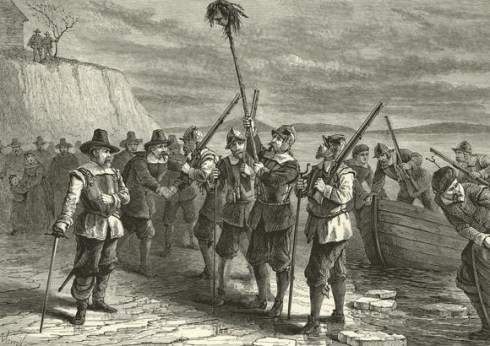
Looking ahead to the new year from a local history perspective, there are commemorative moments for at least six events: five European settlements and a tea party, the 250th Anniversary of the Boston Tea Party, to be precise. A century and a half earlier, there were settlements at Gloucester, Massachusetts and Portsmouth, Rye (the Pannaway Plantation) and Dover (the Cocheco Plantation), New Hampshire. The ill-prepared and -fated Wessagusset Colony was established in Weymouth, Massachusetts in 1622 but its demise came the following year after the brutal Wessagusett “Incident,” more appropriately referred to as a massacre. Commemorative history should acknowledge both the good and the bad, the heroic and the tragic, the kind and the cruel, and so the Wessagusett Massacre of March 1623, a veritable “red wedding” which harmed relations between Native Americans and English settlers for years to come, demands a spotlight. Like the first Gloucester settlement by the Dorchester Company, Wessagusett was decidedly not a plantation in the seventeenth-century sense, but rather a fishing and trading station of 60+ men financed by London merchant Thomas Weston. “Weston’s Men” were completely unprepared for the New World and by the winter of 1622-1623 they were starving, and altogether dependent on both Plymouth and the Native Americans in the region. But foodstuffs were scarce for everyone that winter, and everyone was anxious. Rumors of an impending Native American raid on both settlements drove the Wessagusett men to seek aid from Plymouth, and militia leader Myles Standish and eight men sailed a shallop to the northern settlement and issued an invitation to Massachusett tribal leaders Pecksuot, Wituwamat, and others to attend a summit during which commenced a slaughter just as they all sat down to dinner. I’m going to let Charles Francis Adams tell the tale, as he presented it in his anniversary address on the occasion of the 250th anniversary of Weymouth: the savages were taken by surprise, but they fought hard, making little noise but catching at their weapons and struggling until they were cut almost to pieces. Finally Pecksuot, Wituwamat and a third Indian were killed; while a fourth, a youth of eighteen, was overpowered and secured; him, Standish subsequently hung. The massacre, for such in historic justice it must be called, seeing that they killed every man they could lay their hands on, then began. There were eight warriors in the stockade at the time,—Standish and his party had killed three and secured one; they suddenly killed another while the Weston people despatched two more. Only one escaped to give the alarm, which spread rapidly through the Indian villages. Interesting language for 1873: savages is employed, but Adams does not refrain from calling this slaughter a “massacre” unlike many of his contemporaries who labeled it a pre-emptive strike. Several Wessagusset men also died during the massacre, and the rest opted to abandon the settlement; Standish returned to Plymouth with the head of Wituwamat on a pike in ancient English warrior fashion, “to ornament the Plymouth block-house as a terror to all evil-disposed savages” in the words of Adams. This massacre seems worthy of a bit more commemorative reflection, at least a fraction of what the Boston Massacre receives continuously.

“The Return of Myles Standish from Wessagusset,” from Pioneers in the settlement of America: from Florida in 1510 to California in 1849 by William August Crafts, 1876. Ironically, nearly 300 years later (299!) Myles Standish lost his head when the Standish monument in Duxbury was struck by lightning: according to this post by Carolyn Ravenscroft, archivist of the Duxbury Rural and Historical Society, his replacement head was too heavy for the damaged “body,” so an entirely new Standish was created by Boston sculptor John Horrigon, pictured here in 1930.

I’m not sure what the plans for the commemoration of the Wessagusset Massacre are but all the early settlements have been planning their 400th anniversaries for quite some time, particularly Gloucester, which has assembled a multi-layered calendar of commemorative initiatives and offerings focused overwhelmingly on the city’s social history. I’ve been so impressed with the “400 Stories” project, which aims to collect, present and preserve stories from 400 of Gloucester’s residents from 1623 to 2023, thus connecting the past to the present. There are books, an artistic competition for a new commemorative medal, walking tours, festivals, and a gala: the evolving celebratory schedule is at Gloucester 400.

Portsmouth is all geared up too, although its big reveal party is on January 6 so I don’t know all the details. The PortsmouthNH400 site is here, and so far its signature product is a lovely bookA History of Portsmouth NH in 101 Objects, to which both my Salem State History colleague Tad Baker and alum Alyssa Conary have contributed. There’s an ongoing speakers’ series and exhibition based on the book, and on January 6 Portsmouth’s Memorial Bridge will be illuminated in blue, PortsmouthNH400th’s commemorative color. Like Gloucester, Portsmouth is also collecting stories (of 400 words) from its residents, to be compiled in a commemorative book designed to update its 350th anniversary history. Rye and Dover also have their 400th anniversary committees and calendars, derived from considerable public participation: the mission of Dover400 is “to honor our past, celebrate our present, and to inspire our future through meaningful and creative community engagement.”

The 250th anniversary of the Boston Tea Party is going to be big: after all, from the Boston perspective, it was “the single most important event leading up to the American Revolution.” I’m excited about all of the offerings by Revolutionary Spaces at the Old South Meeting House and the Old State House, including an exhibition on the power of petitions, an “immersive theatrical experience,” and various programs on the nature and expression of protest. Of course the Boston Tea Party Ships & Museum has plans as well, and is already counting down to the big reenactment on December 16, 1773. And there will be merch, including lots of commemorative tea.

Teas from Elmwood Inn & Oliver Pluff & Co.


An Array of Amazing Caterer-Abolitionists!

I’m starting to work on the proposal for a book on Salem history to be published for the city’s 400th anniversary in 2026. This would be a joint enterprise: I have a colleague (and collegial) co-editor, Brad Austin, and we hope to have contributions from as many members of Salem State’s History Department as possible. Brad came up with the tentative title, Salem’s Centuries: 400 Years of Culture, Conflict, and Contributions, and we already have chapter proposals on topics ranging from the material culture of witchcraft in the seventeenth century to Catholic women in the nineteenth century to initiatives in support of Jewish refugees in the twentieth. As usual, I’m kind of in an odd spot: I’m not an American historian and my academic expertise is winding down just when Salem’s history is beginning! But I do think I have learned some things here, and so I’ve committed to chapters on the Remond family in the nineteenth century and urban development/preservation in the twentieth. I’m going to trust my co-editor and my colleagues who have more authority in these eras to prevent me from embarassing myself! For the Remond chapter, I want to use the family’s hospitality and provisioning roles as avenues into civic life in Salem during the early Republic. I’m fascinated with the idea that John and Nancy Remond, in particular, were catering events for institutions which excluded them. I always thought they were exemplary (and I still do, in many ways), but it turns out that there were actually many African-American caterers working up and down the Atlantic seaboard under similar conditions, pursuing their professional careers in civic settings while at the same time working to advance their civil rights. Despite the identification of African-American caterers in Philadelphia as “as remarkable a trade guild as ever ruled in a medieval city… [who] took complete leadership of the bewildered group of Negroes, and led them steadily to a degree of affluence, culture and respect such as has probably never been surpassed in the history of the Negro in America” by no less than W.E.B. Du Bois in his Negro in Philadelphia: A Social Study (1899), I know very little about these powerful purveyors. This is a perfect exemple of the potential pitfalls I am confronting with this project: I know a lot about the Remonds and their Salem world, but very little about the national context in which they lived and worked.

The Remond menu for the 200th Anniversary of the Settlement of Salem Dinner at Hamilton Hall in September of 1828 (I’m not sure why this was not held in 1826?), Phillips Library, Peabody Essex Museum.

Clearly I’ve got to up my game, but this effort will not be a hardship if I get to learn about people like these amazing caterer-abolitionists:

Joshua Bowen Smith (1813-1879): a Pennsylvania native who became a prominent Boston caterer and abolitionist, and later a Massachusetts state senator. Smith catered for Harvard University and many prominent Boston families including that of Robert Gould Shaw, with whom he was reportedly quite close. He was also a close friend of Massachusetts Senator Senator Charles Sumner (along with George T. Downing, below). Smith employed African-American refugees from the South in his business, and aided them in numerous ways through his membership in Boston’s Vigilance Committee, his participation in the Underground Railroad, and his foundation of the New England Freedom Association. Neither his abolitionist activism or his connections aided him when he was stiffed by his fellow abolitionist Governor John Andrew, who refused to pay a $40,000 bill submitted for catering services for the 12th Massachusetts Regiment of Volunteers. Andrew claimed that the legislature had not appropriated the funds, but managed to pay other provisioners without appropriations. Smith was consequently in a financially-vulnerable situation for the rest of his career, but this did not stop his public service.

Joshua Bowen Smith, Massachusetts Historical Society; Bill of Fare for the 75th Anniversary of the American Revolution Dinner for the Boston City Council, 1851. Boston Athenaeum Digital Collections.

Thomas Downing (1791-1866): I think I’ve called John Remond an “oyster king” a few times, and he certainly earned that title in Salem, but his contemporary Thomas Downing was the original Oyster King of a bigger kingdom: New York City. Downing was a native of Chincoteague Island off Virginia (one of my favorite places as a child because of my love for Marguerite Henry’s Misty of Chincoteague: my pony’s name was Chinka), the son of enslaved and then freed parents. He made his way north as a young man, spending some time in that foodie mecca Philadelphia, and then came to New York where his skills as both an oysterman and an entrepreneur enabled him to open the ultimate oyster establishment in 1825. By all accounts, Thomas Downing’s Oyster House was a cut (or several) above all the other oyster “cellars” in New York City, and so it attracted a more genteel, monied, and political crowd. Downing expanded the scale of both his establishment and his business over the next decade, filling mail orders for an international clientele (including Queen Victoria!). Just like John Remond in Salem and Joshua Bowen Smith in Boston, he was also very active in several abolitionist efforts: he founded the Anti-Slavery Society of New York as well as the refuge aid Committee of Thirteen, and worked for both school and transportation desegregation. I’m sure he and John Remond would have heard OF each other, but I’m really curious if they knew each other: they seem to be moving forward on tandem tracks. Downing was definitely the king of PICKLED oysters, which Remond also offered, but I don’t think the New Yorker moved into the latter’s lobster territory.

A stoneware pickled oyster jar from Thomas Downing’s Oyster House (New York City Historical Society) and a handbill for John Remond’s pickled oysters (Phillips Library, Peabody Essex Museum).

George T. Downing (1813-1903): followed in his father’s footsteps in both his profession and his activism, though primarily in a different setting: Newport, Rhode Island. It’s difficult to discern the difference between a restauranteur and a caterer in this period, but Downing Jr. seems to have operated as both with his establishments in Newport and his role as manager of the Members’ Dining Room at the U.S. House of Representatives in Washington from 1865 to 1877. This position was preceded by a long struggle to desegregate the Newport schools: the Remonds had removed to Newport during their own struggle for school desegregation in Salem in the later 1830s, so I’m pretty certain there is a connection here. Both before and after the Civil War, Downing Jr. was active in all of the abolitionist and equal rights organizations which his father and circle supported, always striving for more equality, more access, and more opportunities for African-Americans.

George Thomas Downing and his family, Rhode Island Black Heritage Society. What I would give for a photograph of all of the Remonds!

Robert Bogle (1774-1848): the first of the emerging Philadelphia African-American “caterers’ guild” referred to by Du Bois above; in fact, Bogle is often credited as not just the first African-American caterer but the first caterer, period (although the term was not used until after his death). He merged the professions of caterer and funeral director in Philadelphia for several decades, inspiring Nicholas Biddle to pay tribute to Boggle in 1830 as one whose “reign extends oe’r nature’s wide domain begins before our earliest breath nor ceases with the hour of death.” Bogle’s Blue Bell Tavern opened in 1813, and soon became famous for its meat pies and terrapin creations as well as a gathering place for Philadelphia’s political leaders: this is the hospitality entrée that accomplished caterers of any color could obtain, but perhaps one of the few avenues of access for African-Americans in the nineteenth century. Indeed, the wonderful digital exhibition on the life and work of an enslaved Charleston cook presented by the Lowcountry Digital History Initiative at the College of Charleston observes that the multi-faceted role of caterer was “one of the few, and most lucrative, prominent public positions that could be acceptably filled by an African American during slavery.”

Nat Fuller (1812-1866): It must have been difficult enough to be an African-American caterer in the North during this period, just imagine what that role would entail in the south! Fortunately we don’t have to imagine because we have this great digital exhibition: Nat Fuller’s Feast: the Life and Legacy of an Enslaved Cook in Charleston. As an enslaved teenager in Charleston in the 1820s, Nat Fuller was apprenticed to a remarkable free African-American couple who seem to be playing the same culinary and catering roles in Charleston that John and Nancy Remond were occupying in Salem, at the exact same time: John and Eliza Seymour Lee. Charleston John was the event manager for several venues; his wife Eliza the famous cook and pastry chef. After Nat Fuller completed his culinary training under Eliza, he worked as an enslaved cook for his slaveholder William C. Gatewood, an ambitious man who entertained frequently, for the next three decades under “evolving” conditions: in 1852 Gatewood agreed to let Fuller live outside of his household with his wife Diana (another famous pastry chef) under the so-called “self-hire” system. The Fullers began to operate independent provisioning and catering businesses in Charleston, paying Gatewood a percentage of their profits. By the later 1850s, though still enslaved, Fuller was Charleston’s “well known” and go-to caterer, staging elaborate events like the Jubilee of Southern Union dinner celebrating the completion of a railway between Memphis and Charleston in May of 1857 for 600 guests. In the fall of 1860, though still enslaved, Fuller opened his famous restaurant, the Bachelor’s Retreat, operating it throughout the war except for a few periods of illness and relocation, and at which, as a newly-free man, he hosted a dinner celebrating the end of the war and slavery in the spring of 1865. Abby Louisa Porcher, a white Charleston lady, documented this momentous event in a letter soon afterwards: “Nat Fuller, a Negro caterer, provided munificently for a miscegenation dinner, at which blacks and whites sat on an equality and gave toasts and sang songs for Lincoln and freedom.” Perhaps Fuller could not operate as a caterer-abolitionist like his colleagues in the North, but he emerged as an advocate for racial equality as soon as he was enabled. He died in the next year.


Appendix: you can read all about the “reenactment” of Nat Fuller’s Feast on the occasion of its 150th anniversary in 2015 here; Invitation below. Another prominent southern African-American caterer, John Dabney of Richmond, was born into slavery, is the subject of a beautiful documentary, The Hail-Storm. John Dabney in Virginia, which you can watch here.


Shore Dinners

I have a guilty secret to admit, one which will reveal me to be out of step with most of my fellow Salem residents (no, it’s not about “witches”): I’m not particularly fond of Salem Willows. It’s got a great history and a great spirit, and I’m always happy when I go there, but I don’t really appreciate it. I’m sure I must be a bit of snob about seaside amusement parks, as I never really appreciated York Beach while I was growing up in York either. I don’t understand chop suey sandwiches, and while the popcorn at Hobbs is great, I enjoy my friend Carol’s just as much. While I can take or leave the Willows, I know that many Salem natives wait eagerly for its opening every spring: they have strong memories and associations which I don’t have, and they like chop suey sandwiches. The other day, I came across an article in a 1941 issue of Woman’s Day in a trial database of women’s magazines that we just obtained at Salem State: it was so enthusiastic about the Willows experience back in the day that I began looking at it in a new (old) light.

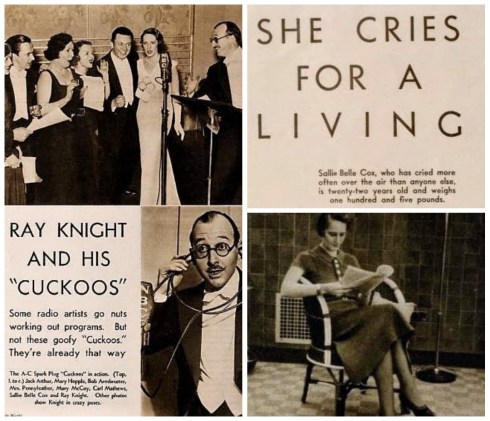
The article is primarily about Ebsen’s, established in 1885 and the last restaurant standing on the Willows’ Restaurant Row. By the end of the decade, it would be gone, but it was clearly alive and well in 1941. Since that was such a fateful year, one can’t help but feel we are “witnessing” the end of the era in the enthusiastic prose of Sallie Belle Cox, who was embarking on her second career after making a name for herself as the “cry baby of the airwaves” playing crying babies on radio broadcasts in the 1930s. On one such program, she met her husband, radio writer and broadcaster Raymond Knight, a Salem native. She became his second (of three) wives, and by her account he was horrified that she did not know the glories of Salem Willows in general and Ebsen’s in particular, so they drove up from New York City in the early summer of 1941. While her husband insisted that his hometown was the “one city in the world where they know how to make a fish dinner,” Cox’s image of Salem was “a weird, fascinating place filled with clipper ships and jaunty old sea captains who brought home exotic wives with rings in their ears to annoy all the other natives whose only fun in life was roasting witches on dull Saturday nights.”

Salem native Raymond Knight and his soon-to-be wife Sallie Belle Cox (behind the microphone at left) in Radio Stars magazine, 1933-34.

And straight to the Willows and Ebsen’s they went. The restaurant was packed, its oilcloth-covered tables and chairs the same which had been installed in 1890. They partake of equally-old Charley Ebsen’s Shore Dinners: fish or clam chowder, fried clams, fried flounders, and fried lobster, with potato chips, pickles, ice cream, and their choice of non-alcoholic beverages. Cox finds the chowder divine and furnishes her readers with the recipe from chef Fred Millet, who has also been around since before 1900. She also notes that “the Rhode Island and Manhattan clam chowders are not even considered worth discussing in Salem” and admits that there can never be enough fried seafood.

“Shore Dinners” by Sallie Belle Cox, Woman’s Day, July 1941.


Candy Land

In my sweetest dreams Salem is Candy Land rather than Witch City, and it certainly has the heritage to claim that title (although Candy Land was a Milton Bradley game rather than a Parker Brothers production.) There are of course the famous Gibralters and Black Jacks, still sold at the Ye Olde Pepper Candy Company on Derby Street, America’s oldest candy company. Mrs. Spencer sold her hard candy from a horse-driven carriage, and her primary competition seems to have been the stationary confectioner John Simon, whose shop was stocked with a variety of syrups and sweets, everything from anise drops to peppermint. He was always announcing his “removal” to Boston but somehow never made the move. Before the later nineteenth century, however, most confectionary item were not sold by single confectioners, but rather by grocers and apothecaries, and their lists of available sweets became longer and longer with every decade. Nourse’s Fruit Store on Washington Street sold “calves foot jelly candy, strawberry jelly candy, sherbet candy, gum jelly drops, and “East India Red Rock Candy” and all sorts of candies made with the New England’s favorite ingredient, molasses. Confections got a bit softer in the later nineteenth century, when cream candies became popular, and then comes Chocolate!

The Theodore Metcalf Company, one of Boston’s most successful apothecaries, published a beautiful pamphlet on gibralters and black jacks but these were SALEM candies; Nourse’s advertisement, Salem Observer 4 November 1865; Trade cards illustrate the softer trend in confectionary consumption.

The decline of hard candy and the rise of chocolate seems to be a major trend, but candy customers still loved variety. The most successful, and very long-running, confectionary business in twentieth-century Salem was the “Palace of Sweets” on Essex Street, from which the Moustakis Brothers sold their “mastermade” (a patented term) confections. This business was in operation from 1905 until 1968, and after the Taft Summer White House in Beverly placed a series of larger orders it received—and marketed—the presidential seal of approval.

Moustakis Brothers’ Menu from the digital archives of the Culinary Institute of Technology.

Salem is still candy central, in fact two confectionary shops opened up just this past year: Curly Girl Candy Shop on Washington Street and the Chocolate Pantry on Derby, not far from Ye Olde Pepper Candy Company further down the street. And then there is the venerable and amazing Harbor Sweets, the manufacturers of my very favorite candy, Sweet Sloops. I don’t even really have a sweet tooth, and if I am going to indulge I prefer jelly beans to chocolates, but bring a box of Sweet Sloops into the house and I will not rest until they are gone!

The House of the Seven Gables and Ye Olde Pepper Candy Company sponsored the ice sculpture of Mrs. Spencer’s horse and carriage for the Salem’s So Sweet festival this past weekend: its position made it difficult to photograph but it’s much bigger than it appears in this photo! My beloved Sweet Sloops, available at Harbor Sweets on Leavitt Street in Salem as well as lots of other retailers.


A Mysterious Matron and other Salem Cookbooks

Salem has a brand new cookbook out just in time for the holiday season: Salem’s Cookin‘, the Official Chamber of Commerce Cookbook. I kind of wish it had more historical recipes, as Salem has quite a few culinary claims to fame, but I’m sure I’m the only person with this wish as it features a range of recipes for dishes served at the city’s most popular restaurants and offerings from other establishments and individuals which seem surprisingly doable. It’s a very practical cookbook as well a showcase of Salem’s culinary landscape. Still, I’d rather read about food than attempt to make it so I thought I would mark the occasion with a survey of Salem cookbooks, beginning with the serious and mysterious The American Matron; or Practical and Scientific Cookery published in 1851 by an anonymous “housekeeper” who lived in Salem. This housekeeper was quite the cook, quite the chemist really, and quite the writer, and I’ve been trying to find out who she was for quite some time, with no success.

As its title implies, The American Matron is a very practical cookbook as well, so practical that it often seems as concerned with preventing food spoilage and consequential poisoning as offering up recipes that are easy to make and pleasant to eat. The instructions for pickle storage below are very representative of its author’s tone throughout: warning her readers not to keep their pickles in pottery or metal containers due to arsenic and acid, she concludes that One may not be instantly poisoned after eating pickles prepared or kept in such vessels; but if constantly used, a deleterious influence must be operated on the health from this cause, even when lest suspected. This is a text which begins with the proper storage of water and reads more like a public health manual than a cookbook in places, but it also includes scores of recipes for both traditional New England dishes as well as more exotic concoctions featuring ingredients from around the globe, highlighting Salem’s continuous seaport status. There are a lot of interesting seafood recipes in particular, all stressing the necessity of using just-off-the-boat ingredients. It is also a manual for housekeeping, containing instructions for dyes, cleaning agents, and pest control that one might see in the more random printed recipe collections of the early modern era: my favorite is her very nineteenth-century prescription for  how to remove the black Dye left on the skin from wearing mourning in hot weather. That’s a predicament I never considered before reading this book!

I can’t find any Salem cookbooks from the later nineteenth century, so I guess that brings us to a collection of historical recipes gathered together under the title What Salem Dames Cooked and published as a fundraiser for the Esther Mack Industrial School in 1910. Like many Salem creations of this particular time, this little volume expresses a Colonial Revival view of the past with its ye olde type and terms, and it was reissued about a decade ago in a glossy reprint so it is widely available. Moving forward another half century, the Hamilton Hall Cook Book was published by the Chestnut Street Associates as a fundraiser for Hamilton Hall just after World War II. Its recipes are quite minimalist, but as it contains both the iconic 1907 photo of Hall caterer Edward Cassell and a lovely illustration of the Hall’s Rumford Roaster I think it must be my favorite Salem cookbook. Old copies turn up on ebay rather regularly but I think Hamilton Hall should reprint it!

A Mary Harrod Northend photograph of the students at the Esther C. Mack School, Historic New England; Mr. Cassell making his deliveries in front of the Peirce-Nichols House.

I am sure there must be more later twentieth-century Salem cookbooks: perhaps issued by ladies’ committees of a church or the Hospital? But the only one I have in my possession is Served in Salem, published in 1981 by the Ladies Committee of the Essex Institute. Both the Hamilton Hall Cook Book and Served in Salem feature lots of recipes with ready-made, canned and frozen ingredients, in stark contrast to The American Matron: twentieth-century cooks didn’t have to worry about preservation and were apparently interested in as many shortcuts as possible. Served in Salem emphasizes entertaining: there are many “party” dishes and featured table settings which showcase the Essex Institute’s collections. Like its Chestnut Street predecessor, however, Served in Salem also features several nods to the past, including a letter from Sally Ropes Orne to her brother Nathaniel which reveals in great detail the Christmas dinner she served to her guests in the family mansion in 1848. It’s so great, and brings us back to the time of of The American Matron, though Sally writes from the perspective of a gracious hostess rather than a practical housekeeper. The dinner began with a toast with sherry, Maderia and hock (which she disdains as too expensive for the taste), then came in the oyster soup, followed by boiled chickens and a ham with caper sauce, mashed potatoes and squash. The next course featured a “noble turkey” accompanied by gravy and liver sauce and more mashed potatoes, this time “browned on top and marked off in diamonds,” which was followed by deserts: plum pudding with hard sauce, mince pies, and cream pudding. Everything was then removed, including the white tablecloth, and the meal was completed with Baldwin apples, grapes, nuts and raisins, along with more sherry. She concludes that “every article was charmingly cooked” and assures her brother that the day went off finely.

Christmas Dinner Service in the Ropes Mansion, from Served in Salem (1981).