
Salem is not particularly known for its folk art, I think. The standard for craftsmanship during the later eighteenth and early nineteenth century was so high, and production so prolific, that the curatorial and collecting emphasis always seems to be on the best and the brightest of the decorative arts rather than the more idiosyncratic. But I’m always looking for interesting examples of folk art, and every once in a while I do a round-up of samplers, silhouettes and signs. The Peabody Essex Museum has wonderful examples of Salem-made folk art in their huge collection, including my favorite trade sign, featuring a bust of Paracelsus made for James Emerton’s Essex Street apothecary shop, samplers from the famous Sarah Stivours school, and the “soft sculpture” (I’m not sure what else to call it) of textile artist, author and abolitionist Lucy Hiller Lambert Cleveland. And all manner of maritime objects of course. The amazing decoys of Captain Charles Osgood, carved while the Captain was biding his time waiting for his gold rush ship to set sail from San Francisco back to Salem in 1849 and hidden in a friend’s hunting lodge in Rowley for a century thereafter, are valued quite highly. Most are in the collection of the Shelburne Museum in Vermont, but one came up for auction recently with an impressive result.


But a lot of anonymous pieces crafted in Salem seem to sell for very little money. There’s a painting of Salem Harbor by an anonymous artist coming up for auction later this month at Eldred’s Auctions that is so beautiful I could fall into it—and it has a higher starting bid than I’ve seen before for folk art marine paintings. It seems worth it; this is not just a painting of a ship, but of life on land and sea. Contrast this with another nautical view below, a reverse glass painting of “Ship Siam of Salem / Built 1847 / Capt. Ebenezer Graves” sold by Jeffrey S. Evans & Associates Auctions. There’s certainly a lot more going on. Also from Evans, these two wonderful carved allegorical figures, which were apparently located at Salem Willows! I really can’t imagine where, precisely. Silhouettes cut in Salem appear at auctions frequently, but I’m not sure these would count as Salem art as such artists seemed to have been characteristically itinerant.


 A front parlor and Mrs. Little’s charming closet office.


 The open hearth kitchen/dining room and various halls of objects. An anonymous couple in their finery by Royall Brewster Smith, c. 1830.


 Mr. Gould in his red cap; second-floor parlor and bedrooms; an amazing pictorial collage of the arrival of the first Oddfellows in America (there they are in the bottom left corner!); the BIG barn.


 Advertisements in the Salem Register, 1852 & 1862.
 The Female Medical College
 Salem Directories, 1882-1892.


 American Terrestrial Pocket Globe made in Wethersfield, CT, c. 1850. A pocket globe is surely better than a pocket atlas.
 English Stumpwork Profile Portrait of King Charles I of England, 1646. How amazing is this—and there are more seventeenth-century lots in the MacKay/Field collection as well, including two more representations of King Charles I during the Civil War, or perhaps even after his execution! Royalist relics–from either side of the Atlantic.
 Silk Needlework Picture of a Gentleman wearing a Tricorn Hat, c. 1770. I like this guy from the next century too.

 Andre’s Journal: an Authentic Record of the Movements and Engagements of the British Army in America from June 1777 to November 1778 as recorded from day to day by Major John Andre,” Edited by Henry Cabot Lodge, Boston: The Bibliophile Society, 1903. This is a beautiful two-volume book which was limited to 487 copies for Bibliophile Society members: I continue to be fascinated by how fascinated Americans were (are?) with Major Andre!
 Lady Liberty Standing on the Head of Great Britain underneath the Great Seal of the United States, American School, War of 1812. LOTS of War of 1812 items in this auction: this is my favorite.
 The Frigate “Arbella” of Salem. American School, early 19th Century. I guess I have to have a Salem item–this is a lovely ink & watercolor painting of a ship with which I am not familiar: the original Arbella brough John Winthrop to Salem in 1630, but I don’t know anything about this Arbella. Only the Phillips Library can tell us, I’m sure!
 The Young Sailor. American School, 4th quarter, 19th century, Mrs. Mary Ide Spencer/Artist. I just love this painting: I know it would make me happy every day if it were mine.

 Ugh.
Ugh.


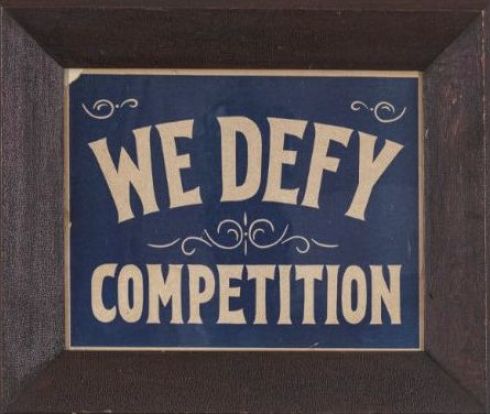
 Nineteenth-century trade signs from





