Tag Archives: Decorative Arts

Old Salem Settings

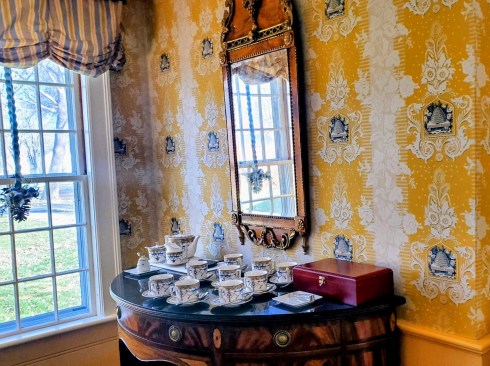
One of the chapters I wrote for the forthcoming (on January 6!) Salem’s Centuries was on the Colonial Revival, and in it I  explored Salem’s experience of that cultural movement as well as Salem’s influence in that cultural movement. I am no art historian, so my purview is very broad, and more focused on popular distillations of “Salem style” than original creations.  There were so many references to “Old Salem” in the first three decades of the twentieth century; now when you hear that phrase it is generally referring to Old Salem Museum & Gardens in North Carolina. But in the 1920s and 1930s, you could buy silverware, furniture, rugs, wallpaper, draperies, and ceramics influenced by “Old Salem.” One product that was particularly effective at conjuring up an image of a very romanticized Salem during its commercial heyday was the “Old Salem” line of china manufactured by Copeland starting in Salem’s tricentennial year of 1926 into the 1950s. This was a “Blue Room” issue marketed under Copeland’s original name Spode, for extra transferware sentimental appeal. I think it was first issued in a polychrome pattern, but the blue-and-white version really took off in the U.S., if advertisements and auction lots are any indication.

I’ve included a snip of text from a House Beautiful feature on “colonial” dinnerware from the 1930s in this last image because there’s a lot there/here. First of all, I love this line about how Old Salem the pattern evokes Old Salem the place, a place lost in time, when “the shoe factories had not yet banished the salty flavor of its existence.” Very Colonial Revival. The author wants to emphasize the pattern’s revival and continuity: it was originally produced back in that “salty” past and New Englanders have always bought Spode. I do find the “original production” assertion a bit confusing as the pattern does indeed feature ships, though not exclusively Salem ships, and the settings are clearly European. In fact, Old Salem, which was produced with old copper plate transfers of Italian views, is kind of a composite view in several ways: old world, new world, maritime, floral, all fused together by the magic of transferware for Salem’s 400th and America’s 150th.


A Colonial Revival Dining Room

I wrote the chapter on Salem’s Colonial Revival movement in our forthcoming book Salem’s Centuries, an effort that I think was pretty ballsy given that I am neither an American historican or an art/architectural historian. You can be sure that I had both types of experts read it before submission and it has been peer-reviewed several times before publication! I felt confident because I took a biographical and cultural history approach, utilizing the work and lives of Salem exemplars Frank Cousins, Mary Harrod Northend, George Francis Dow, and Caroline Emmerton. They were all so respectful of Salem’s material heritage and more than a bit fearful of change. What we now label the Colonial Revival does seem to have been a movement in Salem, fueled as much (I think!) by nostalgia as by a desire to preserve, and its connections to the fledgling preservation movement in the early twentieth century are what interest me particularly. So while I have a sense of the Colonial Revival as a cultural movement, I am far from any aesthetic understanding, although I think I have made some strides in that direction by working at Historic New England’s Phillips House over these past two summers. The house’s dining room, in particular, a great example of the assertive effort of Salem and Boston architect William Rantoul to “marry” its later-19th century back to its Samuel McIntire front, has become my ideal Colonial Revival room. It all started with the alcove for me. I had seen Rantoul’s colleague and contemporary Arthur Little’s alcove in Caroline Emmerton’s house on Essex Street in person and in renderings (the cyanotype below is from a Little & Browne album in the collections of Historic New England), and it just seemed so Colonial-esque to me, so when I saw some semblance of an alcove in the Phillips’ dining room, it all made sense.

As you can see, Rantoul’s alcove is not nearly as enclosed as that of Little, but the former still carved out that space, removing a staircase for the symmetrical china cabinets and fireplace, delineated from the rest of the room by that strident ceiling moulding. He had modernized the systems for the Phillips after their purchase of the house in 1911: there was no need for that fireplace other than to enhance the “colonial” ambiance, which is also provided by the great Joseph Badger portrait of Phillips relative Thomas Mason (c. 1770-75) with his pet squirrel. I’m not even sure you would call this space an alcove, much less a nook, but it’s the semblence that creates the aura of the past in this large light-filled room.

Frankly this chair annoys me but I understand why it’s there.

Of course, the furnishings set the scene as well, and authors of decorating books from the teens and twenties always advised their readers that they should avoid placing items “of a set” if they were to attain that authentic Colonial look. It was relatively easy for the Phillips’, with their multi-generational wealth and trove of possessions from different places and times, to achieve the desired layered look. Their dining room seems to have attained the general “Colonial feeling” recommended by Helen Koues in her popular manual On Decorating the House (1928), in which the walls and woodwork are light in value, the furniture is mahogany or brown mahogany, silver is shown, and side lights or chandeliers may be in silver with glass prisms, or some fixture Colonial in feeling. Andirons and fireirons are of brass or brass and iron, and the china displayed is of Wedgwood in patterns of the eighteenth century. Of course, Stephen and Anna Phillips were both from old Salem maritime families, so their Wedgwood (and Limoges) is supplemented by a dazzling display of East Asian ceramics.


I’m Confused by Pineapples

This is one of those “writing it out” posts. It starts out with confusion in the hope that I can work it out, but I may not so it might end in confusion as well. I’m confused about the symbolism of pineapples. Of course everyone knows that pineapples represent “hospitality,” but do they really? What else might they represent? I started out with the question as to whether pineapples are Colonial or Colonial Revival, and it seems that that they are both. I’m also wondering if there are differences in what they represent in the northern US as opposed to the south, and between the US and the UK. My wonder is prompted by recent road trips down south, where I saw a lot of pineapples, as well as an interest in symbolism in general prompted by the recent discussions here in Salem over our official city seal, which some see as stereotypical and rascist and others see as evocative of a proud global maritime heritage. I always find that a historical perspective helps with understanding both images and events; apparently the members of the Task Force charged with examing the seal do not. In any case, there’s always a personal and arbitrary angle: it’s so interesting that different people see very different things in the same image. And that is true of pineapples too: while for the most part they seem to convey a sense of decorative hospitality, they also have associations with exoticism and exclusivity and excess, colonization, plantations (both in the West Indies and Hawaii), coerced labor and ultimately slavery. I am always interested in Salem’s famed “Pineapple House,” a Georgian structure first located on Brown Street and then removed to Brown Street Court which was demolished by 1911 with only its pineapple-pedimented door preserved, first in the Essex Institute and now in the American galleries at the Peabody Essex Museum. I’ve written about it before, but I know more now: its pineapple was not a local creation but rather a British import and its importer, Captain Thomas Poynton, became one of Salem first Loyalistist refugees, leaving his house (and his wife!) for England in 1775. That conspicuous (always gilded by all accounts) pineapple might have had Tory associations in Revolutionary Salem, but nevertheless it became the inspiration for one of Salem’s most important Tercentenary expressions, the band stand on Salem Common erected in 1926.

There are pineapple motifs on New England furniture and wallpapers from the 18th century through the mid-twentieth, but in terms of conspicuous architectural detail I think the best examples are the Hunter House in Newport, RI and the Wentworth-Gardner House in Portsmouth, NH (after Salem’s Pineapple House, of course). The Hunter House was also owned by a prominent Loyalist, and a recent article on its new Orientation Gallery describes its current interpretation as a  “paradigm shift”: Here visitors can examine a historic photograph of the house’s pineapple pediment alongside a silver coffee pot and a pair of covered baskets adorned with pineapple finials. The display discusses the tropical fruit as a product of colonization and slavery as well as a symbol of wealth and hospitality in colonial Newport. For the Preservation Society, which long ago adopted the pineapple as part of its logo, this analysis represents a paradigm shift. It’s been a few years since I’ve been on a tour, but I don’t think this kind of deep dive is offered up at the Wentworth Gardner House in Portsmouth, which was restored by none other than Colonial Revival evangelist and entrepreneur Wallace Nutting in 1916-18. And there’s no need, as Nutting added the pedimented pineapple, and the entire entrance surround to the house. This very Colonial Revival pineapple anticipated the ever-present fruit emblems at another prominent Colonial-esque institution: Colonial Williamsburg.

And down south, it’s the same thing: there are eighteenth-century pineapples and then there is a twentieth-century pineapple revival. Virginia’s oldest plantation, Shirley, has a very prominent three-foot-tall pineapple right at the apex of the roof of its main house, which was built around the same time as the Poynton House in Salem and the Hunter House in Newport.  Installing a pineapple on the pinnacle of one’s roof must have been a James River Plantation thing, as Brandon Plantation has one as well. Another interesting transatlantic pineapple connection relates to the last Colonial Governor of Virginia, John Murray, the fourth Earl of Dunmore, who commissioned a stone-carved pineapple summerhouse for his Scottish estate in 1761, likely the most famous pineapple construction in the world. The pineapple is very prominent in Charleston, of course, with the pineapple gateposts (which I think were supposed to be pinecones?) of the Simmons-Edwards House dating from around 1816 and the famous pineapple fountain dating from 1990.

Shirley and Brandon Plantations in Virginia; The Dunmore Pineapple, Stirlingshire, Scotland via the National Trust for Scotland; Gate at the Simmons-Edwards House at 14 Legare Street, Charleston, built 1816, from the lovely site Glimpses of Charleston; some pineapple images from one of my favorite books, Charleston Style, by Susan Sully with photographs by John Blais.

Pineapples on the gatepost (and I suppose by extension the very popular pineapple doorknocker) are said to be visual “traditions” based on the practice of ship captains returning from exotic realms displaying pineapples on their properties to indicate that they were home, and ready to receive visitors. This story is repeated again and again and again, but I don’t seem to find any references to it before the early twentieth century. I think it’s more Colonial Revival romance. Pineapple stories just keep getting repeated with very little insight, analysis or research, at least over here. With the exception of the Newport Preservation and a Smithsonian blog post about the “prickly” history of the pineapple, these storied fruits (and their visualizations) don’t have much cultural depth over here in the US: and if they are in fact emblems I think they should have more. But in the UK, wow! Here’s a great History Workshop piece with all sorts of associations, and very recently, a “sinister history of the pineapple” student project at the University of Southampton in collaboration with Royal Botanic Gardens at Kew was featured in DezeenMy research for this post exposed me to yet another pineapple association: apparently an upside-down pineapple sign on a door means means there are swingers within! That’s a long way from friendly sea captains, and obviously there’s much more to pineapples than meets the eye (but I’m still confused).

Dezeen Magazine, July 26, 2025: A “Sign of Status” by Jas Jones, who concludes “the pineapple is no innocent fruit.”


Patriot Properties

An eventful weekend—one of several coming up this summer! I’m going to focus on one event out of several I participated in—a house tour of Patriots’ homes in Marblehead—simply because it yielded the best pictures. Having done this a couple of times myself, I am always grateful to homeowners who open up their houses to the public. As I am focusing on Marblehead, right next door to Salem, today, I have to admit that I’m feeling a bit envious of our neighbor for three essential reasons these days. First of all, it seems to have a very engaged electorate which has much more power than we do in Salem. I had an appointment there last week which happened to fall on local election day, and saw tons of people and signs out and about. Marblehead residents elect their board and commission members and city clerk, while in Salem we only elect a Mayor and city councillors, and the former appoints all the commissioners with the rubber stamp of the latter. There are often uncontested elections in Salem and the voter turnout is very low: 28% in the last mayoral election I believe. Marblehead is a town so they have town meetings! I feel quite disenfranchised by comparison. The second reason I envy Marblehead is its Revolutionary fort, Fort Sewall, which is perfectly preserved and well-maintained in contrast to Fort Pickering, Salem’s major historic fort, which has been left to rot and ruin by the City of Salem. This is, I believe, another example of civic engagement or the lack thereof. The third reason I envy Marblehead, pretty much every single day, is that it has a professional historical society, unlike Salem. The Marblehead Museum was established as the Marblehead Historical Society in 1898, and it continues its mission “to preserve, protect, and promote Marblehead’s past as a means of enriching the present” today. Salem has no such institution; it failed to develop one as the Essex Institute served that role for much of the nineteenth and twentieth centuries, before its assimilation into the Peabody Essex Museum. The Marblehead Museum combines its stewardship roles (of both Marblehead’s historic record and its three properties) in conjuction with a very active calendar of interpretive events, including this weekend’s house tour, which couldn’t have been more timely.

The tour of five houses was self-guided, and so the first house for myself and my friend Liz was the Robert Hooper House on Washington Street, a 1769 reconstruction of an earlier home which I always thought was a Federal house. It has recently been restored so we were both eager to get in, and once inside you could immediately tell it was pre-Revolutionary even with its vibrant decoration. The carriage house was open too, and the views down to its terraced garden were spectacular, even on a rainy day. At first, I was a bit confused as to why this house was on a tour of homes associated with Patriots as I had my Marblehead Robert Hoopers mixed up: the owner of this house was NOT the famouse Loyalist Robert “King” Hooper, whose house is located just across the way, but rather another Robert Hooper. It was also confusing to read that George Washington visited this house during his 1789 visit to Marblehead: I don’t think this is the case as he is recorded as having been greeted at the Lee Mansion just down the street. But Robert “NO KING” Hooper’s son, also named Robert Hooper, was married to a daughter of Marblehead’s most illustrious Revolutionary general, John Glover, and as they inherited the house after his father’s death in 1814 that’s quite enough of a patriot connection for me.

Then we walked over to Franklin Street and the Devereux House, a very classical Georgian house built in 1764 by Marblehead merchant Joseph Homan. Persons enslaved by him likely lived here before Homan sold the property to Eldridge Gerry of “Gerrymandering” fame. Gerry gifted the house to his sister Elizabeth, the wife of Selectman Burrill Devereux who welcomed President Washington to town in 1789. A lovely house, well-maintained over the years and now the home of another Patriot, with whom we discussed the Army’s (rather than the President’s) big birthday.

The most famous Marblehead Patriot (who was born in Salem) is undoubtedly General John Glover, who ferried General Washington and his troops across the Delaware on Christmas night 1776 in advance of their big victory at Trenton. There is a Glover Square named after him, and in the midst of this square is the house most closely associated with him. Like the Devereux House, it’s on the National Register, and features yet another impressive Georgian entrance hall.

On our way back to our final stop, the Jeremiah Lee Mansion, we realized we had missed a house, which is of course a capital crime on any house tour. So we made a little detour to see the Martin-Hulen-Lemaster House on Washington Street. Its generous owner allowed us to see the entire 1755 house, and you could really appreciate the space created by its gambrel roof on the third floor. Marblehead ship captain Elias Hulen, Jr., whose father served on the Seacoast Guards and as a privateer during the Revolution, owned and occupied this house after its orginal owners departed for Maine in the 1770s.

We finished up the tour at the 1768 Jeremiah Lee Mansion, a museum property which I’ve toured before and posted about here. It’s an amazing edifice, with interiors impressive in both detail and scale. Only the first floor was open for the tour so I took some photos of decorative details that I didn’t think I captured in my earlier post, and looked out the tall windows at the archeaological and structural evidence of the Marblehead Museum’s ambitious ongoing project, a $1.4 million renovation of Lee’s Brick Kitchen & Slave Quarters next door. When completed, this project will expand the Museum’s archival, office, and exhibition space in addition to revealing and interpreting spaces of enslavement and labor, a logical extension of the Museum’s continuous efforts to identify and document the lives of African American and Indigenous peoples in Marblehead’s history.

A few photos of the Jeremiah Lee Mansion interiors and the Brick Kitchen/Slave Quarters project behind and adjacent to the Mansion. The only king I was interested in this past weekend was the King of Prussia, as I was just fascinated by this plate! 

One more object of Marblehead envy popped up while I was looking at the Marblehead Museum’s website: the town retains reference to the original Pawtucket Tribe of our region in its land acknowledgement statement, while Salem’s excludes any reference to these native peoples in favor of the Massachusetts Tribe. I wish we could acknowledge the Pawtucket.


The Bowman House

We were vacationing in midcoast Maine last week so I took the opportunity to visit Historic New England’s newest property, the Bowman House, with a few friends. We also saw the nearby Pownalborough Court House, which is one of the most extraordinary Colonial buildings I have ever encountered. The Bowman House is in Dresden, right on what was a very busy Kennebec River short at the time of its construction in the mid-eighteenth century. Now it sits amongst tranquil rolling lawn: this photograph is of the rear, of course; the front entrance looks upon the River.

The house is a very high-style Georgian construction, the type you see built in shipbuilding centers. It has a very charming air about it, partially provided by the architecture, but also by the restoration and decoration, which was the work of Bill Waters, who worked and lived in the house for decades. He died in 2016, after having donated the house to Historic New England with the qualification of lifetime tenure. So even though this house was built in 1762 for Joshua Bowman, a judge with Hancock connections, it really felt like Bill Water’s 21st century Georgian house: his personality shined through both his preservation efforts and his possessions. Since I’ve been working for Historic New England myself this summer, I’ve been thinking about the differences between the work of a tour guide and a professor, and one major one is that the work of the former is a lot more personal: you’re talking to and with smaller groups about more intimate stories rather than trends, causes and consequences. Historic New England’s interpretion focuses on the people who lived in its houses as much as their architectural history, and “Bill’s house” is a great example. (Although our guide did introduce us to local master builder Gershom Flagg, who built both the Bowman House and the Pownalborough Courthouses, and now I am obsessed!) Bill Waters came to the house through the Burrage sisters, Mildred and Madeleine, notable artists and world travelers who moved to Wiscasset in 1962 and became interested in the region’s historic architecture. In 1961 they purchased the Bowman House, and sold it to Waters several years later, and he and his life partner Cyrus Pinkham began their life’s (house) work. 

Bill Waters with Bowman descendant Florence Bixby and the Burrage Sisters in 1968 (Maine Historical Society), and more recently.

So let’s go into the house, shall we? You enter through a single-story sun room which was likely a nineteenth-century addition (the house served as the office for an ice-supply business in the later 19th century) and then into the kitchen and a series of first-floor parlors and dining room adjoining a spacious central hallway—wonderful reproduction wallpapers throughout, including the pillar-and-arch paper that I think is also in Hamilton House? Throughout his tenure, Waters worked to bring as many period-appropriate and/or Bowen furnishings into the house, and everything seems perfect and very colorful, but also very, very livable.

There are several spaces in which he seems like he just stepped away…….like the bar (above) and lots of whimsy, like the feathers on his canopy bed (below). Artful assembly throughout, and very special mirrors!

We exited through the sunroom, a very comfortable space which reveals Waters’ appreciation of trade signs (as well as his southern roots, represented by a small image of General Robert E. Lee) and then drove down the road to the Courthouse: wow! Photographs don’t quite represent the scale of this 1761 building.


Salem 1799

I always tell my students forget dates, you can always look them up, dates are a terrible way to learn history, but sometimes dates just stand out: 1348, 1517, 1776, 1789, 1914. The other day I was engaged in some endnote-editing and somehow, the date 1799 just started jumping out at me: it suddently seemed like the most important date in Salem’s history! Why? A lot of building mostly: of two of the most spectacular Derby houses and Salem’s first federal frigate, the Essex. But there were other notable things that happened in that year too: the foundation of the East India Marine Society for one, and the renaming of Salem’s long-ignored seventeenth-century fortification, Fort Pickering, for another. 1799 was a big year for Salem, then the eighth largest “city” in the United States with a population of over 9000. Its commercial vitality was already well-established, but it aquired a new civic reputation with the construction-by-subscription of the Frigate Essex for the federal government. The most wonderful book sheds light on the whole commission/subscription/construction process: Philip Chadwick Foster Smith’s The frigate Essex papers : building the Salem frigate, 1798-1799 (1974): I wouldn’t presume to add to it! I will, however, include a couple of its maps. Salem had terrible flooding last weekend and I think we need to remember that we live in an infilled-city, and that a river runs through it.

The US Frigate Essex, built in Salem by Salem residents.

Joseph Howard, watercolor of the Essex, after 1799, Peabody Essex Museum.

Maps from Philip Chadwick Foster Smith’s The Frigate Essex Papers.


Not one but TWO Derby houses built in 1799, with Bulfinch & McIntire designs.

The Ezekiel Hersey Derby House and the Elias Hasket Derby Mansion, one which existed long enough to be “denatured” into a commercial building and the other very short-lived, as its commissioner, the wealthy merchant Elias Hasket Derby, died in the same year that it was built: 1799. Think about the Salem in which these two structures were raised: talk about McMansions! These were conspicuous structures: Chestnut Street was at least five years into the future.

These were houses of a son and father of Salem’s first family. I’m not sure how long Ezekiel, the fifth child of Elias Hasket Derby, lived in his elegant house, one of just a few in Salem to be designed by Charles Bulfinch (with interior architectural details by Samuel McIntire). He was more focused on agricultural pursuits and the development of south Salem, where he had a sprawling farm. His town house stood long enough to be stripped, as happened to so many notable houses, and architectural historian Fiske Kimball established a Derby Room at the Philadelphia Museum of Art with its architectural features.

Plans and photos of the Ezekiel Hersey Derby House, Phillips Library, Peabody Essex Museum; the Derby Room at the Philadelphia Museum of Art.

Elias’s mansion did not stand long enough to be “denatured” (which certainly would have happened in its central location, maybe its short life was a blessing) or photographed, but there are sketches and plans in the PEM’s Phillips Library. It gave way to the present-day Derby Square.


Captain Devereux opens up trade with Japan!

It is decidedly NOT true that Commodore Perry opened up trade with Japan in 1853; rather, Captain John Devereux of Salem and the Boston ship Franklin did so in 1799. The Dutch had had a monopoly on western trade with Japan since the early 17th century, primarily because they did not proselytize like their European counterparts during the Reformation. Two centuries later, they licensed American ships to go to their trading post on Deshima Island just off the port of Nagasaki, including the Franklin in 1799 and the Salem ship Margaret in 1801. Devereux brought Japanese goods back to Salem, and so did the captain of the Margaret, Samuel Derby. The former’s account book in the Phillips Library lists “128 raincoats” purchased there, as well as several items of “lacked” (lacquered) furniture: the Peabody Essex Museum has a Hepplewhite-style knife box, several card and tip-top tables, and a large server/oval waiter in its collection from this cargo, the focus of an article in the July, 1954 Magazine Antiques below. Of course, the Reverend Bentley ran right over to see Captain Devereux’s hall at his house on the Common as soon as he returned, as recorded in his famous Diary.


The Foundation of the East India Marine Society!

The Peabody Essex Museum’s foundation date of 1799 and claim to be the oldest (maritime) museum in the United States is based on the establishment of the East India Marine Society in that year. I love the description of the society included in the American Neptune of 1944, in an article marking the completion of the restoration of the the Society’s East India Marine Hall: In the autumn of 1799 a group of thirty Salem shipmasters met to found a society so exclusive that only those who had sailed around Cape Horn or the Cape of Good Hope as masters or supercargos would be eligible for membership. As the first New England vessel had reached China only thirteen years before, this requirement made the society comparable, for its time, to a modern aviation club, for which only pilots who had successfully crossed the Atlantic or Pacific could qualify. Its members were equipped with notebooks so they might advance navigational and geographical knowledge, and like Captain Devereux, they brought home things to embellish their Society’s “cabinet”. There are quite a few old histories of the Society (like the 1920 text below) which reprint the foundation documents and highlight all sorts of little details, but there’s also George Schwartz’s recent history, Collecting the Globe, which presents a more comprehensive context for its foundation year, 1799.


Holiday Tables

If I’m hosting for Christmas or any other holiday, I spend more time thinking about the table than the menu: much more time. I love setting the table, and once I attain my “vision” we’re all relegated to eating in the kitchen, no matter how many days before the big meal. Here it is, December 22, and I am hosting Christmas dinner and the table is not set! I just finished my grading, however, so I’ll get it together. I have a different animal theme every year for Christmas decorating and some animals are easier than others. Obviously deer are super easy, and I’ve also done bears, foxes, sheep, swans, pheasants, mice and hedgehogs—and more. This year, I chose lions, and they have been challenging! But I do have these great lion placemats which are everything. I’m not quite ready, however, so here’s a succession of holiday tables from both sides of the Atlantic.  First we have some Scottish tables from my trip last month, and then a succession of tables from Strawbery Banke in Portsmouth, NH: every year they have a Candlelight Stroll among and within their historic houses, featuring a sweeping and colorful view of holidays past.

Scotland: first up are parlor, dining room, and kitchen tables in the Georgian House in Edinburgh’s New Town, owned and operated by the National Trust for Scotland, then a Georgian “everything” room in another National Trust House, Gladstone’s Land. You’re looking at a table, but a lot more is going on in this room–it reminded by of another Georgian room, just below, in the Concord Museum, which I just visited last week. Back in Edinburgh, nothing is more festive than a pub table, and the city is in the midst of major gin craze. The Jolly Botanist is a great gin bar that we really enjoyed.

Back Home (well in Portsmouuth): Strawbery Banke is a museum “neighborhood” of historic houses, some of which were located in the Puddle Dock area of Portsmouth, others which were moved there when the museum was founded in the 1960s. It’s always been a part of my life, as I grew up across the river in southern Maine. The annual Candlelight Stroll features decorated houses with reenactors, representing different periods and stratas of society. The opulent Goodwin Mansion, first up below, was built in 1811, but it is interpreted as an 1870s house. Below its dining room is that of the Chase House, a Georgian structure that is interpreted c. 1818, followed by that of the Rider-Wood House (1830s), the Shapiro House (1919) and the time-capsule 1950s kitchen of the Pridham House.

My table is not set yet but here are the lions, ready to go! Best wishes for a restorative and merry Christmas.


Adorning Hearts

Something light and bright, fluffy and joyful and merely decorative for Valentine’s Day: I wanted to use the occasion to reaquaint myself with some decorative arts databases. Between my last book project and the two that I’m working on now, and teaching, and being frequently frustrated with Salem heritage and preservation issues (as you know all too well here) I don’t have much time for wandering about in digital image archives. But I gave myself permission to do so this weekend, and here are the results! If you have a universal symbol like ♥♥♥ as your keyword, you’re going to get thousands of results: I limited mine to textiles, and then just chose my favorites by purely aesthetic standards. Whether these fabrics were created for the table, or the wall, or a person, they are more about adornement than adoration.

Above: Furnishing Fabrics from Alsace, c. 1840, Metropolitan Museum of Art, A.C. Pugin, 1851, Victoria & Albert Museum, France, later 19th century, The Design Library, C.F.A. Voysey (who clearly loved hearts!), 1900-1929, Victoria & Albert Museum, and a heart handkerchief by Sylvia Chambers, 1940s, Glasgow School of Art Archives. Below: “Hearts & Flowers” from Folly Cove designer Peggy Hamilton, 1955, Cape Ann Museum.

Happy Valentine’s Day! Great sites for exploring decorative motifs (not just HEARTS) here.


Deerfield Thanksgiving

I know that it was a back-to-big-family-Thanksgiving for many people, but because of health and almost-conflicting family events my husband and I found ourselves alone this year. We made a last-minute decision to head to Historic Deerfield, where we stayed at the Inn for two nights and had a lovely Thanksgiving dinner at the Inn at Boltwood (previously the Lord Jeffrey Inn) in Amherst. We ran into old Salem friends and made new Pennsylvania friends at the Deerfield bar, walked around and in as many of those magnificent houses as we could, and “played” in the attic of the Flynt Center for Early American Life. I have under-appreciated this experience on past visits: there was something about this particular visit that made the “visible storage” of all sorts of items from Historic Deerfield’s collections—everything from ceramics to muskets to wrought iron, in multiples—so very engaging. Maybe it’s because we had this “attic” to ourselves. My husband and I have very different tastes, but he could be over there in the realm of metal-working tools while I was lingering in mocha ware, both of us content. We left the attic only because the weather was so beautiful: clear and sunny and bright, casting all those Connecticut River Valley doorways in stark relief.

Historic Deerfield has always been an exploration of maker/craft culture as much as architecture so a focus on objects on this particular visit seemed correct: I’ve always been too dazzled by the houses to take in the Deerfield-made baskets, famous blue-and-white embroidery pieces and pottery to take proper note of them in situ. Before there was Historic Deerfield, there was Arts and Crafts Deerfield, a haven and destination for traditional crafts and preservation at the turn of the last century, and before then there was of course colonial Deerfield: you can see and feel the layers as you walk down Old Main Street. We had the neighborhood to ourselves as we took a long walk on Thanksgiving morning, so we looked in a lot of windows and hung out in back amongst the barns.

A walk down Old Main Street from South to North and then back towards the Inn: village map with house names and dates.

A recent addition to Old Main Street are the Witness Stone markers laid before every house in which an enslaved person live and worked: these were installed just last month in partnership with the Connecticut-based Witness Stones Project. So there’s another layer uncovered and exposed. Museum neighborhoods can feel a bit static and fixed in time, but I’ve never felt that way about Historic Deerfield: rather it has always seems like an engaging mix of past and present or a cumulative work in progress to me. At the same time, time moves slower there: just turn off Route 5 for an hour or a day or two and catch your breath, take a walk, or rummage around in an attic.

Witness (to slavery) stones, a work in progress, and a signpost right in the midst of Deerfield Academy.


The Eminent Antiquarian

I have been meaning to post on the most eminent of Salem’s antiquarians, Henry FitzGilbert Waters (1833-1913) for a while, but I kept finding more information about him and thought I’d wait until I had the total picture: but clearly he is one of those people for whom references will always appear and it will be impossible to draw the total picture unless one is doing so in the form of a longer piece or even a book. His papers are at the Phillips Library in Rowley, so that might be an interesting project for someone, as genealogy is so popular right now and he is clearly one of its pioneering professional practicioners. But for (or from) me, just a little introduction. Salem produced a succession of eminent antiquarians—-Joseph B. Felt, Sidney Perley, George Francis Dow—so calling Henry F. Waters the most eminent is a big statement, but I think he was: his combinantion of intense genealogical research and incessant collecting gave him a very public status in the later years of his life, and after. And he was the New England Historical and Genealogical Society’s first “foreign agent!” In the obituary written by his friend and Harvard classmate James Kendall Hosmer for the January 1914 issue of the NEHGS’s Register, Hosmer calls Waters “the most eminent antiquarian of his time, perhaps of all times,” so I am just following suit.

Waters in his uniform at the beginning of the Civil War (he served with Co. F, 23rd Regiment, Massachusetts Volunteers until he came down with rheumatic fever followed by yellow fever and then in hospitals after his recovery) and in the facing pages of his publications; portrait by Salem artist Isaac Caliga in the bottom right corner.

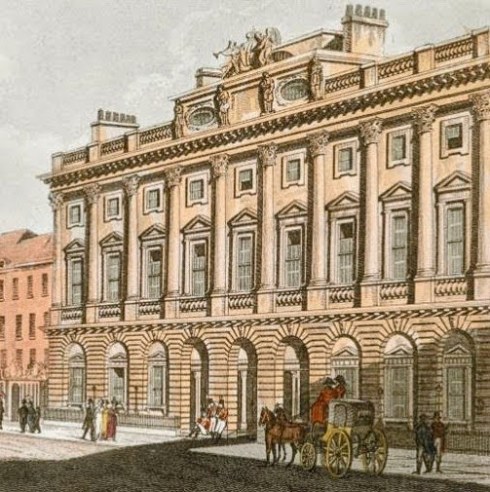
Waters grew up in Salem and went on to Harvard and service during the Civil War, after which he returned to his native city and dabbled according to Hosmer: he “was engaged not earnestly in educational work, collected old furniture, and pored over old documents.” He lived with his parents and unmarried brothers at 80 Washington Square, a c. 1795 McIntire mansion on Salem Common which belonged to his mother’s family (the Townends—who seem to be the reason for his ability to dabble, though his father was a judge). This house was obviously very important to him, as it was his primary residence for his entire long life, but I believe that another “house” was even more important to him: Somerset House in London, a grand classical building on the Strand which is now an arts center, but was the principle probate records repository during Waters’ lifetime—and long after. Waters went to London for the first time in 1879 with his friend Dr. James A. Emmerton (a medical doctor who also preferred to dabble) and they dove into these and other records, looking for anything and everything that might pad the pedigrees of New England families. They were very successful, and published genealogical “gleanings” in both the Historical Collections of the Essex Institute and the Register. Requests for more research were forwarded to both institutions, and in 1883 Waters returned to London as the first salaried “agent” of the New England Historical and Genealogical Society. He remained there (with occasional trips back home) for the next 17 years, during which he traced the lineages of just about every Salem mercantile family and established a national reputation through the continual publication of his genealogical research in journals and books as well as his detailed ancestries of John Harvard, Roger Williams, and George Washington.

80 Washington Square in the 1890s, Frank Cousins Collection at the Phillips Library via Digital Commonwealth; Somerset House in London, Rudolph Ackermann, 1809, British Library; An Examination of the English Ancestry of George Washington: Setting Forth the Evidence to Connect Him with the Washingtons of Sulgrave and Brington (1889).

Waters is credited by his contemporaries with “historical” discoveries as well as genealogical ones: I’m always a bit suspect of archival “discoveries” as that word slights the efforts of archivists, something I am always reluctant to do! But Waters brought several seventeenth-century maps to light, at least over here, including what became known as the “Winthrop-Waters Map” of the coast of Massachusetts c. 1630 and a colored map of Boston Harbor in 1694 which he had copied, as well as Samuel Maverick’s Briefe discription of New England and the severall townes therein: together with the present government thereof (1661) which had been purchased by the British Library several years before his arrival in London. I really think we should term these American discoveries, but they are very much in keeping with Water’s role as a retriever of textual and material heritage.

Copy of “A Draught of Boston Harbor: By Capt. Cyprian Southake, made by Augustine Fitzhugh, Anno 1694;” made for H. F. Waters, Esq., from the original in the British Library, copyright New England Historical and Genealogical Society.

On to the material. Waters’ lifetime closely coincides with the rise of Colonial Revival culture in New England, although he had a headstart on collecting: Hosmer and other observers state that he was able to get the good stuff before antiquing became fashionable and New England became picked over. The authors of the first books on American antiques all referred to him, and Dr. Irving Lyon, the author of the popular and influential The Colonial Furniture of New England is positively deferential, showcasing seventeenth-century chests, a desk and a chair, and other items from the “Waters Collection.” It was clearly all about the seventeenth century for him; I presume he believed that Salem’s Federal-era furniture was appreciated sufficiently in his day.
Furniture from the “Waters Collection” in Irving Lyon’s Colonial Furniture of New England; Essex County cabinet, c. 1670-1710, from the collection of “noted” antiquarian Henry F. Walters, Yale University Art Gallery; An English chair brought to America in the 1630s from Walters’ collection, Museum of Fine Arts, Boston.

This was a man who was appreciated during his lifetime, and after, but I think there is still more to discover and emphasize about him. We could embellish his role as Colonial Revival “influencer”: former Peabody Essex Museum curator Dean Lahikainen emphasized this role in relation to Salem artist Frank Weston Benson in the PEM’s 2000 Benson exhibition. Waters had tutored Benson and his brothers who grew up nearby on Salem Common and several of Benson’s paintings featuring interiors included items from the Waters collection or inspired by it. I think that Waters’ educational roles are a bit underemphasized: he was a gentleman tutor for sure: but he also held formal teaching positions at different times in his life and served on the Salem School Committee. His family is very interesting: he proudly served in the Massachusetts Massachusetts 23rd and in the medical corps, but several of his Waters cousins owned and operated plantations in the south—in Georgia and Louisiana (The Waters Family papers at the Phillips Library in Rowley will yield many “discoveries”, I am certain). And there is also more to say about his genealogical methodology, which I think would be of interest to contemporary genealogists. Salem is projecting a strong and rather stodgy heritage profile during the dynamic Gilded Era, and Mr. Waters was one of its most prominent exemplars.