Tag Archives: Day Trips

Camellia Days

Nineteenth-century monied New Englanders loved camellias and living embodiments of their desire exist at the Lyman Estate greenhouses of Historic New England, which hosts “Camellia Days” in February and March when these old trees are in bloom. Somehow I miss this event every year, but not this year. I drove to Waltham on Wednesday and had a quick view of the Lyman Estate mansion followed by some alone time with the camellias. The Lyman greenhouses are old (1804), and as close as I can get to Salem’s greenhouse era, when there were at least eight (maybe more—my count is ever-evolving) right in the middle of the city. Camellia Days extends to the mansion, which was designed originally by Samuel McIntire, so there’s a more direct Salem connection there too. I was never really a fan of this rambling structure, but now I realize that is because of its robust Victorian additions rather than its original design. McIntire’s plans reveal a charming two-story house unblemished by those bays. I can certainly understand why Arthur Lyman wanted to expand the house in the 1880s, however: he had a large family who enjoyed this bucolic estate as an escape from busy Boston. And I do love the relocated staircase and vaulted ceiling of the added third storey.

The mansion was built in 1793 and expanded and altered in 1882-83, but the Lyman family retained McIntire’s Federal ballroom (which they used as a library) and oval “bow parlor”. The relocated stairway with its Palladian window oversees the grounds and greenhouses.

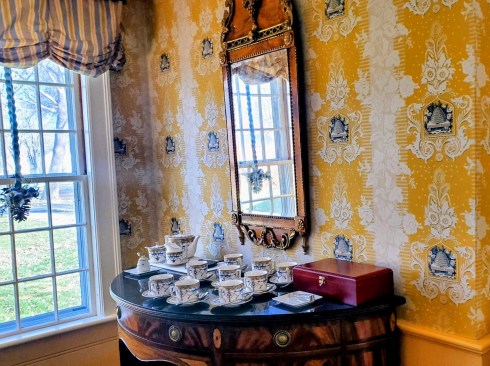
I really liked the very Victorian library as well, but my heart stopped when I entered the adjacent china room with cabinets full to brimming with purple transferware! “My” Waterhouse wallpaper adorned one of the bedrooms upstairs so that was nice too. It’s a lovely summer estate with a preserved landscape in the midst of now-busy Waltham.

But I was there for the camellias and they did not disappoint! These are lush, heirloom varieties. I’m partial to less showy plants in the bright light of summer, but in the very dim light of late winter these bright blooms are just what you need. The Lyman greenhouses are accessible all year long actually (and there are great plant sales), but Camellia Days provide extra enticement.


The Last Week in February

Well, it’s been quite a winter here in eastern Massachusetts, and last week was quite a week, so I think I’m going to take a break from topical posting and just present the week that was. It started with a blizzard, and even though it is now March 1, as I am typing I see big fluffy snowflakes out there again. But not all was white: there was bright blue towards the end of the week as my husband and I proceeded north for a little break. In this topsy turvy winter, Rhode Island experienced 30+ inches of snow while midcoast Maine seems to have had just a dusting. By the time we got up there on Thursday, it seemed springlike to me! We saw my stepson, who works at an oyster farm near Damariscotta, engaged in a bit of house-hunting, and (lucky us) stayed at the storied Norumbega Inn in Camden. The latter was a long-time wish of mine, having driving by the fantasy castle on Route One many a time, and it did not disappoint. After two nights in Camden, we returned to Salem on Saturday for a really cool event at Hamilton HallFashioning Freedom: Layers of Liberty. This was a theatrical performance fashioned as a “a celebratory, historical runway of Black creativity and activism” featuring prominent nineteenth-century African Americans, including the Remond family of the Hall, Frederick Douglass’s wife Anna, educator Charlotte Forten, and sculptor Edmonia Lewis. A collaboration between Salem’s revered historical theater company, History Alive, and the Hall, it was a can’t miss event for me: all Renaissance scholars adhere to the concept of “self-fashioning,” which is just what we saw, and of course after having written about John Remond in Salem’s Centuries it was a thrill to see “him” right in front of me. So it was a very interesting week and I am ready for March!

Monday’s blizzard from my second-floor windows.

And then: bright blue sky and sea in Maine! Obviously there was snow up there too, but less of it and more room to spread it around. City snow can be exhausting: you just can’t find get it out of the way and it is increasingly gray (among other colors). Below are a few houses in Newcastle, Cushing and Friendship, and then we were off to Camden and the Norumbega.

The Norumbega, otherwise known as Norumbega Castle, was built as a private home for Maine native Joseph Barker Stearns in 1886-87 in a style that is generally described as “Queen Anne”. To me, it has always seemed more Romanesque, but its interior was a bit lighter than I imagined—smaller too. Not that it is small, it’s just that the scale is not baronial or overwhelming. We stayed in one of the turret rooms, named Sandringham. Stearns made his millions in the telegraph industry by patenting and licensing duplex telegraphy, by which two messages could be sent over the same wire simulteneously. Camden is a hilly coastal Maine town (with its own municipal ski slope, called the Snow Bowl) and the Norumbega is situated on an elevated site which once, and really still, has unobstructed views over Penobscot Bay. The house remained residential for a century, and then was converted into an inn. We really enjoyed our stay: our room was lovely, as were all the public rooms, and breakfast and bar bites in the small blue cocktail lounge were special touches. We actually saw a bit less of Camden than we expected to because we just wanted to hang out in the castle—you can do that in the winter and not feel guilty. But Saturday morning we knew we had a date with the Remonds so back to Salem we went.

The real Remonds at Hamilton Hall and a few shots from “Fashioning Freedom” before and after the performance. It was a very visual evening so check out Hamilton Hall for more professional photos in the next few days. Congratulations to all involved! The month ended with the news that Salem’s new consolidated elementary school will be named after Sarah Parker Remond–yet another triumph for an important Salem family! I do tend to view them in the collective as they were all so invested and engaged. As we enter women’s history month, here’s a clip of an 1855 petition calling for the resignation of Judge Edward Greeley Loring, the Massachusetts Justice most associated with the enforcement of the Fugitive Slave Act, signed by ALL the Remond women, including matriarch Nancy, her daughters and daughters-in-law, and their friend Charlotte Forten. You can see more at the Massachusetts Archives Anti-Slavery Petititions Dataserve at Harvard University:

https://dataverse.harvard.edu/dataverse/antislaverypetitionsma.


Up North for a Spell

Sorry for the longer time between posts; I generally try (and succeed!) to post once a week but I was on vacation up in Maine and forgot my power cord, which might have been a good thing. I had my Fall Reading List all ready to post, but now I think I’ll save that for next week and just post my Maine pictures this week. We were based in East Boothbay on the Mid Coast, where we have been very casually house-hunting for a summer house. That was supposed to be the mission of this week as well but really it was just a family vacation as both my parents and my brother and brother-in-law joined us, along with a friend from Salem. We had a big beautiful farmhouse right on the water with spectacular sunsets each night. Great New England Summer weather; none of the swampy heat we’ve had in Massachusetts for most of the summer. I had my very first visit to Monhegan Island, which as inspired artists for generations. The other highlight, at least for me, was a visit to one of the National Park Service’s newest monuments, the Frances Perkins homestead in Newcastle. And the capstone was a oyster farming tour of the Damariascotta River given by my stepson Allen, who works at Muscongus Bay in nearby Edgecombe. Just a great week! Posting vacation pictures is definitely low-effort blogging, but I hope you’ll forgive me as I am now in the dreaded syllabus week before the beginning of the semester.

“Our” House with view and sunsets; around East Boothbay.

I could not resist putting my husband John’s lobster pasta in here as he seems to be on a lifelong quest to create the perfect lobster pasta and this was very good!

The Frances Perkins National Monument in Newcastle, with the sign that greeted us in the parking lot!

Maine is very intertwined with Canada, and I heard concerns about few Canadian visitors everwhere I went: given the hostile rhetoric from our President, it was nice to see this welcoming sign. Frances Perkins was a fierce social justice warrior and the first female cabinet member in U.S. history who served as President Franklin D. Roosevelt’s Secretary of Labor throughout his terms. She was integral to the passage of Social Security. This house along the Damariascotta River was in her family for over 250 years: though she was not raised here (her father moved south to Massachusetts for more opportunities, leaving her uncle to carry on the farm) she visited it often. It became a National Historic Landmark in 2014, and President Biden signed its official designation as an NPS Monument in December of 2024. It was quite poignant to visit this place given events recent and past, and there were quite a few people there—-hopefully Americans and Canadians! After we left the Perkins homestead, we drove out to Pemaquid Point, and this is the best picture I have ever taken of that locale so I had to include it.

Monhegan Island. I can’t believe I have never been there but now I have.

Monhegan is just one of thousands of Maine islands, but it is very storied. About ten miles and an hour and a half off the mainland, it’s about a mile in acreage, divided into a small village and lots of forest. Except for an unfortunate experience with sheep, the islanders seem to have been very intent with their land and pursuits, and the result is a very pictorial islandscape which has been captured by a succession of artists for more than a century. I absolutely loved the Monhegan Museum of Art & History, which blended art and history in nearly every exhibit: seemingly there was always an artist around to create posters for lighthouses (Alexander Parris), tea gardens, and baseball games (Frederic Dorr Steele), along with door panels (Karl Schmidt) and tea cups (Rockwell Kent). I could not leave out the lobster claw composition.

Oyster Farming on the Damariascotta River:

My stepson Allen got permission from his boss at Muscongus Bay Aquaculture to take us on a river tour at their Newcastle farm–just down the road from the Frances Perkins Homestead. It was fascinating, and this is seems like such an important industry for Maine (and all of coastal New England I think) right now: the neighboring Glidden Point farm was just featured in an article in the New York Times, and an oyster farmer is running against Senator Susan Collins in the upcoming election. I captured several “oystermobiles” as I drove around, but the one on Georgetown Island in the last photo above is the best.

Coastal Maine Botanical Gardens in Boothbay. The one cloudy day we had was perfect for pictures.

Lots of late summer color and the famous trolls–very popular but I did manage to get a few alone.


Olmsted Central

I have felt vulnerable all summer long, while working on my contributions for our Salem book: my chapters relate to academic fields for which I have no professional preparation, including African-American history (John Remond), art history (the Colonial Revival) and urban planning (Salem’s 20th-century development). I read widely and had support from my colleagues, and all the chapters will be peer-reviewed, so I don’t think I’ll embarass myself in the end, but I’m still a bit anxious. I’m co-writing the last referenced chapter, on Salem’s development from the Great Salem Fire of 1914 to the present, with my co-editor for the entire book, and after I plowed through rebuilding and urban renewal I simply dumped it on him, just done with it! It wasn’t fun to write and I needed some distance to reflect. So that’s what I have been doing for the last two weeks or so, trying to read histories of urban planning for pleasure. This is a field that intersects with the history of landscape design and garden history—and as the latter is more familiar to me I found a comfort zone. So I got some grounding and feel ready to go back into this chapter with some different perspectives and questions. I also realized I needed to cap off my weeks of reading with a visit to what must be the Mecca of landscape history: the Frederick Law Olmsted National Historic Site in Brookline, Massachusetts.

So Chestnut Hill, a beautiful section of Brookline which extends over into Newton, was my weekend destination. This is where Boston Brahmins established their country seats in the later nineteenth century, and because of these considerable investments in land the area still retains its pastoral feel despite its proximity to Boston. At the height of his pathfinding career in 1883, Frederick Law Olmsted purchased an early 19th century farmhouse and several acres of land from two elderly spinster sisters who were reluctant to move: he built them a house next door. Another neighbor was Isabella Stewart Gardner, whose “Green Hill” summer house was built by Salem ship captain Nathaniel Ingersoll earlier in the century. Olmsted did not intend for his new house, named Fairsted, to be a seasonal showplace: it became the center of his business and his practice, as well as a center for the emerging new discipline of landscape architecture. This is the focus of the site’s interpretation: on the practice rather than the personal. The farmhouse was expanded in all directions, most conpicuously in the office addition which served as the headquarters of the Olmstead Brothers after the Frederick Law’s retirement in 1895. The firm endured (as the Olmsted Associates) until 1980, the same year that the National Park Service acquired Fairsted. As you can see from the photographs above, the orginal farmhouse its garden addition are not in the best shape: a planned and funded restoration has stalled due to the quality of the workmanship, and is delayed until the next funding process (but private donations can be made here). The interior of the farmhouse is pristine, and (again) dedicated to telling the story of the Olmsted practice. The office addition is like a time capsule of a 1920s-1930s architecture firm: with a drafting room, a photography room, a blueprint-printing room, a shipping room, and a vault, where all the Olmsted plans are archived.

In the main house: very few personal items, it’s all about the firm. I was primarily interested in the urban planning inititatives of the Olmstead firm as my chapter on Salem’s 20th century development begins with Harlan Kelsey’s 1912 City Plans Commission report. Because the Olmsted projects are so extensive, both in sheer number and geographically, the firm’s archives are always in demand and consequently the NPS has completed a major digitization project and also furnished researchers with an invaluable research guide to the collections. I found five Salem projects, the most important of which is the subdivision of the famous Pickman/Loring farm c. 1900: this was Salem’s first planned neighborhood, and I didn’t include it in my draft chapter (but I’m certainly going to do so now)!

The Olmsted site offers two tours, both of which were given by enthusiastic and articulate interns: one on the cultural landscape, the other on the office and practice. In the first, we learned all about Olmsted’s design philosophy (naturalistic and anti-Victorian, not particulaly interested in PLANTS, “borrowed view”) and the second focused primarily on how the firm was run during the era of the Olmsted sons/brothers. I just loved the office tour: forget AI and digital “reality”: this was immersion!

The Olmsted office wing: photography library with project #s (all materials are preserved in the vault now), drafting room, planting specifications, blueprint-printing room (and a very strange blueprint drying machine), shipping room, little cubbyhole office outside the vault.


The Last Weekend in July

I could have named this post “boats and blooms” because that’s about all I have to offer: this has been a working summer and I am running out of steam so no controversies, critiques or deep dives today. Just boats and flowers. We were up in York Harbor for the weekend and as usual, I bypassed the beach for Portsmouth. I just can’t stay away from that city: it was always the perfect place for me when I was growing up and I moved to Salem because it reminded me of Portsmouth but was a bit closer to Boston. Now it has become my anti- or ideal Salem: without witch kitsch and with smooth brick sidewalks. This year, Portsmouth is particularly festive because it is celebrating its 400th anniversary, and there were tall ships in the harbor, along with the usual display of exuberant gardens, shops, and architecture.

Back home, my father’s plentiful display of bee balm was kind of picked-over by all the hummingbirds it attracts, but still deserves honorable mention. And I never miss the gardens at Stonewall Kitchen’s flagship store in York.

And now for the boats! Something absolutely wonderful happened as Saturday night turned into Sunday morning: a windy storm came in and blew away all of the humidity that we’ve been living with for the past month. I know it’s nothing compared to the extreme conditions that other parts of the country are experiencing, but wow, Sunday felt like a whole new world. We decided to celebrate by going out on a sunset cruise of Portsmouth Harbor on the Piscataqua, a reproduction of a nineteenth-century gundalow, a coasting barge with a distinctive lanteen sail: it always looks medieval to me in the harbor! We sailed past the visiting NAO Trinidad, the Portsmouth Naval Shipyard (which is in Kittery, Maine), Fort Constitution in NH, Fort McClary in Maine and out to Wood Island, with a companion privateer, the Mystic, for the last leg.


Lafayette, You are Here!

I’ll drive down to Newport, Rhode Island for any occasion, and Bastille Day seemed like a good one as French expeditionary forces landed there in 1780 as part of their formal and personal commitment to the American Revolution, a commitment that is honored today by the “French in Newport” festivities on the second weekend of July. From the Rhode Island perspective, the French “occupation” of Newport is the beginning of the end, the road to Yorktown and independence started there. A friend had lent me the Newport Historical Society’s Winter/Spring 2023 issue of its journal, Newport History, which is entirely focused on the French in Newport, so I was well prepared by articles on “The Washington Rochambeau Revolutional Route National Historic Trail,” (from Newport to Yorktown of course), “Forging the French Alliance in Newport,” and “A New Look at how Rochambeau Quartered his Army in Newport.” I arrived just in time for the comte de Rochambeaut’s proclamation, wandered about checking in on my favorite Newport houses and others in which the French were quartered, and then returned to Washington Square to hear the Marquis de Lafayette give an amazing little talk on how he was inspired to cross the Atlantic and join the American ranks. I was quite taken with the Marquis, and as he was speaking an extremely precocious boy yelled out of the window of a passing car “Lafayette, you are here!”

 Print depicting the arrivl of Rochaembeau’s troops in Newport in July 1780, Daniel Chodowiecki, The Society of the Cincinnati, Washington, DC.

Rochambeau and General Washington got on very well, and had lots of planning to do during that fateful year, so Washington was in Newport too for a bit, staying, I believe, at the Count’s headquarters at the William Vernon House. George Washington 2023 was not in Newport, but a replica of his field tent was, as part of the Museum of the American Revolution’s “First Oval Office” initiative. It was rather intimate to go in there—I’ve really got to go and see the real thing, the ultimate “relic” of the Revolution—in Philadelphia. While the French rank and file seemed to be on duty, the officers were relaxed and conversational, underneath their own tent on in the Colony House nearby, wearing light floral banyans when not in uniform. I had not been in the Colony House for a while and had forgotten how grand it is. Certainly worthy of Newport.

A cool (actually very hot) bakehouse on site with an enormous clay (???) oven in back from which you could buy a toasted slice of bread with salt pork butter………

The Colony House, a private home on Spring Street where Francois-Jean de Chastellux, the liasion officer between Washington’s and Rochambeau’s armies, lived while in Newport, one of my favorite Newport houses which must go into every Newport post, and the tricolore.


Colorways: a Parade of Portsmouth Doors

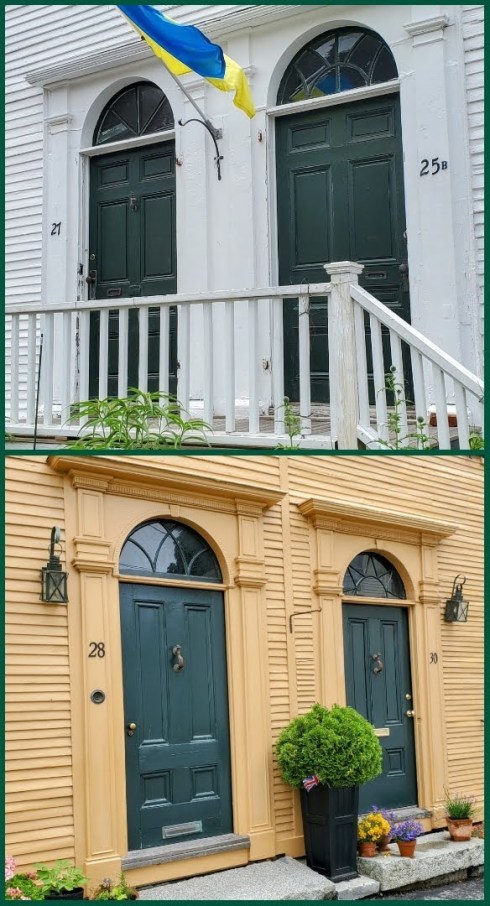
I’ve been in York Harbor all June and just returned to Salem. It was a very productive month removed from daily tasks and diversions, but I missed certain things and people: my husband (I brought the cats), my garden, my street. Certainly not the tour guides and groups though: they were in part what drove me away. Of course I found the usual Dunkin iced-coffee cup propped up on my stoop the moment I got home. Salem is busy and festive all year long now it seems; while the incessant witch tourism annoys me the other celebrations are great, and June is a particularly festive month with its mix of private and public celebrations: weddings and graduations, Juneteenth and Pride. Salem goes all out for Pride and  I missed that, and definitely craved some color amidst our rainy and foggy weather, so I took off for Portsmouth late last week seeking flags but finding doors. When I was growing up across river, Portsmouth was a much shabbier place: now you are hard-pressed to find an old house that is not in perfect condition. I expanded my usual downtown walk to include neighborhoods a bit more outlying like that bordering Christian Shore and the South End, and found so many lovely houses, all with very colorful entries. Red was an exotic front-door color before; now there is a veritable rainbow of Portsmouth doors. And I’ve got some flags here too.

Ok, I think I have the whole spectrum represented! It was surprisingly difficult to find white doors: as you see, one is hiding behind a tree. I wasn’t sure where to put taupe, so I paired it with brown. There are no painted brown doors, just various shades of natural woodwork. Not too many black doors either, but lots of green, and lots of yellow. Do not tell me that one of my purple doors is blue; it is purple. Portsmouth is the best walking city ever: beautiful neighborhoods, dynamic downtown, tons of historical markers, pocket parks, well-maintained sidewalks. More rainbows are there for the making!

Some singular Portsmouth doors: two-tone green and Happy Fourth!


Connecticut Calm (Waters)

I’m generally anxious around this time of year, approaching the end of the semester, but this year I am particularly so: I seem to be uneasy in general and in Salem in particular. The nice weather has kicked off the tourist season earlier than ever, or maybe it never ended? This means large tour groups just outside my house as late as 10:00 at night, with guides speaking about the ancient “ankle breaker” stones along the sidewalk that my neighbors and I installed in the last decade or so. Run, run, to the back of the house, I tell myself, so I don’t have to hear any more, but sometimes I just don’t want to get off the couch—and one guy is so loud I can even hear him way out back. A change of scenery (and perspective) was definitely needed, so for the long Patriots Day weekend my husband and I took off for one of the prettiest towns in Connecticut (a state with many pretty towns): Essex, near the mouth of the Connecticut River. We stayed at the old Griswold Inn, in one of its newer suites, and ate and drank and looked at old houses and the river. It was very foggy, but there were daffodils everywhere, and I do feel a bit cheerier now that I’m back home (or in Salem).

Welcome to Essex, Connecticut!

I started decompressing as soon as we got on one of my favorite Connecticut small roads: Route 169. Well, before, really: right over the state line in Thompson, which has a great common surrounded by wonderful houses (including the resurrected Gothic Revival long neglected by the famous interior designer Mario Buatta). Route 169 leads you through Woodstock, and by Roseland Cottage, to Canterbury, where the amazing Prudence Crandall opened her school for African-American girls (what an amazing woman! I need to know much more about her), to Norwich, where we turned south and drove by the decaying buildings of the long-abandoned Norwich State Hospital which are such a sharp contrast to the shiny Mohegan Sun casino across the river.

The road to Essex: Thompson houses, Roseland Cottage (which I visited just last summer), Prudence Crandall’s school in Canterbury, and one of the derelict buildings of the former Norwich State Hospital (with a glimpse of Mohegan Sun across the river).

I think my husband thinks that Essex is a bit “Truman Show-esque” but it was just what I needed:  a lovely town with clean sidewalks that is proud of its history rather than seeking to sell it 24/7. The houses are pretty perfect, but they are not mansions. It’s really all about watercraft in Essex: this was a rather quiet time but its harbor will be full to brimming in a month or so. Essex built a famous warship for the Revolution named the Oliver Cromwell (which was renamed the Restoration when it was captured by the British in 1779!), it endured the burning of 27 of its privateering ships when the British raided the harbor in April of 1814, the storied schooner yacht Dauntless ended her career on the Essex waterfront at the turn of the last century, and famous steamships line the walls of the Griswold Inn. The wonderful Connecticut River Museum, housed in an old steamship warehouse, explores the layers of local maritime history through art, artifacts and narratives in such an engaging way that I really felt the connection of water to land over history and now I’m absolutely inspired to take another New England road trip: a longer one, up the entire length of the River from Saybrook to Canada.

An array of Essex houses (birdhouses are big in this town too); the Onrust, a replica of a Dutch colonial ship, is moored in front of the Connecticut River Museum (my husband John is looking for me, I think); the Turtle, a Revolutionary-era submarine, which was built just up the River. I love the caption of this c. 1860 painting of Captain and Mrs. Samuel L. Spencer: “Captain Spencer of Old Saybrook, shown with the most important females in his life: his wife and his ship. He was captain of Daniel Webster of the London Line of packets for more than twenty years.” The Connecticut River Museum’s exhibition of Watercraft at Work made even BARGES interesting, and among the items I found my very favorite ship name of all time: of the schooner “Tansy Bitters”.


Deerfield Thanksgiving

I know that it was a back-to-big-family-Thanksgiving for many people, but because of health and almost-conflicting family events my husband and I found ourselves alone this year. We made a last-minute decision to head to Historic Deerfield, where we stayed at the Inn for two nights and had a lovely Thanksgiving dinner at the Inn at Boltwood (previously the Lord Jeffrey Inn) in Amherst. We ran into old Salem friends and made new Pennsylvania friends at the Deerfield bar, walked around and in as many of those magnificent houses as we could, and “played” in the attic of the Flynt Center for Early American Life. I have under-appreciated this experience on past visits: there was something about this particular visit that made the “visible storage” of all sorts of items from Historic Deerfield’s collections—everything from ceramics to muskets to wrought iron, in multiples—so very engaging. Maybe it’s because we had this “attic” to ourselves. My husband and I have very different tastes, but he could be over there in the realm of metal-working tools while I was lingering in mocha ware, both of us content. We left the attic only because the weather was so beautiful: clear and sunny and bright, casting all those Connecticut River Valley doorways in stark relief.

Historic Deerfield has always been an exploration of maker/craft culture as much as architecture so a focus on objects on this particular visit seemed correct: I’ve always been too dazzled by the houses to take in the Deerfield-made baskets, famous blue-and-white embroidery pieces and pottery to take proper note of them in situ. Before there was Historic Deerfield, there was Arts and Crafts Deerfield, a haven and destination for traditional crafts and preservation at the turn of the last century, and before then there was of course colonial Deerfield: you can see and feel the layers as you walk down Old Main Street. We had the neighborhood to ourselves as we took a long walk on Thanksgiving morning, so we looked in a lot of windows and hung out in back amongst the barns.

A walk down Old Main Street from South to North and then back towards the Inn: village map with house names and dates.

A recent addition to Old Main Street are the Witness Stone markers laid before every house in which an enslaved person live and worked: these were installed just last month in partnership with the Connecticut-based Witness Stones Project. So there’s another layer uncovered and exposed. Museum neighborhoods can feel a bit static and fixed in time, but I’ve never felt that way about Historic Deerfield: rather it has always seems like an engaging mix of past and present or a cumulative work in progress to me. At the same time, time moves slower there: just turn off Route 5 for an hour or a day or two and catch your breath, take a walk, or rummage around in an attic.

Witness (to slavery) stones, a work in progress, and a signpost right in the midst of Deerfield Academy.


Flight to Newbury

While I usually make plans to be as far away from Salem as possible on Columbus/Indigenous Day weekend to avoid the crowds and traffic, we had obligations this year so I was stuck in town. I can hide in my house or run over to the Salem Woods to escape the tourists, but not my feelings of anxiety at this time of year. It’s really hard for me to embrace the party as I can’t forget it is based on collective and individual tragedy so I’m just kind of seething in Salem. I wish I could lighten up, but I can’t so the best thing to do is get out of town: if not for a weekend at least for a day, or even a few hours. So as soon as I heard the laughter outside of my house I ran outside, jumped in the car, and drove north. The Newburys (Newbury, Newburyport, West Newbury) always calm me down with their seemingly endless inventory of perfectly restored old houses and litterless streets. Plus, this weekend the “Battle for Newbury” was on at Historic New England’s Spencer-Peirce-Little House: certainly a Revolutionary-war reenactment would distract me. And it did.

Two preserved early Colonial houses in very different places: Salem’s Witch or Corwin House and Historic New England’s Dole-Little House in Newbury. Heading north on Route 1A you come to another HNE property, the Spencer-Peirce-Little Farm, scene of the annual “Battle for Newbury.” Abbreviated tours of the house, which is dated 1690 with many later additions, were offered so I popped in with a bunch of soldiers (dining-room mantle, Federal parlor and back staircase above) but it was such a beautiful day to be outside!

So of course the real battles for Newbury occcurred across the pond during the English Civil Wars but it’s always fun to be with people who crave history, even in an idealized sense. That is certainly not the environment in Salem. And it was peaceful in Newbury, even with the mid-afternoon skirmish: clearly the reenactors, both soldiers and civilians, like to spend time together indulging in camp life. There were colonials from Rhode Island and Acton and Marblehead, Massachusetts, and the redcoats in His Majesty’s 10th Regiment of Foot are from Wrentham, I think (though they drill in Lexington). After a few hours at the Farm, I made a little tour of other seventeenth-century structures in Newbury and Newburyport and ended up at another Historic New England house, the Coffin House (1678), home to generations of the prolific Coffin family. I had a great tour and learned all about the evolution of the house, from its later seventeenth-century origins (oriented south), to its 1712 addition (what you see in “front” from Route 1A), and its 19th century division (so many interior windows!) and acquisition by Historic New England (then the Society for the Preservation of New England Antiquities) in that fateful year of 1929. So much history, so much texture! So calm.

The Coffin House in Newbury: exterior and original (back) house and newer (1712) addition in front: main room, bedroom, buttery, Georgian kitchen and parlors.