Tag Archives: Commodity History

Finishing my 2025 Books

I’m still working on the fall version of my 2025 reading list even as the year draws to a close. I certainly won’t finish it by the end of the year, but I have a LONG break ahead of me as I have a sabbatical for the spring semester! Lots of great books coming out next year (including my own) so I better get going. Next week, I’ll post about Salem’s Centuries as its publication date is January 6 (hoping to change the vibe for that particular date). This is a really good working list of books that I have read, am currently reading (I tend to read books concurrently) and plan to read pretty soon, all of which were published in 2025. In fact the last book is due to be published tomorrow, so I don’t have it in my possession but I pre-ordered it. As usual, this is a nonfiction list; I just don’t read very much fiction so I can’t offer up any kind of a guide to those genres. I read history, history of science, art history, the history of food and drink, folklore, and books about various types of design and architecture. That’s pretty much it. Maybe a bit of politics and popular culture—and media, but the vast number of titles for fiction and self-help books appearing every year seldom catch my attention. So here goes, beginning with books in my period that I felt that I had to read but were nevertheless quite good.

I thought Borman’s book was going to be just a narrative of Elizabeth’s declining years, death, and the succession of James I and VI, and it was that, but it was more too—I learned lots of little things I did not know about these years. Borman is more than a television presenter, clearly: this is a very source-based history, with particular reliance on new revelations about William Camden’s Annales. Just further complexities relating to James for me! I think I have a book on him on many of my book lists here, and as 2025 was the 500th anniversay of his death I had to have one more: Clare Jackson’s Mirror of Great Britian is amazing, one of the best royal biographies I’ve ever read, and that is saying something as James was complex: earnestly Protestant but also a pursuer of pleasure, well-educated but also a true believer in demonic witchcraft, the only contemporary critic of tobacco, the first King of Great Britain. He’s a lot, and Jackson handles both the man and his era really well. Getting away from royalty and this specific era, two other British books which I am kind of reading together, gradually (they are both what I think of as “dipping” books in that you can pick up and dip into them wherever and whenever you like) are all about food and folklore—both just completely entertaining and informative at the same time.

I like to read books that are sweeping in terms of their topics, sweeping over the centuries: a change from most of the academic reading I do which is much more constrained in terms of both topic and time. The very popular genre that I call “commodity history” often includes sweeping titles, but as its title asserts, Jordan Smith’s The Invention of Rum is more narrowly focused on the invention of this “perfect” Atlantic spirit. Another “invention” book (though I really don’t think “design” was invented in the twentieth century but that’s why I want to read The Invention of Design) covers only the twentieth century. A really fascinating book blending history, magic and medicine (one of my favorite combinations), Decoding the Hand covers more ground.


I have my natural, constant interests, but if I’m looking for something new to read the first place I go is to the website Five Books, at which experts recommend five books in their areas of expertise and lots of lists to inspire a wider range of reading. I love this site! One great book that I never would have found on my own came from here: Sara Lodge’s Mysterious Case of the Victorian Female Detective, which was on the shortlist for this year’s Wolfson History Prize, awarded annual for both well-researched and accessible (enjoyable!) history writing. This book was definitely both, and a case study in utilizing historical and literary sources.

Finally, three books of a more timely/political nature. The medievalist Patrick Boucheron has written a great book about Political Fictions over time, I am searching for some explanations for/relief from the NOISE that assaults Salem all year long so I purchased Chris Berdick’s well-reviewed Clamor (though I’m sure he will take on all the sirens and jackhammers but not the tour guides), and I think we should always remember January 6 (for more than the publication of Salem’s Centuries) so I’m going to read Nora Neus’s oral history on that day.


Fall Reading 2025

The stars seem to have aligned and I am all set for a fall full of reading. Salem’s Centuries is in production (and out on January 6), my new saffron project hasn’t taken flight yet, and I have a course release for the semester. I’ve written two books in five years and now is the time to ingest. Escaping into book worlds is another way of avoiding my least favorite season in Salem as well. So I have a long list, already about a quarter devoured. As usual with my book lists, it’s very light on fiction, heavy on history, and reflective of the odd ephemeral interest. So let’s go: it will be interesting to see how I group these rather disparate texts.

I think I’ll start out with broad, cultural histories as they might have the most general appeal: I’m always reading “commodity histories” and this year will be no exception, but I have to tell you that Robert Hellyer’s Green with Milk and Sugar has a bit more depth and dimension than most books about tea—and there are a lot of books about this particular commodity. I had the difference between black and green teas down, but did not discern between different types of the latter (and their impact) until I read this very interesting book. Another important global commodity, sugar, has also received quite a bit of attention from scholars (beginning with Sidney Mintz’s classic Sweetness and Power) but the latest effort, the Dutch economic historian Ulbe Bosma’s World of Sugar, is supposed to be particularly comprehensive. I bought it last year but haven’t delved into it yet. Super excited to read Catland: how can it not be amazing? I’m not sure where to put Chanterelle Dreams, Amanita Nightmares, a book I discovered in the gift shop of the Coastal Maine Botanical Garden a few weeks ago solely for its title (+ lore), in this post so I guess I’ll put it here: it is kind of a broad cultural history of human perceptions of muchrooms. It’s also very much a “pick up and read a bit” book.

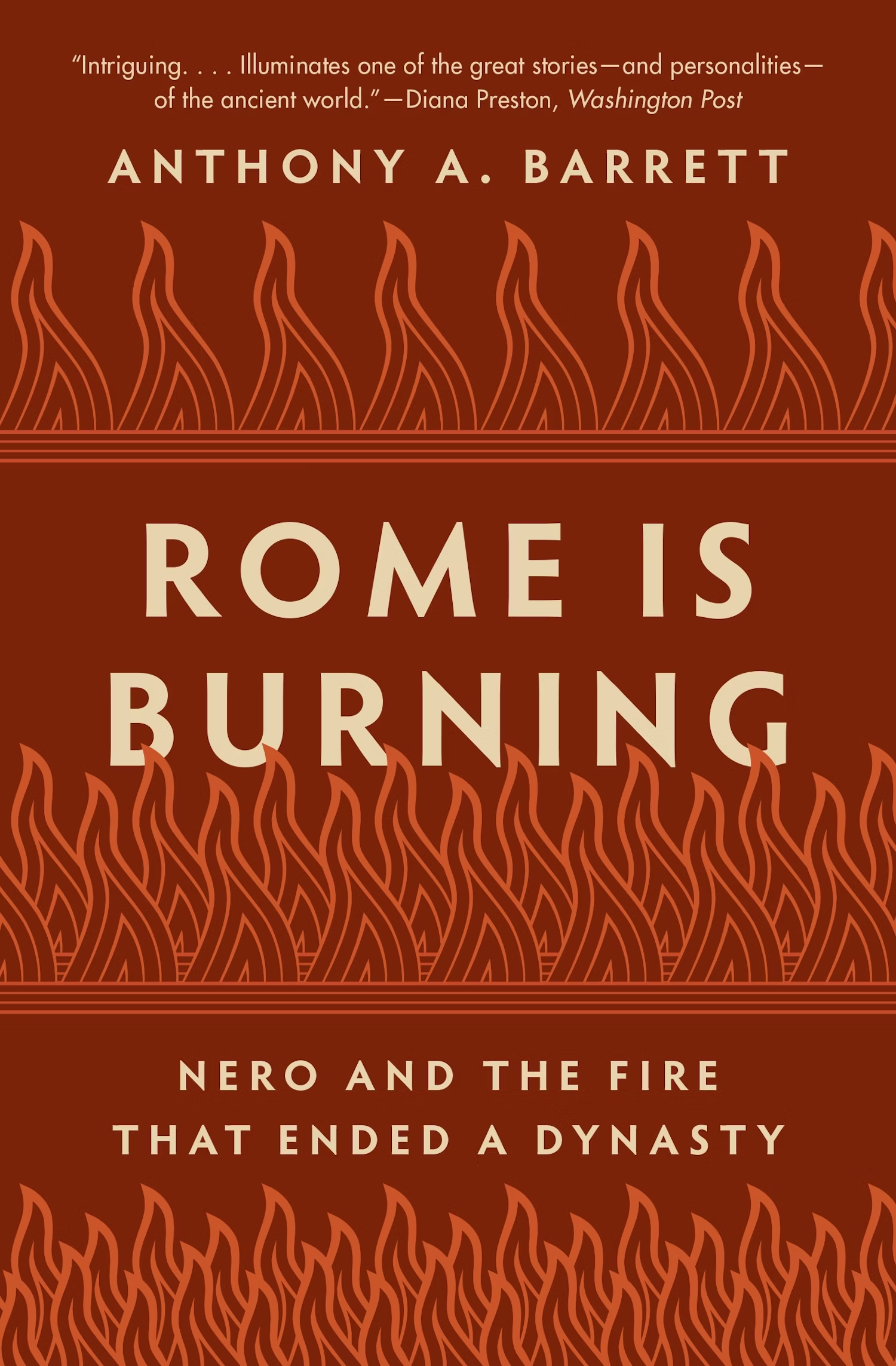
I find that I am reading new books on the Atlantic Slave Trade regularly because we are in the midst of a golden age of research into the history of this terrible trade and provocative analyses of its cascading impacts are published every year.  Traders in Men and Plantation Goods are on my fall list but I should have read them this summer, in advance of teaching my Introduction to European History course. Instead, I had a “Roman interlude” prompted by a re-reading of Suetonius’s Twelve Ceasars last spring. So two half-read Roman books are on my fall list too: a very accessible history by Anthony Barrett about Emperor Nero and the burning of Rome and a book by Roland Mayer about Roman ruins which is more about later perceptions of Rome than Rome itself. The Mayer book probably belongs with the broad cultural history books above. I have started Traders in Men and Plantation Goods (as you will discern by now, I read books in phases, concurrently with other books, a habit I’ve been trying to break but cannot) and my assessment so far would be: both very important and well-sourced studies, with Plantation Goods probably more accessible as it focuses on the basic. It is very much a “material history.”

There are several books which were recently published in my scholarly fields which now sit beside my bed in a stack: first up is Inventing the Renaissance and then we have two books on major late Tudor/Jacobean players: George Villiers, the Duke of Buckingham, and Robert Cecil. I’ll read these for myself, but also to discern whether or not I’ll assign them to students. Stephen Alford (author of All His Spies)’s previous book, London’s Triumph, was a big hit among my grad students this past summer. I suspect that Palmer’s Inventing the Renaissance will be great for historiographical discussions in both undergrad and grad courses. And because it was set in my period and in an interesting period in Mary, Queen of Scots’ life, I actually read a novel all the way through this summer: Flora Carr’s The Tower.

Finally, books on more topical interests which are preoccuping me constantly and/or currently. I’m always interested in architecture, and I read one book this summer which I loved: Thomas Heatherwick’s Humanise (it’s spelled Humanize in its American edition but I prefer the British one’s cover). I don’t think many architects like this book as it is quite critical of contemporary architecture not so much on the basis of design but of craftsmanship. Heatherwick has provoked a reaction among architects in the UK (I’m not sure about here) as he is not an architect himself and does not hold back on characterizing much present-day building as both soul-crushing and soulless (generally because it is so boring) and has launched a campaign to bring joy and craftsmanship back to construction. He’s a real crusader! I’ve been interested in the urban planning idea of the “15-minute city” for a while, so I picked up Shrink the City to learn more about it. The whole idea of meeting all your needs within a 15-minute radius could work for a city with the infrastructure of Salem, but not if we continue our comprehensive commitment to witchcraft tourism, which has resulted in a multitude of witch shops replacing those selling clothing and groceries. As this past year I seem to have become preoccupied with symbols and emblems, first because of the ongoing discussion over the Salem city seal and more recently by the dumbing-down of the Massachusetts state seal and flag, I’ve really been searching more insights into visual culture and graphic design. It’s like another language which I don’t understand. One book that has really helped me is the classic Megg’s History of Graphic Design, but I welcome suggestions. I have yet to find a thoughtful or even interesting book on vexillology.