Tag Archives: China trade

Salem Silk Swatches

Periodically I dip into the papers of Salem supercargo Benjamin Shreve (1780-1839), which offer interesting and insider perspectives on Salem’s early 19th century global trade. Fortunately these sources have been digitized by the Phillips Library, but even before they were available to the general public I had access through an Adam Matthew source collection, to which the Salem State Library has subscribed for quite some time. Benjamin Shreve is interesting, as he is not from one of those old Salem families (nor is he attached to the Shreves of Crump and Low): in the Boston Weekly Magazine for July of 1804, he is described as a “merchant of Alexandria” in the notice of his marriage to Miss Mary Goodhue of Salem, but he quickly made his mark in his wife’s native city. Shreve opens a window into a world of trading logistics and trends through his meticulous commercial correspondence: he’s a numbers guy for sure but also a diplomat of sorts, negotiating the best price and quality for his Salem purchasers back home from his suppliers in South America, East Asia, and Europe. Wherever he goes, he has to fulfill large orders but also buy smaller items for all the wives of his employers back home, as well as for his own. He writes everything down, sometimes in duplicate or triplicate. If I dig into his papers for long my head will start to swirl, so I have to be pretty focused, and this time I was focused on silk. I’m in the exciting stage of research on my next book, which is on saffron in the late medieval and early modern eras, and there are some interesting parallels between it and silk, so that’s where I was coming from, but how I ended up in 19th-century Salem I do not know; I guess it’s just that persistent Salem tug on my time! Anyway, I was looking through a bound book of Shreve’s miscellaneous memoranda from 1809-30 when I came across these cool silk samples in the midst of much drier fare: I was caught!

Benjamin Shreve Papers (MH 20), Trade Memoranda, 1809-1830, Phillips Library, Peabody Essex Museum.

These are samples of Italian silks sent to Shreve by a friend in letter packets, with advice on how and where to buy silk in Italy. It’s 1819; Shreve has certainly been buying silk in China for a while, but he was always looking to expand his sources. I think this is so interesting because I have long thought that Salem’s trade with Europe as compared to Asia has been under-represented in the scholarship. Italy and France were great suppliers of silk so why not buy there if the price was right? And Shreve himself is also under-represented in the scholarship! Why isn’t there a book on him, using all of his amazing accessible papers? He is best represented in China Trade expert Carl Crossman’s book, The China Trade: Export Paintings, Furniture, Silver and Other Objects, 1785-1865, which was published in 1972 and reprinted several times afterwords. Crossman knew the collections of the Peabody (now Peabody Essex) Museum and its library very well and drew on them heavily—I learn a ton of stuff whenever I pick up his book. And as I was just reading about Shreve there, I found two other “Salem silk swatches” from the Shreve papers included by Crossman as illustrations: two sheets of silk samples from the Chinese merchant Eshing given by Pickering Dodge of Salem, owner of the Governor Endicott, to Shreve as a buying guide for Canton, and a letter with some strands of raw silk from Dudley Pickman to Shreve–plus a miniature portrait of our man Shreve on ivory! Crossman digs even deeper into some of the Shreve sources for his last book, The Decorative Arts of the China Trade: Paintings, Furnishings, and Exotic Curiosities (1991). Encouraged by Crossman, I went back to Shreve (for just a bit!) and found one more silk swatch among the Government Endicott papers, a sample of black “Levantine” silk. 

Not for the first time, my title is a bit deceptive: swatch books from the early modern era and after are numerous and generally refer to sample books offered up by producers rather than buyers. The Victoria & Albert Museum has several in its collection, including my favorite, a confiscated traveling salesman’s book of silk samples from Lyon, reproduced in the amazing book Selling Silks. A Merchant’s Sample Book 1763 by textile curator Leslie Ellis Miller. Shreve’s snippets of cloth, embedded in commercial paper, can’t compare to a comprehensive collection such as this, but they certainly offer some visual insights into the global trade of this conspicuous commodity in the early nineteenth century.


History is Gray

For the past month or so, I’ve been considering the case of the Salem City Seal and various reactions to it. In the past, before last month, I’ve probably thought about the seal for 5 minutes; over the last month, I’ve been thinking about it for many hours—too many, certainly. If you haven’t read my previous posts, here is what happened, succinctly: several members of the Salem community complained that the seal, with its depiction of a Sumatran man, pepper plants, and Salem ship, was stereoptypical and insulting to Asian-Americans. Their condern and complaint was brought to the city’s Race Equity Commission, which had deliberations over the summer and concluded that “damage had been done” and the seal should be redesigned. The Race Equity Commission reported this finding to a subcommittee of the Salem City Council which concurred (I think), but somewhere in the process someone stepped in and suggested a public task force to add some transparency and public comment to what had heretofore been quite a closed process—I think at best 40 people knew that our circa 1839 seal was deemed suspect in a city of over 40,000.  And this is what the City Council finally voted on: the creation of a task force which will sit for 18 months and hear public testimony and garner historical perspectives. So that’s where we are and I think that’s a good place, in theory. In practice, I have my concerns, because I’m just not sure those in positions of authority have the capacity to grasp historical perspectives, frankly. In the Salem of my experience, every single public history issue has been black and white, villains vs. heroes, the powerful and the powerless, with an overcast of green, for money. Nothing is nuanced, multi-causal, two-dimensional, or gray, and that’s a problem, because most of history is gray. Salem has been without a professional historical society for a long time, and it shows.


Salem Stereotypes: Seal and Patch

My first concern about how this whole process will play out relates to stereotypes. The original accusation against the seal was that it represents a generic “oriental” stereotype. I can understand that, at face value. But before I gave the seal much thought, I always thought it was really cool for its cosmopolitan character, depicting a ship over there rather than in Salem Harbor. So I sent a note to our city councillors asking them to consider the very global nature of this very early civic symbol. About half wrote back, all but one branding the seal’s figure a stereotype. This got my dander up as it indicated a general closed-mindedness before we had even delved into the matter, and of course I couldn’t help but think about the certain stereotype which is everywhere in the Witch City. Wasn’t this a hypocritical position on the part of our Councilors, given that there is a crone-like character with a pointy hat riding on a broomstick on all of our police cars? And you know, people died who were not witches. (Edit: a city councillor informed that the City Council does not approve “mascots,” only the seal, so the omnipresent witch is not under their jurisdiction—I have to say that it’s not particularly uplifting to know that the Salem schools would choose the witch as their “mascot”).  No matter—there’s really no questioning this particular stereotype, and no constituency for its removal. The historical record regarding the intended depiction of the city seal’s character is pretty clear: he was supposed to be from the specific part of Sumatra (Aceh) which grew the pepper which was so sought after by Salem ship captains and merchants. He did look vaguely Asian to me except for the hat—the hat was a little different and a little distinctive and I thought I had seen it before. And then I remembered: Theodor de Bry, a Dutch engraver and publisher who specialized in depicting and disseminating images of “new” people as Europe intensified its voyages of expansion and conquest in the early modern era. Below is a 1599 engraving by de Bry’s son, and an image from nearly three centuries later of a group of Aceh men during the brutal Aceh War with the Dutch. Same hat, right? But again, it doesn’t matter:even if Salem’s seal features a unique provincial figure and not a general stereotype, if people label it as the latter it becomes one. There’s only so much history can do.

J.T. de Bry, Inhabitants of Sumatra, 1599, Bartele Gallery; Aceh envoys seeking British support against the Dutch in the Aceh War, 1873, Bridgman Images.


The “enormous condescension of posterity”.

George Peabody, Salem alderman and son of Joseph Peabody, one of the city’s wealthiest merchants, chaired the committee that designed the seal following the adoption of a new city charter in 1836. As a Sumatra trader himself, Peabody had familiarity with Aceh and its people, but again, I’m not sure this really matters. As expressed by public opinion, it seems to me that those for a complete redesign of the seal and against are rather equally divided, but last week a long column was published in the Salem News which condemned support of the Sumatran image as “toxic nostalgia.” It’s a well-written piece, so it commanded my attention, as did its almost-complete ahistorical argument: it’s an excellent example of labor historian E.P. Thompson’s famous quote, “the enormous condescention of posterity.” According to the author, “regardless of what the seal was meant to celebrate, it must be acknowledged that George Peabody was a product of his times and that the seal he designed reflects a lot of the imagery that came to be associated with western notions of superiority over eastern peoples.” Coincidental with the adoption of the seal in 1839 was the beginning of the shameful Opium Wars instigated by Great Britain upon a weak China, and as “some American merchants (including no doubt some from Salem) did engage in the Opium Trade and benefitted from the British actions in China” we should reject the seal on the basis of this connection? Are we also to reject the East Asian collections of the Peabody Essex Museum, all the Federal Salem houses built with fortunes made by pepper and spices, and the navigational expertise of Nathaniel Bowditch, whose miraculous return from Sumatra in 1803 made The New Practical American Navigator authoritative? Are we to reject anybody who had anything to say in 1839 and just wallow around in the progressive present? If so, it’s going to be a bit difficult to learn from the past. George Peabody’s time seems far less toxic to me than later in the nineteenth and twentieth centuries, when the Chinese Exclusion Act of 1882 and its extensions unleashed a cascade of anti-Asian vitriol in the United States, and we should all note that one of Salem’s most famous native sons, Joseph Hodge Choate, argued against the Act before the Supreme Court in 1893.


History is not cherry-picking.

Proponents of the seal tend to talk about “history-erasing” and its critics focus overwhelmingly on the violence which characterized the trade with Sumatra, which led to two US interventions after American ships were attacked by Malay pirates. Indeed, it’s not a pretty picture, but history seldom is. It is certainly not true that it was a one-way trade imposed upon the Acehnese: American ships brought a lot of silver over there. I’ve been reading as much scholarship as possible since this seal business began, and last week Anthony Guidone, an assistant professor at Radford University in Virginia, forwarded me his dissertion, “The Empire’s City: a Global History of Salem, Massachusetts, 1783-1820” (George Mason, 2023). It’s a detailed interdisciplinary study: I hope it gets published soon so everyone can read it. Guidone gives us the complete picture of Salem’s first global age: the black and the white, and lots of gray. Trade with Asia brought great wealth to Salem but also intensified its connections with slavery and the plantation economy in the Caribbean. But at the same time, it also benefitted a much wider slice of Salem’s population than I had realized, including African Americans and women, and facilitated the creation of a diverse community of sailors (he makes great use of the Salem Crew Lists 1799-1879 at the Mystic Seaport Museum, a great resource). In summary, Salem’s trade with Asia impacted “nearly all aspects of life in the town, changing Salem’s economy, politics, race relations, material culture, civic identity, and historical memory.” Whew! Even though the dissertation ends in 1820, Guidone expands it a bit further to discuss Salem’s anniversary moments in the next decades and the adoption of the city seal. He sees the commemorative focus on commerce by newish institutions such as the East India Marine Society and the Essex Historical Society as evidence of the desire to “construct a narrative that posed an alternative to the town’s witch-hunting past” even as (or because of ???) encroaching commercial decline. I agree completely: members of these institutions tended to identify the witch trials as a “stain” rather than an opportunity and waved no witch flags. How backward they were!

I’ve got to admit, Paul Revere’s first Massachusetts seal from 1775 is my favorite, even though its central figure cuts a rather simplistic figure.

Salem’s Bêche-de-mer Boom

Back in Salem until I take off for Scotland at the end of next week. I’ve got lots of teaching, writing, and organizing to do, but I ignored all of my obligations last weekend and read a fascinating book about early American trade in the South Pacific: Nancy Shoemaker’s Pursuing Respect in the Cannibal Isles. I couldn’t put it down! It gave me all sorts of insights into a very particular and profitable trade dominated by Salem merchants and sea captains in the 1830s and 1840s: in bêchedemer or sea cucumbers, highly sought after in China for medicinal and culinary uses. Trepang (the primary eastern term) were and are sea cucumbers (often called sea slugs in the 19th century) which were processed in a special way, still in use today: boiled in sea water, placed in baskets and washed again, then dried in smokehouses. A Pacific example of the importance of dried seafood in world history, the bêche-de-mer trade was characterized by boom and bust phases over its long history due to overfishing in response to the sustained demand, but in the 1830s and 1840s Salem traders were very dominant. Shoemaker provides her readers with an appendix of Salem ships engaged in the trade, from ship Clay in 1827 to bark Dragon in 1857, with all sorts of familiar Salem names on board. William Driver, of Old Glory fame, then second mate on the Clay, claimed that he was the first “white man” (not westerner, or American, or Salemite) to execute the bêche-drying process sucessfully, thanks to the instruction of a band of pirates from Manilla. This trade has it all, believe me: daring captains working for equally-daring shipowners engaged in a risky trade that was potentially lucrative but also completely dependent on native “cooperation,” profit-seeking pirates and bureaucrats, a range of nineteenth-century ethnographic attitudes, tales of cannibalism and violence, big money.

Still very much in demand: bêche-de-mer at a Hong Kong market, photo by G. Clayden

My colleague Dane Morrison works in the field, and I can understand why he finds it so enticing: the stories and the sources are amazing, lending great narratives to important historical analyses of trade, imperialism, and cross-cultural influences and interaction. Using a micro-historical approach, Shoemaker explores American-Fijian encounters through the lives of three people: David Whippy, a Nantucket whaler who remained in Fiji and became an extremely important intermediary, Mary D. Wallis, the wife of Salem sea captain Bejamin Wallis who accompanied her husbanad to Fiji in the 1840s and later wrote about her experiences (as an anonymous “Lady”) there in Life in Feegee. Five Years Among the Cannibals (1851), and John B. Williams, son of a prominent Salem commercial family who tried to make his own fortune in the islands through a more bureaucratic route. So we have quite a Salem focus here: it’s another reminder that the historical Salem experience is played out in Salem and abroad. Williams in particular offers a very interesting perspective: born into money and raised on Chestnut Street (at #19) he was desperate to make his own fortune, beause “to go home poor its a curse in Salem.” These stories of Massachusetts men (and one woman) abroad illustrate how the entire bêche-de-mer trade was dependent on Fijian labor, coerced by native elites with whom the Salem traders negotiated and paid off. So many interesting anecdotes emerge from Shoemaker’s analysis of the exploitative yet intimate relationships tied to this trade: a powerful chieftain named Cokanauto whom Salem captain John Eagleston nicknamed Phillips after his employer Stephen C. Phillips back home (apparently it stuck), a young native woman named Phebe who became the servant (slave???) of Mrs. Wallis, a “Feegee dwarf, about four feet in height, —- said to have been a man of some distinction at home,” transported to Salem on the ship Eliza. (Shoemaker tells us that he made it back home). Captain Eagleston, who made four voyages to Fiji (on the Peru, Emerald, Mermaid, and Leonidas) from 1831-1841, called “his” bêche-de-mer operations “our little city.”

Cokanauto in Charles Wilkes’ United States Exploring Expedition (1845): 3:122.

The Zotoff (1922 lithograph) and  Emerald returning to Salem, (c. 1950 postcard issued by the Salem Chamber of Commerce).

Shoemaker’s focus is appropriately on Fiji, but it would be nice to explore the impact of this trade on Salem: the sources are numerous as many participants, Eagleston among them, memorialized their particpation in logs, journals, and reminiscences. I’m always looking for narratives to counter Salem’s storied post-1820 decline, as it seems to imply that merchants and seafarers just sat on their hands looking at empty wharves like Nathaniel Hawthorne. I’m not digging into the economics here, but Shoemaker does, and the fortunes that could be made from this trade were astounding! We can see the material legacy of the trade among the Oceanic collections at the Peabody Essex Museum here in Salem, as all of the bêche-le-mer traders were members of the East India Marine Society and thus brought stuff home, but I want to know more.

Bure Kalou (Spirit House), Fiji. Peabody Essex Museum. Gift of Joseph Winn Jr., 1835. 


When Nixon went to China and Life Magazine came to Salem

For some reason, I’ve been going through the archives of Life magazine over the last month or so: it started with the photographs, and then I had to read the stories too. Life seems like it was a perfect mix of news and popular culture: we don’t have the like now, do we? And I doubt we ever will again with our very diffused and digital media. I’m no twentieth-century historian, but it also seems to represent the collective mindsets of its changing times: it really excels at representing wartime America, of course, but the later decades too. So far my favorite issue bears a beautiful Elizabeth Taylor on the cover on the occasion of her fortieth birthday: but inside the focus is on President Nixon’s imminent trip to China. It was fifty years ago this very month, and a very big deal. For some historical context, Life went to Salem, which emerges as kind of cultural intermediary between the United States and China, as it was the first American city to become thoroughly acquainted with the East. And so we get to read about Elias Hasket Derby and his ships, and see Derby Wharf, and all sorts of “exotic souvenirs” brought back from China by Salem’s daring merchants and later installed in the old Peabody Museum of Salem. It’s all great, but the best photograph is an aerial view of Chestnut Street where nothing much has changed in fifty years.

“When the US Sailed to China,” Life magazine, 25 February 1972. Photographs by Henry Groskinsky.

I think that the Peabody Essex Museum is still playing that intermediary “West meets East” role, although now the perspective is far more global than western. I know that I fault the PEM often for its displaced library and limited local offerings, but their East Asian and China Trade galleries are beyond impressive. I find myself teaching the first half of World History this semester for the first time in a decade, and I really had to do a lot of preparation before I stepped into the classroom (well, first it was on the screen as we had a “staggered” opening). China is the star of pre-1500 world history, and all my “color” comes from the PEM! Its collections are much stronger in later-dynasty objects, but there’s still some wonderful things on display from earlier eras. Much has happened in the past half-century: the Cold War is over, and Life magazine has also concluded its run, but Salem’s “China Cabinet” not only endures, but has been expanded considerably (and we no longer refer to its contents as souvenirs). In fact, aside from Salem’s built landscape, PEM’s East Asian collections constitute one of the largest and most lasting material legacies of “its” history in situ: this seems like an odd statement, but I think it is true.

Yichengyong Picture Workshop, Tianjin. Family celebrating the New Year and welcoming wealth from all directions, 1908-11, reproduction of detail from a woodblock print; Standing official with tablet, Jin dynasty, early 13th century; Guangzhou artists, Tea packer and porter, about 1803; Guangzhou artists, Wu Bingjian, Known as Houqua, about 1835; George Chinnery, detail from Dr. Thomas Richardson Colledge and His Assistant Afun in Their Opthalmic Hospital, Macau, 1833. There’s an emphasis on people and their relationships in PEM’s present galleries, but there’s also the “Great Wall of China” and a transplanted 18th-century Chinese house, Yin Yu Tang, to see.


August Anglo-Americana at Auction

August is high season for antique shows and auctions in New England: generally featuring Americana items with global goods mixed in, as our Yankee forebears, particularly those who dwelled in regional seaports like Salem and Portsmouth, were very worldly, of course, and lived with things that came from other parts of the world. A decade or so ago I was in full-court hunting mode during this season; now I’m an armchair/laptop peruser, although next weekend’s sale at Northeast Auctions looks so good I’m certainly going to attend a preview, at the very least. Such interesting wares! All my picks are from the two (or one long) auctions which will be held on August 18-19: the “Lifelong Collection of Susan MacKay and Peter Field” on Saturday with a general auction following, into the next day. There is no rhyme or reason to these selections: they just caught my fancy.

Auction GlobeAmerican Terrestrial Pocket Globe made in Wethersfield, CT, c. 1850. A pocket globe is surely better than a pocket atlas.


Auction Stumpwork 2English Stumpwork Profile Portrait of King Charles I of England, 1646.  How amazing is this—and there are more seventeenth-century lots in the MacKay/Field collection as well, including two more representations of King Charles I during the Civil War, or perhaps even after his execution! Royalist relics–from either side of the Atlantic.


Auction Silk Needlwork Silk Needlework Picture of a Gentleman wearing a Tricorn Hat, c. 1770. I like this guy from the next century too.


AUction Highboy

English William and Mary Japanned Pine and Hardwood Highboy. I do not have a highboy, or a William and Mary piece, and I would really like both: this doesn’t really suit my present house but who knows where we might end up? I like the subtle Japanning and it has a very low estimate!


Auction Chairs

Set of Eight American Sheraton Fancy Red Painted and Decorated Side Chairs. Do I need chairs? No, absolutely not. But these are RED fancy chairs. Hard to resist.


Andres JournalAndre’s Journal: an Authentic Record of the Movements and Engagements of the British Army in America from June 1777 to November 1778 as recorded from day to day by Major John Andre,” Edited by Henry Cabot Lodge, Boston: The Bibliophile Society, 1903. This is a beautiful two-volume book which was limited to 487 copies for Bibliophile Society members: I continue to be fascinated by how fascinated Americans were (are?) with Major Andre!


Auction Lady LibertyLady Liberty Standing on the Head of Great Britain underneath the Great Seal of the United States, American School, War of 1812. LOTS of War of 1812 items in this auction: this is my favorite.


Arbella NortheastThe Frigate “Arbella” of Salem. American School, early 19th Century. I guess I have to have a Salem item–this is a lovely ink & watercolor painting of a ship with which I am not familiar: the original Arbella brough John Winthrop to Salem in 1630, but I don’t know anything about this Arbella. Only the Phillips Library can tell us, I’m sure!


Auction Young SailorThe Young Sailor. American School, 4th quarter, 19th century, Mrs. Mary Ide Spencer/Artist. I just love this painting: I know it would make me happy every day if it were mine.


The Digitization Dilemma

From my perspective, there are two digitization dilemmas inherent in the Peabody Essex Museum’s plan to relocate the Phillips Library outside of Salem, where it was created over a period of 200+ years. The first is my own dilemma: if the PEM had actually made digitization an institutional priority, I certainly would have much less of a leg to stand on (or no leg at all) in my argument that the Library should remain in Salem. The second is theirs: if they had engaged in digitization equal to that of their peer institutions across the country and globe, or even comparable, their relocation–especially as it comes with promises of increased access– would be more palatable. One thing that the public debate over the relocation has made crystal clear is the fact that despite some confusing messaging, the PEM has actually only digitized the catalog of the Phillips collections, and a few additional items, pictured below.

Digital collageCompare the PEM’s online holdings to those of an institution with similar historical materials, the Massachusetts Historical Society, or another regional institution, the Boston Athenaeum.

This scant list is not completely representative of Phillips materials online: in partnership, the PEM has enabled more of its collection to be accessible, chiefly with the Congregational Library & Archives and Adam Matthew, a British-based digital publisher of primary source databases for teaching and research. Where there is a partner, there is a way. The materials at the Congregational Library site, including witch trial records digitized previously by the University of Virginia and other records digitized as part of a Digitizing Hidden Collections grant from the Council on Library and Information Resources, are open access, but the materials at Adam Matthew are solidly behind a paywall. This is really unfortunate, because these are truly important Salem sources which constitute part of Adam Matthew’s China, America, and the Pacific database and the entirety of its module on Meiji Japan. 

Digital database AM

Digital Japan

Both are wonderful thematic databases, expertly curated, and likely very dear—I wasn’t able to obtain exact pricing information. We don’t have these Adam Matthew products at Salem State, but I was able to get trial access to both databases for the month of January and I dove in. It’s wonderful to have so many Morse materials assembled in one place: Morse was an extraordinary intellectual and person, by all accounts: a naturalist, ethnologist, and director of one of the PEM’s foundation institutions, the Peabody Museum of Science, from 1880 until his death in Salem in 1925. (There’s a wonderful story of Morse’s young colleagues running through and around the Great Salem Fire of 1914 to their mentor’s house on Linden Street, only to find Morse ensconced in his living room, calmly playing a flute). Meiji Japan includes materials drawn from the Phillips’ 55 boxes of Morse papers, including Morse’s famous Japan diaries, correspondence (including letters to and from his colleague Ernest Fenollosa, the Salem-born Japanese Imperial Minister of Fine Arts, whose childhood home is right next door to ours), scrapbooks, and scholarly works. There is a note in the Phillips catalog that This digital resource is available to researchers on Phillips Library computers so I guess we can all troop up to Rowley to see the works of this long-time Salem resident, or perhaps there will be a desktop in Plummer Hall.

Digital Morse

Thomas PerkinsThe very interesting house of Edward Sylvester Morse on Linden Street in Salem; the Account Book of the Thomas Perkins of Salem (pictured above from the Essex Institute’s Old-Time Ships of Salem1922) is included in Adam Matthew’s China, America, and Pacific database.

Morse is amazing, but I found the China, America, and the Pacific collection captivating, as its sources have been even less accessible and are extremely relevant to, and illustrative of, historiographical trends in world history. My trial is rapidly coming to an end with this database, but we have one at the Salem State University Library for the next month or so, so you can go and see for yourself. Records of several major Salem merchants, including Benjamin Shreve, Samuel Barton, Joseph Peabody, Benjamin Crowninshield, Joseph Bowditch, and Nathaniel Kinsman, are included, encompassing account and log books for myriad Salem ships, including Minerva, the first Salem ship to circumnavigate the globe, Canton, New Hazard, China, Comet, Catherine, Bengal, Mount Vernon, and more. These materials don’t just record trade, they decipher relationships for us, as in the account book of the Minerva’s 1809 voyage to Canton, in which “the captain and his clerk have added detailed remarks about the Canton System and the Hong Kong merchants who they met”. This particular Adam Matthew “product” would be wonderful for my students, and I wish SSU could purchase it, but funds are limited and demands great for all library materials at my public university, just as they are at all public institutions. It seems more than a bit ironic then, that so many of the Phillips materials (including the Tucker, Kinsman, Barton, Shreve, Bowditch and Peabody papers) which are included in the China, America, and the Pacific database were, in fact, processed with public funds from either the National Endowment of the Humanities or the National Historical Publications and Records Commission.

I want to be very precise in my presentation of facts as PEM CEO Mr. Dan Monroe has recently complained that those of us who have “virulently criticized” the removal of the Phillips Library from Salem have been “constantly presenting false information to the public”: the PEM has licensed historical materials donated by Salem families and processed with Federal funds to a commercial academic database, and if I want my Salem students to be able to access these materials (after our trial run is over) we will have to pay for the privilege.


In-Vested

Yesterday I was treated to a very special tour of the China Trade gallery and basement of the Peabody Essex Museum by a distinguished and generous curator, and while I was able to snap lots of photographs (exhibition items, packing and conservation materials, amazing things in storage, including a whole subterranean gallery of ship models, some in their original Peabody Museum cases) I came away thinking about just one item, a portrait of Captain William Story by the Chinese artist known in the west as “Spoilum” (Guan Zuolin). The Story portrait stuck with me for two reasons. I had just been reading Nathaniel Hawthorne’s “Custom-House” prelude to The Scarlet Letter, which disses Story as one of the venerable figures, sitting in old–fashioned chairs, which were tipped on their hind legs back against the wall. Oftentimes they were asleep, but occasionally might be heard talking together, ill voices between a speech and a snore, and with that lack of energy that distinguishes the occupants of alms–houses, and all other human beings who depend for subsistence on charity, on monopolized labour, or anything else but their own independent exertions. These old gentlemen—seated, like Matthew at the receipt of custom, but not very liable to be summoned thence, like him, for apostolic errands—were Custom–House officers. By all accounts this is an unfair characterization of Story, who was ending his storied maritime career with a post at the Custom House as Weigher and Gauger, but you can read about his long career here. The other reason I was so taken by Story’s portrait is far less weighty: once again I wondered, why is his hand in his vest? This is a portrait by a Chinese artist who probably knew nothing of that western convention—or perhaps Spoilum was such a popular artist precisely because he did.

Story PEM

Story Spoilum

Importing Splendor gallery wall at the Peabody Essex Museum with portrait of Spoilum’s Portrait of William Story, c. 1804; close-up from MIT’s “Envisioning Cultures” website.

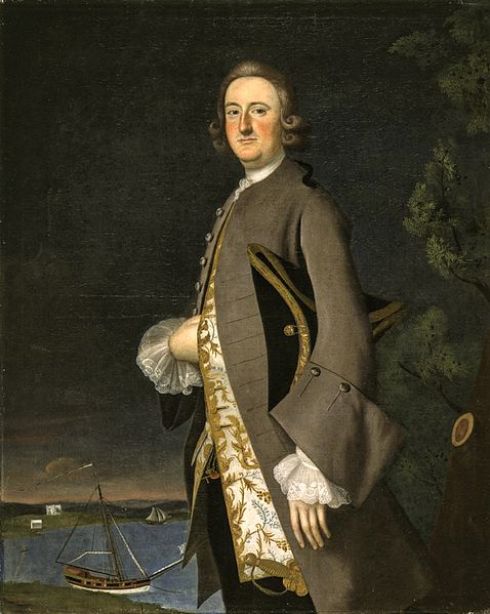
Everyone seems to associate the hand-in-vest/waistcoat pose with Napoleon but many such portraits predate those of the little emperor. Why put the hand in this position in an expression of apparent disablement? Or is it cloaked power? Then there are the rather spurious theories of Masonic hidden hands or attempts by the artists to lessen the challenge of rendering hands by painting just one. Apparently it was simply a dictate of genteel behavior, handed down from the ages of Greece and Rome (which explains the pose’s eighteenth-century origins, in that most neo-classical of centuries). If it was a question of gentility, you can see how the pose would appeal to merchants and sea captains, self-made men who perhaps wanted to appeal a bit more polished for posterity.

Piggot

Young Mariner

George_Washington,_1776

Spoilum Cranstoun

Portrait of a Western Merchant

American Sea Captain Dutch School

Ships Model PEM

Pre-Napoleon in-vested sea captains (+ General Washington): Joseph Blackburn, Portrait of Captain John Pigott, c. 1752, LACMA; John Durand, Portrait of Young Mariner, ca. 1768–1772, collection of John and Judith Herdeg; Charles Willson Peale, General George Washington, 1776, Brooklyn Museum of Art; Chinese-export Reverse Painted Mirror of Captain John Cranstoun, c. 1785, Bonhams; Spoilum, Portrait of Western Merchant, c. 1785, “Envisioning Cultures at MIT; Portrait of an American Ship Captain (Purported to be Captain John Thompson of Philadelphia who engaged in the China trade), c. 1785, Sotheby’s + in the basement of the Peabody Essex: what a treat!


Black Ships

My title is literal, or descriptive. While the phrase “Black Ships” has a larger historical and cultural meaning, as a term used by the Japanese to refer to western vessels approaching their shores in the sixteenth and nineteenth centuries (with a long stretch of relative isolation in between), in my typical materialistic fashion I’m referring to my latest collection obsession: reverse glass painted silhouette ships. It’s a potential collection, because I haven’t actually collected anything yet, but a particular Salem example has captured my fancy, so who knows what else I might find?

Black SHip Salem 1st dibs

Perseverance Crop19th Century Reverse-Painted Ship Silhouette on Glass Maple Frame, circa 1840, Trinity Antiques & Interiors, 1stdibs.

Love this. I’ve seen lots of reverse glass paintings before, mostly on clocks and mirrors, but this silhouette version is more striking and timeless—I’m going to need to see more. There were two Federal-era Salem ships named Perseverance: one was shipwrecked off Tarpaulin Cove, Naushon Island in Vineyard Sound in 1805; the other had a later (and longer) life sailing to Sumatra. The former ship was memorialized by Italian-born Salem painter Michele Felice Corné in his 1805 painting Perseverance Wrecked near Tarpaulin Cove, and the dashing Salem sea captain Richard Wheatland has a connection to both vessels: he was master of the first Perseverance, and part-owner of the second. I’m not sure which ship is portrayed in “my” painting: obviously the lighthouse is a prominent feature, leading one to assume that this is the first Perseverance, but the lighthouse on Naushon Island was not built until 1817 (but this is an 1840 perspective, perhaps creative license is being taken?)

Black Ships Corne_PerserverenceWrecked

Perseverance Richard Wheatland Salem Michele Felice Corné’s Perseverance Wrecked (1805), and a portrait of Captain Richard Wheatland by the Chinese artist Spoilum (Guan Zuolin), from MIT’s “Visualizing Cultures” site.

I found some super-tacky ship silhouettes from the twentieth century, and some elegant Victorian examples: there seems to be no in-between. I’ll spare you the former, and here are some of my favorites of the latter category, nearly all of them from auction archives, and well-beyond my price range. I think my “collection” might end up being more virtual than tangible!

Black SHip Victory

Black Ship Royal Albert

Black Ships collageH.M.S. Victory, H.M.S. Royal Albert, H.M.S. Foudroyant, another Victory, and View from the Coast of H.M. Ships MarlboroEuryalus.


Spectral Visions on Derby Wharf

All summer and fall the Salem Maritime National Historic Site is featuring a virtual exhibition called “The Augmented Landscape” which brings eight spectral sculpture assemblages–visible only through a smartphone equipped with the layar app–to Derby Wharf. It’s a more artistic form of Pokémon Go, with global and topical themes and layered connectivity. Everyone in Salem is missing the site’s major attraction—the Friendship–and while this exhibition/experience is not a replacement, it is certainly a distraction! The creations are the work of four artists commissioned by Boston Cyberarts: John Craig Freeman, Kristin Lucas, Will Pappenheimer and Tamiko Thiel. Thiel’s “GardenAnthropocene” imposes a vivid and chilling vision on a familiar place, a “dystopian science fiction future for the landscape as we enter the Anthropocene, a new geologic time period created by human activity……[in which] native plans grow and mutate in response to the earth’s changing conditions, adding to their evolving climate and altering the landscape as we know it”. This doesn’t sound–or look–good!

Spectral Collage

Spectral Garden GardenAnthropocene

Thiel’s other installation, “TreasuresOfSheRem” focuses more on the past than the present, featuring the coins and commodities that Salem traders brought to the East to exchange for tea, spices, porcelain and other exotic goods. Poppies, yes, but somehow I didn’t know that sea cucumbers were so important to the China Trade……

Spectral Money

Spectral Treasures 2

Spectral Treasures TreasuresOfSheRem

More familiar cod hover over the wharf in Will Pappenheimer’s “Ascension of Cod” and privateers clash, visualized through a “virtual ball of classic galleon type ship masts obtained from disassembled ship models accessed from shared 3D model websites”. I think I was supposed to conjure this up (and that’s what it feels like) in front of the Derby House rather than by Pedrick’s storehouse—I couldn’t quite master the geographical aspect of these installations and ended up with strange things in strange places (but maybe that’s the point?)

Spectral Cod

Spectral PrivateersAscension of Cod and Privateers

My favorite installation is Kristin Lucas’s “Elephant in the Room”, referencing the Crowninshield Elephant that landed in Salem in 1796. He looked funny in the Derby Garden and a bit better in front of the Custom House, but never really in his element. Lucas’s “Goodbyes” also stressed out-of-element images, representing departure, which (on the other hand) is of course quite appropriate for a port. For me, the most literal of the virtual installations are John Craig Freeman’s “Virtual China” and “Virtual Russia”, which project images of Wuhan and St. Petersburg onto Salem’s port[al], emphasizing global connectivity, past and present.

Spectral Goodbye

Spectral people

Specral China

Spectral RussiaGoodbyes, Virtual China and Virtual Russia


Salem on Screen: East meets West

There is quite a long list of films set in Salem, but the list of films that were actually filmed here is impressive as well–and much more impactful. David O. Russell apparently loves Salem, as he filmed scenes from two movies here (American Hustle, Joy) even though their plots did not necessitate this location, tours of Hocus Pocus locations remain ridiculously popular, and though not a film, we’ve decided to dedicate a very prominent city square to Samantha from Bewitched (and TV Land), just because a few episodes were filmed here. The very first production filmed in Salem, however, traded on its commercial reputation rather than its connection to witchcraft: this was the 1923 silent film Java Head, which shot scenes on Derby Wharf, Salem Common, and Chestnut Street.

Filmed in Salem Java Head Lobby Poster

Java Head was based on the novel of the same name by Joseph Hergesheimer, about the scion of an old Salem family who meets a “Manchu princess” in China, marries her to prevent her imminent death, and brings her home to his Yankee family and the girl he left behind. Apparently this love triangle drives the movie, along with lots of cross-cultural conflicts, but I’m basing my plot summary on the novel (and the 1934 “talkie” remake, which replaced Salem with Bristol, England) as the film has not made it to You Tube (and may indeed be lost, along with 75% of all silent films that were produced–the Library of Congress has catalogued the film but there are “no holdings” in its archive). The interior and “Chinese” scenes of Java Head were filmed at a studio in New York, but Derby Wharf (or a nearby stand-in) and several Salem structures were used as locations. In his 1989 memoir Highlight and Shadows, cameraman Charles Galloway Clarke recalls that We loved the good people of Salem for they were friendly and helpful and did everything to make our stay there pleasurable. After finishing the scenes around the recreated dock, for this was a film about the China Trade during the sailing days of Salem, we returned to Astoria for the interior scenes. The title “character” of the film is actually a Federal mansion, exemplifying the fortunes to be made in the China trade. Contemporary sources hint that the Forrester-Peabody Mansion (later the Salem Club and later still the Bertram Home) “played” Java Head, but I think a far more likely suspect is the Devereux-Hoffman-Simpson House on Chestnut Street.There are a few more details and images here, but what I’d really like to see is the film!.

Filmed in Salem Java Head Poster

Filmed in Salem Java Head article

Filmed in Salem Leatrice Joy

Filmed in Salem Java Head 1923

Filmed in Salem Bertram Home

Filmed in Salem Devereux Hoffman Simpson House Chestnut Street

Lobby Card for Java Head (1923) and article from Picture Play from the same year, showing lead actress Leatrice Joy’s transition “from occidental to oriental”; after the transition-a Swedish poster for the film; a still from the film showing the Salem mansion “Java Head” which some sources identify as the Bertram House at 29 Washington Square (with flag, above), but I think it was definitely 26 Chestnut Street (just above).