Tag Archives: Chestnut Street

Cardboard & Chrome

Last week was a little challenging here in Salem, with news of two local businesses closing: one decades old, the other an extremely popular retail shop which caters to residents rather than tourists. Such businesses seem fewer and fewer present along the streets of Salem, and it’s a bit disheartening. The slide towards all-year-long Halloween seems relentless, at least to me, and you can see little black witch hats everywhere you walk even on the hottest days of summer. So it was nice to have two more traditional events this past weekend: the Maritime Festival at the newly-designated Salem Maritime National Historic Park (as opposed to Site, its prior designation) and the Phillips House Car Meet. These events have been going on for decades—the Maritime Festival took a break but was revived several years ago with a new marquis event, a cardboard regatta which is really fun to watch and the Car Meet just gets bigger and better every year. I saw lots of old friends on both days and met quite a few new among the old cars as I was greeting guests at the Phillips House. And I saw only ONE stupid little witch hat on both days! I took lots of pictures, so here they are:

Maritime Festival & Cardboard Regatta at Salem Maritime National Historic PARK on Saturday: the boats were largely family or organization constructions with lots of young sailors aboard and some were very seaworthy while other sank pretty quickly. But everyone paddled as best they could! Lots of entries this year, and the awards were very creative.

They’re still working on her as you can see, but it’s been nice to have the Friendship back at Derby Wharf this summer too. And it was lovely to be able to go into both the Custom House and the adjoining Derby House—I hadn’t been in the latter for at least a decade; I can’t really remember when I was last in there, actually. It looks great.

Love the scale of these rooms!!!

The 23rd Annual Phillips House Car Meet on Sunday: as you can see from my photos, what I like is the juxtaposition of old houses and old cars. This event started out with maybe 15 cars, and now there are cars lining both sides of Chestnut Street so almost every house has its own car! The lower end of the street, where I live, is excluded, as it is narrower and traffic has to flow somewhere so my house does not get its own car. In years past when I was not working this event, I would find out all about the cars but I didn’t have time to do that this year as I just took some snaps during a break. 

And then they were gone….leaving no tracks.


Streetscape and Memory

I am taking my title from Simon Schama’s classic Landscape and Memory, but my inspiration comes from a brief cocktail party conversation a few weeks ago. I was the host of this particular party, so I was hopping around and really only getting snippets of conversation, but I woke up the next morning with a very clear memory of a bit of discussion between a film historian and a maritime historian/curator about a movie that was filmed in Salem in 1922: Java Head, based on the then-popular novel by Joseph Hergesheimer of the same title. I’ve written about this film before: its theme and narrative focuses on the cross-cultural encounters between the Chinese wife of a Salem trader and his friends and family back home. This was no backstage production: Salem served as the set for the exterior scenes of Java Head and Derby Wharf was actually transformed into a century-earlier version of itself during the height of the China Trade by a very detailed reproduction, right on top of the reliquary pier. My two historian friends were bemoaning the fact that it is extremely unfortunate that this is a lost film, as the reproduction had been informed by the memories of those who had seen the wharf when it was still in some semblance of its former glory. And so I was reminded, once again, of the power of memory—and initiatives to recall it. John Frayler and Emily Murphy, past and present historians at the Salem Maritime National Historic Site, maintain that the set designers worked from old photographs in their 2006 piece, “Java Head is Missing” (Pickled Fish and Salted Provisions, October 2006) and I’m sure that’s true, but I’d also like to think that there was an old salt somwhere in the process. This article also features what must be a very cherished photograph of the reproduced wharf—given that the film is lost, one of only a few extant images of its Salem set.

Photograph of Derby Wharf as reproduced for Java Head, from the “Java Head is Missing” 2006 Salem Maritime Newsletter, “Pickled Fish and Salted Provisions”. ALL of these valuable newsletters, and more from the Salem Maritime archives, can be found at its NPS History eLibrary site.

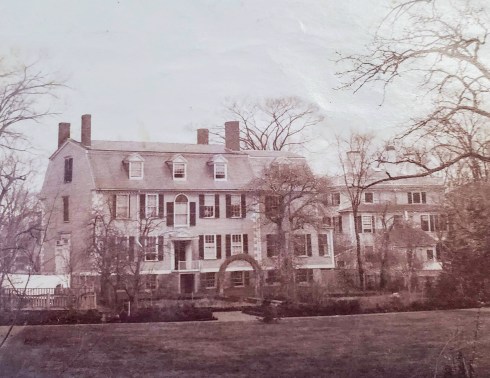
I’m dwelling on this long-lost film and its set because I have always been interested in, and indeed reliant on, captured memories of Salem’s streetscape. We’re so fortunate to have photographic records from the later nineteenth and twentieth centuries, but there are rich textual records too. Long before the field of “oral history” ever existed, or was acknowledged as such, there were people out there asking other people about their memories of Salem’s built environment: the articles which ran under variations of “Notes on the Building of……..[insert street]” in the Essex Institute Historical Collections convinced me that that institution was definitely functioning as Salem’s historical society from the later nineteenth century onwards. From 1945-1947, the Collections featured a series of reminiscences of former residents of Chestnut Street whose memories were prompted by Francis H. Lee, who was compiling his own history of the street in the 1880s. Lee wrote letters to everyone who ever lived on Chestnut, and many responded with missives of varying detail about the street and its surrounding neighborhood. I looked through the Lee Collection at the Phillips Library when I was researching our Salem book last summer, and was immediately transfixed by his photographs; I knew that all the letters were gold, but I didn’t have time for them then. I think I need to go back to Rowley, but in the meantime the Collections transcripts will have to do. They begin with Leverett Saltonstall’s 1885 letter in the January 1945 issue, in which he gives us the built and social history of the neighborhood in his childhood: schools are everywhere as well as bakeries and stables, but he also tells us who lived in which house on Chestnut and Essex Streets, and when and how they added on to their houses. In a bit of commentary about new (1880s) construction, he notes that the Bancrofts lived on the latter street “in a pretty old-fashioned gambrel roof house, once occupied by Judge Prescott, father of the historian, with a solid old elm in front, which I saw quite recently cut down while apparently in full vigor, by some vandal to display his new shingle palace.” Ah, those elms in full vigor! Saltonstall also recalls swimming in the North River with his friends when it was “a clean body of water and the swim across to “Paradise,” the fields beyond the swirling flood, was a feast for a strong boy.” For the 1880s reader or the 1940s reader, that description of the then-tannery-lined North River would have been notable, likely more so than for us. Saltonstall was born in 1825: there are no photographs of the Salem of his childhood, we must rely on his memory if we want to picture it.

Francis H. Lee photographs of the lower and upper Chestnut Street in the 1880s, Francis Henry Lee Papers, MSS 128. Courtesy of Phillips Library, Peabody Essex Museum, Rowley, MA. Saltonstall and others remember only “fields” past the Phillips House at number 134, the lighter house on the right above.

There are actually a few visual references in the Lee letters. Henry K. Oliver actually provided a plan of his house on  Federal Street, Samuel McIntire’s Samuel Cook house, and a very detailed descriptions of its interior, including the French landscape wallpaper on the walls of its east parlor, “put on in 1825 (60 years ago) and now appears fresh and unfaded.” These were not memories, but Oliver went on to recount the built history of the entire neighborhook of upper Federal Street, including houses moved to that location from the more ancient Essex Street (EIHC LXXXII, April 1946). J.B. Chisholm’s letters to Lee from February of 1885 note that “I had once thrown aside my pencil sketch of the South Meeting House in Chestnut Street (which burned down in 1903) but the possibility of its being suggestive to you induces me to enclose it with this.” (but the sketch is not included in the 1946 Historical Collections article!) My favorite recollection (so far) is that of John H. Nichols, who gave Lee an explanation for the distinct width of Chestnut Street which I had never heard before: At the time it was proposed to open the street, the owners of land on one side were unvilling to contribute their portion and it was then made of half its present width by those on the opposite side, who left a narrow strip, with a wall standing upon it, so that the recusant abuttors should not be benefitted by the new street. When, however, at a later period the latter were willing to part with a portion of their land as first contemplated their proposition was rejected, and they then made another street of the same width, leaving the wall at its center. On the erection of some house, Captain Phillips’ I think (#17), each of the workmen employed received a certain stipulated sum for carrying away a stone from the wall every time he left work, until the whole were removed, and thus the street became double the width originally designed. Two parallel streets of like width with a wall between! We’re never going to see a photograph of this, obviously, but there might be a sketch out there somewhere……..

The wide street of the 1880s (no wall): Looking up (west) and down (east) Chestnut Street, from Salem Picturesque, State Library of Massachusetts.


The Salem Tercentenary, 1926

As I’ve been finishing up the manuscript of our 4o0th anniversary volume, Salem’s Centuries, I’ve been writing and thinking about Salem’s 300th anniversary quite a bit. For some reason I thought that I had already posted about this big event on this unwieldly blog, but I haven’t. Quite a lot is out there—the archivists at the Salem State University Archives and Special Collections oversee an ever-larger collection of historical photographs of Salem, many of which they have uploaded to Flickr, and among them are some great Tercentenary views. This is really the best place to go for local history, including an array of blog posts which put their collections in context. So maybe, in my writing-and-teaching-brain-fog, I confused their output for mine? I don’t know, but there’s certainly no Tercentenary post here so I thought I’d pull one together. I’m quite impressed by the activity of the 1926 Tercentennial but it was certainly more celebration than reflection. This was not a moment to be at all critical about the city’s past; this was a party! Beginning on July 3, 1926 and commencing on the 10th, city residents were feted by parades, street parties, reunions, balloon ascensions, a big ball, a field day, a firemen’s muster, a bonfire, various illuminations, and concerts, concerts, and more concerts. Many people were involved in the planning, at least hundreds if not more. Starting in 1924 a general committee came together, followed by the appointment of chairs of the various subcommittees: the bonfire, music, fireworks, the horribles parade, sports, the military, civic, and historical parade, historical exercises, banquet, costume ball, floral parade, firemen’s muster, entertainment and publicity. Then the work began and there were some alterations: a “great” civic and military parade was severed from the floral and historical parade when it became apparent that the consolidated parade would be very, very long and that the guest of honor, Vice-President George Dawes, could be in Salem only for a short period of time. (President Coolidge was invited to the Tercentenary shortly after his election and I have no idea why he couldn’t turn up—it seems like a slight, as didn’t he summer in Swampscott?) The planning seemed to go smoothly but I have no real insights into subcommittee deliberations—I’m not sure where the meeting meeting minutes are, or if there were any. But they seem to have thought of everything, including a temporary “hospital” installed in the Phillips School overlooking Salem Common. The one big pre-celebration problem that surfaced was in relation to one of the big arches erected at the entrances to the city, specifically the arch at the Salem-Beverly Bridge. Once completed, a furor arose: it said “Greetings” rather than “Welcome” and on the wrong side! Greetings was simply not welcoming enough, and people leaving the city and crossing over to Beverly were being greeted! It cost the princely sum of $700 to fix this arch sign but it had to be fixed and so fixed it was.

I think that was it for the missteps, and then came July, and they were off! Here’s the schedule:

Sunday the 4th: Bells ring all over the city, followed by religious services, and then a huge band concert on the Common. Presumably this is what the brand new bandstand was built for, but as the band consisted of “300 pieces” I don’t think all those musicians could have fit in there. In the evening, a 100-foot bonfire was set ablaze (we are right in the midst of Salem’s big July 4th bonfire craze at this time).

Monday the 5th: The “Grotesque, Antiques & Horribles Parade” featuring Salem schoolchildren in costume competing for prizes (this is another Salem/North Shore July 4th tradition).

We are the Freaks Float, Nelson Dionne Salem History Collection, Salem State University Archives and Special Collections, Salem, Massachusetts.

Tuesday the 6th: Tours of old Salem homes open for the occasion, many, but not all, on Chestnut Street, and an exhibition of “treasures brought to Salem by the sea captains of old days.” In the evening, a balloon ascension at Salem Willows and an “illumination” of US Navy vessels in Salem Harbor.

Wednesday the 7th: the “Great” Parade, with Vice-President Dawes in attendance. This was followed by an historical address on Salem Common, another band concert, and fireworks.

Vice President Charles G. Dawes, Mayor George J. Bates, Governor Alvan T. Fuller, and Congressman William M. Butler; Nelson Dionne Salem History Collection, Salem State University Archives and Special Collections, Salem, Massachusetts.

Thursday the 8th: Family reunions for “Old Planter” families; I’m not sure about everyone else. The first Chestnut Street Day, which was quite the event, and a field day on the Common. The Tercentenary Ball was held that evening at Salem Armory.

Friday the 9th: The other parade, the “Floral and Historical Parade.” (I just love the idea of this– flowers and history!)

Floral Float No. 9, 1926 and Brig Leander Float, Leland O. Tilford photographs, Salem News Historic Photograph Collection, Salem State University Archives and Special Collections, Salem, Massachusetts.

Saturdy the 10th: A huge firemen’s muster on Salem Common, yet another parade and band concert, and fireworks on Gallow Hill.

Quite a success I think, and there were some cultural consequences too. One thing I’m curious about is Salem artist Phillip Little’s “huge” painting of Derby Wharf at the beginning of the nineteenth century: it was commissioned by the Naumkeag Steam Cotton Company for a big home exposition in the spring of 1926 and supposedly shown in Salem for the Tercentenary, but I’m not sure where or when. And where is it now? I want to see it! Since I have not seen it, I have to say that my favorite Salem Tercentenary painting remains Felicia Waldo’s impressionistic view of the first Chestnut Street Day.

Felicie Waldo Howell, Salem’s 300th Anniversary, 1926, Christies.

These civic celebrations can seem frivolous on the surface, but they also reveal a lot about the communities which are putting them on. Much of these activities would have been very familiar to Salem people in 1926: they were used to parades, and old home days, bonfires and annual field days, in which children from every neighborhood competed against each other in a variety of athletic activities on Salem Common. It’s a huge generalization which deserves much more documentation and explanation, but Salem seems much more focused on its residents than its visitors at this time, and for much of the twentieth century. The comments and the coverage from 1926 indicate that what was really new about the Tercentenary were the open historic houses throughout the City, and on Chestnut Street in particular. The national house and garden magazines went crazy with the coverage! Chestnut Street Day was so successful that it was repeated on four more occasions, with the last one occurring in 1976 (there are some great Samuel Chamberlain photographs of later Chestnut Street days from the Phillips Library at Digital Commonwealth and here). And there was nary a witch in sight in 1926, certainly not on the official Tercentenary medal.


The Summer of Old Photographs

I worked all summer long on my chapters for Salem’s Centuries and a few other projects, researching and writing, researching and writing, researching and writing. Once I’m on the trail, I’m a pretty steady worker, but I do take breaks: I’ve learned from other writing projects that you have to pause to let your mind absorb and process information. Sometimes the break might be at night when you’re asleep—I got into the habit of leaving a notebook by my bedside when I was writing my dissertation and when I woke up in the morning sometimes I would see notations inside that I didn’t even remember writing! That must have been one of the benefits of a younger mind because it didn’t happen this summer, when all my breaks were conscious. Every time I went up to the Phillips Library in Rowley, I would dutifully call up boring municipal records but also collections which contained old photographs of Salem. I’d pore over them a bit and photograph them for later perusal, and by the end of the summer I had quite a collection. The Phillips has digitized two of its largest collections of Salem photographs: the Frank Cousins and Samuel Chamberlain collections, but there remain many seldom-seen images within collections. Fortunately there are great finding aids to locate such images, but also some very miscellaneous collections which yielded surprises, at least for me! I loved schoolteacher Grace Hood’s shots of the Salem and Massachusetts celebrations in 1926-1930 (PHA 67; including some completely new-to-me views of the opening day of Pioneer Village in 1930) and an unknown photographer’s depictions of a very gritty Salem encased in a large composite collection entitled Photographs of interiors and exteriors of Salem, Mass., circa 1890-1950 (PHA 151). And there’s much more.

Phillips Library PHA 67 & 151.

My favorite collection was the first one I accessed, back in May: a treasure trove of images contained in the scrapbooks of Francis Henry Lee of 14 Chestnut Street, mostly from the 1880s (Phillips Library MSS 128). Lee was the son-in-law of the woman who lived in my house, and a committed architectural antiquarian focused on documenting the history of every house on Chestnut and adjoining streets. He did not rely on hearsay, but sent queries to anyone who ever lived in the neighborhood, and his scrapbooks are filled with detailed responses, some written on black-trimmed stationery indicating that their authors were in mourning. I was familiar with his articles in the Historical Collections of the Essex Institute, but surprised to find his research materials accompanied by so many wonderful photographs.

Some of my favorites: (I filtered those that were really hazy or damaged).

Chestnut, Summer & Norman Streets from two perspectives. I’ll never get over how wonderful Norman Street was!

Riding and looking north on Summer Street, and then south (Samuel McIntire’s house is on the extreme left of the last photograph).

Broad Street, looking west.

Cambridge Street, looking north and south.

Work on Bott’s Court.

Hamilton Street, looking north.

Chestnut Street Houses—what’s going on with that figure at the third-floor level of the third photo above, which I think is #26?

Warren Street, looking towards the “Turnpike” (Highland Avenue).

There were several photographs which were especially exciting to see among the Lee papers, including those which show the magnificent formal garden in the rear of the Cabot-Endicott-Low House on Essex Street, which extended to Chestnut before no. 30 Chestnut was built in 1896. This garden was quite famous: it was prominently featured in many horticultural publications and was by all accounts quite the tourist attraction, especially in the spring. A 1904 Boston Globe article on “Beautiful Old Gardens of Salem” reports that for many years the tulip bed was the greatest feature of this garden, and each spring, when these flowers were in perfection, and upper portion of the high fence on Chestnut was removed to enable the public to view the exhibit.

Even more exciting than this lost garden were two photographs of my own house that I had never seen before, including one sans the apartment that was added on in phases between 1890-1910. Our house is the right side of a double house built in 1827: both sides were identifical until the 1850s, when one of our owners expanded the house considerably in back and altered the interior to look more fashionable at the time—round mouldings rather than square ones! The big entrance alteration reflects the changes inside, but I did not know that this guy also put new mouldings over the windows, and disdained shutters as too colonial, I guess. Several owners later, there was a sequential addition on the side of the house: first as an office for a very well-know opthamologist who lived here, and then bedrooms were built above: this is our present-day 7 1/2, a really cute apartment with the best views of Chestnut Street. I assumed that it covered up windows which were on the side of our house, but it looks like there were none. As you can see from all of the other photos of the street, Chestnut was driveway-less in the nineteenth-century: the larger houses had carriage access on Warren or Essex: the property of our house actually wrapped around Hamilton Hall next door and so our carriage house—long- demolished—accessed Cambridge Street.


The Aesthetics of Ancestry

I’m still simmering with anger and frustration over Salem’s “new” “Heritage” trail, confined to the downtown, anchored by commercial establishments presenting the sad tale of 1692 with pathetic mannequins which inspire laughter rather than learning, marked by a line of yellow paint applied in an egalitarian manner to both new concrete and old brick. All of my original objections are still standing, but they’ve had almost a year to fester. I’ve lost faith in so many people and institutions: city councillors, various public officials, even fellow historians and organizations which I thought were committed to the preservation and presentation of Salem’s rich heritage. I don’t see any understanding of what heritage tourism is in the realm of official or quasi-official Salem, much less any desire to follow its path. Indeed I wonder what heritage means to the people who have put together this heritage trail.

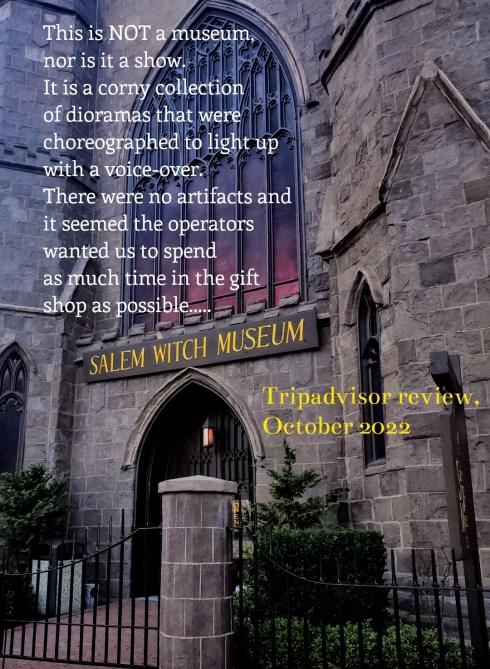
The words in the graphics above illustrate my concerns: a recent review of one of the two commercial institutions featured on the trail, the Salem Witch Museum, and some definitions of heritage by the Center for Heritage & Society at the University of Massachusetts, Amherst. I find the review to be very representative of those that the Salem Witch Museum has received, but of course, I am biased. There are certainly much better reviews, and there are also those which are substantive indictments: you can read them for yourself at the Tripadvisor site. But even many of the good reviews point out the dated nature of the presentation, the fact that the attraction is not a “Museum,” and its blatant commercialism. What is fascinating to me is that these reviews go back years (the Salem Witch Museum recently celebrated its 40th anniversary) and they are very repetitive, yet still the people keep coming and the dated dioramas endure: this is the most successful business in Salem, I believe, certainly the most successful attraction. There’s no attempt to update or improve the presentation, and why should there be? The people keep coming. But what does this institution have to do with Salem heritage and why does it have to be on the Salem Heritage Trail? The Witch Trials are certainly part of Salem’s heritage, though not, I would argue, as large a part as the City of Salem presents them to be—but that argument is certainly a lost cause! But is a dated diorama how we want to acknowlege this tragedy? Is there anything public or in any way reflective of the inclusion of the Salem Witch Museum on on the Salem Heritage Trail? The Salem Witch Museum will continue to be successful, no doubt, regardless of its inclusion on the Heritage Trail, so why can’t this one trail represent a more public and thoughtful presentation of Salem’s heritage in the fullest sense of the word? (I will never get an answer to this question)

I am not a tourism naysayer; I simply respect the past and want both Salem’s visitors and residents to experience its heritage in a layered and an engaging way. As I am writing this, I am looking up Chestnut Street as the Salem Trolley is making its way down, and I’m glad to see it. At least the tourists on board are exposed to more of Salem’s material heritage. It remains absolutely mystifying to me why the Salem Heritage Trail would not include the city’s oldest and largest Historic District, home to the Pickering House, the Phillips House, Hamilton Hall, the Salem Athenaeum, the Ropes Mansion, the Quaker Burying Ground, and streets of beautifully-preserved houses. There are no shops or restaurants or witch “attractions” over here: could that be the answer? Unfortunately the selection of paint in general, and that striking shade of yellow paint in particular, made the exclusion of residential historic districts a foregone conclusion: I know that most of my neighbors would welcome more walking tourists, but I doubt that many of them would like to see that yellow line run in front of their houses. The trolley is running past houses associated with a trio of brothers from a famous Salem family, the Bensons, and I’m wondering if the tourists on board are hearing anything about them, because I think their lives and works are representative of several important strands of Salem’s heritage. I’m sure Frank Weston Benson (residing at 14 Chestnut, 1862-1951) is getting a mention, as he was a pretty famous artist in his day, producing accessible paintings in a light-filled American Impressionist style as well as a succession of distinctive etchings primarily focused on wildfowl. His younger brother Henry (1866-1942) lived around the corner on Hamilton Street and served two terms as Salem’s mayor as well as the president of Salem’s largest business, the Naumkeag Steam Cotton Company. But I think it’s the brother between them, John Prentiss Benson (1865-1947), who is more evocative of an enduring Salem heritage, even though he seldom lived here in his adulthood (though he did design the massive and fantastic Colonial Revival mansion at 30 Chestnut Street).

A 1943 self-portrait by John Prentiss Benson and photograph of his younger self in Salem; Captain Samuel Benson of Salem as depicted by his grandson, John Prentiss Benson and Benson’s copy of “Reaper of Salem, S. Benson, Master, painted originally by Antoine Roux. All of the images and much of the text from this point on is taken from a lovely book entitled The Artistic Legacy of John Prentiss Benson, which was edited and published by the husband of Benson’s granddaughter in 2003. It’s really fabulous–with lots of family pictures and anecdotes.

I’ve never really appreciated maritime art, but I saw a painting that I really liked last week and looked at the signature: John P. Benson! I thought he was an architect by profession and an artist by hobby, but I was wrong: he had two careers, first architecture, then painting. This one painting took me down a rabbit hole of John P. Benson paintings, and I found some really lovely Salem ones, inspired by his birthplace and his heritage, primarily his descent from Captain Samuel Benson, of Reaper fame. All three Benson brothers plus their siblings grew up in an Italianate house which once faced the Common, on a site which is now the parking lot of the Hawthorne Hotel. Frank’s predisposition towards an artistic career was evident pretty early, as was John’s, but apparently there could only be one artist in the family so their father steered the latter towards the more practical architecture. He went to Paris for training, and returned to a job at the prestigious New York architectural firm McKim, Mead & White before setting up his own partnership. By all accounts, Benson had a successful architectural practice focused on the greater New York area, while living in Plainfield, New Jersey and later Flushing, New York with his wife Bessie and their four children. He retired from architecture in his later 50s and began painting full-time, primarily in his studio at a house called Willowbank in Kittery, Maine. He was prolific, and even though he had not lived in his native city since his departure for Paris, a notable number of his paintings are of Salem ships and harbor scenes.

Ship Eliza of Salem, Salem Coal Wharf, and Derby Wharf, John Prentiss Benson.

I particularly like a series of paintings which Benson produced as murals for his son Philip’s Cohasset home, entitled Salem Harbor memories. I trust that they still survive and I wish they could be on public view, because they are a perfect illustration of a family’s heritage and the endurance of a city’s heritage: it’s so interesting that these images were in the home of a man (Philip) who was not born in Salem, who never lived in Salem, but still saw Salem as part of his heritage. I’m not a fan of the witch trials vs. maritime history either/or debate as I believe that Salem’s heritage is both plus MUCH more but these maritime views are so poignant, especially in their invocation of memories which we can “enjoy, regret, and learn from” at the same time. Believe me, I know that the Benson brothers cannot compete with the suffering mannequins of the Salem Witch and Witch Dungeon Museums of the Heritage Trail. I think there are some other Chestnut Street stories that might be able to do so, but that’s not my point or my concern. If this trail was called the “Tourism Trail” or the “Witch City Trail,” I would have no concerns. But it isn’t: it’s called the Heritage Trail. So I ask my fellow Salem residents: does it represent your heritage?

A Memory of Salem Harbor, in Cohasset.


Domed Doors

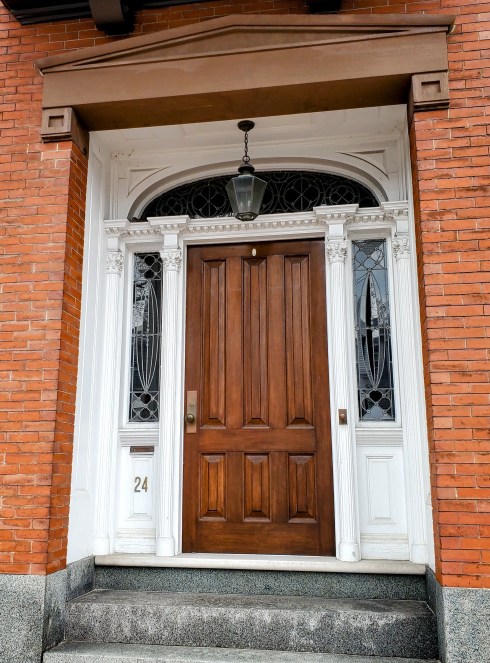
Salem is a great city for doors. There are so many exemplary doors in a succession of architectural styles: First Period, Georgian, Federal, Greek and Gothic Revival, all the Victorian varieties. There are simple plank doors, multi-paned doors, louvred doors, double doors, carved doors, doors with elaborate surrounds and vestibules, and doors of many colors (these have really multiplied over the last decade or so). There are Instagram accounts and hashtags for Salem doors. But one type of door is not very common in Salem: the rounded or arched door. I was looking through the remarkable memory album of G. Albert Lewis at The Library Company of Philadelphia, a volume with incredible illustrations of interiors and exteriors, when I became fixated on the arched entryways of his Philadelphia townhouses. I wondered if Salem had any rounded doors, did a quick Google image search (it was about 11:00 at night, otherwise I would have ran around town), and came up with multiple images of the doors of my own house! I never realized they were so conspicuous; rather I found them incongruous with the attached house next door, with its straightforward Federal entryway. See what I mean?

The second photo above is from the Instagram Account @doorsofsalem where you can see lots more Salem doors.

The double doors, and the entire entrance with bay window above, along with considerable interior alterations and a major addition, are the very tangible results of a considerable investment in the property made by its owner from c. 1860-1890, Willard Peele Phillips. Mr. Phillips was a lawyer, a state representative, and an aficionado of curves: he didn’t just bend the entrance of my house to his will: the parlor pocket doors, the china cabinets in his brand new dining-room, and all the first-floor entryways were rounded as well. He ripped out the elegant slim banister that ascended three stories and replaced it with a mahogany one that is much more bulky but also curvy. The second and third floors were left alone; I guess it was about keeping up appearances. It’s really interesting to compare the pristine house next door to my palimpsest one: 1827 versus 1877. Yesterday I went out in search of more rounded doors and did not find many, but it was fun to snap some beautiful square ones along the way. I’ve been taking photographs of Salem houses for over a decade just for this blog, but there is always a new door to discover.

As you can see, there is a rounded element in several of these Salem doorways in the form of the archways and fanlights, but the actual doors are still standard square (or rather rectangular). Besides my doors, I found arched doors on a famous McIntire summer house on the grounds of the Peabody Essex Museum’s Essex Street campus and its twin across town, constructed by a friend of mine just a few years ago, on Winter and Lafayette Street buildings, and what’s left of the Salem Armory. There are a few Salem churches which also have domed doors, but that’s about it.

But the Federal style which so defines Salem (for now, but maybe not much longer) emphasized light and decoration for its entryways, and so often there is an impression of roundness even if the door is more straightforward. A great example is the doorway of arguably the most beautiful house in Salem, the PEM’s Gardner-Pingree House: its portico and fanlight state (shout) round quite emphatically albeit elegantly. And look at the entrance to my neighbor’s beautiful Italianate house: all you see is curves but the door inside that fabulous vestibule is harmoniously straight.

So then I went back to my inspiration, the Lewis Memory Album at the Library Company, and looked at his doors, and was surprised to find they were not rounded at all—only their surrounds, and dormers! And therein is the magic of architectural texture, evident even on paper.

Illustrations from The old houses and stores with memorabilia relating to them and my father and grandfather / By G. Albert Lewis. The Library Company of Philadelphia.


Samuel Chamberlain’s Salem

The Phillips Library of the Peabody Essex Museum, steward of so much of Salem’s printed, written and visual history amongst its many collections, has recently digitized over 5000 images from the “Samuel V. Chamberlain Collection of Photographic Negatives, 1928-1971″ and they are available and searchable at the Digital Commonwealth. Combined with the Frank Cousins images which the Phillips made available several years ago, there is now a very strong visual record of Salem’s architecture and streetscapes in the first half of the twentieth century, or at least some of Salem’s buildings and streets as neither Cousins or Chamberlain were particularly interested in “working Salem”. Cousins was a bit more of a documentarian than Chamberlain, especially as his era (roughly 1890-1920) encompassed the Great Salem Fire of 1914. Chamberlain was a man of the world, a gourmand, and an artist: his Salem photographs encompass only one part of his work, but an important part as he lived in nearby Marblehead for many years so developed quite an intimate knowledge of the city. I’ve always been struck by his perspectives, but I thought that I’d seen most of his Salem shots as he published so many books of photography of New England scenes in general and of Salem structures in particular, including Historic Salem in Four Seasons (1938), Salem Interiors (1950), and A Stroll through Historic Salem (1969). But I was wrong: there are discoveries to be made among the 1600+ Salem images included in the Phillips Library’s Chamberlain negative collection at Digital Commonwealth. The vast majority of these photographs are of the McIntire Historic District in the 1930s, 1940s, and 1950s, but I can see different details and angles in Chamberlain’s images of these perennially-showcased streets and structures—and lots of wonderful TREES.

New perspectives of old streets: and the interior of the depot!

These are images which struck me as “new” for one reason or another, although the first photograph is just the view of Chestnut Street from my window, over a half-century ago, and everything looks pretty much the same! Look at all the amazing elms: on the other end of Chestnut, on Essex, at the intersection of Federal and Washington Streets. A great photograph of the Lindall-Barnard-Andrews house (c. 1740; 3rd from top) and its amazing fence before some serious mistreatment in the later 20th century. Interesting views of Lynn Street, the Salem Maritime National Historic Site with trees, St. Nicholas Russian Orthodox Church and the Post Office and Washington Street before it became Riley Plaza (What is the white house on Norman?) One of my favorite little buildings on upper Essex Street was a bookstore! The Thomas Sanders house on Summer Street (2nd from bottom) looks much the same, but I want Mr. Chamberlain to turn around: what is behind him? And finally, a rare shot of the interior of the Boston & Maine train depot—rare in general but also for Chamberlain who preferred more timeless and aesthetic perspectives.

Change: Chamberlain was more interested in timelessness and continuity than change, but he couldn’t help but document some changes in Salem over the span of his work, from the 1930s through the 1960s. He was far more interested in urban survival than urban renewal, however: this was a man that sketched French chateaux amidst the destruction of World War I.

Two views of the London Coffeehouse or Red’s Sandwich Shop on Central Street; Nathaniel Hawthorne’s birthplace in its original location and from Hardy Street; The Curwen House rounds the corner from Essex to North Streets; 8 Chestnut Street very hemmed in by the second Second Church; which burned down in 1950, The Richard Derby House also very hemmed in; Charter Street before urban renewal; the cupola from the Pickman-Derby-Rogers House on Washington Street on the grounds of Essex Institute, now gone; the entrance to what Chamberlain called “the Italian Church,” St. Mary’s, built in 1925 and closed by the Archdiocese of Boston in 2003.

A few interiors: Chamberlain’s interior images are lavish and full of architectural and decorative detail; I’ve only included a few shots here but what a resource! All the PEM houses are here, and many Chestnut Street interiors, as well as views of interiors of both public and private homes which are seldom seen. His Salem Interiors has been a favorite book of mine since I was a teenage, and this Phillips/Digital Commonwealth collection includes many shots which are not included in that publication so I’ll going back quite a bit.

Pictorial paper in the Sanders house on Summer Street (see exterior above); much to see in the Northey house parlors, but ships on mouldings—how Salem can you get? Amazing fireplace in the East India House on Essex Street.

Chestnut Street Days! Who knew Chamberlain was such a great photographer of people? Certainly not me. Probably the most charming Salem photos in the Phillips Chamberlain collection are his portraits of Salem residents in colonial dress for the Chestnut Street Days which were held on at least 5 occasions from 1926 to 1976. I think that the photos below are from the 1947 and 1952 Chestnut Street Days, but I’m not entirely sure about the former date. These are wonderful photos of happy people, men, women and lots of children, smiling at the man behind the camera, Samuel Chamberlain. Just delightful. I’m going to post more on these in the future, but I’ve really got to do some oral histories first.

Chestnut Street Day, c. 1947-52. Not a great photograph to close out this wonderful collection, but is this the great man himself? Plus, the dog.


When Nixon went to China and Life Magazine came to Salem

For some reason, I’ve been going through the archives of Life magazine over the last month or so: it started with the photographs, and then I had to read the stories too. Life seems like it was a perfect mix of news and popular culture: we don’t have the like now, do we? And I doubt we ever will again with our very diffused and digital media. I’m no twentieth-century historian, but it also seems to represent the collective mindsets of its changing times: it really excels at representing wartime America, of course, but the later decades too. So far my favorite issue bears a beautiful Elizabeth Taylor on the cover on the occasion of her fortieth birthday: but inside the focus is on President Nixon’s imminent trip to China. It was fifty years ago this very month, and a very big deal. For some historical context, Life went to Salem, which emerges as kind of cultural intermediary between the United States and China, as it was the first American city to become thoroughly acquainted with the East. And so we get to read about Elias Hasket Derby and his ships, and see Derby Wharf, and all sorts of “exotic souvenirs” brought back from China by Salem’s daring merchants and later installed in the old Peabody Museum of Salem. It’s all great, but the best photograph is an aerial view of Chestnut Street where nothing much has changed in fifty years.

“When the US Sailed to China,” Life magazine, 25 February 1972. Photographs by Henry Groskinsky.

I think that the Peabody Essex Museum is still playing that intermediary “West meets East” role, although now the perspective is far more global than western. I know that I fault the PEM often for its displaced library and limited local offerings, but their East Asian and China Trade galleries are beyond impressive. I find myself teaching the first half of World History this semester for the first time in a decade, and I really had to do a lot of preparation before I stepped into the classroom (well, first it was on the screen as we had a “staggered” opening). China is the star of pre-1500 world history, and all my “color” comes from the PEM! Its collections are much stronger in later-dynasty objects, but there’s still some wonderful things on display from earlier eras. Much has happened in the past half-century: the Cold War is over, and Life magazine has also concluded its run, but Salem’s “China Cabinet” not only endures, but has been expanded considerably (and we no longer refer to its contents as souvenirs). In fact, aside from Salem’s built landscape, PEM’s East Asian collections constitute one of the largest and most lasting material legacies of “its” history in situ: this seems like an odd statement, but I think it is true.

Yichengyong Picture Workshop, Tianjin. Family celebrating the New Year and welcoming wealth from all directions, 1908-11, reproduction of detail from a woodblock print; Standing official with tablet, Jin dynasty, early 13th century; Guangzhou artists, Tea packer and porter, about 1803; Guangzhou artists, Wu Bingjian, Known as Houqua, about 1835; George Chinnery, detail from Dr. Thomas Richardson Colledge and His Assistant Afun in Their Opthalmic Hospital, Macau, 1833. There’s an emphasis on people and their relationships in PEM’s present galleries, but there’s also the “Great Wall of China” and a transplanted 18th-century Chinese house, Yin Yu Tang, to see.


A British & Bucolic Gaze on Salem

I adore the venerable and very traditional British magazine Country Life, which has been showcasing stately homes, lush gardens, and rural pursuits since 1897. I’ve had indulgent subscriptions and purchased my share of back issues: there can never be enough manors, fields, and drawing rooms for me! Despite my obsession, I had no idea that Country Life featured Salem in a 1972 issue with Salisbury Cathedral on the cover until just last week, and as soon as I saw the table of contents I searched for a copy and snapped it up. The timing is interesting to me: 1972, as Salem’s long struggle with urban renewal was coming to a close, or at least one phase. Of course, the editors at Country Living were not at all interested in anything new: they were seeking what survived.

The article is interesting and the photographs are great—but rather dated: they had been published by Samuel Chamberlain in several publications prior. Perhaps British readers would not have seen his New England views before but they might have appreciated Salem in color! The author, Helen Hall, observes that “the architectural richness of Salem is not so immediately apparent as it is in Deerfield or Marblehead,” so I assume this article is part of a series. She is not very complimentary about most of the city, actually, noting that “you are not especially aware of being in a town that was once so dependent on the sea for its existence” (I think you might be more aware of that now, but maybe not) and that certain parts “give the impression of never really having recovered from the decline of the Depression years.” She does note the recent renewal but also that “the results so far have been negative, with extensive demolition of often potentially restorable buildings, mostly in the central shopping district, creating blitz-like (!!!!!!) spaces that have become, inevitably, parking lots.” But she does love the Essex Institute and its houses, the Custom and Derby houses of the Salem Maritime National Historic Site, the Common, and Chestnut Street. The latter is still elm-lined when she visited, and while she finds American elms “much more graceful” than their European counterparts, they also hindered her views of the houses.

Samuel Chamberlain photographs of Salem in the August 31, 1972 edition of Country Life.


Salem in (water)color, 1939

Salem set the style standard in the first half of the century when Colonial Revival ruled, ruled, and continued to rule: right up to World War II and then beyond, according to the dictates of shelter magazines. In the first two decades of the twentieth century, you can find photos of Salem houses and house parts in issues of The House Beautiful and House & Garden from nearly every year: after that Salem is not quite as “present” but still around. Much of the attention shed on Salem is a result of two people I’ve written about here time and time again, Mary Harrod Northend and Frank Cousins, and after their deaths in the mid-1920s a Salem publicist-successor did not appear, yet “Old Salem” (rather than the “Witch City”) endured as the quintessential New England seaport. I’ve shared every Salem feature in these two particular periodicals from the teens and twenties in past posts, but not too many from the 1930s. A few weeks ago I came across some Salem images from a 1939 issue of House & Garden which were so striking that I knew I had to track down the original copy rather than rely on a digital version, and when it arrived I was not disappointed. This was an issue devoted to New England in all its glory, and Salem plays a central role. There is an interesting architectural introduction by Frank Chouteau Brown, some charming infographics that indicate that the Federal style had not yet been identified (???) but was rather referred to as the “Late Georgian,” and then some lovely watercolor vignettes of the interiors of several Chestnut Street Houses, the Gardner Pingree House, and the House of the Salem Gables by students at the New York School of Fine and Applied Art, which is now the Parsons School of Design.

Cover and illustrations from the June 1939 special New England issue of House & Garden. No Federal?


The Barstow West and Pickering Dodge Shreve Houses on Chestnut Street.


Parlors and Bedrooms of the Gardner-Pingree House of the Peabody Essex Museum.


Parlor and Dining Room of the House of the Seven Gables.


These rooms look so lively in these images: the interpretations really emphasize color and texture over pristine period perfection. There are some black and white photographs in the issue as well, like the one of the John Ward house below, but I don’t think they can compete with color. The magazine also aims to be a resource, so there’s a listing of all the historic houses in Salem and their hours of operation, which were far more extensive than today. You could go into the Peirce-Nichols House every afternoon from Wednesday to Saturday all year long, and the Gardner-Pingree and Derby houses every day!

The Ward House and notice for the Second Chestnut Street Day, 1939.