
As we enter/endure that season where hordes of tourists come to the Witch City for ghost tours, I’d like to celebrate some dynamic local history initiatives: over the past five years or so, there’s been a virtual Renaissance of African-American history, and consequently we know much more about how some REAL people lived and worked in Salem. Charlotte Forten, our city’s first African-American public school teacher, remains the focus of continuing commemoration at her alma mater, Salem State University, and is now the namesake of a relatively new city park. Her hosts in Salem, the Remond Family of Hamilton Hall, also have a park named after them, and a variety of real and digital resources documenting their entrepreneurial and advocacy activities is available at both the Hall and its website. Hamilton Hall was also the site of an exhibition on African-American enfranchisement by Salem United, Inc. this summer (soon to be on view at the Lynn Museum). The Salem Maritime National Historic Site has made a substantive commitment to regional African-American history in its recent interpretive initiatives, which include a general “History of Slavery in Salem” walking tour as well as more focused “Pathways in Freedom” and “Business of Slavery” digital tours.

The West India Goods Store, one of the “stops” on the “Business of Slavery” tour of the Salem Maritime National Historic Site.
This is all very exciting; such cross-institutional initiatives almost compensate for Salem’s lack of a historical museum, at least in reference to this one aspect of the city’s history. With so much focus on African-History in general, and in the immediate pre- and post-emancipation periods in particular, discoveries will doubtless be forthcoming. Another initiative is both a literal and metaphorical expression of this rising interest in African-American history: the restoration of several graves long neglected in the Howard Street Cemetery. The graves of Prince Farmer and his wife Mary, Samuel Payne, and Venus Chew have been lifted up and repaired, so that the lives of these three distinguished Salem African-American residents are once again marked. This important work was a pro bono, close-to-the-heart project of the two gravestone conservators who make up Epoch Preservation, Rachel Meyer and Joshua Gerloff. As far as I know, the only thing that the Farmers, Mr. Payne, and Mrs. Chew have in common besides their final (segregated) resting place is the fact that they all died in the 1850s. Farmer and Payne were both respected businessmen and by all accounts quite wealthy; Chew died in the Salem Almshouse at the very end of 1852, despite a life of hard work. She was the victim of marital misfortune, despite her very public attempts to defend herself and her property. Venus Thomas Chew was born in nearby Lynn to Peter Thomas, “a free Negro man” and Lavinia/Lucretia Trevet, “a mulatto girl,” in 1779 (The Marblehead Museum has a wonderful history of her famous tavern-keeping sister and brother-in-law here). She married Henry Chew, a mariner, in 1801 and they had at least three children before they separated, by her account, in 1819. They never lived together again, but remained married and thus entangled: this was problematic for Venus as she was clearly the most consistent wage earner. She “declared her independence” in September of 1841 but lost a legal case brought on my her husband’s creditors’ attempts to empty her bank account a year later. She wouldn’t be free of Henry until his death in 1848, and over the next few years her moves from Lemon to Dearborn Street and finally to the Salem Almshouse indicate that she was never completely free.


Notices in the Salem Gazette, 28 September 1841; the segregated listing in the Salem Directory, 1842; “Caleb M. Ames vs. Henry Chew & Trustee, November 1842, in Reports of Cases Argued and Determined by the Supreme Judicial Court in Massachusetts, ed. Theron Metcalf, Volume V (1858); Salem houses associated with Venus: 198 North Street, built for Henry Chew and apparently financed by Venus, 15 Dearborn St. and 18 Lemon Street; Massachusetts Report of the Commissioners of Alien Passengers and Foreign Paupers (1852; I have no idea why Venus was considered “Alien” or “Foreign”).
I went over to see Rachel and Josh of Epoch Preservation and a few other history-minded people on this rainy afternoon for a toast to Venus, and the Farmers, and Samuel Payne (“once a slave, but the last 17 years a resident of Salem. He was an industrious, honest man, and by strict attention to business had acquired a good estate, and a full share of the confidence of the citizens of Salem” in the words of his touching obituary) upon the completion of the restoration of their graves. We toasted with Joe Froggers, the famous molasses, rum and seawater cookie invented by Venus’s sister Lucretia for visitors to the Marblehead tavern which she and her husband Joseph Brown operated for many years. Cheers to these hardworking people that came before us, as well as to the historians, educators, preservationists and restorers whose hard work sustains their memory and memorials.


Venus T. Chew, Died December 31, 1852, Aged 73. Josh Gerloff and Rachel Meyer stand behind their work. Joe Froggers (made by Josh!)


 An abandoned farmhouse on Old Dana Road, and the Quabbin Reservoir.


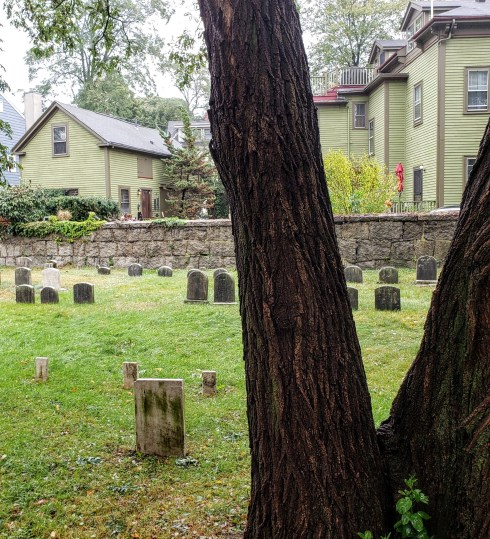


 It seems as if Timothy Lindall’s gravestone has always been in the spotlight.


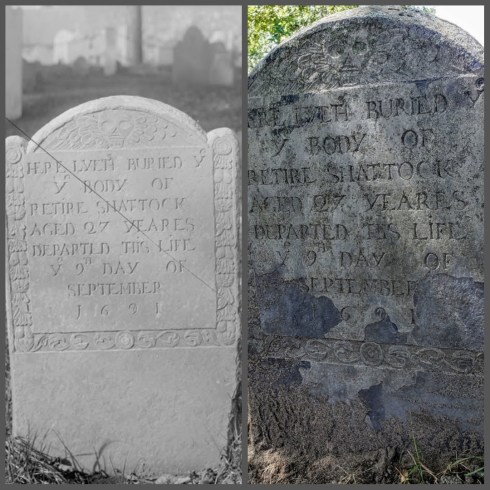
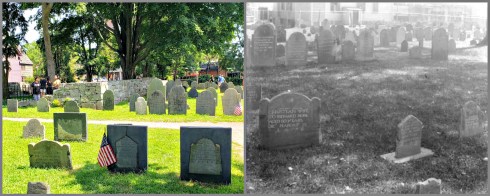
 I feel particularly bad for Mr. and Mrs. Nutting, put to rest in a lovely calm neighborhood and now in the midst of the Salem Witch Village! And I really wish that Cousins had photographed my very favorite Charter Street gravestone: that of Mr. Ebenezer Bowditch. What are those carvings? Does anyone know?
 Old Burying Point Cemetery, Charter Street, Salem, October 2017 & 2018.


 The Old Burying Point on Charter Street in mid-August.
 The Old Burying Point in October via @Linden Tea on Flickr.
 The Hearse House in Marlow, New Hampshire.


 The McDermott Covered Bridge in Langdon (1864); the Meriden Bridge in Plainfield (1880); the Cilleyville (or Bog) Bridge in Andover (1887); the Keniston Bridge, also in Andover (1882); just two of Cornish’s FOUR covered bridges: somehow I missed the “Blow Me Down” Bridge and the Cornish-Windsor Bridge over the Connecticut River is


 Salisbury & Fremont, New Hampshire.
 Salem Register, August 19, 1841.


 Pages from Gardner’s Sketchbook, Volume One at Duke University Library’s


 Calvin Townes of the First Regiment; the surviving Regiment at Salem Willows, 1890; Memorials at Spotsylvania and in the Essex Institute, from the History of the First Regiment of Heavy Artillery, Massachusetts Volunteers, formerly the Fourteenth Regiment of Infantry, 1861-1865 (1917); the demolished Harris Farm.


 The Munroe House on Lexington Green (which is presently for

 The Jonathan Corwin (Witch) House, in all of its incarnations in an early 20th century postcard, Historic New England; in 1947 as restored by Gordon Robb and Historic Salem, Inc., and photographed by Harry Sampson, and in the tourist attraction in the 1950s, Arthur Griffin via Digital Commonwealth.


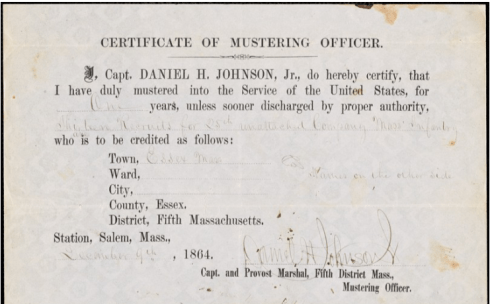 Recruiting posters from 1861-1863, New York Historical Society via New York Heritage; Town of Essex Civil War records, 1864 via Digital Commonwealth.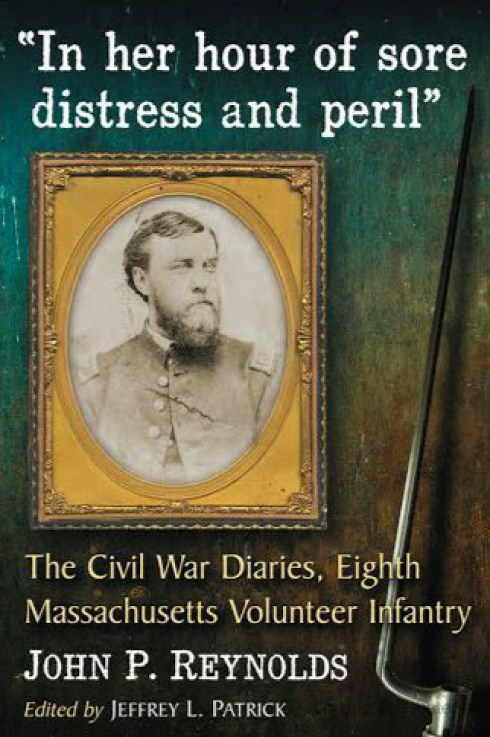

 Valentine’s Virginia vignettes, 1863-64, National Archives.

 Library Company of Philadelphia and Richard Frajola.
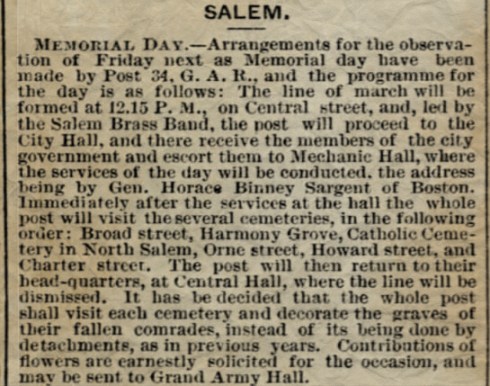

 The evolution of Memorial Day: C.H. Webber outfits participants for the occasion, Salem Register, May 19, 1870; Boston Globe May 1873, 1923, and 1944: the last GAR members in Massachusetts, including Thomas A. Corson of Salem, who died later that year at age 103.


 Salem Gazette, July 1796.
 .
.


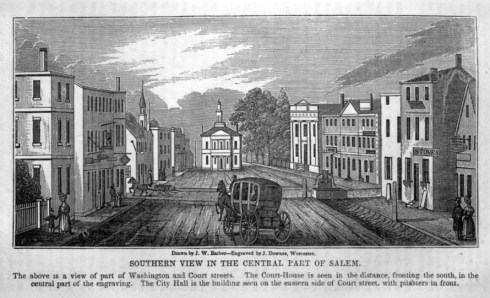

 The Tabernacle Church of 1777-1854, from Samuel Worcester’s Memorial of the Old and New Tabernacle (1855); payments to Daniel Bancroft in the Tabernacle Church administrative






