Tag Archives: books

Salem’s Centuries

Yesterday I received three copies of Salem’s Centuries. New Perspectives on the History of an Old American City, and Tuesday is publication day, so I thought I’d provide an introductory post. The crucible of this book is definitely this blog, so I want to thank all of its followers, readers, and commenters: I truly am grateful for your support and inspiration! I can’t believe that I’ve been writing in this space for fifteen years: that’s a long time in internet years. It started out as just a vehicle to satisfy my own curiosity about Salem’s history and showcase Salem’s architecture, though I definitely thought I would move on to more worldly topics, despite its title. But the Salem posts were always the most popular, by far (except for anything to do with maps!) And so a more sustained focus on Salem led to the book, but a book is different than a blog. What I share here are mostly stories, but Salem’s Centuries is all about the history of this storied place.


I “posed” the books all over the house!

Salem is indeed a storied place. You (or I) can’t walk down the street without seeing a structure that conjures up some story or inspires the search for one. Stories are part of history, but history is more: layers, context, perspectives. After Covid and the publication of The Practical Renaissance I knew I wanted to write something about Salem for its 400th anniversary in 2026, but I wasn’t sure what—or howThe easiest thing to produce would be a compilation of the Salem stories I have posted here, but I wanted more and I thought Salem deserved more, and so the thought of a proper Salem history emerged. It was an intimidating thought for me, as Salem is an important American city and as I have asserted here time and time again, I am not an American historian. I think I’ve acquired some knowledge and expertise in Salem’s history over these fifteen years, but not enough to sustain a volume that attempts to cover 400 years. So I turned to my colleagues at Salem State, and the result is a collection of essays which explore Salem’s history from different scholarly perspectives across time but centered in place. The key moment in this turn was definitely that in which Brad Austin, our Department chair, 20th century American historian and experienced editor, agreed to be my co-editor. And the rest is history!

Here’s an overview of the book, which will be released everywhere on Tuesday and showcased in a series of events, beginning with a presentation (and hopefully discussion) at Hamilton Hall on January 25. Brad and I are incredibly grateful to the Peabody Essex Museum for centering its PEM Reads podcast on Salem’s Centuries throughout 2026. There’s a lot to discuss, but as both Brad and I realized as we finished this book, there’s also a lot more to learn about Salem’s vast history, so we hope that its reception encourages further research. And that’s exactly where you want to be at the end of a history project: stories end, history doesn’t.

The First Century (note: an innovative feature of our book is its division into full-length chapters and shorter, more focused “interludes” on people, places, and specific events. This was Brad’s idea.):

“Putting Salem on the Maps” is a grand display of historical and geographical context by Brad, and a perfect orientation for our place and book. My colleague Tad Baker has written the definititve history of the Salem Witch Trials, A Storm of Witchcraft, but he is also an archeaologist and historian of the indigenous peoples of New England, and his contributions to our book showcase both these fields of expertise. “The Dispossession of Wenepoykin” gives some much needed historical background of Salem’s “Indian Deed,” and “Gallows Hill’s Long Dark Shadow” is a first-hand account of the revelation of Proctor’s Ledge, a space below Gallows Hill, as the execution site of the victims of 1692, set in historiographical and contemporary contexts. My brief history of Hugh Peter, Salem’s fourth pastor and a regicide of King Charles I, enabled me to indulge in my own scholarly expertise for a bit, and Marilyn Howard’s depiction of John Higginson and his world is a rewrite of one of the best (no, the best) masters’ theses that I have read at Salem State. A magisterial chapter on “Salem and Slavery,” including both indigenous and African-American enslavement in Salem, by my award-winning colleague Bethany Jay, completes this century. Salem’s Centuries contains five pieces on African-American history, all set in larger contexts.

The Second Century: 

You would think that an eastern American city as venerable and consequential as Salem would have a published history of its myriad roles during the American Revolution, but no. Hans Schwartz, also a graduate student at Salem State who went on to get his Ph.D. at Clark University, has contributed a succinct yet comprehensive history of these roles in Chapter Four, with an emphasis on the social and economic changes brought about by the Revolution. Another one of our graduate students, Maria Pride, contributes some of her dissertation research on privateering in an interlude on Salem’s “hero among heroes,” Jonathan Haraden, with a little public history push by me. A strong theme of the book is Salem’s continuous “outward entrepreneurialism,” which Dane Morrison’s and Kimberly Alexander’s chapter on the rather tragic expatriate residency of the Kinsman family represents well. “Sabe and Rose” summarizes the collaborative research of Professor Jay and Salem Maritime National Historic Park Education Specialist Maryann Zujewski into the lives of the two people enslaved by Salem’s wealthy Derby family. The much-told story of Mary Spencer, “the Gibralter Woman” who (ironically) made and sold her famous hard candy with slave-made sugar while simultaneoulsy maintaining (and passing down) a fierce Abolitionist stance, gets the Austin treatment while I am able to indulge in a longer history of the man who inspired me to dig in, and dig in deeper, to Salem’s history: patriarch, entrepreneur and abolitonist John Remond.

The Third Century:

The Third Century opens with two studies of Salem and the Civil War by former Salem State graduate students Robert McMicken and Brian Valimont. McMicken contributes a general overview (like the Revolution, there isn’t one!) and Valimont a more focused piece on Captain Luis Emilio of the Massachusetts 54th. Here we have another Salem hero with no statue while a fictional witch reigns in Salem’s most historic square (at least Haraden has a plaque, even though it’s in the Korean barbecue restaurant which stands where his home once did). Our colleague Elizabeth Duclos-Orsello contributes a valuable overview of Salem’s Catholic parishes (Irish, French, Italian and Polish) with her chapter on “Immigrant Catholicisms” and we have another example of Salem’s many connections to Asia in Chapter Nine, “A Salem Scholar Abroad: the Worldview of Walter G. Whitman” by our department’s South Asian historian, Michele Louro, and the Dean of the Salem State Library, Elizabeth McKeigue. This chapter is based on Whitman’s writings and lantern slides of his time in Asia in the SSU Library’s Special Collections, and could definitely be the basis of a larger project. There are two focused studies on Salem Willows in this Century: mine on the evolution of Salem’s famed “Black Picnic” from the eighteenth century to the present, and Brad’s portrayal of the Willows as the “playground” of the North Shore. My chapter on four notable Salem representatives of the Colonial Revival movement definitely transitions well in the twentieth century, while my examination of the 1879 “School Suffrage” election is pretty focused on that one year.

The Fourth Century: 

We were slightly deferential to the nineteenth and twentieth centuries, as Salem historiography has been so focused on the witch trials and maritime history and felt that this last century has been a bit ignored. From a department perspective, we also have several acclaimed twentieth-century historians and wanted to showcase their work. Brad and I worked together on all the editing and introductions in Salem’s Centuries, but the one chapter we co-wrote is an overview Salem’s urban development over the twentieth century, beginning with the aftermath of the Great Salem Fire of 1914. This chapter enabled me to finally figure out Salem’s experience of urban renewal in the 1960s and 1970s! Avi Chomsky, an eminent Latin Americanist who also studies labor history and Hispanic communities here in the US, contributed two pieces to this century, one on the 1933 strike at Salem’s largest employer, the Naumkeag Steam Cotton Company, and another on Salem’s changing demographics in the later twentieth and twenty-first century. Brad worked with SSU archivist Susan Edwards on a chapter on Salem during World War II and with Professor Duclos-Orsello on the Salem State community during the lively 1960s: both pieces are based on SSU archival holdings, which we also wanted to showcase. Readers of this blog have read my rather struggling posts about Salem’s public history in its present “tourism era,” but our book contains two much more illuminating studies by public history professionals Margo Shea and Andrew Darien. Drew Darien, our former chair and now Associate Dean of the College of Arts and Sciences at SSU, presents an analysis of oral histories taken during and after a conference held on the occasion of the 325th anniversary of the Witch Trials back in 2017, which Professor Shea and her former graduate student Theresa Giard explore the lure and meaning of one of Salem’s most popular present attractions, ghost tours. Finally, we have an epilogue (by me, exploring or maybe the better word is summarizing 400 years of Salem history through the perspective of one place, Town House Square) and a coda, by our colleague in the English department, J.D. Scrimgeour, Salem’s very first Poet Laureate.

Salem’s Centuries. New Perspectives on the History of an Old American City. Temple University Press, 2026.


Finishing my 2025 Books

I’m still working on the fall version of my 2025 reading list even as the year draws to a close. I certainly won’t finish it by the end of the year, but I have a LONG break ahead of me as I have a sabbatical for the spring semester! Lots of great books coming out next year (including my own) so I better get going. Next week, I’ll post about Salem’s Centuries as its publication date is January 6 (hoping to change the vibe for that particular date). This is a really good working list of books that I have read, am currently reading (I tend to read books concurrently) and plan to read pretty soon, all of which were published in 2025. In fact the last book is due to be published tomorrow, so I don’t have it in my possession but I pre-ordered it. As usual, this is a nonfiction list; I just don’t read very much fiction so I can’t offer up any kind of a guide to those genres. I read history, history of science, art history, the history of food and drink, folklore, and books about various types of design and architecture. That’s pretty much it. Maybe a bit of politics and popular culture—and media, but the vast number of titles for fiction and self-help books appearing every year seldom catch my attention. So here goes, beginning with books in my period that I felt that I had to read but were nevertheless quite good.

I thought Borman’s book was going to be just a narrative of Elizabeth’s declining years, death, and the succession of James I and VI, and it was that, but it was more too—I learned lots of little things I did not know about these years. Borman is more than a television presenter, clearly: this is a very source-based history, with particular reliance on new revelations about William Camden’s Annales. Just further complexities relating to James for me! I think I have a book on him on many of my book lists here, and as 2025 was the 500th anniversay of his death I had to have one more: Clare Jackson’s Mirror of Great Britian is amazing, one of the best royal biographies I’ve ever read, and that is saying something as James was complex: earnestly Protestant but also a pursuer of pleasure, well-educated but also a true believer in demonic witchcraft, the only contemporary critic of tobacco, the first King of Great Britain. He’s a lot, and Jackson handles both the man and his era really well. Getting away from royalty and this specific era, two other British books which I am kind of reading together, gradually (they are both what I think of as “dipping” books in that you can pick up and dip into them wherever and whenever you like) are all about food and folklore—both just completely entertaining and informative at the same time.

I like to read books that are sweeping in terms of their topics, sweeping over the centuries: a change from most of the academic reading I do which is much more constrained in terms of both topic and time. The very popular genre that I call “commodity history” often includes sweeping titles, but as its title asserts, Jordan Smith’s The Invention of Rum is more narrowly focused on the invention of this “perfect” Atlantic spirit. Another “invention” book (though I really don’t think “design” was invented in the twentieth century but that’s why I want to read The Invention of Design) covers only the twentieth century. A really fascinating book blending history, magic and medicine (one of my favorite combinations), Decoding the Hand covers more ground.


I have my natural, constant interests, but if I’m looking for something new to read the first place I go is to the website Five Books, at which experts recommend five books in their areas of expertise and lots of lists to inspire a wider range of reading. I love this site! One great book that I never would have found on my own came from here: Sara Lodge’s Mysterious Case of the Victorian Female Detective, which was on the shortlist for this year’s Wolfson History Prize, awarded annual for both well-researched and accessible (enjoyable!) history writing. This book was definitely both, and a case study in utilizing historical and literary sources.

Finally, three books of a more timely/political nature. The medievalist Patrick Boucheron has written a great book about Political Fictions over time, I am searching for some explanations for/relief from the NOISE that assaults Salem all year long so I purchased Chris Berdick’s well-reviewed Clamor (though I’m sure he will take on all the sirens and jackhammers but not the tour guides), and I think we should always remember January 6 (for more than the publication of Salem’s Centuries) so I’m going to read Nora Neus’s oral history on that day.


The Revolution in Color

I decided to celebrate the debut of Ken Burns’ new series on the American Revolution by getting out two old books which I always enjoy browsing through, and which I now realize were quite foundational in how I look (and I do mean look) at American history in particular and history in general. The two books are The Pictorial History of the American Revolution by Rupert Furneaux and The Colonial Spirit of ’76 by David C. Whitney, and they were both published for the Bicentennial by Ferguson Publishing of Chicago with ample illustrations, including watercolors of noted Revolutionary spaces and places by “visual artist” Kay Smith. That’s how she is always described, and she died just this year at age 102! Every time I look at her watercolor buildings, I remember when I saw them for the first time; it happened just yesterday when I took the books out. And so it has finally dawned on me that my lifelong pursuit of history through houses began with her. The two books have lots of other cool illustrations too, including prints of every single tavern along the eastern seaboard which has any sort of Revolutionary connection, but Kay provides most of the color. I don’t know about reading these books—they’re definitely rather dated and devoted to storytelling rather than multi-causal analysis, but they are fun to look at. No Salem at all, sadly: colonial capital or Leslie’s Retreat or privateers. The Pictorial History has a chronological/geographical format and the Colonial Spirit is supposed to be more of a social history, I think, but its basic structure is biographical. Here are some of my favorite illustrations—all by Kay Smith, and most of buildings, of course—from Boston to Yorktown.

Kay Smith could depict people too—-her take on Major Andre’s famous sketch of Peggy Shippen Arnold is very charming. Interesting illustrations are scattered throughout both books liberally: uniforms, of course, firearms, vignettes of “daily life,” a great presentation of a Declaration of Independence cover sheet juxtaposed with a facsmimile of Thomas Jefferson’s hand-written and -corrected copy (used by Burns at the opening of episode one of The American Revolution). These books made for just as pleasurable browsing as all those years ago. And what do we think of the latest take on the Revolution?


My Shaker Family

I am very excited about The Testament of Ann Lee, the new film about the Shaker founder, because its sounds like quite the experience and I am descended from a Shaker family. I know that sounds like an odd thing to say, because one of the most conspicuous characteristics of the Shakers is their celibacy, but my great great great grandfather James Valentine Calver sold off all his possessions and left his (rather large, I’ve seen it) home in Diss, England and traveled to America with his wife Susan and nine children, Ellen, Maria, Henry, James Jr., Thomas, William, twins Mariah and Jane, and Amelia, to take up residence near the Shaker community in New Lebanon, New York (generally called Mount Lebanon) in 1849. Five of the children were indentured to the Shakers, including my great great grandfather Henry:

SA 881.2         Henry Calver, age 5, indentured by his father James V. Calver to Frederick W. Evans of the New Lebanon Shakers; Henry is to be educated, and to be taught farming or some other suitable occupation; witnessed by George M. Wickersham and Moses Clement, August 28, 1850 (Winterthur Library).

At the end of their indentured terms, most of the Calver children left Mount Lebanon, some immediately, others later. James Sr. and Susan never lived with the Shakers, but nearby. Maria, Mariah (later known as Mary) and Jane (Jenny) all left pretty quickly and married. The boys left in phases, but all eventually wound up in Washington, DC with professional occupations. My great great grandfather became a lawyer (as did his son and grandson), Thomas became a physician and Treasury Department official, and the last to leave, James and William, became a dentist and inventor, respectively, in their forties.  James Valentine Calver, Jr. was a complex man: he seems to have thrived at Mount Lebanon and I wish I had more insight into his decision to leave. He was a teacher, a deacon, an assistant elder and craftsman, and left a material legacy: about a decade ago a wash stand made (and signed, which is unusual) by him fetched a notably high price at auction and the Shaker Museum has a box of toothpick holders (a more sustainable version of today’s interdentals) which were sold in the Shaker shop. He also had a patent for “toothache pellets” and a successful practice in Washington, but apparently failing health and a “nervous condition” drove him to suicide while in winter residence in Florida in 1901.

Postcard of “Group of Shakers in Costume” at Mount Lebanon, n.d. (before 1871), including James Calver (tall man upper left), Winterthur Digital Collections; Box of tooth-pick holders, Shaker Museum Collections.

The suicide of James in the world seems shocking; the earlier drowning of his sister Ellen while among her Shaker community even more so. Two years before James and William left Mount Lebanon, their sister Ellen committed suicide by drowning herself in the community’s pond. In the summer of 1869, this act was covered with sensational headlines on both sides of the Atlantic, primarily because a local Justice of the Peace, rather than the County Coroner, was called in to rule on the cause of death. Ellen was buried but questions lingered, and so in late August there was an exhumation and a Coroner’s inquisition, which in the end confirmed suicide but compelled the Shakers to be quite assertively defensive. Ellen was found to be clinically “pure” but also insane, and several newspapers (particularly those in Great Britian!) opined that all members of spiritualist sects were mad. I was particularly struck by the words of a London Daily Telegraph story, or should I say editorial: we can quite comprehend how the free, open, frank, social spirit of the States should strongly revolt against a system of silence, abstinence, and stern self-suppression, which not merely takes away the faculty of sound and active citizenship, but tempts the individual nature to seek refuge from a joyless existence in the desperate resources of madness.

The reference to “sound and active citizenship” in the Daily Telegraph piece really references with me as I cannot imagine a more sound and active citizen than the Calver family member who remained with the Shakers at Mount Lebanon throughout her life, clearly flourishing in their company: Amelia Calver. She was a devoted teacher and a published author. She kept bees at Mount Lebanon, wrote poetry and songs for her fellow Shakers, and traveled to Washington to visit her brothers. (I believe her mother was living in Washington as well, after the death of her father in the 1860s). Sister Amelia always came back to the Shaker community, throughout her entire life, and seems also to have cultivated both spiritual and “mind culture” there, to use one of her own phrases. I think she found joy there too. For a disciplined woman, she seems very free, at least in comparison to my largely unformed impression of a Shaker. Her book Every-Day Biography, published by a New York City publisher in 1889, was just that: a collection of brief biographies arranged for every day of the year. According to her preface, she was inspired to write it by the infinite variety of sea pebbles she found while walking along the seashore, and when she returned to her “mountain home” it took shape and flight. All sorts of biographies are inside, including those of many women from the past and her own time, illustrating the Shaker emphasis on gender equality. Sister Amelia seems like the “last Shaker” to me: when she came to Mount Lebanon as a small child in 1850 it was flourishing, with hundreds of menbers; when she died in 1929 it was in obvious decline. I think she thrived in her chosen world but would have been capable of transition if need be.

One of Sister Amelia’s teaching certificates from Columbia County and a stereoview of her classroom (she is at upper right), Shaker Museum Collections; the “Shaker Retiring Room” at the Metropolitan Museum of Art features Amelia’s desk, on the left; portrait photograph taken in Washington, DC, 1890-1910, Every-Day Biography (1889), and her autograph, Shaker Museum Collections.


Words or Pictures or Numbers?

This post is about the work of a venerable but new-to-me graphic designer, Seymour Chwast, but before I get to him I have to explain how I got to him. If you have been reading the blog over the past year or so, you might have perceived that I have become mildly obsessed with two images associated with Salem: the official Salem City Seal with its Sumatran trader, now likely on its way out after 180 years or so, and more recently a cartoon cat mascot chosen by the Mayor of Salem and the Salem 400+ Committee to represent our city’s “unique identity” for our upcoming Quadricentennial. The discussion, and in the latter case lack thereof, over both images has been perplexing. I’ve written quite a bit about the seal, and was going to write more about the mascot, but I now realize that such efforts are a waste of time. These images, deemed rascist or representative or not, will stand or fall according to the whims of five or six or maybe 20 people at best. That’s how Salem works: the average person has very little power over matters of civic identity or branding (or anything else for that matter.) Nevertheless, it’s been so interesting exploring the power of images over the past year or so in various ways. As a Renaissance historian, I’ve always been aware of the complexity of images, but if you want to consider their power in the present, that brings you into the realm of graphic design, and so that brought me to Seymour Chwast, briefly. And then he popped into my consciousness again just last week when I was searching for an image of the Battle of Sluys for a powerpoint lecture on the Hundred Years War. The search led to a compelling image of a medieval naval battle which was not Sluys but rather Chwast’s depiction of the Battle of Zonchio in 1499, fought between Venice and the Ottoman Empire. This is just one of nine hand-colored linocut battle scenes, paired with literary quotes on the opposing page, included in Chwast’s 1957 folio A Book of Battles. 

Chwast is in his 90s and still working, I think: his career is too prolific and illustrious to summarize here but I will take a stab. Over six decades he has published all sorts of images and illustrations, individually and on behalf of the Push Pin Studios (now Group) the graphic design firm he co-founded in the 1954. From magazine covers to posters to corporate advertising to packaging to theatrical backdrops to his own publications: he has done it all. Chwast is the author of 30 childrens’s books and four graphic novels, and he is also a typeface designer! Chwast’s career is marked by his intent and ability to utilize design as a political force on many occasions, and one theme seems to run through much of his editorial work from the beginning: pacifism. This was certainly the inspiration for his Book of Battles, as the juxtapositions of images and words make clear.

And then, in 2017, a capstone (or maybe not yet) anti-war book, At War with War: 5000 Years of Conquests, Invasions, and Terrorist Attacks. An Illustrated Timeline. More striking graphics and literary excerpts, but a timeline too, which means numbers. The (red) numbers somehow make the illustrations all the more menacing, especially as we proceed into the (modern?) information age in which casualties can be marked along with dates. It all packs a powerful punch.


Fall Reading 2025

The stars seem to have aligned and I am all set for a fall full of reading. Salem’s Centuries is in production (and out on January 6), my new saffron project hasn’t taken flight yet, and I have a course release for the semester. I’ve written two books in five years and now is the time to ingest. Escaping into book worlds is another way of avoiding my least favorite season in Salem as well. So I have a long list, already about a quarter devoured. As usual with my book lists, it’s very light on fiction, heavy on history, and reflective of the odd ephemeral interest. So let’s go: it will be interesting to see how I group these rather disparate texts.

I think I’ll start out with broad, cultural histories as they might have the most general appeal: I’m always reading “commodity histories” and this year will be no exception, but I have to tell you that Robert Hellyer’s Green with Milk and Sugar has a bit more depth and dimension than most books about tea—and there are a lot of books about this particular commodity. I had the difference between black and green teas down, but did not discern between different types of the latter (and their impact) until I read this very interesting book. Another important global commodity, sugar, has also received quite a bit of attention from scholars (beginning with Sidney Mintz’s classic Sweetness and Power) but the latest effort, the Dutch economic historian Ulbe Bosma’s World of Sugar, is supposed to be particularly comprehensive. I bought it last year but haven’t delved into it yet. Super excited to read Catland: how can it not be amazing? I’m not sure where to put Chanterelle Dreams, Amanita Nightmares, a book I discovered in the gift shop of the Coastal Maine Botanical Garden a few weeks ago solely for its title (+ lore), in this post so I guess I’ll put it here: it is kind of a broad cultural history of human perceptions of muchrooms. It’s also very much a “pick up and read a bit” book.

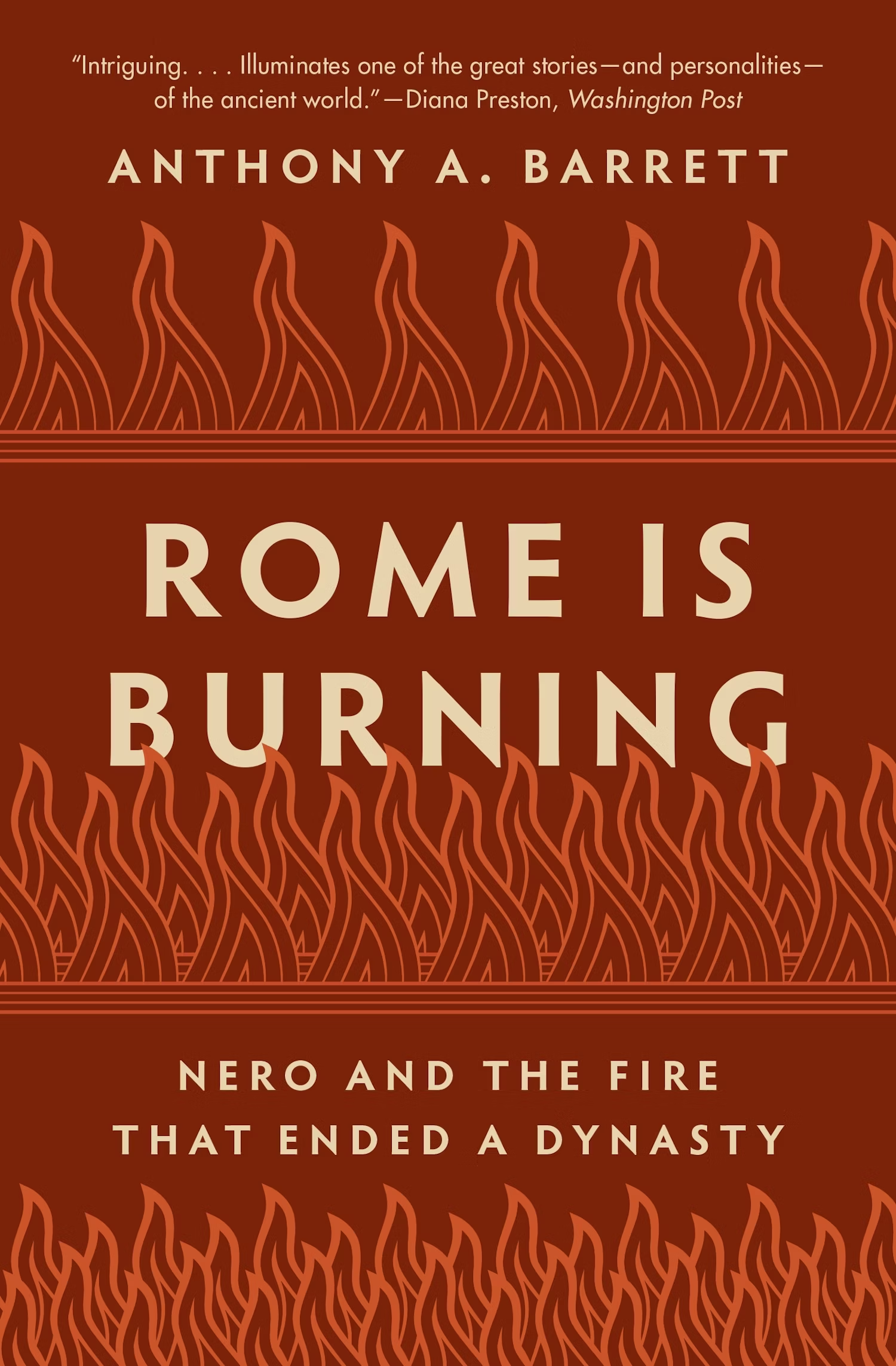
I find that I am reading new books on the Atlantic Slave Trade regularly because we are in the midst of a golden age of research into the history of this terrible trade and provocative analyses of its cascading impacts are published every year.  Traders in Men and Plantation Goods are on my fall list but I should have read them this summer, in advance of teaching my Introduction to European History course. Instead, I had a “Roman interlude” prompted by a re-reading of Suetonius’s Twelve Ceasars last spring. So two half-read Roman books are on my fall list too: a very accessible history by Anthony Barrett about Emperor Nero and the burning of Rome and a book by Roland Mayer about Roman ruins which is more about later perceptions of Rome than Rome itself. The Mayer book probably belongs with the broad cultural history books above. I have started Traders in Men and Plantation Goods (as you will discern by now, I read books in phases, concurrently with other books, a habit I’ve been trying to break but cannot) and my assessment so far would be: both very important and well-sourced studies, with Plantation Goods probably more accessible as it focuses on the basic. It is very much a “material history.”

There are several books which were recently published in my scholarly fields which now sit beside my bed in a stack: first up is Inventing the Renaissance and then we have two books on major late Tudor/Jacobean players: George Villiers, the Duke of Buckingham, and Robert Cecil. I’ll read these for myself, but also to discern whether or not I’ll assign them to students. Stephen Alford (author of All His Spies)’s previous book, London’s Triumph, was a big hit among my grad students this past summer. I suspect that Palmer’s Inventing the Renaissance will be great for historiographical discussions in both undergrad and grad courses. And because it was set in my period and in an interesting period in Mary, Queen of Scots’ life, I actually read a novel all the way through this summer: Flora Carr’s The Tower.

Finally, books on more topical interests which are preoccuping me constantly and/or currently. I’m always interested in architecture, and I read one book this summer which I loved: Thomas Heatherwick’s Humanise (it’s spelled Humanize in its American edition but I prefer the British one’s cover). I don’t think many architects like this book as it is quite critical of contemporary architecture not so much on the basis of design but of craftsmanship. Heatherwick has provoked a reaction among architects in the UK (I’m not sure about here) as he is not an architect himself and does not hold back on characterizing much present-day building as both soul-crushing and soulless (generally because it is so boring) and has launched a campaign to bring joy and craftsmanship back to construction. He’s a real crusader! I’ve been interested in the urban planning idea of the “15-minute city” for a while, so I picked up Shrink the City to learn more about it. The whole idea of meeting all your needs within a 15-minute radius could work for a city with the infrastructure of Salem, but not if we continue our comprehensive commitment to witchcraft tourism, which has resulted in a multitude of witch shops replacing those selling clothing and groceries. As this past year I seem to have become preoccupied with symbols and emblems, first because of the ongoing discussion over the Salem city seal and more recently by the dumbing-down of the Massachusetts state seal and flag, I’ve really been searching more insights into visual culture and graphic design. It’s like another language which I don’t understand. One book that has really helped me is the classic Megg’s History of Graphic Design, but I welcome suggestions. I have yet to find a thoughtful or even interesting book on vexillology.


Hawthorne’s Salem Notebook

For a blog with Salem in its title, I have written relatively few posts about witches, or Hawthorne. Faithful followers will understand the former slight, but I haven’t really discussed my thoughts about Hawthorne here, I think. Essentially I am not a fan of the man or his works. He strikes me as very haughty and melancholy and over-dramatic and not subtle and there are particular aspects of his biography and character which I really don’t like, particularly his attitude towards race and any expression of social reform and his treatment of Salem sculptor Louise Lander in Rome. I don’t think his novels have aged well: just a brief comparison with a near-contemporary like Jane Austen will illustrate what I mean. Despite her smallish world, much smaller than that of Hawthorne, her works are classic and current because she understood people much better than he did. It’s no revelation that Hawthorne was a misanthrope, but it’s difficult to get past that, really, at least for me. In the last year or so, I have been trying to get closer to Hawthorne by reading his notebooks: they’re by my bedside in nice editions and I have been been dipping into them regularly. I started with the European notebooks (English, Italian) and then last month picked up the “lost” notebook, which he kept in Salem from 1835-1841. And now I find myself looking at him not altogether but a bit differently: he seems young, very impressionable, very curious, but still judgemental. True to form, young Nathaniel was not really social in any sense in the world—he even calls himself a recluse—but he is a good observer so he is a good source for Salem. This notebook was published by his widow Sophia in the 1860s in a highly-edited American version: most critics use the word bowdlerized. She took out all the interesting bits! More than a century later it was rediscovered, and published in a 1978 facsimile edition by the Pierpont Morgan Library, which has the original manuscript in its collection.

The entries in the notebooks are basically observations interspersed with story ideas. Hawthorne is always walking around Salem: in general (but not always) he prefers to walk away from the city center into nature, to the Willows and Winter Island, to North Salem, along the coastline. Sometimes something he sees will prompt a story idea but usually the story ideas are coming out of his head rather then his environment. He seems to be practicing describing settings, rather than people’s characters. Sophia took out his descriptions of a well-dressed drunken couple observed on a trip to Boston, and young ladies bathing at the Salem shore, but they are restored in the 1978 publication, and another (really great, but again somewhat detached) discourse on society is a great description of the celebration of July 4 (his birthday!) on Salem Common. I made a list of highlights, but you will surely have your own: the lost notebook, which is also Hawthorne’s Salem notebook, is a quick, engaging read.

On Nature: Hawthorne loves the shoreline and describes its features in great detail. He seems to relish “marine vegetables” in general of an olive color, with round, slender, snake-like stalks, four or five feet long, and a great leaf, twice as long, and nearly two feet broad; these are the herbage of the deep-sea. I had never heard of samphire, or mutton sauce, growing somewhat like asparagus; it is an excellent salad at this season, salt yet with an herb-like vivacity, and eating tender. A succession of cookbook authors agree: where have I been? It’s all over Juniper Point, along with jellyfish. Hawthorne also liked to observe farmland and farm animals, especially pigs, which surely are types of unmitigated sensuality; — some standing /^in/ the trough, in the midst of their own and others victuals; — some thrusting their noses deep into the filth; — some rubbing their hinder-ends against a post; — some huddled together, between sleeping and waking, breathing hard; — all wallowing in each other’s defilement; — a great boar -going /swaggering/ about, with lewd actions; — a big-bellied sow, waddling along, with her swag-paunch. He’s judgemental even of PIGS.

Samphire illustration by Mrs. Henry Perrin from British Flowering Plants (1914).

I would have like to have seen this, but the Bulfinch Almshouse/Hospital was demolished in 1954: The grass about the hospital is rank, being trodden, probably, by nobody but me. The representation of a vessel under sail, cut with a pen knife, on the corner of the house. I would have liked to have seen both the building and the vessel carving.

The Salem Almshouse and Hospital of Contagious Diseases built 1816, Frank Cousins glass lantern slide, Phillips Library, Peabody Essex Museum via Digital Commonwealth.

Looking glasses: Young Hawthorne clearly loved nature, but he was a materialist too, interested in and inspired by structures and objects. I found multiple reference to mirrors: To make one’s own reflection in a mirror the subject of a story. An old looking-glass—somebody finds out the secret of making all the images that have been reflected in it pass back again across its surface.

Wondrous Forces: Many of the story ideas which pop up in the notebook involve plots in which some sort of wondrous force drives the action. I like this one: a person to be writing a tale, and to find that it shapes itself against his intentions; that the characters act otherwise than he thought; that unforeseen events occur; and a catastrophe which he strives in vain to avert. It might shadow forth his own fate — he having made himself one of the personages. Hawthorne seems very interested in all forms of magic, particularly of the kind that alters forms, like alchemy. What I think was the Deliverance Parkman House (demolished just before Hawthorne began his notebook entries; he must have seen it) draws forth several alchemical connections: the house on the eastern corner of North & Essex streets (supposed to have been built about 1640) had, say sixty years later, a brick turret erected, wherein one of the ancestors of the present occupants used to practice alchemy. He was the operative; a scientific person in Boston the director. There have been other Alchemysts of old in this town — one who kept his fire burning seven weeks, and then lost the elixir by letting it go out.

Stereoview of a drawing of the Parkman House, New York Public Library Digital Gallery.

Macabre bits: Hawthorne’s interest in the dead and dying are pretty well-known and there are certainly lots of death references in the notebook: one story idea involves a young couple [who] take up their residence in a retired street of a large town. One day, she summons several of the neighbors in, and shows them the dead body of her husband. That’s it! I wonder where he was going with that? He is of course enchanted with and by the Old Burying Ground on Charter Street where he encounters the grave of his witch-trial judge ancestor and the famous epitaph of Nathaniel Mather, “an aged person that had seen but nineteen winters in the world.” Hawthorne admits that he is quite considerably affected by these words, which he himself revealed to the world when I had away the grass from the half buried stone, and read the name.

July 4: Probably my favorite entry is Hawthorne’s depiction of a very festive Fourth in Salem in 1838. It was a “very hot, bright sunny day,” and the town was “much thronged”. On the Common were booths selling gingerbread &c. sugar-plums and confectionery, spruce-beer, lemonade. Spirits forbidden, but probably sold stealthily. On the top of one of the booths a monkey, with a tail two or three feet long. He is fastened by a cord, which, getting tangled with the flag over the booth, he takes hold and tries to free it. The object of much attention from the crowd, and played with by the boys, who toss up ginger bread to him. He goes on to describe more of the festivity, but he can’t help himself from commenting on the “plebianism” of the crowd!

True Crime via Wax Figures: A very festive July 4th/birthday for Hawthorne as he also attended an exhibition of wax figures which made quite an impression on him. Wax-figure displays had been happening in Salem from at least the 1790s: they were often patriotic or religious in theme, but this particular “statuary” consisted  almost wholly of murderers and their victims; — Gibbs and Wansley the Pirates; and the Dutch girl whom Gibbs kept and finally murdered. Gibbs and Wansly were admirably done, as natural as life; and many people, who had known Gibbs, would not, according to the showman, be convinced that this wax figure was not his skin stuffed. The two pirates were represented with halters round their necks, just ready to be turned off; and the sheriff behind them with his watch, waiting for the moment. The clothes, halters, and Gibbs’ hair, were authentic. E K. Avery and Cornell, the former a figure in black, leaning on the back of a chair, in the attitude of a clergyman about to pray; — an ugly devil, said to be a good likeness. Ellen Jewett and R. P. Robinson; — she dressed richly in extreme fashion, and very pretty; he awkward and stiff, it being difficult to stuff a figure to look like a gendeman. The showman seemed very proud of Ellen Jewett, and spoke of her somewhat as if this was figure was a real creature. Strang and Mrs. Whipple, who together murdered the husband of the latter. Lastly the Siamese Twins. The showman is careful to call his exhibition the “Statuary”; he walks to and fro before the figures, talking of the history of the persons, the moral lessons to be drawn therefrom, and especially the excellence of the wax- work. Gibbs and Wansley were notorious pirates, Ellen (Helen) Jewett was a Maine girl who became a prostitute in New York City and her murder in the spring of 1836 triggered sensationalist headlines for the rest of the year as R.P. Robinson was tried and acquitted of the crime. E.K. Avery was Ephraim Kingsbury Avery, a Rhode Island Methodist minister accused of murdering a factory worker in his congregation named Sarah Cornell whom he had impregnated: he too was aquitted and this was another sensational murder case involving a (very) lasped clergymen which perhaps inspired The Scarlet Letter. In yet another notorious case, Jesse Strang and Elsie Whipple conspired to murder the latter’s husband outside Albany in 1827: she was acquitted and he was executed. I guess “Siamese twins” refers to the conjoined Bunker twins from Thailand who were thrown in here for good sensationalistic measure.

Cornell Digital Collections.

Social Commentary: Hawthorne does not seem to be interested in the contentious causes of his time and place. Salem was characterized by dynamic temperance and abolition movements in the 1830s, and he makes no mention of them in his notebook except for another story idea, a sketch to be given of a modern reformer — a type of the extreme doctrines on the subject of slaves, cold-water, and all that. He goes about the streets haranguing most eloquently, and is on the point of making many converts, when his labors are suddenly interrupted by the appearance of a keeper of a mad-house, whence he has escaped.

While I enjoyed reading Hawthorne’s Salem journal more than the European ones, especially in this unadulterated form, I can’t say I like him anymore than I did before I delved in. I do admire his curiosity, his descriptive abilities, as well as his tendency to engage—-and often wrestle with—the past, even in his odd anti-humanistic way. When I read his proposal of a history of modes of punishment, ancient and modern I finally understood the rationale behind the Salem Museum of Torture! (just kidding; I doubt a Hawthorne connection). And while a statue on Hawthorne Boulevard and the House of the Seven Gables stand testament to Hawthorne today in Salem, there is also a wax representation, which seems appropriate, given his fascination with that genre.

I pinched this photo of Hawthorne’s wax figure at the Salem Wax Museum of Witches & Seafarers from the author J.W. Ocker’s website, Odd Things I’ve Seen. In “Wax City,” Ocker observes that Salem tells its history through wax museums, and I agree, although I would put quotations around the word “museums.” Ocker wrote the great book The Season With the Witch about his residency in Salem during Haunted Happenings in 2015, and since Salem’s tourism has escalated so much over the past decade, I think he should return for a sequel.


A Salem Printer & Procrastination

It’s the end of the semester, a transitional time in which I traditionally don’t quite know what to do with myself. Instead of finishing up all of my little annoying tasks, I am persusing random pieces of print here and there. My stepmother has observed that my father can be sidetracked very easily from any task by “printed matter,” generally a newspaper or magazine, something that can be read quickly but is not (by him). I have observed this many times. It runs in the family: I too can be diverted by printed matter, but for me, it’s not the text but rather the type. I don’t really care what the words (or images) are, it’s how they have been printed, their design and composition. This goes back decades with me, since I wrote my dissertation on English printers in the sixteenth and seventeenth centuries. I did so much research on their world, their shops, their type, that I became a typography fan for life. If I happen to spot a striking typeface, a new-to-me specimen pamphlet, or an interesting title page, I will chase these impressions down to the ends of research database-earth. That happened this past weekend: hours went by, but I did discover a new Salem printer. One glance at the bookplate of Irving Kinsman Annable in the large collection of bookplates amassed by Daniel Fearing at Harvard’s Houghton Library, and I was lost.

Annabale (1867-1949) was a Salem resident who established and ran the Berkeley Press of Boston for over 50 years, eventually passing the business down to his son Walter. When I read some of the advertisements for the Press, I assumed they were job printers, producing forms and flyers, envelopes and enclosures. These very practical (and emphemeral) products were the basis of the Berkeley business, but clearly the Annabales had an artistic and skilled devotion to their craft and were not just pumping pieces out. Inland Printer, the long-running printing industrial periodical, has many reviews of the Berkeley Press, and also features the full range of its advertising: again and again the claim is “a specialty of out-of-the-ordinary printing.” Besides these orders, the Berkeley Press produced or contributed to lots of specialty publications for regional institutions and trade organizations, as well as a succession of patriotic pamphlets, including the Declaration of Independence and Gettysburg Address. Houghton Mifflin even commissioned Berkeley to produce one of the earliest (and most popular) pictorial maps, the black-and-white version Melanie Elisabeth Leonard’s view of Cape Cod, in 1926. Catalogs, portfolios, all sorts of enclosures: the press printed anything and everything, except for larger books. (I think, but I don’t have access to any business records, though there are papers in the Phillips Library collection that I want to check out if my curiosity continues). Of course, Berkeley’s own advertising materials, like the pamphlet on decoration below in the collection of Historic New England, are the most beautiful.

The first half of the twentieth century was such an exciting time for the craft of printing as its practicioners were earnest advocates for its skills and exemplars in the face of increasing mechanization. These men (mostly) were all inspired by William Morris and his Kelmscott Press, but they went on to acquire distinct skills and attributes through their own practice, societies, and appreciation of printing history. They kept their businesses small and identified as artisans first. In Boston, the leader of the printing craft movement was clearly Daniel Berkley Updike (1860-1941) and his Merrymount Press, which produced lots of ephemera as well, but many more books than Berkeley, each one a work of art. I don’t think the contemporaries Updike and Annabale were competitors; I think they were colleagues, and both were active in the Boston Society of Printers. Annabale was definitely more interested in advertising as an art, writing quite clearly about the power of “word images.” The Berkeley Press did produce several small books, especially if there was a local connection as in the case of Joseph Ashton’s History of the Salem Athenaeum, 1810-1910, but they are nothing to get excited about. On the other hand, Annable seems extremely excited about the power of perfectly printed slogans and symbols. In the press prospectus Houseflags & Trademarks (1924—the author is not credited but this reads like all of Annable’s other copy) he compares the flags flown by New England ships a century before, when they “were such frequent travellers across the waters of the world….[that] their flags were familiar spots of color in the harbors of six continents” with the trademarks of his day: if the design was right the same “familiarity” would emerge. Though he did some printing in Salem for friends and organizations which which he was associated, and even produced some picture and postcards which he sold himself (enough that I’m wondering if there was a press at home—a really cute mansard roof cottage still standing on Willow Avenue), I think Annabale saw his professional life as existing in Boston, for over fifty years.

Houseflags & Trademarks courtesy of Bailgate Books, Ltd.


My Top Ten Books on Salem’s Architectural History

I thought I would combine my traditional spring book list with the Preservation Month of May and put together a list of my top ten books on Salem architecture in historical context. I’m a rank amateur admirer of New England architecture up to about 1840 or 1850 but a bit more focused on the later eighteenth and early nineteenth centuries when it comes to Salem structures. While I am offended by every new Salem building which is erected there’s enough inventory from this golden era to keep me enthralled—for now: I’m not at all convinced that our city’s self-professed preservation ethic still holds. These are the books about Salem houses from which I have learned the most and to which I return the most often: some are just picture books but I find myself going back to them again and again for some reason. But this first book, Fiske Kimball’s study of Samuel McIntire, defined architectural history for me. I love Dean Lahikainen’s more recent Samuel McIntire: Woodcarver of Salem too, but Kimball is always near. I’m a big fan of Frank Cousins, of course, but I share the view of his contemporaries at the Essex Institute that his McIntire book was a bit slight—and so they commissioned Kimball. I do rely on Cousins’ (and Phil M. Riley’s) Colonial Architecture in Salem quite a bit though, so it’s number two. I’ll read anything by Frank Chouteau Brown, and the compilation Colonial architecture in Massachusetts : from material originally published as the White pine series of architectural monographs, edited by Russell F. Whitehead and Frank Chouteau Brown (1977) includes one of his classic Salem articles. Likewise, I will read anything by his fellow architect Frank E. Wallis, who came up from Boston to measure and draw Salem exteriors and interiors often in his early career. Wallis was a big contributor to a succession of portfolios of measured drawings published as The Georgian Period and edited by William Rotch Ware which were first published in The American Architect and Building News. These portfolios are GORGEOUS—my former neighbors had one and let me peruse it for a bit: I have no idea why I don’t have at least one myself!

I carry Edwin Whitefield’s books with me in the car everywhere, just because they are so charming. You never know when I will find myself in a town with one of his houses!  Albert MacDonald’s Old Colonial Brick Houses of New England, which has the long subtitle edited and published with the purpose of furthering a wider knowledge of the beautiful forms of domestic architecture developed during the time of the colonies and the early days of the republic is pretty much a picture book too, as is Halliday’s Collection of Photographs of Colonial and Provincial Houses 1628-1775. Early American Architecture by Hugh Morrison is rather old-fashioned but also very practical—it’s the only book on this list that has anything to say about construction. And finally, this is BORING I know, but if you’re interested in Salem architecture you must realize that it was written about quite a bit in early architectural periodicals, so I felt that I should include this classic bibliography.


Salem Silk Swatches

Periodically I dip into the papers of Salem supercargo Benjamin Shreve (1780-1839), which offer interesting and insider perspectives on Salem’s early 19th century global trade. Fortunately these sources have been digitized by the Phillips Library, but even before they were available to the general public I had access through an Adam Matthew source collection, to which the Salem State Library has subscribed for quite some time. Benjamin Shreve is interesting, as he is not from one of those old Salem families (nor is he attached to the Shreves of Crump and Low): in the Boston Weekly Magazine for July of 1804, he is described as a “merchant of Alexandria” in the notice of his marriage to Miss Mary Goodhue of Salem, but he quickly made his mark in his wife’s native city. Shreve opens a window into a world of trading logistics and trends through his meticulous commercial correspondence: he’s a numbers guy for sure but also a diplomat of sorts, negotiating the best price and quality for his Salem purchasers back home from his suppliers in South America, East Asia, and Europe. Wherever he goes, he has to fulfill large orders but also buy smaller items for all the wives of his employers back home, as well as for his own. He writes everything down, sometimes in duplicate or triplicate. If I dig into his papers for long my head will start to swirl, so I have to be pretty focused, and this time I was focused on silk. I’m in the exciting stage of research on my next book, which is on saffron in the late medieval and early modern eras, and there are some interesting parallels between it and silk, so that’s where I was coming from, but how I ended up in 19th-century Salem I do not know; I guess it’s just that persistent Salem tug on my time! Anyway, I was looking through a bound book of Shreve’s miscellaneous memoranda from 1809-30 when I came across these cool silk samples in the midst of much drier fare: I was caught!

Benjamin Shreve Papers (MH 20), Trade Memoranda, 1809-1830, Phillips Library, Peabody Essex Museum.

These are samples of Italian silks sent to Shreve by a friend in letter packets, with advice on how and where to buy silk in Italy. It’s 1819; Shreve has certainly been buying silk in China for a while, but he was always looking to expand his sources. I think this is so interesting because I have long thought that Salem’s trade with Europe as compared to Asia has been under-represented in the scholarship. Italy and France were great suppliers of silk so why not buy there if the price was right? And Shreve himself is also under-represented in the scholarship! Why isn’t there a book on him, using all of his amazing accessible papers? He is best represented in China Trade expert Carl Crossman’s book, The China Trade: Export Paintings, Furniture, Silver and Other Objects, 1785-1865, which was published in 1972 and reprinted several times afterwords. Crossman knew the collections of the Peabody (now Peabody Essex) Museum and its library very well and drew on them heavily—I learn a ton of stuff whenever I pick up his book. And as I was just reading about Shreve there, I found two other “Salem silk swatches” from the Shreve papers included by Crossman as illustrations: two sheets of silk samples from the Chinese merchant Eshing given by Pickering Dodge of Salem, owner of the Governor Endicott, to Shreve as a buying guide for Canton, and a letter with some strands of raw silk from Dudley Pickman to Shreve–plus a miniature portrait of our man Shreve on ivory! Crossman digs even deeper into some of the Shreve sources for his last book, The Decorative Arts of the China Trade: Paintings, Furnishings, and Exotic Curiosities (1991). Encouraged by Crossman, I went back to Shreve (for just a bit!) and found one more silk swatch among the Government Endicott papers, a sample of black “Levantine” silk. 

Not for the first time, my title is a bit deceptive: swatch books from the early modern era and after are numerous and generally refer to sample books offered up by producers rather than buyers. The Victoria & Albert Museum has several in its collection, including my favorite, a confiscated traveling salesman’s book of silk samples from Lyon, reproduced in the amazing book Selling Silks. A Merchant’s Sample Book 1763 by textile curator Leslie Ellis Miller. Shreve’s snippets of cloth, embedded in commercial paper, can’t compare to a comprehensive collection such as this, but they certainly offer some visual insights into the global trade of this conspicuous commodity in the early nineteenth century.