Tag Archives: Atlantic World

Fall Reading 2025

The stars seem to have aligned and I am all set for a fall full of reading. Salem’s Centuries is in production (and out on January 6), my new saffron project hasn’t taken flight yet, and I have a course release for the semester. I’ve written two books in five years and now is the time to ingest. Escaping into book worlds is another way of avoiding my least favorite season in Salem as well. So I have a long list, already about a quarter devoured. As usual with my book lists, it’s very light on fiction, heavy on history, and reflective of the odd ephemeral interest. So let’s go: it will be interesting to see how I group these rather disparate texts.

I think I’ll start out with broad, cultural histories as they might have the most general appeal: I’m always reading “commodity histories” and this year will be no exception, but I have to tell you that Robert Hellyer’s Green with Milk and Sugar has a bit more depth and dimension than most books about tea—and there are a lot of books about this particular commodity. I had the difference between black and green teas down, but did not discern between different types of the latter (and their impact) until I read this very interesting book. Another important global commodity, sugar, has also received quite a bit of attention from scholars (beginning with Sidney Mintz’s classic Sweetness and Power) but the latest effort, the Dutch economic historian Ulbe Bosma’s World of Sugar, is supposed to be particularly comprehensive. I bought it last year but haven’t delved into it yet. Super excited to read Catland: how can it not be amazing? I’m not sure where to put Chanterelle Dreams, Amanita Nightmares, a book I discovered in the gift shop of the Coastal Maine Botanical Garden a few weeks ago solely for its title (+ lore), in this post so I guess I’ll put it here: it is kind of a broad cultural history of human perceptions of muchrooms. It’s also very much a “pick up and read a bit” book.

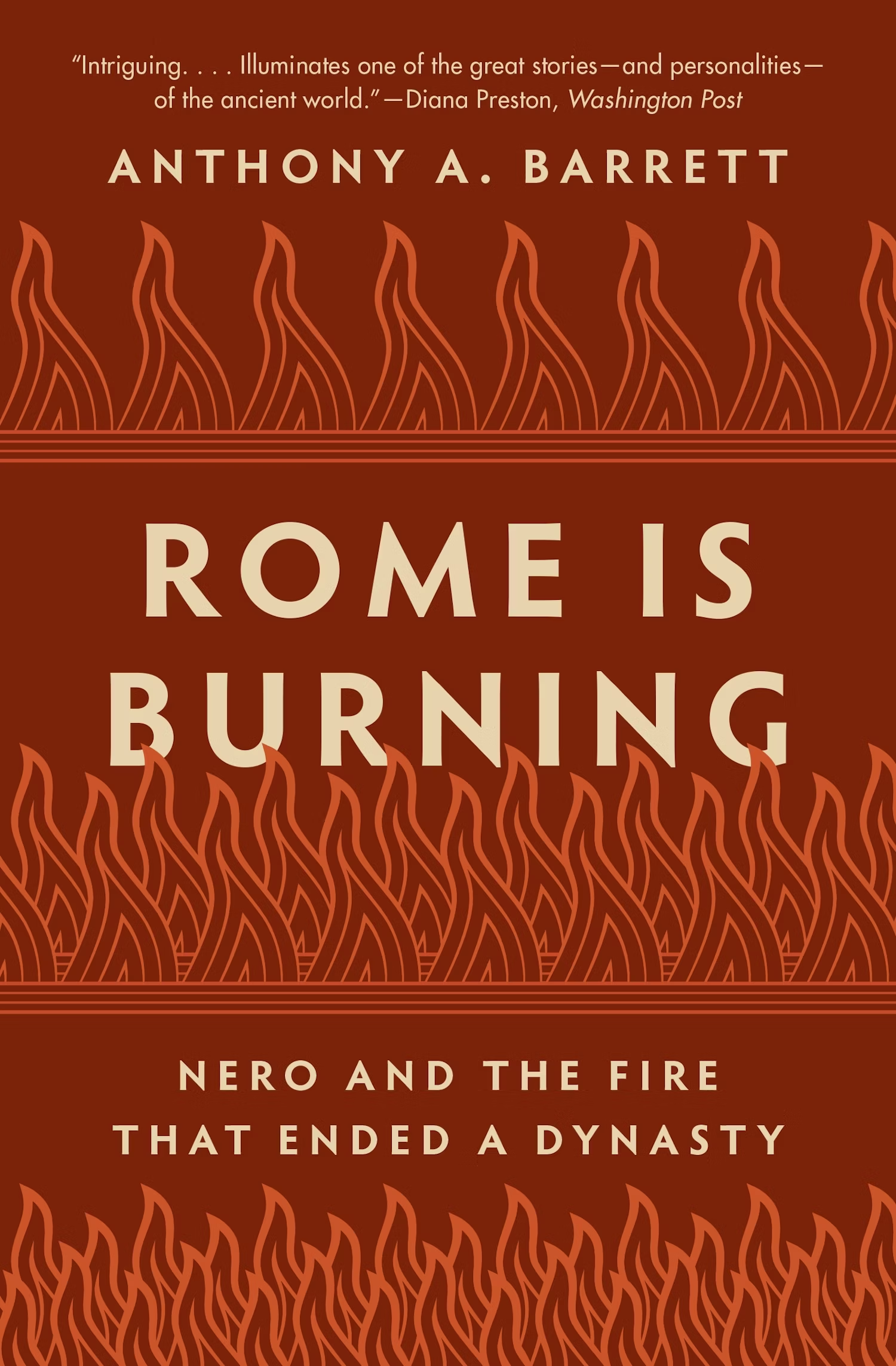
I find that I am reading new books on the Atlantic Slave Trade regularly because we are in the midst of a golden age of research into the history of this terrible trade and provocative analyses of its cascading impacts are published every year.  Traders in Men and Plantation Goods are on my fall list but I should have read them this summer, in advance of teaching my Introduction to European History course. Instead, I had a “Roman interlude” prompted by a re-reading of Suetonius’s Twelve Ceasars last spring. So two half-read Roman books are on my fall list too: a very accessible history by Anthony Barrett about Emperor Nero and the burning of Rome and a book by Roland Mayer about Roman ruins which is more about later perceptions of Rome than Rome itself. The Mayer book probably belongs with the broad cultural history books above. I have started Traders in Men and Plantation Goods (as you will discern by now, I read books in phases, concurrently with other books, a habit I’ve been trying to break but cannot) and my assessment so far would be: both very important and well-sourced studies, with Plantation Goods probably more accessible as it focuses on the basic. It is very much a “material history.”

There are several books which were recently published in my scholarly fields which now sit beside my bed in a stack: first up is Inventing the Renaissance and then we have two books on major late Tudor/Jacobean players: George Villiers, the Duke of Buckingham, and Robert Cecil. I’ll read these for myself, but also to discern whether or not I’ll assign them to students. Stephen Alford (author of All His Spies)’s previous book, London’s Triumph, was a big hit among my grad students this past summer. I suspect that Palmer’s Inventing the Renaissance will be great for historiographical discussions in both undergrad and grad courses. And because it was set in my period and in an interesting period in Mary, Queen of Scots’ life, I actually read a novel all the way through this summer: Flora Carr’s The Tower.

Finally, books on more topical interests which are preoccuping me constantly and/or currently. I’m always interested in architecture, and I read one book this summer which I loved: Thomas Heatherwick’s Humanise (it’s spelled Humanize in its American edition but I prefer the British one’s cover). I don’t think many architects like this book as it is quite critical of contemporary architecture not so much on the basis of design but of craftsmanship. Heatherwick has provoked a reaction among architects in the UK (I’m not sure about here) as he is not an architect himself and does not hold back on characterizing much present-day building as both soul-crushing and soulless (generally because it is so boring) and has launched a campaign to bring joy and craftsmanship back to construction. He’s a real crusader! I’ve been interested in the urban planning idea of the “15-minute city” for a while, so I picked up Shrink the City to learn more about it. The whole idea of meeting all your needs within a 15-minute radius could work for a city with the infrastructure of Salem, but not if we continue our comprehensive commitment to witchcraft tourism, which has resulted in a multitude of witch shops replacing those selling clothing and groceries. As this past year I seem to have become preoccupied with symbols and emblems, first because of the ongoing discussion over the Salem city seal and more recently by the dumbing-down of the Massachusetts state seal and flag, I’ve really been searching more insights into visual culture and graphic design. It’s like another language which I don’t understand. One book that has really helped me is the classic Megg’s History of Graphic Design, but I welcome suggestions. I have yet to find a thoughtful or even interesting book on vexillology.


Parachuting Perspectives

Every day this summer, I have seen relatively large groups of tourists right next door at Hamilton Hall, and heard their tour guides telling them stories—the same old stories every day, which of course are new to these tourists, but not so to me. I think there is a proclivity for historical narratives in Salem, established in large part by the Witch Trials which are understood best through the prism of personal relationships. Local history is necessarily an exercise in “truffle-hunting” to use the analogy of the French historian Emmanuel Le Roy Ladurie, who famously divided all historians into camps of truffle-hunters, searching every little detail out in the archives, and parachutists, who summarized all those details into the big picture, exposing trends and patterns. But both truffle-hunters and parachutists aim to discover, not just tread over the same territory again and again. There’s a tendency to tread over familiar ground in Salem, but the Salem story looks different if it is viewed as only part of a much larger picture. In my academic work, I always try to balance the anecdotal and the general, but blogging definitely favors the former—so every once in a while I take a deep dive into some texts hoping to broaden my frame of reference: after all, I started this blog not only to indulge my curiosity about Salem’s history, but also to learn some American history, which I last “studied” as a teenager!  This summer, I have been slowly working through a pile of recently-published books which offer wider, comparative perspectives on colonial history: most offer the perspective of an Anglo-Atlantic world, in which Salem played a role, but not always a large one. These parachuting perspectives are not from very high up (as the Atlantic World was hardly exclusively Anglo, after all), but just high enough so we can see some things that are not apparent on the ground.

Slavery

Sean D. Moore’s Slavery and the Making of Early American Libraries is an astonishing book, forging connections between the histories of the slave trade and the book trade over a century, and drawing upon the records of the Salem Athenaeum. The impact of the slave trade is multi-dimensional, and here we see its cultural impact, from both transatlantic and local perspectives.


book collage

Building Collage 2

Atlantic history can be very tangible as these recent offerings in the robust field of Anglo-American material cultural demonstrate. I picked up Zara Anishanslin’s extraordinary Portrait of a Woman in Silk earlier this year when I wanted to find some context for the portraits of the silken-garbed Lynde ladies of Salem; the collection of essays in A Material World include two with a Salem focus: by Emily Murphy, Curator at the Salem Maritime National Historic Site, and Patricia Johnston, formerly my colleague at Salem State and now at Holy Cross. Even more expansive views of the material Atlantic world, in terms of topics, time, and places, are Building the British Atlantic World, an anthology edited by Daniel Maudlin and Bernard L. Herman, and Robert DuPlessis’s The Material Atlantic.


Books Inn Civility

Well obviously Inn Civility is one of the best titles ever! I haven’t read this book yet, but anyone with only the slightest knowledge of the American Revolution (such as myself) knows that taverns played a key role, and I’ve always been fascinated with Salem’s many taverns, so I’m looking forward to delving in.


Books winship-m_hot-protestants

Another great title, but more importantly a much-needed transatlantic history of Puritanism (I see that David Hall has another Atlantic history of Puritanism coming out in the fall, but Winship was first). I’m going to use this book in my Reformation courses, and I wish everyone in Salem would read it, because the general view of Puritanism here is strictly simplistic and stereotypical. In our secular society, it’s not easy (or particularly pleasant) to get into the mind of a Puritan, but you’ve got to try if you want to understand seventeenth-century Salem society.


Climate change

1086224_1_07-15-cities-boston_standard

And finally, views that are somewhat removed—though elemental– and closer at hand: climate and comparative history. Environmental history has always been an underlying theme in my teaching, as the “Medieval Warm Period” and “Little Ice Age” are key factors in medieval and early modern European history: I haven’t read any American environmental history so thought I would start with Anya Zilberstein’s A Temperate Empire. And Mark Peterson’s City-State of Boston has been by my bedside ever since it came out for a very parochial reason: everyone knows that Boston’s rise is Salem’s fall.


The Lynde Ladies of Salem

I’ve always admired these three portraits of women from the Lynde family: the wife and daughters of Benjamin Lynde Jr., chief justice of the Massachusetts Superior Court of Judicature and one of the justices who presided over the trial of Captain Thomas Preston following the Boston Massacre. As the portraits were produced by very esteemed and in-demand artists, their existence seems to me to represent the extreme wealth and prestige of the family, and by extension Salem, with which they were all identified. But since I’ve had my “enslavement enlightenment” lightbulb moment, I find I can’t look at them in the same way I used to: a little personal perspective on a challenge faced by many towns, cities, and universities these days. I can’t admire the rich folds of velvet and silk swathing these women without thinking of their other “possessions”.

Lynde Jr Wife Mary Feke Huntington

Robert Feke, Mrs. Benjamin Lynde Jr., c. 1748. The Huntington Library, Art Collections, and Botanical Gardens. Gift of the Virginia Steele Scott Foundation.

01-02_full

Joseph Blackburn, Mary Lynde Oliver, c. 1755. National Gallery of Art.

Lynde Lydia Copley

John Singleton Copley, Lydia Lynde (Walter), c. 1762-64. Lydia Lynde, ca. 1762-64.  New Britain Museum of American Art, Stephen B. Lawrence Fund and through exchange.

Maybe I can look at the silk without guilt: there are references to at least two enslaved men in the various accounts of Justice Lynde’s household, implicating his wife Mary (Bowles) Lynde (1709-91), but I do not know if the Lynde’s two daughters, Mary Lynde Oliver (1733-1807) and Lydia Lynde Walter (1741-1798) are so-tainted. As Mary Jr. was married to a gentleman scientist (Andrew Oliver) and Lydia married the Rector of  Trinity Church in Boston (the Reverend William Walter), I would like to think that they despised the institution and practice of slavery, but that might be anachronistic wishful thinking on my part as science, religion, and slavery seem to be compatible in the eighteenth-century Atlantic world. Mary’s 1751 diary is among other Oliver collections at the Massachusetts Historical Society, and I bet that would yield some clues. Slavery was abolished in Massachusetts during the lifetimes of all of these women, and it would be interesting to know their reactions to that epic event. While the two Marys led much of their lives in the Lynde family home on the corner of Essex and Liberty Streets (demolished in 1836, and then of course the PEM engulfed that latter so that no longer exists either) in Salem, Lydia lived with her husband in Boston until 1776 when they decamped for Nova Scotia with other Loyalists, to return only in 1791. While The Loyalists of Massachusetts described both of Benjamin Lynde’s sons-in-law as “staunch Loyalists”, I’m just not sure that is the case with Andrew Oliver, Mary’s husband. He was certainly part of a conspicuous Loyalist family as his father was the last royal Lieutenant Governor of Massachusetts and his uncle its last royal Chief Justice, but he seems to have been more passionate about science than politics and he and Mary remained in Salem during the Revolution.

Lynde Andrew Olliver

Joseph Blackburn, Andrew Oliver, Jr., c. 1755, National Gallery of Art. In the companion portrait to that of Mary above, Andrew Oliver looks even more resplendent, with his waistcoat and dovecote!

Andrew Oliver by Copley MFA

John Singleton Copley, Andrew Oliver, Jr., 1758. Museum of Fine Arts, Boston

At least I think they did: they’re pretty quiet, only emerging towards the end of the war as executors (she with her maiden name) of her father’s estate. I’d like to think that Mary and Andrew fulfilled the dictates of Benjamin Lynde Jr.’s will and freed his long-term “man” Primus joyfully, and on the most generous of terms. No advertisements for lost or runaway humans before that, thank goodness, only books. We do get some insights into Mary’s character from the ever-quotable Reverend Bentley, although they are not very complimentary: she was “of real piety but not of that mind which could have rendered her a fit companion for her husband who took a high rank in American Literature. She was feeble limited in her enquiries, & a century too late in her manners.” (Diary II, 335-6).

Lynde Salem Gazette 1781

Lynde Essex Gazette 1769

Addendum: There is a fourth portrait of a Lynde lady: Benjamin Lynde Jr.’s mother, Mary Browne Lynde, in the collection of the Peabody Essex Museum: I don’t remember ever seeing it, but it is featured in Lorinda Goodwin’s book An Archaeology of Manners: The Polite World of the Merchant Elite of Colonial Massachusetts (2002) as well as the Smithsonian’s catalog of American portraits, where it is attributed to none other than Sir Godfrey Kneller, the “Principal Painter” of the late Stuart courts. It is quite something to think of a Salem girl being painted by the same artist who portrayed James II, William and Mary, Anne, Locke and Newton! There is no online catalog of its object collections on the PEM website, so I can’t check out their attribution, though Goodwin lists it as unattributed. Mrs. Lynde Sr. appears to have been a very beautiful woman, but not only were her father and husband slave owners, she lived in an age in which slavery became integrated inextricably with the British Atlantic Empire. In 1713 Britain was granted the asiento, the exclusive contract to supply the Spanish American colonies with slaves, in the treaty that ended the War of the Spanish Succession, thus enabling its domination of the Atlantic Slave Trade for the rest of the eighteenth century. 

Mary Browne Lynde

Queen Anne Kneller

Two Kneller portraits? Mary Browne Lynde and Princess Anne before her accession in 1702, Sir Godfrey Kneller, Chirk Castle © National Trust.  After the asiento was granted to Great Britain by the terms of the Treaty of Utrecht, the South Sea Company, in which both Anne and her successor George I were large shareholders, was awarded the contract to supply slaves to Spain’s colonies.