Tag Archives: Architecture

Out by Day

Work and family & friend commitments have kept me in Salem much more than I care to be this October, so I have assumed the habit of a reverse vampire, hiding myself away during the weekends and nights and coming out by (week)day. I just don’t care for the carnivalesque quality of Halloween in Salem, so it’s best to absent myself until November 1, or thereabouts. Salem is a great walking city, and I take long walks all year long: to work, along the water, in the two “botanical” cemeteries, Greenlawn and Harmony Grove, and around the Common and its neighborhoods. Only the cemeteries are safe on October weekends, but during the weekdays the city is mine! If you are traveling to Salem this October, do yourself a favor and: 1) take the train—our traffic has been horrendous— it’s an old city full of bottlenecks and one-way streets and more recent traffic experiments like the roundabout at the end of my street; 2) come during the week if you can— it’s less crowded, less smoky, and less of a carnival; and 3) step off the beaten track just a bit, and this is the city you will see.

20191005_132310

20191004_161051

20191004_171153

20191015_112252

20191015_111316

20191004_170541

screenshot_20191015-185811_instagram

20191015_110146

20191015_100250

20191015_113513

20191015_113108

20191004_170402

20191005_130540

20191015_120712

20191015_105404The Old Burying Point on Charter Street is closed (thankfully) all month long; if you do come during the week you can ride a scooter around town—but not on the weekend as they have been banned because of the crowds.


Mary’s House

I’ve posted previously (several times, actually) on one of my favorite Salem Colonial Revivalists, the author, photographer, and photographic purveyor Mary Harrod Northend (1850-1926), but I am focusing on her again today for two reasons: 1) I’ve uncovered quite a bit of new information about her; and 2) I think those of you who live outside of Salem might not be aware of what has happened to one of her primary residences, which sustained a terrible fire in late November of 2018. I say “primary” because my new information has uncovered a variety of addresses for Mary, but I still think of 12 Lynde Street as Mary’s House, and it’s been sad to see it in a distressed state for the past year. But never fear, it is rising from the ashes: its very responsible owners have hired (SHAMELESS PLUG FOLLOWING) my husband to shepherd its restoration. Whatever fabric (brick foundation, though all the bricks had to be reset and cleaned, some wood, including the front doors which will be dipped) could be saved will be saved, and it will get new window frames, wooden siding and windows, and a rebuilt interior. It was even lifted to straighten it out! It will be stunning, but it’s still unsettling to walk by, especially as I have such a soft spot for Mary.

20190925_165127

20190925_165058

20190925_165011

20190925_164951

20190925_165303

It looks better and better with each passing day, I promise! And while I have you here, does anyone know the name of the entrance detail motif? I have not seen that before: thankfully it was unharmed. Mary’s professional life remains enthralling to me: it started late in life (when she was in her 50s) and was still going strong when she died from complications sustained in an automobile accident in 1926. Consequently it was compacted, and intense: besides her twelve published books there were literally hundreds, maybe even thousands, of magazine articles, on everything from andirons to bread crumbs. In 1914 alone, she sold over 150 articles, employed a stenographer, several file clerks, and a full-time photographer, enabling her to illustrate her own works as well as those of other authors. She had started out ten years earlier with her own camera, and a few sporadic submissions to random publications: now she was almost an industry unto herself, an industry based on highlighting the best of Salem rather than exploiting the worst, darkest days. I guess that’s why I admire her so much.

Mary's House Letter

Here is a letter documenting the very beginning of her career, ten years earlier, from the Century magazine collection at the New York Public Library’s Digital Gallery. At this point in her life, Mary, her widowed mother and younger sister, were living in what sounds like genteel poverty, in the Rufus Choate House just next door to 10-12 Lynde Street. As you can read, Mary has yet to take up her camera or her pen to highlight Salem’s streets and houses, but she is still trading on her Salem connections and heritage: in this case seeking to publish some letters from Nathaniel Hawthorne’s “most intimate friend”, Horace G. (Connolly) Ingersoll, written to her father. She is trying to get in on the big Hawthorne anniversary that year (and boy is she a bad writer! or typist. or both). The Century did not publish these letters, but they are the substance of a 1937 article published in The Colophon by Manning Hawthorne. Mary met with success with other submissions shortly thereafter, largely by abandoning her father’s connections in favor of her own perspectives on architecture and antiques, culled from living in the rapidly-disappearing world of “Olde Salem”. In a marvelous biographical article in the 1915 issue of Massachusetts Magazine, she credits her success to her “friends, the citizens of my hometown, Salem. Had they not thrown open their homes for my inspection and reproduction, I would have been nothing.” The article’s author, Charles Arthur Higgins, opines a bit after that admission, asserting that “now the owners of those beautiful Salem mansions are as proud of the fame and authority of their author as they are of her subject matter” and revealing that “Miss Northen has been repeatedly urged to maker her abode in New York; but she states that nothing can make her forsake the city that has so kindly aided her to fame.”

Mary's Houses Arts and Decoration

Mary's Success 2

Mary's DoorsFame AND Authority:  Occasionally Mary Harrod Northend would present wistful Wallace Nutting-esque views, but mostly she was all about bringing antique material culture into the modern world; notices in Who’s Who in New England and the Architectural Record, citations in trade catalogs were common from 1915 on.


The Forest through the Trees

COURT HOUSES: constant scenes of dramatic Salem history, from the seventeenth century until today. At present, we have one court house being demolished, one recently refurbished in spectacular fashion, and two long sitting vacant, waiting for their redevelopment into something deemed acceptable by the Salem Redevelopment Authority (SRA). One of these warehoused courthouses, an amazing Romanesque structure which was built in several phases over the later nineteenth century, has by all accounts an equally amazing interior library with a huge walk-in fireplace: for some reason I have never been able to make it inside but everyone I know who has raves about it. The other looks like a very pure Greek Revival structure, but again, by all accounts, it has been gutted inside. Because the interior of the Romanesque former Superior Court is so beautiful, several of the proposals for its redevelopment want to preserve areas for public space, which is of course great. And while their ideas for public access have merit conceptually, I am begging the SRA to just say no. While “The Museum of Justice of New England” and “a regional children’s museum that is themed around the Parker Brothers historical presence in Salem” (I’m quoting a September 4 article in the Salem News by Dustin Luca) sound like nice ideas with place-based rationales, the last thing Salem needs is another niche “museum”; what Salem needs, of course, is a Salem Museum, and this scenario offers up likely the last opportunity to make that happen.

20190917_162620

20190917_111025

20190917_111428

img_20190914_150104_773The Superior Court House even has turrets!

Every professional historian, whether working in academic fields or more public positions, along with every well-traveled visitor whom I have squired around Salem, always asks the same question: where is the History Museum? They all notice the commercialism, and the lack of context, and the two are related. We cannot see the forest through the trees. If you have a Salem Witch “Museum” (insert quotes around all the following “museums” please–the first four exist and its only a matter of time before the last surface), and a Salem Witch Dungeon Museum, and a Salem Witch “History” Museum, and a Salem Witch Board Museum, and a Salem Witch Ball Museum, and a Salem Witch Broom Museum, and a Salem Witch Hat Museum, and a Salem Witch Cat Museum, and a Salem Witch Spoon Museum, and a Salem Witch Pin Museum, and a Salem Witch Cauldron Museum, and a Salem Witch Wart Museum, and a Salem Witch Herb Museum, and a Salem Witch Wand Museum then you’re not going to understand anything about the cumulative origins, role and impact of the Salem Witch Trials in context. Likewise, if you go to the Pirate Museum, the Halloween Museum, and the “Lost Museum”, you’re not going to understand anything about Salem’s vast and complex history at all. There are only bits and pieces out there, trees, with Salem’s two professional museums, the House and the Seven Gables and the Salem Maritime National Historic Site, attempting to show Salem’s many visitors some semblance of a forest.

pixlr-2

Court House Costello BPLBits and Pieces of seldom-seen Salem history: Salem printer Ezekiel Russell’s July 1776 Declaration of Independence, the Holyoke family coat-of-arms by Salem artist Benjamin Blyth, a letter from Alexander Hamilton to Salem tax collector Joseph Hiller, Nathaniel Bowditch’s presidential badge from the East India Marine Society, c. 1820, the “Gerrymander” in the Salem Gazette, Salem’s bicentennial banner, Nathan Read’s steam engine, and letters from Salem and Alexander Graham Bell; a photograph of Jessie Costello leaving the Superior Court in Salem after having been found innocent of poisoning her firefighter husband in an absolutely sensational trial in 1933, Boston Public Library, Leslie Jones Collection.

The few images above represent the tip of an iceberg: I could post thousands of pictures of Salem images, stories, “facts”, and events—in fact, I have: that’s my blog! In each post I try to provide context but there is no context for the whole Salem story, and so everything is lost, except for a few well-worn tales about the Salem Witch Trials, and (thanks to Salem Maritime and the Gables) some of the key aspects of its dynamic maritime trade and the work and life of Nathaniel Hawthorne. All those Salem soldiers, in so many wars, forgotten, along with so many Salem artists, entrepreneurs, politicians, and just everyday people, leading their ordinary and extraordinary lives. Could we learn more about legal history and the Parker Brothers? Yes, absolutely, but not in isolation, but rather as part of a larger Salem story. Examples abound, from towns and cities which also draw significant numbers of tourists but seem much more intent on presenting their comprehensive history in an accessible and professional manner. Of course, a comprehensive Salem Museum in this space would have to be a collaborative effort, and it would have an impact on other institutions in the city. All of the court house redevelopment proposals stress the “point of entry” feature of their site, located just across from the train station: the new Salem Museum could also serve as an orientation center, freeing up the Salem Maritime National Historic Site to do their own programming and exhibits at the current Visitors Center on Essex Street.  The new Peabody Essex Museum may be planning historic exhibits in the former Phillips Library buildings, or it may not, but its present and future mission certainly does not include providing the comprehensive and chronological introduction to the Salem story that both our residents and our tourists deserve. There are powerful and influential people in our city who could make this happen, and they should.

pixlr-3A few of my favorite local history museums: the Newport Historical Society Museum, the Concord Museum, and the City of Raleigh Museum in North Carolina. Concord is a perfect role model for Salem: it has a historic national park, and several smaller house museums, but grasped the necessity of establishing a central historical museum for the general public in the 1970s.


An Array of Entrances

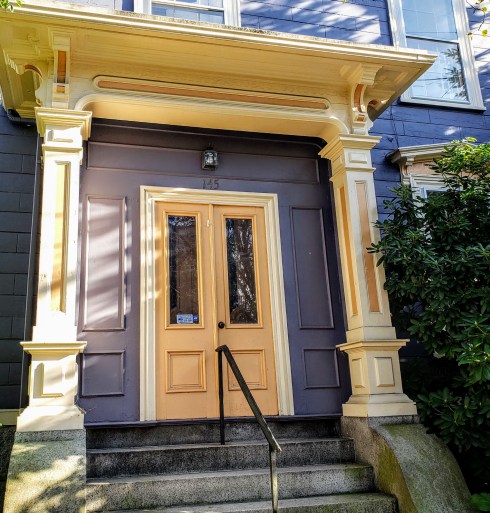
There were two very positive developments regarding Salem’s historical fabric this week: the city’s Cemetery Commission voted to close the Old Burying Point during October, thus shielding our oldest cemetery from its annual occupation by Halloween tourists, and the Peabody Essex Museum announced that it would be returning the anchor which was situated in the front of East India Hall for a century or so to Salem. I am heartened and happy and have nothing to complain about or advocate for in this post! So let’s celebrate with some color, as found on a veritable rainbow of Salem doors. My first house in Salem had a red door, and everyone would comment on it when I told them where I lived; now red is pretty commonplace, but my impression is that the most common door color in Salem is still black. Greens—especially dark green—would be next, followed by a variety of reds, blues, pinks, and orange/peach doors, and finally brown and gray doors. Of course there are lovely Salem doors which are varnished rather than painted, but I’m not including them here. There are yellow doors in every neighborhood, but cream and white doors are hard to find: generally the latter are new Home Depot-ish doors, and not very interesting. There are some pretty nice new custom doors opening out onto the streets of Salem, but if I was in need of a door I think I’d rather find an old one at Old House Parts or somewhere similar. I’ve got one white door here, with some pretty distinctive hardware, and lots in more vivid hues, beginning with the painted door installation at Salem’s Tabernacle Congregational Church, representing diversity and acceptance of all.

20190912_115718

20190910_143549

20190910_143212

20190910_142857

20190912_102040

20190907_165555

20190912_113504

20190912_105451Another reason to praise PEM: the beautiful restoration of the Daniel Bray House on Brown Street: it doesn’t have its new/old door yet as you can see–and I’m not sure if it will be painted this light orange color.

20190912_113844

20190910_140127

20190907_161345

20190907_153717

pixlr

20190907_170036

20190910_134705

20190910_134726

20190907_160454

20190910_140808

20190827_112305Dark Brown/Red is a classic Salem combination.

20190907_170015

20190912_102815

pixlr-1Turquoise is the current it-color, I think.

20190912_110512

20190910_132300

20190907_162959

20190912_114413

20190910_134446

20190910_132834-1T

20190907_170638

20190907_170219

20190907_170103


Six Hours in Salem

At the end of the nineteenth century, Salem was a mecca for architects-in-training, who came individually and collectively—most notably through the “summer school” of the Massachusetts Institute of Technology’s pioneering architecture program—to measure and draw details and outlines of its storied houses. Their work was published occasionally in the the American Architect and Building News as well as in a series of beautiful portfolios titled The Georgian Period. In volume III of the latter, published in 1899, the Rochester-based architect Claude Fayette Bragdon, a fascinating man of many interests including mathematics, set and lighting design, the occult, as well as architectural theory and practice, visited Salem for an afternoon, and rendered his impressions in both text and images. He acknowledges Salem’s two other major draws, the witch trials and Nathaniel Hawthorne, and then gets right into his categorization of Salem architecture: To the mind of an architect the buildings of Salem arrange themselves naturally into three classes: first, those very old houses, built by early settlers in the most primitive times, possessing all the dignity and simplicity and withal, the barrenness of the Puritan character, and around which cluster many strange, true histories and curious traditions; second, those built in later Colonial and Revolutionary days, usually by rich merchants and shipowners, when Salem had become a principal port of entry, and an important commercial centre, and in which the Colonial style is exhibited in its very flower, and third, those purely modern structures—confused, chaotic—which have sprung up in profusion in some part of the town, like weeds in an old fashioned garden. CONFUSED, CHAOTIC WEEDS! If this is Bragdon’s characterization of “modern” architecture in 1899, imagine what he would say now!

Six Hours 3Pickering

Six Hours 5Pingree

Six Hours 4 CH

It’s not entirely clear why Bragdon’s illustrated essay is included in The Georgian Period: he was not affiliated with MIT nor was he was particularly reverent of colonial architecture. But I am very happy to be introduced to him via Salem, as he was a very interesting, multi-faceted man, who wrote several books on theoretical architecture and seems to have worked in every single genre of the decorative arts. He strikes me as a modern Renaissance Man, and I’m looking forward to learning more about him.

Bragdon CollageJust three of Bragdon’s works on architecture, in its widest possible sense.

Bragdon’s essay is included in a volume of select reprinted Georgian Period essays published in 1988 entitled The Spirit of New England, and MIT Summer School drawings and Frank Cousins photographs are added to round out his presentation—but of course that means the presentation is no longer his. But his words are there, as well as his drawings of “old colonial work”, including an interesting rendering of an Eagle-less Hamilton Hall. Missing McIntire? That’s pretty curious. Well, no matter, I’m still struck by Bragdon’s exuberant writing style. At the end of his six hours in Salem, he is reluctant to leave this veritable mine of architectural wealth but his impressions are “permanently” formed of an exceedingly quaint and picturesque old town, striving here and there to be “smart” and modern, like some faded spinster who has seen better days, who mistakenly prefers our shoddy fabrics to the faded silks and yellow lace and other heirlooms of an opulent past. I can see that, still, especially the bit about the mistaken preference for shoddy fabric.

Bragdon collage 2

Bragdon Drawings 2

Bragdon HH


An Almost-Golden Hour in Newburyport

Last week was a very busy time of transition. I have completed my six-year chair term and am going back to full-time teaching, which means four classes, four totally-overhauled syllabi and four first classes–for which I am always a tiny bit anxious, even after twenty+ years of teaching. But in the middle of the week I found myself up in Newburyport, an hour early for an appointment. This free hour was late in the afternoon, not quite the golden hour, on a bright and sunny early September day, so I took a short walk on several streets of Newburyport, where the inventory of seemingly perfectly-restored historic houses of every style seems endless, with more in transition. We’re always in transition in September, it seems, so you’ve got to grab a moment, or an hour, whenever it comes along.

20190814_172410

20190814_172456

20190814_173101

20190814_173239

20190814_173203

20190814_173803

20190814_173549

20190814_174529

20190814_173713

20190814_174034

20190814_174011

20190814_173954

Early September in Newburyport.


Requiem for a Carriage House

There is nothing, nothing, that is worse than neglect, of anything that is in your care. I am always material-minded so I’m going straight to architecture: demolition by neglect infuriates me. It’s expensive to own an old house: I have a long list of tasks that my house needs and I wish I could spend the money that I’m going to spend on the house on travel, or a Sheraton sofa, or lustreware from the 1820s, but I can’t: I bought this house and I therefore I must be a responsible steward of it. I work hard to maintain it in the condition that it demands, as does my husband. The down payment for this house came from money I inherited from my grandfather, who also worked long hours to provide for his extended family; his father came over on a boat from southern Italy all alone at age 10 and worked as a tailor to send all four of his American-born children to college (even the girls) and leave them legacies which they passed down to their children. My legacy is my house, and I would never neglect it: it would be an insult to my family as well as my community. So when I see families of much more ancient American lineage, with the possessions to prove it, exhibiting carelessness at best, and neglect at worst, towards their properties, I get mad. Such is the case with a beautiful brick Federal house overlooking the Ropes Garden, left to rot for years by a family that first arrived in Salem in the seventeenth century, and only recently undergoing renovation. This house will be saved, at long last, but its owner has applied for permission to demolish the mansard-roofed carriage house in the rear of the property. The Historical Commission rules through the granting of certificates: non-applicability, appropriateness, hardship. The owner of this carriage houses seeks the latter, but this is clearly a case of willful neglect over many, many years, initiated by a man who is called, incomprehensibly, “an outspoken champion of historic preservation” in his obituary and carried on by his heirs.

20190903_072519

20190903_072752

20190903_072840

Felt House and Carriage House 2

20190903_073056

As you can see from the photographs (the black-and- white is a Frank Cousins view from the 1890s and the Phillips Library of the Peabody Essex Museum), the Victorian carriage-house doesn’t exactly go with the Federal house adjoining it: it was built as an outbuilding of the Italianate George. C. Shreve house fronting Federal Street and only purchased by our “outspoken champion of historic preservation” in the late 1960s, I believe. The Shreve House was converted to condominiums a while ago, and its residents are probably very tired of having this derelict building looming over their parking lot. But what a loss: of a once-elegant structure, of historical texture and fabric, of opportunity. It’s not difficult to find examples of Victorian carriage houses transformed into residences of all kinds, and just when the City of Salem is seeking to expand its inventory of “accessory dwelling units” (ADUs) in response to an intensifying housing shortage in our region, the impending demolition of this likely candidate seems even more tragic.

Carriage House Kauffman CMA

CARRIAGE-HOUSE-2Larry Kupferman, Victorian Carriage House, Carnegie Museum of Art; the converted carriage house at A Cambridge House Inn, Cambridge, Massachusetts.


On the Tavern Trail

I remain obsessed with colonial taverns, an obsession that stems from 1) the fact that Salem has several establishments called “taverns” which are not really taverns; 2) the loss of one spectacular tavern and “denaturing” of another on one of Salem’s most venerable and now saddest streets, and 3) my desire to learn how to create digital historical maps. I searched through this unwieldy blog of mine (which needs an index) and see that I’ve posted on taverns several times before, but here I go again. This particular post was prompted by a walk down Boston Street, once and still a major entryway into Salem, with many historic structures still standing—though much altered as “spotty” zoning has long been the rule. I don’t think that this street has been paved for decades, so it’s sort of a minefield if you’re in a car, so walking is preferable. Last week’s obsession was cemeteries, and so I wanted to see an old cemetery that is situated on the Salem-Peabody line on Boston Street: the Old South Cemetery, in which many members of the Trask family of Salem are buried as they owned considerable land in this area. As soon as I saw them all lined up in the cemetery, I thought of the “ancient” Trask family homestead which was once nearby, which for many years operated as the Black Horse Tavern, and on my walk back I passed by a much altered building which once served as the tavern of Daniel Frye: its McIntire interior woodwork and Zuber wallpaper was stripped out in the 1920s and sold to the Saint Louis Museum of Art, and now it is tattoo parlor with a fake palm in front, right next to a new housing development distinguished by a mishmash of architectural styles and liberal use of plastic.

Tavern Boston Street Cousins

Tavern Black Horse

Tavern Trask Interior

Tavern Trask Chest

20190819_104539Boston Street in the 1890s from the Frank Cousins Collection of Glass Plate Negatives as the Phillips Library, via Digital Commonwealth; the Trask Homestead/Black Horse Tavern on Boston Street—exterior and interior—in 1901, New England Historical and Genealogical Register Volume 55; the Symonds Chest which was once in the front parlor of the Trask homestead/Black Horse Tavern, Yale Digital Collections; 94-95 Boston Street, once Frye’s Tavern, now partly a tattoo parlor.

I’ve been working intermittently on a series of digital maps which can present Salem’s colonial history in a visual format and contain a lot of information in this blog: the end goal would be one map with many layers like this great prototype here. The work is slow as I’m on a steep learning curve with the software, and there is also a lot of content to uncover: so far I have working maps on Salem churches, houses where enslaved people resided, and taverns. The first topic is easy enough to research, but I need a lot more information to present the extent of slavery and hospitality in a substantive manner. There were a lot of taverns in colonial and early-19th century Salem, both licensed and unlicensed—and I don’t think I’ll ever be able to locate all of the latter! Despite the warning of the pastor of the First Church that “drunkards are excluded from the kingdom of heaven”, the number of taverns in Salem appears to have increased steadily over the century from 1670 to 1775, with many anecdotal complaints against their “excessive number” in the town records. According to Sharon Salinger’s Taverns and Drinking in Early America, “as a whole, Essex County averaged one tavern for every 219 people….[but] Salem town averaged one tavern for every 80 persons, a slightly higher proportion of drinking houses than the larger ports.” I’ve still got quite a bit of work to do to find all those taverns, but this is my working map:

Tavern Map

Tavern Key

It took me quite a while to figure out all the various “Ship” taverns and the myriad tavern names attached to the buildings I have labeled “Essex Place” in my key; I’ve got a lot of tavern-owner names, but not all the locations. Some of the descriptions fuel my obsession: the famous Sun Tavern is described as “rough cast”, or covered in rough plaster in which pebbles and glass shards were embedded in ornamental patterns, and I would love to find an image of the “Great Tavern with many peaks” which was said to resemble the Bradstreet House on Essex Street, itself transformed briefly into the Globe Tavern. Because I can’t find my perfectly-preserved tavern in Salem, I often look for them on road trips. Yesterday I drove west along part of the closest approximation of the old upper “Boston Post Road” between New York and Boston: routes 20, 9, 67, and 20 again from Waltham to Springfield. Along certain stretches of this route–the non-urban and suburban ones—you really feel as if you are on the old Post Road, a feeling that is intensified by the eighteenth-century mile markers along the way. I was looking for taverns but got a bit distracted by the markers: you would expect both to be in clear view but I was looking with 21st century eyes and often they were a bit “hidden” or off the beaten path. But that just makes the journey more alluring.

20190819_113600

20190819_124609

20190819_142353

Tavern Pease Forbes AAS

20190819_135826

20190819_160243

20190819_170833

20190819_171502

20190819_175348

20190819_180407

20190819_175120

20190819_175040

Taverns and markers along the old Boston Post Road in central Massachusetts: the Golden Ball in Weston, Wayside Inn in Sudbury (easy to find!), Pease Tavern in Shrewsbury (and in a c. 1900 photograph by Harriette Merrifield Forbes at the American Antiquarian Society), where the markers were very easy to find, markers in Leicester, East Brookfield and West Brookfield, where “Ye Olde Tavern” is still very much alive and open. There was also a beautiful house for sale right at the head of West Brookfield common, which fulfills all my tavern fantasies–there’s even a ready-made post for the sign.


Covered Bridges & Hearse Houses

I took a very long way home from and through New Hampshire on Sunday, in pursuit of covered bridges and hearse houses. I’ve seen a lot of the former, but I saw my first hearse house on Saturday morning and knew instantly that I needed to see more. I’ve been obsessed with old sheds recently, as I want one for my garden, but this was such a super-specialized shed, just sitting there on the side of the road in Marlow, New Hampshire, locked up with (I assume?) its special carriage still inside, serving no purpose other than to remind us of a public responsibility of the past.

20190727_100654The Hearse House in Marlow, New Hampshire.

Any form of historic preservation is impressive to me, but there’s something about the consideration given to these simple and obviously-anachronistic structures that I find particularly endearing. I stumbled across the hearse house in Marlowe: there was no sign and it is obviously not a historical “attraction”. The covered bridges are more so: New Hampshire’s 55 preserved bridges (out of around 400 built) all have signs, numbers, plaques, and are included in a guide with which you can plot your own scenic drive.

20190727_105735

20190728_123138

20190728_133948

20190728_151428

20190728_120833

20190728_115632The McDermott Covered Bridge in Langdon (1864); the Meriden Bridge in Plainfield (1880); the Cilleyville (or Bog) Bridge in Andover (1887); the Keniston Bridge, also in Andover (1882); just two of Cornish’s FOUR covered bridges: somehow I missed the “Blow Me Down” Bridge and the Cornish-Windsor Bridge over the Connecticut River is here.

My focus was much more on the more elusive prey of hearse houses that afternoon; these bridges came into view along the way. After Marlow, I assumed that many New Hampshire towns would have preserved hearse houses, but this was not the case: near the end of the day, dejected and heading home to Salem,  I found only two more in Salisbury and Fremont. In Salisbury (which also has some great Federal houses), the town historian told me that their hearse house also served as a storage shed for the town’s snow roller, and Fremont’s wonderful meeting-house compound featured an informative marker.

20190728_152822

20190728_185942

20190728_185949

20190728_185838

20190728_185821Salisbury & Fremont, New Hampshire.

Of course now I want to search out hearse houses closer to home: it looks like the town of Essex has a great example, with a very interesting story attached. There’s no surviving hearse house in Salem (for which I am actually grateful, because I dread to think how it would be utilized in Witch City), but it looks like there were actually two at one time, according to this 1841 account in the Salem Register. There is a small stone house in Harmony Grove which I thought was a tomb, but maybe not………..

Hearse House Salem_Register_1841-08-19Salem Register, August 19, 1841.


A Genteel Boarding House in Salem

My fascination with the newly-digitized glass plate negatives of Frank Cousins, documenting Salem at the turn of the last century, continues: right now I’m curious to know all there is to know about the legendary Doyle Mansion on Summer Street, home to many members of ancient Salem families, whether they were “in transition” or truly settled in. Cousins gives us a glancing view of its Summer Street facade in one photograph, but he’s clearly more interested in its rambling additions in the rear. There are also several drawings by a Miss Sarah E. C. Oliver included in an absolutely wonderful 1948 article in the Essex Institute Historical Collections based on the memoirs of Miss Bessie Fabens, whose aunt was a fabled resident of the Doyle Mansion. This same article also includes the first-floor plan of the “ell-ongated” composition by architect Phillip Horton Smith, likely rendered just before the mansion was taken down in 1936.

Cousins Summer Street

Doyle Mansion EIHC 1948

Doyle Collage

Cousins_02453 33 Summer Street

Cousins Doyle House 2Summer Street from Broad with the Doyle Mansion on the right, Frank Cousins collection of glass plate negatives from the Phillips Library at the Peabody Essex Museum, via Digital Commonwealth; drawings by Miss Sarah E.C. Oliver and first-floor plan by Phillip Horton Smith in “The Doyle Mansion—Some Memories and Anecdotes” by Bessie D. Fabens, Essex Institute Historical Collections, Vol. 84 (1948); Cousins’ views of the back of the house and its many addition (+ the lost Creek Street). 

This house was huge and home to 30-35 inhabitants during its peak years: from the 1880s until its closure in 1933.  The original rectangular Federal construction was built by the Reverend Joshua Spaulding of the Tabernacle Church around 1800, but a half-century later it became a boarding house under the ownership of an Irishman named Thomas Doyle: as the tenants of “Doyle’s” increased so did its additions. Miss Caddie (Caroline Augusta) Fabens, Bessie’s great-aunt and the inspiration for her mansion memoir, moved in in 1878 intending to stay only a few weeks; instead she became its “star boarder” over the next 58 years. Bessie visited her often, and got to know the house very well, and so her memoir is incredibly detailed. As verified by Cousins’ photographs, she notes that “ell after ell” was added on “until one side extended the whole length of the old-fashioned garden which sloped down from the back of the house”. These ells very clearly demarcated on the exterior, but inside “no one knew where the original house ended and the additions began”. Bessie describes a rabbit warren with eleven staircases, countless rooms, but only three toilets (all on the ground floor), and a single bathtub for the mansion’s 30+ residents, secured by “appointment only”. Within members of all the “distinguished” families of Salem lived together, “stray survivors” of the Silsbee, King, Cushing, Shepard, Trumbull, Brown and Chase families, in relative harmony, as “not only did [the Doyles’] denizens all know each other, but they knew all the ramifications of their family histories for at least four generations. It was sort of a big family party with the likes and dislikes which go with New England families, and the impersonal toleration which prevents them from being obnoxious”. Wouldn’t this be a great setting for a novel or play?

Doyle Cousins_02349

Doyle Cousins_02274

Doyle Cousins_02350

Doyle Cousins_02348

Doyle Table Cousins_02351Views of the exterior and interior of the Doyle Mansion by Frank Cousins, collection of glass plate negatives at the Phillips Library of the Peabody Essex Museum, Digital Commonwealth.

All of these people brought their furniture and furnishings—including “shelves of blue Staffordshire and Canton China never used in all those years”, documented by both Bessie and Cousins. Bessie adds that “almost every room had its fireplace or Franklin stove” and all the comforts of home except perhaps for the “scanty” plumbing, and concludes that A legend grew up that every true Salemite must at sometime or other stay at the Mansion and there were very few of us who had not done our time there. The Mansion’s time came to an end in 1933 and much of the land on which it sat—as well as Samuel McIntire’s house next door at #31–was sold to the Holyoke Mutual Fire Insurance Company for the construction of their behemoth concrete building in 1934. Despite the recognition that both houses were “historic”, they were both swept away (along with Creek Street) by 1936 for the block-filling structure that still stands there.

Doyle Collage 2

20190708_161930

20190708_162115Boston Globe, June 1934; the Holyoke Mutual Fire Insurance building, built in 1936 and now owned by Common Ground Enterprises (and its rather weedy sidewalk!)