Tag Archives: Antiques

Salem Chests

I’m finishing up my Tudor-Stuart course this week at Salem State, and while doing the course prep for a class on the reign of William and Mary (1689-94/1702) I became bored with the rather mundane political narrative (at least compared with the Tudors!) and turned to the style of the eraThen I became a lot more interested, particularly in following the transmission of material culture traditions and motifs from the Continent to England and ultimately to Salem. 

Like its maritime heritage and architecture, the furniture of colonial and Federal Salem serves as a powerful counterweight to its Witch City reputation.  There seems to be two periods of Salem furniture production that are particularly prized by collectors and scholars:  the late seventeenth-century William & Mary era as represented by the Symonds Shops in Salem (c. 1670-1700) and the Federal era, when Salem had some sixty cabinetmakers working to produce furniture for both the domestic and export markets.

The Symonds business was established by joiner John Symonds (c. 1595-1671) who emigrated to Massachusetts from Norfolk, England in the 1630s and carried on by his sons James and Samuel. A Salem street is named after the family.  Their chests have done very well at auction in the past decade or so, with the Pope  “valuables cabinet” selling for 2.42 million dollars in 2000 (and back to Salem it came, to the Peabody Essex Museum).  This chest is pictured below in a photograph from Christies, along with another Symonds cabinet from the collection of the Metropolitan Museum of Art.  The initials of the married couples who owned these chests (Joseph and Bathsheba Pope of Salem Village and Ephraim and Mary Herrick of Beverly), interwoven with the year (1679) of their creation, is carved on the front in the midst of the characteristic Symonds sunburst.

Another Salem Symonds chest, the “Putnam Family Cupboard”, was photographed by Salem’s famed photographer-entrepreneur Frank Cousins and sketched by Edwin Foley in a fanciful “colonial” environment a century ago.  Both images are below, along with one of a so-called “Witch Bureau”, from the Pageant of America series, with the accompanying caption “from the middle drawer of which one of the witches jumped out who was hung at Gallows Hill in Salem.”

The "Witch Bureau", NYPL Digital Gallery

I’m not quite sure about this piece–very square legs compared to the other examples of the era—(and what a provenance!) although somewhat similar to the most recent Symonds piece to be auctioned off, at Sotheby’s this past January, the 1690 “Trask Chest”.

As I finish up my course with Queen Anne, the last of the Stuarts, I can’t help but dwell on the dramatic change in furniture style (again, because the narrative history is pretty boring, and all about the War of Spanish Succession):  from solid squares to graceful curves.  Edwin Foley, the author-illustrator of The Book of Decorative Furniture (1909-11), made his way right into the Queen’s bedroom so he could capture her colorful bedhangings and “Queen Anne” highboy and one of Frank Cousin’s interior photographs of the Peirce-Nichols house from the 1890s captured a similar chest.

Frank Cousins and the other advocates of Salem and its colonial architecture, furniture, and decorative arts created a brand that was almost as strong as “Witch City” in the early and mid-twentieth century.  As proof, I offer two advertisements for newer models of Salem chests.


The Six-Hundred-Thousand-Dollar Chair

Actually, the Samuel McIntire chair below is worth $662,500, its realized price (against an estimate of $30,000-$50,000) at a January 21 auction at Christie’s in New York.  As reported in yesterday’s Salem News by staff reporter Matthew Roy, the chair, or its buyer, set a world record.

When you compare the winning bid on this chair to that of other McIntire pieces in completed auctions on the Christies’ website, you see a  divergence.  Its comparatively greater value is apparently due to its “possibly original” finish and its commission by Elias Hasket Derby (whom Nathaniel Hawthorne referred to as “”King Derby” in the Scarlet Letter) for the grand mansion that he erected between 1795-99 in the midst of an elevated and landscaped prospect from which he could survey his wharves, ships, and goods-in-transit.  This legendary, short-lived house is referred to as the Derby Mansion to distinguish it from the Georgian brick Derby House which is presently part of the Salem Maritime Historic site on Derby Street.

Robert Gilmor, Derby Mansion (1797), Boston Public Library


Derby House, Historic American Buildings Survey (1933), Library of Congress

Elias and Elizabeth Crowninshield Derby lived in their new mansion only a few months after its completion in 1799; they both died before the new century turned, and the house and its specially-commissioned contents were disbursed to their seven children.  Given the mansion’s central location and the fact that there were many Derby houses on the North Shore, the mansion was not long for this world; it was demolished in 1815 and the new (now “old”) Town Hall was erected in its place.  The $662,500 chair was part of a set of eight, and companion pieces are in the collections of the Museum of Fine Arts, Boston and the Winterthur Museum.  For some semblance of how the chairs might have looked in the Derby mansion, the newly-reinstalled Oak Hill parlor period room in the MFA’s Art of the Americas Wing should suffice, after all it was also the creation of  McIntire and a member of the Derby family, in this case Elias and Elizabeth’s daughter Elizabeth Derby West.


A Succession of Souvenir Plates

Apparently our British cousins across the Atlantic are not entirely pleased with the official royal wedding china issued in advance of the upcoming nuptials of Prince William and Kate Middleton, provoking the production of unofficial alternatives like the plate below, one of several offered by London-based KK Outlet:

This got me thinking about souvenir or commemorative china in general, and plates in particular.  Actually I was inspired by an earlier post on Frank Cousins and his wares to look closer at Salem souvenir plates, but it seems sensible to take a longer (and broader) view.  As they are with so many advertising innovations, I assumed that the Victorians were the pioneering producers of commemorative china, but if we examine the genre in terms of  its most basic purpose—remembrance—we can go back further, to at least the Renaissance.  Italian Renaissance maiolica potters regularly produced domestic pottery to commemorate family events, generally betrothals and births, as these two examples (Urbino, 1530 & 1540)  from the huge majolica collection at the Victoria & Albert Museum illustrate:

Moving forward several centuries we have two amazing examples (also from the V & A)  of European commemorative china commissioned from China, reminders that Europeans had their “China Trade” well before Salem merchants established their Asian trading connections.  Both plates are from the mid-eighteenth century; the first commemorates the arrival of a Dutch East India Company ship in Chinese waters, the second marks the Jacobite Uprising in Scotland in 1745 (Strange Kilts!  Actually the wearing of all tartan kilts was banned by the British government—until 1782—in retaliation for this rebellion).

As we move into the nineteenth century, souvenir china is transformed from bespoke to retail trade because of changing conditions in both supply and demand, converging in the foundation of a “mass market”.  Still mining the vast collection of the Victoria & Albert, I’ve come up with several Victorian and  Edwardian souvenir plates, capturing such iconic British images as the great Crystal Palace Exhibition of 1851, Queen Victoria’s Jubilee Year, and the Bard.

This last Shakespeare plate dates from 1904, and is similar in color, style, period and origin to the Salem souvenir plates below, which represent a very small sample of English plates produced for the American market prior to World War One.  The Boston firm Jones, McDuffee & Stratton had a virtual monopoly on importing the popular Wedgwood blue-and-white transferware decorated with “historic” American scenes (listing 78 designs in their 1910 catalogue and as many as 300 patterns overall), and so their Salem competitor Daniel Low & Company turned to smaller Staffordshire potteries for the production of their designs.  With the earlier success of their witch spoon, it was only natural that they would now offer “Salem Witch” plates.

Fortunately there is another Salem image that has appeared in ceramic form over the past two centuries:  that of the famous Salem East Indiaman Friendship, which made 17 global voyages before its capture by the British in the War of 1812.  Just a few years later (1820), the beautiful Chinese Export Friendship platter below might have been commissioned by some sentimental Salem merchant, and just last year, it was auctioned off by Sotheby’s with an estimate of $6000-$8000 (and a realized price of over $53,000!)    It contrasts quite sharply with the last plate, from a line produced by Wedgwood around 1977, which is widely available on the second-hand collectibles market for around $40.


Pottery by the Numbers (and Letters)

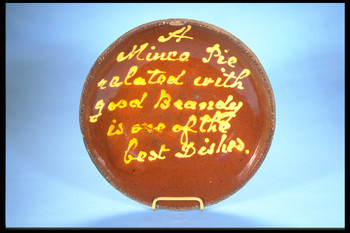
In anticipation of the presentation next week at the Salem Athenaeum on the “Potteries of Salem” by Rick Hamelin, a Massachusetts Scholar in Residence at the Peabody Historical Society as well as a recognized redware potter, I brushed up on my early redware and slipware:  domestic glazed earthenware often glazed and embellished with liquid clay “slip” decoration.  I’m somewhat familiar with English slipware but much less so with American, so I was surprised to learn that there were some 75 potteries in the Salem area—located mostly in present-day Peabody and Danvers—in the late eighteenth and early nineteenth centuries.  Looking at examples of this period pottery, both from America and England, I find myself drawn to numbers and letters decoration, which is very predictable given my typographical inclinations.  The first three examples of slip-decorated redware  (two “tygs”, or large handled mugs, and a flask) below are from the collection of the Victoria & Albert Museum in London; the latter two American plates are from the Metropolitan Museum of Art and Cogswell’s Grant, one of Historic New England‘s House Museums, in Essex, Massachusetts.


Apparently Bertram and Nina Fletcher Little, major collectors of American folk art and the owners of Cogswell’s Grant for much of the middle of the twentieth century before its donation to Historic New England, hung this “temperance” plate in the pantry/bar of the house.