Tag Archives: Antiques and Collectibles

Etsy Harvest

I haven’t done an Etsy post for a while, and my basket is overflowing.  There’s too much creativity and diversity on display to restrict myself to Salem offerings (which tend to be dominated by kitschy witchy stuff and grotesque paintball helmets) so I have cast a wider net, although some Salem items landed in it. For some time, since I spotted some silver lustreware in Maine early last summer, I have been obsessed with silver-covered pottery, so I snapped up this “weeping” silver planter as soon as I saw it.  It was produced by the Swetye Pottery Company of SALEM, Ohio, which specialized in silver and gold glazed pieces–the gold looks a bit gaudy to me but I really like the silver.

And speaking of silver, there are several Daniel Low silver Witch Spoons on Etsy now, including the one below:  these little souvenir spoons almost singlehandedly transformed Salem into Witch City in the 1890s, and they remain very collectible.

More Salem stuff:  a Spode transferware jug, Greeff “China Trade” fabric yardage, and a May 1933 issue of Antiques with an article entitled “Salem Secretaries and their Makers”.

Decorating for Fall:  a few items that have the autumnal vibe that I’m craving right now:  a mixed media illustration (with real pressed leaves) entitled “The Hawthorne Sisters Endeavor to Grow their own Forest” by Fauna Finds Flora, a red squirrel watercolor by harebit, felted pumpkins by feltjar, a paper skull wreath by cardboard safari, and a red leather “green man” mask from MythicalDesigns. (Just click on the image to get to the listing).


Old Sloops in Salem Harbor

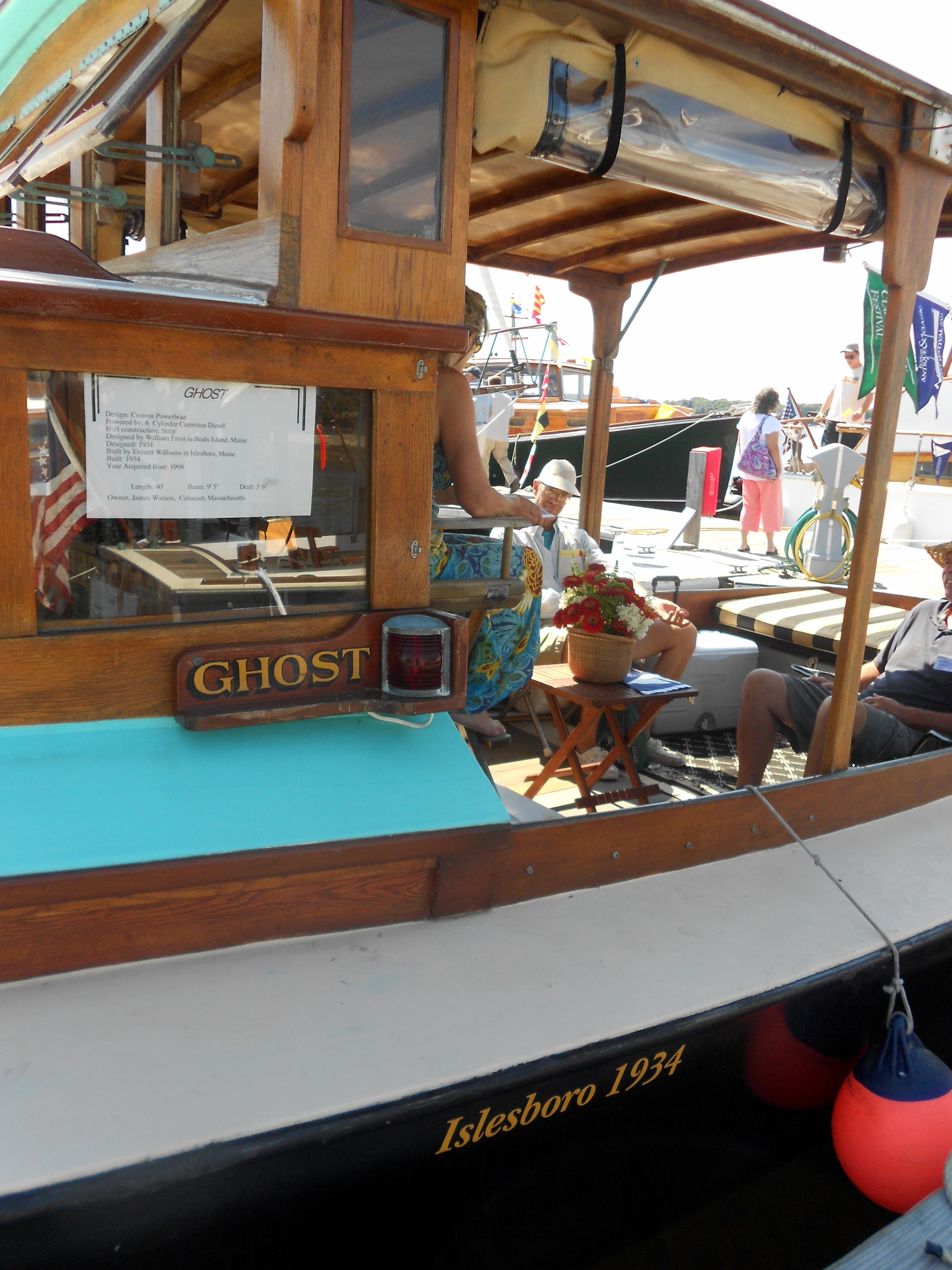
I returned to Salem and the coast in time for the Antique & Classic Boat Festival at Brewer Hawthorne Cove Marina in Salem Harbor, a great event that was cancelled last year because of Hurricane Irene.  This year, the festival’s 30th, the weekend weather was perfect. It’s a nice event because it’s intimate:  there are perhaps 30 boats with their owners right there, very ready to talk about their vessels and even invite you on board (at least some of them).  Plastic is seldom in sight:  it’s all about wood. There are both sailboats and power boats on view from different eras; this particular year, there seemed to be a preponderance of boats from the 1930s.

Several Sloops:  The “Loon”, built in 1937 at Boothbay Harbor, Maine, and two Dutch-built sloops from 1951:  the last sloop, “Rum Shark”, is owned by a Salem artist friend of mine.

I learned all about catboat variations and inspected some beautiful cabins on old power cruisers, often the party boats, with quite a few people on board.  Again–lots of wood. These custom-built boats all dated from the 1930s:  I had no idea that boat commissions flourished during the Depression.

A few sailboats, including Victor, a Cape Cod Catboat dating from 1916, the oldest boat in the festival, and then the power cruisers, including Satin Doll from Salem and Ghost, built in Islesboro, Maine in 1934.

I searched in vain for my favorite boat from past festivals:  Chris-Craft speedboats from the early 1960s.  No luck this year, but the 1960 advertisement below brings them back.


An Array of Elephants

I know that they’re trendy now and have been for some time, but I’ve been an elephant afficionado since I was a little girl, so I have many, many elephants that run the range from extreme tackiness to quite elegant.  I’ve had to edit my collection of elephants down rather dramatically to avoid their takeover of the house, so most of them are in boxes in the basement now (I could not, of course, get rid of them!)  I think that I should forgo future pachyderm purchases, unless they are of the ephemeral variety and don’t take up much room. Nevertheless, I am always looking…and several very different and unattainable elephants  have caught my eye over the past few weeks, renewing my appreciation for those in my own house at the same time.

Three great elephants: a “change packet” (a kind of ephemera I didn’t even know existed! nineteenth-century shopkeepers would give you your change back in these cute little paper packets, which provided them with another avenue for advertising) from the Graphics Arts Collection at the Princeton University Library, the mechanical elephant of the Machines of the Isle of Nantes, which can carry around up to 49 people for 45 minutes, and an elephant embroidered by Mary, Queen of Scots about 1570 from the collection of the Victoria & Alfred Museum in London.

I like this last embroidery panel because it indicates that the Queen had access to the first great Renaissance zoological work, Conrad Gessner’s Historiae Animalium (1551-1558).  Mary’s elephant clearly seems to be based on the image in Volume One of Gessner, and I like to think of the plotting Queen and her ladies leafing through the tome for inspiration.

Elephants in my house:  a few of my favorite elephants, still upstairs, beginning with the wallpaper in my first-floor powder room. I can’t remember what the maker or pattern is.

The little guy below is my very favorite elephant:  I have no idea what he is made of or how old he is. He was in a box with some other little elephants–all cast iron–which I bought for a $1.00, but he is not cast iron but rather a hard plaster-like material.

A recent purchase from an antiques shop in Maine:  this guy seems to be made of old college pennants.  I have no idea what to do with him, so he just sits on a chair in the guest bedroom.

A sixteenth-century book illustration:  I purchased it after it was already cut out, but I still feel guilty.

Moneypenny, one with the elephant garden seat.


Fireboards

I’m never quite sure what to do with fireplaces in the summer time:  just leave them alone, throw a potted fern in them, or a few of those old-fashioned fireplace fans?  Books?  The television? (I’d rather put the television in the fireplace than over it; I hate that television-over-the-mantle look) It seems like a wasted space and opportunity, as the fireplace remains the focal point of the room no matter what the season. Our ancestors had the solution to what was for them not just a decorating problem:  they filled their damperless hearths with fireboards or chimney boards, decorated with flowers, street scenes, ships, or whatever caught their fancy. These boards would keep out (or hide) soot, dust, and birds and brighten up the dark and dusty cave in the room at the same time.

Here in Salem, the Peabody Essex Museum has several fireboards from the early nineteenth century that I have long admired and which have inspired me to try to find my own period fireboard, but I’ve never been able to find one that was even remotely affordable and fit any of my fireplaces at the same time.  But the hunt continues because it’s always nice to have a quest!

Here are some of my favorite fireboards from the PEM, beginning with a beautiful scene of upper Washington Street and the Samuel McIntire courthouse painted by George Washington Felt about 1810-20 and a view of Beverly from the same period, by an anonymous artist.  Departing from street scenes and bird’s-eye views representing pride of place, the last two boards represent an historic gale which sank eleven Marblehead fishing boats in 1846 and the stately mansion of Chatsworth in England.

Fireboards from the Collection of the Peabody Essex Museum, Salem:  View of Court House Square by George Washington Felt, c. 1810-20; View of Beverly by an anonymous American artist, c. 1800-20 (from the Safford House); The Great Gale of 1846 by William Thompson Bartoll; A Distant View of Chatsworth, Derbyshire, England by Michel Felice Corné, c. 1800 (from the Bertram K. Little and Nina Fletcher Little Collection auction at Sotheby’s,  January 29, 1994).

Pieces such as these have fetched high prices at auction:  most recently, a mid-eighteenth century board featuring the John Hancock House in Boston (below) went for over $600,000 at a Sotheby‘s auction (against an estimate of $150,000-$250,000), but this is a very early and apparently very special piece. The trompe loeil louvered fireboard depicting an idyllic landscape was probably made in Philadelphia around 1810-40: it sold for $60,000 in 2005 and is now in the collection of the Museum of Fine Arts, Boston.

The MFA example above features two motifs that often appear on fireboards:  louvers and trompe l’oeil decoration.  In fact, it combines them:  some of the louvers are apparently real and some are fake.  I’ve seen some other louvered boards around, which has made me wonder if something could be made of all the old and abandoned exterior shutters in my basement?  A very literal trompe decoration is on the c. 1820 board below from a Skinner auction a few years ago. I wonder what the purpose was of replicating the bricks behind the board? A more charming example (to me) is the “watermelon” fireboard made in Salem, New York, about 1840, now in a private collection.

A variation on the fireboard is the dummy board or “silent companion”, which did not have to go before the hearth but certainly could and did. You could choose an iconic or period person to go before your fireplace, or you could place a pig there, like the eighteenth-century English example below. In my continuing search for a fireboard (or two), I’ve looked for new sources as well as old, and while most of the former are a bit too rustic for my taste and house, these blue and white pots by British decorative painter Lucinda Oakes look really beautiful.

Pig feeding from a Bowl Dummy Board, c. 1750-1800, Victoria & Albert Museum, London; Blue and White Pots I fireboard by Lucinda Oakes.


Patriotic Publishing: Britain in Pictures

I had very little time last weekend but still found myself rearranging bookshelves, a typical procrastination tactic.  Yet more time disappeared when I started opening up the slim volumes of the Britain in Pictures series, published by Collins (the forerunner of HarperCollins) in the 1940s when Great Britain was facing the imminent threat of German invasion.  Over 100 volumes were issued from 1941, each one covering a basic and essential aspect of British civilization, ostensibly in case it disappeared.  The volumes feature a colorful cover with standardized type, lots of illustrations to record the institutions, places and customs that were threatened with annihilation, and equally illustrious authors:  Cecil Beaton on English Photographers, Edith Sitwell on English Women, John Betjeman on English Cities & Small Towns, and (the most amazing pairing of all), George Orwell on The English People.


Much to my shame, I have to admit that I first bought a few of these books when I was looking for PINK and RED books to decorate the bookcases in my double parlor:  you will notice the preponderance of pink below.  This is a mortifying admission, as an English historian, as an Anglophile, as a reader.  I just loved the way these books looked, never mind the content.  But after they went on the shelf, I started (occasionally) pulling them off and reading them, and then I wanted more, never mind the cover color.  They are written in the most accessible way, almost blog-like, and definitely with the mission of capturing the essence of every single topic, whether it is British fashion, clubs or trade unions.  So now I have quite a few titles, most of which I bought from a used book store in Concord, Massachusetts owned by a woman who always seemed to be able to get more.  No longer; I notice they are fetching higher and higher prices on Ebay and AbeBooks, and there is even a book on collecting them:  Michael Carney’s Britain in Pictures:  A History and Bibliography (1995).

The categories of the series are on the back of each volume, encouraging collection in the 1940s and today:  Art and Craftsmanship, including both the visual and performing arts, History and Achievement (lots of military topics, like the book above, but also books on mountaineering and polar exploration), Social Life and Character (including my three favorite books, British Rebels and Reformers by Harry Roberts, Life among the English by Rose Macaulay, and The English at Table by John Hampson), Natural History, Education and Religion, Literature and Belles LettresTopographical History, Science, Medicine and Engineering, and Country Life and Sport (lots of lords and ladies made contributions here).  The back cover of one of the first books to be published also describes the rationale for the entire series:  The English have never been good at describing themselves or their ways, either for their own benefit or for the benefit of others.  It is, therefore, not surprising that no comprehensive series of books, at a popular price, illustrating, in print and picture, the life, art, institutions and achievements of the British people has ever been issued, either for British or for foreign readers.  At this time, when it has become essential for citizens throughout the Empire to take stock of themselves and their ideas and to express them to others, it is desirable to fill this gap.

A few observations about the series title:  Britain in Pictures.  You can tell from the quote above that while the goal was to capture British civilization, an English bias would emerge.  The majority of the titles focus on English life, although there are volumes on Wales, Scotland, Ireland and Commonwealth countries.  All of these books are illustrated histories in every sense of the word:  images were culled from libraries and museums but also commissioned from contemporary artists. The past and the present come together in these little British books, just in time.

Random illustrations from British Historians by E.L. Woodward, The English at Table by John Hampson, British Clubs by Bernard Darwin, and British Garden Flowers by George M. Taylor.


Gently Used

Besides back to school, September is also renewal-through-shopping time. I’m very much a material girl, but this fall’s clothes aren’t really calling out to me, so I’m focused on the house. There are a number of BIG exterior projects that we need to take on soon (chimneys!) but this doesn’t stop me from looking around for interesting interior items. Fortunately, I’m a big believer in consignment/resale shops, and we have some really good ones on the North Shore of Boston.  I love fine antiques, but that’s not what I’m writing about here; I’m referring to furniture that’s anywhere from a hundred to twenty years old (and generally far better made than anything in new furniture stores today) and decorative and household items of a similar vintage. The twentieth century produced tons of stuff, and we can all save money and the planet at the same time by buying it.

In order of vintage, the three shops that I check in on every month or so are: the Stock Exchange in Manchester-by-the Sea, Once & Again here in Salem, and Grace Sales in Marblehead.  New (or old) things come into all three stores on a regular basis, and they all have different strengths in their inventory.  The Stock Exchange (3 Beach Street, Manchester-by-the-Sea) has been around for decades and is always worth the trip. You can find furniture and decorative accessories as well as clothes, and there’s always a pile of perfectly worn oriental rugs in the corner.

And here is my very favorite purchase from the Stock Exchange:  a not-very-old chair made of mahogany according to my upholsterer, purchased for $100, and re-upholstered in a beautiful silk fabric that cost a lot more.

Once & Again (45 Bridge Street, Salem) opened in Danvers five years ago and then moved to Bridge Street last year; unfortunately the street has been under construction ever since!  Nevertheless, it’s a great place to stop by occasionally if you are in the market for mid-century tabletop items, linens, lighting, and odd pieces of furniture; we bought a dry sink there last year for use as our outside bar. There is always good kitchen stuff there, as well as ironstone serving ware, and fireplace accessories, not antique but without that shiny lacquered brass look that new items have.

Grace Sales Company (185 Pleasant Street, Marblehead), a consignment shop for furniture and decorative accessories, opened just last year. There are serious bargains to be found here on some very serious furniture; the beautiful Henredon couch below was for sale for just $550 last week. The owner likes to make artful displays throughout the shop (actually all of these owners do, as you can hopefully see from the pictures), and was particularly proud of her juxtaposition of  fish and scales atop a really nice little dresser, as well as that of Pucci-designed Rosenthal china from the 1960s.

An addendum about gently-used clothingModern Millie Vintage & Consignment, Salem’s (and Newburyport’s) great vintage shop, has just moved from its Washington street location into a much bigger space at 3 Central Street.  This is another store that is well worth regular visits.


Cars on Chestnut

From two wheels to four: another annual event tied in with Salem’s Heritage Days in August is the Phillips House‘s Antique Car Meet, held yesterday right here on Chestnut Street.  Though not as large a gathering of antique automobiles as that sponsored by its sister Historic New England property, the Codman House, earlier this summer, the Phillips Meet is a bit more intimate and engaging because the cars are parked on the street,where they belong, as opposed to out in a field.  The first floor of the house was open for tours, as was the carriage house out back, home to two rare and HUGE Pierce Arrows and a nice assortment of horse-drawn carriages.

The last car above is a powder pink Edsel!  Below, what looks like a surrey with a fringe on top in the Carriage House, and peaking through at one of the Pierce Arrows.

Just another old car parked on the street, yesterday, and one of similar vintage traveling down (or up) the street in its own time, below.  Chestnut Street is one-way in the other direction now, so this car looks odd to me:  I want to say, turn around, you’re going to crash into someone to the long-dead driver.  Finally, an amazing photograph courtesy of my friend Martha, a North Shore caterer extraordinaire (Lantern Hill ) with deep Chestnut Street roots who has been making some of her old family photographs available to the public.  Pictured is Mrs. Mary Northey Wheatland out for a drive on what looks like nearby Essex Street, in the winter of 1904.