Category Archives: Travel

Up North for a Spell

Sorry for the longer time between posts; I generally try (and succeed!) to post once a week but I was on vacation up in Maine and forgot my power cord, which might have been a good thing. I had my Fall Reading List all ready to post, but now I think I’ll save that for next week and just post my Maine pictures this week. We were based in East Boothbay on the Mid Coast, where we have been very casually house-hunting for a summer house. That was supposed to be the mission of this week as well but really it was just a family vacation as both my parents and my brother and brother-in-law joined us, along with a friend from Salem. We had a big beautiful farmhouse right on the water with spectacular sunsets each night. Great New England Summer weather; none of the swampy heat we’ve had in Massachusetts for most of the summer. I had my very first visit to Monhegan Island, which as inspired artists for generations. The other highlight, at least for me, was a visit to one of the National Park Service’s newest monuments, the Frances Perkins homestead in Newcastle. And the capstone was a oyster farming tour of the Damariascotta River given by my stepson Allen, who works at Muscongus Bay in nearby Edgecombe. Just a great week! Posting vacation pictures is definitely low-effort blogging, but I hope you’ll forgive me as I am now in the dreaded syllabus week before the beginning of the semester.

“Our” House with view and sunsets; around East Boothbay.

I could not resist putting my husband John’s lobster pasta in here as he seems to be on a lifelong quest to create the perfect lobster pasta and this was very good!

The Frances Perkins National Monument in Newcastle, with the sign that greeted us in the parking lot!

Maine is very intertwined with Canada, and I heard concerns about few Canadian visitors everwhere I went: given the hostile rhetoric from our President, it was nice to see this welcoming sign. Frances Perkins was a fierce social justice warrior and the first female cabinet member in U.S. history who served as President Franklin D. Roosevelt’s Secretary of Labor throughout his terms. She was integral to the passage of Social Security. This house along the Damariascotta River was in her family for over 250 years: though she was not raised here (her father moved south to Massachusetts for more opportunities, leaving her uncle to carry on the farm) she visited it often. It became a National Historic Landmark in 2014, and President Biden signed its official designation as an NPS Monument in December of 2024. It was quite poignant to visit this place given events recent and past, and there were quite a few people there—-hopefully Americans and Canadians! After we left the Perkins homestead, we drove out to Pemaquid Point, and this is the best picture I have ever taken of that locale so I had to include it.

Monhegan Island. I can’t believe I have never been there but now I have.

Monhegan is just one of thousands of Maine islands, but it is very storied. About ten miles and an hour and a half off the mainland, it’s about a mile in acreage, divided into a small village and lots of forest. Except for an unfortunate experience with sheep, the islanders seem to have been very intent with their land and pursuits, and the result is a very pictorial islandscape which has been captured by a succession of artists for more than a century. I absolutely loved the Monhegan Museum of Art & History, which blended art and history in nearly every exhibit: seemingly there was always an artist around to create posters for lighthouses (Alexander Parris), tea gardens, and baseball games (Frederic Dorr Steele), along with door panels (Karl Schmidt) and tea cups (Rockwell Kent). I could not leave out the lobster claw composition.

Oyster Farming on the Damariascotta River:

My stepson Allen got permission from his boss at Muscongus Bay Aquaculture to take us on a river tour at their Newcastle farm–just down the road from the Frances Perkins Homestead. It was fascinating, and this is seems like such an important industry for Maine (and all of coastal New England I think) right now: the neighboring Glidden Point farm was just featured in an article in the New York Times, and an oyster farmer is running against Senator Susan Collins in the upcoming election. I captured several “oystermobiles” as I drove around, but the one on Georgetown Island in the last photo above is the best.

Coastal Maine Botanical Gardens in Boothbay. The one cloudy day we had was perfect for pictures.

Lots of late summer color and the famous trolls–very popular but I did manage to get a few alone.


White Houses of Thomaston

We’re up in midcoast Maine for a long Memorial Day weekend and I spent an afternoon walking around Thomaston, which was the site of a very early English arrival in 1605: I’m not sure why this is not more heralded, or at least discussed. It became a very important shipbuilding town over the nineteenth century but for me, growing up in southern Maine, Thomaston had two associations: the prison and large white houses. The Maine State Prison at Thomaston was in operation from 1824 to 2002, and because of my adolescent preoccupation with the Isles of Shoals and the 1873 Smuttynose Murders I knew that the murderer, Louis Wagner, was held and executed at there. My other Thomaston association is far more pleasant: an impression of a succession of large white houses as we drove through on Route One. So I went back to look for the great white houses: there are indeed so many, and not just on the highway.

The most majestic white house of Thomaston (likely very prominent among my childhood impressions) is actually a recreation: of General Henry Knox’s Montpelier. The Revolutionary War hero was married to an heir of the Waldo Patent, which had allocated a large chunk of midcoast Maine to Boston merchant Samuel Waldo in the early 18th century. Waldo’s grandaughter Lucy Knox became his sole heir as her family, the Fluckers, were notable Loyalists who left the country at the onset of the Revolution. After Knox had finished his military and government service, he and Lucy retired to Thomaston and built Montpelier in 1794. They lived there until his death in 1806, after which the house was occupied by members of the Knox family until 1854, when it was sold. Several decades later it was demolished to my way for the Knox and Lincoln Railroad, and recreated in 1930 as a perfect Colonial Revival monument: now it houses the Henry Knox Museum. Was Montpelier the inspiration for all the stately white houses of Thomaston or was it James Overlock (1813-1906), who designed and built scores of solid structures in vernacular and revival styles with all the new building technologies of his day? Likely both, with a healthy measure of New England traditionalism, but all these white houses are certainly a testament to Thomaston’s shipbuilding wealth in the nineteenth century, and to the preservation efforts of their successive owners.

Just one sample of Thomaston’s white houses.


Virginia Green

Sorry for the delay in posting part II of my spring break road trip: I came back with a nasty flu so re-entry and re-engagement have been stalled. I’m feeling a bit better today and I thought it would make me feel better yet by looking at my photos. From the Eastern Shore, we traveled over the scary Chesapeake Bay bridge/tunnel up to Williamsburg for a few days, then we visited my sisters-in-law in Richmond. It was a real treat to stay in the Williamsburg Inn, and I do like Williamsburg in general even if it has its “history disneyland” qualities, but its highlights on this particular trip were definitely the George Wythe House and the museums. On the way up to Richmond, we stopped at the Berkeley Plantation on the James River, a beautiful and very history-rich site. I always love the capital, and we also visited Monticello up in Charlottesville, which I haven’t been to since I was in college. On the long drive back myself this past Saturday, I stopped on Virginia’s northern neck to visit Menokin, a plantation ruin in the midst of an interpretive restoration. As I drove north from there, I started feeling a bit gray but was thinking mostly of green: as we drove down we saw increasing green and on my ride home I was seeing less. That’s one of the things I like most about my March break trips down south: we won’t see that green in Salem for a while.

Four plantations: Eyre Hall on Virginia’s Eastern Shore, Berkeley and one of its “dependencies,”, Monticello & Menokin.

Eyre Hall, overlooking the Chesapeake on Virginia’s Eastern Shore, is a well-preserved, privately-owned 18th-century plantation whose owners open up its gardens to visitors, so we drove right in and I snuck a photograph of the house. The gardens are supposedly beautiful, but it was a a bit early for blooms. Berkeley has direct connections to the Harrison presidential family and to the Civil War, and is also a site rich in the history and documentation of slavery. There is also a claim to America’s “First Thanksgiving” in 1619, which I’m not going to explore because I’m from Massachusetts. Monticello was of course Thomas Jefferson’s beloved home, and he also has a tie to Berkeley and to the George Wythe house in Williamsburg. The Hemings family is also showcased at Monticello, which was the busiest site we visited by far: it was kind of difficult to take in the house on our packed tour. Menokin, as you can see, is currently a ruin, but its restorers have big plans. I took a lot of notes on interpretation over the week, but I haven’t really sorted them out and I’m not quite up to it, so I’m going to reserve my thoughts on inclusion/exclusion (and Thomas Jefferson!) for later.

Colonial Williamsburg: including the George Whythe (rhymes wth Smith) house, the Capitol and Governor’s Palace, and the museums.

And a view of the University of Virginia’s Lawn from the Rotunda (which I never knew you could spot from Monticello before last week).


The Grass is Greener

I’m home now from my spring break road trip, so this is part two: the way home. Looking through my photographs, all I could think of was green. You know I’m a die-hard New Englander, but the mid-atlantic and southern states simply have better springs, period. All is green rather than brown. We’ll get that green, but it won’t be for a while. Picking up where I left off with my last post, I drove south from Mount Vernon into Virginia, stopping at Fredericksburg, Richmond, Williamsburg and Yorktown before turning north towards home. I was still following my George Washington route, and Fredericksburg is really GW-central, with his childhood, mother’s and sister’s home located there, as well as his brother’s house, which is now a tavern. Everything was great, Fredericksburg is a really nice town, but the world kind of slowed down for me when I walked through the doors of Kenmore, the house of his sister and her family. It immediately became my favorite house, displacing Gardner-Pingree here in Salem and last year’s spring break highlight, the Read House in New Castle, Delaware. I’m never loyal, there’s always a new favorite house around the corner, but wow, this 177os house is something: it experienced the typical Colonial Revival restoration and then a later one and is primarily known for its elaborately-designed stucco ceilings, crafted by the same anonymous “Stucco Man” (presumably an enslaved or indentured servant) who worked on Mount Vernon.

It’s quite a house, representing a significant investment of money and labor. Betsy Washington Lewis (pictured in this last photo) and her husband Fielding were both patriots and slaveowners, representing and presenting the typical Virginia conundrum. The interpretation at Kenmore emphasizes both aspects of its owners’ lives, including the financial hardships incurred by their contributions to the cause and the life and work of the over 130 enslaved persons who inhabited the Lewis plantation. The Civil War experience of what was once a working plantation but now seems like a stately townhouse in the midst of Fredericksburg, presents another dichotomy: that beautiful dining room pictured above served as a surgery and there are both Union and Confederate cannonballs embedded in its brick exterior.

I spent so much time at Kenmore that I slighted the rest of charming Fredericksburg, which seemed to me like a perfect town for tourists and residents alike—-I didn’t get to the Civil War history or even to the James Monroe Museum, went quickly through Mary Washington’s house (much more humble than that of her daughter’s, the charming garden is above) and then I was off to see my sisters-in-law in Richmond. The following day was the best: Richmond really has it all for the heritage tourist. First off, it is a city that has made a thoughful and engaging (and likely expensive) commitment to public history: only Arthur Ashe remains on Monument Avenue and on the waterfront, adjacent to the new American Civil War Museum, is a poignant statue commemorating emancipation as well as a creative installation on the fall of Richmond in April of 1865 on a bridge/dam walk across the James River. There are well-marked heritage trails within the historic districts of the city, and mansions outside. And the Poe Museum, located in a cluster of buildings which include Richmond’s oldest house! You really can have it all. We went to an amazing performance (??? lecture??? I wouldn’t call it a tour) at St. John’s Episcopal Church, where Patrick Henry gave his give me liberty or give me death speech, and now I am a complete Henry fan.

Richmond! Brown’s Island, Liberty Trail, Agecroft Hall and the Virginia House, Poe Museum.

In my last few days, I drove down to Surry, Virginia to see Bacon’s Castle, a very rare and beautifully restored Jacobean plantation house with outbuildings (including an 1830 slave dwelling) and gardens: this was a nice tidewater comparison to the Sotterly plantation I had seen in Maryland just days before. Then if was across the river (by ferry!) to Williamsburg and Yorktown, to finish the George Washington tour. I had been to both places before, so no surprises, but I was trying to look at all of the places that I visited on this trip (my Jersey stops, Annapolis, Alexandria, as well as Fredericksburg and Richmond) as more of a tourist than an historian, so that I could try to look at Salem the same way and perhaps become a bit more comfortable with its evolution into a year-round tourist destination. Could smooth brick sidewalks, plentiful public bathrooms and parking, a diverse array of shops, and aesthetic and informative signage be in our future? Fixed-in-time Colonial Williamsburg is certainly an unrealistic and unfair comparison, but there were more robust tourist infrastructures nearly everwhere I went.

Bacon’s Castle, the Nelson House at Yorktown and Whythe House in Williamsburg on Palace Green, where General Washington was headquartered before Yorktown. Dream garden—ready to go.


The Road to Mount Vernon

We have spring break this week, so I’m on one of my road trips, loosely following the footsteps of George Washington. I always feel like I need a theme beyond “interesting old houses” but often I find one along the way which replaces my original intention. Not this year though: George has been pretty present! I started out in northern New Jersey, where I visited a house that I’d long wanted to see because I love Gothic Revival architecture and it looked like the ultimate GR cottage, but it turned out to be much older with a Washington connection: the Hermitage in Ho-Ho-Kus. General Washington was headquartered here following the Battle of Monmouth and during the court martial of General Charles Lee in the summer of 1778, in the company of his aide Alexander Hamilton and the Marquis de Lafayette. Aaron Burr was there too, and a secret romance was initiated between the future Vice-President/duelist and the lady of the house, Theodosia Prevost, who happened to be married to a British officer. At the close of the war and after the death of Theodosia’s husband, the two were married. Decades later this very strategic house was “gothicized” and acquired its present appearance.

Not too far away is a house where Washington and his men spent much more time: the Dey Mansion in Wayne, New Jersey, which served as the General’s headquarters for several months in 1780. This is a beautiful property, maintained and interpreted by Passaic County, which acquired the house in 1934 after which it underwent an extensive restoration. A very knowledgeable guide took me all around the house, even into the atttic, which was absolutely necessary as I couldn’t understand how so many people could have lived in this house during the General’s residence: the Dey family did not vacate! You’re not going to see the house’s gambrel-esque roof that accomodates all this space because I didn’t have a drone with me, but check out the website. It’s a stately house for sure, but the spacious attic made everything clear. Washington, of course, was given the two best rooms, a large parlor/office on the first floor and a bedroom just above, by the master of the house, Colonel Theunis Dey.

The Dey Mansion: the first photos above—all the way down to the blue parlor—are rooms used by George Washington and his aides, including Alexander Hamilton. Then there’s the semi-detached restoration kitchen, and the spacious attic.

So at this point and place, if you really want to do the Washington tour, you should probably drive to Morristown, Trenton, Princeton, east to the Monmouth Battlefield, west to Valley Forge. But I’ve been to all those places several times, so I drove to the General’s last Jersey and last period headquarters in Franklin Township, a rather isolated farmhouse called Rockingham. No Pennsylvania for me; I headed south into Maryland to Annapolis, where Washington resigned his commission at the beautiful State House (obviously my chronology is all over the place, but these two stops did dovetail). I just really wanted to go to Annapolis in any case; George was just an excuse.

Rockingham: Washington’s last headquarters—and on to Annapolis.

A bronze George in the old Senate Chambers of the Maryland State House (Harriet Tubman and Frederick Douglass are just across the way); Hammond-Harwood, Shiplap and row houses in Annapolis.

On to Alexandria, where Washington touchstones abound, given its proximity to Mount Vernon. Like Annapolis, but MORE, Alexandria is full of beautiful townhouses: I started in the center of the Old Town and made my Washington stops—his church, his townhouse (actually a reproduction thereof) his pub—and then walked the streets taking photographs of doorways and wreaths, myriad details, spite and skinny houses. A bright sunshiney day: you almost can’t see this bronze Washington, sitting on a bench outside Duvall’s Tavern, where he was feted after his great victory.

From my parking place on North Washington Street, I drove straight out to Alexandria to Mount Vernon, mere miles away, along the George Washington Memorial Parkway. It definitely felt kind of like a pilgrimage at this point! I have been to Mount Vernon before, but have no vivid memories—an obligatory school trip, I think. It’s one of those houses that looks much bigger on the outside than the inside: it feels quite intimate within, especially as one side was closed off for renovations. I signed up for the “in-depth” tour so I could get some interpretation–and up into the third floor. While the mansion is a must-see, I think you can actually learn more about Washington from the many outbuildings on the estate: he was “Farmer George” and for all of his heroism he was also a slaveowner who seemed to have no regrets in that capacity. There are a lot of Washington contradictions, and there are a lot of Mount Vernon contradictions: while the subject of slavery is addressed up front the overall impression—reinforced especially at the museum adjacent to the orientation center—is of a “great man.” It was a bit too ra-ra for me, but I’m still headed to Yorktown for the last leg of my trip.

Mount Vernon: a house with 10 bedrooms and no bathrooms: the white-canopied bed is in the bedroom where Washington died. The presidential desk, parlor and dining room, key to the Bastille (a gift from Lafayette), greenhouse and garden, and view of the Potomac from the porch.


A Scottish Photo Feast for St. Andrew’s Day

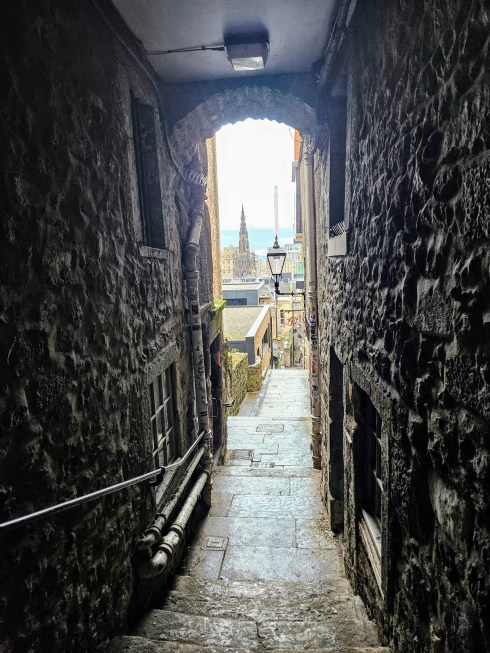
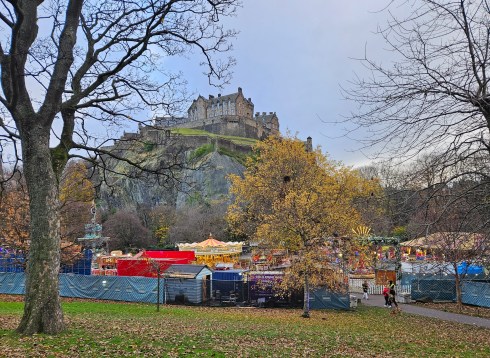
I’m just returned from a long trip to Scotland, during which I took hundreds of photographs, and today marks the feast of the Scottish patron Saint Andrew, so that’s the post! I promise more substantive essays in the future, but I have re-entered at the busiest time of the semester and my Salem’s Centuries manuscript is due in just over a month, so these photos will have to suffice for now. We spent most of our time in Edinburgh, but also covered a wide swath of south central Scotland, including Glasgow, Oban and Fort William in the west, and St. Andrews in the east. I spent my junior year abroad at that city’s university, and while I’ve been back several times since, it’s always great to go back. I really explored Edinburgh on this trip, both Old Town and New and some adjoining neighborhoods, so it was hard to pick my favorite photos of the capital, but I think I’ll favor the light. All the cities and towns we visited were aglow with Christmas trim, and every other day the sun bathed the land-and street-scapes for several intermittent hours: with moody mornings and darkness descending at 4pm, the light is very precious.

In Edinburgh:

Interior shots are of two National Trust properties: Gladstone’s Land in the Old Town and the Georgian House in the new. Of course the modern embellished building is the relatively new Scottish Parliament, about which I learned a lot. Christmas markets and fairs in every available green space!


Glasgow:

Glasgow Cathedral and Council Chambers are quite something, as are the Hunterian Museum and Art Gallery at Glasgow University. Charles Rennie McIntosh immersion is possible.


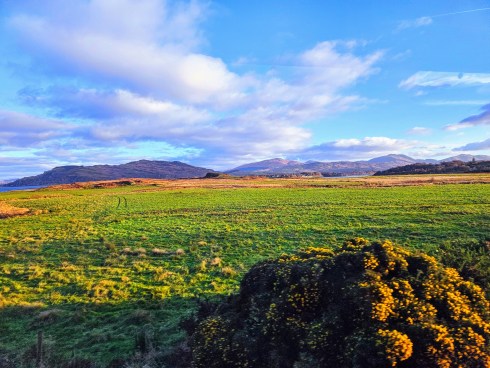
Western Coast from Oban to Fort William and through the Highlands:


Fife villages on the East Coast, and St. Andrews:

So, lots more to write about, including whiskey, GIN, Jacobites, McIntosh, Princes Street, old and new architecture, the power of Outlander, closes, courts and corridors, and hedgehogs, but this postcard post will have to do for now: Happy Feast of St. Andrew day!


Lafayette, You are Here!

I’ll drive down to Newport, Rhode Island for any occasion, and Bastille Day seemed like a good one as French expeditionary forces landed there in 1780 as part of their formal and personal commitment to the American Revolution, a commitment that is honored today by the “French in Newport” festivities on the second weekend of July. From the Rhode Island perspective, the French “occupation” of Newport is the beginning of the end, the road to Yorktown and independence started there. A friend had lent me the Newport Historical Society’s Winter/Spring 2023 issue of its journal, Newport History, which is entirely focused on the French in Newport, so I was well prepared by articles on “The Washington Rochambeau Revolutional Route National Historic Trail,” (from Newport to Yorktown of course), “Forging the French Alliance in Newport,” and “A New Look at how Rochambeau Quartered his Army in Newport.” I arrived just in time for the comte de Rochambeaut’s proclamation, wandered about checking in on my favorite Newport houses and others in which the French were quartered, and then returned to Washington Square to hear the Marquis de Lafayette give an amazing little talk on how he was inspired to cross the Atlantic and join the American ranks. I was quite taken with the Marquis, and as he was speaking an extremely precocious boy yelled out of the window of a passing car “Lafayette, you are here!”

 Print depicting the arrivl of Rochaembeau’s troops in Newport in July 1780, Daniel Chodowiecki, The Society of the Cincinnati, Washington, DC.

Rochambeau and General Washington got on very well, and had lots of planning to do during that fateful year, so Washington was in Newport too for a bit, staying, I believe, at the Count’s headquarters at the William Vernon House. George Washington 2023 was not in Newport, but a replica of his field tent was, as part of the Museum of the American Revolution’s “First Oval Office” initiative. It was rather intimate to go in there—I’ve really got to go and see the real thing, the ultimate “relic” of the Revolution—in Philadelphia. While the French rank and file seemed to be on duty, the officers were relaxed and conversational, underneath their own tent on in the Colony House nearby, wearing light floral banyans when not in uniform. I had not been in the Colony House for a while and had forgotten how grand it is. Certainly worthy of Newport.

A cool (actually very hot) bakehouse on site with an enormous clay (???) oven in back from which you could buy a toasted slice of bread with salt pork butter………

The Colony House, a private home on Spring Street where Francois-Jean de Chastellux, the liasion officer between Washington’s and Rochambeau’s armies, lived while in Newport, one of my favorite Newport houses which must go into every Newport post, and the tricolore.


Colorways: a Parade of Portsmouth Doors

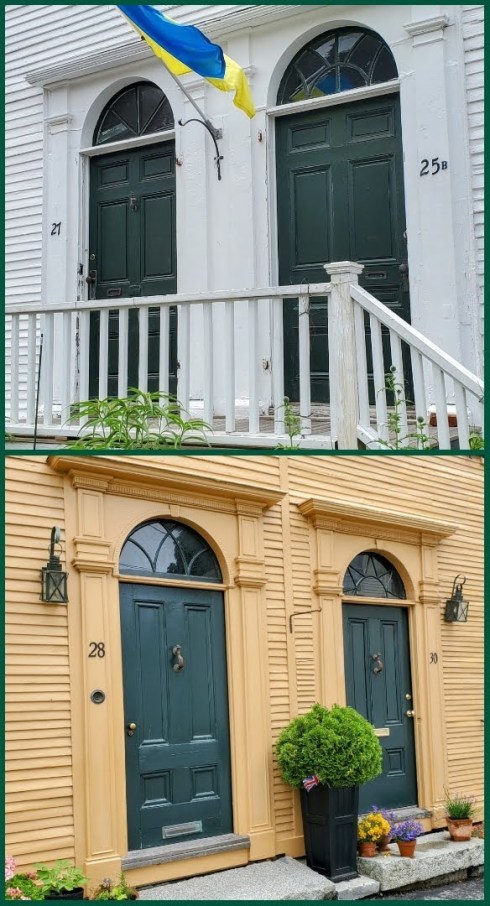
I’ve been in York Harbor all June and just returned to Salem. It was a very productive month removed from daily tasks and diversions, but I missed certain things and people: my husband (I brought the cats), my garden, my street. Certainly not the tour guides and groups though: they were in part what drove me away. Of course I found the usual Dunkin iced-coffee cup propped up on my stoop the moment I got home. Salem is busy and festive all year long now it seems; while the incessant witch tourism annoys me the other celebrations are great, and June is a particularly festive month with its mix of private and public celebrations: weddings and graduations, Juneteenth and Pride. Salem goes all out for Pride and  I missed that, and definitely craved some color amidst our rainy and foggy weather, so I took off for Portsmouth late last week seeking flags but finding doors. When I was growing up across river, Portsmouth was a much shabbier place: now you are hard-pressed to find an old house that is not in perfect condition. I expanded my usual downtown walk to include neighborhoods a bit more outlying like that bordering Christian Shore and the South End, and found so many lovely houses, all with very colorful entries. Red was an exotic front-door color before; now there is a veritable rainbow of Portsmouth doors. And I’ve got some flags here too.

Ok, I think I have the whole spectrum represented! It was surprisingly difficult to find white doors: as you see, one is hiding behind a tree. I wasn’t sure where to put taupe, so I paired it with brown. There are no painted brown doors, just various shades of natural woodwork. Not too many black doors either, but lots of green, and lots of yellow. Do not tell me that one of my purple doors is blue; it is purple. Portsmouth is the best walking city ever: beautiful neighborhoods, dynamic downtown, tons of historical markers, pocket parks, well-maintained sidewalks. More rainbows are there for the making!

Some singular Portsmouth doors: two-tone green and Happy Fourth!


Connecticut Calm (Waters)

I’m generally anxious around this time of year, approaching the end of the semester, but this year I am particularly so: I seem to be uneasy in general and in Salem in particular. The nice weather has kicked off the tourist season earlier than ever, or maybe it never ended? This means large tour groups just outside my house as late as 10:00 at night, with guides speaking about the ancient “ankle breaker” stones along the sidewalk that my neighbors and I installed in the last decade or so. Run, run, to the back of the house, I tell myself, so I don’t have to hear any more, but sometimes I just don’t want to get off the couch—and one guy is so loud I can even hear him way out back. A change of scenery (and perspective) was definitely needed, so for the long Patriots Day weekend my husband and I took off for one of the prettiest towns in Connecticut (a state with many pretty towns): Essex, near the mouth of the Connecticut River. We stayed at the old Griswold Inn, in one of its newer suites, and ate and drank and looked at old houses and the river. It was very foggy, but there were daffodils everywhere, and I do feel a bit cheerier now that I’m back home (or in Salem).

Welcome to Essex, Connecticut!

I started decompressing as soon as we got on one of my favorite Connecticut small roads: Route 169. Well, before, really: right over the state line in Thompson, which has a great common surrounded by wonderful houses (including the resurrected Gothic Revival long neglected by the famous interior designer Mario Buatta). Route 169 leads you through Woodstock, and by Roseland Cottage, to Canterbury, where the amazing Prudence Crandall opened her school for African-American girls (what an amazing woman! I need to know much more about her), to Norwich, where we turned south and drove by the decaying buildings of the long-abandoned Norwich State Hospital which are such a sharp contrast to the shiny Mohegan Sun casino across the river.

The road to Essex: Thompson houses, Roseland Cottage (which I visited just last summer), Prudence Crandall’s school in Canterbury, and one of the derelict buildings of the former Norwich State Hospital (with a glimpse of Mohegan Sun across the river).

I think my husband thinks that Essex is a bit “Truman Show-esque” but it was just what I needed:  a lovely town with clean sidewalks that is proud of its history rather than seeking to sell it 24/7. The houses are pretty perfect, but they are not mansions. It’s really all about watercraft in Essex: this was a rather quiet time but its harbor will be full to brimming in a month or so. Essex built a famous warship for the Revolution named the Oliver Cromwell (which was renamed the Restoration when it was captured by the British in 1779!), it endured the burning of 27 of its privateering ships when the British raided the harbor in April of 1814, the storied schooner yacht Dauntless ended her career on the Essex waterfront at the turn of the last century, and famous steamships line the walls of the Griswold Inn. The wonderful Connecticut River Museum, housed in an old steamship warehouse, explores the layers of local maritime history through art, artifacts and narratives in such an engaging way that I really felt the connection of water to land over history and now I’m absolutely inspired to take another New England road trip: a longer one, up the entire length of the River from Saybrook to Canada.

An array of Essex houses (birdhouses are big in this town too); the Onrust, a replica of a Dutch colonial ship, is moored in front of the Connecticut River Museum (my husband John is looking for me, I think); the Turtle, a Revolutionary-era submarine, which was built just up the River. I love the caption of this c. 1860 painting of Captain and Mrs. Samuel L. Spencer: “Captain Spencer of Old Saybrook, shown with the most important females in his life: his wife and his ship. He was captain of Daniel Webster of the London Line of packets for more than twenty years.” The Connecticut River Museum’s exhibition of Watercraft at Work made even BARGES interesting, and among the items I found my very favorite ship name of all time: of the schooner “Tansy Bitters”.


Dickinson Domicile

I drove “out west” to the recently-reopened Emily Dickinson Museum last week thinking it would just be a pleasant last road trip of the summer during which I would learn a bit more about the poet, take some photographs of her house and the surrounding Pioneer Valley, and then return home to dash off a quick post and then turn to my syllabus prep as the new semester starts TOMORROW. But that’s not how it worked out: I couldn’t dismiss Emily or the rest of the Dickinsons that quickly or easily. The “Homestead” was striking and the tour substantive, but I left with fewer pictures and more questions than I intended to have. Emily remains enigmatic, but I found myself more interested in her living conditions than her work: the physical space of the house and its surrounding land, which was much larger and more pastoral in her time, her dashing brother Austin and very close sister-in-law Susan next door, the constant companionship of her younger sister Lavinia, and what can only be called the LOOMING presence of her brother’s pushy mistress and the first editor of her work, Mabel Loomis Todd. Emily managed never to meet Mabel (which I find particularly impressive) but nevertheless she was there. It was just all too much for me, so I wondered how Emily persevered/flourished in such a space! So when I got home, I couldn’t possibly post before I read three books about Emily and her family, all when I should have been working on my syllabi! This beast was the best: I could not put it down for two days, an amazing work of scholarship.

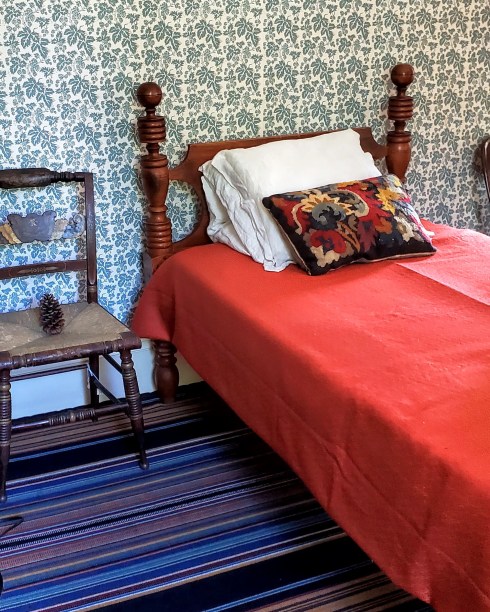
The Dickinson “Homestead,” members of the family, the library and conservatory. The Museum places pinecones on period seating which it does not want you to sit on, but also provides period seating in green!

So much LOVE and DEATH! Emily’s parents die–her mother after a long incapacitation in the bedroom next to Emily’s, and then her beloved young nephew. His father, her brother Austin, begins his passionate and long affair with Mabel, wife of a young Amherst College astronomer, and Emily has to pussyfoot around her own house, the Homestead, to get to her conservatory off the library while they are having liasons! Next door at the Evergreens, the social center of Amherst it seems, her very best friend and “sister over the hedge,” Sue Dickinson, is in distress over her husband’s open adultery. Emily herself commences a passionate-yet-platonic (I think?) relationship with an old friend of her father’s, Judge Otis Phillips Lord from SALEM. She refers to him as “My Lovely Salem” in her letters and he visited her often before his death in 1884. Emily died two years later and then Mabel the Mistress takes over, with the approval, at first, of Lavinia. The Poet is established, but conflict between all of the surviving insiders ensues, resulting in many Dickinson possessions and Emily’s papers going to Harvard. The recently-restored Homestead contains period copies of everything and so you really feel the Dickinson presence (or at least I did) but Harvard’s Houghton Library is the major Dickinson repository.

The amazingly colorful double parlor: somewhat subdued walls and brightly-patterned floors seems to be the theme. The lovely runner and second-floor landing floorcover by Thistle Hill Weavers; Emily’s bedroom and stand-in “desk”—a Federal work table. The real desk in the Dickinson Room at the Houghton Library.

But displaced possessions don’t matter, believe me, the house is THE HOUSE, and it is so colorful and full of texture, it feels alive! I loved it: the curation of the interiors seemed to echo the “meticulous care” Emily took with her own life. There are period pieces, both authentic and reproduction papers and textiles, and also some donations from the recently-concluded Dickinson series. The Homestead is a palimpest house: built in 1813 in a more austere Federal style, it was expanded and embellished by Emily’s father, and interpreted as her family house. I think I responded to it so much because it reminded me of my own house, built in 1827 and “italianaticized” in the 1850s, but my double parlor is nowhere near as colorful as Emily’s! You’ve got to go; you’ll have your own response, believe me.

A fragment of period wallpaper in Emily’s room, and an utilitarian white dress representative of what she preferred; her mother’s room next door, furnished with a bed from Dickinson the television series; the only surviving tree from the Dickinson era: an oak which survived the Hurricane of 1938. The Evergreens, Austin’s and Sue’s house, which is closed now but apparently still perfectly Italianate inside.