Category Archives: New England

So much WOOD!

The Historic New England season is closing this Columbus/Indigenous People’s Day weekend and as I am up in York Harbor, I went to visit one of HNE’s oldest houses (both in terms of sheer vintage and time under its stewardship): the Jackson House in Portsmouth, built circa 1664. This is an extraordinary house: I’m sorry to be posting at this time when you won’t be able to visit it until next June, because I’d really like to urge everyone reading to go. I had been in it before, but when I was much younger and couldn’t appreciate it properly. But now, wow. I always thought it was a saltbox: it is not. It’s a seventeenth-century two-story small square house which had an elaborate lean-to added a bit later, along with two additions on each side. It is also a lavish display of wood: certainly not from an American perspective, but from an English one, which would have been its builder, Richard Jackson’s perspective. When I was writing my first book, The Practical Renaissance, I was reading treatises written for carpenters and shipbuilders, as well as some more general agricultural pamphlets, all of which made me aware of the increasing concern about the shortage of wood in seventeenth-century England. All the first-growth forests had long been chopped down, so to come to North America and see all this wood must have been something. So for me, the Jackson House was just a great illustration of that abundance. Our guide emphasized this theme adroitly as she described the house’s framing, exterior and interior, and she also illustrated the construction impact of less-abundant woodland in New Hampshire by showing us the attic over the eighteenth-century addition, with its decidedly less-robust timbers. The Jackson House is one of Historic New England’s unfurnished study houses (like the Gedney House in Salem), so the emphasis is decidedly on construction, but we got to learn a fair amount about the family as well, who possessed the house until 1924, when William Sumner Appleton, the founder of the Society for the Preservation of New England Antiquities (now Historic New England) purchased it.

Perfect 17th century parlor and east and west wings, with a patch of preserved wallpaper.

Appleton had apparently been obsessed with the Jackson House since his freshman year at Harvard, when he came up from Cambridge and knocked on the door. A pioneering preservationist and critic of “one property museums,” he began acquiring choice properties after the founding of SPNEA/HNE in 1910. Rather than stripping off the east and west additions of the house, he removed stucco and plaster to reveal its construction. The original property was extensive, fifty acres or so just across the North Mill Pond from downtown Portsmouth, in a neighborhood named Christian Shore. When I was growing up across the Piscataqua River in southern Maine in the 1970s and 1980s, Christian Shore seemed to me a drive-through area with delapidated old houses, but then suddenly appeared The Inn at Christian Shore and I started noticing all the beautiful old houses and now they really are all beautifully restored. Portsmouth is actually growing in this direction, with several hotels built in what were once vacant lots which divided Christian Shore from downtown. But when you look out the windows (replaced by Appleton, but in their original openings) of the house on its slightly elevated lot, you can imagine, and even sort of feel, the aura of its first century.

The replacement windows and upstairs, including some wood-carvings. I knew all about the counter-magical daisy wheel from the M.A. thesis on apotropaic marks by Alyssa Conary at Salem State, so it was fun to see it (a perfect example of how I didn’t “see” on my first visit as I have no memory of it). A watercolor and Detroit Publishing Co. (Library of Congress) photograph of the house before it became a museum.


Up North for a Spell

Sorry for the longer time between posts; I generally try (and succeed!) to post once a week but I was on vacation up in Maine and forgot my power cord, which might have been a good thing. I had my Fall Reading List all ready to post, but now I think I’ll save that for next week and just post my Maine pictures this week. We were based in East Boothbay on the Mid Coast, where we have been very casually house-hunting for a summer house. That was supposed to be the mission of this week as well but really it was just a family vacation as both my parents and my brother and brother-in-law joined us, along with a friend from Salem. We had a big beautiful farmhouse right on the water with spectacular sunsets each night. Great New England Summer weather; none of the swampy heat we’ve had in Massachusetts for most of the summer. I had my very first visit to Monhegan Island, which as inspired artists for generations. The other highlight, at least for me, was a visit to one of the National Park Service’s newest monuments, the Frances Perkins homestead in Newcastle. And the capstone was a oyster farming tour of the Damariascotta River given by my stepson Allen, who works at Muscongus Bay in nearby Edgecombe. Just a great week! Posting vacation pictures is definitely low-effort blogging, but I hope you’ll forgive me as I am now in the dreaded syllabus week before the beginning of the semester.

“Our” House with view and sunsets; around East Boothbay.

I could not resist putting my husband John’s lobster pasta in here as he seems to be on a lifelong quest to create the perfect lobster pasta and this was very good!

The Frances Perkins National Monument in Newcastle, with the sign that greeted us in the parking lot!

Maine is very intertwined with Canada, and I heard concerns about few Canadian visitors everwhere I went: given the hostile rhetoric from our President, it was nice to see this welcoming sign. Frances Perkins was a fierce social justice warrior and the first female cabinet member in U.S. history who served as President Franklin D. Roosevelt’s Secretary of Labor throughout his terms. She was integral to the passage of Social Security. This house along the Damariascotta River was in her family for over 250 years: though she was not raised here (her father moved south to Massachusetts for more opportunities, leaving her uncle to carry on the farm) she visited it often. It became a National Historic Landmark in 2014, and President Biden signed its official designation as an NPS Monument in December of 2024. It was quite poignant to visit this place given events recent and past, and there were quite a few people there—-hopefully Americans and Canadians! After we left the Perkins homestead, we drove out to Pemaquid Point, and this is the best picture I have ever taken of that locale so I had to include it.

Monhegan Island. I can’t believe I have never been there but now I have.

Monhegan is just one of thousands of Maine islands, but it is very storied. About ten miles and an hour and a half off the mainland, it’s about a mile in acreage, divided into a small village and lots of forest. Except for an unfortunate experience with sheep, the islanders seem to have been very intent with their land and pursuits, and the result is a very pictorial islandscape which has been captured by a succession of artists for more than a century. I absolutely loved the Monhegan Museum of Art & History, which blended art and history in nearly every exhibit: seemingly there was always an artist around to create posters for lighthouses (Alexander Parris), tea gardens, and baseball games (Frederic Dorr Steele), along with door panels (Karl Schmidt) and tea cups (Rockwell Kent). I could not leave out the lobster claw composition.

Oyster Farming on the Damariascotta River:

My stepson Allen got permission from his boss at Muscongus Bay Aquaculture to take us on a river tour at their Newcastle farm–just down the road from the Frances Perkins Homestead. It was fascinating, and this is seems like such an important industry for Maine (and all of coastal New England I think) right now: the neighboring Glidden Point farm was just featured in an article in the New York Times, and an oyster farmer is running against Senator Susan Collins in the upcoming election. I captured several “oystermobiles” as I drove around, but the one on Georgetown Island in the last photo above is the best.

Coastal Maine Botanical Gardens in Boothbay. The one cloudy day we had was perfect for pictures.

Lots of late summer color and the famous trolls–very popular but I did manage to get a few alone.


Massachusetts Menus

I had a more substantive post planned for this week but I took a little detour and so here I am with menus. I started to write about my experience as a tour guide at the Phillips House of Historic New England, as I’m in my second year and I thought it was time for some reflection. But in doing so, I became fixated on a moment during my tour (well during all of my colleagues’ tours, I’m sure, as it’s definitely a great device) when I show our guests a menu from July 1919 in order to interpret both the dining room and one of the ways in which the household worked. Everyone loves this menu: adults, children, southerners, northerners, midwesterners, westerners, visitors from other countries, Salem residents. There is one particular item on this menu that captures everyone’s attention without exception: Orange Fairy Fluff!

So I thought that before I delved into my reflective post about what I have learned as a tour guide, I should discover the origins of Orange Fairy Fluff, and this took me down a road of restaurant history marked by menus. And then I went down my own memory lane of menus, and so here we are with menus from storied Massachusetts restaurants. The restaurant most closely associated with Orange Fairy Fluff is the famous Toll House Inn in Whitman, Massachusetts, the birth place of chocolate chip cookies. I think the timing is a bit off, however, as the menu above is from 1919 and the Toll House didn’t open until the 1930s, but an earlier (1916) Sunkist cookbook published a recipe before the Toll House owner Ruth Wakefield’s popular “Tried and True” cookbook. The Toll House menu is a perfect example of the “mid-century Colonial” aesthetic I’m so fond of, as are those of its competitors in the 1940s and 1950s.

I’ve been to, or driven by, all of these restaurants, with the exception of the Adams House in Marblehead. I just like its menu and “shore dinners” evokes the restaurant of Salem Willows. I never went to the Towne Lyne House in Lynnfield, but it was a “landmark” on the drive along Route One to and from Boston from Maine, along with “The Ship” restaurant on the other side of the road. All menus above from the Culinary Institute of America’s Menu Collection.

I have very warm memories of Filene’s, in truth the Basement more than the restaurants, but I do like the map menu below—although it doesn’t have Salem on it! Seeing the House of the Seven Gables front and center on the 1940s menu mollified me a bit, as did a menu for St. Clairs Restaurant from Historic New England’s collections which also features the Gables prominently on the cover. I also have childhood and teenage memories of meals at Locke-Ober, the Union Oyster House, and Cafe Marliave in Boston—and the Parker House, of course. The last time I went there—maybe just before Covid?—-it was looking a bit dowdy so I was pleased to hear that it’s going through a big refresh this year. (I wonder if they will keep the worst portrait ever of Nathaniel Hawthorne?)

The CIA collection has a few menus from Salem restaurants, including one from the famous Moustakis “palace of sweets” on Essex Street.When I look at this menu, I think that Salem could use an ice cream parlor today, especially one which offered up Moxie floats (!!!) and College ices (???), but I am also aware that Moustakis was no mere ice cream parlor. A half-century after its founding, it functioned as important gathering place for Salem businessmen according to the 1956 sociological study Community Organization: Action and Inaction by Hunter Floyd:

Other prestige groups observed during the process of study now may be briefly mentioned. There is no athletic club in Salem, nor any downtown men’s club that can serve as a luncheon meeting place. There is, however, a loose tradition that has grown up for various businessmen to eat in a restaurant owned by a Greek named Moustakis. At a rear table of the restaurant, six or eight men can be seated comfortably at a time. During the lunch hour there is a tendency for some of the well-known merchants on “The Street,” as Essex or the main street is called, to gather at this table. As the lunch hour proceeds, professional men, lawyers, accountants, real estate men, and finally bankers may join the group or take the places of men who have finished eating. There is a shifting pattern of membership of this group, but through habit on the part of members, the key pattern is relatively stable. Not all men, by any means, who represent the commercial and professional interests of the community eat at Moustakis’. The restaurant is, however, recognized as a place where gossip is exchanged and an eye is kept on important happenings. Other restaurants serve a similar function, of course, but none are quite as well known as the Moustakis’ “clearing house.”

Menus from the Culinary Institute of America’s Menu Collection and Historic New England’s Collections Access.

And finally, menus from two very different Salem restaurants: the House of the Seven Gables Tea Room (squash pie!) and China Sails, which is still with us, in its original location on Loring Avenue near Vinnin Square. These China Sails menus look like they date from a bit later, and only the Salem location survives (though I don’t think Dave Wong is still in the picture).


Stone Enders

I met several work deadlines last week so now it’s officially summer road trip season: about time! So yesterday I drove south to Rhode Island to see a very distinct form of its early architecture: stone enders. This is a very descriptive term: stone enders are late 17th century houses which feature one exterior and interior wall consisting entirely of an expansive side chimney. They are rare because they are so old, but also because in several documented cases the chimney walls were assimilated into an expanded house, rendering them central: stone enders were and could be hiding in plain sight! Often there are interesting house detective stories associated with stone enders, and for those that do survive, there is always a restoration story. Both cases were true with the two stone enders that I visited, the Clemence Irons house (1691) in Johnston and the Eleazer Arnold house (1693) in Lincoln, both owned by Historic New England.

Clemence-Irons (top) in Johnston and the Arnold house in Lincoln.

The Arnold House, one of Historic New England’s (then the Society for the Preservation of New England Antiquities) earliest acquisitions in 1918, survived through adaptation and expansion in the back with its chimney wall always exposed but still there were mysteries to solve about its original appearance. It went through several restorations, which are discussed in a great little article that Abbot Lowell Cummings wrote for the magazine Antiques in 1960:

  • The Eleazer Arnold is one which students have loved for its persistent puzzles, not all of which were entirely solved by laying bare nearly every scrap of structural evidence the house had to offer. As early as 1895 Norman M. Isham (in his Early Rhode Island Houses) was concerned about both the original plan and the window arrangement. From what he could then see of the structure he assumed that the house had originally been built, as the rear slope of the stone chimney indicates, as a two-story house with lean-to and with its present full length, providing for two rooms at the front on the ground floor and two rooms behind them in the lean-to. The roof had been finished with an impressive facade gable, the valley rafters of which remain in the attic (though not restored). Without having full knowledge of evidence concealed in the frame of the house, Mr. Isham suggested the possibility of single casement openings in the front or south wall. By the time his Early American Houses was published in 1928 he had had a chance to explore enough of the hidden frame to know that the pattern of original wall studs there confirmed his supposition about these windows.

The Isham restoration is characterized as one of “exploration and stabilization” while the later restoration was far more ambitious, focused on returning the house to its seventeenth-century appearance, however, apparently “inauthentic fenestration” was introduced at this time. As Isham was also involved with the Clemence-Irons house, I went off on a midnight deep dive into some of his books, and I have to say that Early Rhode Island Houses is absolutely charming with its wonderful architectural drawings by Albert Frederic Brown. The later book, Early American Houses, is less charming as no Brown but it does have several photographs and some discussion of Salem houses.

I had a very detailed tour which focused on the Arnold family and the evolving roles of the house before taking us inside to examine its interiors from ground floor great room to the garret, where a succession of contractors signed their names on its beams. Obviously, one (or two or three) conspicuous interior detail of a stone ender are its expansive hearths. The Arnold house is pretty large for a stone ender, and became larger still over time, and its scale and convenient location along the Great Road in Lincoln made it a logical choice for a tavern and it still felt very taverny to me.

The Clemence-Irons house is about a twenty-minute drive south from Lincoln, but I realized that there was actually another stone-ender in town, the Valentine Whitman house (1696), which was not only currently for sale but had a scheduled open house in my window of opportunity between Historic New England tours! So I popped right over there, of course. This house was restored under the auspices of Preserve Rhode Island several years ago, and I was quite impressed by its combination of modern livability and traditional details. It’s even bigger than the Arnold house—at one point it was actually a four-family house. Beautiful lot too, further along the Great Road. I admitted that I wasn’t going to buy it to the listing agent, and she was really nice and said that I could take as many pictures of the interior as I liked but she wanted to request permission from the owners before I posted them. I promptly lost her business card, so I couldn’t ask permission, but the listing is here if you want to peek inside.

So then I was off to Clemence Irons in Johnston, where I had a very informative tour (along with two ladies from the Arnold tour—it’s a great idea to do these together, and not just because of their proximity) from a guide who was a historic preservationist. Clemence Irons is interpreted a bit differently than the Arnold house, more as a 1930s restoration of a seventeenth-century house than a seventeenth-century house. After the last owner/occupant of the house, Nellie Irons, died in 1938, it was sold to a trio of wealth Rhode Island siblings who wished to restore it to its original appearance and operate it as a museum. They hired Norman Isham to supervise the restoration, and he oversaw a great stripping of the structure down to its studs, following by a rebuilding with original materials as well as newly-sourced ones. The result is a bit of reverential and romanticized Colonialism, in keeping with the Colonial Revival era: Isham also fashioned seventeenth-century furniture for the museum, a practice that began by George Francis Dow right here in Salem when he created the first “Period Rooms” for the Essex Institute. I love the photograph of the house circa 1910 below: I think it’s the first “adulterated” house which I find aesthetically pleasing but it became even cuter after its restoration/recreation. The house was gifted to Historic New England in 1947, and it represents an important acquisition not only because it is a stone-ender, but also a well-documented example of mid-twentieth century restoration theory and practice.

There are more stone enders to see in Rhode Island: Preserve Rhode Island estimates fourteen in all though more may be hiding in plain sight. But I was focusing so hard on all of the architectural details of these two houses that I was exhausted by the middle of the afternoon so I headed north towards home. But I’m going back!


Weekend in Wiscasset

Just back from a long weekend in Wiscasset, Maine with family, lots of eating and drinking, house-hunting, and pumpkins. My stepson is working at an oyster farm in the region so we’re going to midcoast Maine pretty regularly, and this Columbus/Indigenous Peoples Day weekend was of course a good opportunity to escape Witch City. We stayed in a lovely house in Wiscasset, one of Maine’s prettiest towns, and made regular trips up Route One to Damariascotta, which was holding its annual Pumpkinfest, complete with Pumpkin Queen, Pumpkin Drop, Pumpkin Derby, Pumpkin Regatta, and a main street embellished with large embellished and carved Pumpkins.

Wiscasset houses & shopping & Damariascotta pumpkins.

I worked at Historic New England’s Phillips House in Salem on Saturday and visited Historic New England’s Nickels-Sortwell House in Wiscasset on Sunday. It certainly has been an HNE summer for me! We spent so much time with the pumpkin festivities in Damariascotta that I turned up at Nickels-Sortwell at 3:00 pm: the last tour of the day on the last day of their season! Bad form on my part, and I apologized profusely, but of course my guide was  completely gracious and welcoming and eager to show off the house. Historic New England has two houses in Wiscasset: the very dramatic Castle Tucker and the very……..strident Nickels-Sortwell, and I had never been to the latter so I was thrilled to be able to squeeze it in this weekend. I always look at history and houses through a comparative Salem prism, and this was not difficult to do regarding the Phillips and Nickels-Sortwell Houses: both are Federal constructions which evolved into a Victorianized rooming house/hotel and then were restored with Colonial Revival inspiration by wealthy Yankee families.

I learned a lot about the house and the families who lived in it on my tour, but after we said our goodbyes I was still puzzled by the assertion of my guide that in the year of the house’s construction, 1807, “Wiscasset was the busiest port north of Boston.” Of course I couldn’t stop myself from contesting that statement: I think Salem was? Certainly Portsmouth and Portland were busier? She responded that she wasn’t sure but that was a pretty standard Wiscasset claim. And she’s right: I looked at all the the Wiscasset tourist and historical information on the web and there it was, again and again: Wiscasset was the busiest port north of Boston, Wiscasset was the busiest port east of Boston in 1807, the year of the Jefferson Embargo Act. This is clearly not true in terms of tonnage or voyages, but I’m wondering if “busiest” means something else? Shipbuilding and other maritime industries AND customs revenues? HELP early American maritime historians!


Meeting Houses of Rockingham County

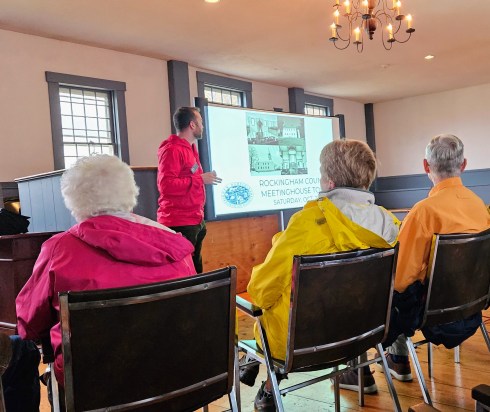
(Sorry—I have been reading and writing about meeeting houses for the past few months but still do not know if their identifier is one word or two). On this past Sunday, a rather dreary day, the New Hampshire Preservation Alliance sponsored a driving tour of meeting houses in southern Rockingham County, encompassing structures in Hampstead, Danville, Fremont, and Sandown. I drove over from York Harbor, fighting and defeating an inclination to just stay cozy at home. There was an orientation at Hampstead, the only colonial meeting house of the four that features a steeple addition (I envisioned Salem’s third meeting house, built in 1718), and then we were off to Danville, Fremont and Sandown. I have to tell you, I was in awe all day long: these structures are so well-preserved (cherished, really), simple yet elegant, crafted and composed. I remember thinking to myself when I was first set foot in the Danville meeting house: “I’d rather be here than in Europe’s grandest cathedral” (I think because I had just talked to my brother, on his way to Rome).  There’s just something about these places, and the people who care for them. Just to give you a summary of  the orientation that I received: they were built in the eighteenth century as both sacred and secular buildings, as close to the center of their settlements as possible and by very professional craftsmen. In the early nineteenth century, their religious and polical functions were seperated, so they became either churches or town halls or were abandoned altogether as other denominations built their own places of worship. It seems to me that they survived because of the preservation inclinations of their surrounding communities, and we were introduced to each meeting house by contemporary stewards who were clearly following in a long line of succession. Nice to encounter historical stewards rather than salesmen.

Hampstead:

The second floor of the meeting house, with its stage and original window frames propped up against the wall and all manner of remnants of civic celebrations, was really charming.

Danville: (which used to be called Hawke, so that’s the name of the meeting house. Hawke, New Hampshire–how cool a name is that!)

Incredible building—I had to catch my breath! I think it has the highest pulpit of these meeting houses, and there was just something about the contrast of that feature and the simplicity (though super-crafted) of the rest of the interior that was striking.

Fremont (which used to be called Poplin):

This meeting house is the only one remaining in NH with “twin porches” on each side, plus a hearse house (see more here–I have long been obsessed and have been to Fremont before but never inside the meeting house or the hearse house) with a horse-drawn hearse inside plus an extant town pound! Very simple inside, but note the sloping second-floor floors in picture #4 above. Took me a while to get used to those.

Sandown:

The most high-style of this set of meeting houses, particularly impressive from the back, I thought. Very light inside, even on this miserable day. Another high pulpit, and more marbleized pillars. Short steps to the second floor–I’m a size 7!

My photos are a bit grainy–not sure what my settings were, I was shifting them around to get more light, and too awestruck by the architecture to really focus, so in compensation I want to refer to you the wonderful work of photographer Paul Wainwright, who has photographed all of these meeting houses and more. Simply stunning!