Category Archives: Houses

So much WOOD!

The Historic New England season is closing this Columbus/Indigenous People’s Day weekend and as I am up in York Harbor, I went to visit one of HNE’s oldest houses (both in terms of sheer vintage and time under its stewardship): the Jackson House in Portsmouth, built circa 1664. This is an extraordinary house: I’m sorry to be posting at this time when you won’t be able to visit it until next June, because I’d really like to urge everyone reading to go. I had been in it before, but when I was much younger and couldn’t appreciate it properly. But now, wow. I always thought it was a saltbox: it is not. It’s a seventeenth-century two-story small square house which had an elaborate lean-to added a bit later, along with two additions on each side. It is also a lavish display of wood: certainly not from an American perspective, but from an English one, which would have been its builder, Richard Jackson’s perspective. When I was writing my first book, The Practical Renaissance, I was reading treatises written for carpenters and shipbuilders, as well as some more general agricultural pamphlets, all of which made me aware of the increasing concern about the shortage of wood in seventeenth-century England. All the first-growth forests had long been chopped down, so to come to North America and see all this wood must have been something. So for me, the Jackson House was just a great illustration of that abundance. Our guide emphasized this theme adroitly as she described the house’s framing, exterior and interior, and she also illustrated the construction impact of less-abundant woodland in New Hampshire by showing us the attic over the eighteenth-century addition, with its decidedly less-robust timbers. The Jackson House is one of Historic New England’s unfurnished study houses (like the Gedney House in Salem), so the emphasis is decidedly on construction, but we got to learn a fair amount about the family as well, who possessed the house until 1924, when William Sumner Appleton, the founder of the Society for the Preservation of New England Antiquities (now Historic New England) purchased it.

Perfect 17th century parlor and east and west wings, with a patch of preserved wallpaper.

Appleton had apparently been obsessed with the Jackson House since his freshman year at Harvard, when he came up from Cambridge and knocked on the door. A pioneering preservationist and critic of “one property museums,” he began acquiring choice properties after the founding of SPNEA/HNE in 1910. Rather than stripping off the east and west additions of the house, he removed stucco and plaster to reveal its construction. The original property was extensive, fifty acres or so just across the North Mill Pond from downtown Portsmouth, in a neighborhood named Christian Shore. When I was growing up across the Piscataqua River in southern Maine in the 1970s and 1980s, Christian Shore seemed to me a drive-through area with delapidated old houses, but then suddenly appeared The Inn at Christian Shore and I started noticing all the beautiful old houses and now they really are all beautifully restored. Portsmouth is actually growing in this direction, with several hotels built in what were once vacant lots which divided Christian Shore from downtown. But when you look out the windows (replaced by Appleton, but in their original openings) of the house on its slightly elevated lot, you can imagine, and even sort of feel, the aura of its first century.

The replacement windows and upstairs, including some wood-carvings. I knew all about the counter-magical daisy wheel from the M.A. thesis on apotropaic marks by Alyssa Conary at Salem State, so it was fun to see it (a perfect example of how I didn’t “see” on my first visit as I have no memory of it). A watercolor and Detroit Publishing Co. (Library of Congress) photograph of the house before it became a museum.


Schoolhouse to Outhouse

I had some obligations here in Salem so could not leave the Witch City for the weekend, but I did spend yesterday driving around a little part of our county stopping in at open houses for the annual Essex Heritage Trails and Sails event series, which features an array of heritage, cultural and nature events over three weekends every September. I do not like my city during this time of year, but I love my county! I do believe that Essex County has the most colonial houses of any region in the US, and even though I’ve been driving around it for thirty-odd years, I’m always discovering new-to-me ones. I started out my Sunday trip with a visit to the old schoolhouse on Newbury’s Lower Green, restored for the Bicentennial and full of treasures, and ended it at the Samuel Holten House in Danvers right next door to Salem, which has the cutest outhouse ever.I have admired it for years, and always thought it was some sort of shed, but no, outhouse it is. In between, I saw several structures in Georgetown, including a great old tavern, the town’s oldest house, an old firehouse and another schoolhouse, and a former famous inn. The buildings were all great, but what I particularly like about these open houses are the passionate introductions of their stewards, who are so eager to showcase them. In these places, the stewards were representatives of the Newburyport Historic Commission, the Georgetown Historical Society, and the Daughters of the American Revolution.

An 1877 schoolhouse in Newbury.


Georgetown: the Brocklebank-Nelson-Beecher House and a few other structures.


Samuel Holten House in Danvers.

From these stewards, you’re going to learn a lot of lore and more. I learned that: literacy tests for voting were in place not only down South but also up here in the early 20th Century (the schoolhouse served as a polling place), Byfield, another village of Newbury, had lots of mills, and one still standing (I couldn’t find it), Georgetown had a little village in its midst called Marlborough as well as a trolley linewhere the oldest house in Georgetown is (see above, dressed for Halloween), where the once-famous Bald Pate Inn is (see above), all about Patriot Samuel Holten, and that there was at least one enslaved person, named Cato, in his house (see under the eaves room above).


A Colonial Revival Dining Room

I wrote the chapter on Salem’s Colonial Revival movement in our forthcoming book Salem’s Centuries, an effort that I think was pretty ballsy given that I am neither an American historican or an art/architectural historian. You can be sure that I had both types of experts read it before submission and it has been peer-reviewed several times before publication! I felt confident because I took a biographical and cultural history approach, utilizing the work and lives of Salem exemplars Frank Cousins, Mary Harrod Northend, George Francis Dow, and Caroline Emmerton. They were all so respectful of Salem’s material heritage and more than a bit fearful of change. What we now label the Colonial Revival does seem to have been a movement in Salem, fueled as much (I think!) by nostalgia as by a desire to preserve, and its connections to the fledgling preservation movement in the early twentieth century are what interest me particularly. So while I have a sense of the Colonial Revival as a cultural movement, I am far from any aesthetic understanding, although I think I have made some strides in that direction by working at Historic New England’s Phillips House over these past two summers. The house’s dining room, in particular, a great example of the assertive effort of Salem and Boston architect William Rantoul to “marry” its later-19th century back to its Samuel McIntire front, has become my ideal Colonial Revival room. It all started with the alcove for me. I had seen Rantoul’s colleague and contemporary Arthur Little’s alcove in Caroline Emmerton’s house on Essex Street in person and in renderings (the cyanotype below is from a Little & Browne album in the collections of Historic New England), and it just seemed so Colonial-esque to me, so when I saw some semblance of an alcove in the Phillips’ dining room, it all made sense.

As you can see, Rantoul’s alcove is not nearly as enclosed as that of Little, but the former still carved out that space, removing a staircase for the symmetrical china cabinets and fireplace, delineated from the rest of the room by that strident ceiling moulding. He had modernized the systems for the Phillips after their purchase of the house in 1911: there was no need for that fireplace other than to enhance the “colonial” ambiance, which is also provided by the great Joseph Badger portrait of Phillips relative Thomas Mason (c. 1770-75) with his pet squirrel. I’m not even sure you would call this space an alcove, much less a nook, but it’s the semblence that creates the aura of the past in this large light-filled room.

Frankly this chair annoys me but I understand why it’s there.

Of course, the furnishings set the scene as well, and authors of decorating books from the teens and twenties always advised their readers that they should avoid placing items “of a set” if they were to attain that authentic Colonial look. It was relatively easy for the Phillips’, with their multi-generational wealth and trove of possessions from different places and times, to achieve the desired layered look. Their dining room seems to have attained the general “Colonial feeling” recommended by Helen Koues in her popular manual On Decorating the House (1928), in which the walls and woodwork are light in value, the furniture is mahogany or brown mahogany, silver is shown, and side lights or chandeliers may be in silver with glass prisms, or some fixture Colonial in feeling. Andirons and fireirons are of brass or brass and iron, and the china displayed is of Wedgwood in patterns of the eighteenth century. Of course, Stephen and Anna Phillips were both from old Salem maritime families, so their Wedgwood (and Limoges) is supplemented by a dazzling display of East Asian ceramics.


Houses are History

Last week I was thinking about all the things that annoy or concern me about Salem now, and the list seemed endless, which depressed me, and then I suddenly thought, why don’t I focus on the things that I love about Salem so I won’t be so depressed? This seemed like a good idea, and an easy realignment. Why did I move to Salem? Architecture. What do I love about Salem? Architecture. So I’m going to go back to the foundations of my own Salem story and getting back to architecture with an occasional series here and on social media (#salemhistoryhouses) looking at individual houses in the present and past as a means of telling more Salem stories. Just one house can open a wide window into the city’s history, American history, even world history, as Salem has always had a global orientation. This is not a novel observation, but somehow as I pursued a range of Salem topics here and in our forthcoming book Salem’s Centuries I lost sight of one of the most basic expressions of cultural achievement: houses. Besides the inspiration of merely pursuing my own happiness, I am also motivated by the efforts of two people who I’ve written about a lot here and also in Salem’s Centuries: Frank Cousins and Mary Harrod Northend. These two contemporaries dedicated a good part of their lives to highlighting Salem architecture in print and image. Both wrote books and magazine articles and established photographic publishing companies which distributed images of Salem houses nationwide. They were both particularly keen to emphasize that all not was lost with the Great Salem Fire of 1914, and that much of Salem’s architectural heritage remained; a decade later both were intent on celebrating that heritage during Salem’s Tercentenary in 1926. Cousins died the year before; Northend in that very year. I’ll feature a lot of their work in my series, as preserved and digitized by the Phillips Library (via Digital Commonwealth), the Winterthur Library, and Historic New England, as well as the large collection of images available at the Salem State University Archives and Special Collections. So there you are, or there I am: one of the things that annoys me about Salem is its lack of a professional historical museum, but all these institutions, and more, are in fact collecting, preserving, and sharing Salem history.

My first social media post is a great example of how just one house can lead you in all sorts of directions. The Eden-Browne has was built in 1762 by Captain Thomas Eden as a warehouse, and then converted into a (very elegant) residence by Benjamin Cox in 1834. Captain Eden was a trader in the codfish rectangular trade between Salem, southern Europe, and the West Indies, and the very first member of the Salem Marine Society: his grandaughter, the artist Sarah Eden Smith, lived and died in the house. Her other grandfather, Jesse Smith, was an officer in General Washington’s First Horse Guards, and she herself was a professional artist and instructor who spent several years at the Hampton Institute (now University) teaching Native American students. Miss Smith, “the last of her family,” was also the author of a lovely little pamphlet on the history of the Second Church of Salem, visible below in the top photograph, which obviously dates from before it was demolished by fire in 1903. So that’s a lot of history tied to just one Salem house!

A house that both Cousins and Northend adored (both really seem to have preferred Salem’s 18th-century houses) is the Dean-Sprague-Stearns House on the corner of Essex and Flint Streets. It was built in 1706 and acquired a portico by Samuel McIntire a century later. It has a connection to Salem’s most notable Revolutionary event, Leslie’s Retreat, through the residence of distiller Joseph Sprague, a major participant in that resistance, and it was operated as an inn named the East India House in the middle decades of the twentieth century. I love the description of this house in Samuel Chamberlain’s Open House in New England: “the EAST INDIA HOUSE  contains a wig room, two powder rooms and a Tory hide-out in one of the chimneys. A quadrille was given here for General Lafayette in 1824.” TORY HIDE-OUT.

Top photograph from the Frank Cousins Collection of Glass Plate Negatives at the Phillips Library, via Digital Commonwealth.

Talk about going back to Salem houses: One Forrester Street was one of the first house reports I researched and wrote for Historic Salem, Inc., way back in the 1990s! I was in graduate school, and this was my way of “learning” Salem. These are another great resource (and mine are far from the best!), as members of the Salem Historical Society digitized them several years ago. These house histories, in addition to the Massachusetts Historical Commission’s MACRIS database, represent accessible information about hundreds of Salem houses. I remember being very excited about researching One Forrester as it’s such a great house, with a distinctive profile right on Salem Common. Though built by a tanner named John Ives, the house was kept in the Webb family for quite some time, I think, almost two centuries. In the northwest corner of the house is a “cent shop” straight out of the House of the Seven Gables; it might even have been Hawthorne’s inspiration.

Stereoview (top) from the 1860s, and the  Nelson Dionne Salem History Collection at Salem State University.

There were many Webbs in Salem and it is quite a challenge to keep them straight! Sea captains in the 18th century, entrepreneurs in the nineteenth. Another Webb house is one of my favorite brick-sided houses in Salem, adjacent to what was long a Webb apothecary shop on Essex Street. These buildings are 52 (house) and 54 (shop) Essex Street, and they represent what were probably hundreds of attached or adjacent residences and shops which once existed in Salem.

Stereoview from the Dionne Salem History Collection, Salem State University Archives and Special Collections.

I’ve decided that I’m not going to feature lost houses in my little series, as I am engaged in the pursuit of happiness. But I’m definitely going to feature houses that were moved, because there are so many, and also because I love these examples of nineteenth-century (and a bit of twentieth-century) sustainability. One house that was moved from Salem’s main street, Essex, to a nearby side street is Five Curtis Street, which is featured prominently in one of my favorite architecture books, John Mead Howells’ Lost Examples of Colonial Architecture: Buildings That Have Disappeared of Been so Altered as to be Denatured: Public Buildings,Semi-Public Churches, Cottages, Country Houses, Town Houses, Interiors, Details (1931). It is indeed one of my favorite books, but I also realize that Howells makes a lot of mistakes, so I always check him. He indicates that the house was moved in 1895, which does check out, and refers to the house as the Joseph J. Knapp House. More recent researchers refer to the house as the the John White House, and I think this is correct: White, a mariner, built the house around 1802 and sold it to Knapp, another mariner (a loose term which generally means merchant and maybe captain but more likely owner of shares in a ship at that time) six years later. The house remained in the Knapp family until 1848, which means that this house has a connection to the most notorious murder in nineteenth- century Salem. Joseph J. Knapp’s two sons, John Francis (Frank) and Joseph Jenkins Jr., hired Richard Crowninshield to murder their wealthy uncle Captain Joseph White in 1830 and all three met their deaths before the end of that year. Mr. Knapp Sr. had already decamped for Wenham before these events, and he remained there until his death in 1847.

Frank Cousins photograph of the Knapp House in its original location on Essex Street (on the corner of Orange), John Mead Howells, Lost Examples of Colonial Architecture (1931). 


Stone Enders

I met several work deadlines last week so now it’s officially summer road trip season: about time! So yesterday I drove south to Rhode Island to see a very distinct form of its early architecture: stone enders. This is a very descriptive term: stone enders are late 17th century houses which feature one exterior and interior wall consisting entirely of an expansive side chimney. They are rare because they are so old, but also because in several documented cases the chimney walls were assimilated into an expanded house, rendering them central: stone enders were and could be hiding in plain sight! Often there are interesting house detective stories associated with stone enders, and for those that do survive, there is always a restoration story. Both cases were true with the two stone enders that I visited, the Clemence Irons house (1691) in Johnston and the Eleazer Arnold house (1693) in Lincoln, both owned by Historic New England.

Clemence-Irons (top) in Johnston and the Arnold house in Lincoln.

The Arnold House, one of Historic New England’s (then the Society for the Preservation of New England Antiquities) earliest acquisitions in 1918, survived through adaptation and expansion in the back with its chimney wall always exposed but still there were mysteries to solve about its original appearance. It went through several restorations, which are discussed in a great little article that Abbot Lowell Cummings wrote for the magazine Antiques in 1960:

  • The Eleazer Arnold is one which students have loved for its persistent puzzles, not all of which were entirely solved by laying bare nearly every scrap of structural evidence the house had to offer. As early as 1895 Norman M. Isham (in his Early Rhode Island Houses) was concerned about both the original plan and the window arrangement. From what he could then see of the structure he assumed that the house had originally been built, as the rear slope of the stone chimney indicates, as a two-story house with lean-to and with its present full length, providing for two rooms at the front on the ground floor and two rooms behind them in the lean-to. The roof had been finished with an impressive facade gable, the valley rafters of which remain in the attic (though not restored). Without having full knowledge of evidence concealed in the frame of the house, Mr. Isham suggested the possibility of single casement openings in the front or south wall. By the time his Early American Houses was published in 1928 he had had a chance to explore enough of the hidden frame to know that the pattern of original wall studs there confirmed his supposition about these windows.

The Isham restoration is characterized as one of “exploration and stabilization” while the later restoration was far more ambitious, focused on returning the house to its seventeenth-century appearance, however, apparently “inauthentic fenestration” was introduced at this time. As Isham was also involved with the Clemence-Irons house, I went off on a midnight deep dive into some of his books, and I have to say that Early Rhode Island Houses is absolutely charming with its wonderful architectural drawings by Albert Frederic Brown. The later book, Early American Houses, is less charming as no Brown but it does have several photographs and some discussion of Salem houses.

I had a very detailed tour which focused on the Arnold family and the evolving roles of the house before taking us inside to examine its interiors from ground floor great room to the garret, where a succession of contractors signed their names on its beams. Obviously, one (or two or three) conspicuous interior detail of a stone ender are its expansive hearths. The Arnold house is pretty large for a stone ender, and became larger still over time, and its scale and convenient location along the Great Road in Lincoln made it a logical choice for a tavern and it still felt very taverny to me.

The Clemence-Irons house is about a twenty-minute drive south from Lincoln, but I realized that there was actually another stone-ender in town, the Valentine Whitman house (1696), which was not only currently for sale but had a scheduled open house in my window of opportunity between Historic New England tours! So I popped right over there, of course. This house was restored under the auspices of Preserve Rhode Island several years ago, and I was quite impressed by its combination of modern livability and traditional details. It’s even bigger than the Arnold house—at one point it was actually a four-family house. Beautiful lot too, further along the Great Road. I admitted that I wasn’t going to buy it to the listing agent, and she was really nice and said that I could take as many pictures of the interior as I liked but she wanted to request permission from the owners before I posted them. I promptly lost her business card, so I couldn’t ask permission, but the listing is here if you want to peek inside.

So then I was off to Clemence Irons in Johnston, where I had a very informative tour (along with two ladies from the Arnold tour—it’s a great idea to do these together, and not just because of their proximity) from a guide who was a historic preservationist. Clemence Irons is interpreted a bit differently than the Arnold house, more as a 1930s restoration of a seventeenth-century house than a seventeenth-century house. After the last owner/occupant of the house, Nellie Irons, died in 1938, it was sold to a trio of wealth Rhode Island siblings who wished to restore it to its original appearance and operate it as a museum. They hired Norman Isham to supervise the restoration, and he oversaw a great stripping of the structure down to its studs, following by a rebuilding with original materials as well as newly-sourced ones. The result is a bit of reverential and romanticized Colonialism, in keeping with the Colonial Revival era: Isham also fashioned seventeenth-century furniture for the museum, a practice that began by George Francis Dow right here in Salem when he created the first “Period Rooms” for the Essex Institute. I love the photograph of the house circa 1910 below: I think it’s the first “adulterated” house which I find aesthetically pleasing but it became even cuter after its restoration/recreation. The house was gifted to Historic New England in 1947, and it represents an important acquisition not only because it is a stone-ender, but also a well-documented example of mid-twentieth century restoration theory and practice.

There are more stone enders to see in Rhode Island: Preserve Rhode Island estimates fourteen in all though more may be hiding in plain sight. But I was focusing so hard on all of the architectural details of these two houses that I was exhausted by the middle of the afternoon so I headed north towards home. But I’m going back!


Holiday Tables

If I’m hosting for Christmas or any other holiday, I spend more time thinking about the table than the menu: much more time. I love setting the table, and once I attain my “vision” we’re all relegated to eating in the kitchen, no matter how many days before the big meal. Here it is, December 22, and I am hosting Christmas dinner and the table is not set! I just finished my grading, however, so I’ll get it together. I have a different animal theme every year for Christmas decorating and some animals are easier than others. Obviously deer are super easy, and I’ve also done bears, foxes, sheep, swans, pheasants, mice and hedgehogs—and more. This year, I chose lions, and they have been challenging! But I do have these great lion placemats which are everything. I’m not quite ready, however, so here’s a succession of holiday tables from both sides of the Atlantic.  First we have some Scottish tables from my trip last month, and then a succession of tables from Strawbery Banke in Portsmouth, NH: every year they have a Candlelight Stroll among and within their historic houses, featuring a sweeping and colorful view of holidays past.

Scotland: first up are parlor, dining room, and kitchen tables in the Georgian House in Edinburgh’s New Town, owned and operated by the National Trust for Scotland, then a Georgian “everything” room in another National Trust House, Gladstone’s Land. You’re looking at a table, but a lot more is going on in this room–it reminded by of another Georgian room, just below, in the Concord Museum, which I just visited last week. Back in Edinburgh, nothing is more festive than a pub table, and the city is in the midst of major gin craze. The Jolly Botanist is a great gin bar that we really enjoyed.

Back Home (well in Portsmouuth): Strawbery Banke is a museum “neighborhood” of historic houses, some of which were located in the Puddle Dock area of Portsmouth, others which were moved there when the museum was founded in the 1960s. It’s always been a part of my life, as I grew up across the river in southern Maine. The annual Candlelight Stroll features decorated houses with reenactors, representing different periods and stratas of society. The opulent Goodwin Mansion, first up below, was built in 1811, but it is interpreted as an 1870s house. Below its dining room is that of the Chase House, a Georgian structure that is interpreted c. 1818, followed by that of the Rider-Wood House (1830s), the Shapiro House (1919) and the time-capsule 1950s kitchen of the Pridham House.

My table is not set yet but here are the lions, ready to go! Best wishes for a restorative and merry Christmas.


Late Summer at Greenwood Farm

I’ve been taking walks at Trustees of Reservations properties all summer long, so it seems appropriate to end the season with a post on one: Greenwood Farm in Ipswich, Massachusetts. I had never been to this saltmarsh farm before this spring, and I returned every other week. Last week was definitely my favorite time: there’s just something poignant about golden late summer, just before the appearance of any red. It’s not a huge reservation, but it is a well-situated one, overlooking the marshes and islands of Ipswich Bay. A perfect first-period house, the Paine House, sits right there along the its main path, with no driveway or modern conveniences in sight. There are venerable oak trees, and some recent additions: “Remembrance of Climate Futures” markers, indicating how and when the landscape will change. They were the only source of anxiety on my walks around Greenwood Farm.

Once again we must be grateful for the efforts of an old and wealthy New England family, the Dodges, who purchased the property in the early 20th century, were responsible stewards during their summer residence, and eventually donated the farm to the Trustees of Reservations in the 1970s. A larger, newer farmhouse built on the property by Thomas Greenwood in the early 19th century served as their principal summer house, and they used the 1694 Paine House as a well-appointed guest house. I’d love to go inside, but it’s never been open—in fact I have never seen a single person on this whole property on my walks this summer! Of course there is a Salem connection: Robert Paine, the first of six generations of farmers to live in the house was a jury foreman during the Salem Witch Trials. As you can see, the house is a touchstone for me as I walk around the farm, but I’ve also developed more appreciation for trees this summer, and solid land when I come across these jarring “remembrance” markers.

Appendix: I searched for an image of the Paine house among the works of  Ipswich artist extraordinaire Arthur Wesley Dow (1857-1922), who mastered all genres—oils, woodblock prints, cyanotypes—and seemed dedicated to depicting every square inch of his native town (as well as being a very influential art educator), but  found nothing. Many of his landscapes look like the farm, because saltmarsh farms ARE Ipswich. This little collaboration of Dow and the poet Everett Stanley Hubbard, which you can access here, is particularly evocative.


Treasure House

Treasure House. That’s how the guide introduced the Codman Estate in Lincoln, Massachusetts, long known as “The Grange,” at the beginning of her tour the other day. It’s a term which has a specific meaning for Historic New England, which has been the owner and steward of the house since 1968: not only the house itself, but all of the treasures therein, encompassing the possessions and papers of the Codman family of Boston. The Grange was their summer house, expanded and decorated in successive eras by family members/design luminaries John Hubbard Sturgis and Ogden Codman Jr. My ears pricked up when I heard that term, because it’s how Salem was often described in the early and mid-twentieth century, as a treasure house of American material culture. That’s certainly not how Salem is thought of now, but in that heyday, proponents of the Colonial Revival like Ogden Codman Jr. thought and referred to it as such. When I was writing my chapter on Colonial Revival Salem for our forthcoming book this summer, I read quite widely (trying to make up for a disciplinary deficit) and reread Edith Wharton’s and Codman’s classic collaboration, The Decoration of Houses (1897). This book is so crystal clear in its articulation and presentation of interior design as a branch of architecture rather than “dressmaking” that I became more interested in Codman, who was both an architect and interior designer. I went off on a tangent, learning some very interesting design theories and practices as well as trivial details like the fact that he called Wharton (who was his client before his collaborator) “Pussy” and she called him “Coddy.”  And then it only seemed right to revisit the Grange, as the last time I went there, when I was in my 20s, I didn’t have a clue. I seem to remember being impressed with its Federal forthrightness, but not its interior, which I found “shabby.”

Well, its origins are not Federal: the models above show how the original Georgian house was transformed into the Federal Grange over the next century or so. But, it still strikes me as shabby, in an authentic rather than “chic” way: very layered and very waspy. This was really his father’s house, and there were things that Ogden Codman Jr. could change and things he could or would not. You can see his attempts to lighten things up, in his characteristic French-Colonial Revival fusion style, but the heavier hand of his uncle, John Hubbard Sturgis, is still much in evidence. So it’s quite a melange! Toile and Chintz in the sitting rooms and Tudor Revival in the dining room. I think I liked chintz back then, not a fan now, but will always love toile.

The very different stamps of Sturgis and Codman Jr. make for an interesting house. The Elizabethan dining room must have driven the latter crazy, but I love it. We went into only the front bedrooms, which seemed very Ogdenesque.

The other layering effect in the house is a result of the sheer number of Codman possessions therein: photographs, paintings, books, assorted personal items. There’s a time-capsule feeling, as if the family just went out the door, quite a while ago. That feeling is really resonant in the back of the house, where the servants lived and worked. I don’t remember seeing these spaces before: such a succession of rooms and staircases! How many staircases are there in this house? An impressive double staircase in front, and two or three in back? I lost track. Sturgis designed the rear addition, but I’m sure that neither he nor Codman ventured out back, so in a way (and except for the appliances and utilitarian elements) these ways feel even more timeless.

All the staircases and the way out back, eventually into the Italian Garden, which was being set up for a wedding on a VERY humid afternoon. I hope everything went well!


No Filter: A Magnificent Marblehead Garden

Today’s post is a special treat courtesy of the owners of a beautiful property on Peach’s Point in Marblehead, who graciously opened their garden to visitors as a benefit for the Marblehead Museum this past Saturday. I understand that this kind of generosity is a pattern for them, and I feel privileged to have spent some time in this beautiful space, even (actually especially!) though it was cloudy and rainy. I came down to Salem for several events, a few of which were washed out the by the rain, but not this one, and I’m so glad: the garden was a green seldom seen, and all of its flowering plants popped to perfection. I swear: I have used no filter on the photographs below taken with my trusty old Samsung (and if things look a little filmy, my lense was fogged up). I have long wanted to see this garden, as it is a restoration/recreation of the garden which was part of the estate of Louise DuPont Crowninshield, one of my personal preservation heroes, and her husband Francis Boardman Crowninshield. The Crowninshield House is no longer standing, but the present owners of the property have built a lovely modern Colonial Revival Home which is well-situated on the Point, looking back at the town of Marblehead and out to its outlying islands and open sea. And then, an allee to the side which leads you to the formal gardens in a more protected space: a rose garden, a knot garden, lots of little garden nooks enclosed by topiaries, lovely (warm) brick enclosure tying everything together. Finally you come to a pool and a gorgeous greenhouse/garden house, in that same warm brick. I’m going to give you the tour the same way I walked it in the rain.

Approaching the property; encircling the house.

And on to the Gardens and Garden House……………

It’s not a poolhouse, it’s a garden house (or building): while this expansive garden is obviously the work of professionals (Doug Jones and Rick Elder), clearly the homeowners (Brian and Nancy McCarthy) were and are involved intimately in its creation and maintenance. There were personal touches everywhere you just don’t see in purely professional gardens, principally the mature houseplants, brought out of the garden house for the summer to embellish further several garden “rooms”.  And towering over everything was a very obvious sign of respect for what was there before: a HUGE and ANCIENT copper beech tree.


The Elizabeth Perkins House

One of the chapters I’m working on for Salem’s Centuries this summer is about Colonial Revival Salem, or should I say, a group of antiquarians who lived and worked in Salem from about 1890-1930 who were dedicated to preserving and promoting any and everything about Colonial-era Salem in their time and for the future. Our book is a work of social history, so our focus in on Salem people. But when it comes to the various expressions of the Colonial Revival movement, if you can call it that, I’ve always found that individuals and their often-passionate attachments to the past are so important, and this is particularly true in the case of the Elizabeth Perkins House, one of the Old York Historical Society’s  properties that has recently been reopened. For some reason, this is the one Old York house that I’ve never been inside, and I’d always heard that it was a perfect example of Colonial Revival influence in this region, so I was pretty eager when I showed up for my tour this past Friday.

The Elizabeth Perkins House of the Old York Historical Society, looking over the York River, Sewall’s Bridge and the Hancock Warehouse beyond. Its restorers, expanders and occupants: Mary Sowells Perkins and Elizabeth B. Perkins (photo on right from Old York Historical Society as featured in a very helpful Willaim & Mary 1988 thesis by Melisssa Mosher shows Elizabeth Perkins in front of the house).

This house is absolutely central to the preservation history of York as its early 20th century occupants, Mary Sowles Perkins (1845-1929) and her daughter Elizabeth B. Perkins (1869-1952) contributed it and several other structures (the Old Gaol, Jefferds Tavern, the old Schoolhouse, and the John Hancock warehouse) to what would eventually become the Old York Historical Society as well as encouraging other preservation efforts. So it seems right that Old York’s administrative offices have been relocated to this site as well. There was a whirlwind of restoration, expansion, embellishment and entertaining after the Perkins family purchased the house in 1898: they were from New York, and seem to have known everyone. Mark Twain came over from his summer rental across the river to use their telephone, the first one in York, and in 1905 they hosted the grandest party of the era: a Japenese-themed fête to celebrate the conclusion of the Portsmouth Peace Treaty ending the Russo-Japanese War of 1905 with over 700 guests in attendence. The tour really focused on their house, so much so that I’m not really sure of its pre-Perkins history. Old York is dating the house to around 1730 now, which seems about right to me, but I have postcards from my childhood (showing the house exactly as it looks now and at the time of Perkins’ death in 1952) bearing the date of 1680. The one below of the dining room shows the very “colonial” room that the Perkins created but also one of its most off-putting features for me—the electrified girondoles along the back wall.

Postcard of the dining room from 1960s or 1970s? I think it is a rule that every Colonial Revival house must have Hessians!

At first the house seemed to me like one of those sprawling recreations/creations which Mary Harrod Northend, one of the Colonial Revivalists in my Salem chapter, showcased in her Remodeled Farmhouses (1915) and I immediately wanted to know if Harrod knew either of the Perkins women–the two Marys were of the same generation. But inside, besides the dining room, it felt a little different to me than standard Colonial Revival: I guess there is no standard Colonial Revival because it is often an individual expression. The parlors of the Perkins house felt very traditional to me, but also more cosmopolitan, more worldly, more lavish, more of a mashup between past and present than a “period rooms”. A case in point would be this wonderful 20th century copy of an earlier portrait: this modern woman dressed in period costume just like Elizabeth Perkins above (well, a bit more elegantly). I love this portrait!

Hooked rugs abound of course, but the Perkins ladies were great travelers so that accounts for the worldliness of their rooms and all the interesting assemblages. Now I’m wondering about comparative Colonial Revival settings: if you’re trying to create and preserve a “colonial” home in the country it’s a different experience than in the city, where change is so much more apparent—and threatening. My Salem people, including Harrod, Frank Cousins, George Francis Dow, Caroline Emmerton and Daniel Low, are living and working in an environment of constant development, fire, pollution, and immigration: it seemed like things were being swept away. The Perkins ladies were facing none of that in York, so I’m thinking that they didn’t have to be quite so strident in their pusuit and preservation of the Colonial. Just a thought.

Front parlors and a very traditional entry; love the 17th century “open-back” ??? chairs.

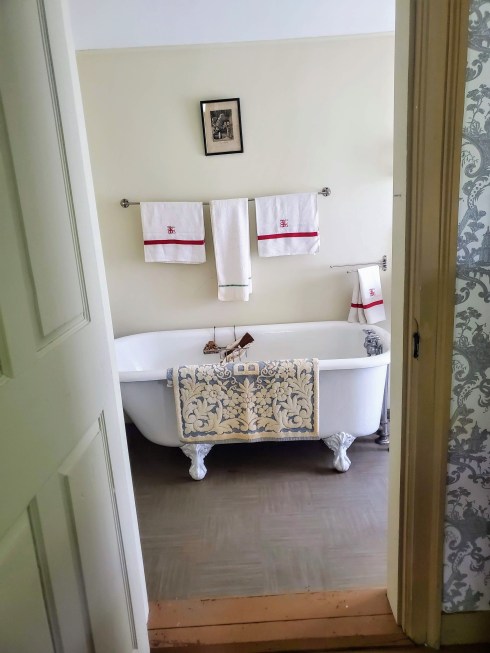
Loved the Currier & Ives presidential prints in the guest bedroom, which also has an en suite bathroom. The other bedrooms, including that of Mrs. Perkins above, have that “just left”/ I was just reading……. feeling, which is very Colonial Revival too: George Francis Dow pioneered the use of the folded-newspaper-by-the-gentleman’s chair motif in his period rooms in Salem, I believe.

Tours every Friday and Saturday available here.