Category Archives: Current Events

Saints & Sinners & a Bad Professor

So you would think that I would be happy when an exhibition of paintings, texts and objects right in my teaching sweet spot of late Medieval/Renaissance/Reformation/Early Modern Europe comes to my very own city, and yes, I am. Have I taken advantage of said exhibition and brought my students to see things which I regularly refer to? No I have not. The “Saints & Sinners” in my post title refers to the current exhibition at the Peabody Essex Museum, Saints, Sinners, Lovers, and Fools: 300 Years of Flemish Masterworks, and the “Bad Professor” is me. This has happened before: the PEM has a global purview, and several exhibits which have complemented my courses have been up, but this one is really spot on. So when I finally went yesterday afternoon (it opened in December and is up until May), I really enjoyed it, but also felt bad. I am really not good at out-of-the-classroom activities with my students: I never have been and I never had to be. All my colleagues are a lot better. I always used to think, oh well, they’re Americanists, it’s easy for them, but that’s not going to work in this case is it? And I’ve always blamed it on Salem State’s location—about a mile out of downtown Salem. It’s not very far, but it feels far, when you’re trying to cover so much in the limited time of a semester. I walk it often, but to and from is going to eat up an entire class with not much time for viewing in between. The original Salem State (Salem Normal School) was located just behind my house on Broad Street, but in the 1890s there was a big move to a more expansive—now residential—area south. The move made sense at that time, but now I think our university would benefit from a downtown location, or maybe I’m just making excuses! I have occasionally invited my students to join me at exhibitions, and a few have, but never the entire class: my students seem very busy, taking six classes and working two jobs—oops, more excuses. In any case, I’m certainly going to extend that offer to them for this exhibition, because they will in fact see many things which they have heard about before.

Detail  from Jan Wildens, Panoramic View of the City of Antwerp across the River Scheldt, 1630.

Saints and Sinners is a traveling exhibition co-organized by the Denver Art Museum and the Phoebus Foundation in Antwerp, and it is very Antwerp-centric. Once certainly gets a sense of the somewhat wider world that was late medieval and Renaissance Flanders, but Antwerp is the star of the show. But that’s ok, because Antwerp was a very dynamic city in this era–the first non-Italian European entrepot. [a great read for the non-specialist is Michael Pie’s Europe’s Babylon: the Rise and Fall of Antwerp’s Golden Age] The exhibition opens with two galleries exploring intense late medieval piety and the rise of Christian humanism in northern Europe: there wasn’t much discussion in the exhibition text about the latter (or humanism in general, really) but I saw it all around me in both the Christocentric devotion and the subtle critique of the Church, most evident in Anthony Rebukes Archbishop Simon de Sully in Bourges, (c. 1475, by Master of the Prado Adoration). There is a lovely little triptych with a nice interpretive feature.

Circle of Dirk Bouts, The Virgin and Child in an Enclosed Garden , about 1468; Master of the Prado Adoration, Anthony Rebukes Archbishop Simon de Sully in Bourges, about 1475; Artist in the Southern Netherlands, Triptych with Saint Luke Painting the Virgin Mary and Jesus, 1520-30.

Then we were on to more worldly things: shockingly fresh portraits of people who were not saints, still-lives of stuff, a few landscapes, battle scenes, scenes of daily life and satire, cabinets of curiosities. The segue between the spiritual and material worlds was a succession of Adoration of the Magi paintings, focusing on stuff. You can never underestimate the impact of the Renaissance portrait, and I was particularly wowed by the portrait of Joost Aemsz. van der Burch by Jan van Scorel. He looks very (Thomas) Cromwellian to me, and yes, he was a contemporary and also a legal advisor, to Holy Roman Emperor Charles V. I love portraits of the new nobility of merit or robe (rather than the sword) and also of merchants, the other new men of the era. One of the most captivating (double) portraits of this exhibition is the rather pointed portrait of two “tax collectors,” a copy of the famous Quentin Massys painting of the same title. This image is a great teaching tool: I suspect the men were in fact “tax farmers,” collecting taxes for the government for a certain percentage, a practice which emerged before the expansion of professional state fiscal agencies, and their depiction conveys a lot about attitudes towards money, class, occupation, society, and even color. Another double portrait of a married couple was also interesting: they are obviously well-heeled and playing “triktrak,” an early form of backgammon.

Quinten Massys, Tax Collectors, late 1520s, oil on panel, 86 x 71 cm. Liechtenstein Collection, Vaduz/ Vienna.

LOVE this first portrait above: Jan van Sorel, Portrait of Joost Aemsz. van der Burch1530-1; Marinus von Reymerswaele, After Quinten Metskis, Tax Collections, about 1530; Jan Sanders van Hemessen (Hemessen c. 1504-1556 Antwerp), Double Portrait of a Couple Playing Triktrak, 1532.

I was familiar with most of the printed texts in the exhibitions but the key reference works were there: the very important and popular Cosmographia of Petrus Apianus, the pioneering On the Fabric of the Human Body by Andreas Vesalius, and the Nova Reperta engravings by Flemish artist Johannes Stradanus published by Philips Galle. The Nova Reperta (New Intentions of Modern Times) is a portfolio of 19 European “inventions” (many of which are not inventions and certainly not European inventions) is such a testament to European pride (and invention!) at the end of the very dynamic sixteenth century. The frontispiece alone is revealing [I use this great digital site at the Newberry Library in class]: highlighted are 1) the western hemisphere (ok Europe gets credit for that discovery), the printing press (Chinese origin–I don’t see the type here!), distillation (I would call this a Eurasian collaboration), wood from the guiacum tree in Brazil (then thought of as the cure to another American import, syphillis, but soon to be abandoned for mercury), a cannon (ok the Europeans encased Chinese gunpowder), a saddle with stirrups (ancient!), a clock (clock history is complicated but if we’re talking mechanical I think I will give it to Europe).  As the exhibit moved into a surreal and satirical gallery, with a Bosch-esque Hell, and lots of foolery, I was with it, but I walked right through the boring Classical Impact section (not what I’m looking for in Antwerp) into the galleries of wonder and cabinets of curiosity. It was fun to see actual Wunderkammer as well as paintings of wealthy Flemish men and women with their collections of exotic objects and paintings; one can easily grasp how connoisseurship expanded into collecting and it was almost as if these galleries were a mirror of the entire exhibition.

Andreas Vesalius, On the Fabric of the Human Body in Seven Books, 1543; Follower of Hieronymus Bosch, detail from Hell, 1540-5-; Daniel Teniers, Festival of Monkeys, 1633;  Gillis van Tilborgh II, Twelve Gentlemen in an Elegant Interior, about 1661; The Famous Pocupine in London, 1672 @Trustees of the British Museum. After I saw him in the bottom right corner of the Cabinet in the exhibition, I had to put in him here as he is my favorite early modern porcupine.

Salem and the Eclipse of 1806

Apparently we have not seen a solar eclipse of such long “totality” since 1806, and in that year the “point of greatest duration” of daytime darkness was Salem, timed at 4 minutes and 48 seconds! When I read that, I had to drop everything and do a little research into this very notable eclipse in early America, starting with a pamphlet by Boston instrument maker Andrew Newell entitled Darkness at Noon (more than a century before and much more literal than Koestler). This is a wonderful little book that Newell published just before the 1806 eclipse, to get everybody ready, and it actually made me more excited for the great North American Eclipse of 2024! I will not be following Newell’s advice for eclipse-viewing, however, using “a piece of common window glass, smoaked on both sides sufficiently to prevent any injury to the eye.” The author James Fenimore Cooper offered colored panes of glass to friends and family viewing the eclipse in New York State, where Spanish astronomer José Joaquín de Ferrer, made measurements and drawings of its totality in Kinderhook, and coined the term corona.

Andrew Newell, Darkness at Noon: or, the Great Solar Eclipse of the 16th of June, 1806. Boston: D. Carlisle & A. Newell, 1806 (you can read the entire text at the Linda Hall Library); Ferrer’s Corona Sketch, 1806.

Back in Salem, the famed mathemetician Nathaniel Bowditch was also recording observations of the phenomena he observed on June 16, 1806, right in his backyard. They were later published as a Memoir on the Solar Eclipse of June 16, 1806 (plus an addition). You can sense the intellectual community in which he lived from his notes:  The time of conjunction deduced from my observations at Salem compared with the time of conjunction at Paris, computed by La Lande, gives, by allowing 53 seconds for the difference of meridians of Salem and Cambridge, the longitude of Cambridge Ah. 44 24 *9 W from Greenwich, as is shown in the additional observations on that eclipse given in this memoir. Among the general population, there is no sense of fear, only wonder, and the most popular adjective in day-after reports of the eclipse was sublime. The Salem Gazette’s report was purely descriptive: Yesterday the great solar eclipse took place, agreeably to the calculations which had been made. The day was very favorable to viewing it. The air was remarkably clear, and there was not a cloud in the hemisphere. As the sun shut in, the stars appeared, and many were visible at the time of total darkness. A considerable alteration in the temperature was felt during the continuance of the eclipse.

Philadelphia publisher John Poulson adapted Newell’s pamphlet for his Philadelphia readers in the  “Approaching Solar Eclipse” (courtesy Boston Rare Maps) and Simeon De Witt, the Surveyor General of New York State, described the eclipse in Albany in a letter to the American Philosophical Society which was accompaned by a painting of its corona by local artist Ezra Ames. (I’m kind of anxious about how these guys captured their coronas!) The broad swath of the 1806 eclipse.


Books for Christmas/Break

Classes have just ended and after grading I will attack the big pile of books by my bedside: I’ve already dipped into one or two but I have a full month with very few obligations ahead of me to really indulge. As I’ve been consumed with writing my own book (out in February) over the past few years, along with teaching and everything else, I haven’t had much time to read generally and broadly, so I’m really looking forward to the next few weeks. My list below is about as general and broad as I get: when I don’t have to read history for scholarship or teaching I tend to read histories of periods and places which I do not write or teach about. I’d love to read more fiction over the next month, but nothing has caught my attention except for the sole work of historical fiction below—and only because it’s related tangentially to my next project.

So here we go, beginning with two books that fall into the category of personal history:

Mr. Atkinson’s Rum Contract is an amazing personal history of Richard Atkinson’s own family, including his namesake forebear, a British merchant with considerable interests in the West Indies in the late 18th century who acquired the lucrative contract to supply the British army in North America with rum and other essentials during the American Revolution. This is a “warts and all” family history, as the family fortune was based as much on slavery as it was on sugar and land, of course, and one told in a truly captivating manner. Lotharingia is the last of Simon Winder’s surveys of central European travelogue history, following Germania and Danubia. I liked both of these books: they are rather breezy but still engaging and it’s easy to skip over the occasional boring bits. Lotharingia is the “land in between” established by the terms of the Treaty of Verdun in 843, which divided Charlemagne’s empire between his three grandsons: younger brothers Louis the German and Charles the Bald received lands east of the Rhone River and West Francia, respectively, while the eldest brother Lothar received the imperial title and “Francia Media”, a long strip of territory encompassing the Low Countries, parts of modern Germany and France, Switzerland, and much of northern Italy. A place of shifting boundaries and perspectives, for sure.

Since we are back in the early middle ages, I must admit that I have to do some work over the break: I’m teaching our early world civilization survey for the first time in a decade or so, so I must delve into some global history: Silk Road scholar Valerie Hansen’s The Year 1000 will be very helpful, and I’m hoping that Gary Paul Nabhan’s Cumin, Camels and Caravans, written from a more personal and cultural perspective, will provide me with some great “spicy” anecdotes.

And speaking of spices, I also want to use this break between semesters to do some background reading on my next project: a history of saffron in medieval and early modern England. A storied spice, a wonder drug, used in medical and culinary recipes and as a dyestuff, saffron has many threads to follow—through economic, social, cultural and even political history. I’m going to start with its most obvious attribute, its color, and then expand into some textile history. I’m not sure whether or not Atlantic sericulture will have much bearing on my understanding of saffron cultivation, but I’ve met Ben Marsh so I want to read his magisterial book (and you might know him too, from his family’s viral pandemic rendition of “One Day More”—he’s a Renaissance Man!) And then there is A Net for Small Fishes, Lucy Rago’s fictional account of the “Overbury Affair” in which Mrs. Anne Turner, she of the conspicuous yellow ruff, was implicated in the murder by poisoning of courtier Thomas Overbury and executed in 1615. There’s even a fictional Salem connection, as Nathaniel Hawthorne includes Anne Turner in The Scarlet Letter as a friend of suspected witch Mistress Hibbins, even teaching her how to color her ruffs yellow. Anne Somerset’s Unnatural Murder is a more straightforward account of the murder of Overbury set against the backdrop of poisonous Jacobean court culture.

I think I always include books about gardening on my lists, and this one is no exception. I like whimsical, personal books about gardening as an activity, but also cultural histories of evolving landscapes and horticulture: The Morville Hours is a perfect example of the former, and The Acadian Friends of the latter. It would be nice if someone would buy me the forthcoming Architects of the American Landscape and Nature and its Symbols, a reference book from Lucia Impelluso and the Getty Museum.

Finally, two texts focused on the interpretation of history for the general public, a constant concern and interest of mine. The United States is in the midst of a real reckoning (as opposed to a pandering PEM-esque reckoning) about its history and understanding of slavery, and Clint Smith’s bestselling How the Word is Passed is the very next book I want to read about this important process. Here in Salem, there’s very little reckoning; just an increasing amount of ghosts! All summer long, I was hearing ghost stories on the streets of Salem and I feel like I’m surrounded by their professional proponents. This fall, I went to a talk by a very prominent head of interpretation at a very prominent New England heritage organization and in the Q and A I asked him about ghost stories as history and he replied that ghost stories are history. While I understand and agree with that statement to a point, I’ve gone beyond my comfort level and so want to read up a bit more on dark or “paranormal tourism”: Haunted Heritage is about the scene in York, known as Great Britain’s most “haunted” city, so it should be just the ticket.


Trial by Combat

Like most Americans, I am outraged by the pillaging of the Capitol on Wednesday by a mob incited by the President of the United States and his personal lawyer, once a serious figure, now a joke, who called for “Trial by Combat”. Tears and despair reigned on Wednesday and Thursday, but yesterday I was just mad: mad at so many things, but I think principally upset about the misuse of history by everyone on the wrong side of it. It’s really clear that there is massive ignorance of history in our country, enabling its constant exploitation. When you look at the scenes of the Capitol riots what do you see? Flags, so many flags: the Confederate flag was the most conspicuous, of course: we had never seen it in that building before. But there were several Revolutionary War flags as well, outrageously displayed in an ignorant attempt to establish some sort of equivalency or legitimacy. I’m used to the quasi-“medieval” emblems used by white supremacists, and I saw them on display as well: of course the Vikings never wore horned helmets—they are a Victorian creation—but these people don’t read so they don’t know. Anything medieval is just Game of Thrones fantasy to them, but how dare they use the “Appeal to Heaven” flag of the nascent U.S. Navy or the Gadsen “Don’t Treat on Me” flag.

A flag hangs between broken windows after President Donald Trump supporters tried to brake through police barriers outside the U.S. Capitol, Wednesday, Jan 6, 2021. (AP Photo/John Minchillo)

That casual reference to trial by combat, which was archaic in the sixteenth century at the very least! As it evolved into the duel, monarchs wanted a monopoly on warfare, and so it was disdained, not celebrated, as it was on Wednesday (by the cowardly “generals” who of course did not accompany their “army” to the Capitol). And we’re supposed to be more civilized? I hardly think so. Trial by combat is already depicted as “orderly” and idealized in the fifteenth century: it’s on its way out then, only to be resurrected in the twenty-first.

Trial by combat as depicted in two late medieval manuscripts (British Library MS Royal 15 E VI and Royal 14 D I) and a Victorian reimagining.

Maybe it’s because I’m writing about the Renaissance now and completely focused on its messaging, but I feel like we can only move forward by looking back. We’ve got to learn our history, our real history. I think I’m also a bit concerned about this now because the Liberal Arts are being challenged across our nation at institutions of higher education, particularly public ones like the one at which I teach. I’m worried we are going to be transformed into a vocational school by our administration with its “bold” plan: offering instruction primarily in social service rather than social science. We excel at teacher education in several fields (including history, of course) because that is our history, and nothing is more important than that now. How can we move forward if we don’t know where we’ve been?

Oh, and those “backward” medievals always distinguished between trial by combat and pillage: that’s what happened on Wednesday.

Pillaging, BL MS Royal 14 D I


The Dance Will Go On!

There is no contest for me: my favorite Salem event has always been the Christmas Dance at Hamilton Hall: I have never missed it in all the years I’ve lived in Salem, even in the one year I had to go alone. Last year I was in terrible pain from sciatica, but I still hobbled over there and stayed for as long as possible. It’s just that important to me. Anything related to Hamilton Hall is a women’s history topic, very appropriate for my #SalemSuffrageSaturday posts, as women have worked in the Hall, danced in the Hall, held fairs and other fundraising events in the Hall for a variety of causes, and supported the Hall in myriad ways for its two+ centuries. Women continue to support the Hall through two major fundraising events which date to the period right after World War II, when the Hall was in dire need of repairs: the annual Christmas (now Holiday) Dance and Lecture Series, traditionally held on Thursday mornings in February and March. I served as President of the Hall for six years, and on its board before and after, so I know how very, very important the funds from these events are: when we received the checks from the Dance Committee (all ladies) and the Ladies’ Committee which runs the Lecture Series, we breathed a sign of relief. The Hall was built by subscription, and incorporated only in 1986: at that time it had a very small endowment, and it still does: events have always supported it, making an event-less 2020 a very precarious time. But as always has been the case, the ladies rose to the occasion: the Lecture Series will be virtual, increasing accessibility for many people as it always sold out in a week or so, as will the Holiday “Dance”, with some very special patronesses.

I’m so happy about this invitation and event! It combines two endeavors which are very important to me: the preservation of the Hall and its traditions and the showcasing of some remarkable women of Salem who have not received the attention they deserve. There’s a long tradition of naming patronesses for dances at the Hall; these hostesses ensured the success of everything from military balls to debutante assemblies. When the Christmas Dance began, patronesses (and now patrons) became as integral to its popularity as the famous bourbon punch (which I am now realizing that I’ve referred to as rum punch in posts past. What can I say? It always knocked me out). I was a patroness about ten years ago and it was not only an honor but also great fun: waiters with silver trays of champagne kept coming over and people bow and curtsy to you—what could be better? When the chair of the Dance Committee notified me that this year’s dance would go on virtually with patronesses from the past , I was thrilled: what a perfect way to recognize the Suffrage Centennial in this challenging year! I was happy to put forth some candidates, but the ladies of the Dance Committee made their choices, and it was all their idea. I’m just thrilled to see Margery, Mary, Elizabeth, Sarah (Symonds), Nancy, Louise, Clarissa and Sarah (Sherman) get their Salem due! Especially Nancy, whom I think of whenever I step inside the Hall, toiling away in the hot downstairs kitchen on the Rumford Roaster, while everyone was dancing in the ballroom upstairs.

Post-war Patronesses in a photo belonging to my friend Becky Putnam: staring directly into the camera, while in a perfect curtsy, third from the left, is her lovely mother Rosamond Putnam; Debutantes in 1969 in curtsy—-sorry for the quality but I wanted you to see the extended-front-leg curtsy which I found difficult to do when I was a patroness—they do too, although they really had to go low! My two favorite Hamilton Hall dresses: left is vintage Ceil Chapman from the late 1950s which I wore in 2004; right is from 2017. For some reason I cannot find a photo of myself as a patroness–if anyone has one, let me know! Even though there will be no dance IN the Hall this year, it is still as dressed up for Historic Salem’s virtual Christmas in Salem tour. Here is Jetsan, who belongs to current Hall president Michael Selbst, exhausted from his decorating efforts. 

Hamilton Hall Holiday Dance link: a video will be uploaded for ticket-holders on December 19 featuring the patronesses and dance history. To the Ladies!


Voting Matters

I am very, very anxious about the election and can think of little else. I have enough of a historian’s sensibility, of a human’s sensibility, to know that this is the most momentous election of my life. Of course there is little that I can do–other than donate and vote–so I have been appeasing my anxieties in my usual way: by reading about elections past. It has also helped me to read and listen to Boston College history professor Heather Cox Richardson, who has been putting the current situation in a comprehensive historical context for months now: talk about commitment! I have learned a lot about American history during this whole blogging experience, but I think I’ve learned more in the last 6 months than the past ten years: the problem is, I’ve been looking for the comfort of we’ve been here before but I seem to be surmising that many aspects of our current situation are truly aberrant! Apart from the search for context, there is just something very interesting about the logistics and detritus of elections past: in this digital age, we don’t have enough electoral texture. So here are just a few items that caught by eye.

Early Election Ballots: I love browsing through the early election ballots at the American Antiquarian Society: if you don’t understand the Electoral College—they are rather clear illustrations: also of the evolving concept of the ticket. Plus it’s interesting to see the emergence and disappearance of various political parties.

Mass Appeal: I love this flyer for Nathaniel Prentice Banks (also from the American Antiquarian Society), who was running for a Massachusetts congressional seat in the election of 1852. I don’t know if you can read it all, but he is appealing to all different sorts of men—mechanics, young men, middle-aged men and veterans! Plus he courts the ladies, and exhorts them to “stir up” their men!


Voting by Mail: since 1864. Very American. Poll Book from the Smithsonian Institution.


Poll Taxes! Who knew? I associated poll taxes with the segregated South, but in fact, people had to pay them right here in Massachusetts, and in other states as well, right up to the ratification of the 24th amendment in 1964! Imagine paying to vote. Imagine being an active suffragist, working your whole life for the voting rights of women, all women, and even after enfranchisement this barrier is still there! There were a few snarky articles published in the Boston papers right after the ratification of the 19th amendment in which the theory was put out there that perhaps women wouldn’t want to vote as they would have to tell the poll tax assessor their true ages! Unbelievable!


A Salem Parade Flag. Just because it must have been fun to see election parades, which I assume must have brought people together, but perhaps not. 13-star flag used in 1896 Salem parade, Cowan’s Auctions.

Pinback Buttons! Never can get enough of these: most are Roosevelt and McKinley, 1900 & 1904, from the Smithsonian; the Citizen pin is from 1915-20 and the Ann Lewis Suffrage Collection. I love the sentiment of Vote as you please but please vote.


A flyer from Margaret Chase Smith’s presidential campaign, 1964 (Smithsonian Collection). Because Margaret Chase Smith. And that’s as close as I am getting to our present time.


Eat, Drink & Be Merry

For the most part, I’ve managed to avoid dwelling on the pandemic and I must admit that I haven’t been that affected by it either, apart from the radical reconfiguration of my work environment! My struggle is to improve my online communication skills so that I can convey my passion for history through the screen—and that really isn’t much of a struggle, relatively speaking. I feel grateful as I’ve been fortunate: fortunate in my profession, which enables me to work in isolation reading and writing about a distant time and place, and fortunate in my residence—Massachusetts was hard hit in March and April but the steady leadership of our Governor and the responsible compliance of (most of) our citizens has enabled us to contain the spread of the Covid. Most days I am in a sixteenth-century fog writing my book, but headlines from the radio and the television intrude, and of course, the numbers of the infected and the dead keep climbing. I can’t believe that the President would hold rallies in this environment, and I am fearful of the maskless merrymakers I see whenever I do get outside and happen to find myself near a body of water, which is often, because I live on the coast. These “mask slackers” (a great term that comes from the last epic pandemic, when an Anti-Mask League formed in San Francisco) do not in any way remind me of a proverbial and patriotic “live free or die” movement but rather another, older, proverbial expression of selfishness: “eat, drink and be merry for tomorrow we shall die”. This is a biblical reference, of course, and as such it does not imply selfishness on the part of those partaking in the joys of daily life; rather it began to acquire its modern meaning at the time of the Black Death, or shortly thereafter. One of our best sources for the plague’s impact is the Italian author Giovanni Boccaccio, who set the scene for his tales of the Decameron by giving us a first-hand account of plague-time Florence, where

Some thought that moderate living and the avoidance of all superfluity would preserve them from the epidemic. They formed small communities, living entirely separate from everybody else. They shut themselves up in houses where there were no sick, eating the finest food and drinking the best wine very temperately, avoiding all excess, allowing no news or discussion of death and sickness, and passing the time in music and suchlike pleasures. Others thought just the opposite. They thought the sure cure for the plague was to drink and be merry, to go about singing and amusing themselves, satisfying every appetite they could, laughing and jesting at what happened. They put their words into practice, spent day and night going from tavern to tavern, drinking immoderately, or went into other people’s houses, doing only those things which pleased them. 

Boccaccio’s description echoed the late medieval Danse Macabre (“Dance of Death”) allegory, an expression of the egalitarian and universal nature of all-conquering Death found in poetry, music, and images both before, and especially after, the Black Death. Late medieval people heard (or saw) the message as a reminder to be ready for Death, which could strike at any time, in a spiritual sense, not just as a call to indulge. Over the next centuries the hoarding isolationists and the dancing fools converged and the focus on sinfulness and salvation was diminished and forgotten, leaving us only with self-centered indulgence in the face of things we can’t, or won’t control: eat, drink, and be merry for tomorrow we die. It’s the end of the world as we know it (and I feel fine).

Screenshot_20200720-123018_Arts-Culture

Screenshot_20200401-081302_TwitterAre we in a crisis? Death is just outside the door in The Feast of Dives, Master of James IV of Scotland, c. 1510-20, from the Collection of the J. Paul Getty Museum; I took this screenshot of Governor Kevin Stitt’s tweet back in March because I could not quite believe it: it was later taken down. I’m sad to say that Governor Stitt has recently announced that he is the first Governor to test positive for Covid and I hope he makes a speedy recovery. He attended the President’s rally in Tulsa on June 20 (without wearing a mask) but does not believe that it was where he was infected.

Screenshot_20200720-123433_Chrome

Screenshot_20200720-123154_Chrome

Screenshot_20200720-124158_Chrome

Detail of a photograph of  the Danse Macabre frieze at St. Mary’s Church in Lübeck painted by Bernt Notke in 1463; it was destroyed during World War II.  Ink & watercolor Dance of Death by anonymous German artist, 16th century, Metropolitan Museum of Art; inset of 17th century oil painting of the Dance of Death, Wellcome Library.


Women on a Pedestal

Obviously statues have been in the news of late, so I thought I would tap into the national (and international) focus by looking at some of our country’s more notable monuments to women, either striving for the franchise or striving in general, for this week’s #salemsuffragesaturday post. It doesn’t matter what your political inclination is, everyone seems to agree that there are not enough statues of women anywhere and everywhere, and corrective measures are being taken, along with initiatives associated with this Suffrage Centennial year. The husband and wife team who constitute Statues for Equality have established that statues of women represent less than 10% of public monuments in several American cities, and far less in most. In Salem we have only one statue to a woman: Samantha Stevens from Bewitched, situated in our city’s most historic square. She never accomplished anything (because she never actually existed) and her prominent situation and whimsical depiction mocks the real victims of the 1692 trials who were falsely branded “witches”, but nonetheless she is deemed worthy of monumental representation in Witch City. There are so many more women (real women) that deserve to be put a pedestal in Salem—that’s what this year has been all about for me.

pixlrSamantha is currently wearing an ensemble by local artist Jacob Belair, which I think is lovely on its own but also because it covers part of her up! I wish it extended to her unfortunate pedestal. I’m not in Salem now, so I asked my stepson ©Allen Seger to take the photos of Samantha in crochet.

Let’s turn to some more serious representations. Ever since it’s installation 15 years or so ago, the Boston Women’s Memorial has been one of my favorite monuments: not only is it aesthetically pleasing and immediately engaging, but it represents a spectrum of women who shaped Boston’s history (as well as that of Massachusetts and the nation): Abigail Adams, Phillis Wheatley, and Lucy Stone. These women are not just on pedestals (actually they have come off their pedestals) but depicted by sculptor Meredith Bergmann in the process of thought and activity, with their words accompanying them. Monumental women are in large part, active women, the feminine counterpart of all those masculine equestrian statues.

Screenshot_20200612-082211_Chrome

Screenshot_20200612-082224_Chrome

Screenshot_20200612-082234_ChromeThe Boston Women’s Memorial by Meredith Bergmann; photographs from her website.

Meredith Bergmann was also commissioned to create the most anticipated installation of this Suffrage Centennial Year: the Women’s Rights Pioneers Statue in Central Park in New York City, which will be unveiled on August 26, the date on which the ratification of the 19th Amendment was certified in 1920. This will be the park’s first statue honoring real women, and it also focuses on their activity: Sojourner Truth, Susan B. Anthony, and Elizabeth Cady Stanton are gathered around a table, intently focused on drafting a document. The statue had a controversial conception in that Truth was originally excluded, but public discussion and debate resulted in a more inclusive—and representative—monument.

Screenshot_20200612-082723_Chrome

Screenshot_20200612-082623_ChromeModel and Mock-up of the first and final monument to the Women’s Rights Pioneers by Sculptor Meredith Bergmann, to be unveiled in Central Park on August 26, 2020.

As the state which ultimately ratified the 19th Amendment in August of 1920, Tennessee takes its suffragist history very seriously and has produced two notable monuments to the women who worked so hard to make it happen (because it’s really not all about a wavering state senator is it?) There is the Tennessee Woman’s Suffrage Memorial (2006) in Knoxville, depicting Lizzie Crozier French, Anne Dallas Dudley, and Elizabeth Avery Meriwether, and the Tennessee Woman Suffrage Monument (2016) in Nashville’s Centennial Park, featuring Dudley along with Abby Crawford Milton, J. Frankie Pierce, Sue Shelton White and Carrie Chapman Catt. Even more recently, the Commonwealth of Virginia—always the site of so much statue furor—dramatically increased its commemorative depictions of accomplished women with its Virginia Women’s Monument: Voices from the Garden initiative, honoring the “full scope” of women’s achievements with twelve representative statues.

Screenshot_20200612-075354_Chrome

Screenshot_20200613-080549_Chrome

Screenshot_20200612-072439_Chrome

Screenshot_20200612-072336_ChromeThe Knoxville and Nashville Suffrage statues—both by Tennessee sculptor Alan LeQuire—and the unveiling of seven statues of prominent Virginia women last fall: former Virginia First Lady Susan Allen points to a statue of Elizabeth Keckley, dressmaker for Mary Todd Lincoln, and suffragist Adele Clark among the crowds (Bob Brown/ Richmond Times-Dispatch).

I like the fact that so many of these monuments are collective, featuring women engaged with each other. Sometimes they are working, sometimes they are simply “conversing”—or meeting for the first time like one of the most famous Suffragist monuments, the “When (Susan B.) Anthony met (Elizabeth Cady) Stanton” statue in Seneca Falls, New York, portraying the moment when these two icons were introduced by Amelia Jenks Bloomer in 1851. My very favorite “conversation piece” is the lovely statue of two prominent Rochester, New York suffragists, Anthony and Frederick Douglass, having a cup of tea: I would love to have been a fly on the wall (or the bench) for that conversation!

Screenshot_20200613-075828_Google

Screenshot_20200613-080112_ChromeThe Anthony-Stanton-Bloomer statue (1998) by Ted Aub in Seneca Falls; Ira Srole’s “Let’s Have Tea” (2009) in Rochester.

The most official Suffrage statue of all, Adelaide Johnson’s “Portrait” monument to Anthony, Stanton, and Lucretia Mott completed (and dedicated) in 1921, is also a collective representation but the women don’t seem particularly engaged with each other: it’s not my favorite statue but that doesn’t mean I think it should have been hidden away for most of the twentieth century! The “unfinished” appearance of the work also engulfs the women in their “pedestal” rather than placing them on it, but rumor has it that Johnson was making room for at least one more prominent woman—perhaps the first female president—to be carved out of that raw marble in the back at some point in time. Clearly not 2020.

Capitol StatueOffice of the Architect of the Capitol.


How do You Re-open a Tourist Town?

After a pandemic—or in the midst of one? Obviously the answer is very carefully. I grew up in a summer tourist town, York, Maine, and have lived in a seasonal–going on all-year tourist town, Salem, Massachusetts, for several decades, so the question is very interesting to me, and obviously far more than interesting to the residents and business owners of both communities. I’m in York now, so I thought I would start with some observations of what is going on here, and then follow up with Salem (whose many restaurants started opening up yesterday—in the streets) when I return in a few weeks. The policy in Maine is self-quarantine for two weeks for all people coming from outside: I am following that policy I believe: I came up with two weeks’ worth of groceries and supplies and am going to no public places, with the exception of parks and walkways near our home which are open. Self-quarantining in Massachusetts allowed daily exercise as well as essential shopping, so I was assuming that the former is allowed here: I found some contradictory information, but if I am the wrong let me know, Maine authorities! I stay far away from everyone on my daily walks and wear my mask at all times. We have the perfect situation here, as we have a big family house where my husband, stepson and I are staying, and my parents–who are Maine residents—are in their condominium less than a mile away. So if we run out of anything they can go and get it for us! The one time I was walking in rather public place, with my Maine parents and mask on, they insisted on going to the walk-in counter of Rick’s All-Season Restaurant for Bloody Mary’s: I stayed far away from the window and we imbibed at home. There is an ice-cream take-out window in Salem, but I don’t know if we have a Bloody Mary one—-yet.

IMG_20200607_120623_791The Take-Out Window at Rick’s Restaurant in York Village

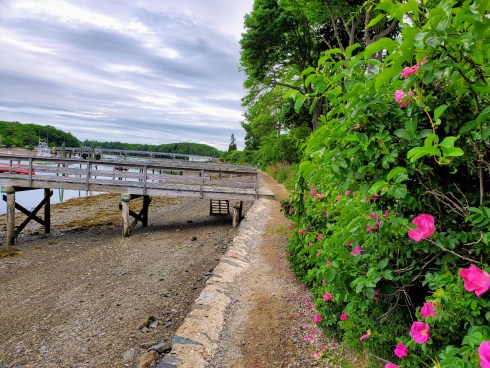
I was quite accustomed to seeing masks on the streets of Salem as well as inside public places: here in Maine there seems to be less mask-wearing outside, but as I haven’t been inside anywhere but our home I’m not sure what’s going on there. Obviously Maine is a much larger state than Massachusetts with a much smaller population, so there is less concern about population density: in York the population typically swells in the summer, but with this two-week self-quarantine policy in effect I would guess that this would not be the case this summer. That is the pressure point. York is a really large town, geographically, with a lot of public outdoor space: three major beaches, a mountain with trails, parks, ponds, pathways—lots of room for social distancing. The beaches are open for active use: no sunbathing, but walking, swimming, fishing are allowed. In York Harbor, where we live, there are two coastal paths: the Cliff Walk and the Fisherman’s Walk. I grew up walking on the former in four seasons: but there have been some access issues over the past decade or so, and the owner of one abutting property has built a fence to block pedestrian access to part of the walk. It has been Covid-closed, but the nearby Fisherman’s Walk is open so that is where I will be taking most of my harbor walks. As you can see, it’s lovely, and very uncrowded: we’ll see what happens as June progresses.

20200609_102633

20200609_102553

20200609_095055

20200609_095449

20200609_095313

20200609_095625

20200609_101256

20200609_101139Fisherman’s Walk, York Harbor, Maine, with a new house (next-to-last photo) rising over the Harbor.


Quarantines in Salem

I’m pretty familiar with the origins of the quarantine, having taught classes on or in the era of the Black Death for twenty years: quaranta (40) days that ships were required to anchor in the harbor off Venice before they could unload their passengers and cargoes to prevent the passage of plague in the fourteenth century. The Black Death came to Europe by sea, in ships: it was external. The circumstances in which we find ourselves prompted me to look at Salem’s quarantines, as Salem was a mini-Venice in its day, an entrepôt for worldly goods coming from far, far away. And by the time of Salem’s heyday, everyone knew that deadly germs could accompany those precious commodities. The plague was over (until its reappearance in the later nineteenth century) but other plagues persisted: smallpox, yellow fever, cholera, influenza, scarlet fever.

Quarantine-Venice Puck Magazine drawing from 1883, showing the NYC Board of Health attempting to ward off the arrival of Cholera.

Disease operates like war in history: it dramatically intensifies the size, scale and power of the government in reaction. Quarantines are evidence of the government’s powers and/or ability in the face of crisis, and they leave a record. Massachusetts experienced several smallpox epidemics in the seventeenth and eighteenth centuries, provoking both quarantine measures and medical relief in the form of inoculation. In Salem, smallpox was still considered threatening enough to provoke the establishment of a designated hospital and committee to deal with it in the eighteenth century, but it was by no means as frightful as the disease which was often simply referred to as the “pestilence”: yellow fever. Maybe I’m wrong, but the public discourse at the time seems to imply that smallpox is containable, yellow fever, not at all.

Quarantine-Salem_Gazette_1798-07-03_3

Quarantine-Salem_Gazette_1794-09-16_4Salem Gazette

Strict maritime quarantines were implemented as soon as any news of yellow fever was reported, particularly after the dreadful epidemics in Philadelphia in 1793 and New York in 1795, and the concurrent epidemics in both cities and Boston in 1798. The last two years of the eighteenth century marked a turning point in Salem’s public health history, with the appointment of a new inspector of police: apothecary Jonathan Waldo. In several long articles in the Salem Gazette, Waldo asserted that the dreadful pestilence was not only an external threat, but one that was festering right in Salem, and thus a series of quarantine and hygiene regulations must be implemented as soon as possible. Salem needed to clean up its act.

Quarantine-Salem_Gazette_1799-03-08_2

First, a new Board of Health, the Overseers of the Poor, or some other body should be empowered with the mandate to enforce the necessary regulations, which included: confiscation of “corrupted” properties for the “public good”, with compensation to the owners, the establishment of a “pest house”(another one: Salem already had two by my count), “suitable” privies, “so situated as to incommodate their next neighbor as little as possible”, proper cisterns for butchers, docks and flats to be kept clean, no dead animals are to be thrown into the streets or the river, no storage of hides, fish, and beef for prolonged periods of time, and “the public streets, wharves and enclosures should be kept in a good wholesome state of cleanliness, especially during the hot season.” And so you see, we can learn a lot about societies in the midst of, or facing, a contagion! Once the hot season arrived, the city imposed a maritime quarantine on all incoming vessels. Another apothecary (who interests were even more wide-ranging than those of Waldo), Scottish exile James Tytler, published his Treatise on the Plague and Yellow Fever in Salem in this same, fevered, year of 1799.

Screenshot_20200329-224211_Chrome

KeithFeverDistrictsUSA1856Library of Congress

As the map above (from Alexander Keith Johnston’s Physical Atlas: a Series of Maps & Notes Illustrating the Geographical Distribution of Natural Phenomena) depicts, I always associated yellow fever with the south: the Caribbean, and New Orleans, in particular. But this was not strictly the case. I have no access to the City of Salem archives—some seem to be up in the Phillips Library up in Rowley; some remain here in Salem, in City Hall I presume—but fortunately a predecessor of mine from the Salem State History Department, Charles Kiefer, created an inventory and finding aids for the municipal records from 1681-1832 in the 1970s which is preserved in the Salem State Archives. According to Kiefer’s notes, most of Waldo’s recommendations went into effect in the first decade of the nineteenth century, with the additional improvement of paved streets. These notes also reference the first outbreak of what would be the new threatening disease of the nineteenth century, cholera, with a very early outbreak for Salem in 1812. I was surprised to read of the implementation of a maritime quarantine against cholera by the Salem Board of Health as late as 1885: I thought it was all about railroads at this point. There were influenza alerts (but not quarantines as far as I can tell) in 1890 and (of course) 1918, a late smallpox scare in 1912 which brought out police guards, and several scarlet fever quarantines in the twentieth century. Despite the fact that it was revealed to be contagious in the 1880s, I don’t see any quarantine measures used by Salem authorities to combat the most endemic of nineteenth- and early-twentieth century diseases: tuberculosis. There was clearly increasing concern and focus on preventative public health, hygiene, and housing, an updated Waldo regimen if you will, but no extreme measures.

Quarantine

Smallpox-1912

Quarantine-Scarlet-Fever-3