Category Archives: books

Finishing my 2025 Books

I’m still working on the fall version of my 2025 reading list even as the year draws to a close. I certainly won’t finish it by the end of the year, but I have a LONG break ahead of me as I have a sabbatical for the spring semester! Lots of great books coming out next year (including my own) so I better get going. Next week, I’ll post about Salem’s Centuries as its publication date is January 6 (hoping to change the vibe for that particular date). This is a really good working list of books that I have read, am currently reading (I tend to read books concurrently) and plan to read pretty soon, all of which were published in 2025. In fact the last book is due to be published tomorrow, so I don’t have it in my possession but I pre-ordered it. As usual, this is a nonfiction list; I just don’t read very much fiction so I can’t offer up any kind of a guide to those genres. I read history, history of science, art history, the history of food and drink, folklore, and books about various types of design and architecture. That’s pretty much it. Maybe a bit of politics and popular culture—and media, but the vast number of titles for fiction and self-help books appearing every year seldom catch my attention. So here goes, beginning with books in my period that I felt that I had to read but were nevertheless quite good.

I thought Borman’s book was going to be just a narrative of Elizabeth’s declining years, death, and the succession of James I and VI, and it was that, but it was more too—I learned lots of little things I did not know about these years. Borman is more than a television presenter, clearly: this is a very source-based history, with particular reliance on new revelations about William Camden’s Annales. Just further complexities relating to James for me! I think I have a book on him on many of my book lists here, and as 2025 was the 500th anniversay of his death I had to have one more: Clare Jackson’s Mirror of Great Britian is amazing, one of the best royal biographies I’ve ever read, and that is saying something as James was complex: earnestly Protestant but also a pursuer of pleasure, well-educated but also a true believer in demonic witchcraft, the only contemporary critic of tobacco, the first King of Great Britain. He’s a lot, and Jackson handles both the man and his era really well. Getting away from royalty and this specific era, two other British books which I am kind of reading together, gradually (they are both what I think of as “dipping” books in that you can pick up and dip into them wherever and whenever you like) are all about food and folklore—both just completely entertaining and informative at the same time.

I like to read books that are sweeping in terms of their topics, sweeping over the centuries: a change from most of the academic reading I do which is much more constrained in terms of both topic and time. The very popular genre that I call “commodity history” often includes sweeping titles, but as its title asserts, Jordan Smith’s The Invention of Rum is more narrowly focused on the invention of this “perfect” Atlantic spirit. Another “invention” book (though I really don’t think “design” was invented in the twentieth century but that’s why I want to read The Invention of Design) covers only the twentieth century. A really fascinating book blending history, magic and medicine (one of my favorite combinations), Decoding the Hand covers more ground.


I have my natural, constant interests, but if I’m looking for something new to read the first place I go is to the website Five Books, at which experts recommend five books in their areas of expertise and lots of lists to inspire a wider range of reading. I love this site! One great book that I never would have found on my own came from here: Sara Lodge’s Mysterious Case of the Victorian Female Detective, which was on the shortlist for this year’s Wolfson History Prize, awarded annual for both well-researched and accessible (enjoyable!) history writing. This book was definitely both, and a case study in utilizing historical and literary sources.

Finally, three books of a more timely/political nature. The medievalist Patrick Boucheron has written a great book about Political Fictions over time, I am searching for some explanations for/relief from the NOISE that assaults Salem all year long so I purchased Chris Berdick’s well-reviewed Clamor (though I’m sure he will take on all the sirens and jackhammers but not the tour guides), and I think we should always remember January 6 (for more than the publication of Salem’s Centuries) so I’m going to read Nora Neus’s oral history on that day.


The Revolution in Color

I decided to celebrate the debut of Ken Burns’ new series on the American Revolution by getting out two old books which I always enjoy browsing through, and which I now realize were quite foundational in how I look (and I do mean look) at American history in particular and history in general. The two books are The Pictorial History of the American Revolution by Rupert Furneaux and The Colonial Spirit of ’76 by David C. Whitney, and they were both published for the Bicentennial by Ferguson Publishing of Chicago with ample illustrations, including watercolors of noted Revolutionary spaces and places by “visual artist” Kay Smith. That’s how she is always described, and she died just this year at age 102! Every time I look at her watercolor buildings, I remember when I saw them for the first time; it happened just yesterday when I took the books out. And so it has finally dawned on me that my lifelong pursuit of history through houses began with her. The two books have lots of other cool illustrations too, including prints of every single tavern along the eastern seaboard which has any sort of Revolutionary connection, but Kay provides most of the color. I don’t know about reading these books—they’re definitely rather dated and devoted to storytelling rather than multi-causal analysis, but they are fun to look at. No Salem at all, sadly: colonial capital or Leslie’s Retreat or privateers. The Pictorial History has a chronological/geographical format and the Colonial Spirit is supposed to be more of a social history, I think, but its basic structure is biographical. Here are some of my favorite illustrations—all by Kay Smith, and most of buildings, of course—from Boston to Yorktown.

Kay Smith could depict people too—-her take on Major Andre’s famous sketch of Peggy Shippen Arnold is very charming. Interesting illustrations are scattered throughout both books liberally: uniforms, of course, firearms, vignettes of “daily life,” a great presentation of a Declaration of Independence cover sheet juxtaposed with a facsmimile of Thomas Jefferson’s hand-written and -corrected copy (used by Burns at the opening of episode one of The American Revolution). These books made for just as pleasurable browsing as all those years ago. And what do we think of the latest take on the Revolution?


Fall Reading 2025

The stars seem to have aligned and I am all set for a fall full of reading. Salem’s Centuries is in production (and out on January 6), my new saffron project hasn’t taken flight yet, and I have a course release for the semester. I’ve written two books in five years and now is the time to ingest. Escaping into book worlds is another way of avoiding my least favorite season in Salem as well. So I have a long list, already about a quarter devoured. As usual with my book lists, it’s very light on fiction, heavy on history, and reflective of the odd ephemeral interest. So let’s go: it will be interesting to see how I group these rather disparate texts.

I think I’ll start out with broad, cultural histories as they might have the most general appeal: I’m always reading “commodity histories” and this year will be no exception, but I have to tell you that Robert Hellyer’s Green with Milk and Sugar has a bit more depth and dimension than most books about tea—and there are a lot of books about this particular commodity. I had the difference between black and green teas down, but did not discern between different types of the latter (and their impact) until I read this very interesting book. Another important global commodity, sugar, has also received quite a bit of attention from scholars (beginning with Sidney Mintz’s classic Sweetness and Power) but the latest effort, the Dutch economic historian Ulbe Bosma’s World of Sugar, is supposed to be particularly comprehensive. I bought it last year but haven’t delved into it yet. Super excited to read Catland: how can it not be amazing? I’m not sure where to put Chanterelle Dreams, Amanita Nightmares, a book I discovered in the gift shop of the Coastal Maine Botanical Garden a few weeks ago solely for its title (+ lore), in this post so I guess I’ll put it here: it is kind of a broad cultural history of human perceptions of muchrooms. It’s also very much a “pick up and read a bit” book.

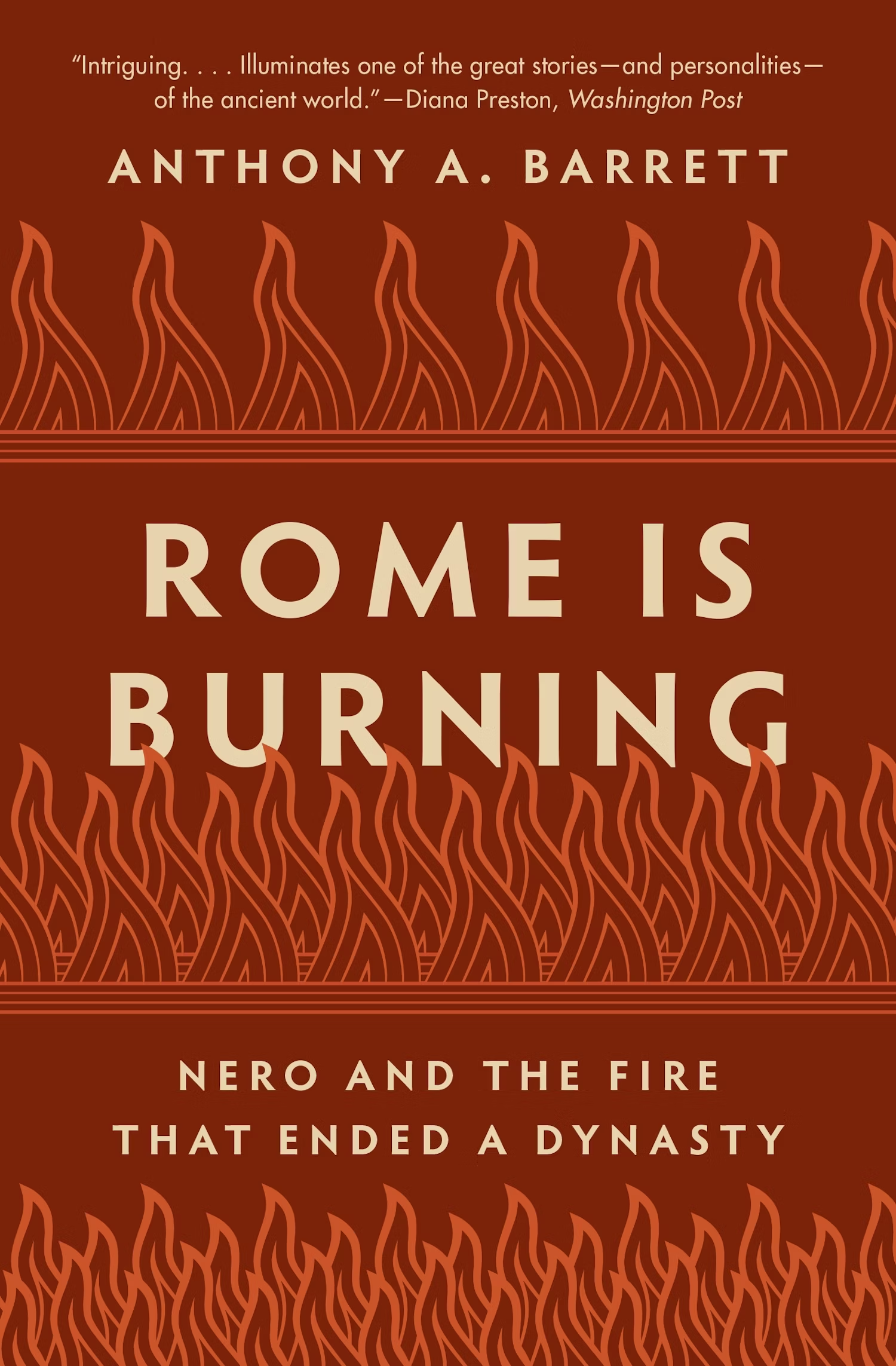
I find that I am reading new books on the Atlantic Slave Trade regularly because we are in the midst of a golden age of research into the history of this terrible trade and provocative analyses of its cascading impacts are published every year.  Traders in Men and Plantation Goods are on my fall list but I should have read them this summer, in advance of teaching my Introduction to European History course. Instead, I had a “Roman interlude” prompted by a re-reading of Suetonius’s Twelve Ceasars last spring. So two half-read Roman books are on my fall list too: a very accessible history by Anthony Barrett about Emperor Nero and the burning of Rome and a book by Roland Mayer about Roman ruins which is more about later perceptions of Rome than Rome itself. The Mayer book probably belongs with the broad cultural history books above. I have started Traders in Men and Plantation Goods (as you will discern by now, I read books in phases, concurrently with other books, a habit I’ve been trying to break but cannot) and my assessment so far would be: both very important and well-sourced studies, with Plantation Goods probably more accessible as it focuses on the basic. It is very much a “material history.”

There are several books which were recently published in my scholarly fields which now sit beside my bed in a stack: first up is Inventing the Renaissance and then we have two books on major late Tudor/Jacobean players: George Villiers, the Duke of Buckingham, and Robert Cecil. I’ll read these for myself, but also to discern whether or not I’ll assign them to students. Stephen Alford (author of All His Spies)’s previous book, London’s Triumph, was a big hit among my grad students this past summer. I suspect that Palmer’s Inventing the Renaissance will be great for historiographical discussions in both undergrad and grad courses. And because it was set in my period and in an interesting period in Mary, Queen of Scots’ life, I actually read a novel all the way through this summer: Flora Carr’s The Tower.

Finally, books on more topical interests which are preoccuping me constantly and/or currently. I’m always interested in architecture, and I read one book this summer which I loved: Thomas Heatherwick’s Humanise (it’s spelled Humanize in its American edition but I prefer the British one’s cover). I don’t think many architects like this book as it is quite critical of contemporary architecture not so much on the basis of design but of craftsmanship. Heatherwick has provoked a reaction among architects in the UK (I’m not sure about here) as he is not an architect himself and does not hold back on characterizing much present-day building as both soul-crushing and soulless (generally because it is so boring) and has launched a campaign to bring joy and craftsmanship back to construction. He’s a real crusader! I’ve been interested in the urban planning idea of the “15-minute city” for a while, so I picked up Shrink the City to learn more about it. The whole idea of meeting all your needs within a 15-minute radius could work for a city with the infrastructure of Salem, but not if we continue our comprehensive commitment to witchcraft tourism, which has resulted in a multitude of witch shops replacing those selling clothing and groceries. As this past year I seem to have become preoccupied with symbols and emblems, first because of the ongoing discussion over the Salem city seal and more recently by the dumbing-down of the Massachusetts state seal and flag, I’ve really been searching more insights into visual culture and graphic design. It’s like another language which I don’t understand. One book that has really helped me is the classic Megg’s History of Graphic Design, but I welcome suggestions. I have yet to find a thoughtful or even interesting book on vexillology.


What I’m Reading, Spring 2025

I’ve working my way through a stack of books this semester and looking forward to some notable new publications so I thought I’d put together a post to relieve everyone (including myself!) from the Revolutionary focus. As is generally the case with my reading lists, there’s no fiction here. I really, really wish I could read fiction, but I am for the most part an “information reader”: I’m looking for something or want to learn something. I aspire to read for pleasure but I’m not there yet. I’m always teaching and writing about history, so most of what I read is history too, but I have various sideline subjects: architecture, urban planning, folklore, art. I will often have a stack of books by my bed or desk which I will dip into for an hour or two, but for the past year I’ve been trying to break that habit and read through every book I pick up. I’ve been moderately but not completely successful in this aim. I’m also trying to kick my Amazon habit, but have been less successful in that goal! So here’s the list, in no particular order.

Big, sweeping cultural histories of monsters and fairy tales! I’ve been eagerly awaiting Humans. A Monstrous History, which was published just last month. I ordered a desk copy from the publisher, because if it’s as good as I think it will be, I will definitely use it in class. I think I know where Surekha Davies is coming from, because I read her first book on Renaissance ethnography, but she is really stretching it our here—“monsters” are a bit different in the medieval and early modern era. But every civilization has its monsters, and their creation tells us a lot about every civilization. I’ve had Warner’s Once Upon a Time for a while, but finally finished it, as I thought it would be a good companion book for the monsters.

American history always seems much more….tangible! I love books that can explain how just one thing—whether tangible or not, can be “revolutionary” so this book on the Franklin stove is right up my alley: I have a Franklin stove and have written about its companion technology, Rumford roasters! I have not received this book yet (I couldn’t order a desk copy as I don’t teach American history) but I am really looking forward to reading it. I have read No Right to an Honest Living and while it was a bit slow-going for me, I really learned a lot. I wanted to read it as I have thought and written about the Remond family here in Salem so much and I thought this book on Boston African Americans who lived at the same time might give me some insights into their lives, and it has.

Some women’s history (and literature) for Women’s History Month. These are two very accessible, informative, and complementary books: I read straight through them in a weekend. I am a fast reader but I also tend to “gut” books as they taught us in graduate school: you really can’t do that with either of these books. This is the anniversary year of Jane Austen’s birth so I expect we will get more Austen books but I suspect Jane Austen’s Bookshelf will do it for me: I liked this very personal window into her reading world.

A wide range of architecture. I guess I’m going for complementary reads here; I hadn’t planned on that, a pattern is emerging! Now that I think about it, I guess this is how I read. If I read an engaging book, I want more, or I want some kind of response. I’m not sure these that Inessential Colors and A Paradise of Houses will be complementary: I’ve only read the former and the latter is going to be published at the end of this month, I think. I pre-ordered it because its title gave me hope: Salem is just getting uglier and uglier with its new construction and I yearn for a reversal and “rebirth” back to urban integration and intention: do we even have a city planner anymore? Maybe this is not what Podemski is offering, but I’ll see. Works on pre-modern architecture that are not theory seem rare so I snapped Inessential Colors right up: it’s an academic book which explores the beginnings of the use of color in architectural renderings. I’ve been reading a lot of color theory for the next book I’m researching, on saffron, so it hit the sweet spot of architecture + color for me but it might be a bit specialized for most.

Different Forms of Memory. Here are another pair of books of which one (I’m showing two covers here because mine is on the left but I much prefer the right) I’ve read and the other I’m waiting for: I should have subtitled this post “books I planned to read.” I’m really interested in statues and other forms of public commemoration: Fallen Idols was an ok overview but it didn’t quite do it for me. I think I’ll read Erin Thompson’s Smashing Statues: The Rise and Fall of America’s Public Monuments next. I’ve really become interested in Revolutionary remembrance because of my deep dive into the Revolution last year and this year’s commemorations. The Memory of ’76 looks like it’s going to answer a lot of questions I have about this topic, so I wanted to include it here as a reminder—it’s coming out in July.

Lightening (Liquoring) up. I have the occasional habit of posting my Friday cocktail creations to Instagram, and was rewarded with several books on alcohol this past Christmas! Kind of embarassing, but both of these gin books have some great recipes and Austen + alcohol—what could be better? I write quite a bit about the cordial consequences of early modern distillation in my book The Practical Renaissance, but Camper English has a much more accessible and expansive take on this trend: Doctors and Distillers is a really enjoyable book.

Would love some suggestions for engrossing historical fiction and public art marking history!


Nancy Drew & the Peabody Sisters of Salem

What do a fictional detective and three very real women of mid-nineteenth century Salem have in common? Well, books have been written about them, and in certain editions of these books there are silhouette endpapers. That’s it, that’s the post. Well not really, there’s a bit more I want to say but mostly I want to show. When I was a girl my very favorite books after my Black Beauty and Little House on the Prairie phases were Nancy Drew mysteries. I had a whole bunch and always wanted more. Most of my Nancy Drews were later editions—1960s and 1970s I think—and they weren’t great- looking books to tell you the truth. Nancy was on the cover, in whatever setting she was dealing with in that volume, and inside were some boring oval portraits. So I didn’t really think about the books at all, just Nancy. Then someone gave me an older book, it must have been one of the first editions of the series, and inside were these amazing endpapers of orange silhouettes! I remember distinctly thinking at the time, wow, older is better, older is (more vivid, more creative, more rare, more CRAFTED) better. So then I wanted more older Nancy Drews, of course, Nancy Drew BOOKS, not just Nancy Drews. I had also become more concious of what a book was as an object, or I should say simply conscious. So I sought out the orange silhouette endpapers (and found some more red than orange), then black ones, which came a bit later, and then finally “the diggger” depictions which are not quite silhouettes but still cool.

My Nancy Drew endpaper obsession continued on for quite some time, but I progressed to other books, including Louise Hall  Tharp’s Peabody Sisters of Salem, about Elizabeth, Mary, and Sophia Peabody of Salem, who had interesting Salem childhoods with their teacher parents and led quite engaging adult lives.. Elizabeth was an early childhood education pioneer and Transcendentalist, Mary was also very focused on educational reform, and wrote several books, though she is perhaps best known as the second wife of the “father of public education” Horace Mann. Sophia was an artist before her marriage to her fellow Salemite Nathaniel Hawthorne. (Sophia always seemed like the least interesting of the three sisters to me, but as she was married to Hawthorne she gets more attention). A more scholarly book on the Peabody sisters was published by Megan Marshall in 2005, but my heart belongs to the Tharp book, which I read and reread as a teenager. I was captivated by her ability to capture the sisters’ world (s), and I’ve always had a rather undistinguished copy in my bedside bookshelf. But last month, I came across a special sleeved 1980 Book of the Month Club/The American Past edition online, and promptly purchased it (books in sleeves are always a treat). When it arrived, I was thrilled to see its beautiful Salem-silhouette cover, but inside, a big surprise: endpaper silhouettes of the entire Peabody family! Apparently these are from a selection of  “Dr. Nathaniel Peabody & Family. Profiles drawn from life Nov. 8, 1835” in the collection of the former Essex Institute/current Peabody Essex Museum. I just love them: a special summer surprise.


Spring 2024 Reading List

I have been reading! I intend to read more! So much writing and so much teaching over the past few years, I’ve had very little time for general reading, as opposed to targeted reading, trying to find the answer to some very specific question in as little time as possible. That’s not really reading, so I’m trying to get back into the “practice”.  We have our Salem’s Centuriemanuscript in now, and the semester is winding down, so I’ve ordered up a stack of books and am digging in. If you’re familiar with my reading lists you know there’s never a lot of fiction: novels cannot retain my attention unless I’m on a plane. Otherwise, I put them back in the stack and generally forget about them. I do have one novel on this list, Richard Harris’s Act of Oblivion, which is about the manhunt for two regicides in seventeenth-century New England, a topic I can’t resist. I haven’t started it yet, and I’ll be thrilled if I finish it. I like the idea of reading novels and I hope to return to fiction at some point, but that time is not now; I’m just too hungry for information, even when reading for pleasure. Most of these books are adjacent to some of my scholarly interests, but not spot-on, although I could have written this first one and wish I did!

This first batch of books (above) could be generally classified as early modern cultural history and I’m kidding, I certainly could not have written Jill Burke’s great book about beauty culture in Renaissance Italy. I included a few recipes for cosmetics in my book, The Practical Renaissance, and made both a mental and actual note (in one of my writing notebooks) to dig a little deeper into that realm but then forgot all about it. Burke’s book is both scholarly and accessible and if you’re interested in learning more about her topic check out the Wellcome Collection’s “Cult of Beauty” exhibit. Ulinka Rublack is another early modern historian whom I admire and her latest work is on the shifting patronage environment in that era, through the perspective of Albrecht Durer’s career. Like Burke, Rublack really opens what has been/could be a much more contained “world”.  Marcy Norton’s The Tame and the Wild. People and Animals after 1492 is also global in its orientation and focused on a topic which I explore in several of my courses (now that I think about it, ALL of my courses): how Europeans viewed the New World/ how the New World impacted the Old. In this case, all about animals. Spycraft is not quite out yet, but soon, and I really want to read it so I put it on this list. I just finished The Wisest Fool, a very engaging biography of King James I and VI, as I wanted to be all ready for the debut of Mary & George this week! Victoria Finlay’s Fabric: the Hidden History of the Material World, is one of those sweeping “commodity histories” which are always on my lists—I haven’t read this yet, but I enjoyed her last book on color.

The last three books are a bit more local: as noted above, Act of Oblivion is historical fiction, largely set in New England, Flee North is about the African-American shoemaker//abolitionist/author/ liberator Thomas Smallwood, and A House Restored is about the restoration of a Massachusetts house.  Flee North is the only book on this list with any sort of Salem connection: Smallwood worked with Charles Torrey, former minister at the Howard Street Church in Salem, to organze escapes of enslaved men and women from the Washington-Baltimore region. I believe that Lee McColgan, whose restoration of the first-period Loring House in Pembroke, Massachusetts is detailed in A House Restored, is going to be one of the speakers at Historic Salem’s annual meeting next month, so I will be reading his soon-to-be released book in advance.


Good Queen Bess

It’s the first week of a new semester, and I’m still working on my Salem book for imminent submission, so I have to admit that I don’t have much time or energy to post here. But it’s also coronation week for Queen Elizabeth I (in 1559) and I’ve come across a lovely children’s book which has captured my teaching imagination—why these scenes? why these stories? Sometimes the blog is a nice break from pressing responsibilities, and that is the case here. Good Queen Bess (1907) is a quarto containing 23 illustrations by the artist John Hassall and text in red by Miss Brenda Girvin. The visuals are striking in their color and context, with some editorial choices immediately apparent (of course we need to see Sir Walter Ralegh’s puddle-covering cloak) while others are a bit more elusive, but all portray the iconic queen as a person first and foremost, beginning with her childhood.

It’s a children’s book, so it might be a bit jarring to depict the young princess alone, as the orphan she was. Instead, she’s with her longtime companion Kat Ashley, cuddling by a fire with dog and toys nearby. Years later, her situation more precarious during her sister Mary’s reign, she is “imprisoned” at Woodstock, with Ashley and more dogs nearby. Not too scary, but still an experience that will shape the young Elizabeth. Somehow her character got her out of that situation, and she is next pictured accompanying Queen Mary at her entrance into London, echoing another entrance image in Parliament. Hassall misses a great opportunity to show the poignancy of the moment in which Elizabeth is informed of her sister’s death and her own ascendance at Hatfield, depicting her in a crowd rather than alone under the venerable oak tree of legend. At this moment, and again at her coronation, Elizabeth’s profile is that of the majestic mature Queen in white (with “wings”) rather than the young woman that she actually was, with her hair down. As Queen, she has to have that majestic look, whether she is stepping on Ralegh’s cloak, dancing (as she loved to do), receiving the famous authors of her reign (Shakespeare and Bacon), refusing the crown/title offered by Dutch emissaries at war with Spain (an odd choice for a children’s book) or addressing her troops at Tilbury with her “heart and stomach of a king” speech.

Elizabeth is defined by her own personal characteristics and experiences but she also represents a “Golden” Age so we must see some scenes without her: a man in stocks represents her policy towards “tramps” (better known as “masterless men” in her own era), reluctant Elizabethans cultivate the potato (perfect, this is my favorite illustration, although cultivation began long after introduction), and then of course we must see the glorious defeat of the Spanish Armada, a fitting finale.


Some Salem News and Views

A whirlwind of a week! Or should I say a rollercoaster, from my personal perspective. Against the backdrop of finishing the semester, grading and graduation was Salem’s special mayoral election, as our previous Mayor ascended (?) to the office of Lieutenant Governor in last fall’s election. The first new Mayor in 17 years: an exciting and momentous occasion, especially given all that’s happened over those years, particularly the intensification of both development and Haunted Happenings. I was with the candidate who expressed some concerns about both trends, and he lost to the candidate who served as our former mayor’s right-hand man, so I assume that both trends will continue unabated. A disappointing outcome for me, but not nearly as disappointing as the turnout: a miserable 28% of the electorate. Both candidates were out there, there was was spirited debate, and signs everywhere, but as they say, signs don’t vote, and neither did the vast majority of Salem people. So I had a day to process that disheartening development, and then the clouds cleared when my co-editor and I received word that Temple University Press was extending a contract to us for our proposed book on Salem history tentatively titled Salem’s Centuries: New Perspectives on the History of an Old American City, 1626-2026! This is a project we put together for Salem’s coming 400th anniversary in 2026, and I couldn’t be more pleased and excited that it will materialize.

As soon as you know you’re going to get a book published, you think about the cover! Or at least I do. One of the major reasons I started blogging is my interest in historical imagery: I’m always matching words and pictures in my head. I’ve always liked past and present blended photographs, so I made one for our big announcement, but my co-editor and colleague Brad Austin chose a crop of Salem artist George Ropes’ Salem Common on Training Day (Peabody Essex Museum) for our proposal image. I love this painting too, but I think it’s been used too much over the last decade so I’d like to find something else for our cover: I have a digital file of all my favorite Salem images and I’m sure I’ll be creating various compilations, collages and compositions over the next year or so, particularly when I’m struggling to write! I also welcome all suggestions. Whatever we choose will need to feature Salem people, as our book is first and foremost a social history of Salem: early Salem settlers and those who lived on the land before it became Salem, traders, farmers, and the accused and the enslaved, soldiers from Salem who served in the Revolutionary, Civil, and World Wars, entrepreneurs and privateers, Salem expats in the East, Salem families, Salem African-Americans, Irish-Americans, Polish-Americans, Italian-Americans, French Canadian-Americans and Hispanic-Americans, Salem antiquarians and reformers, Salem students, Salem men and Salem women, as individuals and as members of the community, the parish, and the neighborhood. Another photograph which we featured in our proposal was of the dedication ceremony for the “Mourning Victory” statue erected in Lafayette Square in 1947 to honor the men and women of St. Joseph’s Parish who served in both World War I and World War II. Contrast this with a more recent photograph of the crowd at the dedication (I think that’s the wrong word)/ revealing of the Bewitched statue in June of 2005: what a difference! Unity and division, service and entertainment, but both Salem.

The dedication of “Mourning Victory” in September 1947; the unveiling of the Bewitched statue in Town House Square, photograph from the June 16, 2005 edition of the Lynn Daily Item.

I plan to write the concluding chapter of Salem’s Centuries on the evolution of the square in which Samantha stands, formally known as Town House Square as this is where Salem’s first meeting house was built as well as the site of other notable buildings, from the seventeenth century to the present. I’m also writing several other chapters, as well as the introduction with my colleague and co-editor Brad Austin, but the remaining chapters will be written by our colleagues at Salem State (and also several of our grad students who have gone on to Ph.D. programs) according to their fields and expertise. We have an amazing department: we’ve been together for a while and we have a very united front when it comes to teaching and our role in the university, but we also have very different research fields so this project represents a unique opportunity to work together. This makes me very happy, and you should be happy too, dear readers, especially those of you who have been following along for a while, because the strident, snippy and snarky writer of recent years, clearly and consistently frustrated by the state of historical affairs in Salem, will retreat! The reason that I have been so frustrated with Salem’s arbitrary heritage initiatives is their inability to engage: both the past in meaningful ways, and the public in representative ways. Select committees of “stakeholders” (one of our former Mayor’s favorite words, along with “hip”) responded to the Peabody Essex Museum’s removal of Salem primary historical resource and repository, the Phillips Library, oversaw a plan (with some very expensive consultants) to move Salem’s Colonial Revival Pioneer Village, beloved by many people in our city) to Salem Willows, plotted out Salem’s “new” Heritage Trail, and are currently planning Salem’s 400th anniversary celebrations. I have learned that there’s no way to penetrate the structure of these select stakeholder committees, so I’m delighted that I will be engaged in a more constructive activity from now on. I do wonder if this restricted access to civic heritage, along with its commodification, has had some impact on declining civic engagement in Salem? I think that question is beyond the bounds of our book, but it’s something to consider.

I tried! It’s great that we have Remond Park, but there’s no association of place and the sign is incorrect: a “large population of African Americans” did not live in the vicinity; I can’t find one African-American resident of this neighborhood. I presented my evidence to the powers that be years ago: no response– the inclusive moment had passed. There ARE two Salem neighborhoods which were quite cohesive in terms of African-American communities at different times in the nineteenth century: neither are recognized by the City, and one is in imminent danger of being overshadowed and overwhelmed by a proposed over-sized development. We will have several chapters on Salem’s African-American history in the Salem’s Centuries and some smaller pieces too: we’ve got an interesting format which will feature longer academic chapters and shorter topical “interludes” which we hope will attract a range of readers.


A Visual History of Home

My mind is whirling these days: we’re at the end of the semester, and a teaching-free summer lies ahead of me, but so do three writing projects, maybe more. I’m always thinking, but I’m also really tired, so it’s not all constructive. Thankfully gardening season has begun, but I did not feel particularly re-energized after my first foray out back last weekend—just sore! Then I remembered this book that I picked up down in Connecticut during our stay at the Griswold Inn a few weeks ago. The Griswold has no televisions in their rooms, which pleased me, but not my husband, so I suggested we go to a rather elegant used bookstore next door. We browsed, he more intently than I, but I came across a beautiful book that I thought I could add to my bedside stack of books I never read because I seem to only read for information, and all my informational books are in my study. I bought it, threw it in my suitcase, brought it home and forgot all about it until this past Sunday, when I poured myself a glass of wine and opened it up………….and immediately began to relax, in the best possible, almost entranced way. This book is entitled At Home. The American Family 1750-1870, and it was written by Elisabeth Donaghy Garrett (now Widmer), then (1990) a vice-president at Sotheby’s, and author of several books on historic interiors. Apparently Ms. Garrett had published a series of articles on “the American Home” in The Magazine Antiques in 1983 that was so well-received that it prompted the publication of this book and boy, I can understand why. Peter Thornton, whose book Authentic Decor: the Domestic Interior 1620-1920 I am familiar with, notes in his Forward that the “outstanding quality” of At Home is “the sheer weight of evidence that has been marshaled and the manner in which it has all been presented.” I agree, but I think the manner is more important, at least for my personal purposes: I seldom read for pleasure, and this book offered both pure pleasure and tons of information, in well-crafted text and well-curated pictures. It really took me away, and that never happens.

I really wanted this book to be a picture book, a coffee table book, which I could just breeze through from time to time. And I suppose it is that, if you want it to be. The illustrations are amazing, representing a full-spectrum of deep-hued oils from well-known American artists of the eighteenth and nineteenth centuries, to seldom-seen (at least by me) watercolors of domestic scenes sourced from local historical societies. But once I started reading, I couldn’t stop: Garrett is a wonderful writer who favors narrative and literary sources, so her text is quite lively, and as Thornton observed, she manages to integrate a lot of information in a very accessible manner. I could take a lesson from her, but I’d rather just enjoy her book. The chapters begin with individual rooms in the house (their uses and all about their furnishings, in great detail) and then proceed to the myriad elements and tasks that go into making a home, all year round, and in the city and the country. So we have: parlors, the dining room, the kitchen, the bedchambers, lighting, “the daily dog-trot routine of domestic duties,” “the quest for comfort,” (probably my favorite chapter–a lot of heating and cooling advice, and bugs!), the tribulations of the early American housewife, and husband and wife as consumers. Here are some of my favorite images, and a few notes about how Garrett used them: I tend toward the vernacular, because so many of the paintings and prints in this book were new to me, but there are plenty of formal interior scenes as well. Since we’re in the beautiful month of May, I’m also going to focus primarily on summer homes: cozy parlors can come later.

The Children of Nathan Comfort Starr, Middletown, CT by Ambrose Andrews, 1855, Metropolitan Museum of Art. Garrett notes the elevation of the house, designed to promote healthy air inside. This looks like a happy scene of children playing shuttlecock, but Garrett believes that it is a memorial painting of the youngest son (in the dress, of course) who died when he was just over a year old.

York, Pennsylvania Family, 1828, anonymous artist, St. Louis Museum of Art. At Home is just as much about households as houses, including servants. Garrett discusses servants but she does not discuss race. This is a book of its time (1990), which is before the renewed historiographical focus on the roles of African-Americans in the northern US. She includes three images of African-Americans in the corners or the margins, but she does not digress on their identity or position beyond that of “trusted servants.” At Home is a study in material culture, not a social history, and so this painting is used to describe the vivid wallpaper and carpet (boy does this book have a lot to say about carpets!) contrasted with the simple painted furniture.

Rhode Island Interior by an anonymous artist, 1800-1810, collection of Fenton Brown. It’s really all about the carpets! They demanded so much time, and money. Women (or their servants) pulled them up in the spring, nailed them down in the fall, and spent a lot time worrying about moths. Garrett uses this particular image to present a European gaze on American interiors, which she does often throughout her book. An Italian observer noted that Americans “displayed few pictures, statues, or ornamented furniture, preferring instead mahogany furniture and fine carpets.”

Two paintings by Massachusetts artist Ellla Emory of Peter Cushing House in Hingham, MA: East Chamber and Old Laundry, c. 1878, both Private Collection. I love this artist! Back to the floors: this sisal-like straw matting was very popular in the summer for centuries—one of my favorite paintings of the Elizabethan court shows the same covering! Floors could be bare in the back of the house, and in hallways as well, and beach sand was spread around.

Garrett includes quite a few watercolors by new-to-me New Bedford artist Joseph Shoemaker Russell (1795–1860), all of which I found absolutely charming. Russell painted New England interiors, but spent some time in Philadelphia too, where he captured all the rooms of his boarding house: above are Mrs. A.W. Smith’s Parlor and Mrs. J.S. Russell’s Room at Mrs. A.W. Smith’s, both 1853 and in private collections. These are summer views, and present opportunities for Garrett to discuss shutters in detail, as well as the necessity of closing up the fireplace with fireboards or flowers during the warm months. The parlor view shows a gas-fed lamp of the 1850s, and also the American custom (noted by all of Garrett’s European sources) of placing all the furniture along the walls of the room. Silhouettes are everywhere in this book!

More summer images (and challenges): View from the House of Henry Briscoe Thomas, Baltimore, by an anomynous artist, c. 1841, Metropolitan Museum of Art; Tea, Alexandria by William Marshall Merrick, 1860, New York Public Library. Come Spring, the lady of the house (or her servants) had to change not only the carpet, but also the draperies. If she didn’t have shutters, she had to pull down the heavy drapes and replace with sheers. She (or her servants) also had to drag all the furniture outside for an airing: Spring cleaning was a really big deal. The battle against bugs intensified with the warm weather, but it was really fought all year long, the principal enemies being flies, mosquitoes, moths and bedbugs.

Ice Cart by Nicolino Calyo, c. 1840-44, New-York Historical Society. The provisioning of the household also varies with the seasons, and “the ice-cart was an integral part of the iconography of summer in the city” from May until October. The New England re-export ice trade was an Atlantic affair, and Garrett’s European observers frequently commented on the abundance of ice in American households.

Now refreshed: I can attack the (digital) pile of final papers and examinations before me!


A Big end-of-year Book Post

I always do a book post at this time of year for several reasons: it’s fun to go through the mental process of compiling “best of” lists, I like to offer gift suggestions, and the time between semesters is always one of intense reading for me. This year, I’m a little late for gift suggestions, but the two other inspirations apply: I read some great books over the past summer and I have my usual stack of unread books right by my bedside, all ready for December 26. This was the year that I published my own book, so I had more time for reading, but now I’ve just finished proposals for two new books, so the next year might not be so free (hopefully). I want to take advantage of the time that I have to read as much as I can, and I’m driven to learn more about: 1) Ukraine (because war); 2) commodities and trade in the pre-modern world (because saffron, the subject of one of my proposed books; 3) information dispersion, broadly defined (because academic+general interest); 4) the history of science (because academic+general interest); 5) early American history (because Salem, the subject of the other proposed book); and anything to do with design (just because). No fiction recommendations here, sorry: I  like fiction, I try to read fiction, but I just don’t seem to be able to finish novels at this point in my life. I put them down because I get curious about something: there are dog-eared spine-cracked books all over the house! So here goes: this is a “best of” list of what I’ve read or was on my radar in 2022 rather than what was published this year, and it’s pretty academic, but there are some fun and beautiful books here too.

Ukraine: I read Yale historian Marci Shore’s The Ukrainian Night: An Intimate History of the Revolution this past summer (and into September—it took me a while): I really learned a lot. My Ph.D. is in European comparative history, but boy, this book made me realize how little I know about Eastern Europe—and the twentieth century. The Ukrainian Night places the Crimean crisis of 2014 in historical context and thus also provides the context for the current crisis, and it is very much a personal, “intimate” history rather than an academic tome. I picked up Polish journalist Pawel Pieniazek’s Greetings from Novorossiya (2017) for more personal history of the ongoing conflict in eastern Ukraine and Timothy Snyder’s introduction: the latter (also at Yale) is my guide to everything Ukraine on Twitter (still). I imagine we’ll get “first-draft” histories of the Russian assault and Ukrainian response soon.

The demand, supply, consumption, and exchange of a range of commodities in the late medieval and early modern world are all academic and personal interests of mine, and 2022 was a banner year for books on all sorts of economic history. Any former student of mine will tell you that I believe that the Black Death was the most consequential event ever, for a variety of reasons, so I have been waiting for Belich’s book forever. It’s brilliant, and ties together all the trends and themes I have been teaching for years. I wanted to assign it to my undergrads this past semester, but I thought it would be a bit much for them. Future grad students, however, are duly “warned.” In terms of economic dominance in the world the plague made, it’s increasingly all about the Dutch, so Pioneers of Capitalism. The Netherlands 1000-1800 is a welcome book too. I like its long time span: too often the Dutch “Golden Age” seems to spring from a rather shallow pool. Anne Gerritsen’s The City of Blue and White has been by my bedside for a year or so, but I recently moved it to the top of the stack.

The City of Blue and White is definitely calling me, but it will probably have to wait until I have finished Pamela H. Smith’s latest book From Lived Experience to the Written Word. Reconstructing Practical Knowledge in the Early Modern World as I’m reviewing it for an academic journal. I wish I had read this book before I wrote my own, but Smith is a prolific and active scholar so I had the benefit of her prior publications. She teaches at Columbia, where she is also the Director of the Center for Science and Society and its Making and Knowing Project, which “explores the intersections between artistic making and scientific knowing.” There’s nothing new about “maker culture” and it was far more robust and fluid in the early modern era, when making became knowing. Jumping up a century or so and into the realm of visual information dissemination, I am obsessed with the new book series from San Francisco’s Visionary Press : Information Graphic Visionaries, edited by RJ Andrews, who told Print magazine’s Steven Heller that he is “obsessed with craft. To me, the most fascinating thing is to understand the story behind how something came to be.” That’s just how I feel, so I wish I had put these three books on my Christmas list. I’ll just have to buy them myself, beginning with volume on Emma Willard’s history maps (the “Temple of Time,” above, is just one) which are just fascinating in so many ways.

Speaking of ambitious and confident Victorians who believed in progress passionately, Iwan Rhys Morus’s How the Victorians Took Us to The Moon is a survey of nineteenth-century British innovators as well as the innovative “spirit” of their era. It’s a bit biographical for me but that approach definitely increases its accessibility. The other history of science, broadly and brilliantly focused, which I purchased this year is Lorraine Daston’s Rules: A Short History of What We Live By. I thought it would be a good aid for teaching, but I just devoured it, and find myself picking it up often: reference and readability: you can’t beat that!

My Salem State colleagues and I are collaborating on a book of essays for Salem’s 400th anniversary in 2026 and I’m going to have to do a deep dive into several periods of American history for my contributions. Since I’m not an American historian, I need some foundations, and I really like the “American Beginnings” series from the University of Chicago. Three series books are above: the first two explore a topic that my colleague Dane Morrison has been working on for a while: how trade to the East in particular and maritime history in general contributed to the formation of American identity. Dane has a book out this year too: Eastward of Good Hope. Early America in a Dangerous World. Salem was absolutely central to this expansive trade and thus to America’s emerging identify, and this is the broad context that we want for our book.

I’m just realizing that this is a very serious list so let’s lighten it up a bit! I’m not sure it’s an actual genre, but my favorite books to read for pleasure are “house stories” focused on houses and their evolution over time, along with, and because of, the people who lived in them. Here are three examples I picked up this year:

I absolutely hated the recent Netflix series on Anne Boleyn, Blood, Sex & Royality: it is that same weird hybrid documentary drama approach last seen in The Last Czars, which remains the most appalling historical “thing” I have ever seen. It’s so odd to see the main characters, actual historical people, engaging in intimacies followed by the commentary of a talking head. Anyway, one of the talking heads in Anne’s story, Owen Emerson, is one of the authors of The Boleyns of Hever Castle, which I absolutely love. I bought the book after I viewed the program, just to get all the horribly imagery of the latter out of my head, and it did. Clive Aslet’s The Story of the Country House is just wonderful, and I think Ruth Dalton’s Living in Houses. A Personal History of English Domestic Architecture (over four centuries) is going to be great too: I do hope I have time to read it. As you can see, I really need some stories of houses outside of Britain, so please send recommendations! Merry Christmas to all, and to all: try to reserve the week between Christmas and New Year’s for yourself: for reading (or whatever else you like to do).