Category Archives: Architecture

Mint McIntire

It’s always a big moment when a Salem house crafted by Samuel McIntire comes on the market, and that moment is approaching! Likely the most important McIntire house still in private hands, the very-storied Cook-Oliver House at 142 Federal Street, is coming up for sale quite soon. This house will certainly need considerable work, but my title is an attempt to epitomize the great creative and material efforts of its successive owners to preserve McIntire’s design and craftsmanship. The house was built by Captain Samuel Cook (1769-1861) whose span of life represents Salem’s spectucular maritime rise and fall. He was one of a score of Salem captains and merchants who earned great profits by re-exporting commodities from the East Indies to Europe in the first few decades of the nineteenth century, and only a year or so after the dramatic shipwreck of his ship Volusia off Cape Cod in early 1802 he was able to finance the construction of a house which spared no expense by all accounts. The fortunes of these men always seem so fluid to me! The carved detail, evident inside and out, was so notable in its time that there emerged a narrative which connected Captain Cook’s house to an even more notable McIntire construction: the short-lived Derby Mansion in the center of town. Salem’s merchant prince or King, Elias Hasket Derby, financed the construction of what looks like a proper manor house in his declining years, and it was completed according to the plans of Charles Bulfinch and Samuel McIntire in 1799, the very year he died. Given its central and conspicuous location (right in the middle of what is now called Derby Square), the mansion’s life was short: it was torn down in 1815 to make way for what eventually became the Old Town Hall or Market House. Even though Cook’s house was built a decade earlier, there persisted a story that some of the woodwork was somehow salvaged by him. There is a particular focus on the gateposts of the Cook House having Derby Mansion origins, repeated again and again and again in periodicals and monographs on old American houses until Fiske Kimball dismissed the connection as “legend” in his 1940 study, Mr. Samuel McIntire, Carver: the Architect of Salem.

I was thrilled when my friend Michael Selbst, a very busy Salem realtor with the listing, texted me with an invitation to view the house just before the election, and we went in two days afterwards: a welcome distraction! As you can see, it was a sunny day and the house glowed, despite the traces of moving activity all around. I think that this is the only McIntire house in Salem in which I have not entered before: it was kind of chilling (in a good way) because I had seen so many photographs and now here I was in the real house. It’s hard to explain just how lovely this house is and the photos will not do it justice: there’s something about the combination of the smaller scale and the very detailed woodwork. It is not by any means a small house (especially with its additions) but it has a more intimate presence than the other McIntire houses I have been in: I was actually and immediately reminded of Leonardo’s embrace of the classical concept of in all things is the measure of man. It’s a humanist house!

These two doorways, to the right (parlor) and left (dining room) just as you enter the house, have been photographed so often over the last century or so that I was a little starstruck upon my entrance. 

It is also, and has always been, a family home, and Michael and its owners hope it will be a family home again, with its essential structure and details preserved intact. Captain Cook and his wife Sarah (Sally) lived in the house until their deaths in the 1860s and then it passed on to their daughter Sally and her husband Henry Kemble Oliver, real Renaissance Man: a soldier, officer, civil servant, politican and musician who served successively as mayor of both Lawrence and Salem. Sally Oliver died in 1866, but Henry continued to live at 142 Federal Street until his death in 1885. Several owners later, the long tenure of Dr. and Mrs. Carroli saw the only “losses” for the house as the Dufour wallpaper in the parlor was donated to the Society for the Preservation of New England Antiquities (now Historic New England) in 1904 and a cornice to the Metropolitan Museum of Art in the 1920s. There are apartment and porch additions to the back that did not alter the original structure in any way. The woodwork throughout looks to my eye exactly as it does in the many photographs that date from the early twentieth century. After spending a good part of last year working on the Colonial Revival chapter for our forthcoming book Salem’s Centuries, not always a pleasant task as it involved documenting the “stripping” of several Salem houses, it was nice to see so much in situ!

I got a little flustered in the parlor looking at a unique fireplace insert, so I didn’t get proper photos of the mantle or even much of the room! So I have included some HABS photos, as well as two Frank Cousins views from Historic New England and the New York Public Library Digital Gallery with the Dufour paper, which was removed in 1904. The mantle remains the same! A lovely Palladian window on the second-floor landing, which has a very unique detail. More details, the dining room, kitchen, and my favorite third-floor bedroom. There are more bedrooms, and quite a few cute little rooms—I actually lost count: a sewing room? studies, a trunk room?

All summer long at the Phillips House, I kept describing the original McIntire construction (or relocation to Chestnut Street) as “shallow,” just one room deep. You rarely see Federal houses with this original shallowness—over the nineteenth century they were built on and on and on as needs dictated and so they become more square than rectangular. There’s something about being able to see the backyard from the front door: it adds a lightness to a house. On the dining-room side of the Cook-Oliver house, a first-floor kitchen was added and then the apartments wing, but in the hall and on the parlor side, you can see right through. And what you see is a very expansive yard. A quarter of an acre! Very lavish for Salem, as if this house wasn’t amazing enough.


Appendix: Period Homes, 2005.


Streetscape and Memory

I am taking my title from Simon Schama’s classic Landscape and Memory, but my inspiration comes from a brief cocktail party conversation a few weeks ago. I was the host of this particular party, so I was hopping around and really only getting snippets of conversation, but I woke up the next morning with a very clear memory of a bit of discussion between a film historian and a maritime historian/curator about a movie that was filmed in Salem in 1922: Java Head, based on the then-popular novel by Joseph Hergesheimer of the same title. I’ve written about this film before: its theme and narrative focuses on the cross-cultural encounters between the Chinese wife of a Salem trader and his friends and family back home. This was no backstage production: Salem served as the set for the exterior scenes of Java Head and Derby Wharf was actually transformed into a century-earlier version of itself during the height of the China Trade by a very detailed reproduction, right on top of the reliquary pier. My two historian friends were bemoaning the fact that it is extremely unfortunate that this is a lost film, as the reproduction had been informed by the memories of those who had seen the wharf when it was still in some semblance of its former glory. And so I was reminded, once again, of the power of memory—and initiatives to recall it. John Frayler and Emily Murphy, past and present historians at the Salem Maritime National Historic Site, maintain that the set designers worked from old photographs in their 2006 piece, “Java Head is Missing” (Pickled Fish and Salted Provisions, October 2006) and I’m sure that’s true, but I’d also like to think that there was an old salt somwhere in the process. This article also features what must be a very cherished photograph of the reproduced wharf—given that the film is lost, one of only a few extant images of its Salem set.

Photograph of Derby Wharf as reproduced for Java Head, from the “Java Head is Missing” 2006 Salem Maritime Newsletter, “Pickled Fish and Salted Provisions”. ALL of these valuable newsletters, and more from the Salem Maritime archives, can be found at its NPS History eLibrary site.

I’m dwelling on this long-lost film and its set because I have always been interested in, and indeed reliant on, captured memories of Salem’s streetscape. We’re so fortunate to have photographic records from the later nineteenth and twentieth centuries, but there are rich textual records too. Long before the field of “oral history” ever existed, or was acknowledged as such, there were people out there asking other people about their memories of Salem’s built environment: the articles which ran under variations of “Notes on the Building of……..[insert street]” in the Essex Institute Historical Collections convinced me that that institution was definitely functioning as Salem’s historical society from the later nineteenth century onwards. From 1945-1947, the Collections featured a series of reminiscences of former residents of Chestnut Street whose memories were prompted by Francis H. Lee, who was compiling his own history of the street in the 1880s. Lee wrote letters to everyone who ever lived on Chestnut, and many responded with missives of varying detail about the street and its surrounding neighborhood. I looked through the Lee Collection at the Phillips Library when I was researching our Salem book last summer, and was immediately transfixed by his photographs; I knew that all the letters were gold, but I didn’t have time for them then. I think I need to go back to Rowley, but in the meantime the Collections transcripts will have to do. They begin with Leverett Saltonstall’s 1885 letter in the January 1945 issue, in which he gives us the built and social history of the neighborhood in his childhood: schools are everywhere as well as bakeries and stables, but he also tells us who lived in which house on Chestnut and Essex Streets, and when and how they added on to their houses. In a bit of commentary about new (1880s) construction, he notes that the Bancrofts lived on the latter street “in a pretty old-fashioned gambrel roof house, once occupied by Judge Prescott, father of the historian, with a solid old elm in front, which I saw quite recently cut down while apparently in full vigor, by some vandal to display his new shingle palace.” Ah, those elms in full vigor! Saltonstall also recalls swimming in the North River with his friends when it was “a clean body of water and the swim across to “Paradise,” the fields beyond the swirling flood, was a feast for a strong boy.” For the 1880s reader or the 1940s reader, that description of the then-tannery-lined North River would have been notable, likely more so than for us. Saltonstall was born in 1825: there are no photographs of the Salem of his childhood, we must rely on his memory if we want to picture it.

Francis H. Lee photographs of the lower and upper Chestnut Street in the 1880s, Francis Henry Lee Papers, MSS 128. Courtesy of Phillips Library, Peabody Essex Museum, Rowley, MA. Saltonstall and others remember only “fields” past the Phillips House at number 134, the lighter house on the right above.

There are actually a few visual references in the Lee letters. Henry K. Oliver actually provided a plan of his house on  Federal Street, Samuel McIntire’s Samuel Cook house, and a very detailed descriptions of its interior, including the French landscape wallpaper on the walls of its east parlor, “put on in 1825 (60 years ago) and now appears fresh and unfaded.” These were not memories, but Oliver went on to recount the built history of the entire neighborhook of upper Federal Street, including houses moved to that location from the more ancient Essex Street (EIHC LXXXII, April 1946). J.B. Chisholm’s letters to Lee from February of 1885 note that “I had once thrown aside my pencil sketch of the South Meeting House in Chestnut Street (which burned down in 1903) but the possibility of its being suggestive to you induces me to enclose it with this.” (but the sketch is not included in the 1946 Historical Collections article!) My favorite recollection (so far) is that of John H. Nichols, who gave Lee an explanation for the distinct width of Chestnut Street which I had never heard before: At the time it was proposed to open the street, the owners of land on one side were unvilling to contribute their portion and it was then made of half its present width by those on the opposite side, who left a narrow strip, with a wall standing upon it, so that the recusant abuttors should not be benefitted by the new street. When, however, at a later period the latter were willing to part with a portion of their land as first contemplated their proposition was rejected, and they then made another street of the same width, leaving the wall at its center. On the erection of some house, Captain Phillips’ I think (#17), each of the workmen employed received a certain stipulated sum for carrying away a stone from the wall every time he left work, until the whole were removed, and thus the street became double the width originally designed. Two parallel streets of like width with a wall between! We’re never going to see a photograph of this, obviously, but there might be a sketch out there somewhere……..

The wide street of the 1880s (no wall): Looking up (west) and down (east) Chestnut Street, from Salem Picturesque, State Library of Massachusetts.


Salem’s Uber-Inglenook

A month or so ago, I was very fortunate to be able to tour Salem’s former Superior Court, a grand Victorian castle, complete with turret, built in 1861 and expanded in the 1880s. It’s been mothballed for quite some time, and is now part of big development/redevelopment project, in which it and its adjoining Greek Revival courthouse will be restored and a new multi-story residential building built alongside Salem’s train station. My husband’s firm, Seger Architects, is working on this project, and so after a big of nagging, I got to tag along on one of their site visits. I recall being in this building before, but I was not really present in the way I was on my recent visit: there were only a few people milling about and I had time to focus on every little detail. And there were so many: iron staircases with intricate designs, all manner of rounded and squared and arched windows, crafted courtrooms, with carved benches and siding and vaulted ceilings, small spaces for conferences delineated by smooth panelled doors and frosted windows, wooden phone booths, tiled floors with mosaic embellishments. But above and beyond all, there is the Essex County Law Library, with its magnificient “walk-in” fireplace. It’s impossible to describe the baronial beauty and presence of this particular room and feature, so I might as well just show you some photographs, of present and past.

My photos of the former Essex County Law Library and the Superior Court exterior from last month; Frank Cousins’ photographs from c. 1891, Cousins Collection, Phillips Library via Digital Commonwealth.

I posted a few photos on facebook, and one of my friends referred to this fireplace as an “inglenook,” which surprised me, as I think of inglenooks as small cozy places in pubs, where one gathers around the fire. This spacious enclosure does not strike me as particularly “nook-like”.  But the definition (according to Curl’s Dictionary of Architecture and Landscape Architecture) is more general: “corner of a large fireplace where the opening of the chimney was far larger than needed, and there was space where persons could sit” and “area off a room containing the fireplace, often with a small window, fitted with seats behind the chimney-breast and the wall.” So maybe it is an inglenook–it certainly could be fitted with myriad seats, though it was more purposely filled with bookcases. In the Cousins photographs above, you can see the windows on each side of the fireplace, long blocked-off. This area is more of an inglenook room, though, and its size and scale certainly impressed contemporaries when it was unveiled to the public upon its completion in 1889: “on entering it one is confronted by a fireplace so massive that, like one in the Castle of Chillon, it seems to dominate the whole room” wrote Thomas Franklin Hunt in the 1895 edition of Visitor’s Guide to Salem. I looked at all the Chillon fireplaces, and could not find one to rival Salem’s (imho) and none seem to be encased in inglenooks, so I think we have a very special space here, and also a relatively early example of the great inglenook revival ushered in by the Arts and Crafts movement on both sides of the Atlantic. The original architect of the Superior Court was Enoch Fuller of Boston; the 1880s addition was the commission of Wheeler & Northend of Lynn, the partnership of Holman King Wheeler and and William Wheelwright Northend. I’m not sure which partner designed the Library and its majestic fireplace, but I’d like to think it was Northend as he was from Salem and the younger brother of one of my favorite Salem authors, Mary Harrod Northend. In any case, it was was influenced by a burgeoning Tudor-esque revival of inglenooks, manifested in Britain most notably by the Richard Norman Shaw at Cragside in Northumberland in the 1870s and 1880s  and locally by Arthur Little’s renovation of Caroline Emmerton’s house on Essex Street in the latter decade.

Cragside Inglenook, Royal Academy of Arts; Sir William George Armstrong, 1st Baron Armstrong of Cragside (18101900), in the Inglenook at Cragside, by Henry Hetherington Emmerson, National Trust Collection; Arthur Little’s rendering of the dining room inglenook at 328 Essex Street, Salem, American Architect & Building News, November, 1890.

These inglenook fireplaces were the forerunners of more generic variants featured a few decades later in the pages of The Craftsman and on the cover of the Inglenook magazine. Like William Morris in Britain, Gustav Stickley loved these crafted “rooms within rooms”: for every bungalow an inglenook! It seems like this feature came to symbol craftsmanship in the early twentieth century, so it seems appropriate that the ultimate inglenook is right here in Salem, a very well-crafted city until recent decades. It’s not clear what new function the former library will serve in the future, but I’m hopeful that more people will be able to take (walk!) in this treasure in the years to come.

Gustav Stickley, Craftsman houses : a book for homemakers (1913). Cover of the weekly Inglenook magazine, 1906.


Before, During and After the Revolution

I have been thinking about Salem during the American Revolution quite a bit over the past few months. It’s yet another era in Salem’s history which is tragically under-represented, and we’re going to try to correct that with our forthcoming book. We have one whole chapter on the Revolution, and a shorter piece on privateers, but Salem really deserves an entire book on its revolutionary role. And why our city has a “real pirates” of Cape Cod museum and no exhibition on privateers when Salem supplied more sailors and ships than any other American port remains inexplicable to me. In any case, our chapter on the Revolution, written by Hans Schwartz, is really interesting: his thesis is that the Revolution was revolutionary for Salem, which sounds simplistic but is not. He examines the social changes in Salem during and after the Revolution, using houses and neighborhoods as one way to illustrate transitions. I didn’t agree with all of his analysis (which is presumptuous of me since he knows far more about this era than I do, but I guess editors need to be presumptuous), but it certainly got me thinking about houses built in Salem in the Revolutionary era. I decided to take a little tour of before, during and after. Federal Street seemed the best place to start.

The first three houses illustrate a pre-revolutionary style: two-story boxes, square or rectangular. They get additions and embellishments later on, but they are stalwart, well-built houses from the pre-Revolutionary era. They make me wonder: what were their builders thinking? Oh, this will all blow over? Obviously building a house is an expression of hope and confidence, or maybe I’m just projecting too much of a modern mindset. And when the war is not quite over, we start to see the Salem Federals built: larger three-story buildings that just exude confidence—we’re winning (lots of houses built in 1782, including the Peirce-Nichols House below) or we’ve won. 

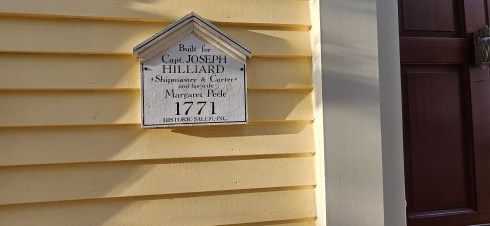
Does style follow politics? I’m just not certain: I think fashion might, but architecture? Most of the characteristic Federals for which Salem is famous were built at the beginning of the nineteenth century, not the tail end of the eighteenth. And if you widen your search for Revolutionary-era houses to all of downtown Salem, an architectural conservatism is immediately apparent: the first house below, on Turner Street, was built in 1771, but it’s similiar to the two yellow houses off the Common and Derby Street built ten and twenty years later. And before the Revolution, before the laying out of Chestnut Street in 1805 really, there is no housing segregation, so we are left with an interesting mix of architectural styles: so very evident along Essex and Derby Streets.

Building in 1779-1780: now that’s confidence. Elias Hasket and Derby began construction on Salem’s Maritime’s Hawkes House in the latter year, as their family had outgrown the Derby House next door.

I’m off to Scotland on Friday so no posts for a few weeks: “see” you after Thanksgiving! In the meantime, if you’re interested in Salem architecture, tickets for Historic Salem’s Christmas in Salem tour on December 2-3, featuring houses in the Salem Common neighborhood, are available here.


Meeting Houses of Rockingham County

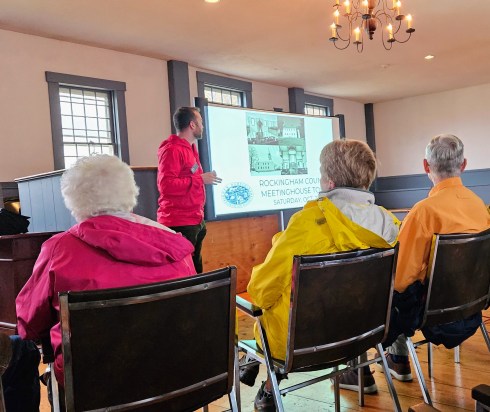
(Sorry—I have been reading and writing about meeeting houses for the past few months but still do not know if their identifier is one word or two). On this past Sunday, a rather dreary day, the New Hampshire Preservation Alliance sponsored a driving tour of meeting houses in southern Rockingham County, encompassing structures in Hampstead, Danville, Fremont, and Sandown. I drove over from York Harbor, fighting and defeating an inclination to just stay cozy at home. There was an orientation at Hampstead, the only colonial meeting house of the four that features a steeple addition (I envisioned Salem’s third meeting house, built in 1718), and then we were off to Danville, Fremont and Sandown. I have to tell you, I was in awe all day long: these structures are so well-preserved (cherished, really), simple yet elegant, crafted and composed. I remember thinking to myself when I was first set foot in the Danville meeting house: “I’d rather be here than in Europe’s grandest cathedral” (I think because I had just talked to my brother, on his way to Rome).  There’s just something about these places, and the people who care for them. Just to give you a summary of  the orientation that I received: they were built in the eighteenth century as both sacred and secular buildings, as close to the center of their settlements as possible and by very professional craftsmen. In the early nineteenth century, their religious and polical functions were seperated, so they became either churches or town halls or were abandoned altogether as other denominations built their own places of worship. It seems to me that they survived because of the preservation inclinations of their surrounding communities, and we were introduced to each meeting house by contemporary stewards who were clearly following in a long line of succession. Nice to encounter historical stewards rather than salesmen.

Hampstead:

The second floor of the meeting house, with its stage and original window frames propped up against the wall and all manner of remnants of civic celebrations, was really charming.

Danville: (which used to be called Hawke, so that’s the name of the meeting house. Hawke, New Hampshire–how cool a name is that!)

Incredible building—I had to catch my breath! I think it has the highest pulpit of these meeting houses, and there was just something about the contrast of that feature and the simplicity (though super-crafted) of the rest of the interior that was striking.

Fremont (which used to be called Poplin):

This meeting house is the only one remaining in NH with “twin porches” on each side, plus a hearse house (see more here–I have long been obsessed and have been to Fremont before but never inside the meeting house or the hearse house) with a horse-drawn hearse inside plus an extant town pound! Very simple inside, but note the sloping second-floor floors in picture #4 above. Took me a while to get used to those.

Sandown:

The most high-style of this set of meeting houses, particularly impressive from the back, I thought. Very light inside, even on this miserable day. Another high pulpit, and more marbleized pillars. Short steps to the second floor–I’m a size 7!

My photos are a bit grainy–not sure what my settings were, I was shifting them around to get more light, and too awestruck by the architecture to really focus, so in compensation I want to refer to you the wonderful work of photographer Paul Wainwright, who has photographed all of these meeting houses and more. Simply stunning!


Treasure House

Treasure House. That’s how the guide introduced the Codman Estate in Lincoln, Massachusetts, long known as “The Grange,” at the beginning of her tour the other day. It’s a term which has a specific meaning for Historic New England, which has been the owner and steward of the house since 1968: not only the house itself, but all of the treasures therein, encompassing the possessions and papers of the Codman family of Boston. The Grange was their summer house, expanded and decorated in successive eras by family members/design luminaries John Hubbard Sturgis and Ogden Codman Jr. My ears pricked up when I heard that term, because it’s how Salem was often described in the early and mid-twentieth century, as a treasure house of American material culture. That’s certainly not how Salem is thought of now, but in that heyday, proponents of the Colonial Revival like Ogden Codman Jr. thought and referred to it as such. When I was writing my chapter on Colonial Revival Salem for our forthcoming book this summer, I read quite widely (trying to make up for a disciplinary deficit) and reread Edith Wharton’s and Codman’s classic collaboration, The Decoration of Houses (1897). This book is so crystal clear in its articulation and presentation of interior design as a branch of architecture rather than “dressmaking” that I became more interested in Codman, who was both an architect and interior designer. I went off on a tangent, learning some very interesting design theories and practices as well as trivial details like the fact that he called Wharton (who was his client before his collaborator) “Pussy” and she called him “Coddy.”  And then it only seemed right to revisit the Grange, as the last time I went there, when I was in my 20s, I didn’t have a clue. I seem to remember being impressed with its Federal forthrightness, but not its interior, which I found “shabby.”

Well, its origins are not Federal: the models above show how the original Georgian house was transformed into the Federal Grange over the next century or so. But, it still strikes me as shabby, in an authentic rather than “chic” way: very layered and very waspy. This was really his father’s house, and there were things that Ogden Codman Jr. could change and things he could or would not. You can see his attempts to lighten things up, in his characteristic French-Colonial Revival fusion style, but the heavier hand of his uncle, John Hubbard Sturgis, is still much in evidence. So it’s quite a melange! Toile and Chintz in the sitting rooms and Tudor Revival in the dining room. I think I liked chintz back then, not a fan now, but will always love toile.

The very different stamps of Sturgis and Codman Jr. make for an interesting house. The Elizabethan dining room must have driven the latter crazy, but I love it. We went into only the front bedrooms, which seemed very Ogdenesque.

The other layering effect in the house is a result of the sheer number of Codman possessions therein: photographs, paintings, books, assorted personal items. There’s a time-capsule feeling, as if the family just went out the door, quite a while ago. That feeling is really resonant in the back of the house, where the servants lived and worked. I don’t remember seeing these spaces before: such a succession of rooms and staircases! How many staircases are there in this house? An impressive double staircase in front, and two or three in back? I lost track. Sturgis designed the rear addition, but I’m sure that neither he nor Codman ventured out back, so in a way (and except for the appliances and utilitarian elements) these ways feel even more timeless.

All the staircases and the way out back, eventually into the Italian Garden, which was being set up for a wedding on a VERY humid afternoon. I hope everything went well!


Preservation Polaroids

I have heard, and read about, Salem’s experience with urban renewal many times, including first-hand accounts, so I thought I understood its causes, course and impact pretty well, but when you write about something, you have to engage on another level and come to your own understanding in order to explain it to others. It’s the same with teaching. One of the chapters for Salem’s Centuries that I’ve been working on this summer is about the city’s development over the twentieth century and so I really had to dig deep into urban renewal. I decided to start fresh with primary sources, so I went through all the records of the Salem Redevelopment Authority (SRA) located up at the Phillips Library in Rowley (these are public records, which should be in Salem, but I’m actually glad they are in Rowley because the City’s digitized records are impossible to search and I don’t know how one might access the paper). The SRA was the agency created to oversee urban renewal in Salem’s downtown and it still has jurisdiction: its composition was incredibly important and remains so. I’m going to be quite succinct here, because the narrative is rather complex and therefore quite boring to read or write about, but here’s the gist of what happened: after conducting a comprehensive study in the early 1960s the City created the SRA and put forward a very ambitious urban renewal plan which was overwhelmingly focused on clearance, including the demolition of between 120-140 buildings in Salem’s downtown area. The goal was to create a new pedestrian shopping plaza, to compete with the new Northshore Shopping Center just miles away in Peabody. The focus was on Parking, Parking, and more Parking. What I did not know before I delved into this research was that at the same time that this plan was brewing, Salem also had another committee looking at the downtown: an Historic District Study Committee, which was surveying all of central Salem’s buildings for inclusion in potential historic districts. What a clash! The “before” photos that you see below, candid polaroids, were taken by members of the Study Committee in 1965, the same year that the SRA was rolling out its demolition plan. Among the SRA records up in Rowley, there is a mimeographed document entitled a “Do it Yourself Walking Tour” prepared by John Barrett, Executive Director of the SRA, for Historic Salem, Inc., Salem’s preservation organization, then and now. It’s a remarkable document, because Barrett basically takes the Study Committee’s inventory and turns it into a hit list: this is what we’re going to demolish! Take a tour and see for yourself! There were 119 building slated for demolition, a number that would expand to over 140 over the next few years. The polaroids represent buildings that Salem’s preservationists were trying to save: they were successful in some cases, but not in others. Their resistance resulted in a far less destructive approach to “renewal”, however, which focused more on rehabilitation than destruction, as these images illustrate well.

This doesn’t line up perfectly, but what a great restoration +addition by Salem architect Oscar Padjen: very representative of the creativity of  “Plan B”!

As these photos also illustrate, once rehabilitation became an objective, several key buildings were restored in exemplary fashion, by local Salem architects and utilizing the new means of facade easements. If you compare past facades of these building with the present, urban renewal looks great, particularly with the hardscaping design of landscape architect John Collins of Philadelphia, whose work is also representative of the “Plan B” approach. What is more difficult to illustrate are the great wide swaths of buildings that were taken down, principally on the main Essex and Federal Streets but also on St. Peter and Brown Streets, while Plan A was still operational. We can never see these buildings restored, they were just swept away. What remains are parking lots and ghastly modern buildings. I’m not a fan of what was called the East India Mall in its orginal incarnation, but its colonnaded side entrance (not quite sure what to call it???) was quite distinctive, and it was butchered under the auspices of the SRA in the 1990s so now we have the Witch City Mall. I think Front Street (below) it probably the most perfect example of Plan B, along with Derby Square, but Central Street (just above) is pretty representative too.

Washington Street was the boundary of “Heritage Plaza East,” where most of the renewal activity happened in both phases, but it did not experience as much demolition as it had already weathered a major tunnel project just a decade before. That’s another realization for me: I somehow never put Salem’s “Big Dig,” during which its railroad tunnel was constructed and depot demolished in the 1950s, in such close chronological proximity to its experience with urban renewal in the 1960s. This generation of Salem residents weathered a lot of construction and dislocation: as always, past experiences temper the present. If you shift the perspective even further back, to the 1930s, when the new Post Office was built after an entire neighborhood was cleared out, you can understand why there is so much concern about the lack of housing downtown today: 51 buildings gone in the 1930s, 87 in the 1960s. Salem’s long “plaza policy” certainly took its toll, but I remain grateful to those residents who persevered in their preservation efforts for what remains.

Strking transformations on Washington Street.

NB: I’m confident in most of these past-and-present pairings, but not all, because streets numbers can change—not quite sure about the Subway market on Front Street for example……….


Colorways: a Parade of Portsmouth Doors

I’ve been in York Harbor all June and just returned to Salem. It was a very productive month removed from daily tasks and diversions, but I missed certain things and people: my husband (I brought the cats), my garden, my street. Certainly not the tour guides and groups though: they were in part what drove me away. Of course I found the usual Dunkin iced-coffee cup propped up on my stoop the moment I got home. Salem is busy and festive all year long now it seems; while the incessant witch tourism annoys me the other celebrations are great, and June is a particularly festive month with its mix of private and public celebrations: weddings and graduations, Juneteenth and Pride. Salem goes all out for Pride and  I missed that, and definitely craved some color amidst our rainy and foggy weather, so I took off for Portsmouth late last week seeking flags but finding doors. When I was growing up across river, Portsmouth was a much shabbier place: now you are hard-pressed to find an old house that is not in perfect condition. I expanded my usual downtown walk to include neighborhoods a bit more outlying like that bordering Christian Shore and the South End, and found so many lovely houses, all with very colorful entries. Red was an exotic front-door color before; now there is a veritable rainbow of Portsmouth doors. And I’ve got some flags here too.

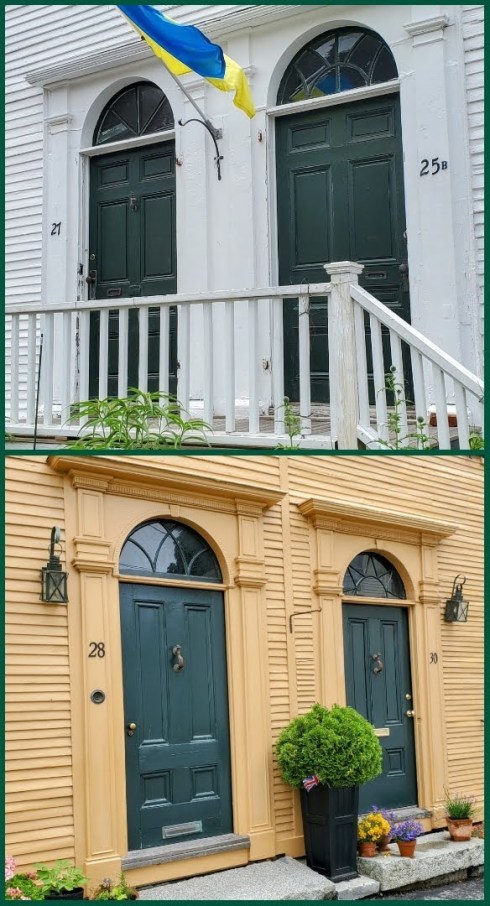
Ok, I think I have the whole spectrum represented! It was surprisingly difficult to find white doors: as you see, one is hiding behind a tree. I wasn’t sure where to put taupe, so I paired it with brown. There are no painted brown doors, just various shades of natural woodwork. Not too many black doors either, but lots of green, and lots of yellow. Do not tell me that one of my purple doors is blue; it is purple. Portsmouth is the best walking city ever: beautiful neighborhoods, dynamic downtown, tons of historical markers, pocket parks, well-maintained sidewalks. More rainbows are there for the making!

Some singular Portsmouth doors: two-tone green and Happy Fourth!


A Big Move

No, not me: the Crowninshield-Bentley House! Visiting Louise DuPont Crowninshield’s former garden in Marblehead last week prompted me to reconsider her impact on Salem as a preservation advocate and philanthropist as it is considerable. At least two institutions in Salem, the Salem Maritime National Historic Site and the Peabody Essex Museum, reflect her commitment to the preservation of Salem’s material heritage which was manifested both by her direct involvement and her inspiration. The best example of the latter is one of the Peabody Essex Museum’s historic houses, the Crowninshield-Bentley House, which was moved by the Essex Institute from a rather precarious position on Essex Street to its current location in 1959. This early Georgian house, home to generations of the Crowninshield family as well as Salem’s pre-eminent diarist the Reverend William Bentley, was originally located at 108 Essex Street. In 1958 the Hawthorne Hotel donated the house to the Essex Institute with the condition that it be removed to make way for a parking lot. The move to its new site adjacent to the Gardner-Pingree House and across the street from the Hotel, was preceded by the demolition of a venerable commercial building and succeeded by a comprehensive restoration to its 18th century form under the direction of Abbot Lowell Cummings as a tribute to the “work and memory of preservationist Louise DuPont Crowninshield.” The Crowninshield-Bentley House became the cornerstone of the Essex Institute (now Peabody Essex Museum)’s main “campus” of historic structures, and to complete the vision, gardens also dedicated to the legacy of Mrs. Crowninshield were installed in its midst. Another reason I wanted to post on this big move today is the great visual documentation by Essex Institute President Albert Goodhue, Jr., who snapped photographs of the the entire process over what must have been several days (weeks???) in 1965. These are among some great sources at the Phillips Library in Rowley documenting Salem’s ever-evolving streetscape, one of the major topics we’ll be covering in our upcoming book Salem’s Centuries.

Washington Square West and Essex Street, Salem (Mass.) Photographs, MSS 0.1619. Courtesy of Phillips Library, Peabody Essex Museum, Rowley, MA.

Amazing!!! I love the nonchalance of the pedestrians, and not a police detail in sight. Everyone is just going about their business while the walls are tumbling down! The building being demolished was quite a storied commercial building, also an 18th century structure (I think) but altered and extended considerably. There were some very notable apothecary and stationary shops located within, and Salem architect/artist William Henry Emmerton made an iconic image of it in 1850 when it was his cousin’s apothecary shop (Emmerton was a great draftsman, and the Phillips Library has digitized the records of his architectural firm, Emmerton, Foster & Putnam, so you can see more of his work here). Those big storefront windows were apparently the second of their kind installed in Salem, and the Paracelsus bust trade sign was pretty conspicuous too. After the move and restoration was completed, the Crowninshield-Bentley House received a lot of attention in both academic and popular publications: there are both feature articles and cover stories throughout the 1960s into the 1970s and even the 1980s. The more scholarly pieces tend to focus on the detailed 1761 probate inventory of Capt. John Crowninshield as a primary source for the restoration (which includes references to “a Negro man” valued at £66.13.4 and a “Negro woman” valued at £40 about whom I’d like to know more)§ while trade periodicals seem to focus overwhelmingly on the kitchen. There’s a big spread on the interior of the house in the July 1987 Colonial Homes, part of feature on Salem as the “showcase of early America,” which it was, then.

William Henry Emmerton, Apothecary shop of James Emerton in Salem, c.1850 (pen & ink and sepia wash on paper), Peabody Essex Museum; the Crowninshield-Bentley House on the cover of Americana, September 1973; the kitchen as photographed by Samuel Chamberlain (1970, Phillips Library via Digital Commonwealth) and in House and Garden, January 1974; Frank Cousins photograph of the house in its original Essex Street location, 1890s, Phillips Library via Digital Commonwealth. The House today.

§ The Phillips Library has also digitized all of the booklets in the Essex Institute Historic House Booklet Series, including The CrowninshieldBentley House, Essex Institute historic house booklet series, no. 2, by Abbot Lowell Cummings, Dean A. Fales, Jr., & Gerald W.R. Ward, which you can access here. “An Inventory of the Estate of Capt. John Crowninshield Late of Salem and Apprized by Us the Subscribers at Salem November 10th 1761” is included as an Appendix.


The Elizabeth Perkins House

One of the chapters I’m working on for Salem’s Centuries this summer is about Colonial Revival Salem, or should I say, a group of antiquarians who lived and worked in Salem from about 1890-1930 who were dedicated to preserving and promoting any and everything about Colonial-era Salem in their time and for the future. Our book is a work of social history, so our focus in on Salem people. But when it comes to the various expressions of the Colonial Revival movement, if you can call it that, I’ve always found that individuals and their often-passionate attachments to the past are so important, and this is particularly true in the case of the Elizabeth Perkins House, one of the Old York Historical Society’s  properties that has recently been reopened. For some reason, this is the one Old York house that I’ve never been inside, and I’d always heard that it was a perfect example of Colonial Revival influence in this region, so I was pretty eager when I showed up for my tour this past Friday.

The Elizabeth Perkins House of the Old York Historical Society, looking over the York River, Sewall’s Bridge and the Hancock Warehouse beyond. Its restorers, expanders and occupants: Mary Sowells Perkins and Elizabeth B. Perkins (photo on right from Old York Historical Society as featured in a very helpful Willaim & Mary 1988 thesis by Melisssa Mosher shows Elizabeth Perkins in front of the house).

This house is absolutely central to the preservation history of York as its early 20th century occupants, Mary Sowles Perkins (1845-1929) and her daughter Elizabeth B. Perkins (1869-1952) contributed it and several other structures (the Old Gaol, Jefferds Tavern, the old Schoolhouse, and the John Hancock warehouse) to what would eventually become the Old York Historical Society as well as encouraging other preservation efforts. So it seems right that Old York’s administrative offices have been relocated to this site as well. There was a whirlwind of restoration, expansion, embellishment and entertaining after the Perkins family purchased the house in 1898: they were from New York, and seem to have known everyone. Mark Twain came over from his summer rental across the river to use their telephone, the first one in York, and in 1905 they hosted the grandest party of the era: a Japenese-themed fête to celebrate the conclusion of the Portsmouth Peace Treaty ending the Russo-Japanese War of 1905 with over 700 guests in attendence. The tour really focused on their house, so much so that I’m not really sure of its pre-Perkins history. Old York is dating the house to around 1730 now, which seems about right to me, but I have postcards from my childhood (showing the house exactly as it looks now and at the time of Perkins’ death in 1952) bearing the date of 1680. The one below of the dining room shows the very “colonial” room that the Perkins created but also one of its most off-putting features for me—the electrified girondoles along the back wall.

Postcard of the dining room from 1960s or 1970s? I think it is a rule that every Colonial Revival house must have Hessians!

At first the house seemed to me like one of those sprawling recreations/creations which Mary Harrod Northend, one of the Colonial Revivalists in my Salem chapter, showcased in her Remodeled Farmhouses (1915) and I immediately wanted to know if Harrod knew either of the Perkins women–the two Marys were of the same generation. But inside, besides the dining room, it felt a little different to me than standard Colonial Revival: I guess there is no standard Colonial Revival because it is often an individual expression. The parlors of the Perkins house felt very traditional to me, but also more cosmopolitan, more worldly, more lavish, more of a mashup between past and present than a “period rooms”. A case in point would be this wonderful 20th century copy of an earlier portrait: this modern woman dressed in period costume just like Elizabeth Perkins above (well, a bit more elegantly). I love this portrait!

Hooked rugs abound of course, but the Perkins ladies were great travelers so that accounts for the worldliness of their rooms and all the interesting assemblages. Now I’m wondering about comparative Colonial Revival settings: if you’re trying to create and preserve a “colonial” home in the country it’s a different experience than in the city, where change is so much more apparent—and threatening. My Salem people, including Harrod, Frank Cousins, George Francis Dow, Caroline Emmerton and Daniel Low, are living and working in an environment of constant development, fire, pollution, and immigration: it seemed like things were being swept away. The Perkins ladies were facing none of that in York, so I’m thinking that they didn’t have to be quite so strident in their pusuit and preservation of the Colonial. Just a thought.

Front parlors and a very traditional entry; love the 17th century “open-back” ??? chairs.

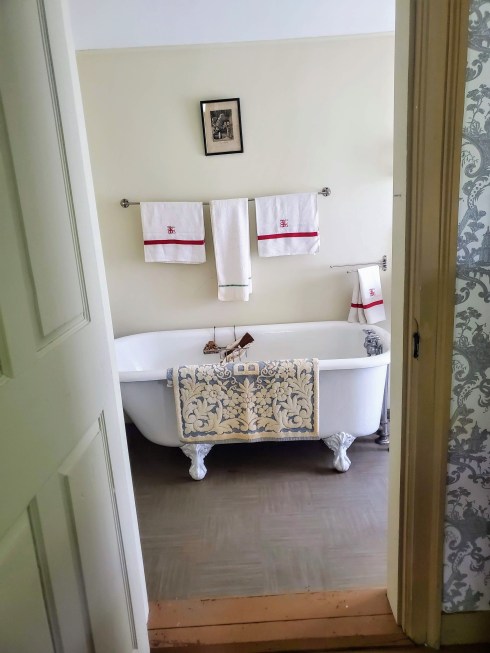
Loved the Currier & Ives presidential prints in the guest bedroom, which also has an en suite bathroom. The other bedrooms, including that of Mrs. Perkins above, have that “just left”/ I was just reading……. feeling, which is very Colonial Revival too: George Francis Dow pioneered the use of the folded-newspaper-by-the-gentleman’s chair motif in his period rooms in Salem, I believe.

Tours every Friday and Saturday available here.