
Historic New England offers comprehensive “nooks and crannies” tours through several of its properties occasionally, and I was fortunate to go on one of these basement-to-attic-and-all-the-closets-in-between tours of Beauport, the rambling Queen Anne “cottage” on Eastern Point in Gloucester, the beneficiary of a generous friend’s conflict! Beauport was built and decorated in great detail by Henry Davis Sleeper, one of America’s first professional decorators, over several decades beginning in 1907: it is an incremental construction driven by Sleeper’s evolving vision and career. The former was preserved by Helena Woolworth McCann, who purchased Beauport after Sleeper’s death in 1934, following the advice of Henry Francis DuPont: “the minute you take things out of this house, or change them about, the value of the collection does not exist, as really the arrangement is 90%. I have no feeling whatsoever about the Chinese room, as I think it is distinctly bad; but the rest of the house really is a succession of fascinating pictures and color schemes.” Mrs. McCann had Sleeper’s pagoda removed from the China Trade room and made it her own, and likely packed away some of Sleeper’s stuff while she and her family were inhabiting the house over successive summers, but seems to have understood DuPont’s assertion that the house was the sum of its parts–and her family donated the intact property to Historic New England (then the Society for the Preservation of New England Antiquities) in 1942. So when you go to Beauport today, you are stepping into Henry Davis Sleeper’s house, the way he wanted it, and you know that this is a man who admired arrangement above all, incorporating the contrast of light and dark, all color of glass, green, anything and everything that projected the spirit of idealized and romanticized pre-industrial American and English material culture, depictions of great men (George Washington above all, but also Benjamin Franklin, Lafayette, and Lords Nelson and Byron, among others), and a fair amount of whimsy. Beauport is a lot to take in, even on a standard tour much less this exhaustive one, so I’ve divided my photographs into room views and details—but they represent only a small measure of both! You’ve really got to see Beauport for yourself: several times.
The bigger picture: it’s really difficult to photograph the entirety of this house, except from above or the ocean! I focused on inside, but there’s some lovely photographs of both the interior and exterior taken by T.E. Marr & Son c. 1910-1915 here.


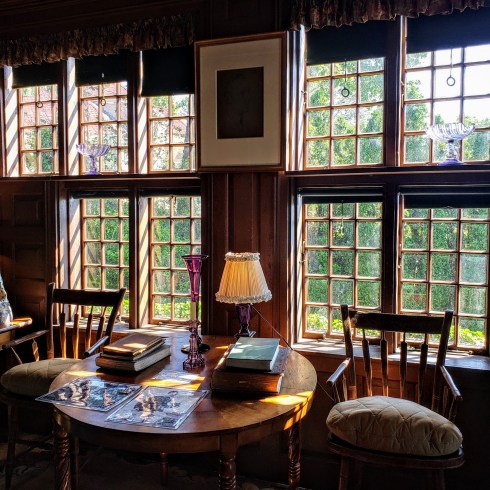


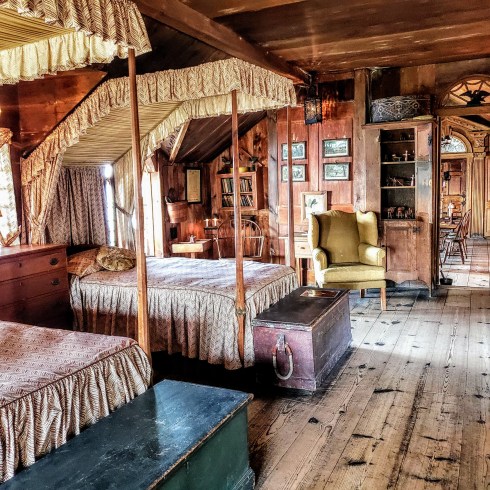


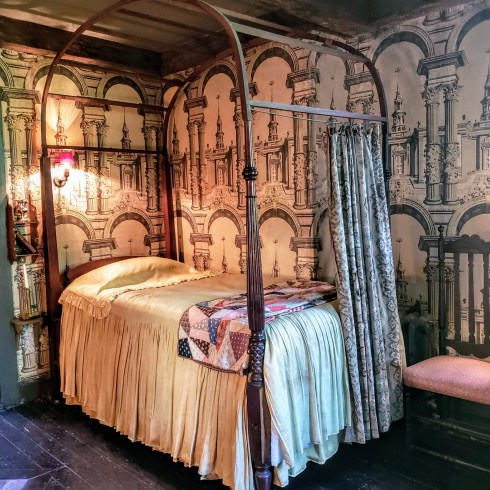
 The China Trade Room from Sleeper’s “Minstrel’s Gallery” above, within the Book Tower, the Octagon Room, where it’s all about eight, the Golden Step dining room, the South Gallery, the Master Mariner’s Room, the “Red Indian” Room with its ships-cabin overlook of Gloucester Harbor, the Strawberry Hill room which became Sleeper’s bedroom, the Belfry Chamber—my favorite room in the house—-the Jacobean Room, the Chapel Chamber Room, and the Franklin Game Room.
Every salvaged discovery provoked an aesthetic reaction from Sleeper, and his design sense was so strong that it lives on well after his death in Beauport. Despite its size (it grew to 56 rooms by Sleeper’s “reactions”) the house remains very personal. It certainly reflects Sleeper’s personality, but as his collection of objects was so vast and varied it is possible to have a personal reaction to what you are seeing. That certainly happened for me, so my more detailed focus below reflects my own taste, in reaction to what I was seeing. And you will notice many other things that I missed.


 Details, Details: marble mantle and 18th century hand-painted wallpaper from China in the China Trade room (it was purchased by Philadelphia financier Robert Morris in 1784 and discovered, still rolled up, in the attic of the Eldridge Gerry House in Marblehead in 1923), wooden “drapes” in the book tower room, a portrait by Matthew Prior (c. 1845) in the Blue Willow room, fishermen’s floats ( I think Sleeper was the original high-low decorator!), beehive pull, memorial to the death of a former slave, majolica hedgehog or porcupine (?) Nathaniel Hawthorne in the Belfry Chamber, Green glass urn in the Chapel Chamber, plate commemorating the visit of Hungarian nationalist Louis Kossuth to Boston in 1852 & window shade commemorating the American victory in the Spanish-American War in the Pine Kitchen or Pembroke Room, my favorite of Sleeper’s many hooked rugs, and the portrait of a dapper anonymous man.
♠ A more comprehensive history of both the house and the man can be found here.

 The Frank Cousins “Team”/ Employees’


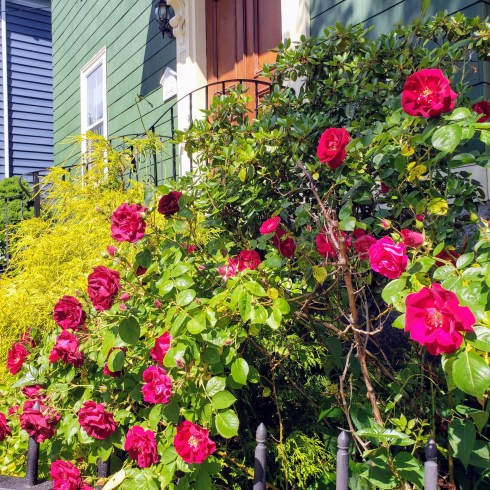


 John Ramsbottom’s “King Penguin” book, 1939, with its York and Lancaster illustration; Mrs. L. Burke’s The Language of Flowers, 1865; Rosa Mundi from Curtis’s Botanical Magazine, 1790s.




 The Hawthorne Hotel’s lobby and Main Brace cocktail lounge; Jonathan Butler, Harriet Shreve & John Pickering X in the Main Brace c. 1942 from Kenneth Turino’s and Stephen Schier’s Salem, Volume 2 (Arcadia Publishing, 1996); Larry O’Toole’s Salty Map of Cape Ann from


 Signs everywhere in Raleigh, which has held on to its state heritage markers (even for sites that no longer exist) and added lots more.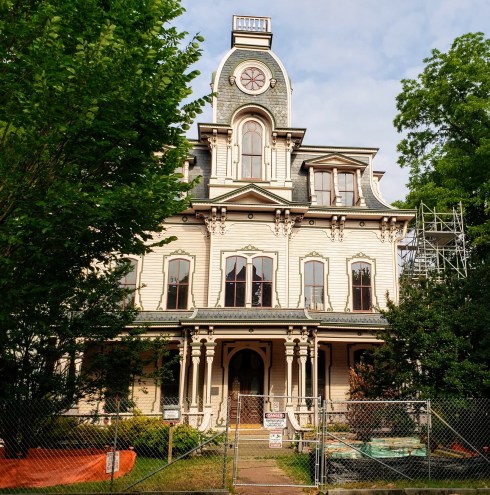


 The Heck-Andrews House (under renovation), Polk House, and Executive Mansion in the city center, and Oakwood beyond—and beyond Oakwood.

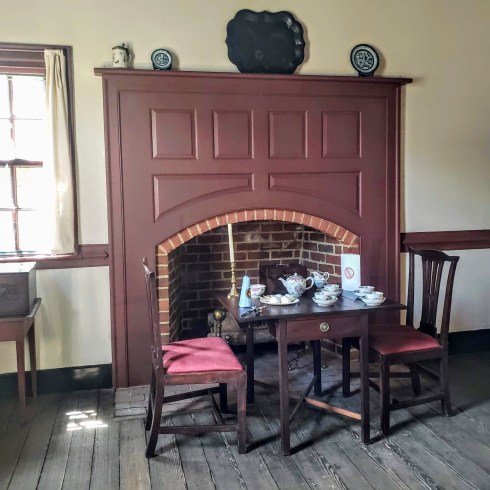


 Exteriors and Interiors of the Lane and Mordecai Houses + their gardens and the Andrew Johnson birthplace, adjacent to Mordecai.


 The City of Raleigh (COR) Museum: a must-visit spot; this last question is existential!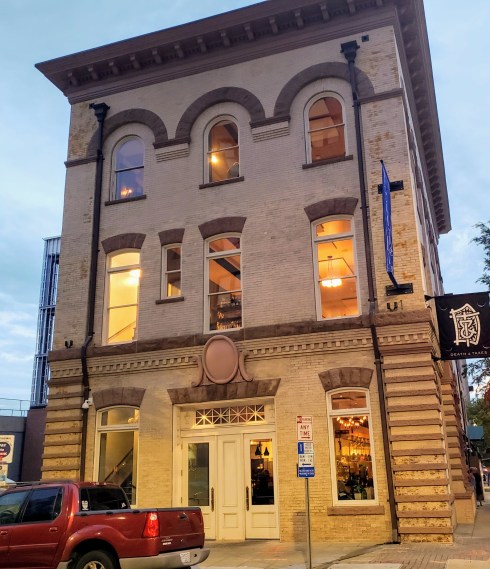


 A Treasure Trove of Silver in an old Salem house, from Walter Dyer’s Lure of the Antique (1910).
 Amazing photo of a lady (perhaps Mary Harrod Northend?) at the original location of the Hooper-Hathaway House (now on the House of the Seven Gables campus) inspecting some Old Salem wares in Dyer’s Lure of the Antique. The caption reads: “Don’t expect to buy these old treasures for a song. You are lucky to get them at all.” Once the Ward House was relocated and opened, it became the workshop of Sarah Symonds, who “perpetuated antiques” in the form of plaster-cast doorstops and mementos of famous Salem structures (Boston Herald, January 17, 1918). I think the days of buying antiques from guileless Salem homeowners were gone even by 1910, and in the next few decades the number of shops advertising in periodicals exploded.

 Salem Antique advertisement from the 1922 volume of the magazine Antiques, and from the collections of Historic New England.


 Atkinson’s Advertising, and her shop on the left-hand side of the Witch House, in photographs from the New Bedford and Cambridge Historical Societies, via Digital Commonwealth; Some items from the “Atkinson Collection” in Dyer: she was particularly known for her selection of Lowestoft.





